
Automatic Multiple Face Recognition and
Annotation Based on Principle Component
Analysis cum Least Mean Square Error
(PLMSE)
Aakansha S Thakur 1, Mahendra Rai 2
M.E. Student, Department of CSE, Shri Ram Institute of Technology, Jabalpur, Rajiv Gandhi Proudyogiki
Vishwavidyalaya, Bhopal, Madhya Pradesh, India1
Head of Department, Department of IT, Shri Ram Institute of Technology, Jabalpur, Rajiv Gandhi Proudyogiki
Vishwavidyalaya, Bhopal, Madhya Pradesh India2
ABSTRACT: Face recognition has received substantial attention from researchers in biometrics, pattern recognition field and computer vision communities. Major drawback in old work was that this method was design to recognize single face only and there was no procedure for annotation of the face. Thesis work represents standard procedures for multiple face recognition and annotation, means one or more face can be recognized in single execution and automatic representation of name of the person at the same time, also lists pros and cons of standard methods and review of few latest techniques of face recognition. Throughput and recognition rate is been discussed and goal of work is to compare all the procedures, so to provide an optimized procedure with higher accuracy and better response rate. A face recognition system based on Principle component (PCA) [6] and Least Mean Square Error (LMSE) is proposed and developed. The system consists of three stages: preprocessing, face identification and recognition & annotation. In preprocessing stage, image quality enhancement, segmentation, filtering and thresholding is done. Viola Jones method is applied to detect face which is important for identification. PCA is calculated for every face in database, and then recognition is done on the basis of LMSE and PCA [6] named PLMSE analysis between capture face and database face. Annotation is been done in form of a rectangle highlighted on the recognized face and name of the person is mentioned at the top left corner of that rectangle. Recognition rate obtained is 99.93% and time taken for recognition is 10.18 seconds. It is observed that the average recognition rate that we have achieved is 97.018% for real time face recognition in static conditions and the throughput for the face recognition we have achieved is 246.99 Kbps.
KEYWORDS: Face Recognition, LMSE (Least Mean Square Error), PCA (Principle Component Analysis), FERET (The Face Recognition Technology), ICA (Independent Component Analysis), HSV (Hue Saturation and Value), RGB (Red Green Blue), PLMSE (Principle Component Analysis cum Least Mean Square Error).
I. INTRODUCTION
some researchers, is certain to fail in cases where the variability is great. In particular, the correlation is very low between two pictures of the same person with two different head rotations.
Automatic face recognition has been an active research area in the last decade. The progress in this area can be found in review papers [11, 2] and proceedings of last four international conferences on face and gesture recognition. Among various approaches, techniques based on PCA, LDA and ICA [7,8,9] popularly called Eigen faces [15, 10], have played a fundamental role in dimensionality reduction and demonstrated excellent performance. PCA/ICA/LDA based approaches typically include two phases: training and classification.
Majority of already designed face recognition procedures generally have at least one of these two problems:
Too high computational (time-, space-) complexity
Too low effectiveness.
LDA [7], ICA [8] and PCA [6] are conventional procedures of face recognition but major issue with these procedures are that these procedures require database which increases its cost and recognition rate is also less, problem with available work [1] & [3] its recognition rate is 97.5% & 95% only.
In this thesis work, we proposed a computational model of face detection and recognition and annotation, which is fast, reasonably simple, and accurate in constrained environments such as an office or a household. Face recognition using Eigen faces have been shown to be accurate and fast. When LMSE technique is combined with PCA, non-linear face images can be recognized easily. Face identification and recognition has many applications in various fields such as security system, video conferencing and identification. A new uni-vector discrete face database is been created to recognize and authenticate face with the help of PLMSE and its difference. In this work, a separate 10 image database is built for each person. Results observed for PLMSE method having 99.93% successful face recognition for the FERET database and having the throughput of 214.59 Kbps.
II. PRINCIPLE COMPONENT ANALYSIS CUM LEAST MEAN SQUARE ERROR -PLMSE
Another problem with available method is that it has been develop for recognizing a single face at a time and available method requires twice execution for two different faces. Annotation of the face can be possible only when the system can recognize the face and detection of the face is quite simple but recognition is a job which requires lots of memory and time to find out. As we have seen in Facebook, that someone has to tag the name of person on the face in the image so others can see the name of the person on the face, but it is not automatic though the face detection is automatic.
The main concern of the PLMSE work is to overcome the flaws of available work and to improve the recognition rate and to quickly recognize and annotate the face so time can be saved. For achieving all these, proposed thesis work has two major concerns, first to fast detect the multiple faces and second to recognize and annotate that faces.
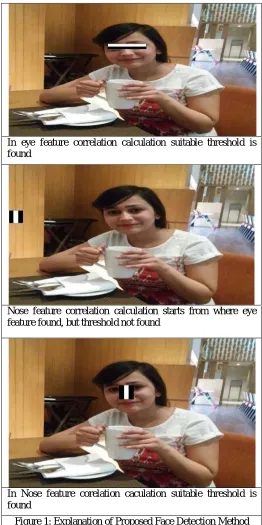
Face Detection: Face detection is been shown in figure 1. The simple features used are reminiscent of Haar basis functions. Face detection features are:
Two-rectangle feature: Difference between the sums of the pixels within two rectangular regions used for eye feature.
Three-rectangle feature: Sum within two outside rectangles subtracted from the sum in a center rectangle used for nose feature.
Rectangle filters: This is used to isolate that a rectangle type feature is available or not
Value = Σ (pixels in white area) – Σ (pixels in black area)
The original image
In eye feature correlation calculation suitable threshold is not found
Face Recognition: PLMSE is a LMSE which is used to compare signals, combined with PCA. Proposed procedure uses LMSE for comparing the variance of faces.
In eye feature correlation calculation suitable threshold is found
Nose feature correlation calculation starts from where eye feature found, but threshold not found
In Nose feature corelation caculation suitable threshold is found
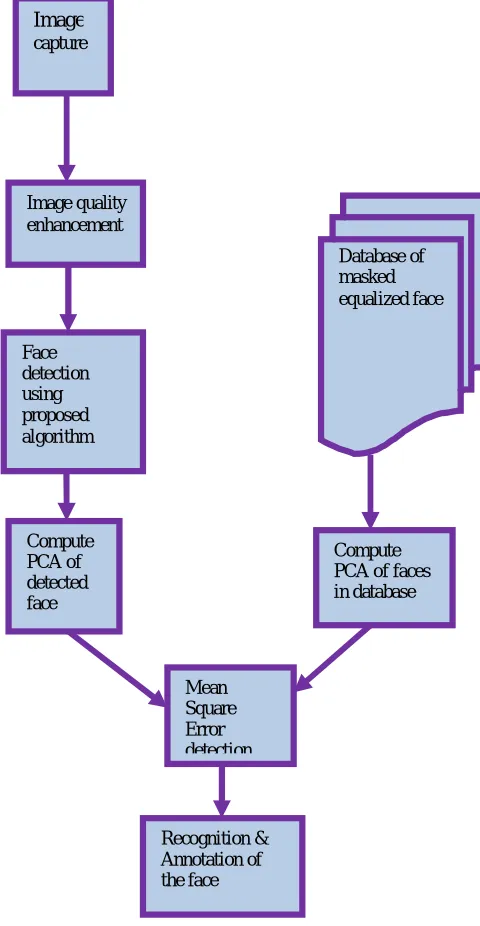
Proposed block diagram is shown in figure 2 and flow of proposed algorithm as follow:-
Step 1: Capture image of total pixel size 640x480 in any YUY or RGB format.
Step 2: Face identification is a MATLAB based procedure which uses cascade object detector to detect the face of the person in the image. The proposed method of face detection is already been explained earlier and explained in figure 1, the algorithm focuses on detection of faces in the image using noses and eyes. The proposed method first crops the face from an image by using proposed face reorganization procedure. Later face is converted into ‘.pgm’ standard format of fix size 112x92, so all the faces in the image whether big or small can be converted into a fixed standard size.
Step 3: Image quality enhancement is done by two different stages. First, HSV stretching and second is Median filtering. HSV (Hue, Saturation, and Value) stretching is performed for enhancing the quality of the image. MAX is the maximal value in R, G, B of all pixels in an image, and MIN is the minimal one.
H=
⎩ ⎪ ⎪ ⎨ ⎪ ⎪
⎧ Unde ine ifMAX = Min
60X + 0 ifMAX = RandG≥B
60X + 360 ifMAX = RandG <
60X + 120 ifMAX = G
60X + 240 ifMAX = B
S= 10 − ifotherwiseMAX = 0
V=MAX
Step 4: Principle Component Analysis (PCA) is calculated for the detected and enhanced image. There are two principle components first Covariance and second Eigen vector, derived with the help of SVD is calculated for both captured image and database image.
Let X is captured image and Y is an image from database, then to compute covariance between these two formulas is given below where, and are the mean of all pixels and n is the total number of pixels.
SVD is Singular value decomposition. [U,S,V] = svd(X) produces a diagonal matrix S, of the same dimension as X and with non-negative diagonal elements in decreasing order, and unitary matrices U and V so that
X = U*S*V'
S = svd(X) returns a vector containing the singular values.
[U,S,V] = svd(X,0) produces the "economy size" decomposition. If X is m-by-n with m > n, then only the first n columns of U are computed and S is n-by-n. For m <= n, svd(X,0) is equivalent to svd(X).
Figure 2: Block diagram of Proposed PLMSE Method
Step 5: Thedatabase has been created bythe development of total 400 face images (40 face each having 10 poses) into
a single file is required because we need to match all these 400 faces with the face which is to be recognized.
Step 6: The covariance & Eigen value computed for captured image and database image, and then MSE is computed between the captured image and database image.
Image
capture
Image quality enhancement
Compute PCA of faces in database Face
detection using proposed algorithm
Compute PCA of detected face
Database of masked equalized face
Recognition & Annotation of the face
Let X is captured image and Y is an image from the database and row in image are ‘r’ and column in image are ‘c’ then
=∑(X−Y)
The lowest MSE will be considered as recognized face.
Step 7: Once the face is recognized, next step is to represent that face. For the representation of the face, we used face annotation in which a rectangle is shown on the face part and name of that particular recognized person is mentioned at the top of the rectangle.
III.EXPERIMENTAL RESULTS
Proposed work is an improved module of multiple face recognition which is better than available procedures in terms of performance parameters which are time delay that is used for computing time taken for recognition and recognition rate means how many times the face is been successfully recognized.
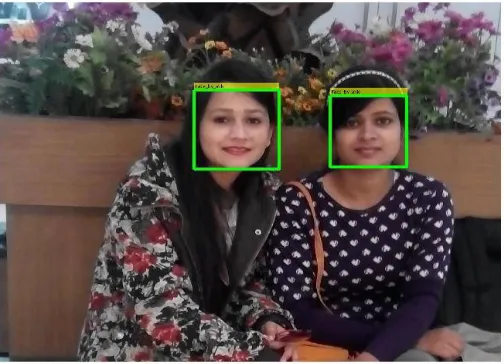
Figure 3: Face Identification in Given Image
Figure 3 shows dimension of the face detected in a captured image using proposed PLMSE face detection method in the form of a green rectangle named ‘face_by_aki’ highlighted on the recognized face.
Then we cropped these faces which is shown in figure 4, later the faces have been converted into a standard .pgm format in a fixed size of 112x92. The proposed PLMSE design has total 40 folders and each folder having 10 face image of the same person in various expressions.
Figure 5: Single Face Detection by Proposed PLMSE Method
As shown in figure 5 the face is detected in a captured image in real time & in static conditions by using proposed PLMSE face detection method, in the form of a yellow rectangle named ‘face_by_aki’ highlighted on the recognized face, when a single person is standing in the front of the camera.
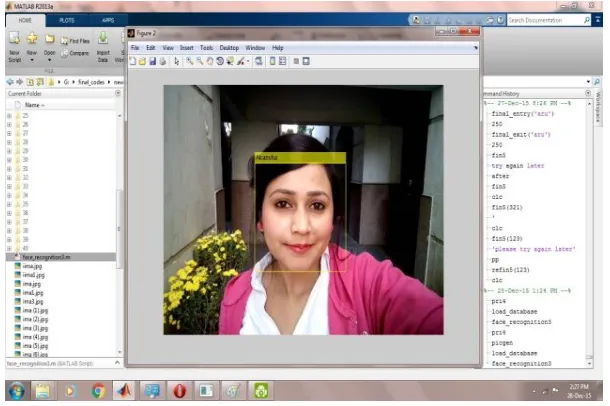
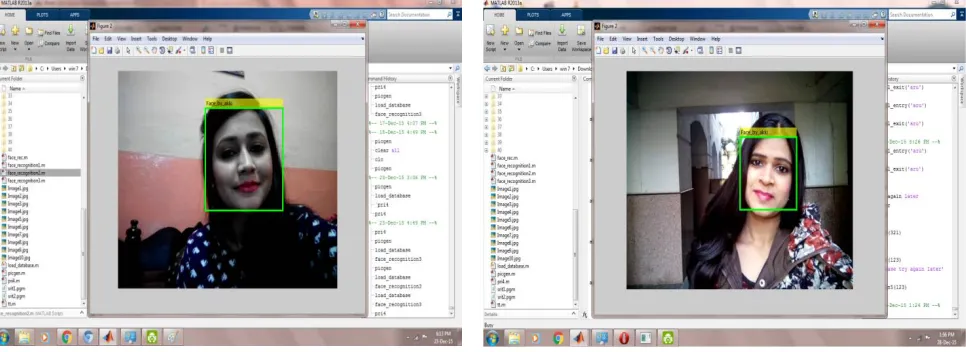
Figure 6 represents the recognition of the face in real time & in static conditions by proposed PLMSE method after the detection of the face as shown in figure 5, then the name of the person is annotated as ‘Akansha’ in the form of a yellow rectangle highlighted on the recognized face, when a single person is standing in the front of the camera.
Figure 7: Double Face Detection by Proposed PLMSE Face Detector
As shown in figure 7 two faces are detected in a captured image in real time & in static conditions using proposed PLMSE face detection method in the form of a yellow rectangle named ‘face_by_aki’ highlighted on the recognized faces, when two persons are standing in the front of the camera.
Figure 8: Real Time Double Face Recognition by Proposed PLMSE Method
Figure 9: Face Recognition in FERET Database
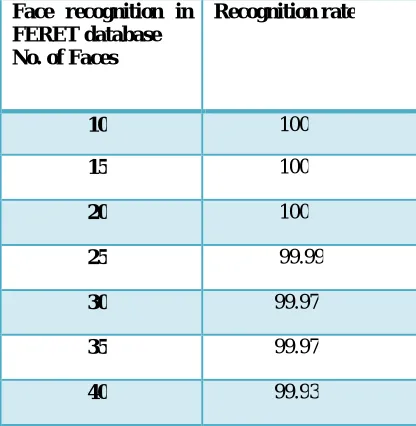
Figure 9 above shows the recognition results when we recognized any person’s face out of the FERET database by proposed PLMSE method. In the proposed work, recognition rate is the major parameter hence, the recognition rate is measured on the behalf of testing procedure in which for the FERET face recognition, we made 10000 attempts to recognize face from FERET [18] database & there was 9993 times successful recognition found with proposed method. The process was lengthy but requires observation of the number of times the face is recognized and the similar process is been followed for different number of faces for observing the results. The amount of time taken for recognition is been measured with the MATLAB [17] feature ‘Run in time’ it gives the timing details of the proposed face recognition script along with its every component time.
Face recognition in FERET database No. of Faces
Recognition rate
10 100
15 100
20 100
25 99.99
30 99.97
35 99.97
40 99.93
Table 1: Recognition Rate
conditions and the throughput for the face recognition we have achieved is 246.99 Kbps. The results are been developed with the help of MATLAB and been developed for nine different test conditions of the face database.
Table 2 below shows the comparative results of proposed PLMSE method with the available method [1] & [2] and also shows the comparison with standard method [6], [7] and [8]. It can be observed that recognition rate achieved for FERET database by PLMSE is 99.93% and time taken to recognize face is 10.18 seconds while GholamrezaAnbarjafari et al. [1] has recognition rate of 99.78% and time take to recognize face is 43.4 seconds. And WaelOuarda et al. [2], Mettewtruk et al [6] (PCA), Jie Yang et al. [7] (LDA), and Bruce A. Draper et al. [8] (ICA) has recognition rate of 99.79%, 90.1%, 90.3%, and 93.6%respectively.
Recognition rate for FERET database
Time delay
GholamrezaAnbarjafar i et al. [1]
99.78 % Max 43.4 sec
WaelOuarda et al. [2] 99.79% Max --
Mettewtruk et al [6] (PCA)
90.1% Max --
Jie Yang et al. [7] (LDA)
90.3 % Max --
Bruce A. Draper et al. [8] (ICA)
93.6% Max --
PLMSE
Aakansha S Thakur
99.93% Min 10.18 sec
Table 2: Comparative Results
It can be clearly observed from the above table that PLMSE recognition for the same standard face database FERET is best among the available methods that are Gholamreza Anbarjafari et al. [1] and WaelOuarda et al. [2]. Also, it can be observed that proposed method is working better than conventional face recognition techniques LDA, PCA and ICA.
Figure 10: Comparative Results
IV. CONCLUSION AND FUTURE WORK
In this paper, we presented a new technique i.e. PLMSE which is used for identifying valid face from an image or real time video or any other data and annotating the face at the same time which is a way to represent the recognized person’s face. The proposed procedure is a combination of LMSE and PCA, a new approach (PLMSE) of the base thesis work. PLMSE is an idea of multiple face recognition which includes a mathematical procedure designed for finding approximation. Here, we have used that procedure for finding face parameters (features) which are necessary for identification. We believe that this approach has significant benefits over existing methods because of its high recognition rate and the amount of time taken for recognition is less. We conclude that the proposed technique of face recognition is been done as expected with high speed and very high recognition rate and the face annotation is been successfully achieved. We have achieved 99.93% recognition rate for recognizing one out of 40 faces in FERET database and time taken for recognizing the face from 40 available faces is 10.18 seconds. The average recognition rate that we have achieved is 97.018% for real time face recognition in static conditions and the throughput for the face recognition we have achieved is 246.99 Kbps. The procedure implemented, verified and validated a new optimized
84 86 88 90 92 94 96 98 100
99.78 99.79
90.1 90.3
93.6
99.93
design on MATLAB, results observed of proposed PLMSE procedure are better than all previous work as proposed PLMSE work recognition rate is 1% better than base work for FERET database. At the same time proposed PLMSE work also achieve multiple face recognition with single execution. At last we conclude that the proposed technique of face recognition is been done as expected with high speed and very high recognition rate and the face annotation is been successfully achieved.
With PLMSE only double face is recognized and multi face recognition has a future scope. PLMSE is for static faces/images, static environment and can be enhanced for the moveable object and changing environment. For more accuracy and recognition rate high camera quality and higher computational quality computer will be required. PLMSE identification of face is based on Viola Jones procedure, so in the near future this face identification can be further enhanced with few better identification procedures.
REFERENCES
[1] Gholamreza Anbarjafari, Face recognition using color local binary pattern from mutually independent color channels, Anbarjafari EURASIP Journal on Image and Video Processing, licensee Springer 2014.
[2] Jatin Chatrath, Pankaj Gupta, Puneet Ahuja, Aryan Goel, Shaifali M Arora, Real Time Human Face Identification and Tracking, International Conference on Signal Processing and Integrated Networks (SPIN) 2014.
[3] Dr.S.B.Thorat, S.K Nayak, Miss Jyoti P Dandale, Facial Recognition Technology: An analysis with Scope in India, (IJCSIS) International Journal of Computer Science and Information Security, Volume 8, No. 1, 2010.
[4] RabiaJafri and Hamid R. Arabnia, A Survey of Face Recognition Techniques, Journal of Information Processing Systems, Volume 5, No.2, June 2009.
[5] Kresimir Delac, Mislav Grgic, Sonja Grgic, Independent Comparative Study of PCA, ICA, and LDA on FERET Data Set, Wiley Periodicals, Volume 15, 2006.
[6] Mettewtruk and Alex pentland, Eigen face of Recognition, Journal of Cognitive Neuroscience, Massachusetts Institute of Technology, Volume 3, Number 1, 1991.
[7] Jie Yang, Hua Yu, William Kunz, An Efficient LDA Algorithm of Face Recognition, International Journal of Computer Applications, 2012. [8] Bruce A. Draper, Kyungim Baek, Marian Stewart Bartlett, and J. Ross Beveridge, Recognizing Faces with PCA and ICA, Computer Vision and Image Understanding , Elsevier, 2003.
[9] Rodriguez Y, Marcel S, Face Authentication Using Adapted Local Binary Pattern Histograms, Proceedings of 9th European Conference on Computer Vision, Graz, Austria, Volume 4, 2006.
[10] Yang MH, Kriegman D, Ahuja N, Detecting Faces In Images: A survey, IEEE Trans Pattern Anal Mach Intel 2002.
[11] Adrian Kapczyński, Relationship between IT Security and Users Needs, Proceedings of International Multi conference on ISSN 1896-7094, Computer Science and Information Technology, 2006.
[12] T. Kohonen, Self-organization and Associative Memory, Springer-Verlag, Berlin, 1989.
[13] M. Turk and A. Pentland,``Eigen faces of recognition,' 'Journal of Cognitive Neuroscience, Vol. 3, No.1, 1991.
[14] Jordi Portell, Alberto G. Villafranca, Hamed Ahmadloo, Enrique García-Berro, Gabriel Artigues, Discrete Wavelet Transform, Journal of Applied Remote SensingAug 01, 2013.
![Table 2 below shows the comparative results of proposed PLMSE method with the available method [1] & [2] and also shows the comparison with standard method [6], [7] and [8]](https://thumb-us.123doks.com/thumbv2/123dok_us/1645198.1205768/11.595.182.448.308.613/table-comparative-results-proposed-plmse-available-comparison-standard.webp)