Evaluation and Application of Acrylic Based
Binder for Leather Finishing
M.I. Ugbaja.1, A. Ejila.2, P.A.P. Mamza.3, M.I. Uzochukwu.1, H. Opara.1
Lecturer, Department of Polymer Technology, Nigerian Institute of Leather and Science Technology, Zaria, Kaduna
State, Nigeria1
The Director, Directorate of Research and Development, Nigerian Institute of Leather and Science Technology, Zaria,
Kaduna State, Nigeria2
Associate Professor, Department of Chemistry, Ahmadu Bello University, Zaria, Kaduna State, Nigeria3
ABSTRACT: Acrylic based binder AE 558 Nycil was evaluated using the FT-IR spectroscopy technique, solution
viscometry process, and a melting point apparatus. Five different formulations based on the resin binder was prepared and then applied on originally retanned leathers to generate five samples for testing. The result of the FT-IR indicates that the resin binder is predominantly an acrylate. The intrinsic viscosity of the resin binder is 227 dL/g and the resulting (calculated) molecular weight is 4.03 x 10⁵. The melting temperature of the resin binder is found to be in the range 361.7 oC- 370.0 oC. The effect of the finish formulations on water vapour permeability and wet rub fastness of the originally retanned leathers were investigated. Water vapour permeability test was also carried out for the unfinished (originally retanned) leathers as control samples. The results indicated that the water vapour permeability of the finished leather samples was significantly lower when compared to that of the unfinished (control) leather samples. However, for the finished leather samples, water vapour permeability increases as the quantity of the binder varied in this experiment was increased. The result of the VESLIC test indicated the resistance of the finished leather samples improves as the quantity of the binder varied in this experiment was increased. The overall results showed that the formulations containing the 200 g and 250 g of the binder are good for leather finishing applications where suitable water vapour permeability and excellent rub fastness are both required. In conclusion, the result of the study showed that the binder is a high polymer material that qualifies them for use in leather finishing.
KEYWORDS: Water Vapour permeability, Wet Rub Fastness, Finished Leathers, Binder,
I. INTRODUCTION
Polymer binders are the main components of aqueous finishing preparations. The three chemically different synthetic types of binders widely used in leather finishing include acrylates, butadiene, and urethanes. Acrylic polymers have found extensive use in leather finishing as a result of their basic properties such as softness, heat and light stability, and favourable economics [1]. Acrylic polymer emulsions have been widely used for leather coatings, with interest in polyurethane dispersions increasing because they are environmentally friendly material [2- 4]. A blend of the two systems and synthesis of the polyurethane/polyacrylate (PUA) composite latex particles has also been reported [5]. These systems can be tailored to form a unique core shell and interpenetrating network structures, a technique which has been widely practiced in recent years [6- 9].
The synthesis of acrylic polymer dispersions is obtained by free radical polymerization.
poly(lauryl acrylate) soft blocks and hard blocks composed of poly(methymethacrylate), poly(isoborny acrylate), or poly(styrene) homo- or copolymers.
Various analytical techniques have been developed to study structural changes in complex composite biomaterials such as leather. Fourier transform infrared (FTIR) is particularly one of the most adaptable analytical methods for molecular structural elucidation especially of organic based compounds, particularly in the analysis of raw materials. [11,12]. Rashid et al [13] has been able to elucidate the molecular structure of sulfonated melamine glycoxylated based resin using the FT-IR and the nuclear magnetic resonance spectroscopic analysis, a technique which has also been reported by several researchers [14,15]. Infrared spectra of commercial polymers in substance or film provide information on the main constituents of the polymer, i.e. the monomers from which it was synthesized, the plasticizer, and the inorganic additives such as pigments or dulling agents provided they are present in sufficiently high concentrations. The technique however, do not normally yield information about the degree of polymerization, antioxidants, initiators, chain transfer agents, the type of polymer, i.e. whether block or graft copolymer, or mixture, and the nature of other constituents present in small quantities.
Many methods are available for measuring viscosity of polymer solutions. The Ostwald method is a simple method for the measurement of viscosity, in which viscosity of liquid is measured by comparing the flow times of two liquids of equal volumes using same viscometer. Mamza and Folaranmi, [16] successfully determined the molecular weight of polymer blend systems by comparing their viscositie using the solution viscometric method. The result of their experiment confirmed that the versatility of viscometric techniques and density measurement is not affected by the choice of solvent.
Melting temperature is the temperature at which the crystallites of a polymer melt and the polymer becomes a viscous liquid. The process of melting involves separation of chains in crystalline regions so that melting points will inevitably depend on interchain forces. The melting point of linear polyethylene, with only dispersion forces between the chains, is only 135 oC but that of nylon 6,6 with additional interchain forces due to hydrogen bonding between >CO groups is 280 oC. The melting point of polyacrylonitrile is 300 oC but the reduction of interchain attraction by introduction of methyl groups reduces the melting point of methacrylonitrile to 115 oC [18Moore, 1993].
Moore, 1993 (18) has reported that binders with small particle size have better penetration properties. These are good for impregnation, but less suitable for covering grain defects and not good for embossing. The acrylic binders are very useful for tightening the grain. The harder a product based on the same chemistry, the better it tightens the grain. That means that an acrylate with a shore A hardness of 45 o would be better than the one with 25 o. On the other hand the leather becomes slightly firmer. The shore A hardness recorded in this article is higher than the reported ones.
There is a number of aqueous dispersed resin binders based on acrylics, polyurethanes, synthetic rubbers available commercially in the market. After selection of the proper binders the formulation of the finish is worked out according to requirements.
Water vapour permeability of finish on leather substrate controls the escape of moisture and is responsible for foot comfort when shod. It is one of the most precious physical properties of leathers, which may greatly affect the breathability and the comfortable feelings of leather goods [17]. The numerous capillaries among collagen fibres in leathers as well as lots of hydrophilic groups on the collagen chains might have endowed leathers with good water vapour permeability, compared with other synthetic clothing materials [18]. Different methods of measuring water vapour permeability of leathers have been reported by a couple of researchers [19-21]. Analysis of the results indicated that the thickness, density, water-absorbing ability, and aperture ratio of the samples are the main factors that may affect the water vapour permeability of leathers [21].
the water vapour permeability of leathers may vary greatly with changing temperature and relative humidity of the environment when the experiment is conducted. Because of the complexity of leathers and the uncertainty of affecting factors on the water vapour permeability of leathers, it is difficult to study the water vapour permeability of leathers, and few studies are reported in this field [21].
The VESLIC type test adopted in this study, contain two independent factors that need to be considered. One is the ability to prevent discolouration or transfer of colour onto the cloth or felt pad, and the other is the ability of the finish to resist damage. Polymers that form a good film and are hydrophobic give good performance in preventing discolouration. However, when it comes to resisting finish damage, harder or high Tg polymers perform better that soft
polymers in acrylics and polyurethanes [1]. These factors are important in achieving a good rub resistance and were considered in this experiment.
Water vapour permeability and wet rub fastness of finished leathers are two opposing physical properties. Therefore, any attempt to improve on one could jeopardize the performance of the other. Hence the leather finisher would have to decide on the type of finish and formulation of the mix in order to strike a balance for optimal performance. And talking of choice, acrylics are used in top coats, mostly in admixture with urethanes, indicating an on-going interest for their further development as a versatile resin binder. There is a number of aqueous dispersed resin binders based on acrylics, polyurethanes, synthetic rubbers available commercially in the market. After selection of the proper binders the formulation of the finish is worked out according to requirements. This article presents results of the evaluation of acrylic based commercial resin binder and the effect of finish formulations on the water vapour permeability and wet rub fastness of finished leathers.
II. EXPERIMENTAL Material
Wet blue sheep skins, acrylic resin binder (Nycil, AE 558), wax (Lepton- Wax A, Basf), penetrating agent (EE 8044, Pixel Colour), liquid syntan (Syntan-SA, Smit Zoom), powdered syntan (syntan-SA, smit zoom) were used as supplied. Bagaruwa (vegetable tannin), fatliquor and sodium carbonate were obtained from the research and development unit of the Nigerian Institute of Leather and Science Technology, (NILEST), Zaria, Nigeria.
Sample preparation
Five (5) pieces of the sheep skins in the blue state was weighed and then soaked in 200 % water at 50 oC for 15 minutes. The leather samples were then neutralized under this condition with 1 % sodium carbonate (NaHCO3) for 45
minutes and the resulting pH of the bath was determined at the end of the operation. The samples were then rinsed with 200 % water at 50 oC for 15 minutes. The leather samples were then retanned using the following retanning agents: liquid syntan (4 %) for 20 minutes, powdered syntan (6 %) for 10 minutes, and bagaruwa (6 %) for 60 minutes in that order in 200 % water at 60 oC. Finally, 6 % fatliquor was added with 80 % water at 60 oC temperature for 30 minutes. The leathers were then horsed up overnight, hanged to dry at room temperature for 45 minutes. The samples were then conditioned and hand staked before finishing. The leathers were cut into two groups of five leathers each where one group labeled A1 to A5 had the finish formulations (table 1) applied on them, while the other group labeled B1 to B5
was left unfinished.
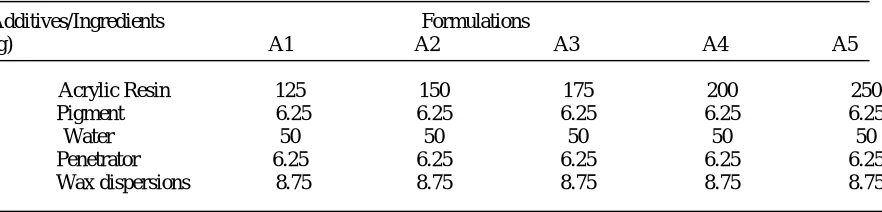
Table 1: Typical finish formulation for leather
Additives/Ingredients Formulations
(g) A1 A2 A3 A4 A5
Acrylic Resin 125 150 175 200 250
Pigment 6.25 6.25 6.25 6.25 6.25
Water 50 50 50 50 50
Penetrator 6.25 6.25 6.25 6.25 6.25
Solution viscosity measurement
The solution viscosity measurement of the Binder was carried out at 25oC using toluene as the solvent. 1g of the solid polymer was dissolved in 50ml of the solvent to give a stock solution of 0.02g/dl. The stock solution was divided into four portions, one was left that way while the other three was diluted by adding the solvent in the order 5ml, 10ml, and 15ml. 10ml of the pure solvent was introduced into the viscometer and the elution time, t0 was obtained. This was
repeated for each solution and the corresponding elution time was obtained and recorded as t1, t2, t3, and t4 respectively. FT-IR spectroscopy of the resin binder
The FT-IR is commonly used for the qualitative identification of various functionalities. The FT-IR spectrum of the Resin Binder was obtained to ascertain its functionality in accordance with standard procedure using a Shimadzu FT-IR 8400s Spectrophotometer. A dry solid of the Resin Binder was cut into pieces and mixed with KBr and was pressed into pellets. The spectrum was obtained by scanning between 4500 and 500/cm.
Melting point determination of the resin binder
A melting point capillary was used. A tiny sample of the resin Binder was placed on a piece of weighing paper. The samples were placed into three melting point capillaries which have been previously sealed at one end. The capillaries containing the samples were then inserted into sample compartment of the melting point apparatus Barnstead Electrothermal A9100 (UK), and the instrument was switched on with a set temperature of 0-400oC. The capillaries containing the samples were heated slowly and the temperatures at which melting occurred was observed and read out from the scale of the instrument.
Water vapour permeability measurement
The water vapour permeability cup method [19] was employed in this experiment. Circular shapes of the finished leathers were cut, weighed and then placed inside thermostated sample holders containing 20 cm3 of water positioned in a water vapour permeabilimeter (Muver model 5011) for 1 hr. The test sample capsules together with the leathers were weighed again and the difference between the first and the second weighings was obtained. This was repeated also for the unfinished leather. Water vapour permeability is calculated as: Pwv (mg/cm2/hr) = 7460 M/ d2t, where, M = mass gain between weighings in milligrams; d2 = area of diameter of sample in cm2, t = time in minutes between the first and second weighing.
Wet rub fastness measurement
The SATRA machine (VESLIC) test method was used to measure the wet rub fastness of the finished leathers [1]. Rectangular piece of the finished leather samples was cut, and for each track 20 mm wide. The side the leather to be tested was rubbed along the given track with pieces of wool felt under pressure in forward and backward motions. Each sample was examined for discolouration or transfer of colour to the felt, and/or for finish damage after 32, 64, 128, 256, 512 and 1024 revolutions. After every examination, scores ranging from ‘0’ (poor resistance) to ‘5’ (excellent wet rub resistance) was assigned when compared with a standard grey scale. Score of ‘0’ was assigned for damaged finish.
III. RESULTS AND DISCUSSION
Solution viscosity measurement
Results of solution viscometry of the polymer are presented in table 2 below. The elution time measured in seconds of the varied concentrations was transformed into relative viscosity, specific viscosity, and reduced viscosity. The plot (figure 1) of reduced viscosity against concentration was extrapolated to the intercept which correlates the intrinsic viscosity of the polymer. The intrinsic viscosity was found to be 227dL/g.
Table 2: Solution Viscosity Measurement of the Binder
Concentration (g/dl) Reduced viscosity, ῃred (dl/g)
0.040 140.5
0.020 146.5
0.013 166.2
0.010 246.0
Intrinsic viscosity of the acrylic binder is for determining the average molecular weight of the polymer binders. The calculated viscosity average molecular weight was 403,000. This result showed that the binder is a high molecular weight polymer suitable for use in leather finishing.
Figure1: Plot of reduced viscosity versus concentration
FT-IR spectroscopy of the resin binder
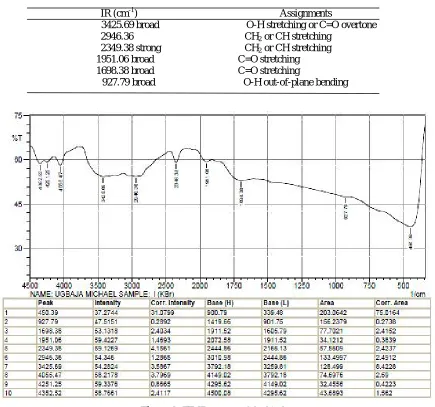
The FTIR spectrum of the resin binder is shown in Figure 2. The corresponding assignments are presented in Table 3. FTIR spectroscopy has been shown to be a powerful technique in resolving the functional groups of organic compounds. It is useful in the characterization of intermolecular interaction between groups in self-polymer or different polymer molecules interactions, mainly hydrogen bonding and dipole-dipole interaction lead to either shift in frequency or changes in absorbance of specific functional groups. The infra-red spectrum of the binder was characterized by relatively broad and conformational sensitive backbone modes and hydrogen bonded carboxylic acid (-COOH). The binder absorbs at 3425.69, 2946.36, 1951.06, 1698.38 and 927.79 cm-1. Absorbance of the carboxyl (C=0) stretch were 1951.06 broad and 1698.38 cm-1. The presence of two carbonyl shifts in the spectra could be due to the absorbance of the surface active agent used as an admixture during emulsion polymerization of the resin. It should be noted that during the precipitation of the resin emulsion in acetone, both emulsifier and resin were involved. The slightly lower
0
50
100
150
200
250
300
0
0.01
0.02
0.03
0.04
0.05
ηred (dl/g)
value (1698.38 cm-1) for the carbonyl stretching frequency may be attributed to the fact that the spectroscopy was carried out in the solid state of the binder. The polymer resin CH2 or CH stretching were obtained at 2946.36 and
2349.38 cm-1 strong band. The broad O-H stretching at 3425.69 cm-1 may be attributed to water in the film. It was also an indication of carboxyl (C=O) overtone or the peak may be due to –OH group of a carboxylic acid or water trapped in the film. A broad 1698.38 cm-1 band slightly lower than that of C=O band of a carboxylic acid is due to the state (solid) which the binder was studied. The absorption spectrum of the binder has a characteristic feature to that of polyethylene acrylate (PEA).
Table 3: Absorption Bands of the Binder and Band Assignment
IR (cm-1) Assignments
3425.69 broad O-H stretching or C=O overtone
2946.36 CH2 or CH stretching
2349.38 strong CH2 or CH stretching
1951.06 broad C=O stretching 1698.38 broad C=O stretching
927.79 broad O-H out-of-plane bending
Figure 2: FT-IR spectra of the binder
Melting point determination of the resin binder
(Tm) of the acrylic resin was in the range of 346-371oC.This is an indication of good thermal stability due to the high molecular weight and polydispersity of the resin. The process of melting involves separation of chains in crystalline regions so that melting points will inevitably depend on interchain forces.
Water vapour permeability
The values of the water vapour permeability measurement for both finished and the unfinished leathers are shown in table 2 (figure 1). Results indicate that the water vapour permeability of the unfinished leathers is better than that of the acrylic finished leathers which is in order according to literature.
Table 4: Effect of acrylic dispersion on water vapour permeability of leather
Sample (finished leather)
Resin (g) Mean mass
(g)
Mean Wvp (mg/cm2/hr)
WVP per unit thickness (mg/cm2/hr/mm)
A1 125 0.18 18.71 11.62
A2 150 0.28 29.10 23.28
A3 175 0.25 25.98 22.39
A4 200 0.62 64.45 43.54
A5 250 1.10 114.34 47.84
(unfinished)
B1 - 3.20 332.6 220.26
B2 - 4.08 424.1 350.49
B3 - 3.18 330.54 277.76
B4 - 4.00 415.78 349.39
B5 - 3.25 337.82 268.11
Fig. 3: Water vapour permeability of finished (experimental) and unfinished (control) leathers
0
50
100
150
200
250
300
350
400
450
125
175
225
275
W a te r v a po ur pe rm ea bi li ty ( m g /c m 3/h r)
Acrylic offer (g)
Figure 3 shows a plot of the water vapour permeability of the unfinished leather samples and the corresponding finished leather samples against the resin finish formulations. The results obtained showed that the water vapour permeability of the unfinished leather is significantly higher than that of the finished leather samples. It has been reported by [22] Tang et al., 2002 that finishing plays an important role in affecting the water vapour permeability of leathers. They [22] showed that the water vapour permeability of unfinished leather was far better than polyurethane finished leather, filmed leather and synthetic leather. For the finished leather samples the water vapour permeability increases from A1 to A5 as the resin offer (g) present in the formulations is increased. The values obtained are typical for uncrosslinked acrylates when used as basecoats. When crosslinked and used as topcoats on the other hand, the water vapour permeability could be as low as 0.9 mg/cm2/hr [1]. However, the unfinished leather samples give values that are consistent for unfinished shoe upper and lining leathers [24]. By scientific fitting, the calculated water vapour permeability of the leather samples may serve as a reference in leather making and leather goods making to get leather goods with good water vapour permeability.
Keyong et al., [21] has reported that among the four major contributing factors of water vapour permeability of leathers studied, that water- absorbing capacity affects the water vapour permeability of leathers the mostly, followed by the thickness of the samples. The contributions to the water vapour permeability from the real density and aperture ratio are really less in comparative terms. Therefore, in order to improve the water vapour permeability of leathers, the most efficient way is trying to increase the water-absorbing capacity of leathers. This is demonstrated by the results obtained for the finished leathers (see figure 1). The hydrophilic nature of the binder is able to contribute to the water absorbing capacity of the leather samples; hence increasing the resin offer in the formulation increases the water vapour permeability of the leather samples. It is therefore better to choose leather chemicals with polar group to increase the water affinity of the collagen fibres in leather making. The results can also be guidance in choosing leather materials (such as shoe or garment) with good water vapour permeability. The second contributing factor to the water vapour permeability of leathers is the thickness of the leather samples [21]. This is shown by the results obtained for the unfinished leather samples where the curve is m-shaped. Thin leathers usually have advantages of providing high water vapour permeability.
Wet rub fastness
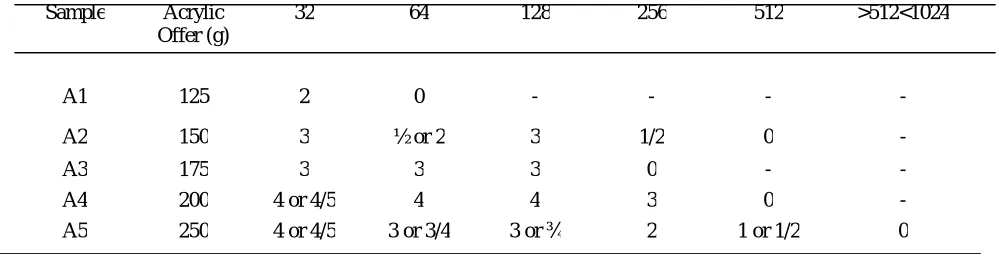
The values of the effect of the finish formulations on the wet rub fastness of the finished leathers are shown in table 5.
Table 5: Effect of finish formulations on wet rub fastness of the finished leathers
Sample Acrylic
Offer (g)
32 64 128 256 512 >512<1024
A1 125 2 0 - - - -
A2 150 3 ½ or 2 3 1/2 0 -
A3 175 3 3 3 0 - -
A4 200 4 or 4/5 4 4 3 0 -
A5 250 4 or 4/5 3 or 3/4 3 or ¾ 2 1 or 1/2 0
good performance in discolouration, but when it comes to resisting finish damage, harder or higher Tg polymers
perform better than soft polymers in acrylic and polyurethanes.
IV. CONCLUSION
The objective of this study which is to evaluate an acrylic based binder and to prepare leather finishing formulations based on the resin binder has been achieved. The results of the tests carried out showed that the binder is predominantly an acrylate with high melting temperature range. The effect of the binder based formulations on leather showed that the finished leathers has good water vapour permeability and adequate wet rub fastness at the same time. The water vapour permeability and wet rub fastness of the finished leathers are enhanced as the quantity of the resin binder in the finish formulations is increased. The water vapour permeability of the originally retanned (unfinished) leathers is also affected when finishing is applied. This indicates that finishing plays an important role in affecting the water vapour permeability and wet rub fastness of leathers.
REFERENCES
[1]A. K. Campbell and C. Y. Choi “SB Acrylic Technology, Closing The Performance Gap”, Journal of American Leather Chemists Association, vol. pp17-20, 1997.
[2] Chan, W.C., and Chen, S.A “Polyurethane Ionomers: Effect Of Emulsion On Properties Of Hexamethylene Diisocyanate-Based Polyether Polyurethane Cationnomers”, polymer, 29: pp1995-2001, 1988.
[3] Martin, M., Michae, S., Claus, K., and Eberhard, J “Recent Development in Aqueous Two Component Polyurethane Coatings”, Prog. Org. Coat., 40: 99-109, 2000.
[4] Biemond, G.J.E., Braspenning, K., and Gaymans, R.J “Polyurethanes With Monodisperse Rigid Segments Based On A Diamine-Diamine Chain Extender, J. Appl. Polym. Sci., 107: pp 2180-2189, 2008.
[5] Wu, L.M., You, B., and Li, D.J “Synthesis and Characterisation of Urethane/Acrylate Composite Latex”, J. Appl. Polym. Sci., 84: 1620-1628, 2002.
[6] Zhang, H.T., Guan, R., Yin, Z.H., and Lin, L.L. “Soap-Free Seeded Emulsion Copolymerization of MMA onto PU-A and their Properties”, J. Appl. Polym. Sci., 82: 941-947, 2001.
[7] Shi, Y.C., Wu, Y.S., and Zhu, Z.Q. “Modification of Aqueous Acrylic-Polyurethane via Epoxy Resin Post Crosslinking”, J. Appl. Polym. Sci., 88: 470-475, 2003.
[8] Barrere, M., and Landfester, K. “High Molecular Weight Polyurethane and Polymer Hybrid Particles in Aqueous Miniemulsion”, Macromolecules, 36: 5119-5125, 2003.
[9] Anzlover, A., and Zigon, M. “Semi-Interpenetrating Polymer Networks With Varying Mass Ratios of Functional Urethane and Methacrylate Prepolymers, Acta. Chem. Slov., 52: 230-237, 2005.
[10] Richard, R.E., Schwarz, M., Ranade, S., Chan, A.K., Matyjaszewski, K., and Sumerlin, B. “Evaluation of Acrylate-Based Block Copolymers Prepared by Atom Transfer Radical Polymerization as Matrices for Paclitaxel Delivery from Coronary Stents”, Biomacromolecules, Vol. 6 No. 6. 3410- 8, 2005.
[11] Ibrahim, M., Mahmoud, A.Z., Osman, O. et al., (2010): Spectrochem Acta, A, 81: 724. In Rashid S., Ahmad, A., and Fashim, A.Q. Synthesis and Application of Eco-friendly Amino Resins for Retanning of Leather under Different Conditions, Society of Leather Technologists and Chemists, 98:8-15, 2014.
[12] El-Nahass, M.M., kamel, M.A., El-barbary, A.A. et al., (2013). In Rashid S., Ahmad, A., and Fashim, A.Q. Synthesis and Application of Eco-friendly Amino Resins for Retanning of Leather under Different Conditions, Society of Leather Technologists and Chemists, 98:8-15, 2014. [13] Rashid S., Ahmad, A., and Fashim, A.Q. Synthesis and Application of Eco-friendly Amino Resins for Retanning of Leather under Different
Conditions, Society of Leather Technologists and Chemists, 98:8-15, 2014.
[14] Ibrahim, M.A. and Gawad, A.E.A. (2012). In Rashid S., Ahmad, A., and Fashim, A.Q. Synthesis and Application of Eco-friendly Amino Resins for Retanning of Leather under Different Conditions, Society of Leather Technologists and Chemists, 98:8-15, 2014.
[15] Nashy, E.H.A, Osman, O. et al., (2010). In Rashid S., Ahmad, A., and Fashim, A.Q. Synthesis and Application of Eco-friendly Amino Resins for Retanning of Leather under Different Conditions, Society of Leather Technologists and Chemists, 98:8-15, 2014.
[16] Mamza, P.A.A.P. and Folaranmi, F.M. Compatibility Studies on Solution of Polystyrene and Polyvinylacetate Blend by Density and Viscometric Methods, European Polymer Journal 32(7): 909-912, 1996.
[17] E. Marcinkowska, and W. Ewa, - Journal of the American Leather and Chemists Association, vol 95: p341, 2000. In T. Keyong, W. Fang, W; L. Jie, J. Pengxiang, and L. Jingling, - Water vapour permeability of leathers by grey system theory, Rev. Adv. Mater. Sci., vol. 33, pp 373-382, 2013.
Jie, J. Pengxiang, and L. Jingling, - Water vapour permeability of leathers by grey system theory, Rev. Adv. Mater. Sci., vol. 33, pp 373-382, 2013.
[19] T. Keyong, W. Fang, W; L. Jie, J. Pengxiang, and L. Jingling, - Water vapour permeability of leathers by grey system theory, Rev. Adv. Mater. Sci., vol. 33, pp 373-382, 2013.
[20] K. Y. Tang, F. Wang, J. Liu, and W. Fan, - Study on the Water Vapour permeability of Leathers, China Leatther, vol. 31, No. 7, p17, 2002. [21] T. Bosch, A. M. Manich and R. Palop – Journal of the Society of leather Technol, Chem. Vol. 83, p 243, 1999. In T. Keyong, W. Fang, W; L. Jie,
J. Pengxiang, and L. Jingling, - Water Vapour Permeability Of Leathers By Grey System Theory, Rev. Adv. Mater. Sci., vol. 33, pp 373-382, 2013.
[22] Fan, H.J and Shi, B. “The Synthesis of Cationic Acrylic Resin for Water-based Leather Finish”, Chemistry, 11: 722-726, 2001.
[23] Williams-Wynn, D.A. “Factors Affecting Finish Fastness, proceedings of the society of leather traders chemists, South African section, Journal of the Society of Leather Technologists and Chemists, 53: 49, 1969.