Exposing Digital Image Forgeries Using
Feature Extraction and Adaptive Over
Segmentation
Dhania V S1, Harish Binu K P2
P.G. Student, Department of Computer Engineering, MEA Engineering College, Perinthalmanna, Kerala, India1
Assistant Professor, Department of Computer Engineering, MEA Engineering College, Perinthalmanna, Kerala, India2
ABSTRACT:A novel copy-move forgery detection method using adaptive over segmentation and feature point
matching is proposed in this work. The proposed methodintegrates both block-based and key point-based forgery detection methods. First, theadaptive over segmentation algorithm divides the host image into non- overlapping andirregular blocks adaptively. Then the features points are extracted using SIFT andmatched with each other to locate the labeled feature points which can almost showthe suspected forgery regions. To find the forgery regions more precisely, the proposedmethod provide the forgery region extraction algorithm. This algorithm crop the inputimage using the located feature points to generate the detected forgery regions. Thisproject is mainly concentrated on improving the detection and localization of duplicatedregions using more powerful keypoint-based features. The SIFT algorithm is a powerfulfeature extraction technique, which extracts features invariant to scale, rotation, andbrightness. However, SIFT descriptors are not invariant to mirror reflection. In thiscontext, this work also adopted a more powerful set of keypoint-based features, calledMIFT, which shares the properties of SIFT features but also are invariant to mirrorreflection transformations. Experimental results show the good performance of the proposed copy-move forgery detection.
KEYWORDS:Copy-move forgery detection, adaptiveOver-segmentation, SIFT, MIFT, Matching
I. INTRODUCTION
Nowadays, digital image forgery has been becoming gradually easy to perform. Of the existing kinds of image forgery, one of the common manipulations with digital image is copy-move forgery, which is to paste one or several copied region(s) of an image into another part(s) of the same image.In the past years, many forgery detection methods have been proposed for copy-move forgery detection.During the copy and move operations, someimage processing methods such as rotation, scaling, blurring, compression, and noiseaddition are sometimes applied to make convincing forgeries. Because the copy andmove parts are copied from the same image, the noise component, color character andother important properties are compatible with the rest of the image; some ofthe forgery detection methods that are based on the related image properties are notapplicable in this case.
The current block-based forgery detection methods divide the host imagesinto overlapping and fixed image blocks; then, the interfered region can be obtainedby matching blocks of image pixels or transform coefficients. As an alternative to theblock-based methods, feature key point based forgery detection methods were suggested, whereimage key points are extracted and matched over the whole image to resist some imagetransformations while recognizing duplicated regions.
II. RELATEDWORK
Fridrich et al. [1] suggested the forgery detection method where the input image was segmented into over-lapped rectangular blocks, and from which the quantized Discrete Cosine Transform (DCT) coefficients of blocks were matched to find the tampered regions. Luo et al. [2] was used the RGB color components and direction information as block feature. Li et al.[3] was used Discrete Wavelet Transform (DWT) and Singular Values Decomposition (SVD) to extract image features. Mahdian and Saic [4] calculated the 24 Blur-invariant moments as feature. Bayram et al. [5] used the Fourier-Mellin Transform (FMT) to obtain feature. Wang et al.[6] suggested the mean intensities of circles with different radii around the block center to represent block feature. Ryu et al. [7] used Zernike moments as block feature. Bravo-Solorio and Nandi [8] used the information entropy as block feature. In the Scale Invariant Feature Transform (SIFT)[9] was used to the input images to extract feature points, which are then matched to each other.
Although these methods are effective in forgery detection, they have three main drawbacks: 1) the input image is divided into over-lapped regions, which will cause the computation complexity expensive; 2) the methods cannot deal with significant geometrical transformation of the forgery areas; 3) the host image is divided into regular blocks, which will cause low recall rate. And the existing keypoint based forgery detection methods can somewhat reduce the computation complexity and can be strong against some attacks, the recall results were still poor. To address the shortcomings of the existing methods, we propose a novel copy-move forgery detection scheme using adaptive over-segmentation and feature point matching in this paper. The Adaptive Over-Segmentationalgorithm is proposed to adaptively divide the host image into non-overlapping and irregular blocks. Then the feature points are extracted from each block and matched with each other to find the labeled feature points which can approximately indicate the suspected forgery regions. And finally the labeled feature points are processed and the morphological operation is applied to generate the detected forgery regions.
III. PROPOSED METHOD
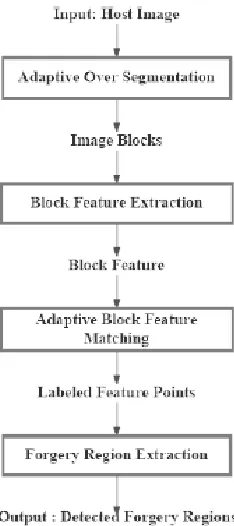
Fig. 1 Framework of the proposed copy-move forgery detection scheme
A. Adaptive Over Segmentation
In order to segment the input image into non-overlapping regions of irregular shape, we used the SLIC algorithm to divide the host image into meaningful superpixels. As a non-overlapping segmentation method, SLIC [10] can reduce the computational expenditures comparing with the overlapping blocking; furthermore, in most of the cases, the irregular and meaningful regions can signify the forgery region better than the regular blocks. However, the initial size of the superpixels in SLIC is hard to determine. When the initial size is too small, it will cause large computation expenses; otherwise, when it is too large, it will cause the forgery detection results not accurate enough. At present, there is no such a good method to determine the initial size in superpixel segmentation algorithms. Therefore, in this paper, we proposed the Adaptive Over-Segmentation method which can define the initial size adaptively based on the texture of the host image and thus can segment the input image into irregular and non-overlapping blocks. In the proposed Adaptive Over-Segmentation method, firstly, the Discrete Wavelet Transform (DWT) is employed into the host image to generate the low frequency and high frequency sub-bands. Then the initial size of the superpixels is calculated with the adaptive block size computation. Finally, with the calculated initial size, the SLIC segmentation algorithm is employed to divide the input image into irregular and non-overlapping image blocks.
B. Block Feature Extraction-SIFT
blurring, and compression. Experiments have shown that the results obtained using SIFT are moreconstant and havebetter performance compared to other feature extraction methods. Hence, in this proposed scheme SIFT is used for feature point extraction. Therefore, each block feature contains irregular block information and the extracted SIFT feature points.
C. Block Feature Extraction-MIFT
In this study, we improve copy-move forgery detection using keypoint-based features by focusing on the issue of accurate detection and localization of duplicated regions. Exactly, we have made several contributions in this work. The SIFT algorithm is a powerful feature extractiontechnique, which extracts features invariant to scale, rotation, and brightness. However, SIFT descriptors are not invariant to mirror reflection. To account for this issue, previous approaches proposed extracting SIFT descriptors from horizontally and vertically reflected versions of the original image. In this paper, we have adopted MIFT [11] descriptors that are invariant to mirror reflection transformations. MIFT is one of the auspicious local feature detector based on SIFT, that is robust to mirror reflection also. A Mirror reflected version of an image can beacquired by reversing the axis of the image, hence, in a horizontally reflected imagethe row order of pixels remains the same, but the column order changes which is shown in Figure 2. As for original descriptors, a fixed encoding policy is accepted,which results in distinct descriptors in different mirror reflection situations for thesame feature, as shown in Fig. 2(e) and (f).So in MIFT mirror invariance isachieved by simple descriptor reorganization. This descriptor reorganization firstorganises the arrangement of cell order around the interest points. This is done bychecking the values of total left pointing (ml) and right pointing (mr) orientations.Based on the winning orientation, column order may change (ml >mr) or not. Second, for each cell, it checks whether the order of orientation bins to followclockwise or anticlockwise direction. Thus MIFT provides a descriptor which isidentical in all cases of mirror reflections.
Fig. 2Different mirror reflections and the concept of MIFT. A simplified SIFTdescriptor with 22 cells and 4 oriented bins in each cell is used for illustration. (a) Theoriginal image. (b) The combined reflection of (a). (c) The horizontal reflection of (a).(d) The vertical reflection of (a). (e) The
original and MIFT descriptor for (a). (f) Thedescriptor of original version for (c). (g) The MIFT descriptor for (c).
IV. EXPERIMENTAL RESULTS
In this section, a sequence of experiments is conducted to evaluate the effectiveness and robustness of the proposed copy-move forgery detection scheme. We have evaluated the performance of the proposed methodology by performing a comprehensive set of experiments with a large database of real images. Comparisons with competitive approaches show that the proposed method can find duplicated regions in copy-move image forgery more accurately, especially when the size of the duplicated regions is small. Below figures shows the result of forgery detection with the input image shown in fig.3.
Fig. 3.(a) Original Image (b) Forged Image
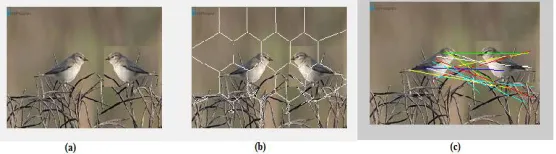
In below figure, fig.4.(b) shows the results after adaptive over segmentation and 4.(c) was the result after feature extraction using SIFT algorithm. Then 4.(d)and (e) was the feature point matching and forgery region extraction results.
Fig. 4(a) Host Image (b) Segmented Image (c) Feature Extraction using SIFT (d)Feature Matching (e)Forgery Region Extraction
Fig.5 (a) Host Image (b) Segmented Image (c) Feature Extraction using MIFT
Experimental results show that the proposed scheme can achieve much better detection results for copy-move forgery images under various challenging conditions, such as geometric transforms, JPEG compression, and down-sampling. But this method, however, cannot handle reflection. Mirror reflection invariant feature generalizes SIFT by producing
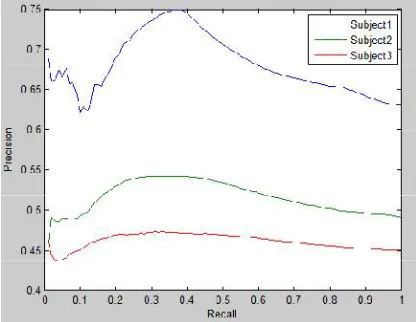
In the above experiments, the two characteristics precision and recall [10] are used to evaluate the performance of the proposed forgery detection scheme. Precision is the probability that the detected regions are relevant, and it is defined as the ratio of the number of correctly detected forged pixels to the number of totally detected forged pixels, as stated in [10]. Recall is the probability that the relevant regions are detected, and it is defined as the ratio of the number of correctly detected forged pixels to the number of forged pixels in the ground-truth forged image. Fig 6 shows the precision and recall rate of the method using MIFT.
Fig. 6Precision and Recall Results at the Pixel Level
V. CONCLUSION
In this paper, we have proposed a novel copy-move forgery detection scheme using adaptive over-segmentation and feature extraction. The proposed Adaptive Over-Segmentation algorithm can adaptively divide the input image into non-overlapping and irregular blocks. In each block, the features points are extracted using SIFT and matched to indicate the suspected forgery regions. The proposed methodology employs a new set of keypoint-based features, called MIFT, for finding similar regions in an image. We have performed comprehensive experiments using a large dataset of real images to evaluate the proposed approach. In particular, we have investigated the effect of different transformations in creating the image forgery on detection accuracy. It should be mentioned that like with similar methods employing keypoint-based features for matching, the proposed approach will not work well if the duplicated region corresponds to a flat surface where no interest points can be detected.Future workcould focus on applying the proposed forgery detection scheme based on adaptiveover-segmentation and feature-point matching on other types of forgery, such assplicing or other types of media, for example, video and audio.
REFERENCES
[1] J. Fridrich, D. Soukal, and J. Lukáš, “Detection of copy–move forgery in digital images,” in Proc. Digit. Forensic Res. Workshop,Cleveland,OH,Aug 2003
[2] W. Luo, J. Huang, and G. Qiu, “Robust detection of region-duplication forgery in digital image,” in Proc. 18th Int. Conf. Pattern Recognit. (ICPR), pp. 746–749, Aug. 2006.
[3] G. Li, Q. Wu, D. Tu, and S. Sun,“A sorted neighborhood approach for detecting duplicated regions in image forgeries based on DWT and SVD,” in Proc. IEEE Int. Conf. Multimedia Expo, pp. 1750–1753, Jul. 2007.
[4] B. Mahdian and S. Saic , “Detection of copy–move forgery using a method based on blur moment invariants,” Forensic Sci. Int., vol. 171, nos. 2–3, pp. 180–189, 2007.
[5] S. Bayram, H. T. Sencar, and N. Memon, “An efficient and robust method for detecting copy–move forgery,” in Proc. IEEE Int. Conf. Acoust., Speech, Signal Process. (ICASSP), pp. 1053–1056, Apr. 2009.
[7] S. J. Ryu, M. Kirchner, M. J. Lee, and H. K. Lee, “Rotation invariant localization of duplicated image regions based on Zernike moments,” IEEE Trans. Inf. Forensics Security, vol. 8, no. 8, pp. 1355–1370,Aug. 2013.
[8] S. Bravo-Solorio and A. K. Nandi, “Exposing duplicated regions affected by reflection, rotation and scaling,” in Proc. IEEE Int. Conf. Acoust., Speech, Signal Process. (ICASSP), pp. 1880–1883, May 2011.
[9] I. Amerini, L. Ballan, R. Caldelli, A. Del Bimbo, and G. Serra,“A SIFT-based forensic method for copy–move attack detection and transformation recovery,” IEEE Trans. Inf. Forensics Security, vol. 6,no. 3, pp. 1099–1110, Sep. 2011.
[10] Chi-Man Pun, Xiao-Chen Yuan,, M. J. Lee, and Xiu-Li Bi, “Image Forgery Detection Using Adaptive Over segmentation and Feature Point Matching,” IEEE Trans. Inf. Forensics Security, vol. 10, no. 8, pp. 1705–1716,Aug. 2015.
[11] Maryam Jaberi, George Babis, “Accurate and robust localization of duplicated region in copy–move image forgery,” Springer-Verlag Berlin Heidelberg 2013.