ISSN(Online): 2319-8753 ISSN (Print): 2347-6710
International Journal of Innovative Research in Science,
Engineering and Technology
(An ISO 3297: 2007 Certified Organization)
Website: www.ijirset.com
Vol. 6, Issue 4, April 2017
Image Mosaicing for Misaligned Images Using
a Novel Method
Prof. Waheeda Dhokley1, Chaudhary Zamirhasan2, Khan Zahid3, Shaikh Asif4
Associate Professor, Department of Computer Engineering, M.H.S.S. College of Engineering, Byculla, Mumbai, India1
U.G. Student, Department of Computer Engineering, M.H.S.S. College of Engineering, Byculla, Mumbai, India2
U.G. Student, Department of Computer Engineering, M.H.S.S. College of Engineering, Byculla, Mumbai, India3
U.G. Student, Department of Computer Engineering, M.H.S.S. College of Engineering, Byculla, Mumbai, India4
ABSTRACT: Image mosaicing is alignment of multiple images into a larger composite. The primary aim of image mosaicing is to enlarge the field of view thus obtaining a high resolution image. Our camera lens has a drawback of capturing an image with a lesser field of view. Image mosaicing overcomes this limitation and gives a larger field of view by combining the input images having some overlapping region between them. In this paper we have proposed a novel technique which mosaics the input images which are not aligned either horizontally or vertically. The proposed technique will acquire two input images which are misaligned and the finds the overlapping region between them and finally mosaics them.
KEYWORDS: Image Mosaicing, Mosaic image, overlapping region, misaligned image, pixel matching.
I. INTRODUCTION
Image mosaicing has emerged as one of the most important subject in the field of image processing. The main aim of image mosaicing is to stitch the split images having some overlapping region between them into one large mosaic image with high resolution. In real world while capturing the images our camera lens is restricted to a limited field of view of 50 to 35 degrees. So the images captured by the camera have less information. In order to tackle this, image mosaicing comes into picture. By applying image mosaicing we are able to get an image with larger field of view and hence more information. There are various fields where there is application of image mosaicing such as 3- dimensional vision, photogrammetric, satellite imagery, video images and motion change detection. So in such situations it is not possible to capture images where we need a large field of view. Therefore in such cases we need mosaicing of images. Automatic image mosaicing construction has been applied in many fields such surveillance, mapping, satellite imagery, scanning documents etc. The construction of mosaiced image and the use of such images on several computer vision/graphics applications have been active areas of research in recent years. There has been variety of new addition to classic application methods that have primary aim to enhance image resolution and field of view.
(a) (b) (c)
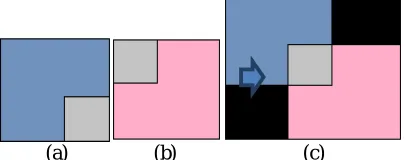
Fig 1(a) Input image 1 (b) Input image 2 (c) OutputMosaic image(c)
ISSN(Online): 2319-8753 ISSN (Print): 2347-6710
International Journal of Innovative Research in Science,
Engineering and Technology
(An ISO 3297: 2007 Certified Organization)
Website: www.ijirset.com
Vol. 6, Issue 4, April 2017
preprocessing on the input images are performed before applying actual algorithm to them. The next step is applying the actual algorithm to mosaic the two input images. After mosaicing is done there may be some discontinuities in the mosaiced image. So in order to remove these discontinuities we perform blending on the mosaiced image. Finally we get the high resolution mosaiced image as output.Before our system, various methodologies have been proposed in the field of image mosaicing. One of the techniques feature based image mosaicing [11] in which an image mosaicing algorithm using improve discrete cosine transform (DCT)-based phase correlation (PC) have been proposed. In [12] various image mosaicing methodologies have been presented.
Another technique for image mosaicing was proposed in [10] in which the comparisons between various image mosaicing methodologies along with their advantages and disadvantages have been presented. A novel approach was proposed in [1] which uses un sharp masking algorithm for mosaicing of input images.
To avoid discontinuities in the mosaic image, we have used intensity based methodology for mosaicing of two input images. The system performs an intensity based comparison between the two input images and finds the overlapping region. Finally the system stitches the two input images in order to get high resolution mosaic image.
II. IMAGEMOSAICINGMETHODOLOGYANDPROBLEMS
Steps in image mosaicing and their problems:
A. Preprocessing
Before applying the actual algorithm for mosaicing the two input images we have to do some preprocessing on them. In preprocessing the color image which is in RGB format is converted into grayscale format. After converting the input images into grayscale format the actual algorithm is applied on the input images which are in grayscale format.
B.Find Overlapping region
After preprocessing is done then the next task is to apply actual algorithm to find the overlapping region between the two input grayscale images. In order to find the overlapping region, an intensity based pixel matching is performed between the two input images to find the overlapping region.
C.Image Stitching and Blending
The final step is to stitch the two images after finding the overlapping region. For stitching we cut the overlapping region from one of the input image and then finally stitch the input images. After stitching is done, there may be some discontinuities in the mosaiced image. So to remove the discontinuities blending is applied to the mosaiced image. After this the gray scale mosaiced image is converted into color image by restoring the color information to get the high resolution mosaiced image as output.
III. EXISTINGSYSTEM
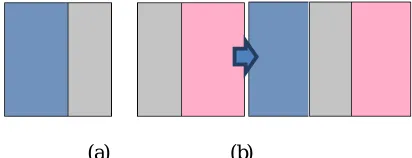
The Bidirectional algorithm which is proposed by us in [16] is an intensity based algorithm which is used for mosaicing the input images. This algorithm takes two images which are either horizontally or vertically aligned and compares them pixel by pixel. If the two images are horizontally aligned then bidirectional algorithm will compare pixels of first input image with the pixels of the second input image from left to right to get the overlapping region between the two input images.
(a) (b)
ISSN(Online): 2319-8753 ISSN (Print): 2347-6710
International Journal of Innovative Research in Science,
Engineering and Technology
(An ISO 3297: 2007 Certified Organization)
Website: www.ijirset.com
Vol. 6, Issue 4, April 2017
After getting the overlapping region between the two input images, the distance of overlapping region is calculated in image1 say D1 and the distance of overlapping region in image2 is calculated say D2. After calculating D1 and D2 both the distance are compared. If distance D1 is greater than distance D2 the overlapping region in image2 is removed and both the images are stitched. If the distance D2 is greater than D1 then the overlapping region in image1 is removed and both the images are stitched. In general the algorithm performs a bidirectional scan from left to right in case of horizontally aligned images and from top to bottom in case of vertically aligned images. After scanning it finds the overlapping region between them. Finally it stitches both the images by removing the overlapping region from one of the input image.
IV. PROPOSEDSYSTEM
The Bidirectional Algorithm has some limitations. It is applicable to the input images only if they are horizontally or vertically aligned. However if the input images are not horizontally or vertically aligned that is if the input images are misaligned then Bidirectional Algorithm gives poor results.
In order to overcome the limitation of Bidirectional Algorithm we have proposed a novel method which mosaics the input images even if they are misaligned. The method takes the two input images which are either horizontally aligned or vertically aligned or misaligned and produces high resolution mosaiced image as output.
A. Working of the system
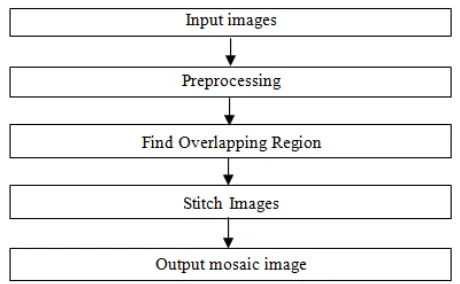
The block diagram of image mosaicing using novel method is shown below.
Fig. 3 Block Diagram for the proposed system which is carried out in five steps Step 1: Input Images
In this step we take the two input images from the user having some overlapping region between them. The input images can be either horizontally aligned or vertically aligned or misaligned.
Step 2: Pre-processing
In pre-processing we store the color information of the two input images. After storing the color information we convert the RGB image into grayscale image so as to reduce the processing time for finding the overlapping region.
Step 3: Find Overlapping Region
After performing pre-processing on the input images we apply the novel method to find the overlapping region between the two input images. This method does an intensity based comparison between the two input images to find the overlapping region. This method gives the size of the overlapping region between the two input images which decides the overall size of the output mosaiced image.
Step 4: Stitch images
ISSN(Online): 2319-8753 ISSN (Print): 2347-6710
International Journal of Innovative Research in Science,
Engineering and Technology
(An ISO 3297: 2007 Certified Organization)
Website: www.ijirset.com
Vol. 6, Issue 4, April 2017
Mosaic image = Image1 + Image2 – Overlapping region
Step 5: Output Mosaic image
In this step we get the mosaic image which is in gray scale format. Now in order to convert it into RGB format we restore the color information of the mosaic image which we have stored while performing the preprocessing step. We get the mosaiced image in RGB format after restoring color information. Finally we display this mosaiced image to the user.
B. Algorithm Step 1: Start
Step 2: Take the two images image1 and image2 as input has some overlapping region between them and each having size m x n where m represents number of rows and n represents number of columns in the input images.
Step 3: Take two pointers i and j where i point to the first row of the input images and j pointing to the first column of the input images. Compare all the pixels of the ith row and jth column of image1 with all the pixels of ith row and jth column of image2. If all the pixels match the go to Step 6 else go to Step 4
Step 4: Increment the jth pointer of image1 and compare all the pixels of ith row of image1 and all the pixels of jth column of image1 with compare all the pixels of ith row of image2 and all the pixels of jth column of image2. If match found the go to Step 6 else repeat.
Step 5: If jth pointer of image1 reaches n then increment the ith pointer in image1 and make the jth pointer point to first column in image1 and then search for common region between the two images by comparing the al the pixels of ith row f image1 and jth column of image2 with ith row of image2 and jth column of image2. If match found the go to Step 6 else go to Step 4.
Step 6: If ith pointer of image1 reaches m then no overlapping region is found.
Step 7: Return ith and jth pointer where ith pointer gives the row number where the overlapping region is found and jth pointer gives the column number where overlapping region is found.
ISSN(Online): 2319-8753 ISSN (Print): 2347-6710
International Journal of Innovative Research in Science,
Engineering and Technology
(An ISO 3297: 2007 Certified Organization)
Website: www.ijirset.com
Vol. 6, Issue 4, April 2017
V. EXPERIMENTALRESULTS
If the input images are horizontally aligned then our system gives the following results:
Fig. 3: Horizontally aligned images,
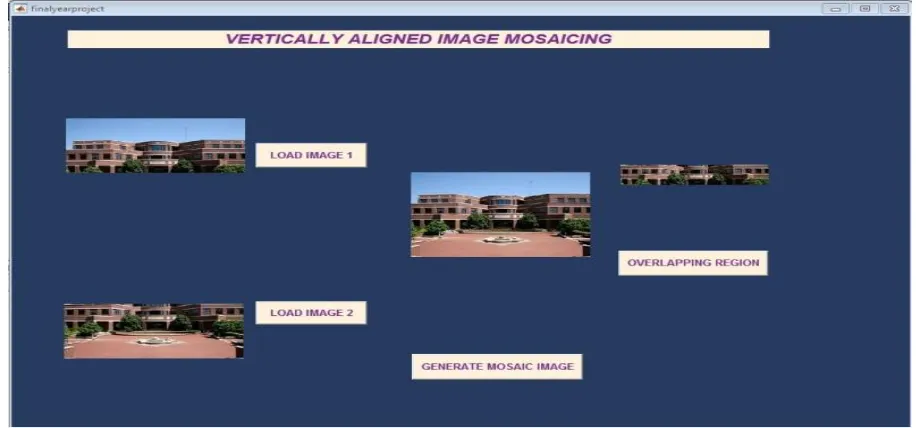
If the input images are vertically aligned then our system gives the following results:
Fig 4: Vertically aligned images.
ISSN(Online): 2319-8753 ISSN (Print): 2347-6710
International Journal of Innovative Research in Science,
Engineering and Technology
(An ISO 3297: 2007 Certified Organization)
Website: www.ijirset.com
Vol. 6, Issue 4, April 2017
Fig 5: Misaligned images
Another form of misalignment is handled by our system thus giving the following results:
Fig 6: Misaligned images
VI. FUTURE SCOPE
ISSN(Online): 2319-8753 ISSN (Print): 2347-6710
International Journal of Innovative Research in Science,
Engineering and Technology
(An ISO 3297: 2007 Certified Organization)
Website: www.ijirset.com
Vol. 6, Issue 4, April 2017
VII. CONCLUSION
The proposed system performs mosaicing of two input images which have some overlapping region and produces high resolution mosaic image as output. In order to do the mosaicing .of two input images it uses Bidirectional algorithm which is a direct intensity based method of image mosaicing, thus by comparing the intensity values between the two input images it finds the overlapping region between them. The Bidirectional algorithm does mosaicing of two input images only if they are horizontally or vertically aligned. The Bidirectional algorithm scans the two input image from left to right for horizontally aligned images and from top to bottom for vertically aligned image and then finds the overlapping region between two image .Using this overlapping region mosaic image is produced.
REFERENCES
[1] ShishirMaheshwari and UmeshC.Pati “Mosaicing of Images using Unsharp Masking Algorithm for Interest Point Detection”, in 2014 IEEE International Conference of Advanced Communication Control and Computing Technologies, Pages 1431 – 1434,2014.
[2] Soo-Hyun Cho, Yun-koo Chung, Jae Yeon Lee, “Automatic Image Mosaic System Using Image Feature Detection and Taylor Series”, in Proceeding VIIthDidgital Image Computing:Techniques and Applications, Sun C., Talbot H., Ourselin S. and Adriaansen T. (Eds.), 10-12 Dec. 2003.
[3] Ms.Parul M. Jain and Prof. Vijayak. Shandliya, “ A Review Paper on Various Approaches foe Image Mosaicing ”, in International Journal of Computer Engineering Research, Volume 3, issue 4, pages 106-109.
[4] Nikhil Ranjan, BrajBiharSoni and BrahmiSharaman, “ An Efficient Technique for Image Mosaicing using Random Sample Consencus Algorithm “, in International Journal of Computer Application, May 2015.
[5] Fischler, M. A. Andbolles, R.C, “Random Sample Concensus: a paradigm for model fitting with applications to image analysis and automated cartography “, Communication Association Machine, 1981, pp.381-395.
[6] Richard Szeliski Image Alignment and Stitching: A Tutorial Foundations and Trends in Computer Graphics and Vision volume. 2, No 1 (2006) pages 1104
[7] Xiong Shi, Jun Chen “Image moaiacing algorithm based on feature block matching,” IEEE Tranc. 2011.
[8] C. D. Kuglin and D. C. Hines, "The phase correlation image alignment method," in Proc. IEEE 1975 Int. Conf.Cybernet. Society,, New York, NY, pp. 163-165.
[9] P. Dani S. Chaudhuri. Automated assembling of images: Image montage preparation. Pattern Recognition, 28(3):431-445, 1995
[10] K. SaiVenuPrathap, Dr.S.A.K.Jilani and Dr.P.Ramana Reddy, “A Critical Review on Image Mosaicing”, in 2016 International Conference on Computer Communication and Information, Jan 2016.
[11] AchalaPandey and UmeshC.Pati ,“An Improved DCT-based Phase Correlation for Image Mosaicing” in Third International Conference on Image Information Processing 2015, Pages 265 – 270 ,2015.
[12] DusyantVaghela and Prof. KapildevNaina , “A Review of Image Mosaicing Techniques ”, in Proceedings of International Journal of Advance Research in Computer Science and Management Studies, volume 2, issue 3 , March 2014.
[13] Heeseung Choi, Kyoungtaek Choi, Jaihie Kim, “MosaicingTouchless and Mirror-Reflected Fingerprint Images ”, in Proceedings of IEEE Transactions on Information Forensics and Security , volume 5 , pages 52 – 61, 2010.
[14] T. Kasar and A.G. Ramakrishnan , “Block-Based Feature Detection and Matching for Mosaicing of Camera-Captured Document Images”, in Proceedings of 2007 IEEE Region 10 Conference TENCON 2007 , Pages 1 – 4 , 2007
[15] WaheedaDhokley, MandarSohani, Dr.S.A.Patekar,”Image Mosaicing using Enhance Dynamic Programming Based Stitching Technique”,inInternational conference &Workshop on Recent Trends & Technology(TCET),2012,Page 1-5.