ABSTRACT
CRAMP, GRACE LOUISE. Modification and Molecular Interactions of a Soy Protein Isolate. (Under the direction of Dr. Christopher R. Daubert and Dr. Prachuab Kwanyuen).
Soy is a nutritional protein source with gelation and emulsification abilities that have expanded its use in the food industry. This research aimed to further the capabilities of soy protein by producing a readily reconstituted isolate capable of gelling at ambient
temperatures. The modified soy protein isolate would have application in food systems requiring a high quality vegetarian protein and gelation ability without reaching required denaturation temperatures. Foods where the isolate may find use include a shelf stable soy protein based powder that may be used “on the go” to form a pudding type of dessert upon the addition of water.
Soy protein was modified with a heat treatment that denatured the protein at a concentration of 8% (w/w), required for gelation. The resulting soy protein isolate
demonstrated immediate dispersibility and gelation in water, as well as heat stability during subsequent rheological thermal scans. The heat modified soy protein also remained two orders of magnitude higher in viscosity than an isolate that was originally denatured below a concentration required for gelation, after both of the isolates received a second thermal treatment at 8% protein (w/w). The viscosity difference between the two isolates
demonstrates the importance of concentration at the point of denaturation, as irreversible denaturation may prevent interactions leading to preferable functionality at a later point.
interactions contribute to a majority of the network influencing final viscosity, intermolecular disulfide bonds must initiate network formation.
The heat modified soy protein isolate demonstrated an ability to conjugate to dextran (100-200 kDa) via Maillard reaction during a dry heat procedure. However, the conjugation of dextran (100-200 kDa) to the native soy protein isolate displayed a viscosity several orders of magnitude higher than the heat modified soy protein conjugate. The native soy protein isolate also showed a higher viscosity and greater ability as an emulsifier when conjugated to higher molecular weight polysaccharides such as dextran (100-200 kDa) than when
conjugated to small molecular weight sugars such as mannose. Therefore, the heat modified soy protein isolate demonstrated gelation at ambient temperatures, whereas the high
MODIFICATION AND MOLECULAR INTERACTIONS OF SOY PROTEIN ISOLATE
by
GRACE LOUISE CRAMP
A thesis submitted to the Graduate Faculty of North Carolina State University
In partial fulfillment of the Requirements for the Degree of
Master of Science
FOOD SCIENCE
Raleigh, NC 2007
APPROVED BY:
___________________________________ ____________________________________ Dr. Christopher R. Daubert Dr. Prachuab Kwanyuen
Chair of Advisory Committee Co-Chair of Advisory Committee
DEDICATION
BIOGRAPHY
ACKNOWLEDGEMENTS
• My advisor Dr. Christopher Daubert for his guidance and support in my MS program. His ability to joke, especially during Rheology class, filled the two years with more than a few laughs.
• My co-advisor Dr. Prachuab Kwanyuen for his guidance, support, excellent stories, and ability to keep his lab in impeccable order.
• Sharon Ramsey, for her wisdom in Rheology and in life in general and her ability to put things into perspective.
• Dr. Debra Clare, for imparting her experience in the lab and in life.
• Penny Amato for her assistance with technical aspects of my project.
• My lab mates John Lillard and Kristin Price, for being excellent listeners and study partners.
• My parents, for providing the encouragement and support I needed, especially during my first year in Raleigh.
TABLE OF CONTENTS
Page
LIST OF TABLES ... vii
LIST OF FIGURES ... viii
PART I: Introduction... 1
1.1 Soy Proteins ... 2
1.1.1 Soy Protein Fractions and Subunits ... 4
1.1.2 Soy Protein Gelation and Associated Molecular Interactions ... 4
1.1.2.1 Electrostatic Interactions and Hydrogen Bonds... 6
1.1.2.2 Hydrophobic Interactions... 7
1.1.2.3 Covalent Bonds... 7
1.1.2.4 Ionic Bonds ... 8
1.1.2.5 Effect of Denaturation on Interactions... 8
1.1.3 Elucidating Molecular Interactions in Soy Protein Gelation ... 9
1.1.3.1 Electrostatic Interactions, Including Hydrogen Bonds ... 9
1.1.3.2 Hydrophobic Interactions and Hydrogen Bonds... 10
1.1.3.3 Sulfhydryl/disulfide Interchange ... 11
1.1.4 Contribution of Each Molecular Interaction in Soy Protein Gelation ... 12
1.2 Functionality Through Carbohydrate Conjugation via Maillard Reaction... 14
1.2.1 Maillard Reaction... 14
1.2.1.1. Maillard Reaction Conditions ... 17
1.2.2 Reducing Sugars ... 18
1.2.2.1 Dextran... 18
1.2.2.2 Mannose... 19
1.2.3 Emulsions and Soy Proteins ... 20
1.2.3.1 Emulsifying Capacity (EC)... 20
1.2.3.2 Emulsifying Stability (ES)... 21
1.2.3.3 Emulsifying Activity... 21
1.2.3.4 Destabilization Mechanisms ... 23
1.2.4.1. Functionality of Conjugates in Gelation... 24
1.2.4.2. Functionality in Emulsification: Non-Maillard Conjugates ... 24
1.2.4.2. Functionality in Emulsification: Maillard Conjugates... 25
1.3 Rheological Properties... 28
1.4 Conclusions... 29
1.4 Works Cited ... 30
PART 2: Molecular interactions and functionality of a cold-gelling soy protein isolate .. 36
2.1 Abstract... 37
2.2 Introduction... 38
2.3 Materials and Methods... 41
2.3.1 Chemicals... 41
2.3.2 Extraction of Soy Protein Isolate ... 41
2.3.4 Sample Preparation for Viscoelastic Tests ... 42
2.3.5 Measurement of Viscoelastic Properties... 43
2.3.6 Polyacrylamide Gel Electrophoresis... 43
2.3.7 Differential Scanning Calorimetry (DSC) ... 45
2.3.8 Determination of Sulfhydryl Content ... 45
2.3.9 Carbaminomethylation of SPI ... 46
2.4 Results and Discussion ... 47
2.4.1 Viscoelastic Response in Water and Urea ... 47
2.4.2 Denaturation of the Proteins Determined Through DSC... 50
2.4.3 Viscoelastic Response in DTT and Urea + DTT ... 51
2.4.4 Effect of Iodoacetamide, Urea, and DTT in Combination on Gelation... 52
2.4.5 Further Support for Intermolecular Disulfides with SDS-PAGE ... 53
2.5 Conclusion ... 56
2.6 Works Cited ... 58
PART 3: The formation and functionality of soy dextran and soy protein-mannose conjugates ... 71
3.1 Abstract... 72
3.3 Materials and Methods... 75
3.3.1 Chemicals... 75
3.3.2 Extraction of Soy Protein Isolate ... 76
3.3.3 Protein Modification ... 76
3.3.4 Color Analysis ... 77
3.3.5 SDS-Polyacrylamide Gel Electrophoresis ... 77
3.3.6 Sample Preparation for Rheological Test ... 78
3.3.7 Emulsion Preparation for Stability and Rheological Tests... 78
3.3.8 Measurement of Viscosity ... 78
3.3.9 Particle Size Measurement... 79
3.3.10 Emulsifying Stability ... 79
3.3.11 Emulsifying Capacity... 79
3.4 Results and Discussion ... 80
3.4.1 Conjugation Verification with SDS-PAGE ... 81
3.4.2 Effect of Conjugation on Viscosity... 82
3.4.3 Effect of Conjugation on Emulsifying Stability (ES) ... 84
3.4.4 Effect of Conjugation on Emulsifying Capacity (EC)... 87
3.5 Conclusion ... 87
3.6 Works Cited ... 89
APPENDICES... 98
I. Acronyms ... 99
LIST OF TABLES
Page
LIST OF FIGURES PART 1: Introduction
Page
Figure 1.1. London dispersion forces – induced dipoles. ... 6
Figure 1.2. Hydrogen bonding between the amine group on an amino acid and water and a carboxylic group on an amino acid and water. ... 6
Figure 1.3. Hydrophobic interaction... 7
Figure 1.4. Covalent disulfide bond between two cysteine residues. ... 8
Figure 1.5. Ionic bond between sodium and chloride in salt. ... 8
Figure 1.6. Schematic of sulfhydryl/disulfide interchange from intramolecular disulfide bond to intermolecular disulfide bond. ... 11
Figure 1.7. Maillard reaction for protein and reducing sugar combinations around pH 7, modified from Nursten (2005). ... 16
Figure 1.8. Structure of dextran. ... 19
Figure 1.9. Structure of D-Mannose. ... 20
Figure 1.10. Schematic of emulsion forming and electrical conductivity measuring apparatus (Firebaugh 2002)... 22
Figure 1.11. Flocculation and Coalescence. ... 23
Figure 1.12. Depletion flocculation due to free polymer or particle in solution. ... 23
PART 2: Figure 2.1. Flow Chart of Soy Protein Isolate Preparation... 61
Figure 2.2. Preparation of soy protein isolate samples. All samples were rehydrated to 8% protein (w/w) for viscoleastic testing... 62
Figure 2.3. Complex viscosity (η*) as a function of frequency of Native SPI, 3% SPI, and 8% SPI to determine concentration effects. ... 63
Figure 2.4. Temperature effects on the complex viscosity (η*) of a. native SPI rehydrated at 8% protein w/w with various denaturants. b. 8% SPI rehydrated at 8% protein w/w with various denaturants. ... 64
Figure 2.5. DSC thermogram showing heating curves for native and 3% heated SPI. ... 65
Figure 2.6. Iodoacetamide treated soy protein isolate a. after heating at 95°C for 3 hours and b. unheated control. Phase separation after two hours... 66
Figure 2.7. a. SDS-PAGE of soluble and insoluble fractions of Native, 8%, and 3% SPI without β-SH. b. SDS-PAGE of soluble and insoluble fractions of Native, 8%, and 3% SPI with β-SH, soluble and insoluble fractions separate. ... 68
Figure 2.8. SDS-PAGE densitometer analysis showing percentage of each SPI subunit present in soluble and insoluble native, 8% SPI, and 3% SPI a. with β-mercaptoethanol b. without β-mercaptoethanol. ... 69
PART 3:
Figure 3.1. Sample preparation... 91 Figure 3.2. Schematic of emulsion forming and electrical conductivity measuring apparatus
(Firebaugh 2002)... 92 Figure 3.3. SDS-PAGE gel stained for a. protein bands and b. carbohydrate containing bands.
Soy is a high quality vegetarian protein source with associated nutritional benefits that have expanded soy’s utility to the food industry in recent years. The U.S. soy crop value was greater than $17 billion in 2004, with $8 billion in soy and associated products exported. Around 40% of the crop was used in soy meal production, the majority of which is used in animal feed (Soy Stats, 2005). Soybean ingredients are currently used in many food products, including bakery foods, baby foods, confections, pastas, dairy, and snack foods (Soy Stats, 2005). Specifically, soy protein ingredients function in a range of applications in the food industry including foaming, fat absorption control, water absorption, gelation, and texture (Wolf, 1970). The health benefits of soy provide an opportunity to expand the functionality of soy ingredients and increase the use of soy products in food. Understanding the molecular implications incurred during soy protein processing can increase knowledge to improve or modify functional capabilities.
1.1 Soy Proteins
process in relation to structure formation of a particular isolate to tailor soy protein ingredients to a specific application.
As the use of soy protein ingredients has increased, the number of patents commercializing on the functional aspects of soy protein gelation are on the rise in an attempt to capitalize on the functionality produced by processing differences. A thermally processed high molecular weight soy protein isolate has been described to have high water solubility and low sedimentation and viscosity, with applications in emulsification for beverages and meat analogs (Monagle et al., 2002). In this patent, isolate production may incorporate a concentrating step with membrane filtration, however, the filtration step comes after an initial thermal process. The temperatures used (110-121°C) have been shown to lead to gel softening, higher protein solubility, and loss of disulfide bonds (Shimada and Cheftel, 1988). The actual molecular network forming the large molecular weight aggregates in the patent was not explained, leaving an opportunity to understand the formation of the
aggregates and the increase in protein solubility (Monagle et al., 2004).
Traditionally soy protein is a thermally-gelling protein. However, cold set gelation of soy protein gels at ambient temperature has been demonstrated using a preheating step to denature the proteins, followed by addition of calcium to induce gelation through
electrostatic interaction (Maltais et al., 2005). This example of cold gelation demonstrates the potential for modifications to soy protein isolate (SPI) to improve and expand on current functional capabilities. An understanding of soy protein and current thermal-gelation mechanisms is required to increase SPI functionality through modification.
2005). However, there is opportunity to increase the range of functional performances through carbohydrate selection prior to conjugation.
1.1.1 Soy Protein Fractions and Subunits
There are four major fractions of soy proteins, based on ultracentrifugal
sedimentation rates, designated by Svedberg unit: 2S, 7S, 11S, and 15S. The 2S fraction accounts for 22% of the water extractable soy protein and contains trypsin inhibitors and cytochrome c (Wolf et al., 1962; Steiner and Frattali, 1969; Fridman et al., 1968). The 7S fraction accounts for 37% of the water extractable soy protein, the majority of which is β-conglycinin (7S) with a molecular weight of 140-210 kDa, containing 3 major subunits, α', α, and β with molecular weights of 58 kDa for α', 57 kDa for α, and 42 kD for β (Wolf et al., 1962; Thanh and Shibasaki, 1977; Thanh and Shibasaki, 1978; Koshiyama, 1968). Glycinin (11S) makes up 31% of the protein, and consists of the major soybean reserve protein, 11S globulin (glycinin), with a molecular weight around 320-375 kDa (Wolf and Briggs, 1959; Wolf et al., 1962; Utsumi et al., 1981; Badley et al., 1975). The 11S fraction consists of six subunits of disulfide bonded acidic and basic polypeptide chains. When the disulfide bonds are broken, the individual acidic polypeptides are around 35-38 kDa and the basic
polypeptides are 18-20 kDa (Utsumi et al., 1981; Badley et al., 1975). The 15S fraction makes up 11% of the protein. Overall, 80% of the proteins have a molecular weight greater than 100,000 (Wolf, 1970). The soy proteins are insoluble at their isoelectric point (pH 4.3-4.5), aiding in protein extraction processes (Wolf, 1970; Lusas and Rhee, 1995).
1.1.2 Soy Protein Gelation and Associated Molecular Interactions
aggregate and become insoluble during thermal processing contribute mostly to gelation functionality (Wolf, 1970; Petrucelli and Anon, 1995a.; Petrucelli and Anon, 1995b.; Sorgentini et al., 1995). At greater than 8% soy protein isolate powder the α', α, and β subunits became insoluble during heating (Sorgentini et al., 1995). The basic subunit was also observed to aggregate and become insoluble during heating (Wolf, 1970; German et al., 1982). The basic subunit and the β subunit were reported to become insoluble during heating at 0.5% protein concentration (Utsumi et al., 1984), likely due to aggregation between the subunits after the 11S disulfide bonds are reduced and the basic subunit is free to interact (Petrucelli and Anon, 1995b). The concentration dependence (8% protein) found for some subunits to aggregate and lose solubility has also been observed to be the “critical
concentration” for gelation. Soy protein isolate was observed to form a gel during heating above a concentration of 7-8% soy protein (Circle et al., 1964; Sorgentini et al., 1995; Catsimpoolas and Meyer, 1970). Circle et al. (1964) showed exponential increases in apparent viscosity with concentration for both unheated and heated gels. Gelation occurred at concentrations of 7% soy protein and greater during heat denaturation, which is the point where a continuous network forms.
1.1.2.1 Electrostatic Interactions and Hydrogen Bonds
Electrostatic interactions are collectively known as van der Waals forces and include dipole-dipole forces, London dispersion forces, and hydrogen-bonding. These forces are less than 1/6 as strong as covalent or ionic bonds (Brown et al., 2000).
London dispersion forces are momentary, weak interactions that can occur in proteins between two molecules when one instantaneous dipole moment induces an adjacent
instantaneous dipole moment in an adjacent molecule (Brown et al., 2000) (figure 1.1).
C H
δ-δ+
C H
δ-δ+
Figure 1.1. London dispersion forces – induced dipoles.
Hydrogen bonds are stronger interactions in proteins, between the hydrogen atom in a polar bond and the unshared electron pair in a nearby electronegative ion or atom (Brown et al., 2000). In proteins, hydrogen bonds can exist between the amino groups of proteins and water (figure 1.2), or between proteins.
O N
δ+ δ-H H C R H C O H δ+ δ+ δ-H δ+ δ- H δ+ O H H δ+ δ+
δ-WATER AMINO
ACID
WATER O
1.1.2.2 Hydrophobic Interactions
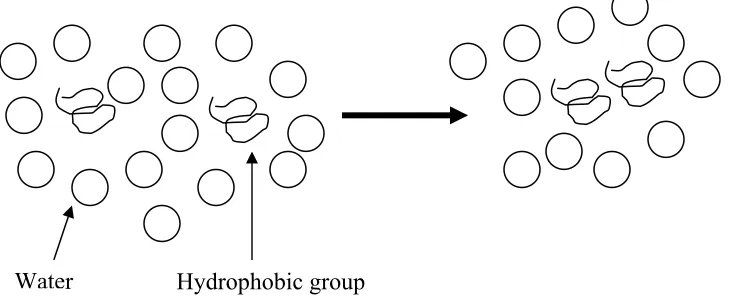
Hydrophobic interactions are even stronger than hydrogen bonds, and are due to the repulsion of water by hydrophobic molecules. The hydrophobic amino acid side chains associate with each other rather than with water, decreasing the number of water molecules required to form an ordered structure around the hydrophobic groups, increasing the entropy of the system (Brown et al., 2000) (figure 1.3).
Water Hydrophobic group
Figure 1.3. Hydrophobic interaction.
1.1.2.3 Covalent Bonds
H3N
CH2 S
C H
COO
-H3N
CH2 S
C H
COO
-Figure 1.4. Covalent disulfide bond between two cysteine residues.
1.1.2.4 Ionic Bonds
Ionic interactions may occur in proteins when salts are present. These are very strong and are created by the attraction between the positive and negative charges on salts (Na+, Cl-, K+, Ca2+, and so on) (figure 1.5) (Brown et al., 2000). The charges created by salts can affect the strength of many gels. For example, calcium salts interact with soy protein to form tofu.
Na+ Cl
-Figure 1.5. Ionic bond between sodium and chloride in salt.
1.1.2.5 Effect of Denaturation on Interactions
creating intermolecular bonds in the aggregated protein molecules where intramolecular bonds once existed. Sulhydryl/disulfide interchange would not necessarily change the total number of disulfide bonds (Walstra, 2003).
The molecular interactions involved in gelation may vary based on the soy protein subunits involved, which may depend on the temperature involved in gelation, and the resulting degree of denaturation. The temperature of denaturation ranges from 68-82°C for 7S and 83-95°C for 11S (Sorgentini, et. al. 1995; German et al., 1982; McKlem, 2002). The denatured subunits may aggregate and become insoluble (Wagner et al., 1992), resulting in a protein gel with different interactions depending on the subunits involved. The molecular interactions of proteins can be elucidated by the use of several reducing or denaturing agents. 1.1.3 Elucidating Molecular Interactions in Soy Protein Gelation
Denaturants that interfere or interact with different types of bonds may be used to provide insight into the molecular interactions involved in a network. Changes in viscosity or firmness upon the addition of a denaturant may indicate the presence of a type of bond in the network, as well as its importance.
1.1.3.1 Electrostatic Interactions, Including Hydrogen Bonds
1.1.3.2 Hydrophobic Interactions and Hydrogen Bonds
Protein hydrophobic interactions and hydrogen bonds can be destabilized by urea and guanidinium hydrochloride. Urea is commonly used to denature proteins, but the mechanism is not clearly understood. Wallqvist et al. (1998) found that urea denatures a protein
molecule through preferential adsorption with charged protein solutes, dehydrating the molecules and causing repulsion between proteins, stabilizing the unfolded form. Zou et al. (1998) reported that urea binds to amide groups through hydrogen bonds, decreasing the hydrophobic effect through dehydration of the protein molecule, and indicating hydrophobic groups and hydrophilic groups are involved with urea denaturation. Walstra (2003) also reported that the denaturing effect is caused by a dehydration of peptide bonds as urea binds to them, weakening hydrophobic interactions. Therefore, urea likely interferes with both hydrogen bonding and hydrophobic interactions by dehydrating a molecule and interacting through hydrogen bonds that might otherwise interact with the solvent surrounding the molecule.
Low concentrations of detergent or urea resulted in soy protein conformational changes (Wolf and Briggs, 1958). The 7S subunits α, α', and β were found to associate mainly through hydrophobic interactions (Thanh and Shibasaki, 1978). The resulting trimeric glycoprotein contains mannose and glucosamine (Thanh and Shibasaki, 1978; Koshiyama, 1969). Nagano et al. (1994) also found that hydrophobic interactions were important in 7S gelation, but the findings also included a significant contribution from
hydrogen bonds. The presence of hydrogen bonds was supported through thermoreversibility of soy protein gels (Nagano, 1994; McKlem, 2002). Utsumi and Kinsella (1985) also
significant contribution from hydrophobic interactions in 11S gelation. Hydrophobic interactions have been shown to become important at lower gelation temperatures (80°C), where only the cysteine deficient 7S fraction was denatured (Catsimpoolas and Meyer, 1970).
1.1.3.3 Sulfhydryl/disulfide Interchange
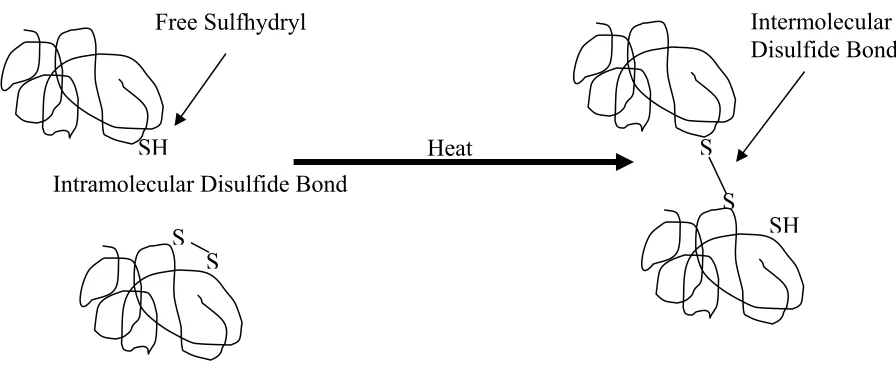
Sulfhydryl/disulfide interchange during protein denaturation and aggregation was described in 1959 (Jensen, 1959). This method proposed that free sulfhydryl groups could interchange with a disulfide linked group, forming a new disulfide bond and a new sulfhydryl group, a reaction often occurring during protein denaturation. The interchange may result in intermolecular covalent bond formation where an intramolecular covalent bond had existed, creating a protein network (figure 1.6) (Walstra, 2003).
Heat Intramolecular Disulfide Bond
S S
SH S
SH
S
Free Sulfhydryl Intermolecular
Disulfide Bond
Figure 1.6. Schematic of sulfhydryl/disulfide interchange from intramolecular disulfide bond to intermolecular disulfide bond.
Wang and Damodaran, 1990), β-mercaptoethanol (β-ME) (Briggs and Wolf, 1957; Wolf and Briggs, 1958; Catsimpoolas and Meyer, 1970; Utsumi et al., 1984; Utsumi and Kinsella, 1985; Wolf, 1993), dithiothreitol (DTT) (Utsumi and Kinsella, 1985; Wolf, 1993; McKlem, 2002), N-ethylmaleimide (NEM) (Briggs and Wolf, 1957; Wolf and Briggs, 1958;
Catsimpoolas and Meyer, 1970; Utsumi and Kinsella, 1985; Shimada and Cheftel, 1988; Wang and Damodaran, 1990), iodoacetamide (Briggs and Wolf, 1957; Wolf, 1993), sodium borohydride (NaBH4) (Wolf, 1993), and sodium sulfite (Na2SO3) (Circle et al., 1964; Petrucelli and Anon, 1995b). Previous investigations of disulfide bonds and sulfhydryl groups in soy protein have indicated most opportunities for disulfide bonding are in the 11S fraction (Shimada and Cheftel, 1988; Thanh and Shibasaki, 1977; Koshiyama, 1971; Utsumi and Kinsella, 1985). Sulfhydryl groups provide the potential for irreversible covalent interactions. The 7S fraction contains four sulfhydryl groups that participate in two intramolecular disulfide bonds, whereas 11S has 48 sulfhydryl groups, many of which interact in bonds between the acidic and basic subunits (Koshiyama, 1971; Hermansson, 1978).
1.1.4 Contribution of Each Molecular Interaction in Soy Protein Gelation
Although most researchers agree that sulfhydryl/disulfide interchange plays a part in gelation due to the effect of disulfide reducing agents, their actual role with respect to other molecular interactions has not been fully established and may depend on gelation
sulfhydryl/disulfide exchange must be a part of the gelation mechanism. Alternatively, Catsimpoolas and Meyer (1970) proposed a schematic involving a sol, progel, and gel, where the gel, formed at 80°C, was reversible and therefore must be formed through noncovalent interactions. In addition, Catsimpoolas and Meyer (1970) found that small amounts of reducing agents reduced gel strength, but large amounts allowed the gel to unfold and create more preferential interactions. However, further support for disulfide bonds was
demonstrated when SPI gels were shown to increase in firmness with temperature up to 120°C, coincident with a decrease in free sulfhydryl groups and protein solubility (Shimada and Cheftel, 1988).
Utsumi and Kinsella (1985) found that sulfhydryl/disulfide exchange was involved in the elasticity of SPI gels, but not necessary for gel formation. Alternatively, Wang and Damodaran (1990) reported that the increase in molecular weight due to intermolecular disulfide bond formation resulted in gelation by creating a network capable of entanglement. Further debate as to the role of disulfides was provided when McKlem (2002) revealed that disulfides are important in the native protein, but become less significant post thermal treatment, once hydrophobic interactions occur.
Disulfide-linked polymers of the 11S fraction were also found to form due to air oxidation during isolation (Briggs and Wolf, 1957). These fractions were shown to depolymerize with the addition of mercaptoethanol, simultaneously increasing solubility. Polymerization was found to occur when the protein was in the precipitated, reduced state, and was prevented by NEM and iodoacetamide.
films in heated soy protein isolates (Krochta and McHugh, 1996). The temperatures required to form these patented coatings and films ranged from 70-95°C and heat treatments times ranged from 15 minutes to 3 hours.
Native thaumatin proteins are commercially available natural sweeteners that do not contain a free sulfhydryl group. However, disulfide rearrangement has occurred in thaumatin proteins when heated above 70°C for 15 minutes, resulting in aggregation and loss of
sweetness and demonstrating the ability of disulfides to break under appropriate thermal conditions. Iodoacetamide and NEM suppressed the disulfide rearrangement and prevented insoluble thaumatin aggregates from forming via intermolecular disulfide bonds (Kaneko and Kitabatake, 1999). The disulfide exchange in the absence of a free sulfhydryl group
demonstrates an increased potential for rearrangement at high temperatures, where disulfides break.
1.2 Functionality Through Carbohydrate Conjugation via Maillard Reaction
Soy protein functionality may also be increased by conjugation to polysaccharides via the Maillard reaction (Cabodevila et al., 1994; Diftis and Kiosseoglou, 2004; Diftis et al., 2005). There is opportunity to increase the range of functionalities through carbohydrate selection prior to conjugation. An understanding of the Maillard reaction would facilitate choice in carbohydrate and conjugation conditions.
1.2.1 Maillard Reaction
Nonenzymatic browning reactions are desirable in foods such as cookies and cakes. However, in other food systems there is a concern with the formation of carcinogens
(Izydorczyk, 2005) or the loss of the essential amino acid, lysine (Nursten, 2005), as the proteins and amino acids react with sugars.
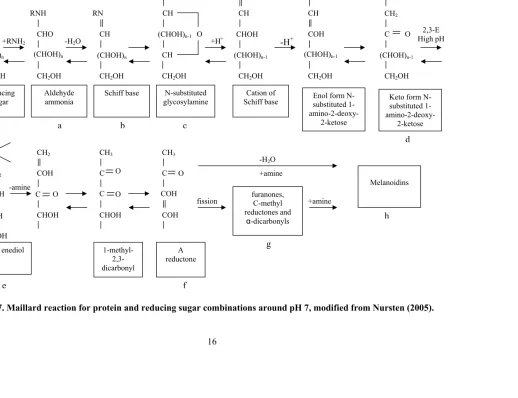
The Maillard reaction begins with a carbonylamine reaction when the amino group of an amino acid reversibly condenses with the carbonyl group of a reducing sugar (figure 1.7.a). Subsequently, water is formed when the molecule forms a Schiff’s base (figure 1.7.b). An N-substituted glycosylamine is formed when the Schiff’s base cyclizes (figure 1.7.c) (Nursten, 2005; Izydorczyk, 2005). Digestible lysine is not lost in the beginning stages of the Maillard reaction, as it is still bioavailable when bound in glycosylamine (Nursten, 2005).
The cyclization is rapidly followed by an irreversible, acid catalyzed, Amadori rearrangement to convert the unstable aldose form to a ketose form, the N-substituted 1-amino-2-deoxy-2-ketose Amadori compound (figure 1.7.d) (Izydorczyk, 2005; Nursten, 2005). The Amadori rearrangement may take place spontaneously, as its products have been found at room temperature, and even in frozen products. Amadori compounds bind lysine so it is no longer bioavailable (Nursten, 2005).
CH2OH
CHO
Figure 1.7. Maillard reaction for protein and reducing sugar combinations around pH 7, modified from Nursten (2005).
+RNH2 (CHOH)n R ducing sugar e CHO (CHOH)n
CH2OH
RNH
Aldehyde ammonia
-H2O
CH CH
(CHOH)n-1
CH2OH
RNH N-substituted glycosylamine O +H+ CH
CH2OH
RN Schiff base (CHOH)n Cation of Schiff base -H+ CH (CHOH)n-1
CH2OH
RNH
COH
Enol form N-substituted 1-
amino-2-deoxy-2-ketose
Keto form N-substituted 1- amino-2-deoxy-2-ketose C CH2 (CHOH)n-1
CH2OH
RNH
O High pH 2,3-E
-amine
CH2OH
(CHOH)n-1
CH
CHOH RNH+
a b c
d 2,3 enediol COH CH2 COH CHOH N COH CH2 C CHOH O C CH3 COH COH O 1-methyl- 2,3-dicarbonyl C CH3 C CHOH O O A reductone fission
-H2O
melanoidins (Izydorczyk, 2005). At a lower pH, the Amadori compound takes longer to decompose and less browning is evident than at a higher, more neutral pH (Nursten, 2005).
At a high pH, 2,3-enolization takes place at a different position on the amino-deoxy-ketose molecule and 2,3-enediols are formed (figure 1.7.e). Enediols lead to the production of reductones (figure 1.7.f). This reaction produces dicarbonyl intermediates that form flavor compounds (aldehydes, furans, maltol, isomaltol, and diacetyls) when they decompose, dehydrate, or fragment (figure 1.7.g). Melanoidins may also be produced when reductones interact with amino acids (figure 1.7.h) (Izydorczyk, 2005).
Finally, flavor compounds may be produced through Strecker degradation, beginning when dicarbonyl intermediates formed from the production of reductones are present during amino acid oxidization and form aldehydes. Flavor compounds result when the aldehydes form melanoidins or are involved in condensation reactions to form heterocyclic compounds, pyrazines, pyrrolines, oxazole, oxazolines, and thiazole derivatives (Izydorczyk, 2005). 1.2.1.1. Maillard Reaction Conditions
The Maillard reaction is regulated by water activity, type of amino acids available, and type of sugar present. Different sugars exhibit different rates of reactions and reactivity depending on how fast the ring opens. For example, pentoses are more reactive than
hexoses. When considering hexoses, galactose is more reactive than mannose, which is more reactive than glucose (Izydorczyk, 2005).
water is a byproduct of several intermediate reactions (Izydorczyk, 2005) and high water activities may also dilute the reactants (Stamp and Labuza, 1983).
1.2.2 Reducing Sugars
Different sugars are expected to have different functionalities when conjugated to protein. Polysaccharides may have fewer reducing ends per molecular weight, and so have fewer chances to conjugate, but the longer chain may increase steric effects and improve emulsifying capabilities of proteins (Dickinson and Galazka, 1991). Smaller sugars with more reducing ends per molecular weight may have the potential to conjugate to a greater extent, but lack the large hydrophilic chains extending from the molecule. Dextran and mannose are a long chain polysaccharide and a simple sugar, respectively.
1.2.2.1 Dextran
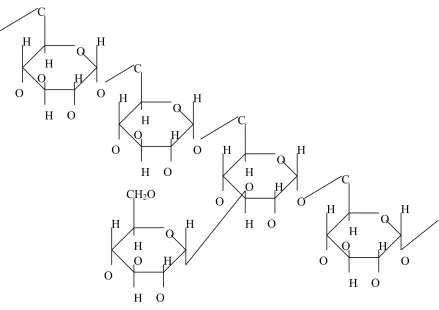
Dextran is a branched polysaccharide that ranges in molecular weight distribution and may be produced from sucrose by the microorganisms Leuconostoc mesenteroides
C
Figure 1.8. Structure of dextran.
(modified from Pharmacosmos A/S, 2007) 1.2.2.2 Mannose
Mannose is a simple six carbon monosaccharide with a reducing end that may participate in the Maillard reaction (figure 1.9). Each hexose has a reducing end, providing the potential for more reactivity via the Maillard reaction than larger polysaccharides with fewer reducing ends or steric hindrances (Izydorczyk, 2005). However, the high molecular weight and branching of dextran may provide the opportunity to increase the functionality of proteins when conjugated through the Maillard reaction (Kato et al., 1988).
O H CH2O
H O O O H H H O H C H O O O H H H O O H C H O O O H H H O O H C H O O O H H H O O
H H
OH OH
OH
OH H
H H
H C C C C CHO
CH2OH
Figure 1.9. Structure of D-Mannose. 1.2.3 Emulsions and Soy Proteins
The ability of a soy protein conjugate to act as an emulsifier may be defined in terms of emulsifying capacity, emulsifying stability, or emulsifying activity of the final emulsion (Pearce and Kinsella, 1978). Soy protein must have surface active features to function as an emulsifier and lower the interfacial tension of dispersed oil droplets in a continuous phase (Walstra, 2003). Soy proteins contain amphiphilic features allowing them to interact with both a hydrophobic phase and a hydrophilic phase (Voutsinas et al., 1983).
1.2.3.1 Emulsifying Capacity (EC)
Emulsion capacity is defined as the maximum amount of oil that a standard amount of protein can emulsify under specified conditions (Pearce and Kinsella, 1978). Emulsion capacity is a function of the equipment, method, and other conditions (pH, type of oil, temperature), not just the type or quantity of protein. Therefore, EC is a qualitative test useful when comparing the emulsifiers under the same conditions (Tornberg and
protein solution, producing an oil-in-water emulsion, and visually determining when the emulsion collapsed. The EC was reported as the amount of oil emulsified by 100 grams of protein. Subsequently, Webb et al. (1970) modified the method by Swift et al. (1961) and used electrical conductivity to objectively determine the emulsifying capacity of several muscle proteins. A sudden spike in the blender amperage represented the point where the emulsion destabilized. The method is based on the ability of water and the inability of oil to conduct electricity (Webb et al., 1970). Firebaugh (2004) compared the EC of a commercial whey protein concentrate and a modified whey protein isolate using the electrical
conductivity method, and determined there was no difference in EC between the two systems. Firebaugh (2004) used the setup exhibited in figure 1.10 to measure EC. 1.2.3.2 Emulsifying Stability (ES)
Emulsion stability is a measure of the oil separation from an emulsion over a standard period of time (Pearce and Kinslla, 1978). Emulsion stability may be measured with a creaming index by relating the height of the emulsified layer to the height of the original emulsion (Equation 1) (Keowmaneechai and McClements, 2002).
creaming index = 100 x (Hs/He) Equation 1 1.2.3.3 Emulsifying Activity
1.2.3.4 Destabilization Mechanisms
When the emulsifier is unable to prevent oil droplet contact, emulsions may be destabilized through flocculation and coalescence (figure 1.11) (Walstra, 2003).
Thin film or “lamella”
Flocculation Coalescense
Below critical thickness film drains,
collapses
Figure 1.11. Flocculation and Coalescence.
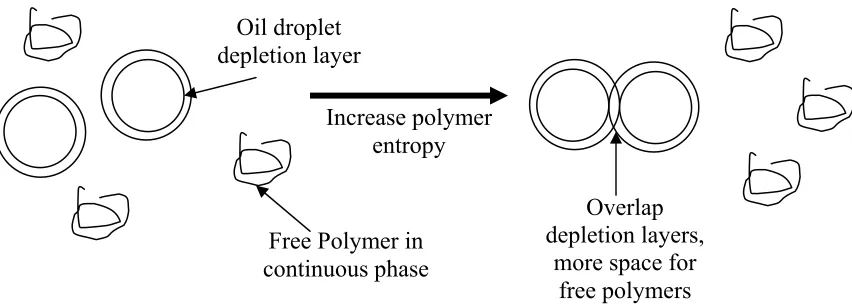
Depletion flocculation is a mechanism where the free emulsifier in the solvent may cause destabilization. Depletion flocculation or aggregation occurs because nonabsorbing free polymers are excluded from an interface in an emulsion. The interface has a depletion layer that may overlap with another droplets depletion layer, increasing the free space in the bulk phase and increasing the entropy for the free polymer (figure 1.12) (Walstra, 1996; Walstra, 2003). Depletion flocculation has been found in soy protein emulsions with free dextran (Diftis et al., 2005).
Oil droplet depletion layer
Free Polymer in continuous phase
Increase polymer entropy
Overlap depletion layers,
more space for free polymers
1.2.4.1. Functionality of Conjugates in Gelation
Soy protein isolate has previously been conjugated to reducing sugars, resulting in improvements in gelation functionality. Cabodevila et al. (1994) conjugated soy protein isolate (10-20%) to 3% xylose through the Maillard reaction using a wet heat procedure at 121°C for one hour. Conjugation was confirmed by a decrease in pH from 7.15 to 5.5 and a darkening in color. The SPI-xylose gels produced less syneresis, and had a higher elasticity resulting in a higher breaking force. The conjugation also reduced the concentration needed to form a gel. The greater elasticity of the conjugated gels was attributed to non-disulfide covalent crosslinking resulting from the Maillard reaction, because beta-mercaptoethanol-SDS had a reduced effect on the SPI-xylose gels than an SPI-glucono-delta-lactone (GDL) gel, but both gels showed similar solubility in SDS alone. The reduced effect of the beta-mercaptoethanol also suggested that the Maillard crosslinks were probably in the 11S globulin of the gel, which had more disulfides to start with, while the SDS-soluble protein was part of the 7S globulin. (Cabodevila et al., 1994).
1.2.4.2. Functionality in Emulsification: Non-Maillard Conjugates
Kato et al. (1988) conjugated dextran (75 kDa) to ovalbumin, soy protein, and lysozyme with a method utilizing cyanogen bromide instead of the Maillard reaction. The resulting ovalbumin and dextran conjugate solutions, 0.1% (w/v), demonstrated emulsifying stability and activity improvements over commercial emulsifiers (SunSoft SE-11 and Q-18S), ovalbumin and dextran mixture, dextran, and ovalbumin with 25% corn oil. Kato et al. (1988) measured additional improvements in the emulsifying properties of
improvements in emulsifying properties. However, when pectin (single-stranded chain) was conjugated to ovalbumin instead of dextran (highly branched), no improvement in
emulsifying properties was measured. Heating the conjugated protein-dextran solutions to 90°C at 0.1% protein also improved the emulsifying activity. The conjugate’s use as an emulsifier was based in their improved solubility in both oil and water. Overall, Kato et al. (1988) demonstrated the potential for manipulating emulsion properties of proteins through polysaccharide selection and conjugation, as well as heat and salt treatments.
1.2.4.2. Functionality in Emulsification: Maillard Conjugates
Dextran has demonstrated functionality benefits when conjugated to ovalbumin, soy protein, and gluten via the Maillard reaction (Kato et al., 1990; Kato et al., 1991; Diftis et al., 2004). Kato et al. (1990) utilized the Maillard reaction to conjugate ovalbumin with dextran. The resulting conjugates showed improvements in emulsification and solubility, just as the conjugates made with the cyanogens bromide method had shown (Kato et al., 1988; Kato et al., 1990). Preheating at 100°C increased the emulsifying properties of ovalbumin and dextran conjugates (Kato et al., 1990). The Maillard reaction was also used to conjugate pronase-treated gluten to dextran (MW 60-90 kDa), resulting in increased solubility and emulsifying capability (Kato et al., 1991).
The occurrence of conjugation of pronase-treated gluten with dextran (Kato et al., 1991), ovalbumin to dextran (Kato et al., 1990), and soy protein isolate to dextran (Diftis and Kiosseoglou, 2004) has been demonstrated with SDS-PAGE. The branched dextran
migrating through the gel. The dense pattern provided support that conjugation had taken place.
Diftis et al. (2004) used the Maillard reaction to conjugate dextran (144 kDa) to soy protein isolate at a 1:1 weight ratio using a dry heat procedure at 60°C for one week. The resulting conjugate demonstrated the ability to adsorb onto oil droplet surfaces, increasing emulsion stability over non-conjugated soy proteins in systems with 10% oil and 0.5% soy protein (w/v). The conjugates enhanced emulsion stability even when partially displaced through competitive adsorption with the surface-active molecules Tween 40 and bovine serum albumin. However, glycerol monosteareate destabilized the emulsions stabilized by SPI-dextran conjugates. The destabilization was believed to be due to increased protein-protein interaction resulting in bridging flocculation.
bridging of the protein between oil droplets during the longer heating time. When dextran and SPI were mixed, but not conjugated, the emulsion droplets flocculated. The
destabilization was attributed to depletion effects caused by the non-adsorbing dextran (Diftis et al., 2005). On a longer time frame (100 days), however, the non-conjugated SPI-dextran mixture exhibited less emulsion destabilization than the conjugated mixture. This behavior was probably due to the more solid-like response of the non-conjugated mixture compared to the liquid-like behavior and continuous droplet rearrangement of the conjugated SPI-dextran (Diftis et al., 2005).
Emulsification ability is not entirely related to solubility. Denaturation may increase the surface hydrophobicity of a soluble protein, increasing the amphiphilic nature or the fat binding capacity. The emulsifying activity of soy protein was increased by heat denaturation at 100°C and 121°C for several minutes, correlating to a hydrophobicity increase (Voutsinas et al., 1983).
Dickinson and Semenova (1992) determined the emulsification ability of 11S globulin and BSA covalently linked to several molecular weights of dextran. It was determined that conjugating too much large hydrophilic dextran to BSA shielded the hydrophobic protein from the interface and lowered the emulsification ability of the conjugate. Also, there was an ideal ratio, different for each protein-polysaccharide
combination, that provided the highest amount of conjugation and steric stabilization on the interface without having a large amount of free polysaccharide causing depletion
1.3 Rheological Properties
Rheology is the study of the flow and deformation of matter (Steffe, 1996). The effect of each soy protein modification on viscosity may be elucidated through the use of rheological tests.
When a food gels, a continuous network of cross-linked polymers or aggregated particles (Walstra, 2003) that may contain both a viscous (fluid-like; G'') and elastic (solid-like; G') component is created (Steffe, 1996). Oscillatory tests are unsteady shear
measurements that subject a sample to a sinusoidal deformation in a simple shear field separating the G' and G'' components. When G' is higher than G'' and the lines are parallel over a range of frequencies, the material is considered to have a gel network. (Steffe, 1996)
Oscillatory tests are reliably conducted in the linear viscoelastic region, where rheological parameters are independent of stress and strain (an applied stress will produce a proportional strain). The gel network is not disturbed in the linear region, producing reliable G' and G'' values. The linear viscoelastic region may be determined with a stress sweep of the material at a constant frequency. Non-linear, or fracture, properties may be determined at higher frequencies. The highest frequency that produces a linear region should be used because all smaller frequencies will contain this linear region. (Steffe, 1996)
An oscillatory shear test may be used to determine the complex viscosity (η*) of samples. The η* is calculated with G' and G'' values and two viscosity values, dynamic viscosity (η') and an out of phase component of the η* (η'') (Equations 2-4) (Steffe, 1996).
ω G
ω G
η′′= ′ Equation 3
( ) ( )
2 2η η
η∗= ′ + ′′ Equation 4
The η* is almost equal to steady shear viscosity (η) when shear rate ( ) and frequency (ω) are equal according to the Cox-Merz rule (Equation 5) (Steffe, 1996), allowing for
comparison between materials tested under oscillatory and steady shear conditions.
γ&
η* = η|ω=γ& Equation 5 1.4 Conclusions
1.4 Works Cited
Badley, R. A.; Atkinson, D.; Hauser, H.; Oldani, D.; Green, J. P.; Stubbs, J.M. The structure, physical and chemical properties of the soy bean protein glycinin. Biochimica et Biophysica Acta. 1975, 412, 214-228.
Briggs D. R.; Wolf, W. J. Studies on the cold-insoluble fraction of the water-extractable soybean proteins. I. Polymerization of the 11S component through reactions of sulfhydryl groups to form disulfide bonds. Archives of Biochemistry and Biophysics. 1957, 72, 127-144.
Brown, T. L.; Lemay, H. E.; Bursten, B. E. Chemistry: The Central Science, 8th Ed. Prentice Hall: Upper Saddle River, NJ. 2000; 395-402.
Cabodevila, O.; Hill, S. E.; Armstrong, H. J.; De Sousa, I.; Mitchell, J. R. Gelation enhancement of soy protein isolate using the Maillard reaction and high temperatures. Journal of Food Science. 1994, 59(4), 872-875.
Carpenter, J. A.; Saffle, R. L. A simple method of estimating the emulsifying capacity of various sausage meats. Journal of Food Science. 1964, 29, 774-781.
Catsimpoolas, N.; Meyer, E. W. Gelation phenomena of soybean globulins. I. Protein-protein interactions. Cereal Chemistry. 1970, 47, 559-570.
Circle, S. J.; Meyer, E. W.; Whitney, R. W. Rheology of soy protein dispersions. Effect of heat and other factors on gelation. Cereal Chemistry. 1964, 41, 157-172.
Chronakis, I. S. Network formation and viscoelastic properties of commercial soy protein dispersions: effect of heat treatment, pH and calcium ions. Food Research International. 1996, 29(2), 123-134.
Dickinson, E.; Semenova, M. G. Emulsifying properties of covalent protein-dextran hybrids. Colloids and Surfaces. 1992, 64, 299-310.
Dickinson, E.; Galazka, V. B. Emulsion stabilization by ionic and covalent complexes of β-lactoglobulin with polysaccharides. Food Hydrocolloids. 1991, 5(3), 281-296.
Diftis, N.; Kiosseoglou, V. Competitive adsorption between dry-heated soy protein-dextran mixture and surface-active materials in oil-in-water emulsions. Food Hydrocolloids. 2004, 18, 639-646.
Eichner, K.; Karel, M. The influence of water content and water activity on the sugar-amino browning reaction in model systems under various conditions. Journal of Agricultural and Food Chemistry. 1972, 20(2), 218-223.
Firebaugh, J. D. Emulsification and foaming properties of a derivatized whey protein
ingredient. IN: Characterization and Application of a Derivatized Whey Protein Isolate. MS thesis, NCSU. 2004.
Fridman, C.; Lis, H.; Sharon, N.; Katchalski, E. Isolation and characterization of soybean cytochrome c. Archives of Biochemistry and Biophysics. 1968, 126, 299-304.
German, B.; Damodaran, S.; Kinsella, J. E. Thermal dissociation and association behavior of soy proteins. Journal of Agricultural and Food Chemistry. 1982, 30, 807-811.
Hermansson, A. M. Physico-chemical aspects of soy proteins structure formation. Journal of Texture Studies. 1978, 9, 33-58.
Hermansson, A. M. Soy protein gelation. Journal of the American Oil Chemists’ Society. 1986, 63(5), 658-666.
Horan, F. E. Defatted and full-fat soy flours by conventional processes. Proceedings of the International Conference on Soybean Protein Foods. Peoria, Ill. October 1966; 129-141. Izydorczyk, M. Understanding the chemistry of food carbohydrates. IN: Cui, S.W. Food Carbohydrates: Chemistry, Physical Properties, and Applications. Taylor and Francis: New York, 2005; 44-47.
Jensen, E. V. Sulfhydryl-disulfide interchange. Science. 1959, 130, 1319-1323.
Kaneko, R.; Kitabatake, N. Heat-induced formation of intermolecular disulfide linkages between thaumatin molecules that do not contain cysteine residues. Journal of Agricultural and Food Chemistry. 1999, 47, 4950-4955.
Kato, A.; Murata, K.; Kobayashi, K. Preparation and characterization of ovalbumin-dextran conjugate having excellent emulsifying properties. Journal of Agricultural and Food
Chemistry. 1988, 36, 421-425.
Kato, A.; Sasaki, Y.; Furuta, R.; Kobayashi, K. Functional protein-polysaccharide conjugate prepared by controlled dry-heating of ovalbumin-dextran mixtures. Agricultural and
Biological Chemistry. 1990, 54, 107-112.
Keowmaneechai, E.; McClements, D. J. Influence of EDTA and citrate on physicochemical properties of whey protein-stabilized oil-in-water emulsions containing CaCl2. Journal of Agricultural and Food Chemistry. 2002, 50, 7145-7153.
Koshiyama, I. Chemical and physical properties of a 7S protein in soybean globulins. Cereal Chemistry. 1968, 45, 394-404.
Koshiyama, I. Isolation of a glycopeptide from a 7S protein in soybean globulins. Archives of Biochemistry and Biophysics. 1969, 130, 370-373.
Koshiyama, I. Some aspects of subunit structure of a 7S protein in soybean globulins. Agricultural and Biological Chemistry. 1971, 35(3), 385-392.
Krochta, J. M.; McHugh, T. H. Water-insoluble protein-based edible barrier coatings and films. United States Patent 5,543,164. 1996.
Lusas, E. W.; Rhee, K. C. Soy protein processing and utilization. IN Erickson, D. R., ed. Practical Handbook of Soybean Processing and Utilization. AOCS Press: Champaign, IL, 1995; 117-160.
Maltais, A.; Remondetto, G. E.; Gonzalez, R.; Subirade, M. Formation of soy protein isolate cold-set gels: protein and salt effects. Journal of Food Science. 2005, 70(1), 67-73.
McKlem, L. Investigation of molecular forces involved in gelation of commercially prepared soy protein isolates. MS thesis, NCSU. 2002.
Meyer, E. W. Soy protein concentrates and isolates. Proceedings of the International Conference on Soybean Protein Foods. Peoria, Ill. October 1966, 142-154.
Monagle, C.W.; Darland, C. M.; Navpreet, S. Highly soluble, high molecular weight soy protein. US Patent 6,803,068. 2004.
Nagano, T.; Mori, H.; Nishinari, K. Effect of heating and cooling on the gelation kinetics of 7S globulin from soybeans. Journal of Agricultural and Food Chemistry. 1994, 42, 1415-1419.
Nash, A. M.; Wolf, W. J. Solubility and ultracentrifugal studies on soybean globulins. Cereal Chemistry. 1967, 44, 183-192.
Petrucelli, S.; Anon, M. C. Thermal aggregation of soy protein isolates. Journal of Agricultural and Food Chemistry, 1995b, 43, 3035-3041.
Pearce, K. N.; Kinsella, J. E. Emulsifying properties of proteins: Evaluation of a
turbidimetric technique. Journal of Agricultural and Food Chemistry. 1978, 26(3), 716-723. Pharmacosmos A/S. Dextran Structure. Denmark: Pharmacosa A/S. Accessed from:
http://www.dextran.net/dextran_structure.html. 2007, Accessed Feb 2007.
Shimada, K.; Cheftel, J. C. Determination of sulfhydryl groups and disulfide bonds in heat-induced gels of soy protein isolate. Journal of Agricultural and Food Chemistry. 1988, 36, 147-153.
Sorgentini, D. A.; Wagner, J. R.; Anon, M. C. Effects of thermal treatment of soy protein isolate on the characteristics and structure-function relationship of soluble and insoluble fractions. Journal of Agricultural and Food Chemistry. 1995, 43, 2471-2479.
Stamp, J. A.; Labuza, T. P. Kinetics of the Maillard reaction between aspartame and glucose in solution at high temperatures. Journal of Food Science. 1983, 48, 543-547.
Steiner, R. F.; Frattali, V. Purification and properties of soybean protein inhibitors of proteolytic enzymes. Journal of Agricultural and Food Chemistry. 1969, 17(3), 513-518. Steffe, J. F. Rheological Methods in Food Process Engineering, 2nd Ed. 1996.
Swift, C. E.; Lockett, C.; Fryar, A. J. Comminuted meat emulsions – the capacity of meats for emulsifying fat. Food Technology, 1961, 468-473.
Thanh, V. H.; Shibasaki, K. Beta-conglycinin from soybean proteins: Isolation and immunological and physicochemical properties of the monomeric forms. Biochimica et Biophysica Acta, 1977, 490, 370-384.
Thanh, V. H.; Shibasaki, K. Major proteins of soybean seeds. Subunit structure of β-conglycinin. Journal of Agricultural and Food Chemistry. 1978, 26(3), 692-695. The American Soybean Association. Soy Stats 2005. Available from:
www.soystats.com/2005. 2005, Accessed Feb 2007.
Tornberg, E.; Hermansson, A. M. Functional characterization of protein stabilized emulsions: Effect of processing. Journal of Food Science. 1977, 42(2), 468-472.
Utsumi, S.; Inaba, H.; Mori, T. Heterogeneity of soybean glycinin. Phytochemistry, 1981, 20(4), 585-589.
Utsumi, S.; Damodaran, S.; Kinsella, J. E. Heat-induced interactions between soybean proteins: preferential association of 11S basic subunits and β subunits of 7S. Journal of Agricultural and Food Chemistry. 1984, 32, 1406-1412.
Utsumi, S.; Kinsella, J. E. Structure-function relationships in food proteins: subunit interactions in heat-induced gelation of 7S, 11S and soy protein isolates. Journal of Agricultural and Food Chemistry. 1985, 33, 297-303.
Voutsinas, L. P.; Cheung, E.; Nakai, S. Relationships of hydrophobicity to emulsifying properties of heat denatured proteins. Journal of Food Science. 1983, 48, 26-32.
Wagner, J. R.; Sorgentini, D. A.; Anon, M. C. Effect of physical and chemical factors on rheological behavior of commercial soy protein isolates: protein concentration, water imbibing capacity, salt addition, and thermal treatment. Journal of Agricultural and Food Chemistry. 1992, 40, 1930-1937.
Wallqvist, A.; Covell, D. G.; Thirumalai, D. Hydrophobic interactions in aqueous urea solutions with implications for the mechanism of protein denaturation. Journal of American Chemist Society. 1998, 120, 427-428.
Walstra, P. Dispersed systems: Basic considerations IN: Fennema OR, ed. Food Chemistry, 3rd Ed. Marcel Dekker: New York, Inc. 1996; 117.
Walstra, P. Physical Chemistry of Foods. Marcel Dekker, Inc.: New York, 2003. Wang, C. H.; Damodaran, S. Thermal gelation of globular proteins: Weight-average molecular weight dependence of gel strength. Journal of Agricultural and Food Chemistry, 1990, 38(5), 1157-1164.
Webb, N. B.; Ivey, F. J.; Craig, H. B.; Jones, V. A.; Monroe, R. J. The measurement of emulsifying capacity by electrical resistance. Journal of Food Science, 1970, 35, 501-504. Wikipedia. Dextran. Accessed from: http://en.wikipedia.org/wiki/Dextran. 2007, Accessed Feb 2007.
Wolf, W. J.; Babcock, G. E.; Smith, A. K. Purification and stability studies of the 11S component of soybean proteins. Archives of Biochemistry and Biophysics. 1962, 99, 265-274.
Wolf, W. J.; Briggs, D. R. Purification and characterization of the 11S component of soybean proteins. Archives of biochemistry and biophysics. 1959, 85, 186-199.
Wolf, W. J. Soybean proteins: their functional, chemical, and physical properties, Journal of Agricultural and Food Chemistry. 1970, 18(6), 969-976.
Wolf, W. J. Sulfhydryl content of glycinin: Effect of reducing agents. Journal of Agricultural and Food Chemistry. 1993, 41, 168-176.
2.1 Abstract
A thermally modified, readily reconstituted, soy protein isolate (SPI), prepared at 8% protein (w/w) for three hours at 95°C, demonstrated improved heat stability and cold-set gel functionality when compared to a control SPI. When SPI was heated at 3% protein (w/w) equivalently, prior to reconstitution to 8% protein (w/w), the final viscosity was about three orders of magnitude less than the original sample. The viscosity of SPI heated at 3% protein (w/w) was still nearly two orders of magnitude less than the original sample after both samples were reheated at 8% protein. These results suggested that heat denaturation at low protein concentrations limited network formation even after the protein concentration and interaction sites increased, which in turn impacted the viscosity parameters of the system. Also, gelation was entirely prevented upon treatment of SPI with iodoacetamide, which carbaminomethylated the cysteine residues, a finding that established the role of disulfide bonds in network
formation. The viscosity of the 8% protein (w/w) dispersion was also reduced by two orders of magnitude when treated with 8M urea, and when combined with 10mM DTT the viscosity of the gel was decreased by another order of magnitude. These results suggested that
2.2 Introduction
Soy protein isolate (SPI) is a high quality plant protein source, generally greater than 90% protein, with associated nutritional benefits that have increased its utilization to the food industry in recent years. Soy protein is one of several heat-gelling proteins. Recently cold set gelation of soy protein gels has been demonstrated using a preheating step to denature the proteins, followed by addition of calcium to induce gelation through electrostatic interactions (Maltais et al., 2005). This example of cold gelation demonstrated the potential for
modifications to SPI to improve and expand current functional capabilities. An
understanding of soy protein and current gelation mechanisms is required to increase SPI functionality through modification
Soy protein isolate consists of two major storage proteins, β-conglycinin (7S) and glycinin (11S), that vary in amount depending on the soybean variety. Their amino acid composition, molecular weights, and physical properties provide different mechanisms for structure formation and functionality. The molecular weight (MW) of the 7S fraction ranges from 140-210 kD, containing 3 major subunits, α', α, and β, with molecular weights of 58 kD, 57 kD, and 42 kD, respectively (Thanh and Shibasaki, 1977; Thanh and Shibasaki, 1978; Koshiyama, 1968). The MW of the 11S fraction is approximately 320-375 kD, containing six acidic (MW 35-38 kD) and six basic (MW 18-20 kD) disulfide-bonded subunits (Utsumi et al., 1981; Badley et al., 1975).
and become insoluble above certain protein concentrations during heating (Sorgentini et al., 1995; Utsumi et al., 1984). The basic subunit has also been shown to become insoluble during heating (Sorgentini, et al. 1995; Wolf, 1970; Utsumi et al., 1984). The nature of these aggregates and a greater understanding of soy protein gels is a continuous subject for
research.
Soy protein isolate has been shown to form a gel during heating above a
concentration of 8% powder w/w (Circle et al., 1964; Sorgentini et al., 1995; Catsimpoolas and Meyer, 1970). Previous insight into soy protein isolate structure involved various chemical reagents: cysteine (Circle et al., 1964; Wang and Damodaran, 1990),
β-mercaptoethanol (β-ME) (Briggs and Wolf, 1957; Catsimpoolas and Meyer, 1970; Utsumi et al., 1984; Wolf, 1993), dithiothreitol (DTT) (Wolf, 1993; McKlem, 2002), N-ethylmaleimide (NEM) (Briggs and Wolf, 1957; Catsimpoolas and Meyer, 1970; Shimada and Cheftel, 1988; Wang and Damodaran, 1990), iodoacetamide (Wolf, 1993), sodium borohydride (NaBH4) (Wolf, 1993), sodium thiocyanate (NaSCN) (Nagano et al., 1994), sodium sulfate (Na2SO3) (Petrucelli and Anon, 1995b), urea (Catsimpoolas et al., 1969; Petrucelli and Anon, 1995b), sodium dodecyl sulfate (SDS) (Petrucelli and Anon, 1995b), and guanidine hydrochloride (GHCl) (Nagano et al., 1994). Use of these reagents revealed the existence of
sulfhydryl groups that participate in two intramolecular disulfide bonds, whereas 11S has 48 sulfhydryl groups, many of which interact in bonds between the acidic and basic subunits (Koshiyama, 1971; Hermansson, 1978).
Although most researchers agree that sulfhydryl / disulfide interchange plays a part in gelation due to the decrease in gel strength upon the addition of disulfide reducing agents, their actual role with respect to other molecular interactions has not been fully established and may depend on gelation temperature and protein concentration. Circle et al. (1964) observed that soy protein gels are irreversible under heating conditions of 100°C for 30 minutes and concluded that disulfide bonds must be a part of the gelation mechanism. Alternatively, Catsimpoolas and Meyer (1970) proposed a schematic involving a sol, progel, and gel, where the gel, formed at 80°C, was reversible and therefore must be formed through noncovalent interactions. In addition, Catsimpoolas and Meyer (1970) found that small amounts of reducing agents reduced gel strength, but large amounts allowed the gel to unfold and create more preferential interactions. However, further support for disulfide bonds was demonstrated when SPI gels were shown to increase in firmness with temperature up to 120°C, coincident with a decrease in free sulfhydryl groups and protein solubility (Shimada and Cheftel, 1988).
The presence of hydrogen bonds was also supported through thermoreversibility of soy protein gels (Nagano, 1994; McKlem, 2002). Hydrophobic interactions have been shown to be important at lower gelation temperatures (80°C), where only the sulfur deficient 7S group is denatured (Catsimpoolas and Meyer, 1970).
The objective of this work was to utilize soy protein concentration and thermal denaturation to produce a soy protein isolate that readily reconstitutes and gels at ambient temperatures upon the addition of water. Insight into the functional mechanisms of cold gelation, depending on protein concentration at denaturation, is provided. An understanding of the functional mechanism that provided the versatility of this SPI ingredient enables further expansion of soy protein-based ingredients.
2.3 Materials and Methods 2.3.1 Chemicals
Urea, dithiothrietol (DTT), iodoacetamide, β-mercaptoethanol (β-ME), hexane, Trizma base, sodium dodecyl sulfate (SDS), glycine, ethylenediaminetetraacetic acid (EDTA), Bis-Acrylamide (40%), glycerol, bromphenol blue, ammonium persulfate, methanol, acetic acid, and sucrose were purchased from Sigma Chemical (St. Louis, MO). All other chemicals were of analytical grade. Distilled water or purified Milli-Q water (Millipore Corp., Billerica, MA) of 18 mΩ-cm resistivity was used for the preparation of all analytical reagents and buffers.
2.3.2 Extraction of Soy Protein Isolate
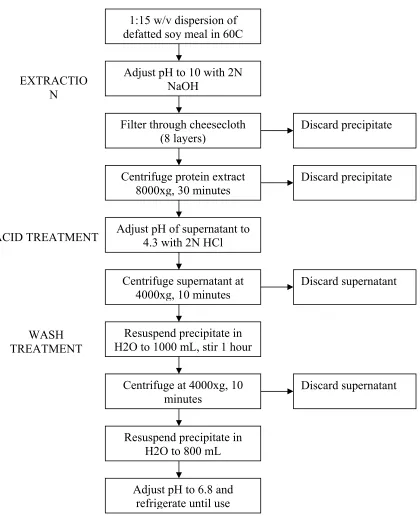
motor speed set at 14,000 rpm. This setting produced ground samples with a uniform particle size of less than 0.5 mm for efficient oil and protein extraction. Oil was extracted from the ground meal using a Soxhlet apparatus with warm hexane. Native protein was extracted batchwise from the defatted meal using the commercial procedure described by Lusas and Rhee (1995) and brought to pH 6.8 with NaOH (figure 2.1). The final protein concentration was approximately 3% at pH 6.8. The majority of the protein solution was lyophilized and used as a control while the remainder was modified as described herein. The lyophilized SPI was ground in a centrifugal grinder, but with a 0.5mm sieve size, to produce SPI in a powdered form. The protein content of the lyophilized SPI was determined by the Dumas combustion method (Nielsen, 1998). Unless otherwise stated, all experiments and procedures were performed at room temperature.
2.3.3 Protein Modification
The lyophilized SPI was rehydrated to 8% protein (w/w) (figure 2.2). A portion of the 8% solution was lyophilized again in the native state, serving as the control (native SPI). The remaining 8% solution and the remaining portion of the native protein still in solution at ~3% protein (w/w) was heated for 3 hours at 95°C ± 3°C and lyophilized. Both samples were ground to powdered form as previously described and stored at 4°C. The heated samples are referred to as 8% SPI and 3% SPI.
2.3.4 Sample Preparation for Viscoelastic Tests
2.3.5 Measurement of Viscoelastic Properties
A Rheologica Stresstech Rheometer, ATS Rheosystems (Bordentown, NJ), was used to measure viscoelastic properties of all test solutions as a function of frequency (0.005 – 10Hz) and temperature (from 10°C to 90°C) within a predetermined linear viscoelastic region. Thermal measurements began at room temperature (25°C), and were continuously recorded as the samples were cooled to 10°C and then heated to 90°C (2.5°C per minute). The sample temperature was held at 90°C for 30 minutes, simulating potential processing conditions. The samples were cooled to a final temperature of 25°C (2.5°C per minute), establishing a baseline comparison for sample temperature stability from the beginning of the test to the end. Pressure was applied to the sample using an ATS Rheosystems sealed cell (Bordentown, NJ) to prevent moisture loss, and data were recorded in triplicate.
2.3.6 Polyacrylamide Gel Electrophoresis
The subunit profile of soluble and insoluble soy protein fractions was evaluated using a Bio-Rad (Richmond, CA) Protean II vertical slab gel apparatus according to Chua (1980) with the following modifications. A soybean reference protein (SRP) was prepared
according to Bradford (1976). Each sample contained about 25 mg/ml protein. The three SPI samples and SRP were mixed at a 1:1 ratio with 0.06M Tris-HCl, pH 8.0, 5% SDS prepared with 0.1M β-mercaptoethanol. In some samples, 0.1M β-mercaptoethanol was excluded in order to evaluate the disulfide banding pattern. Proteins were dissociated in a boiling water bath for 10 minutes. The tracking dye was added to the samples at a
concentration of 10% glycerol and 0.025% bromophenol blue. Samples were loaded onto the gel (10 μg protein per well) and electrophoresed using a 10% to 20% gradient
2.3.7 Differential Scanning Calorimetry (DSC)
Thermal denaturation of the soy proteins was assessed with a Perkin-Elmer DSC 7 (Wellesley, MA), calibrated with indium and mercury using N2 purge gas. Native SPI and 3% SPI were rehydrated to 20% protein (w/w) and analyzed in a hermetically sealed stainless steel pan with an empty pan of similar weight as the reference. The samples were heated from 10-110°C at 10°C/min, held at 110°C for 1 min, cooled to 10°C at 10°C/min, held at 10°C for 1 min, and heated to 110°C at 10°C/min. Denaturation temperatures were
determined at peak height and enthalpy was determined from area under the peak for the 7S and 11S protein fractions.
2.3.8 Determination of Sulfhydryl Content
Sulfhydryl content was measured according to the method of Shimada and Cheftel (1988) with modifications. Native SPI and 8% SPI were solubilized at 4mg/ml in 0.086M Tris-HCl at pH 8.0 containing 0.09M glycine, 4mM Na2EDTA, 0.5% SDS, 6M urea, and 10mM dithiothreitol (DTT). The disulfide reduction was carried out at room temperature under vacuum for one hour and excess DTT was then removed by gel filtration using
Sephadex G-25 column chromatography previously equilibrated with 0.086M Tris-HCl at pH 8.0 containing 0.09M glycine and 4mM EDTA. The sulfhydryl content was determined according to the procedure of Ellman (1959) using 10mM DTNB in 0.1M NaH2PO4 at pH 8.0. A Shimadzu 2101 UV-VIS spectrophotometer (Tokyo, Japan) was used to quantify the free sulfhydryl content at wavelength 412nm.
protein solution was sampled at 0.2, 0.4, 0.6, 0.8 and 1.0 ml and diluted in 3 ml of water. Twenty-five µl of sodium deoxycholate was added to each protein sample and reacted for 15 minutes. The protein was precipitated by addition of 1ml of 24% trichloroacetic acid and collected upon centrifugation at 3,300 xg for 30 minutes. The protein pellets were
redissolved in 1.5 ml Lowry Reagent C (50 parts of Reagent A (2% Na2CO3 in 0.10N
NaOH) + 1 part of Reagent B (0.5% CuSO4·5H2O in 1% sodium tartrate)). After 10 minutes of incubation, 0.15ml of 1N Folin-Ciocalteu reagent was added, and the solutions reacted for 45 minutes in the dark. Bovine serum albumin was used to generate a standard curve. Absorbance was measured on the Shimadzu spectrophotometer at wavelength 730nm. 2.3.9 Carbaminomethylation of SPI
Native SPI (lyophilized only once after isolation) was reacted with iodoacetamide according to the method of Aitken and Learmonth (1996). Protein solutions (8% w/w) were dissolved in 0.6M Tris-HCl, pH 8.6 containing 8M urea. Disulfide bonds were reduced by adding 5M DTT at 0.166% of the total weight. The protein solution was sealed, evacuated, and flushed with nitrogen and held for three hours to fully reduce the disulfide bonds while preventing air oxidation of sulfhydryl groups to disulfide bonds. The sulfhydryl groups were then covalently linked to iodoacetamide, which was added as 10% of the total weight, using a concentration of 500mM. Carbaminomethylation proceeded in darkness at 38°C for 30 minutes under anaerobic conditions, as described previously. The solution was dialyzed against water for 40 hours with three changes of water. The protein sample was then
then ground to a powder in the same manner as previously described. A control was
prepared without a thermal treatment. The powders were rehydrated to 8% protein w/w and visual observations were recorded.
2.4 Results and Discussion
2.4.1 Viscoelastic Response in Water and Urea
A critical concentration for heat induced gelation of soy proteins was previously reported to be approximately 8% (w/w) SPI powder (Sorgentini et al., 1995; Circle et al., 1964). During laboratory isolation, the soy protein concentration was around 3%. In this work, the isolated soy protein solution was freeze dried and rehydrated at 8% protein (w/w) before thermally inducing gelation, then dried to a powder (figure 2.2). In a commercial setting, proteins may become completely denatured during isolation (Hermansson, 1978; Wagner et al., 1992). Commercially prepared soy protein isolates have been shown to provide different functionality and mechanisms of gelation depending on degree of denaturation, method of processing, or other unknown causes (Hermansson, 1978;