ABSTRACT
TALEBI, SAHAR. On Routing and Spectrum Assignment in Elastic Optical Networks. (Under the direction of Dr. George Rouskas and Dr. Rudra Dutta.)
In recent years, OFDM has been the focus of extensive research efforts in optical transmission and networking, initially as a means to overcome physical impairments in optical communications. However, unlike, say, in wireless LANs or xDSL systems where OFDM is deployed as a transmission technology in a single link, in optical networks it is being considered as the technology underlying the novel elastic network paradigm. Hence, we dedicate this work to study and propose different solution methods for elastic optical networks (EONs) topologies.
In Chapter 1, we discuss the necessity of applying EONs along with all the benefits it brings to the optical networks. We also review the set of constraints (i.e. spectrum contiguity and continuity constraints) that must be satisfied during traffic demands allocation to the spectrum. Then, we classify existing spectrum management techniques for EONs, including offline and online routing and spectrum assignment (RSA), distance-adaptive RSA, fragmentation-aware RSA, traffic grooming, survivability, and multi-path RSA problems in Chapter 2.
We then provide a new insight into the spectrum assignment (SA) problem in mesh net-works in Chapter 3 and show that the SA problem transforms to the problem of scheduling multiprocessor tasks on dedicated processors. Similarly, we prove that the RSA problem with fixed-alternate routing in general-topology (mesh) networks (and, hence, in rings as well) is a special case of a multiprocessor scheduling problem.
Based on this new perspective, we show in Chapter 4 that the SA problem in chain (linear) networks is NP-hard for four or more links, but is solvable in polynomial time for three links. We also develop new constant-ratio approximation algorithms for the SA problem in chain networks with the fixed number of links. Finally, we introduce a suite of list scheduling algorithms that are computationally efficient and simple to implement, yet produce solutions that, on average, are within 1-5% of the lower bound.
In Chapter 5, we consider bidirectional ring networks and investigate two problems: (1) the SA problem under the assumption that each demand is routed along a single fixed path (e.g., the shortest path), and (2) the general case of the RSA problem whereby a routing decision along the clockwise and counter-clockwise directions must be made jointly with spectrum allocation. Based on insights from multiprocessor scheduling theory, we investigate the complexity of these two problems and develop new constant-ratio approximation algorithms with a ratio that is strictly smaller than the best known ratio to date.
of efficient and effective DA-RSA algorithms that build upon list scheduling concepts. The numerical results indicate that as the network size increases beyond a point that depends on the traffic demand distribution, the spectrum overhead associated with using a long path becomes sufficiently high that it is always best to use the shortest path. Overall, the best algorithm is always within 10-20% of the lower bound, indicating that scheduling concepts can be successfully adapted to address network design problems.
In Chapter 7, we examine the complexity of the DA-RSA problem for general (mesh) networks and derive a set of conditions that makes this problem either NP-hard or polynomially solvable. We also develop an efficient and effective algorithm for mesh networks that builds upon list scheduling concepts in which routing and spectrum allocation decisions are made jointly. We then run an extensive simulations for DA-RSA in mesh networks to estimate the required amount spectrum for different size networks. Our work explores the tradeoffs involved in DA-RSA algorithm design, and opens up new research directions in leveraging the vast literature in scheduling theory to address important and practical problems in network design.
© Copyright 2015 by Sahar Talebi
On Routing and Spectrum Assignment in Elastic Optical Networks
by Sahar Talebi
A dissertation submitted to the Graduate Faculty of North Carolina State University
in partial fulfillment of the requirements for the Degree of
Doctor of Philosophy
Operations Research
Raleigh, North Carolina 2015
APPROVED BY:
Dr. Yahya Fathi Dr. Matthias Stallmann
Dr. George Rouskas Co-chair of Advisory Committee
Dr. Rudra Dutta
DEDICATION
To my dear mother, Safieh Abdolmohammadi, and my wonderful sisters, Sara Talebi and Sepideh Talebi,
BIOGRAPHY
Sahar Talebi is a PhD candidate in Operations Research with co-major in Computer Science at North Carolina State University. She received her BS degree in Industrial Engineering from University of Tehran in 2006 and her MS degree in Industrial Engineering from Iran University of Science & Technology in 2010 in Tehran, Iran. She has more than three years of work experience in the field of analytics in oil industries.
ACKNOWLEDGEMENTS
This dissertation is the end of my PhD journey. It would not have been possible to finish this journey without the support and help of many people. I would like to take this opportunity to recognize them.
First and foremost, I would like to express my deepest gratitude to my advisor, Professor George Rouskas, who has been a tremendous mentor during this journey. His guidance, dedication, kindness, and patience have contributed immensely to my development as an independent researcher. I am deeply grateful for having the opportunity to collaborate with him during my time at the North Carolina State University. There is no doubt that I would not be able to complete this work without his support, guidance, and tutelage. I am forever indebted to him for believing in me, being extremely supportive, and teaching me the importance of good research.
I would like to extend my sincere gratitude to Professor Rudra Dutta for letting me be a part of his team, co-advising me along this way, and assisting me in shaping as a student and researcher. His patience and encouragement remarkably helped me during this journey. It is a great honor and privilege for me to have experience of working with an extremely knowledgeable, inspiring, and kind teacher.
I am also grateful to Professor Yahya Fathi for kindly accepting to be in my doctoral committee and for his supervision during my first year as a graduate student at the North Carolina State University. I admire him for his intelligent suggestions on my work, encouragements, and unceasing support. Words cannot express my thankfulness for his invaluable assistance both during performing this research and through my entire graduate studies.
I owe a word of great appreciation to Professor Matthias Stallmann for accepting to serve on my doctoral committee and generously sharing his knowledge with me. My work has undoubtedly benefited from his constructive comments and creative ideas. I am thankful for his assistance and exceptional willingness to help me to work out the details and improve the quality of my work.
I would also like to express my gratitude to Professor Evripidis Bampis and Doctor Giorgio Lucarelli at Pierre and Marie Curie University (University of Paris VI) for their collaboration and creative suggestions on my work. Their guidance helped me immensely come up with great ideas. I am specially thankful to them for answering my questions and enlightening me along this way.
in the way of teaching assistantship. I would like to thank the National Science Foundation for supporting my work financially under grant CNS-1113191. I am extremely appreciative to the faculty and staff of the department of Industrial & Systems Engineering, the department of Operations Research, and the department of Computer Science.
I am so blessed and grateful to have many true and real friends all over the world. Many thanks go to my wonderful college friends Maliheh Aramoon, Golshid Baharian, Sara Ghorbani, Negar Golchin and my amazing friends Bahar Aghashiri, Arsineh Galestanian, and Maryam Zaghian who have enriched my life and always supported me emotionally during this journey. I further wish to express my appreciation to fellow friends and graduate students at the North Carolina State University who have always supported me and made this journey memorable. Special thanks go to Zahra Zamani, Atefeh Zamani, Shadi Hassani Goodarzi, Maryam Delavarrafiee, Anahita Kamyab, Roya Yousefelahiyeh, Shakiba Enayati, Golbarg Kazemi, Giti Karimi, Pegah Pooya, Armita Mohammadian, Magreth Mushi, Morteza Amouzgar, Arash Rezaei, Amir Bahmani, Mehdi Mashayekhi, and Farid Alborzi for extreme kindness, heartfelt friendship, and lifting my spirits when I needed it the most. I thank Shahrzad Azizzadeh, Zohreh Asgharzadeh, Katy Salamati, Nastaran Gharkholonarehe, Moin Ayazifar, Reza Jafari, Ramin Shahriari, and Behnam Adib for their blissful company and all the joyful memories.
TABLE OF CONTENTS
LIST OF TABLES . . . ix
LIST OF FIGURES . . . x
Chapter 1 Elastic Optical Networks (EONs). . . 1
1.1 Introduction and Related Work . . . 1
1.2 OFDM-Based Elastic Optical Networks . . . 3
1.3 Structure of the Dissertation . . . 5
Chapter 2 Spectrum Management Techniques for EONs . . . 7
2.1 The Offline RSA Problem . . . 7
2.1.1 ILP Formulations and Heuristics . . . 8
2.2 The Online RSA Problem . . . 11
2.2.1 Heuristic Algorithms . . . 11
2.2.2 Performance Models . . . 13
2.3 Distance-Adaptive RSA (DA-RSA) . . . 14
2.4 Fragmentation-Aware RSA (FA-RSA) . . . 16
2.4.1 Proactive FA-RSA . . . 17
2.4.2 Reactive FA-RSA . . . 18
2.5 Traffic Grooming with RSA (TG-RSA) . . . 20
2.6 Survivability and RSA . . . 22
2.6.1 Protection . . . 23
2.6.2 Restoration . . . 25
2.7 Multi-Path RSA . . . 27
Chapter 3 A Multiprocessor Scheduling Perspective for SA & RSA in EONs. 29 3.1 The SA Problem in General Topology Networks . . . 29
3.2 The RSA Problem in General Topology Networks . . . 32
Chapter 4 The SA Problem in Chain EONs . . . 35
4.1 The SA Problem in Chain Networks . . . 35
4.2 Complexity Results for P m|linej|Cmax . . . 36
4.3 Approximation Algorithms for P|linej|Cmax . . . 39
4.3.1 Two-Stage Approximation Algorithms . . . 39
4.4 List Scheduling Algorithms forP m|linej|Cmax . . . 42
4.4.1 Block-Based Scheduling Algorithms . . . 42
4.4.2 Compact Scheduling Algorithms . . . 43
4.5 Numerical Results . . . 45
4.5.1 SA in Chain Networks . . . 45
4.5.2 Scheduling on Large Multiprocessor Systems . . . 48
Chapter 5 The RSA Problem in Ring EONs. . . 52
5.1.1 Complexity Results for Rings withN = 3,4 Nodes . . . 54
5.1.2 Complexity Results for Rings withN ≥5 Nodes . . . 58
5.1.3 Approximation Algorithms . . . 60
5.1.4 Numerical Results . . . 63
5.2 The RSA Problem in Ring Networks . . . 64
5.2.1 Complexity Results . . . 65
5.2.2 Approximation Algorithms . . . 67
Chapter 6 DA-RSA in Ring EONs . . . 69
6.1 DA-RSA in General Graphs As a Special Case of Multiprocessor Scheduling . . . 69
6.1.1 Lower Bound for Ring Networks . . . 72
6.2 DA-RSA Algorithms for Ring Networks . . . 72
6.2.1 R+SA Algorithms . . . 72
6.2.2 Joint Routing and Spectrum Assignment Algorithms . . . 73
6.3 Numerical Results . . . 78
Chapter 7 DA-RSA in Mesh EONs . . . 82
7.1 DA-RSA in Mesh Networks . . . 82
7.2 Complexity Results for Mesh Networks . . . 83
7.3 A List Scheduling Algorithm forP m|setj|Cmax . . . 88
7.4 Numerical Results . . . 90
7.4.1 Topology and Shortest Paths . . . 90
7.4.2 Spectrum Demand Matrix . . . 90
7.4.3 Evaluation Metrics . . . 92
7.4.4 Results and Discussion . . . 93
Chapter 8 Conclusions and Future Work . . . 99
8.1 Future Work . . . 100
References. . . .102
Appendices . . . .115
Appendix A P4|linej|Cmax Approximation Ratio . . . 116
A.1 LB=L1 . . . 116
A.1.1 C1≥0.5LB . . . 117
A.1.2 C1<0.5LB . . . 117
A.2 LB=L2 . . . 118
A.2.1 C0 1≥0.5LB . . . 118
A.2.2 C10 <0.5LB . . . 119
Appendix B P5|linej|Cmax Approximation Ratio . . . 121
B.1 LB=L1 . . . 121
B.1.1 C1≥0.5LB . . . 122
B.1.2 C1<0.5LB . . . 123
B.2 LB=L2 . . . 124
B.2.2 C0
1<0.5LB . . . 126 B.3 LB=L3 . . . 127 B.3.1 C100≥0.5LB . . . 127 B.3.2 C00
LIST OF TABLES
LIST OF FIGURES
Figure 1.1 Fixed ITU grid versus flexible grid . . . 2
Figure 1.2 Elastic data rates as a function of the number of allocated subcarriers . . . . 4
Figure 1.3 Spectrum contiguity and continuity features in EONs . . . 5
Figure 2.1 Defragmentation in EONs; a) moving subcarriers; b) shifting subcarriers . . . 17
Figure 2.2 Traffic grooming in EONs . . . 21
Figure 2.3 Dedicated versus shared path survivability in EONs . . . 24
Figure 3.1 (a) Instance of the SA problem on a mesh network with five directed links (arcs). (b) Optimal schedule of the correspondingP|f ixj|Cmax problem . . . 32
Figure 4.1 (a) An instance of the offline RSA problem on a directed path; (b) The optimal schedule for the correspondingP3|linej|Cmax problem . . . 36
Figure 4.2 Feasible schedule withCmax= 4B . . . 38
Figure 4.3 A two-stage scheduling algorithm forP|linej|Cmax . . . 41
Figure 4.4 2-approximation schedule for m= 9 processors . . . 42
Figure 4.5 A block-based scheduling algorithm forP m|linej|Cmax . . . 44
Figure 4.6 A compact scheduling algorithm for P m|linej|Cmax . . . 45
Figure 4.7 Average ratio vs. number of processors, discrete uniform distribution . . . 47
Figure 4.8 Average ratio vs. number of processors, discrete high distribution . . . 47
Figure 4.9 Average ratio vs. number of processors, discrete low distribution . . . 48
Figure 4.10 Average ratio vs. number of processors, uniform distribution . . . 50
Figure 4.11 Average ratio vs. number of processors, skewed high distribution . . . 50
Figure 4.12 Average ratio vs. number of processors, skewed low distribution . . . 51
Figure 5.1 Optimal schedule for the clockwise direction of a four-node bidirectional ring with shortest path routing . . . 56
Figure 5.2 A feasible schedule withCmax= 3B for the clockwise direction of a four-node bidirectional ring with shortest-path routing except for one demand routed along a three-link path . . . 58
Figure 5.3 A feasible schedule withCmax= 5B for the clockwise direction of a five-node ring with shortest path routing . . . 60
Figure 5.4 Two-part schedule for a five-node bidirectional ring with shortest path routing 62 Figure 5.5 Average ratio of solutions produced by the approximation algorithms to the lower bound . . . 64
Figure 5.6 A feasible schedule for the RSA problem in a 4-node bidirectional ring with Cmax= 3B . . . 65
Figure 6.1 A traffic load balancing (TLB) algorithm to select one setf ixj for executing each taskj of the P m|setj|Cmax problem . . . 74
Figure 6.2 A set scheduling algorithm forP m|setj|Cmax . . . 77
Figure 6.3 Average ratio vs. number of nodes, distance-independent distribution . . . . 80
Figure 6.5 Average ratio vs. number of nodes, distance-decreasing distribution . . . 81
Figure 7.1 The digraph K40 obtained after removing the two arcs between nodes 1 and 3 from K4 . . . 84
Figure 7.2 A feasible schedule with Cmax = 3B for the P4 problem instance of Theo-rem 7.2.1 . . . 86
Figure 7.3 The digraph K50 created fromK5 by removing two pairs of arcs (a) with no common node, and (b) with one common node. . . 87
Figure 7.4 A list scheduling (LS) algorithm to select one setf ixj and its corresponding processing time pj to execute each taskj of the P m|setj|Cmax problem. . . . 89
Figure 7.5 The NSFNet topology . . . 91
Figure 7.6 The GEANT2 topology . . . 91
Figure 7.7 The 60-node network topology derived from the CORONET CONUS . . . . 92
Figure 7.8 Spectrum slots vs. numberk of paths in NSF . . . 95
Figure 7.9 Spectrum slots vs. numberk of paths in GEANT2 . . . 95
Figure 7.10 Spectrum slots vs. numberk of paths in 60-node network . . . 96
Figure 7.11 Average ratio vs. number kof paths in NSF . . . 97
Figure 7.12 Average ratio vs. number kof paths in GEANT2 . . . 97
Figure 7.13 Average ratio vs. number kof paths in 60-node network . . . 98
Figure A.1 The schedule corresponding withLB=L1 and C1 ≥0.5LB . . . 117
Figure A.2 The schedule corresponding withLB=L1 and C1 <0.5LB . . . 118
Figure A.3 The schedule corresponding withLB=L2 and C10 ≥0.5LB . . . 119
Figure A.4 The schedule corresponding withLB=L2 and C10 <0.5LB . . . 120
Figure B.1 The schedule corresponding withLB=L1,C1 ≥0.5LB, and T45<0.5LB . 122 Figure B.2 The schedule corresponding withLB=L1,C1 ≥0.5LB, and T45≥0.5LB . 123 Figure B.3 The schedule corresponding withLB=L1 and C1 <0.5LB . . . 124
Figure B.4 The schedule corresponding withLB=L2 and C10 ≥0.5LB . . . 125
Figure B.5 The schedule corresponding withLB=L2 and C10 <0.5LB . . . 126
Figure B.6 The schedule corresponding withLB=L3 and C100 ≥0.5LB . . . 128
Figure B.7 The schedule corresponding withLB=L3 and C100 <0.5LB . . . 129
Figure C.1 A six-node bidirectional ring with shortest path routing . . . 131
Figure C.2 A seven-node bidirectional ring with shortest path routing whereS1 ≥ S2 . . 132
Chapter 1
Elastic Optical Networks (EONs)
1.1
Introduction and Related Work
Optical networking technologies are crucial to the operation of the global Internet and its ability to support critical and reliable communication services. In response to rapidly growing IP traffic demands, 40 and 100 Gbps line rates over long distances have been deployed, while there is substantial research and development activity targeted to commercializing 400 and 1000 Gbps rates [1]. On the other hand, emerging applications, including IPTV, video-on-demand, and inter-datacenter networking, have heterogeneous bandwidth demand granularities that may change dynamically over time. Accordingly, mixed line rate (MLR) networks [2] have been proposed to accommodate variable traffic demands.
Nevertheless, optical networks operating on a fixed wavelength grid [3] necessarily allocate a full wavelength even to traffic demands that do not fill its entire capacity [4]. This inefficient utilization of spectral resources is expected to become an even more serious issue with the deployment of higher data rates [5, 6]. Figure 1.1 compares fixed IUT grid versus flexible grid optical networks. As it can be seen there, the fixed grid optical networks can only support data rates of 10, 40, and 100 Gbps with a great portion of bandwidth capacity left unutilized, whereas flexible grid optical networks can also support 400 and 1000 Gbps rates [7]. Still, some parts of bandwidth capacity are unusable to transmit data in flexible grid optical networks, in that the traffic demands associate with them cross the established grids (i.e. black bar).
modula-100 G b /s 40 G b /s Flexible grid 400 G b /s 10 G b /s Frequency 50 GHz 1 T b /s Fixed grid
Figure 1.1: Fixed ITU grid versus flexible grid
tion format that has been widely adopted in broadband wireless and copper-based communication systems, is a promising candidate for high-speed (i.e., beyond 100 Gbps) optical transmission [9]. Other key technologies include distance-adaptive modulation, bandwidth-variable transponders and flexible spectrum selective switches; for a recent survey of optical OFDM and related technologies, and how they impact network and control algorithm design, we refer the reader to [9].
OFDM is a multiple-carrier modulation scheme that splits a data stream into a large number of sub-streams [10]. Each data sub-stream is carried on a narrowband sub-channel created by modulating a corresponding carrier with a conventional scheme such as quadrature amplitude modulation (QAM) or quadrature phase shift keying (QPSK). The modulated signals are further multiplexed by frequency division multiplexing to form what is referred to as multicarrier transmission. The composite signal is a broadband signal that is more immune to multipath fading (in wireless communications) and intersymbol interference. The main feature of OFDM is the orthogonality of subcarriers that allows data to travel in parallel, over sub-channels constituted by these orthogonal subcarriers, in a tight frequency space without interference from each other. Consequently, OFDM has found many applications, including in ADSL and VDSL broadband access, power line communications, wireless LANs (IEEE 802.11 a/g/n), WiMAX, and terrestrial digital TV systems.
as the key challenge to be addressed in network design and control.
1.2
OFDM-Based Elastic Optical Networks
OFDM technology is the foundation of the elastic optical network (EON) concept [7], also referred to as ‘‘spectrum-sliced elastic optical path network’’ orSLICE [13]. The major difference between RWA and RSA lies in the SLICE network architecture as it flexibly adjusts to the format of the modulation [14]. The main driver of the EON architecture is the ability to allocate bandwidth at the granularity of an OFDM subcarrier rather than at the coarse unit of a wavelength in a fixed-grid network, using bandwidth-variable and format-agile transponders that may be reconfigured dynamically via software [10]. Optical signals are routed along the path to the destination by multi-granular optical switches that adapt to the data rate and center frequency of incoming channels via software control [15, 16]. Bandwidth-variable transponders and switches make it possible to support efficiently a range of traffic demands, from sub- to super-wavelength, by slicing off just a sufficient amount of spectral resources along end-to-end paths to satisfy the client requirements. OFDM-based EONs have several advantages relative to existing WDM networks, including [7, 9]:
• Resilience to physical impairments. Since each subcarrier operates at a low symbol rate,
inter-symbol interference is reduced and the effects of physical impairments are alleviated.
• Elastic data rates. The number of allocated subcarriers and the modulation format may
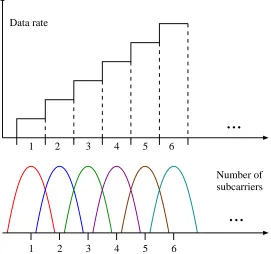
be adjusted dynamically, on a per-connection basis, to account for: 1) demand granularity, making it possible to support data rates from Gbps to Tbps, 2) path distance, so as to trade off spectrum utilization for reach, and 3) the time-varying nature of demands. Therefore, EONs may support multiple data rates, either by grouping together any number of subcarriers, as shown in Figure 1.2, or by supporting a different data rate per subcarrier depending on network conditions. Importantly, EONs are highly scalable in that a transition to higher data rates would not require major changes in system design
• Spectral efficiency.Two features of OFDM enable highly efficient use of spectral resources.
On one hand, adjacent subcarriers may overlap in spectrum due to their orthogonality, as shown in the bottom part of Figure 1.2. This reuse of spectrum increases the overall system capacity. On the other hand, adapting the data rate to demand size, path length, and time variations, achieves better use of existing spectrum.
subcarriers
...
1 2 3 4 5 6
...
1 2 3 4 5 6
Data rate
Number of
Figure 1.2: Elastic data rates as a function of the number of allocated subcarriers
the design and control of such networks. These challenges call for new spectrum management techniques that address effectively and efficiently issues related to:
• Scalability. With an OFDM subcarrier as the unit of bandwidth allocation, the number of
spectral resources to be managed network-wide is significantly larger than the number of wavelengths in existing WDM networks.
• Spectrum contiguity.If a demand requirestunits of spectrum, thentcontiguous subcarriers
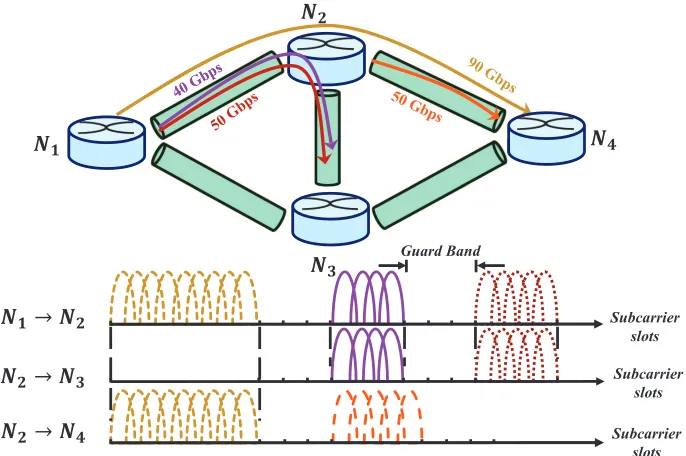
must be allocated to it. This constraint, not encountered in wavelength-based networks, may, unless appropriately accommodated, lead to severe fragmentation of the spectral resources that counters the inherent efficiency of fine-grain allocation. Consider Figure 1.3 to see how adjacent subcarriers slots are allocated for each traffic demand.
• Spectrum continuity. The samet contiguous subcarriers must be allocated on each link
ࡺ ՜ ࡺ
ࡺ՜ ࡺ ࡺ ՜ ࡺ
Subcarrier slots Subcarrier
slots Subcarrier
slots Guard Band
ࡺ
ࡺ ࡺ
ࡺ
Figure 1.3: Spectrum contiguity and continuity features in EONs
• Variable data rates. Support for elastic data rates, a core feature of EONs, requires
precise tracking of the spectral width and center frequency of optical signals, and tight coordination of bandwidth-variable transponders and switches along end-to-end paths. Due to the spectrum continuity constraint, there is a tight coupling between spectrum allo-cation and routing of a demand. Consequently, routing and spectrum assignment (RSA) [17, 18] has emerged as the essential problem for spectrum management in EONs. Since the performance of a network depends not only on its physical resources (e.g., transponders, physical links, usable spectral width, optical switches, etc.) but also on how it is controlled, the objective of an RSA algorithm is to achieve the best possible performance within the limits of physical constraints. The RSA problem can be cast in numerous forms. The different variants of the problem, however, can be classified under one of two broad versions: offline RSA, whereby the traffic demands are known in advance, andonline RSA, in which a sequence of client requests arrive in some random fashion. Spectrum management techniques for both offline and online RSA are discussed in Chapter 2.
1.3
Structure of the Dissertation
Chapter 2
Spectrum Management Techniques
for EONs
In Chapter 1, we introduced EONs and reviewed all the advantages and challenges associated with it. In this chapter, we classify the RSA problem as the offline and online problems. More specifically, we explore variants of integer linear programming (ILP) formulations and heuristics for the offline RSA problem in Section 2.1. Then, we classify existing algorithms for the online RSA problem and discuss performance modeling techniques for this problem in Section 2.2. We also examine and categorize solution approaches for distance-adaptive RSA (DA-RSA) and fragmentation-aware RSA (FA-RSA) in Section 2.3 and Section 2.4, respectively. Next, we present traffic grooming techniques for RSA in Section 2.5 and review survivability mechanisms for EONs in Section 2.6. Finally, we study multi-path RSA in Section 2.7.
2.1
The Offline RSA Problem
Definition 2.1.1 (RSA) Given
• a graph G= (V,A) where V is the set of nodes and A the set of arcs (directed links),
• a spectrum demand matrix T = [tsd], where tsd is the number of spectrum slots required
to carry the traffic from source node sto destination node d, and
• k alternate routes,r1sd, . . . , rsdk , from nodes to node d,
assign a route and spectrum slots to each demand so as to minimize the total amount of spectrum
used on any link in the network, under three constraints:
1. each demand is assigned contiguous spectrum slots (spectrum contiguity constraint);
2. each demand is assigned the same spectrum slots along all links of its path (spectrum
continuity constraint); and
3. demands that share a link are assigned non-overlapping parts of the available spectrum (non-overlapping spectrum constraint).
RSA is a generalization of the well-known routing and wavelength assignment (RWA) problem [19]. If a single route for each source-destination pair is provided as part of the input, and each traffic demand is constrained to follow the given route, the RSA problem reduces to the spectrum assignment (SA) problem.
Definition 2.1.2 (SA) The RSA problem under the additional constraint that all traffic from
source s to destination d must follow the given physical path rsd, (i.e., k = 1 in the above
definition).
A recent study [20] considered the complexity of the offline SA problem in chain (path) networks, in which no routing decision is involved. Using results from graph coloring theory, it was shown in [20] that the SA problem in paths is NP-hard, and that a (2 +)-approximation algorithm (whereis an arbitrary real number that approaches zero) for computing the interval chromatic number of an interval graph may be used for solving the SA problem with the same performance bound. The study also extends this algorithm to solve the SA problem in ring networks with a performance bound of (4 + 2).
2.1.1 ILP Formulations and Heuristics
been proposed, each tailored to a specific problem variant. Since the problem is intractable, these ILP formulations cannot be solved within a reasonable amount of time for problem instances corresponding to network topologies encountered in practice. Therefore, an array of heuristic algorithms have been put forward to obtain reasonably good solutions efficiently.
Link-based ILP formulations of RSA as a multicommodity flow problem have been studied in [18, 21, 22]. In addition to the spectrum contiguity, spectrum continuity, and non-overlapping spectrum constraints, the formulations also impose guard carrier constraints in allocating frequency slots (i.e., subcarriers) to the traffic demands. These studies consider three main objectives to minimize: the maximum number of subcarriers allocated on any fiber, the maximum subcarrier index allocated on any fiber, and the total number of subcarriers over all fibers. Upper and lower bounds on the optimal solution for ring and mesh networks were presented under both predetermined and non-predetermined routing. The lower bounds were obtained either using cut-set techniques or the even-load method, and the latter was shown to provide tighter bounds. It was also shown that, in ring networks with uniform demands, the lower and upper bounds are tight. Finally, two heuristic algorithms were developed to solve the RSA problem efficiently. The first algorithm, referred to as shortest path with maximum spectrum reuse (SPSR), uses shortest path routing and the first-fit spectrum allocation strategy to assign frequency slots to demands in decreasing order of their size. The second algorithm, balanced load spectrum allocation (BLSA), considers the kshortest paths as candidates for each demand, and selects the one that minimizes the maximum link load, so as to balance the use of spectrum across the network links.
A similar link-based formulation of an RSA variant referred to as the routing, wavelength assignment, and spectrum allocation (RWSA) problem was studied in [23, 24]. In these studies, the network was assumed to support only a given set of line rates (e.g., 10/40/100/400/1000 Gbps), and each line rate requires a predetermined amount of spectrum that does not depend on the path length. The objective was to select a set of line rates for each demand and a corresponding set of lightpaths (one lightpath per line rate) so as to minimize the total spectrum width in the network. For each lightpath, the ILP formulation determines the center wavelength, the spectral width, and the physical route across the network. It was shown that RWSA is a generalization of the RWA problem in mixed line rate (MLR) optical networks. Due to the complexity of the problem, the ILP formulation was solved only for a six-node network in [23]. Consequently, the problem is decomposed in [24] into two subproblems: (1) the line rate selection problem that determines the line rates for each demand, and which is solved using dynamic programming, and (2) a variant of the routing and wavelength assignment (RWA) problem that seeks to establish lightpaths at the specific line rates. The latter subproblem is solved using three greedy heuristic methods.
path-based formulation, kpaths, where k is a small integer, are pre-computed for each demand, such that the demand may be routed only along one of these paths. The ILP is used to assign one of the predetermined paths to each demand, while also satisfying the spectrum contiguity and non-overlapping spectrum constraints; the spectrum continuity constraint is implicitly satisfied since the assignment of subcarriers is along a whole path. In [17], the objective is to minimize the number of subcarriers that are used in any link in the network. Although this path-based formulation is more compact than the link-based ILP of [18], the number of decision variables and constraints is substantially large that it cannot be solved directly. Accordingly, a heuristic algorithm called adaptive frequency assignment with collision avoidance (AFA-CA) was presented to select the path for each demand. The algorithm uses a link metric that captures the number of subcarriers that may potentially be allocated to a link, based on the paths that use this link. Then, it processes demands in an adaptive order that depends on previously allocated demands and the current usage of frequency slots in the network, and uses the link metric above to avoid selecting paths that will result in congested links.
Another path-based ILP formulation for the RSA problem was presented in [25, 26], where the objective is to minimize the maximum subcarrier index assigned on any link in the network. In addition to the joint formulation, the study in [26] also presents a decomposition into two formulations that address the routing (R) and spectrum assignment (SA) aspects of the problem, respectively, and is referred to as R+SA. The first formulation takes as input a predetermined set of paths for each demand, and selects one path per demand so as to minimize the amount of traffic flow (i.e., spectrum use) on any link. In the second phase, the SA formulation assigns frequency slots to demands so as to minimize the maximum subcarrier index. While each ILP formulation in the decomposition is more compact and scalable than the joint ILP, such a sequential solution is not guaranteed to yield an optimal solution to the joint problem. A greedy heuristic algorithm is also presented, that processes demands in decreasing order of either their size or their shortest path length; this order is fixed, unlike the heuristic in [17] that adapts the order as the algorithm progresses. A simulated annealing meta-heuristic that builds upon the greedy algorithm was also presented. Finally, the spectrum utilization in an elastic network was compared to that in a fixed-grid WDM network in [25].
that achieves a significant speed-up in running time compared to those that directly account for the spectrum continuity constraints [27].
2.2
The Online RSA Problem
Under a dynamic traffic scenario, clients submit to the network requests for optical paths to be set up as needed. Thus, connection requests are initiated in some random fashion. Depending on the state of the network at the time of a request, the available spectral resources may or may not be sufficient to establish a connection between the corresponding source-destination node pair. The network state consists of the physical path (route) and spectrum assignment for all active connections. The state evolves randomly in time as new connections are admitted and existing connections are released. Thus, each time a request is made, an algorithm must be executed in real time to determine whether it is feasible to accommodate the request, and, if so, to perform routing and spectrum assignment. If a request for a connection cannot be accepted because of lack of resources, it is blocked. Therefore, the blocking probability of connection requests arises as the key performance metric of interest in an online RSA scenario.
2.2.1 Heuristic Algorithms
Because of the real-time nature of the problem, RSA algorithms in a dynamic traffic environment must be simple and fast. Since combined routing and spectrum assignment is a hard problem, most studies devise heuristic algorithms. Online RSA algorithms can be broadly classified in two categories depending on whether they tackle the routing and spectrum assignment aspects jointly (i.e., in one step) or separately (i.e., in two steps).
2.2.1.1 Two-Step Algorithms
Two-step online RSA heuristics decompose the problem into two subproblems, the routing prob-lem and the spectrum assignment subprobprob-lem, which are then solved sequentially. Specifically, such an approach consists of the following steps:
• Compute a number of candidate physical paths for each source-destination node pair and arrange them in a path list.
• Starting with the path at the top of the corresponding list, use a spectrum allocation policy to assign a feasible path and set of contiguous slots, if they exist, for the requested connection.
The routing algorithm may be static, in which case the paths are computed and ordered offline,
state of the network. The number of path choices is another important parameter. Often, as in [28], multiple alternate paths are computed for each request. The spectrum allocation policy determines which set of available contiguous slots are assigned to a request, and is crucial to the performance of an online RSA algorithm. Afirst-fit policy [28, 29] selects the lowest index set,
a random-fit policy [30] randomly allocates one of the available sets, whereas a best-fit policy
selects the smallest set that can satisfy the request. Note that an improvement in the operation of the first-fit policy has been proposed in [31]. This study proposed an evolutionary algorithm to search for the most feasible spectrum ordering for first-fit so as to minimize the blocking probability; the study showed that the algorithm performs far better than the conventional first-fit policy.
The study in [29] investigated the optimal slot width for EONs by measuring the blocking probability under dynamic traffic using Monte Carlo simulations. Each demand was routed on its shortest path, and the first-fit policy was used for spectrum allocation. The main finding of the study was that the best performance is achieved when the slot width is equal to the greatest common factor of the spectrum widths of the data rates supported in the network. On the other hand, the KSP-based RSA algorithm proposed in [28] first computeskshortest paths for a given request, and then searches each path to find the required number of contiguous subcarriers using the first-fit policy.
The two-step online RSA algorithm in [32] proposes an interesting adaptive routing algorithm to solve the first subproblem. Specifically, routing tables at each node associate a probability with each (next hop, destination) pair. A dynamic ant colony optimization (ACO) algorithm is run continuously that updates these probabilities based on spectrum usage information on each link collected by ants as they traverse the network. When a request arrives, a path is selected starting at the source and visiting next-hop nodes based on the current values of the probabilities stored at the routing tables until the destination has been reached. Once the path has been determined, the first-fit policy is used to assign frequency slots to the request. This ACO-based online RSA algorithm compares favorably to the KSP-based algorithm in [28].
2.2.1.2 One-Step Algorithms
established connections) of the network. With this representation, finding a path and contiguous spectrum for a new request reduces to finding a shortest path on the auxiliary graph.
Two different one-step online RSA algorithms were introduced in [28]. In the first, a modified Dijkstra shortest path algorithm is employed, in which, every time a link is considered to extend the shortest path to the destination node, the link is checked to ensure that it has available contiguous spectrum in common with links already in the path. If so, the link is added, otherwise the algorithm considers other links even if they have a higher cost. The second one-step RSA algorithm builds a path vector tree routed at the source node such that all links along each path have sufficient contiguous spectrum for the request. The algorithm then searches the path vectors to find one that has available spectrum and minimum cost; this algorithm is more computationally demanding but results in better blocking performance. A modified Dijkstra algorithm similar to the one in [28] was proposed in [34] to solve the online RSA problem in one step. The main difference is that the spectrum availability along the path is maintained by keeping track of the channels (as defined in [27]) that may fit the given connection request.
2.2.2 Performance Models
Evaluating the performance (e.g., in terms of blocking probability, spectrum utilization, or fragmentation rate) of an EON operating under a given online RSA algorithm requires analytical models that are able to capture accurately the evolution of the system’s state. However, developing such models is a challenging task due to the nature of the RSA problem. The spectrum continuity constraint introduces load correlation between subcarriers in adjacent links, similar to the wavelength continuity constraint in current WDM networks. In addition, the spectrum contiguity constraint introduces correlation between subcarriers in the same link. Hence, it is not possible to use multiclassM/M/K/K models directly, as these do not account for the fact that a new connection must occupy a set of contiguous servers simultaneously.
An exact analytical model for a single link of an EON has been developed in [30]. The model captures three important features of such a system: the load correlation among subcarriers due to the contiguity requirement; the fact that subcarriers are not equivalent (e.g., the lowest and highest index subcarriers are not equivalent to other subcarriers since they have contiguous subcarriers on one side only); and the existence of multiple classes of calls, each requiring a different spectral width. Under the assumption of Poisson arrivals, two continuous-time Markov chain models were developed, one each for the first-fit and random-fit allocation policies. Since the state space grows exponentially with the number of subcarriers, two heuristic algorithms were also developed to compute the stationary distribution from which the blocking probability and other parameters may be obtained.
problem are developed in [35]. This study considers demands with time-varying requirements and proposes spectrum extraction and contraction policies to adjust dynamically the amount of spectrum assigned to each demand in response to these requirements. The analytical models are used to evaluate the blocking performance of the various policies. These blocking models are then used within an iterative RSA algorithm to minimize the average blocking probability.
2.3
Distance-Adaptive RSA (DA-RSA)
The design of commercial WDM networks has traditionally focused on optimizing the transmis-sion performance in the worst case [36]. Specifically, for a given data rate (e.g., 40 Gbps), the modulation format is determined so as to ensure that the signal is transmitted with sufficient quality along the worst path (typically, the longest path and/or the one with the most hops) in the network. Then, the same format is used for every, say, 40 Gbps demand. In other words, each such demand is assigned the exact same amount of optical spectrum irrespective of its path length, the number of nodes it traverses, or the level of impairments it encounters. Engineering for the worst-case scenario leads to low spectrum utilization given that the transmission quality along most paths is far better than that in the worst case.
In OFDM-based networks, on the other hand, it is possible to adjust the modulation format and/or number of bits per symbol to account for link impairments (e.g., available signal-to-noise ratio (SNR)) so that demands with the same data rate are allocated different amounts of spectral resources depending on the quality of their path [10, 37--41]. Distance-adaptive (DA) spectrum allocation, a concept first introduced in [36], exploits the tradeoff between spectrum width and reach (for the same data rate) to improve utilization [42] by tailoring the modulation format to the level of impairments: a high-level modulation format with narrow spectrum and low SNR tolerance may be selected for a short path, whereas a low-level modulation with a wider spectrum and high SNR tolerance may be used for a longer path [43]. In fact, it has been argued [36] that the utilization of spectral resources depends not only on the network size and topology, node and link characteristics, or traffic pattern, but also on the specific RSA algorithm employed.
An offline version of the DA-RSA problem, referred to as the routing, modulation level, and spectrum allocation (RMLSA) problem was studied in [44]. In this problem, each demand is mapped to a modulation level based on the requested data rate and the distance of the path over which it is routed, with the mapping function provided as input to the problem. A path-based ILP formulation for RMLSA was first provided, and then the problem was decomposed into two subproblems, routing and modulation level (RML) and spectrum assignment (SA) and solved sequentially (RML+SA) using ILPs. Finally, a greedy heuristic and a simulated annealing meta-heuristic, similar to the ones in [26], were also presented.
algorithms to accommodate randomly arriving connection requests. Several algorithms follow a two-step approach similar to the one we discussed in Section 2.2.1.1 for the basic (i.e., non-distance-adaptive) online RSA problem. The main difference is that a spectrum allocation model is used to determine the number of subcarriers as a function of data rate and path length. Therefore, in the second step of the algorithm, the number of slots that the spectrum allocation policy must search for varies depending on the length of the path considered.
Two-step heuristics for the online DA-RSA problem were presented in [36, 45]. These algorithms compute a number of fixed-alternate paths (i.e., they use static routing) for each source-destination pair, and order them in decreasing length. In the second step, they employ the first-fit spectrum allocation policy and sequentially consider each path until a number of contiguous frequency slots that can accommodate the requested data rate over the given path length is found; if no spectral resources are available on any of the paths in the list, the request is blocked. The main difference between the two algorithms is that the latter only considers paths for which the number of slots is the same as for the shortest path. A similar algorithm was used in [39] for routing of super-wavelength demands.
A version of the online DA-RSA problem referred to as dynamic impairment aware routing and spectrum allocation (IARSA) was studied in [43]. The objective was to select a feasible path for each request and allocate subcarriers by using an appropriate modulation format with the transmission reach for the requested data rate. Two variants of IARSA were investigated, one in which regenerators may modify the modulation format of the incoming signal, and one in which the modulation format does not change in the network. The heuristic algorithm used to solve the IARSA problem works as follows. For each modulation format, each link in the network is assigned a weight equal to the ratio of the required spectrum over the number of free slots on this link. For each modulation format, a modified version of Dijkstra’s algorithm is used to find a minimum cost path with sufficient contiguous spectrum for this request; this approach is similar to the one-step heuristics for the basic online RSA problem we discussed in Section 2.2.1.2. Finally, the path and modulation format with the smallest cost (if any is found) is assigned to the request.
2.4
Fragmentation-Aware RSA (FA-RSA)
Whereas the ability to allocate variable data rates is an attractive feature of EONs in terms of supporting heterogeneous applications, two challenges arise in operation when connections arrive and depart dynamically [46]:
• Fragmentation.Fragmentation of spectral resources emerges as allocation and de-allocation
of blocks of contiguous slots on demand may cause part of the spectrum to become unusable. There are two sources of stranded spectrum in EONs [46]. The spectrum continuity constraint causeshorizontal fragmentation in that the same block of spectrum may not be available along successive links of a path despite the fact that each link may have sufficient bandwith for a request; this issue is similar to wavelength fragmentation in WDM networks. Variable data rates along with the spectrum contiguity constraint, on the other hand, are the cause of vertical fragmentation, a situation whereby the spectral resources on a single link are fragmented into small non-contiguous blocks that cannot be allocated to a single large demand.
• Fairness.If spectral resources become fragmented across the network links, heterogeneous
connection requests will experience blocking rates that depend strongly on their data rate and/or path length. Due to vertical fragmentation, large contiguous blocks of slots may become sparse, hence high-rate connections will be more likely to be rejected than low-rate ones. On the other hand, for a given amount of spectrum, horizontal fragmentation makes it more difficult to find continuous blocks on long paths compared to short ones. Therefore, if left unchecked, fragmentation may lead to starvation of high-rate and/or long-path connections.
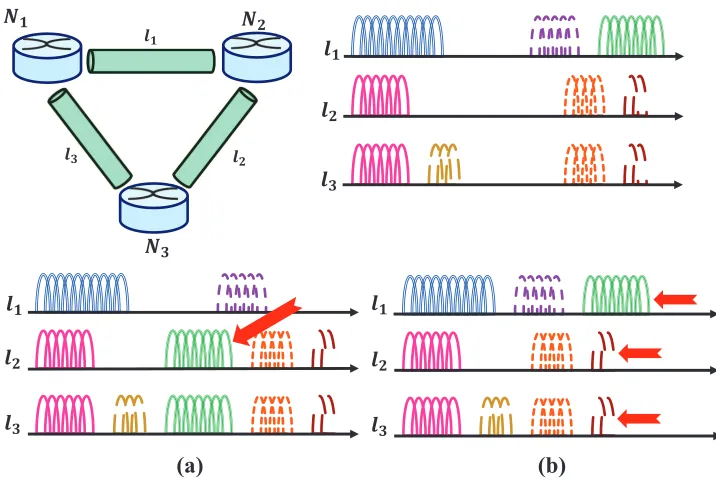
Fragmentation-aware RSA algorithms attempt to improve the blocking performance, fairness, and spectrum utilization of EONs by minimizing the extent of spectrum fragmentation. Figure 2.1 schematically tries to depict how these algorithms are working. Figure 2.1(a) shows that the number of subcarrier indices could be reduced if another path with sufficient number of slots is taken to transmit a traffic demand. On the other hand, Figure 2.1(b) displays that defragmentation can be performed by squeezing all the subcarriers with regard to SLICE features (i.e. spectrum continuity and contiguity constraints).
(a)
ࡺ ࡺ
ࡺ
(b)
Figure 2.1: Defragmentation in EONs; a) moving subcarriers; b) shifting subcarriers
a path by considering the status of a given slot on pairs of successive links in the path. The fragmentation ratios proposed in [48, 49] to measure the bandwith fragmentation of a link or path are inspired by similar ratios proposed for storage systems, and take into account not only the status of neighboring slots or that of a slot on adjacent links, but also the size of free blocks of slots. In [46], each contiguous block of unused slots is assigned a value equal to the maximum data rate that it can support, and the fragmentation index of a path is computed by taking the ratio of the sum of the value of available blocks to the value of the sum of the slots in all blocks; the latter sum represents the value of these slots as if they were contiguous. The fragmentation index concept is extended to capture spectrum fragmentation over the whole network by taking the average of the fragmentation indices of the shortest paths between every source-destination pair.
Fragmentation-aware RSA algorithms may be classified as proactive or reactive [46], as we discuss next.
2.4.1 Proactive FA-RSA
the whole spectrum using the first-fit policy. With ‘‘pseudo partition,’’ low-rate connections are allocated bandwidth from one end of the spectrum (using first-fit), while high-rate connections are allocated from the other end (again using first-fit). Under the ‘‘dedicated partition’’ scheme, spectrum is partitioned and each partition is dedicated to serving connections of a given data rate; hence, vertical fragmentation due to variable rates is eliminated and each partition reduces to a wavelength-routed network. Finally, ‘‘shared partition’’ is a generalization of the previous scheme in that spectrum is partitioned but higher data rate connections may access partitions assigned to lower data rate ones. It was shown in [46] that the dedicated and shared partition schemes improve both fairness and fragmentation compared to complete sharing or pseudo partition.
A similar concept of spectrum reservations is studied in [50]. Instead of partitioning spectrum such that each partition is shared only among connections with the same rate, [50] proposes that a block of contiguous subcarriers be reserved for each source-destination pair. In addition, subcarriers that are not reserved may be shared on demand among all connections. This study assumes that demands vary with time, but as long as a demand stays within its reservation, it can always be accommodated. However, if a connection requires additional bandwidth, an FA-RSA algorithm is executed to allocate shared subcarriers along one of a set of candidate paths.
Two FA-RSA algorithms that make spectrum allocation decisions based on the current state of fragmentation were introduced in [49]. The first algorithm assigns each new request to a path that minimizes a network-wide fragmentation ratio defined in the same study. The second algorithm attempts to utilize slots that are already used the most in the network. The maximize common large segment (MCLS) algorithm in [51] generates a number of candidate paths for a request. For each candidate path, the algorithm considers all the links in the path (i.e., candidate links), as well as links that are adjacent to the candidate links at any node on the path. The algorithm then computes a metric that captures the availability of contiguous slots between candidate and adjacent links after spectrum for this request has been allocated. Finally, it selects the path and spectrum allocation that has the smallest value for this metric, so as to maximize the probability that future requests will find a sufficient number of contiguous slots to be accepted.
We also note that all the FA-RSA algorithms above [49--51] can be classified as two-step heuristics based on our discussion in Section 2.2.1.1.
2.4.2 Reactive FA-RSA
to accommodate high-rate and long-path connections. The objective of defragmentation is to rearrange the spectrum allocation of existing traffic demands so as to consolidate available slots into large contiguous and continuous blocks that may be used to establish future requests. Defragmentation strategies may be broadly classified asperiodic or path-triggered [34]. Periodic defragmentation runs at long time scales and is initiated either at regular intervals or whenever a metric indicative of network-wide fragmentation exceeds a certain threshold. The process tackles the fragmentation of spectral resources across the whole network, and hence it is computationally expensive and may disrupt ongoing connections along large parts of the network. The scope of path-triggered defragmentation, on the other hand, is more narrow. It is invoked when the online RSA algorithm is unable to find adequate resources to satisfy a new traffic demand, with the objective of assembling continuous/contiguous blocks of spectrum sufficient for this demand. Therefore, path-triggered defragmentation is executed at shorter time scales but only disrupts connections sharing a link with the new request. With either strategy, a make-before-break rerouting (MBBR) [40] scheme may be used to minimize the disruption to existing connections as they are moved to a new spectrum block. Spectrum defragmentation has been demonstrateed experimentally in [52].
The network-wide defragmentation problem was studied in [53] under two objectives. The problem was defined as one of rearranging existing connections so as to minimize the total spectrum required for these connections (and, hence, maximize spectrum consolidation for future connections). However, this objective may be achieved with an offline RSA approach, and does not take into account the disruption to connections caused by the rearrangement. Therefore, the study also considered the secondary objective of minimizing the number of connections interrupted during the reconfiguration process. The problem was formulated as an ILP, and two heuristics were proposed to solve it.
meta-heuristic was proposed.
The spectral defragmentation algorithm in [54] consists of two phases. When a new request arrives but cannot be accommodated, a greedy heuristic is executed in the first phase to identify the spectrum block for the new request that minimizes the number of ongoing connections that will be affected. In the second phase, the problem of assigning new spectrum to the affected connections is formulated as a bipartite matching problem. If a perfect matching (i.e., one that satisfies all connections) exists, then existing connections are moved to the new spectrum and the request is assigned the spectrum block selected in the first phase; otherwise, the request is blocked or the algorithm repeats from the first phase to determine a new spectrum block for the request.
A set of reactive defragmentation strategies that capitalize on hitless optical path shift (HOPS) were described in [55]. HOPS technology, assessed in [56] where it is referred to as ‘‘push-pull defragmentation,’’ allows a connection to shift to a new block of spectrum as long as the route of the connection does not change and the move to the new spectrum does not affect other established connections. A simple technique was proposed in [55] to consolidate the spectrum freed by a terminated connection with other blocks of spectrum available along the links of its path. Specifically, upon the departure of a connection, ongoing connections that share a link with the just terminated connection are shifted, whenever possible, to the lower end of the spectrum, thus creating larger available blocks at the higher end for future connections. A more complex algorithm was proposed to create continuous and contiguous blocks of spectrum for new requests whenever they cannot be accommodated by a basic online RSA algorithm that is applied first.
2.5
Traffic Grooming with RSA (TG-RSA)
Traffic grooming [57] is an optimization problem that arises in the design and control of networks with multigranular traffic. In conventional WDM networks, the main objective is to aggregate sub-wavelength demands onto lightpaths of fixed capacity so as to improve the utilization of wavelengths and reduce the number of add/drop ports that represents a major cost for the network [58]. The aggregation of traffic takes place at specific grooming nodes that are analogous to hub airports where passengers are ‘‘groomed’’ onto fixed-capacity airplanes.
F E
D A
B
C
OXC OXC
20 G + 50 G Guard Band
30 G + 40 G
(20 + 40) G
(20 + 40) G + (50 + 30) G
(50 + 30) G
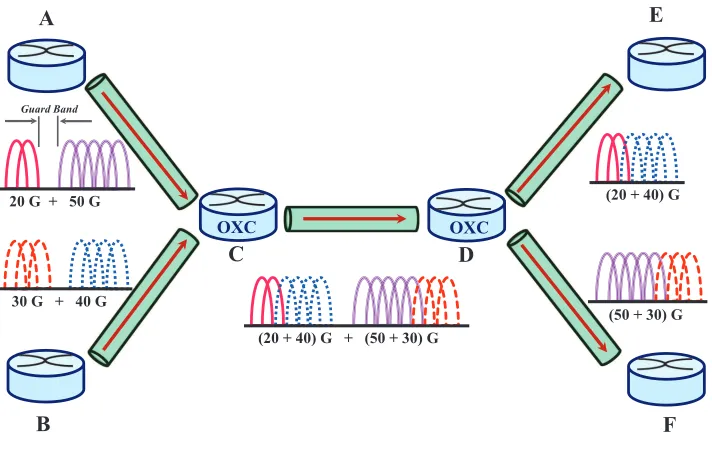
Figure 2.2: Traffic grooming in EONs
spectrum efficient than transporting a number of low-rate connections with the same total data rate (e.g., 4×100 Gbps) [60]. Second, a smaller number of independent lightpaths results in a smaller number of guard bands around these lightpaths, hence reducing the spectrum required to support a given set of demands (or, equivalently, increasing the amount of spectrum available to carry client traffic). Importantly, in EONs it is possible to perform traffic grooming at the optical layer thereby eliminating expensive O/E/O operations. Figure 2.2 illustrates how traffic grooming works in EONs where both nodes Aand B send two distinct traffic demands to node C (i.e. 20G and 50G fromA and 30Gand 40Gfrom B). The optical cross-connect (OXC) at node C figures out that incoming traffics of 20G and 40G must be transmitted to node E, whereas demands of size 50Gand 30Gmust be sent to nodeF. Hence, it combines the demands with the same destination into a one such that there is no guard band between them. Finally, an OXC installed at nodeD routes these combined traffics to their final destinations. Optical traffic grooming involves setting up an optical tunnel [59] that carries several LambdaFlex connections in a contiguous block of spectrum; the bandwidth-variable transceiver and switch requirements to implement such optical tunnels are discussed in [61].
fiber length. The formulations in [61, 62] are path-based, and, in fact, the formulation presented in [61] leverages the formulation of the basic offline RSA in [25] and adds grooming-specific constraints. Two TG-RSA heuristics are presented in [61] to solve the problem efficiently on realistic networks. The least spectrum grooming (LSG) heuristic attempts to minimize the spectral resources by grooming demands with the same source and paths that share the most links. The minimum transmitter grooming (MTG) algorithm is similar to LSG but its goal is to minimize the number of transponders.
The online TG-RSA problem has been addressed in [64], and an auxiliary graph was used to model the problem. Specifically, each physical node is represented using several layers in the auxiliary graph: the transponder layer captures the O/E/O conversion (i.e., grooming) ability and the spectrum layers represent the available spectrum resources. The spectrum continuity constraint is enforced by having edges between the same spectrum layers of adjacent nodes. The spectrum contiguity constraint is enforced by deleting edges between spectrum layers if the amount of contiguous spectrum is not sufficient to carry a demand. A path for a demand is found by running a shortest path algorithm on the auxiliary graph representing the state of the network at the time a request arrives, as well as the data rate requirement of the request. This auxiliary graph approach makes it possible to apply a range of grooming policies (e.g., minimize the number of transponders, the number of physical or logical links, etc.) by setting the weights of the edges appropriately.
The auxiliary graph model of [64] was used in [65] to find both a working and a backup lightpath in a dynamic traffic grooming scenario under shared protection. The working path is selected among the kshortest paths in the auxiliary graph, while the backup path is link-joint with the working path. This study proposes a protection scheme referred to as elastic separate-protection-at-connection (ESPAC) that allows the backup lightpaths of two connections to share spectrum if the respective working lightpaths are link-disjoint. ESPAC maximizes the opportunities for spectrum sharing by using the first-fit policy to assign spectral resources, starting with one end of the spectrum for working lightpaths and on the other end for backup lightpaths. Protection and restoration schemes for EONs are discussed in more detail in the following section.
2.6
Survivability and RSA
by a failure. In an optical network, three types of failures are generally considered: link failures (e.g., caused by cable cuts), node failures (e.g., due to equipment malfunction at a switch or router), and channel failures (e.g., caused by the failure of transmitting or receiving equipment specific to that channel).
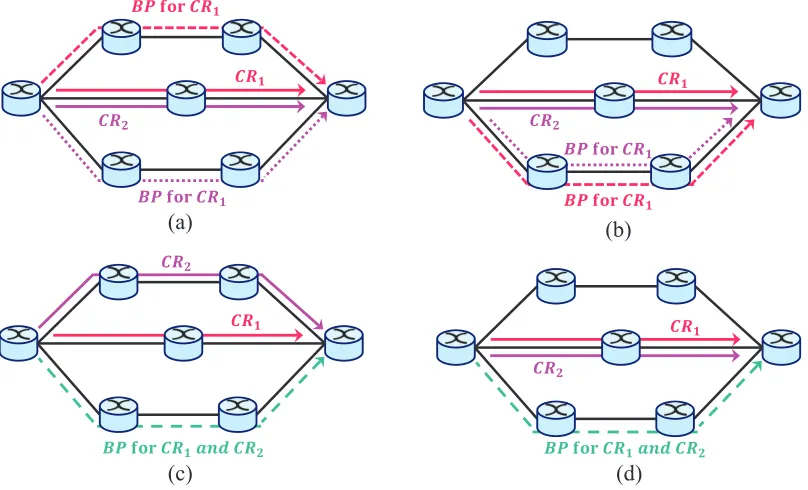
Several survivability mechanisms have been explored in WDM networks [66] and can be classified in one of two broad categories: protection or restoration. Protection schemes are carried out at the network design or planning phase inanticipation of a network failure. Backup resources reserved by these schemes may bededicated to a single connection orshared among multiple connections. During normal network operation, reserved resources remain idle. Upon occurrence of a failure, affected connections are redirected to reserved resources according to the plan determined at the planning phase (typically, at the time a connection was set up). Figure 2.3(a)-(b) illustrate the case where a dedicated path is considered as a backup path (BP) for each connection request (CR), while these BPs may use a common path. However, Figure 2.3(c)-(d) represent shared backup path for several CRs such that these CRs may use the same path as their primary path in EONs.
A restoration scheme, on the other hand, does not reserve resources for a connection at the time of establishment. Instead, resources for recovering a connection are discovered dynamically immediatelyafter the occurrence of a failure affecting the connection. With either protection or restoration, a recovery scheme may be eitherfailure-independent (also referred to as path-based)
or failure-dependent (also referred to as link-based). In failure-independent recovery, the source
and destination nodes of each affected connection take action to switch to a backup path that is disjoint with the corresponding failed working path, regardless of the location or type of failure. In contrast, with failure-dependent recovery, it is the nodes at either side of the failure (e.g., the endpoints of a failed link) that redirect all affected connections around the failure without intervention of the various source and destination nodes. As was remarked in [67], similar survivability mechanisms may be applied to EONs.
2.6.1 Protection
The problem of ensuring dedicated or shared protection of established connections in an EON may be viewed as a variant of the offline and online RSA problems with additional constraints to account for the backup paths and the sharing (if any) of backup spectrum. The following studies all consider failure-independent mechanisms. Note that the ESPAC algorithm [65] we discussed in Section 2.5 also implements a failure-independent shared-protection scheme in a traffic grooming context.
ࡼ ܗܚ ࡾ
ࡾ
ࡾ
ࡼܗܚࡾ (a)
ࡾ
ࡾ
ࡼ ܗܚ ࡾ
ࡼܗܚࡾ
(b)
ࡾ
ࡾ
ࡼ ܗܚ ࡾ ࢇࢊ ࡾ (c)
ࡾ
ࡾ
ࡼ ܗܚ ࡾ ࢇࢊ ࡾ (d)
Figure 2.3: Dedicated versus shared path survivability in EONs
paths. In both cases, the shortest (respectively, alternate) path around the ring was assigned as working (respectively, backup). With 1+1 dedicated protection, the same set of frequency slots are assigned to the working and backup paths of a connection independently of other connections. With 1:1 shared protection, on the other hand, the algorithm assigns the same set of slots to the working paths of several connections as long as they are pair-wise disjoint, and similarly for the backup paths of the same set of connections.
The offline RSA problem was considered in [69] under the additional constraint that all demands be assigned two disjoint paths, one working and one backup, and that spectral resources on backup paths be shared among connections with disjoint working paths. A MILP formulation of the problem was developed with the objective of minimizing the amount of spectrum allocated on the most congested link. Furthermore, a heuristic algorithm was proposed. The algorithm finds the k shortest cycles for each demand, and processes demands in decreasing order of shortest cycle length. It uses the first-fit policy to assign spectrum for the demand on each cycle (hence, on the working and backup paths), and selects the one that yields the lowest congestion
on any link of the cycle.
that represent the network state, and then running Suurballe’s algorithm on each graph to find the shortest pair of disjoint paths for the request. The i-th auxiliary graph includes an edge between two nodes if the corresponding fiber link has a number of contiguous slots starting at slot ithat may satisfy the demand. The algorithm selects the shortest pair of paths among the ones constructed.
The study in [71] considered the online RSA problem with shared protection, and introduced two policies for spectrum sharing among backup paths. Under the conservative policy, sharing is allowed only if the backup paths have the same bandwidth, whereas under the aggressive policy, sharing is allowed even if the backup paths have different bandwidth. Of course, with the aggressive policy, the number of resources allocated to the backup path equals the maximum bandwidth on the working paths that share this backup path. It is noted that, while the aggressive policy leads to more sharing opportunities, it may fragment the spectrum along backup paths. A heuristic algorithm was proposed that first computes the working path and then the backup path (each selected from respectivek shortest paths), and allocates spectrum using the first-fit policy.
A recent study [72] considered three types of networks (single- and multi-rate WDM networks, and EONs) and compared them in terms of cost and energy efficiency under dedicated (1+1 or 1:1) and shared protection. The respective RWA and RSA problems were solved using heuristics. The heuristics are similar to ones discussed earlier in this section in that candidate pairs of working/backup paths for each connection were computed using a k-shortest path algorithm. The main difference is that each candidate pair was evaluated using a metric that accounts for power consumption on both paths.
2.6.2 Restoration
The BSR scheme was extended in [74] to allow for three recovery scenarios: (i) full bandwidth guaranteed recovery (FBGR), (ii) partial bandwidth guaranteed recovery (PBGR), or (iii) best-effort recovery (BER). FBGR is a conventional recovery scheme, while PBGR is akin to restoring the committed rate as in [73]. The BER scheme is unique to EONs and makes it possible to allocate any amount of spectral resources available at the time of failure so that a connection may proceed even at a low rate. Since the amount of available resources must be discovered after the failure, even if the backup path has been pre-planned, BSR may be classified as a dynamic restoration scheme.
The dynamic load balancing shared-path protection (DLBSPP) algorithm presented in [67,75] is a hybrid protection/restoration algorithm. Similar to shared protection schemes we discussed in the previous subsection, DLBSPP protects from single failures by allocating a working and backup path to each connection at setup time. An interesting feature of the algorithm is that, for the purpose of path computation, link weights are set proportional to the number of available frequency slots, in an attempt to balance the load across the network links. On the other hand, DLBSPP adopts a restoration strategy to recover from the simultaneous failure of multiple links. In the event of a multi-link failure, the algorithm attempts to restore all connections for which both the working and backup paths become unavailable. To this end, affected connections are prioritized in decreasing order of their spectrum demands, and the algorithm computes, on the fly, a new path for each connection, starting with the connection with the highest priority (i.e., the highest data rate). The motivation for this approach, referred to as traffic adaptive restoration (TAR), is based on the observation that it is more difficult to find paths for high-rate connections, hence these should be accommodated before allocating resources to low-rate connections.
A pure restoration scheme for EONs was presented in [42] as part of a study to evaluate the benefits of elastic bandwidth allocation relative to fixed-grid optical networks. Initially, only a working path is provisioned for each connection; however, if a single working path that can support the requested data rate is not available, at most two working paths of lower data rates may be assigned to a connection. Upon occurrence of a link failure, new routes are dynamically computed for all connections affected by the failure. Furthermore, if there are multiple connections with the same source and destination with failed working paths, they are all aggregated into a single connection so as to minimize the amount of resources required for restoration.