A Framework for Child Development analysis
and Learning Disability Prediction using a
Hybrid Naive Bayes and Decision Tree Fusion
Technique – NB Tree
Ambili K 1, Afsar P2
P.G. Student, Department of Computer Engineering, M.E.A Engineering College, Perinthalmanna, Kerala, India1
Assistant Professor, Department of Computer Engineering, M.E.A Engineering College, Perinthalmanna, Kerala, India2
ABSTRACT: Child development analysis has long been a research interest that seeks to understand and explain the different aspects of growth, including physical, emotional, intellectual, social, perceptual and personality development. By better understanding how and why people change and grow, one can apply this knowlede to understand the needs of a child and fulfilling them and allow them to reach their full potential. Clearly, the aim of child development is broad and the scope of the field is extensive. The research study therefore focus to apply a datamining approch to predict the child's learning behavior and skills using machine learning algorithms. The information gained from this evaluation is furthur used to predict learning disbility found in children. The purpose of learning disability prediction is to determine a child's strengths and weaknesses so that parents and school authorities can provide the best learning environment for a child. The observations show that the prediction model developed using a Hybrid Naive Bayes and Decision Tree fusion technique-NB Tree is found to be the best among classification and prediction algorithms for child development analysis and learning disability prediction.
KEYWORDS:Child development analysis, Learning disability, Naive Bayes, Decision Tree, NB Tree.
I. INTRODUCTION
Child development analysis has long been a research interest that seeks to understand and explain the different aspects of growth, including physical, emotional, intellectual, social, perceptual and personality development. Inorder to study the growth, change and stability, child development takes a scientific approach. Researchers in child development test their assumptions about the nature and course of development by applying scientific methods. The study of child development is important in a number of fields including Biology, Anthropology, Sociology, Education, Psychology, Pediatrics etc.. However most important are the practical applications of studying child development. By better understanding how and why people change and grow, one can apply this knowlede to understand the needs of a child and fulfilling them and allow them to reach their full potential. Evidence tells that a person's life successes, health and emotional wellbeing have their roots in early childhood. The quality of a child's earliest environments and the availability of appropriate experiences at the right satges of development are crucial determinants of the way each child's brain architecture develops.
A major idea of machine learning research is to automatically learn to recognize complex patterns and make intelligent decisions based on data. In recent years the sizes of databases have increased rapidly. This has lead to a growing interest in the development of tools capable in the automatic extraction of knowledge from data. The term Data Mining or Knowledge Discovery in databases has been adopted for a field of research dealing with the automatic discovery of implicit information or knowledge within databases. Knowledge Discovery in Databases (KDD) is the process of identifying useful information in data . Data mining is the non-trivial extraction of implicit previously unknown and potentially useful information about data. Conventionally, the information mined is denoted as a model of the semantic structure of the datasets.
Clearly, the aim of child development is broad and the scope of the field is extensive. However, only a limited number of studies have been focussed in this field. The application of datamining in early childhood research is still at an infancy stage and is yet to be widely embraced. The prediction model for child development analysis covers quite diverse areas.
This paper is organized as follows. Section II presents some related work and recent studies on child development analysis using data mining techniques. Section III gives a brief overview of the available data and the transformations carried out to clean and put the data in the proper format for analysis. Section IV gives the description of the proposed approach which have shown best accuracy with our dataset. Section V presents the obtained results and Section VI concludes with some remarks about the described work.
II. RELATEDWORK
The application of data mining in early childhood research is still at an infancy stage. There are only very limited studies conducted on the adoption of data mining techniques in analysing early childhood datasets[1]. Clearly, the aim of child development is broad and the scope of the field is extensive.
Finally, child development focuses on the ways people change and grow during their lives. It seeks in which areas and in what periods, people show change and growth and when and how their behaviour reveals consistency and continuity with prior behaviour.Some of the data mining technique used for child development analysis used machine learning algorithms such as Rough set apprach and Decision tree algorithm, Fuzzy expert systems, Neural Networks etc..[2,3,4]. The Rough set approach seems to be of fundamental importance to artificial intelligence [5,6]. Rough set theory (RST) has been successfully applied in many real life problems such as medicine, pharmacology, engineering, banking, finance, market analysis, environment management and others. The rough set approach of data analysis has much important advantage.
During the late 1970s and early 1980s, J. Ross Quinlan, a researcher in machine learning developed a decision tree algorithms known as ID3 [7]. This work expanded on earlier work on concept learning system. This work expanded on earlier work on concept learning system. Decision tree method is widely used in data mining and decision support system. Decision tree is fast and easy to use for rule generation and classification problems. It is an excellent tool for decision representations. The accuracy of a classifier refers to the ability of a given classifier to correctly predict the class label of new or previously unseen data.
For prediction of learning disability, decision trees are probably the most frequently used tools for rule extraction from data,[7,8] whereas the rough sets based methods seems to be their newer alternative. In both cases, the algorithms are simple and easy to interpret by users. The practical aspects of application of those tools are different. The computational times of decision trees are generally short and the interpretation of rules obtained from decision trees can be facilitated by the graphical representation of the trees.
III.DATACOLLECTION
The data set used for the research focus on information regarding various milestones of child development in all perspectives. It covers quite diverse areas including physical development, cognitive development, knowledge and understanding of the world, communication, language and literacy, personal-social and emotional development, problem solving, reasoning, numeracy and creative skills. The primary methods for collecting data are interviews and questionnaires. The child development data was collected from various sources including psychologists, school councellors, MSW child welfare workers, parents, websites, and books related to Child development and pedagogy, Advanced pediatric assessment etc.
Data Analysis : - Participants in the research are parents/ caretakers/ teachers of children aged between 0-8 years. The purpose of the research and brief data collection process are explained to them.
Data Preparation:- Age and domain related questionnaire is prepared based on the different domains of child development. The questionnaire contains statements concerning the skills and behaviours of children in various domains of development. The statements in the questionnaire are followed by boxes marked “Does not apply", “Applies sometimes" or “Applies". The parents have to respond to the questionnaire by choosing a box that contains the statement that they think best corresponds to their child's functioning in everyday situations.
Data Selection and Transformation:- The useful information is selected according to rquirements and the data in pdf
format will be converted to rtf format using miscellaneous tools and tricks. Data preprocessing is done to handle missing values, noise and outliers.
Input Variables:- From the vast initial dataset, a limited number of important attribuites are selected which have the highest contribution to analyse the developmental factors. These attributes are however age dependent. They are :-
1. Gross Motor
2. Fine Motor
3. Communication
4. Problem Solving
5. Personal, Social And Emotional Development
Table 3.1:- Factors analysed for age 0 to 5 years.
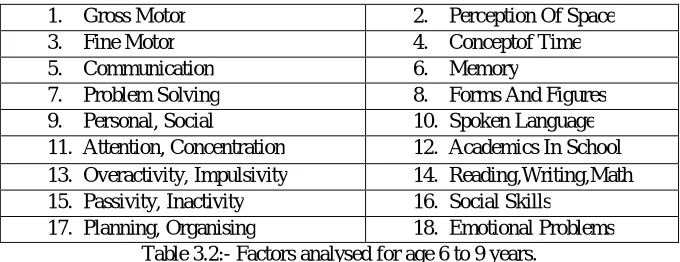
1. Gross Motor 2. Perception Of Space
3. Fine Motor 4. Conceptof Time
5. Communication 6. Memory
7. Problem Solving 8. Forms And Figures
9. Personal, Social 10. Spoken Language
11. Attention, Concentration 12. Academics In School
13. Overactivity, Impulsivity 14. Reading,Writing,Math
15. Passivity, Inactivity 16. Social Skills
17. Planning, Organising 18. Emotional Problems
Table 3.2:- Factors analysed for age 6 to 9 years.
SL NO ATTRIBUTES SYMPTOMS OF LD
1 DR Difficulty with Reading
2 DS Difficulty with Spelling
3 DH Difficulty with Handwriting
4 DWE Difficulty with Written Expression
5 DBA Difficulty with Basic Arithmetic
6 DHA Difficulty with Higher Arithmetic
7 DA Difficulty with Attention
8 ED Easily Distracted
9 DM Difficulty with Memory
10 LM Lack of Motivation
11 DSS Difficulty with Study Skills
12 DNS Does Not like School
13 DLL Difficulty in Learning a Language
14 DLS Difficulty in Learning a Subject
15 STL Slow To Learn
16 RG Repeated a Grade
Table 3.3:- Factors analysed in diagnosis of LD
This data was used as the training set for various algorithms. The testing data was collected through the questionnaire of 30 school children.
IV.PROPOSED METHOD – NB TREE MODEL
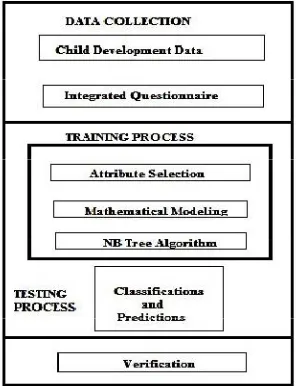
The framework for predicting child development analysis uses a Hybrid Naive Bayes and Decision Tree technique. Both these algorithms are good classification and prediction techniques individually. By combining both these techniques, more accurate prediction techniques can be obtained. The architecture of the prediction model is shown in figure 1.
Figure 4.1: The prediction framework architecture
Child Development factors identifcation and Modelling
Classifications and Predictions
Ld prediction
Verification
Classifications And Predictions:- The NB-Tree technique is a hybrid of two classifiers :- the ID3 Decision Tree and
Naive Bayes. ID3 is interesting in its representation of knowledge, its approach to the management of complexity, its heuristic for selecting candidate concepts, and its potential for handling noisy data. It represents the concept of decision tree, that allow for classification for an object by testing its value for certain properties. The Naive Bayes classifier is based on the Bayesian theorem and is particularly suited for high dimension inputs. It is simpler than most methods but it still outperforms other sophisticated classification techniques.
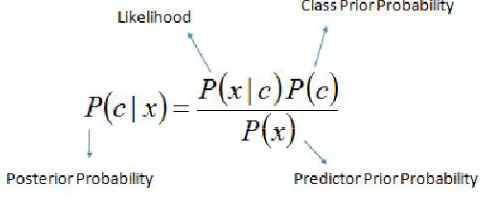
Naive Bayes Formula:- The naive Bayes classier greatly simplify learning by assuming that features are
independent of given class. Naive Bayes model records how often a target field value appears together with a value of an input field. It considers each of the symptoms to contribute independently to the probability that the child has proper development or not. It estimates the probability of observing a certain value in a given class
Figure 4.2:- Naive Bayes Formula
Algorithm Decision Tree:-The Decision Tree is a ow chart like structure, where each internal node denotes a test on an attribute, each branch of the tree represents an outcome of the test and each leaf node holds a class label. The topmost node in a tree is the root node. Decision trees are powerful and popular tool for classification and prediction. It is a classifier in the form of a tree structure where each node is either a leaf node that indicates the value of the target attribute of examples or a decision node that specifies some test to be carried out on a single attribute with one branch and sub tree for each possible outcome of the test. Classifiers do not require any domain knowledge or parameter setting and therefore is appropriate for exploratory knowledge discovery. Decision tree can handle high dimensional data. The learning and classification step of decision tree are simple and fast. A decision tree can be used to classify an example by starting at the root of the tree and moving through it until a leaf node, which provides the classification of the instance.
The algorithm for ID3 Decision tree is shown below:
Figure 4.3:- Algorithm ID3 Decision Tree
The condition attribute, that induces most amount of entropy reduction and information gain are placed closer to the root node.
V. EXPERIMENTAL RESULTS
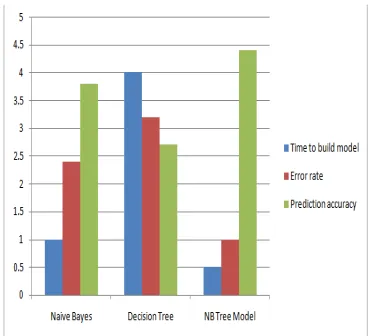
The experiment makes a comparative study on the performances of machine learning algorithms for child development analysis. They are evaluated on the basis of three criteria :-
From the results, it was able to understand that our proposed approach NB Tree algorithm provides more number of correctly classified instances than the other two algorithms. Regarding the Learning time of algorithms, it was able to understand that Decision Tree model consumes more time to build the model. Out of these three algorithms, our proposed method has high prediction accuracy than other two algorithms.
VI.CONCLUSION
In this research study, a comparitive study was conducted on various datamining classifcation and prediction algorithms for child development analysis. The framework for predicting child development analysis uses a Hybrid Naive Bayes and Decision Tree technique. Both these algorithms are good classification and prediction techniques individually. By combining both these techniques, more accurate prediction techniques can be obtained. From the study it was able to conclude that the proposed framework out performs other machine learning algorithms in terms of prediction accuracy, time consumption and error rate.
REFERENCES
[1] M. Gera and S. Goel, “A model for predicting the eligibility for placement of students using data mining technique," International Conference on Computing, Communication and Automation, vol. 4, pp. 18-23, January 2015.
[2] Sellappan Palaniappan and Rafiah Awang, “Intelligent Heart Disease Prediction System Using Data Mining Techniques,” IJCSNS International Journal of Computer Science and Network Security, Vol.8, No. 8, August 2008.
[3] E. A.Q. Ansari, Neeraj Kumar Gupta, “Automatic diagnosis of asthma using neurofuzzy system,” Fourth International Conference on Computational Intelligence and Communication Networks, Vol.7, April 2012.
[4] Muhamad Hariz and Wahidah Husain “A Framework for Childhood Obesity Classifications and Predictions using NBtree,” International Conference on IT in Asia, No.8, November 2011.
[5] Cios, K.J., Pedrycz W., Swiniarski, R.W. and Kurgan, L.A., “Data Mining: A Knowledge Discovery Approach”, Springer, New York. [6] Grzymala-Busse JW, “ Knowledge Acquisition under Uncertainty-A Rough Set Approach,” Journal of Intelligent & Robotic Systems, Vol 1,
3-16, 1988.
[7] Quinlan J.R., “Induction on decision trees, Machine learning,” Vol 1,8 1-106,1986.
[8] Stuart R., Peter N., “Artificial Intelligence – A Modern approach,” Pearson Prentice Hall, 2009.
[9] Julie M. David, Kannan Balakrishnan, “Prediction of Frequent Signs of Learning Disabilities in School Age Children using Association Rules,” In Proceedings of the International Conference on Advanced Computing, Vol 13, April 2009.
[10] Chen R.S, Wu R.C., Chang C.C, “Using data mining technology to design an intelligent CIM system for IC manufacturing,” in proceedings of sixth international conference on software engineering, artificial intelligence, network, parallel distribution, computation self assembly wireless network, 70-75, 2005.
[11] Kusiak A, Kurasek C, “Data mining of printed circuit board defects”, IEEE Transactions on Robotic Automations, Vol 17, No.2, 74-384, March 2006.