DOI: 10.1534/genetics.110.121590
Changes in Selective Effects Over Time Facilitate Turnover of
Enhancer Sequences
Kevin Bullaughey
1Department of Ecology and Evolution, University of Chicago, Chicago, Illinois 60637 Manuscript received August 2, 2010
Accepted for publication November 10, 2010
ABSTRACT
Correct gene expression is often critical and consequently stabilizing selection on expression is wide-spread. Yet few genes possess highly conserved regulatory DNA, and for the few enhancers that have been carefully characterized, substantial functional reorganization has often occurred. Given that natural selection removes mutations of even very small deleterious effect, how can transcription factor binding evolve so readily when it underlies a conserved phenotype? As a first step toward addressing this question, I combine a computational model for regulatory function that incorporates many aspects of our present biological knowledge with a model for the fitness effects of misexpression. I then use this model to study the evolution of enhancers. Several robust behaviors emerge: First, the selective effects of mutations at a site change dramatically over time due to substitutions elsewhere in the enhancer, and even the overall degree of constraint across the enhancer can change considerably. Second, many of the substitutions responsible for changes in binding occur at sites where previously the mutation would have been strongly deleterious, suggesting that fluctuations in selective effects at a site are important for functional turnover. Third, most substitutions contributing to the repatterning of binding and constraint are effectively neutral, highlighting the importance of genetic drift—even for enhancers underlying conserved phenotypes. These findings have important implications for phylogenetic inference of function and for interpretations of selection coefficients estimated for regulatory DNA.
C
ORRECT spatial and temporal gene expression isnecessary for many developmental (Carrollet al. 2005; Davidson 2006; Prud’homme et al. 2007), cel-lular (Breeden 2003), and physiological (Gaschet al. 2000) processes. Pervasive conservation of gene ex-pression across many evolutionary timescales (Rifkin et al. 2003; Denver et al. 2005; Gilad et al. 2006a,b; Hare et al.2008; Viselet al.2008) suggests that most genes are subject to stabilizing selection for an optimal expression pattern most of the time. Indeed, there are a number of vertebrate developmental enhancers that show near complete expression conservation and se-quence conservation over the last 75 million years of evolution (Nobregaet al.2003; Viselet al.2008). On this basis, one may be tempted to equate functional conservation with evolutionary conservation of the sequence encoding that function.
A number of observations make clear that this equa-tion is not strictly true, however, and raise important questions. InDrosophila melanogaster, for example, more intergenic sequence appears to be constrained than can
be explained by known functions (Halliganet al.2004; Andolfatto 2005; Halligan and Keightley 2006) and although less compact genomes show a correspond-ingly smaller fraction of the genome under constraint (Petersonet al.2009), the amount of constrained DNA is still inexplicably high. As an illustration, the signal of conservation often extends beyond the regions bound by transcription factors inin vivoassays (Liet al.2008). These observations either signal an important func-tional role for these conserved but apparently unbound regions [perhaps an important role for weak binding (Tanay 2006)] or suggest that the conservation is a vestige of a historical functional role (Dermitzakiset al. 2003), but is a poor predictor for present-day function (Li et al. 2008). These alternatives have practical implications. Indeed, a widely used method to identify functional regulatory elements, phylogenetic footprint-ing, looks for conserved sequences among many related species (Tagle et al. 1988; Cliften et al. 2003). This approach relies on the assumption that functional elements will be conserved and nonfunctional elements will not. When applied to noncoding DNA, this ap-proach has fallen short of the success achieved in the identification of protein-coding genes (Cliften et al. 2003; Kellis et al. 2003). While it does well in the aggregate, identifying collections of genes enriched for motifs, it remains unclear how well any individual motif instance can be trusted (Tompaet al.2005). The limited Supporting information is available online athttp://www.genetics.org/
cgi/content/full/genetics.110.121590/DC1.
Available freely online through the author-supported open access option.
1Address for correspondence: Department of Ecology and Evolution, University of Chicago, 920 E. 58th St., CLSC 413, Chicago, IL 60637. E-mail: [email protected]
success of phylogenetic footprinting further suggests that conservation of regulatory sequence is not synon-ymous with conservation of regulatory function.
This uncoupling of function and conservation has also become clear from detailed characterizations of en-hancers for the even-skipped (eve) gene in Drosophila, in which functional transcription factor (TF) binding sites have been gained or lost while maintaining en-hancer output (Ludwiget al.1998, 2000, 2005). More recently, turnover has been observed in other Drosophila developmental enhancers (Ho et al. 2009), with sub-stantial reorganization possible over long evolutionary time frames (Hareet al.2008). Turnover is also extensive when viewed at a genome-wide scale (e.g., Moseset al. 2006), consistent with genes tending to have a flexible regulatory architecture that is permissive of small-scale rewiring while largely maintaining functional output. Thus, qualitatively we know that both the functional organization (i.e., which nucleotides bind transcription factors) and the patterns of constraint (i.e., which nucleotides are under purifying selection) evolve. Yet, natural selection is effective in eliminating even delete-rious mutations of very small effect [a few times the reciprocal of the effective population size (Crowand Kimura 1970)], raising the question of how the func-tional organization of an enhancer evolves when the expression phenotype is under stabilizing selection.
Here, I use a computational modeling approach that relies on simple, biologically motivated assumptions about how gene expression is implemented to examine the relationship between functional organization and patterns of selective constraint. My model consists of two components: (i) a mapping from sequence to gene ex-pression using a computational model that was shown to have good predictive value for modeling expression in the Drosophila segmentation pathway (Segal et al. 2008) and (ii) a mapping from gene expression to fit-ness that provides a description of stabilizing selection around an optimum. The first component captures important mechanistic aspects of transcriptional regu-lation and the second component allows one to model evolution under a regime of stabilizing selection on gene expression,i.e., to assume that the phenotype is conserved. I then investigate the evolution of regulatory DNA by running forward population simulations. In this model, the fitness effect of each mutation is cal-culable and follows directly from the mechanistic model of transcription and the model for stabilizing selection. This study differs from earlier efforts to model sub-stitution processes on complex fitness landscapes in a number of respects (Kauffmanand Levin1987; Orr 2005, 2006; Kryazhimskiy et al. 2009; Draghi et al. 2010). First, these earlier models are general and do not consider constraints on the nature of the fitness land-scape that result from modeling the biological function of the sequence. The preference for such abstracted models stems in part from how little is known about
fitness landscapes (Kryazhimskiy et al. 2009) and in part from their simplicity, which makes them analytically approachable. In contrast, the structure of the fitness landscape in my model reflects a specific biological function, namely transcription. Second, these earlier efforts were concerned with the adaptive phase of the substitution process, focusing primarily on the dynamics of adaptive walks, such as walk length, adaptive step size, and time intervals between adaptive events (Kauffman and Levin1987; Orr 2005, 2006; Kryazhimskiyet al. 2009), or more recently on questions of robustness (Draghi et al.2010). In contrast, I model evolution under stabilizing (purifying) selection.
The most well-studied and biologically realistic sequence–phenotype mapping is that of RNA secondary structure. Computational predictions of secondary structure are a good approximation to the biological function of RNA, such that the evolution of these struc-tures can be investigated using simulations. A number of important results have come out of this body of work. First and foremost is the existence and properties of neutral networks—connected sets of mutationally ac-cessible sequences all yielding the same structure (Schuster et al. 1994). A population of sequences encoding a structure with a large neutral network is free to explore the network by drift. Thus structures with large neutral networks are more robust to mutation and may also be more evolvable (Huynenet al.1996; Ancel and Fontana2000; Wagner2008). The focus of these studies has been primarily on the role that neutral networks play in facilitating adaptation, rather than on the process of turnover during the exploration of the neutral network. Another difference between these RNA landscapes and the landscapes that I consider is that the former are discrete—mutations either result in a different structure or not—and thus questions con-cerning the role of weakly deleterious mutations are not easily addressed. In contrast, in the case of regulatory sequence landscapes, fitness is mediated through ex-pression, which is quantitative, and under the model I consider, very few, if any, sequences result in identical fitnesses.
view turnover as a two-step process, in which a new binding site arises, obviating an existing one. Such two-step models are forced to assume functional equivalency of alleles with redundant binding sites (Luskand Eisen 2010) or to assume an arbitrary selection coefficient for the intermediate form (Durrettand Schmidt2008). Binding-site–oriented models may portray the turnover process unrealistically because, in a population setting, even a fewfold variation in a selection coefficient can be the difference between having an appreciable or van-ishingly small fixation probability. Mutations with small selection coefficients may not correspond to binding site creation or disruption, but could still determine which evolutionary paths are possible.
A recent analysis of promoter substitution rates incor-porates continuous estimates of transcription factor binding, rather than discrete binding sites (Hoffman and Birney2010). The authors’ hidden Markov model-based estimates of TF binding are similar in spirit to part of the model that I employ; however, in assessing the effect of mutations, the authors focus strictly on the TF binding profile. In contrast, I model the expres-sion resulting from TF binding and assume selection acts on the expression phenotype, rather than directly on binding.
By putting together a model for regulatory function and a model for stabilizing selection on gene expres-sion, I can address the question of how functional turnover occurs despite strong stabilizing selection on expression output. I show that selective constraint on individual sites varies extensively over time and that this variation explains much of the functional turnover. Additionally, I show that both functional organization and selective constraint evolve with a high degree of historical contingency, whereby multiple realizations of the evolutionary process show markedly different de-grees of turnover. Admittedly, the modeling assump-tions are obvious simplificaassump-tions, as is always the case with computational models of biology. But, importantly, assumptions similar to these are often made—implicitly or explicitly—when thinking about regulatory evolution (Kelliset al.2003; Wrayet al.2003).
METHODS
Model overview: Modeling the evolution of regula-tory DNA using forward population simulations re-quires computing the fitness for each haplotype that arises in the population. I break this computation down into two components: (i) a sequence-to-expression map-ping and (ii) an expression-to-fitness mapmap-ping. I model a number of distinct regulatory problems, each of which can be thought of as the task faced by a particular gene or enhancer: to be expressed correctly in a small number of regulatory contexts, termed trans-backgrounds. In turn, eachtrans-background can be thought of as a cell
type, a developmental time point, or a spatial position. Trans-backgrounds are characterized by the expression levels of the various input TFs in that background. Together, the set oftrans-backgrounds and the optimal expression in those backgrounds, along with the nu-cleotide binding affinities and interaction properties of the TFs, define the complete regulatory problem (see Figure 1 for a simple schematic). Fitness is then a function of how close the expression pattern of an enhancer is to the optimal expression for that regula-tory problem.
I compute the expected expression of an enhancer using a model proposed by Segalet al. (2008), the crux of which is a probabilistic computation that sums the contributions of all possible arrangements of TFs on the regulatory sequence. This model is designed to capture a number of important aspects of transcriptional reg-ulation: (i) the locations of TF binding are determined primarily by TF–DNA affinities, (ii) higher TF concen-trations result in more binding, (iii) multiple TFs can-not simultaneously bind the same stretch of DNA, and (iv) protein–protein interactions may influence binding (e.g., through cooperativity or quenching). This model is well suited for studying substitution processes in regulatory DNA because it performs a computation on the entire enhancer, potentially allowing mutations at any nucleotide to affect expression (Segalet al.2008; Fakhouriet al.2010).
The remainder of the methods section provides a
detailed description of the Segal model, of how the regulatory problems were selected, and of the forward population simulations. Additional details are provided relating to mutational opportunities and the classifica-tion of funcclassifica-tional mutaclassifica-tions.
Details of the Segal model:The Segal model (Segal et al. 2008) predicts expression from an enhancer sequence, given prior information about the binding specificities of TFs and the expression levels of the input TFs. In addition, there are number of free parameters, which were estimated in the original article for 44 enhancers involved in the Drosophila segmentation pathway using a training set of observed expression levels. Here I fix these parameters, which include the activity levels of the TFs and their interactions, assuming these are intrinsic aspects of the fully specified regula-tory problem. Given the parameters appropriate for an enhancer, the model computes the expression of that enhancer and does not incorporate the temporal dynamics of expression, autoregulation, or other sorts of feedback.
of the constituent TFs to their respective locations on the DNA, the expression levels of the TFs, and their inter-action properties. Given that a particular configuration occurs, transcription of an mRNA occurs with probabil-ityP(Ejck), which is a function only of the number and kinds of TFs in the configuration. The expression out-put of the enhancer is then assumed to be proportional to the overall probability of expression, P(E), in that trans-background, which is the sum of the contributions toward expression of all possible configurations, weighted by their probabilities:
PðEÞ ¼X ck
PðEjckÞPðckÞ:
P(E) can be interpreted as the expression level as a fraction of maximal expression (in a sense averaging over potential transcription events). The probability of configurationck,P(ck), is the joint probability of its TFs binding to the DNA, which can be factored into con-ditional probabilities as follows:
PðckÞ ¼PðTFm;TFm1;. . .;TF1Þ
¼PðTFmjTFm1;. . .;TF1Þ. . .PðTF2jTF1ÞPðTF1Þ:
By making the standard Markov assumption, whereby the probability of observing a TF bound at a certain location is contingent only on the adjacent TFs, one obtains the following factorization, where the TFs are numbered according to their appearance on the se-quence (in either direction):
PðTFm;. . .;TF1Þ
¼PðTFmjTFm1Þ. . .PðTF3jTF2ÞPðTF2jTF1ÞPðTF1Þ:
Let tTF
i be the expression level of the ith bound
TF and let PWMTFiðsx;sx11;. . .;sx1r1Þ=PWMbðsx;
sx11;. . .; sx1r1Þbe the affinity of the ith TF to the
DNA sequence at sites sx through sx1r1 relative to
background [ris the width of the PWM and PWMb() assumes equal affinity to each base]. Then, the conditional probability of a TF binding given that another TF is bounddnucleotides away is
PðTFijTFi1Þ}tTFi
PWMTFiðsx;sx11;. . .;sx1r1Þ
PWMbðsx;sx11;. . .;sx1r1Þ
gðTFi;TFi1;dÞ;
whereg(tfi,tfi1,d) accounts for the strength of the interaction betweentfiandtfi1. The product over all TFs, termed the weight (or energy) of the configura-tion,w(ck), is proportional to the probability of interest
PðckÞ}wðckÞ
¼Y
M
i¼1 tTFi
PWMTFiðsx;sx11;. . .;sx1r1Þ
PWMbðsx;sx11;. . .;sx1r1Þ YM
i¼2
gðTFi;TFi1;dÞ;
where the constant of proportionality is simply the reciprocal of the sum of all weights:
PðckÞ ¼P 1 k9wðck9Þ
wðckÞ:
In addition to homotypic interactions, present in the original Segal model, I also allow heterotypic interac-tions (i.e., between two distinct TFs) and I allow for both synergistic (e.g., cooperative binding) and antagonistic TF interactions (e.g., quenching). Let 1 1 gjk be the strength of the interaction when theith TF,j, is bound adjacently to the (i– 1)th TF,k, wheregjkis positive for synergistic and negative for antagonistic interactions and gjk 2 (1, ‘). The effect of the interaction then decays as a function of the number of intervening nucleotides,d:
gðTFi¼j;TFi1¼k;dÞ ¼11gjked
2=y
:
Here,ycontrols the rate of decay of the curve, which I set to 80, as this means that 11gjked
2=y
approaches 1 by d 20 bp for modest gjk[e.g., –0.9, gjk, 9, a range covering up to a 10-fold decrease or increase in P(ck) due to the interaction]. I chose y ¼ 80 so that the interaction does not extend across the entire toy enhancer.
In addition toP(ck), the computation of expression also requires the conditional probability of expression given the configuration,P(Ejck). To capture saturation effects, whereby a little more or less binding does not alterP(Ejck) when there is already either very little or extensive binding, the authors chose a logistic function of the sum of the contributions toward transcription of all the TFs in that configuration. The ith TF in the sequence, TFi¼k, has a parameterlk, which is positive for activators and negative for repressors. The logistic equation is
PðEjckÞ ¼
1 11expðPM
i¼0lTFiÞ ;
wherel0is the basal activity of the enhancer.
For a more detailed description, see the original article (Segal et al. 2008). I made a few additional decisions in my implementation that I presume were similarly made by the original authors. These include symmetrically modeling both forward- and reverse-strand binding and modeling one empty configuration, with probability 1=PwðckÞ.
Computation of expression: I computed P(E) by
For my application, very small errors in the estimation of expression could heavily influence the evolutionary dynamics, producing fluctuations in the selection co-efficients of mutations at a site simply as a result of noise in the estimate of expression. I avoid this problem by ensuring that errors in the estimation ofP(E) are more than an order of magnitude smaller than the reciprocal of the effective population size, 1/N, which is the magnitude at which the fate of mutations starts being influenced by natural selection (for most simulations I
use N ¼ 1000). I determined that sampling 200,000
configurations from P(ck) is sufficient to achieve the desired precision. For the simulations involving N ¼ 10,000, I sample 106configurations. The C11 source code of my implementation is available upon request.
Generation of regulatory problems: I initially ex-plored the parameter space of regulatory problems by generating hundreds of regulatory problems and vary-ing regulatory problem parameters, includvary-ing the number of TFs, TF binding affinities, target expression levels, input TF expression levels, TF–TF interaction parameters, and activity levels of the TFs. I then sampled 10,000 sequences uniformly under each of these regu-latory problems, examining the fitness distribution for each problem. These distributions are primarily de-termined by the problem being solved, e.g., the input expression of the TFs and the target expression. For example, the following problem is impossible (i.e., no sequence produces the desired expression): two trans-backgrounds, one with only activator TFs expressed and for which the optimal expression level is silent,
combined with another trans-background with only
repressor TFs expressed and optimal expression at the maximum. In contrast, onetrans-background consisting solely of high activator expression with a goal of max-imal expression combined with anothertrans-background of only high repressor expression with a goal of no ex-pression can be satisfied by a large fraction of random sequences. I chose to investigate a collection of nine reg-ulatory problems with the property that only a small, but nonzero fraction of randomly sampled sequences have a high fitness (e.g.,w$0.99) and such that these problems collectively offer a broad variety of input and target expression levels (supporting information,Figure S1).
To present comparable regulatory problems, I keep many of the parameters identical, including using two TFs (one activator,l1¼2, and one repressor,l2¼ 3, in
a slightly repressive environment,l0¼ 1) and
employ-ing the same TF–TF interaction matrix (g12¼g21¼ 0.5
and g11 ¼ g22 ¼2) and the same pair of TF binding
functions (Figure 1B). To assess whether the behaviors of the model are robust with respect to the choice of these parameters, I conducted additional simulations, systematically varying these parameters (seeFile S1for details).
Definition of the expression–fitness function: I penalize misexpression as a function of the Euclidean distance
between the expression computed for a haplotype and the expression at the global fitness optimum for the regulatory problem. I use a Gaussian kernel as the fitness penalty for misexpression,
w ¼exp ðeoÞ
TðeoÞ
s2
;
where w is absolute fitness,e is the expression output vector (vector components are expression in eachtrans -background),ois the optimum expression vector, and s2(equal to 0.6 in most simulations) is a scalar for the steepness of the misexpression penalty. In some ways, this specification is similar to parameterizations of Fisher’s geometrical model (Fisher 1930), which can also be used to model purifying selection (Martinand Lenormand 2006); however, my mutational model is not at the level of the phenotype, and instead it de-scribes the mutation process on the sequence with an explicit sequence-to-fitness mapping.
Forward population simulations: I use standard
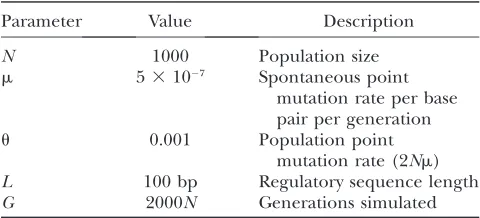
Wright–Fisher multinomial sampling. The effective population size, N, is constant, and the population is haploid (equivalent to genic selection in a diploid population). Although I choseu¼2Nm¼0.001 to ap-proximate humans, to speed up drift I used a popula-tion size ofN¼1000 and a correspondingly high point mutation rate (as expected, results are comparable for simulations withN¼10,000 and 10,000Ngenerations,
but keeping u ¼ 0.001; not shown). Mutations occur
uniformly on the sequence with equal mutation rates among all base pairs and all simulations are without recombination. All replicates for a particular regulatory problem are initiated with the same initial haplotype at frequency 1, which has initial fitness 1 and is therefore at the global fitness optimum. Parameters for the popula-tion simulapopula-tions are shown in Table 1. For most analyses, 12 replicate simulations of each regulatory problem were run, an arbitrary number, but sufficient to consider variation among replicates. For select analyses requiring a larger number of observed mutations, 100 replicate simulations were run.
Computation of selection coefficients of mutation opportunities: Mutation opportunities are those hap-lotypes that are accessible with a single mutation from an observed haplotype. To compute selection coeffi-cients for these mutation opportunities, which I use in the analyses, I use the standard definition,s¼w9=w1, wherewis the absolute fitness of the background upon which the mutation could occur andw9is the absolute fitness of the haplotype generated by the mutation.
Classification of substitutions into large and small functional effect: In classifying substitutions by func-tional effect size, I use the Euclidean distance (Ed)
length L, then I compute the Euclidean distance be-tween the two vectors each of length 23 3 3 L. For Figure 6, large-effect substitutions are defined as those withEd.2 and small-effect substitutions are those with Ed,0.1.
RESULTS
Simulations of enhancer evolution: I investigate the substitution processes during regulatory evolution and the dynamics of turnover by running forward popula-tion simulapopula-tions in which the fitness of each enhancer sequence is computed using a computational model for expression, combined with a model for stabilizing se-lection on that expression phenotype (see Figure 1 for a simple schematic). In themethodssectionModel over-viewprovides an overview of the model, defines termi-nology, and is followed by sections offering additional detail.
In brief, I combine the Segal model, which provides a sequence-to-expression mapping, with a model of sta-bilizing selection, which provides an expression-to-fitness mapping. The bulk of the regulatory problems that I investigate involve two TFs (an activator and a repressor) and three trans-backgrounds (see Figure 1 for an example and Figure S1for the full set). These regulatory problems differ in their optimal expression and the expression levels of the input TFs. All regulatory problems that I investigate are nontrivial; i.e., few random sequences encode an expression profile very near the optimum.
I simulate the evolution of a constant-size population by sampling alleles according to their fitnesses. This provides a model of drift and selection, which is essential for modeling the substitution processes of enhancers because many mutations are likely affected by both. I selected the simulation parameters to op-timize the trade-off between simulation efficiency and realism (shown in Table 1). The bulk of the results involve nine regulatory problems. For each regulatory problem I ran 12 replicate simulations starting from the same initial sequence. The simulation duration of 2 million generations (2000N) corresponds to a relatively long evolutionary time: between 0.25 and 0.46 substitu-tions per site, which is about the divergence observed between human and mouse in the vicinity of transcrip-tion start sites (Taylor et al. 2006). The population mutation rate, u, corresponds to a plausible value for
Figure1.—Schematic description of
the model. (A) The expression of an enhancer sequence in each of the given trans-backgrounds is determined ac-cording to the Segal model. The fitness is then computed using a model of sta-bilizing selection, in which fitness is a function of the Euclidean distance be-tween the realized and the optimal ex-pression. (B) The binding specificities of the activator (top) and the repressor (bottom) are shown as position-weight matrices (PWMs), with the site-wise af-finity of the TF to each nucleotide shown scaled by information content (in bits). These two PWMs are used for the nine primary regulatory prob-lems. (C) Each regulatory problem is characterized by the expression levels of the two TFs (horizontal and vertical axes) in each of the three trans-backgrounds (points of the triangle) with the tar-get expression (red diamond) shown on the adjacent 0–1 scale. The regula-tory problem for enhancer 1 is shown.
SeeFigure S1for the other regulatory
problems.
TABLE 1
Parameters for forward population simulations
Parameter Value Description
N 1000 Population size
m 53107 Spontaneous point
mutation rate per base pair per generation u 0.001 Population point
humans. Although regulatory modules are often on the order of 1 kb, numerous developmental regulatory modules in mouse and Drosophila are as small as 100 bp (Kirchhameret al.1996). I chose to model 100-bp en-hancers as these are large enough to allow an investiga-tion of the dynamics of turnover and are easily visualized and efficiently simulated (simulations of 500-bp en-hancers yield similar results; not shown). I chose not to model recombination given the short enhancers, and consequently the entire sequence shares the same, sin-gle evolutionary history. I sample the most common haplotype at the end of the simulation and consider the succession of haplotypes leading from the initial haplo-type to this final one. Although much of what I report involves simulations without insertions or deletions (indels), I also investigated regulatory evolution with indels, as these may be important mechanisms by which regulatory regions evolve (Rockman and Wray2002; Luskand Eisen2010). All of the behaviors that I report here are also seen when including indels (seeFile S1 and Figure S23, Figure S24, Figure S25, Figure S26, Figure S27, Figure S28, Figure S29, Figure S30, and Figure S31).
I ensure that the population starts at the global fitness optimum by setting the optimum to the expression produced by the initial haplotype. In my simulations, populations invariably stay very close to this global optimum, and thus adaptation is not seen other than mutations compensating for weakly deleterious substi-tutions (the lowest absolute fitness among all runs was 0.990 with a mean of 0.999 across runs; given the optimum is at 1, the maximum selection coefficient was thusNs¼110). By choosing to model a population near the global fitness optimum, I consider the effects of stabilizing selection alone, without confounding these with those of adaptive processes.
Selective constraint on individual sites varies greatly over time: To consider how selective constraint within an enhancer varies over time, I compute selection co-efficients of each mutation that can occur at each site in the observed enhancer sequences. More specifically, for each haplotype ancestral to the most common one at the end of a simulation, I compute the selection coefficient for each of the 3Lmutation opportunities (i.e., opportunities to mutate to one of the alternative 3 bases in a sequence of length L). Nearly all of these potential point mutations occur during the simula-tions—many occurring multiple times—although only a tiny fraction reach any appreciable frequency in the population. Computing these 3Lselection coefficients provides a snapshot of the constraint facing a haplo-type at a given time and is informative about feasible substitutions. I then consider two summaries: the maximum selection coefficient at each site among the three alternative nucleotides (smax) and the
aver-age (s, also at each site). The former is suitable for considering whether any of the substitutions are feasible whereas the latter better summarizes the over-all constraint on the site.
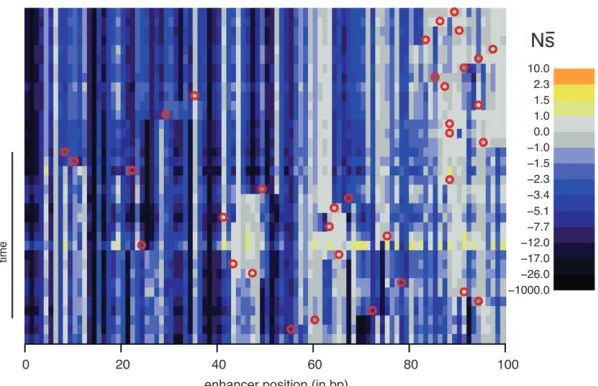
Perhaps the most striking finding is the large extent to which the selection coefficients associated with mutation opportunities fluctuate over time (Figure 2; Figure S13, Figure S14, Figure S15, Figure S16, Figure S17,Figure S18,Figure S19,Figure S20,Figure S21, andFigure S22show the corresponding plots for other enhancers/replicates). Large vertical stretches of dark colors in Figure 2 show regions of enhancer sequence in which deleterious mutations are possible, such thatsis low. Patches of light gray are sites where, on average, point mutations are neutral. One can see from this plot that, although there are regions in which mutations are consistently (on average)
delete-Figure2.—Evolution of constraint. Rows
cor-respond to the haplotypes formed by each succes-sive substitution during the 2000N generation evolutionary history. The initial haplotype is at the top and the final one, which is the most fre-quent haplotype at the end of the simulation, is at the bottom. For each haplotype, the positions (along the horizontal axis) are colored according toN s: the mean population selection coefficient of point mutations at that site (were they to oc-cur), averaged over the three possible alternative bases.N sis on a nonlinear scale that moves away from zero in both directions logarithmically, which expands the range sensitive to genetic drift. The locations of substitutions (red circles) are in-dicated on the background haplotype on which they occurred (with the resulting haplotype in the next row). This simulation is without indels. Enhancer 7, replicate 3 is shown; plots for other enhancers and replicates can be found in
Fig-ure S13,Figure S14,Figure S15,Figure S16,
Fig-ure S17, Figure S18, Figure S19, Figure S20,
rious, s differs between successive haplotypes at a substantial number of sites.
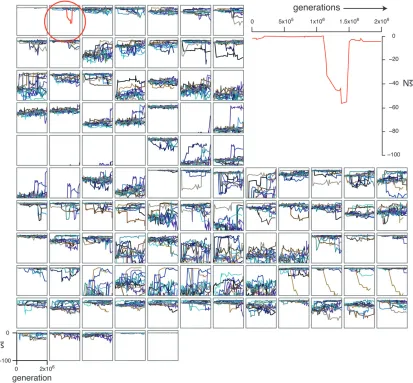
Figure 3 highlights one example site (position 2 of en-hancer 6, replicate 7) that switches from having a rather modest deleterioussto a highly deleterious one. In this particular case, a substitution at position 3 causes this dramatic change at position 2; it is followed by a second substitution at position 5 nearly 500Ngenerations later, which largely restoressat position 2. Interestingly, the two substitutions at positions 3 and 5 were approxi-mately neutral yet they dramatically altered the selec-tion coefficients of mutaselec-tions at posiselec-tion 2 (seeFigure S22for a plot ofN sover time for all sites). Such fluc-tuations in selection coefficients of mutations are the rule rather than the exception, as the majority of sites show substantial changes in the mean selection coef-ficient (s) in one or more replicate simulations (small panels in Figure 3). While in this example the critical sites (2, 3, and 5) are all highly clustered, this is not
always the case, with appreciable changes in selective effects at more distance sites (seeFigure S2).
Patterns of selective constraint change when sites that were previously constrained become candidates for substitution and conversely, when previously uncon-strained sites come under increased purifying selection. This process requires that the selection coefficient associated with a mutation opportunity switch between being deleterious and being effectively neutral (i.e., the fixation probability is within a fewfold of the neutral fixation probability). As detailed in Figure 4, the number of mutation opportunities whose selective effects are altered by substitutions elsewhere in the enhancer has a highly skewed distribution, with the majority of sub-stitutions opening or closing only a few opportunities for turnover. Yet not infrequently, a sizable number of mutation opportunities switch from having deleterious to effectively neutral selection coefficients (or the reverse). Thus most substitutions are responsible for
Figure3.—Change in selective pressures at single sites over time in replicate simulations of enhancer 6. Each of the 100 small
plots corresponds to one position in the 100-bp enhancer.N s(vertical axis) is shown over the 2000Ngenerations (horizontal axis) for each of the 12 replicate simulations (different colors). Replicate 7 of position 2 (red) is also shown in the large plot (top right).
SeeFigure S22for a depiction similar to Figure 2 ofN sfor all sites for replicate 7. The range plotted is100,Ns,9, although
some change in constraint and a subset of substitutions causes substantial selective repatterning. This fluctua-tion in selecfluctua-tion coefficients over time has important implications for how one interprets constraint. For example, on average only 55% of the sites of enhancer 7 (replicate 8) have nondeleterious mutational oppor-tunities (Ns.2), yet at some point or another during that simulation all sites have one or more nondelete-rious opportunities—in other words, despite high over-all constraint, none or few of the sites are always constrained (seeTable S1).
Functional turnover is in a large part due to shifting constraint: To consider the implications of changing constraint for the evolution of function, I usemaximum occupancyas a measure of the functional importance of a nucleotide. The occupancy of a nucleotide by a TF is the expected fraction of time during which the TF binds, overlapping the nucleotide, in a given trans -background; maximum occupancy of a nucleotide is the
maximum occupancy over TFs andtrans-backgrounds.
Figure 5 shows how maximum occupancy evolves during one simulation. The vertical banding illustrates func-tional conservation of TF binding. Although most bands remain intact, there are cases where the binding site is essentially knocked out (yellow circle in Figure 5), newly created (red circle), split into two (blue circle), or shifted (seeFigure S13,Figure S14,Figure S15,Figure S16, Figure S17, Figure S18, Figure S19, Figure S20,
Figure S21, and Figure S22 for other enhancers/ replicates). Although many sites show similar binding between the beginning and the end of the simulations, there is a subset that experiences radical changes in occupancy levels; for example, among the 12 replicate simulations of enhancer 3, 6% of sites see either an increase or a decrease in maximum occupancy of.0.5 between the beginning and the end of the simulation (seeFigure S3). How, then, do these changes in occu-pancy occur?
The substitutions that most dramatically alter the TF occupancy profile of the enhancer (i.e., contribute most to functional repatterning) are often mutations that would have been deleterious had they occurred on an earlier allelic background (see Figure 6 andFigure S11). In contrast, substitutions that do not substantially re-pattern TF binding are much less often deleterious on earlier allelic backgrounds. In other words, many of the function-repatterning substitutions were able to sub-stitute only because the pattern of constraint shifted. This result exemplifies the extensive context depen-dence [sometimes referred to as physiological or func-tional epistasis (Brodie 2000)] of this enhancer and suggests that such context dependence is of particular importance to mutations that lead to functional repat-terning. More generally, a substantial fraction of sub-stitutions occur at sites that at one point in time could have mutated only to deleterious alleles (Nsmax,–4). Figure 4.—Counts of
mutations that switch from effectively neutral to dele-terious (or deledele-terious to neutral) after a single sub-stitution at another site. As a result of each substitution, each of the 3(L1)¼297 mutation opportunities at other sites may have a selec-tion coefficient that is dif-ferent from what it was on the old haplotype. Most substitutions affect a small number of mutation oppor-tunities at other sites, while some affect a considerable number of mutation oppor-tunities, often with a sub-stantial overall net increase or decrease in effectively neutral mutation opportu-nities. (A) The number line showing the two categories of selection coefficients: deleterious (Ns,4) and effectively neutral (jNsj
For example, using the final haplotype as a proxy for present-day constraint, a sizable subset of substitutions occurred at sites that are presently constrained (see Figure S4). Thus, observing a substitution at a site does not necessarily imply that the site is currently uncon-strained. Conversely, a site that is presently constrained will not necessarily remain constrained.
Fixation by drift of nearly neutral mutations under-lies variability among evolutionary realizations:To gain insight into the variability among evolutionary realiza-tions, I consider the change in constraint over time for 12 replicate simulations of each enhancer. I measure change in constraint by the correlation between the mean selection coefficients,s, of the initial haplotype and those of each subsequent haplotype. Strikingly, distinct realizations of the same evolutionary process often result in dramatically different amounts of turn-over in the pattern of constraint (Figure 7). Like the evolution of constraint, the evolution of functional organization (i.e., TF occupancy) exhibits variation in the extent of departure from the original functional organization (Figure S5).
While variation among regulatory problems may be due to the distinct regulatory problem solved by each enhancer, variation within replicates of the same enhancer reflects the chance fixation of repatterning mutations by genetic drift. The probability of a mutation fixing by genetic drift is a well-known function of the selection coefficient (Ewens 2004), with mutations quickly becoming unlikely to fix asNs becomes increasingly negative (e.g., forNs¼ 10, the probability of fixation is 1/2200 that of a neutral mu-tation). One explanation for variation among replicate simulations is that repatterning is largely the result of the chance fixation of large-effect, deleterious muta-tions, which occur rarely, and hence inconsistently across replicate simulations. While there is clearly a relationship between the selection coefficient of a
substitution and how much that substitution repat-terns constraint or binding, the relationship is weak. There are very few deleterious substitutions, and many effectively neutral substitutions have large repatterning effects (Figure S6andFigure S7). So although clearly an important factor, the chance fixation of large-effect, deleterious mutations may be insufficient to explain the full extent of the variation among replicates.
Another process that appears to underlie the varia-tion among replicate simulavaria-tions is that some substitu-tions can open opportunities for repatterning, leading to more repatterning in some replicates than in others. Supporting this hypothesis is the observation that a large fraction of substitutions alter the amount of repatterning of TF binding that is likely to subsequently occur (e.g., after such a substitution occurs, the pattern of TF binding evolves more, on average, over the next
500N generations than if the substitution had not
occurred). Interestingly, even effectively neutral muta-tions are capable of altering the amount of patterning expected (Figure S8).
Chance may thus play an important role (e.g.,
Lenormandet al.2009) in shaping regulatory evolution in two ways: directly, through the occasional fixation of large-effect repatterning mutations by genetic drift, and indirectly, because drift may fix mutations that do not themselves cause much functional repatterning, but that open opportunities for repatterning. For both the direct and the indirect effects of drift, nearly neutral mutations play an important role. In light of how much the turnover in function and constraint varies among evolutionary realizations, the divergence among orthol-ogous regulatory sequences—which might be thought of as distinct realizations of the evolutionary process—-may therefore not be due solely to changes in the underlying regulatory problem, but also to the stochas-tic nature of drift and how substitutions alter the oppor-tunities for future repatterning.
Figure5.—Evolution of TF binding over time.
Rows correspond to the haplotypes formed by each successive substitution in the 2000 N-generation evolutionary history. The initial haplotype is at the top and the final one is at the bottom. For each haplotype, the positions (along the hori-zontal axis) are shaded according to maximum occupancy (i.e., the largest fraction of time bound by any TF among the varioustrans-backgrounds). The locations of substitutions (purple circles) are indicated on the background haplotype on which they occurred. Larger colored circles are cases where a binding site disappears (red, left), arises (orange, right), or splits into two overlapping sites (blue, center). This simulation is without indels. Enhancer 6, replicate 6 is shown; for more examples seeFigure S13,Figure S14,Figure S15,
Figure S16,Figure S17, Figure S18,Figure S19,
DISCUSSION
As models of regulatory function become more pre-dictive ( Jaegeret al.2004; Segalet al.2008; Fakhouri et al.2010), it is plausible that they also better reflect the underlying biology. It is then worth asking whether such models offer insight into the evolution of regulatory DNA. To my knowledge, the present simulation study is the first of its kind to combine a model of regulatory function shown to have substantial predictive value in a real biological setting (Segalet al.2008) with a model of fitness to gain insight into the evolution of regulatory DNA.
Although I model only toy enhancers, the behaviors of the simulations are hopefully informative because the small number of assumptions was chosen to reflect important aspects of regulatory function. Most nota-bly, these simulations suggest that even under a regime consisting solely of stabilizing selection on the expres-sion phenotype, substantial functional reorganization is possible. Both the evolution of functional organiza-tion and that of selective constraint show extensive context dependence and involve a large fraction of sites and substitutions. Pervasive context dependence means that when a mutation arises at a particular site, it may have a different selection coefficient from previous mutations to the same base at that site. This fluctuation in the selection coefficients of mutation opportunities is a primary avenue for functional turn-over. Thus, rather than seeming puzzling, the obser-vations that functional sequence does not always appear conserved and conserved sequence may not be functional should be expected from simple assump-tions. Together, these findings have important implica-tions both for the use of phylogenetic comparisons to infer function (or lack thereof) and for population genetic analyses, notably the inference of selection coefficients.
Challenges posed by markedly changing selection coefficients: Much of our intuition for thinking about selection on DNA stems from work modeling mutations in protein-coding genes. The redundant nature of the genetic code and the high ratio of synonymous to nonsynonymous substitutions led Kimura to make the simplifying assumption that mutations fall into two categories, those that are neutral and those that are ‘‘definitely deleterious’’ (Kimura 1977), and that, be-cause of the genetic code, the category to which a site
Figure6.—Large functional changes are facilitated by
pre-ceding substitutions. I consider two classes of substitutions: ones that substantially change TF occupancy and ones that produce little change (on the basis of the Euclidean distance between the full occupancy profiles; seemethods). The top
two plots illustrate a single, observed substitution of the large-effect class while the bottom plot is a collated summary of all substitutions falling into these two classes for 100 replicates of enhancer 3. (Top) For the particular T to G substitution (solid red dot) I consider each of the most recent 10 ancestral haplotypes (vertical lines) leading up to it. I then compute the selection coefficient associated with the haplotypes (mid-dle) had that mutation occurred on that earlier background. As can be seen, had the mutation occurred only two haplo-types earlier, it would have been deleterious and highly un-likely to fix. (Bottom) I calculate the proportion of substitutions (vertical axis) that would have been deleterious had they occurredxsubstitutions in the past (horizontal axis). Mutations are considered deleterious if Ns , 4. Purple circles show the fraction of large-effect substitutions that would have been deleterious on ancestral haplotypes, and
belongs is easily determined. This basic premise [even if approximate (Kreitman1996)] has been hugely impor-tant for estimating neutral rates of evolution (Bromham and Penny 2003), understanding the histories of dupli-cate genes and gene families (Guet al.2002), measuring constraint (Eyre-Walkerand Keightley1999), and de-tecting adaptively evolving proteins using either McDonald– Kreitman-style tests (McDonaldand Kreitman1991) or PAML-style tests (Yang and Bielawski 2000). This assumption is also employed in the widely used Poisson random field methods for estimating selection coeffi-cients (Sawyer and Hartl 1992; Bustamante et al. 2005).
Implicit in this categorization is that mutations at a site are considered independent of the background on which they arise. While originally developed for
protein-coding genes, these methods have been used to detect positive selection in noncoding regions (Torgerson et al.2009) and similar assumptions have been employed to estimate the constraint in intergenic regions (e.g., Shabalinaet al.2001) and estimate the distribution of selective effects in noncoding regions (Kryukov et al. 2005). Studies interested in constraint on TF binding sites make this type of assumption in using the position-specific substitution rates in TF binding motifs as a proxy for constraint (Moseset al.2003; Kimet al.2009). As shown here, however, the regulatory code has a more complex architecture (Wrayet al.2003), with marked context dependence. Selection coefficients associated with mutation opportunities change dramatically over time as substitutions occur in the background, and thus one cannot safely assume the selection coefficient is a
Figure 7.—Change in the
organiza-tion of selective constraint over time. Each row of plots corresponds to a dis-tinct regulatory problem with 12 repli-cates arranged horizontally (shown in alternating shades of gray). For each simulation, only the haplotypes ances-tral to the most common haplotype at 2000N generations are considered. For each haplotype, the pattern of con-straint is summarized bysat each site (so that a given haplotype is repre-sented by a vector of length 100 bp). The Pearson correlation between the N s vectors for the initial haplotype and the haplotypexsubstitutions later is shown as a single bar; the vertical axis is [0, 1]. Correlations for each succes-sive haplotype relative to the first are ar-rayed in sequence along the horizontal axis. Thus the width of each small plot is the number of substitutions on that lineage in 2000Ngenerations.
Figure8.—The distribution of
selec-tive effects over time. Each plot shows the proportion (over time) of the en-hancer sequence in each of three selec-tive classes: neutral (tan), weak purifying selection (blue), and strong purifying selection (purple). The selec-tive bin into which a site is placed is de-termined by the maximum selection coefficient,smax, among the three
possi-ble point mutations at that site, relative to the observed base. The vertical axis indicates the cumulative fraction of sites in the three bins. The bins are cho-sen to reflect three categories of sites (neutral, weakly deleterious, and dele-terious), which have markedly different fixation probabilities. Time is indicated on the horizontal axis in units of 1000 generations (for a total of 2 million generations). Four replicates are shown for each of two regulatory problems: enhancer 2 (A) and enhancer 6 (B). Binning bysmaxrather thanN sensures that sites are considered strongly
fixed property of the site. In fact, the overall fraction of constrained sites across the whole enhancer changes substantially over time, as do the fractions of weakly constrained and neutral sites (Figure 8). For example, the fraction of the sequence that experiences only neu-tral mutations shifts from70% to,40% (seven of the nine regulatory problems show changes in constraint at least this large in one or more replicates, for a total of 30 replicates of 108). Thus, even the distribution ofs across sites changes over time, suggesting that it may not be appropriate to think of assigningsfrom a fixed dis-tribution, let alone ascribing a fixed value to an entire class of sites.
Phylogenetic interpretations: Replicate simulations can be interpreted as independent evolutionary trajec-tories from the same ancestral sequence and are thus equivalent to an idealized star phylogeny. During the evolution of this phylogeny, stabilizing selection for a particular optimum expression pattern is unchanging. Yet different replicates exhibit markedly different amounts of turnover in functional organization and selective constraint. In a phylogenetic context, one may be tempted to infer that the selective pressures them-selves have changed, and yet these simulations show this need not be a valid conclusion. Instead, the varying levels of turnover reflect the high degree of historical contingency apparent in this model, combined with the stochastic nature of genetic drift.
This variability among replicate simulations is also important for interpreting particular functional changes. As an illustration, Figure 9 shows maximum occupancy over time for the 12 replicate simulations of the left quarter of enhancer 4. This part of enhancer 4 has high maximum occupancy, and yet several of the replicate simulations show substantial decreases in maximum occupancy. Thus, were one to observe an evolutionary realization after which nucleotides 3–8 still showed strong
binding at the end, one might be inclined to assume this site is highly conserved and necessary for proper expres-sion; alternatively, observing replicate 3 or 6 might suggest binding was dispensable. A more nuanced perspective is that few binding sites are completely necessary or com-pletely dispensable and that the evolutionary outcome is simply one realization among many possible ones. Thus, differences in the rate of turnover are not necessarily indicative of changes in selective pressures or function, but may result simply from which particular mutations fix by drift: not only those that directly repattern function, but also those that open up new opportunities to re-pattern function.
Limitations to the model of regulatory function:The informativeness of this approach hinges on the validity of the model; although the Segal model showed an im-pressive fit to data in one context (Segalet al.2008), it is unclear how well it captures the evolutionary processes that I investigate here, after incorporating my model of fitness effects of misexpressison. Also, there are a number of important departures of my model from known reg-ulatory biology. First, I am not modeling nucleosome binding or other aspects of chromatin organization, such as methylation or histone modifications. These features of regulatory biology are known to affect gene regulation (Liet al.2007) and are important to regulatory evolution (Fieldet al.2009).
Nucleosomes, for example, compete with
transcrip-tion factors for DNA (Workmanand Kingston1992)
and have been suggested to also induce synergistic TF–
TF binding (Mirny 2009; Wasson and Hartemink
2009), compartmentalize enhancers (Raveh-Sadkaet al. 2009), and affect the variability of gene expression (Tirosh and Barkai 2008). Although nucleosome binding is comparatively well understood and can be accurately modeled (Kaplanet al.2009) and integrated into models such as the one I am using (Raveh-Sadka Figure9.—The evolution of TF binding varies markedly over replicate evolutionary realizations. Each of the 12 plots
et al.2009), I chose to forgo this layer of complexity in favor of focusing on a smaller set of features of trans-cription, which suffices to address a preliminary set of questions about turnover.
Second, the regulatory problems that I investigate do not necessarily correspond to those faced by real enhancers. Instead I rely on the observation that the behaviors I characterize are general, depending little on the number of TFs or regulatory contexts modeled (not shown), the entropy of the TF binding functions (Figure S9andFigure S12), and the TF–TF interaction parameterizations (not shown). Additionally, the qualitative patterns are apparent for a broad spectrum of strengths of stabilizing selection on the expression phenotype (Figure S10andFigure S11).
Third, I do not model recombination within the enhancer. This is probably a reasonable approximation for small enhancers, like those I investigate. Given this short enhancer size (100 bp) and the relatively small population mutation rate (u¼0.001), the majority of substitutions are sequential (i.e., the mutations did not cosegregate), suggesting the results would not differ substantially in the presence of recombination. For larger enhancers or particularly high rates (like in Drosophila), intraenhancer recombination may have important effects on enhancer evolution, and thus this remains an important topic for future work.
On the whole, the observations resulting from this model of regulatory evolution appear to be quite robust and should help better guide the interpretation of comparative genomic approaches as well as the design of methods to infer selection on regulatory DNA.
The relevance of nearly neutral mutations: A nice feature of this modeling approach is that it offers insight into aspects of the evolutionary process for which there is not much information in available or readily obtain-able data. For example, measurements of selection co-efficients can at best detect effects of sizejsj.0.01 in yeast (DeLunaet al.2008). Yet it may be that many of the important dynamics of regulatory evolution under stabilizing selection involve mutations of small func-tional effects and even smaller fitness effects. By using a computational model, quantities such as selection coefficients and the amount of binding at each position in the enhancer are directly computable and can be related to the few assumptions underlying the model.
Indeed, this model of regulatory evolution reveals the role that neutral mutations play in remodeling function and constraint. The label of ‘‘neutral’’ ascribed to a mu-tation is simply a statement about the fitnesses of indi-viduals carrying the allele relative to those that do not. If one assumes mutations have substantial functional con-sequences only when they also have substantial fitness consequences, then turnover may be possible only if combinations of weakly deleterious mutations and com-pensatory mutations substitute jointly (Kimura 1985). Such a process is highly dependent on the effective
population size—and for parameters relevant to
hu-mans, may not be common (Durrett and Schmidt
2008). Yet one need not presume that a mutation that is neutral with respect to fitness is neutral with respect to function. As shown here, effectively (or nearly) neutral mutations can not only alter the functional organization of the enhancer directly; they can also shift the pattern of selective constraint at other sites, opening up oppor-tunities for subsequent functional change. Importantly, this process is prevalent at even modest population sizes and levels of diversity.
I thank Molly Przeworski, Guy Sella, and Ilya Ruvinsky as well as three anonymous reviewers for helpful comments on the manuscript and Molly Przeworski, Martin Kreitman, and Bin He for helpful discussions. This work was supported by a National Science Founda-tion Research Fellowship to K.B. and by NaFounda-tional Institutes of Health grant GM72861 to Molly Przeworski.
LITERATURE CITED
Ancel, L. W., and W. Fontana, 2000 Plasticity, evolvability, and
modularity in RNA. J. Exp. Zool.288(3): 242–283.
Andolfatto, P., 2005 Adaptive evolution of non-coding DNA in
Drosophila. Nature437(7062): 1149–1152.
Breeden, L. L., 2003 Periodic transcription: a cycle within a cycle.
Curr. Biol.13(1): R31–R38.
Brodie, E. D., 2000 Why evolutionary genetics does not always add
up, pp. 3–19 inEpistasis and the Evolutionary Process, edited by J. B. Wolf, E. D. Brodieand M. J. Wade. Oxford University Press,
Oxford.
Bromham, L., and D. Penny, 2003 The modern molecular clock.
Nat. Rev. Genet.4(3): 216–224.
Bustamante, C. D., A. Fledel-Alon, S. Williamson, R. Nielsen,
M. T. Hubiszet al., 2005 Natural selection on protein-coding
genes in the human genome. Nature437(7062): 1153–1157. Carroll, S. B., J. K. Grenierand S. D. Weatherbee, 2005 From
DNA to Diversity: Molecular Genetics and the Evolution of Animal Design, Ed. 2. Blackwell, Malden, MA.
Cliften, P., P. Sudarsanam, A. Desikan, L. Fulton, B. Fultonet al.,
2003 Finding functional features in Saccharomyces genomes by phylogenetic footprinting. Science301(5629): 71–76. Crow, J. F., and M. Kimura, 1970 An Introduction to Population Genetics
Theory.Harper & Row, New York.
Davidson, E. H., 2006 The Regulatory Genome: Gene Regulatory Networks
in Development and Evolution.Academic Press, Burlington, MA. DeLuna, A., K. Vetsigian, N. Shoresh, M. Hegreness, M. Colo´ n
-Gonza´ lezet al., 2008 Exposing the fitness contribution of
du-plicated genes. Nat. Genet.40(5): 676–681.
Denver, D. R., K. Morris, J. T. Streelman, S. K. Kim, M. Lynchet al.,
2005 The transcriptional consequences of mutation and natural selection in Caenorhabditis elegans. Nat. Genet.37(5): 544–548. Dermitzakis, E. T., C. M. Bergmanand A. G. Clark, 2003 Tracing
the evolutionary history of Drosophila regulatory regions with models that identify transcription factor binding sites. Mol. Biol. Evol.20(5): 703–714.
Draghi, J. A., T. L. Parsons, G. P. Wagner and J. B. Plotkin,
2010 Mutational robustness can facilitate adaptation. Nature
463(7279): 353–355.
Durrett, R., and D. Schmidt, 2008 Waiting for two mutations: with
applications to regulatory sequence evolution and the limits of Darwinian evolution. Genetics180(3): 1501–1509.
Ewens, W. J., 2004 Mathematical Population Genetics, Ed. 2. Springer,
New York.
Eyre-Walker, A., and P. D. Keightley, 1999 High genomic
delete-rious mutation rates in hominids. Nature397(6717): 344–347. Fakhouri, W. D., A. Ay, R. Sayal, J. Dresch, E. Dayringeret al.,
short-range repression in the Drosophila embryo. Mol. Syst. Biol.
6:341.
Field, Y., Y. Fondufe-Mittendorf, I. K. Moore, P. Mieczkowski,
N. Kaplanet al., 2009 Gene expression divergence in yeast is
coupled to evolution of DNA-encoded nucleosome organization. Nat. Genet.41(4): 438–445.
Fisher, R. A., 1930 The Genetical Theory of Natural Selection.Clarendon
Press, Oxford.
Gasch, A. P., P. T. Spellman, C. M. Kao, O. Carmel-Harel, M. B.
Eisen et al., 2000 Genomic expression programs in the
re-sponse of yeast cells to environmental changes. Mol. Biol. Cell
11(12): 4241–4257.
Gilad, Y., A. Oshlackand S. A. Rifkin, 2006a Natural selection on
gene expression. Trends Genet.22(8): 456–461.
Gilad, Y., A. Oshlack, G. K. Smyth, T. P. Speedand K. P. White,
2006b Expression profiling in primates reveals a rapid evolution of human transcription factors. Nature440(7081): 242–245. Gu, X., Y. Wang and J. Gu, 2002 Age distribution of human
gene families shows significant roles of both large- and small-scale duplications in vertebrate evolution. Nat. Genet.31(2): 205–209.
Halligan, D. L., and P. D. Keightley, 2006 Ubiquitous selective
constraints in the Drosophila genome revealed by a genome-wide interspecies comparison. Genome Res.16(7): 875–884. Halligan, D. L., A. Eyre-Walker, P. Andolfattoand P. D. Keightley,
2004 Patterns of evolutionary constraints in intronic and inter-genic DNA of Drosophila. Genome Res.14(2): 273–279. Hare, E. E., B. K. Peterson, V. N. Iyer, R. Meierand M. B. Eisen,
2008 Sepsid even-skipped enhancers are functionally con-served in Drosophila despite lack of sequence conservation. PLoS Genet.4(6): e1000106.
Ho, M. C. W., H. Johnsen, S. E. Goetz, B. J. Schiller, E. Baeet al.,
2009 Functional evolution of cis-regulatory modules at a home-otic gene in Drosophila. PLoS Genet.5(11): e1000709. Hoffman, M. M., and E. Birney, 2010 An effective model for
nat-ural selection in promoters. Genome Res.20(5): 685–692. Huynen, M. A., P. F. Stadlerand W. Fontana, 1996 Smoothness
within ruggedness: the role of neutrality in adaptation. Proc. Natl. Acad. Sci. USA93(1): 397–401.
Jaeger, J., S. Surkova, M. Blagov, H. Janssens, D. Kosmanet al.,
2004 Dynamic control of positional information in the early Drosophila embryo. Nature430(6997): 368–371.
Kaplan, N., I. K. Moore, Y. Fondufe-Mittendorf, A. J. Gossett, D.
Tilloet al., 2009 The DNA-encoded nucleosome organization
of a eukaryotic genome. Nature458(7236): 362–366.
Kauffman, S., and S. Levin, 1987 Towards a general theory of
adap-tive walks on rugged landscapes. J. Theor. Biol.128(1): 11–45. Kellis, M., N. Patterson, M. Endrizzi, B. Birrenand E. S. Lander,
2003 Sequencing and comparison of yeast species to identify genes and regulatory elements. Nature423(6937): 241–254. Kim, J., X. Heand S. Sinha, 2009 Evolution of regulatory sequences
in 12 Drosophila species. PLoS Genet.5(1): e1000330. Kimura, M., 1977 Preponderance of synonymous changes as evidence
for the neutral theory of molecular evolution. Nature267(5608): 275–276.
Kimura, M., 1985 The role of compensatory neutral mutations in
molecular evolution. J. Genet.64(1): 7–19.
Kirchhamer, C. V., C. H. Yuhand E. H. Davidson, 1996 Modular
cis-regulatory organization of developmentally expressed genes: two genes transcribed territorially in the sea urchin embryo, and addi-tional examples. Proc. Natl. Acad. Sci. USA93(18): 9322–9328. Kreitman, M., 1996 The neutral theory is dead. Long live the
neu-tral theory. BioEssays18(8): 678–683.
Kryazhimskiy, S., G. Tkacikand J. B. Plotkin, 2009 The dynamics
of adaptation on correlated fitness landscapes. Proc. Natl. Acad. Sci. USA106(44): 18638–18643.
Kryukov, G. V., S. Schmidtand S. Sunyaev, 2005 Small fitness
ef-fect of mutations in highly conserved non-coding regions. Hum. Mol. Genet.14(15): 2221–2229.
Lenormand, T., D. Rozeand F. Rousset, 2009 Stochasticity in
evo-lution. Trends Ecol. Evol. (Amst.)24(3): 157–165.
Li, B., M. Careyand J. Workman, 2007 The role of chromatin
dur-ing transcription. Cell128:707–719.
Li, X.-Y., S. MacArthur, R. Bourgon, D. Nix, D. A. Pollardet al.,
2008 Transcription factors bind thousands of active and inac-tive regions in the Drosophila blastoderm. PLoS Biol.6(2): e27. Ludwig, M. Z., N. H. Pateland M. Kreitman, 1998 Functional
anal-ysis of eve stripe 2 enhancer evolution in Drosophila: rules govern-ing conservation and change. Development125(5): 949–958. Ludwig, M. Z., C. Bergman, N. H. Patel and M. Kreitman,
2000 Evidence for stabilizing selection in a eukaryotic enhancer element. Nature403(6769): 564–567.
Ludwig, M. Z., A. Palsson, E. Alekseeva, C. M. Bergman, J. Nathan
et al., 2005 Functional evolution of a cis-regulatory module. PLoS Biol.3(4): e93.
Lusk, R. W., and M. B. Eisen, 2010 Evolutionary mirages: selection
on binding site composition creates the illusion of conserved grammars in Drosophila enhancers. PLoS Genet.6(1): e1000829. Martin, G., and T. Lenormand, 2006 A general multivariate
exten-sion of Fisher’s geometrical model and the distribution of muta-tion fitness effects across species. Evolumuta-tion60(5): 893–907. McDonald, J. H., and M. Kreitman, 1991 Adaptive protein
evolu-tion at the Adh locus in Drosophila. Nature351(6328): 652–654. Mirny, L., 2009 Nucleosome-mediated cooperativity between
tran-scription factors. Available from Nature Precedings. http:// hdl.handle.net/10101/npre.
Moses, A. M., D. Y. Chiang, M. Kellis, E. S. Landerand M. B. Eisen,
2003 Position specific variation in the rate of evolution in tran-scription factor binding sites. BMC Evol. Biol.3:19.
Moses, A. M., D. A. Pollard, D. A. Nix, V. N. Iyer, X.-Y. Liet al.,
2006 Large-scale turnover of functional transcription factor binding sites in Drosophila. PLoS Comput. Biol.2(10): e130. Nobrega, M. A., I. Ovcharenko, V. Afzal and E. M. Rubin,
2003 Scanning human gene deserts for long-range enhancers. Science302(5644): 413.
Orr, H. A., 2005 The genetic theory of adaptation: a brief history.
Nat. Rev. Genet.6(2): 119–127.
Orr, H. A., 2006 The population genetics of adaptation on
corre-lated fitness landscapes: the block model. Evolution 60(6): 1113–1124.
Peterson, B. K., E. E. Hare, V. N. Iyer, S. Storage, L. Conneret al.,
2009 Big genomes facilitate the comparative identification of regulatory elements. PLoS ONE4(3): e4688.
Prud’homme, B., N. Gompeland S. B. Carroll, 2007 Emerging
principles of regulatory evolution. Proc. Natl. Acad. Sci. USA
104(Suppl. 1): 8605–8612.
Raveh-Sadka, T., M. Levoand E. Segal, 2009 Incorporating
nucle-osomes into thermodynamic models of transcription regulation. Genome Res.19(8): 1480–1496.
Rifkin, S. A., J. Kimand K. P. White, 2003 Evolution of gene
expres-sion in the Drosophila melanogaster subgroup. Nat. Genet.33(2): 138–144.
Rockman, M. V., and G. A. Wray, 2002 Abundant raw material for
cis-regulatory evolution in humans. Mol. Biol. Evol.19(11): 1991– 2004.
Sawyer, S. A., and D. L. Hartl, 1992 Population genetics of
poly-morphism and divergence. Genetics132(4): 1161–1176. Schuster, P., W. Fontana, P. F. Stadler and I. L. Hofacker,
1994 From sequences to shapes and back: a case study in RNA secondary structures. Proc. Biol. Sci.255(1344): 279–284. Segal, E., T. Raveh-Sadka, M. Schroeder, U. Unnerstalland
U. Gaul, 2008 Predicting expression patterns from regulatory
sequence in Drosophila segmentation. Nature 451(7178): 535– 540.
Shabalina, S. A., A. Y. Ogurtsov, V. A. Kondrashov and A. S.
Kondrashov, 2001 Selective constraint in intergenic regions
of human and mouse genomes. Trends Genet.17(7): 373–376. Tagle, D. A., B. F. Koop, M. Goodman, J. L. Slightom, D. L. Hess
et al., 1988 Embryonic epsilon and gamma globin genes of a prosimian primate (Galago crassicaudatus). Nucleotide and amino acid sequences, developmental regulation and phyloge-netic footprints. J. Mol. Biol.203(2): 439–455.
Tanay, A., 2006 Extensive low-affinity transcriptional interactions in
the yeast genome. Genome Res.16(8): 962–972.
Taylor, M. S., C. Kai, J. Kawai, P. Carninci, Y. Hayashizakiet al.,
Tirosh, I., and N. Barkai, 2008 Two strategies for gene regulation
by promoter nucleosomes. Genome Res.18(7): 1084–1091. Tompa, M., N. Li, T. L. Bailey, G. M. Church, B. D. Mooret al.,
2005 Assessing computational tools for the discovery of tran-scription factor binding sites. Nat. Biotechnol.23(1): 137–144. Torgerson, D. G., A. R. Boyko, R. D. Hernandez, A. Indap, X. Hu
et al., 2009 Evolutionary processes acting on candidate cis-regulatory regions in humans inferred from patterns of polymor-phism and divergence. PLoS Genet.5(8): e1000592.
Visel, A., S. Prabhakar, J. A. Akiyama, M. Shoukry, K. D. Lewis
et al., 2008 Ultraconservation identifies a small subset of extremely constrained developmental enhancers. Nat. Genet.40(2): 158–160. Wagner, A., 2008 Neutralism and selectionism: a network-based
reconciliation. Nat. Rev. Genet.9(12): 965–974.
Wasson, T., and A. J. Hartemink, 2009 An ensemble model of
com-petitive multi-factor binding of the genome. Genome Res.19(11): 2101–2112.
Workman, J. L., and R. E. Kingston, 1992 Nucleosome core
displace-ment in vitro via a metastable transcription factor-nucleosome com-plex. Science258(5089): 1780–1784.
Wray, G. A., M. W. Hahn, E. Abouheif, J. P. Balhoff, M. Pizeret al.,
2003 The evolution of transcriptional regulation in eukaryotes. Mol. Biol. Evol.20(9): 1377–1419.
Yang, Z., and J. Bielawski, 2000 Statistical methods for detecting
mo-lecular adaptation. Trends Ecol. Evol. (Amst.)15(12): 496–503.