Study of Stabilization for Rural Road
Sub-Grade Development
Raja Patel S Mujeebuddin1, Syed Aqib, Khan Umair S. A2, Akash Biradar3, Yaseen.S4,
Prof. S.S. Kudale5, Prof. P.A. Manatkar6
B.E. Student, Department of Civil Engineering, KJEI's Trinity Academy of Engineering, Pune, India1,2,3,4, Assistant Professor, Department of Civil Engineering, KJEI's Trinity Academy of Engineering, Pune, India5,6
ABSTRACT:The rural roads in India form a substantial portion of the Indian road network. These roads are in poor shape, affecting the rural population's quality of life and Indian farmer's ability to transfer produce to market post-harvest. Over 30 percent of Indian farmer's harvest Spoils post-harvest because of the poor road infrastructure Adjusted for its large population, India has less than 3.8 kilometresof roads per 1000 people, including all its paved and unpaved roads. As per the statistical data available the length of rural roads in India is 33,37,255 km’s. Even though some of the agency areas don’t even have minimum road facilities. These problems will overcome to some extent by providing Soil Cement Roads. Soil cement roads are better and economical way to provide rural road facility where the traffic volume is very low.Soil-cement is the simple product of Portland cement blended with soil and water and compacted for use in pavement structure. It is an engineered material designed and constructed for various pavement applications or material characteristics. The present project is a practical study on using soil cement product as the pavement material. As a part of this project we conducted Unconfined compressive tests, moisture-density relations of soil-cement mix. on different proportions of soil cement mixes based on research studies made across the globe Finally, the results shown that the soil is suitable for using in subgrade development in the conditions of low volume traffic flows
.
KEYWORDS: Soil – cement, pavement, design, sub base, soil,flyash flexible pavement.
I. INTRODUCTION
Image The rural roads in India form a substantial portion of the Indian road network. These roads are in poor shape, affecting the rural population's quality of life and Indian farmer's ability to transfer produce to market post-harvest. Adjusted for its large population, India has less than 3.8 kilometresof roads per 1000 people, including all its paved and unpaved roads. In terms of quality, all season, 4 or more lane highways, India has less than 0.07 kilometresof highways per 1000 people, as of 2010. These are some of the lowest road and highway densities in the world. These statistics showing that India has very low road densities. Hence a solution is needed to improve the road densities in India in an economical way. Soil cement roads are one of the best options for the improvement of road densities in developing countries like India. Soil-cement is an engineered material designed and constructed for various pavement applications or material characteristics. The best soil-cement product is the one best suited to the Specific application. Soil-cement is frequently used as a construction material for pipe bedding, slope protection, and road construction as a sub base layer reinforcing and protecting the sub grade. It has a good compressive strength, so it is prone to cracks Substantial length of the existing low volume rural roads in India is unpaved. Heavy rainfall and floods affect almost all these roads frequently.
1.Problem Statement:
• For development of roads in India, there is need to improve the roads.
• Soil cement roads are one of the best option for improvement of roads in India.
• Soil-cement is an engineered materials designed for pavement application and also for slope protection. • It makes the sub-grade stronger and it’s an economical solution for rural roads in India.
II. OBJECTIVES
• To study the cases of stabilization of sub grade and effect of governance in terms of stabilization of soil and improving its strength by mixing materials like lime, fly-ash, cement and sand.
• By considering the resources being implement and the nature of the problem, proposing feasible solutions that could be accepted by market, benefiting the society & enhancing sustainable development of soil sub-grade.
• To study the improvement in physical and engineering properties of soil using innovative material namely Consoled system application in sub base and base course in rural road
III.RELATED WORK
2.1 General: Soil stabilization has proved to be very economical as it provides cheap material for the construction of low cost roads. Local materials can be used effectively. They are many techniques of soil stabilization. Cement stabilization is an important method of stabilization it has proved very much effective in case of sandy soil due to the ease of pulverization & mixing & the smaller quantity of cement required. Cement stabilization refers to stabilizing soil with Portland cement. The primary reaction is with water in the soil that leads to the formation ofcementitious materials.
2.4 Saket Prasad (SEP 2016):
It is necessary to study the characteristics of properties of the material, testing its feasibility, the test on various parameters of material, strength etc. It will help to design the cement treated base and sub base layers for service road, to improve the strength properties of layers with addition of cement. The objective of the present study is to develop Comprehensive guidelines for pavement design for rural roads using CTB/CTSB. Roads expand farm and non-farm production through increased availability of relevant inputs and lower input costs.
IV.METHODOLOGY
As portrayed in the fig. 1 methodology is elaborated as below
3.1 General
This project deals mainly with field soil stabilization using cement and fly–ash, and then using this stabilized soil as sub-base course and base course of pavement.
The following steps are followed for the stabilization process
Evaluating the properties of field soil where we want to do stabilization
Checking the suitability of that soil for the cement stabilization
Designing the stabilized soil-cement mix by conducting strength tests
General
Evaluating the Properties of
Soil
Check for Suitability
Design of Soil-Cement
Mix
Construction Tests on Sample Conclusion
Considering the construction procedure by adequately compacting the stabilized layers and laying the road.
3.1.1 How Is Soil-Cement Built
Before construction begins, simple laboratory tests establish the cement content, compaction and water requirements of the soil material to be used.
during construction, tests are made to see that the requirements are being met. Testing ensures that the mixtures will have strength and long-term durability.
the basic materials used in soil-cement roads are as follows. Soil, ordinary Portland cement, water anyhow. Soil-cement road needs a light coat of bituminous material to prevent moisture loss. Hence in addition to the above bituminous chips or asphalt mat is used based on the requirement.
Soil-cement can be mixed in place or in a central mixing plant. Central mixing plants can be used where borrow material is involved. Friable granular materials are selected for their low cement requirements and ease of handling and mixing. Normally pug mill-type mixers are used. The mixed soil-cement is then hauled to the jobsite and Spread on the prepared subgrade. Compaction and curing procedures are the same for central-plant and mixed-in-place procedures. Contractors bidding on soil-cement jobs know that construction will be relatively easy and problem-free; weather delays rare; and reworking of completed sections unnecessary.
3.2 Evaluating the Properties of Soil
Properties of the soil such as plasticity characteristics would affect the performance of the mix. A mix containing soil with high plasticity index, results in poor stability under soaking conditions. Hence evaluation of properties of field soil is an important task in the process.
3.3 Check for Suitability
As per IRCSP 89-2010 for stabilizing a soil with cement, the soil has to be a plasticity index between 10 to 20 range and other Specifications like uniformity coefficient, coefficientof curvature. Then only we can proceed for further operations.
3.4 Design of the Soil-Cement Mix
The soil-cement mix has to be prepared by varying the cement content. As per IRCwe need to maintain a minimum of 2% cement for the stabilization process. On these mixes the strength tests are performed for obtaining the best mix. There are various mix design methods, the most commonly known and used method is British method.As per this method, the soil cement mix which gives a 7 days’ strength as 17 kg/cm is selected as the best mix. This is the most important step in this project investigation. In the present study the cement content added to soil from 3%, 5%, 7%, 8%, 9%, 10% and the investigation is follows the code IRCSP 89–2010 Guidelines for soil and granular material stabilization using cement, lime and fly ash [8]. As per this code the soil that has to be modified has to comply with the requirements Specified in the code, if not the more additive is required for stabilization purpose. The strength of stabilized material is evaluated by the most common methods. After the strength tests the durability test has to be performed on the best mix obtained from the strength test. In the present study the 7 days unconfined compressive strength test has been implemented. Stepsfollowed are
3.5 Construction
Finally, with the obtained mix using plant mix or mix-in-place method the field soil isstabilized. As the project considers the mix in place method, the following are the steps considered in mix-in-place method.
Pulverization of soil
Application of cement and dry mixing
Addition of or Spraying water and remixing
Spreading and grading
Compaction
Curing the soil-cement layer is allowed moist curing either by preventing the moisture to escape or Field testsby covering with moist soil.
Laying a thin bituminous layer as the surface coat.
3.6.Following methods were adopted to work out the data required- 3.6.1Standard Proctor
Test-Determination of the relationship between the moisture content and density of soils compacted in a mould of a given size with a 2.5 kg rammer dropped from a height of 30 cm. the results obtained from this test will be helpful i increasing the bearing capacity of foundations, Decreasing the undesirable settlement of structures, Control undesirable volume changes, Reduction in hydraulic conductivity, Increasing the stability of slope sand so on.
3.6.2Optimum Moisture Content-
The Optimum Moisture Content of soil is the water content at which a maximum dry unit weight can be achieved after a given compaction effort. A max dry unit weight would have no voids in the soil. If you were trying to compact a hard dry soil to make it denser, you might want to get it wet. The OMC is the water content of the soil in which you could compact it the most. If there is too much water you would have too much pore water pressure during compression to compact any further. If there is too little water the soil would naturally resist compaction via shear strength/friction/effective stress. The determination of the OMC is important because if tillage is carried out on fields that are wetter or drier than the OMC many problems can be caused, including soil structural damage, through the production of large clods, and an increase in the content of readily dispersible clay which is indicative of the soil stability.
3.7 Work Done –
Veritiesof testing of samples were carried out on soil sample and Soil+Cement+fly-ash.
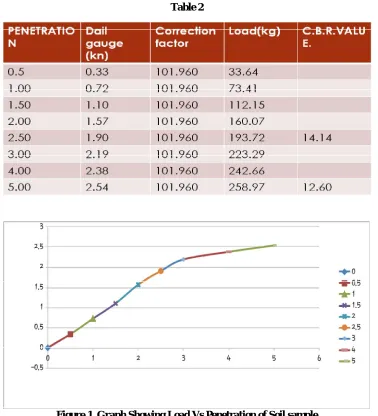
3.7.1 C.B.R TEST On Soil Sample-
Table 2
Figure 1. Graph Showing Load Vs Penetration of Soil sample
3.7.2 CBR TEST ON SOIL SAMPLE+CEMENT+FLYASH
Table 3
NATURAL MOISTURE CONTENT 4.120(4-5)
OMC 156.220(15-17)
Figure 2: Graph Showing Load Vs Penetration ofSoil+Cement+Flya
Figure 2CBR Test
The above photograph shows the CBR testing of material for the project.
In The Present Project, The Soil Available in The Premises Salunke Vihar Rd, Kondhwa was Taken for The Investigation Purpose. The Following Tests Were Conducted On the Field Soil in The Laboratory.
• Moisture Content of Field Soil
• Grain Size Analysis Using Mechanical Sieve Shaker
• Standard Proctor Test to Determine the Optimum Moisture Content (OMC) And Maximum Dry Density (MDD) All The Tests Were Performed in The Civil Engineering PWD Pune Corporation
Table 4
Test Results
Moisture content 13.68%
Grain size analysis Shape of the curve- Hump shape Type of soil- Gap graded Uniformity coefficient- 12.17 Coefficient of gradation- 0.599 Consistency limits LL: 19.68%, PL: 14.6%, PI: 5.08% Dry density 1.59 gm/cc
Standard Proctor Test Optimum moisture content (OMC) of soil is 15.490% Maximum dry density at OMC is 1.802 gm/cc
The Results Obtained Are Compared with Indian Standards Specified inIRCSP 89-2010 And as Per This Code the Plasticity Index (Pi) Soil Should Be Less Than 20 The for The Cement Stabilization. The Pi ofthe Soil We Had Taken Is 5.08%. As Per IRCSpecificationa Soil Has to Be a Uniformity Coefficient Greater Than 10 Then Only It Will Be Preferred to Stabilization with Cement. The Sample We Had Taken Has a Uniformity Coefficient of 12.17. Hence We Had Moved to Further Operation
.
V. DESIGNOFSOILCEMENTMIX
5.1 Standard Proctor Test
of stabilized material is evaluated by the most common method unconfined compressive strength test after 7 days of curing. After the strength tests, the durability test has to be performed on the best mix obtained from the strength test. In the present study the 7 days unconfined compressive strength test has been implemented. Steps followed are
• Obtaining the OMC for each % of addition of cement to the soil using the standard proctor test conforming to is code. • Conducting of strength tests on the cylindrical Specimens after the 7 days from the mixing and compaction time. • Conducting the durability test on the obtained mix as per the code
• Checking other requirements like ll, pl, organic content and content in the stabilized material as per the code.
Table 4Results of Standard Proctor Test On Soil + Cement Mixes
SR.NO` DETAILS OF MIX OPTIMUM MOISTURE CONTENT
MAXIMUM DRY DENSITY
1 Soil+5%
cement+5%Fly-ash.
15.220 1.765
5.2 Strength Tests On Soil Cement Mixes
After The Obtaining of Optimum Moisture Contents, The Strength of Soil Cement Mixes Is On Each Sample After 7 Days from Time of Casting of Cylindrical Specimen. The Cylindrical Mould Dimensions to Prepare Specimen Are 150 mm Diameter and 175 mm Height. The Tests Were Performed with Very Care Inspectionas It Was One ofthe Important Area to Pay Special Focus During the Investigation Process.
5.3 Mixing Methods
Soil-Cement Can Be Mixed in Place orin A Central Mixing Plant. Central Mixing Plants Can Be Used Where Borrow Material Is Involved.
5.3.1 Central Mixing Method COMPARISON OF RATES
As Per the Market Rate Analysis Done by The Group Members and Data Collected from Public Works Department, The Rates ofthe Various Material Used for Road Construction Has Been Mentioned Below.
6.1.Cost Analysis of Rigid Pavement
The Design of Rigid Pavement Depends Upon The CBR Value of Sub Grade, Design Axle Load Of Commercial Vehicles During the Design Life. Which Is Generally 20 Years or More for Rural Road. A Typical Pavement Composition Based UponSP:89-2010 And Its Cost for Rural Road withCBR Value 4 And Traffic of 75cvpd Is Given Below
Table 5
Layers: Full width: Rate: Per M^2:
GSB 100mm @Rs 600 Rs.120
PQC 180mm @Rs 3300 Rs.600
Total 280 Rs.720
6.2 Cost Analysis of Flexible Pavement
Table 6
Layers: Full width: Rate: Per M^2:
GSB 250mm @Rs.600 Rs.300
WBM 225mm @Rs.800 Rs.180
PC 20mm L.S Rs.90
Total Rs.570
6.4 Comparison Result
As per the data collected from the quantity survey of the various material to the mix, we prepared the rate of the soil mix is quite cheaper as compared to concrete and bitumen road.
Henceforth the soil sample mix is much economical and useful for low volume traffic in rural region of the country.
VI.RESULTS
The California bearing ratio test is penetration test meant for the evaluation of sub grade strength of roads and pavements. The results obtained by these tests are used with the empirical curves to determine the thickness of pavement and its component layers. This is the most widely used method for the design of flexible pavement the effect of quantity of cement added to the soil on consistency limit.
Several Specimens were prepared in the laboratory for the compressive strength testing. The Specimens were prepared by proportioning soil and cement according to selected ratios then adding the optimum percentage of water. With the increase in cement content, it was found that strength of soil increase. The strength of soil also depends on curing period. Figure 4 shows the effect of curing period on UCS of soil. From the figure, it was observed that with the increase in curing period strength of soil increases. So the strength of soil not only depends on cement content, but it also depends on the curing period of soil
7.1.CBR Value @5mm Penetration (For Soil) To Be Used for Rigid/Flexible Pavement - 12.60
7.2.CBR Value @5mm Penetration (For Soil+Cement+Fly-Ash)-54.72
VII. CONCLUSION
From The Research Done We Concluded That, The Soil Which We Taken Is Slightly Plastic and having the Uniformity Coefficient Greater than 10. Hence the Soil is suitable for Stabilization Process with Cement & Fly-Ash. While the project Going on we Observed that with the increase in Cement & Fly-Ash content the OMCandMDD Values Were Also Incremented easing.there byafter Conducting C.B.R Test, The Value ofthe Soil Obtained at 5 mm Penetration Was 54.72%
REFERENCES
[1] Indian Roads network from Wikipedia the free encyclopedia, Wikipedia https://en.wikipedia.org./wiki/Indian_road_network
[2] Studymafia, A seminar report on Soil cement, studymafia.org/wpcontent/
[3] R. Shiromani Et.al “Study of soil cement stabilization for pavement based course and sub grade”, International Journal of Engineering Research & Management Technology,volume 2-Issue 2, (135-139), March 2015
Sr no. Type of road Rate/m^3(Rs)
[4] Abu siddique and bipradas rajbongshi, “Mechanical properties of a cement stabilized coastal soil for use in road construction”, Journal of civil engineering the institution of Engineers”, Volume CE 30, NO. 1, 2002
[5] Costas A.Anagnostopoulus (2004), “Physical and Engineering properties of a cement stabilized soft soil treated with Acrylic Resin additive”, www.ejge.com
[6] Highway Engineering Textbook by S.K. Khanna, C.E.G. Justo
[7] Code provisions of IRC SP:89-2010 “Guidelines for Soil and Granular material stabilization using cement , lime, fly ash” , Indian Road Congress , November 2010
[8] Ms Neetu B Ramteke, Anil Kumar Saxena, “Stabilization of black cotton soil with sand and cement as a sub grade for pavement”, IJESRT, June 2014, 688-692
[9] Ms Neetu B Ramteke, Anil Kumar Saxena, “Stabilization of black cotton soil with sand and cement as a subgrade for pavement”, IJESRT, June 2014, 688-692.
[10] Hadj Bekki Et.al, “Durability of treated silty soil using lime and cement in road construction – A comparative study”, The online Journal of science and technology, Vol(2) Issue (5), 23-31.