PERFORMANCE COMPARISON OF BIT ERROR RATE
FOR BPSK AND DS-BPSK FOR AWGN AND RAYLEIGH
CHANNELS
1
Mrityunjay prasad Tripathi,
2Dr. Soni Changlani,
3Saiyed Tazin Ali
1,2,3
LNCTS college Bhopal (India)
ABSTRACT
In the past two decade wireless communications has gained exponential growth due to increasing number of users
and decreasing coast. The high speed digital communication over a wireless media required to understand the
channel and its characteristics. In a wireless media we have multipath components because of scattering,
diffraction, reflection etc. This limits the error performance of digital channels. The Binary phase shift keying
(BPSK) is widely used modulation technique in satellite communication. In this paper a comparative study is carried
out to obtain the Bit error rate (BER) performance for BPSK based transmission scheme under the Additive white
Gaussian noise (AWGN) and Rayleigh fading channel. We are using Monte Carlo based algorithm for the same.
Here BER performance is compared for using simulated and theoretical results.
Keywords:
BER, BPSK, DS-BPSK, AWGN channel, Rayleigh fading,
I INTRODUCTION
Digital modulation techniques are the widely used technologies which allow digitized data to be carried or transmitted via the analog radio frequency (RF) channels. Digital modulation techniques [1, 3, 7 and 9], contribute to the evolution of our satellite and mobile wireless communications by increasing the capacity, speed as well as the quality of the wireless network. The wireless channel is a harsh time-varying propagation environment. A signal transmitted on a wireless channel is subject to many problems viz. Fading, Shadowing, Interference, Delay spread, Doppler spread, and Propagation path loss. While it is possible to increase data rates by increasing the transmission bandwidth or using higher transmit power, both spectrum and transmit power are very constrained in a wireless system.
The rapid proliferation of internet and the strong growth of mobile telephony promise a key role for “broadband” and “wireless” in future telecommunications. So there is always a greater demand for capacity, reliability and also
need to integrate voice, data and other type of traffic over radio channels. The demands for higher bit rates combined with the ever-increasing number of users, however, introduces the need for clever and efficient usage of limited resources of the wireless channel.
Phase Shift Keying is often used because it provides a highly bandwidth efficient modulation scheme and it is easy to implement.
II. LITERATURE REVIEW
Due to the increasing bandwidth requirement the performance of digital modulation techniques have been frequently evaluated by researchers in past. Syed Md. Asif, et al [3], discussed about the fading problem in their paper and to mitigate the fading problem and to have reliable communications in wireless channel, channel coding technique is often employed. In this paper the BER (Bit Error Rate) performances is shown from analytically and by means of simulation for Rayleigh fading multipath channels. By simulation, it is shown that the improvement of BER using the convolution code in the presence of the fading provides a better performance gain than that of the un-coded signal. Vikas et al.[9] in 2011 has studied the PSK-based digital modulation scheme (BPSK, PSK or GMSK) and identifies the scheme that gives the best BER performance in a multipath fading environment using computer simulation. A comparison study is carried out to obtain the BER performance for each PSK-based transmission scheme. Mayank et al.[10] in 2011, Has study the performance of the BPSK (Binary phase shift keying) modulation technique using AWGN (Additive white gaussian noise) and Multipath Rayleigh fading channel. Method also studies the bit error rate of the WCDMA system by designing the WCDMA system using BPSK technique.
Riaz et al.[6], in 2010 given a comparison of symbol error probability(SEP) for different M-ary modulation techniques over slow, flat, identically independently distributed Rician fading channel is presented Exact analysis of symbol error probability for M-ary differentially encoded or differentially decoded phase shift keying(PSK) and coherent M-ary phase shift keying, transmitted over Rician fading channel has been performed with N branch receive diversity using maximal ratio combining(MRC) where channel side information known at the receiver.
III.
BPSK TRANSMITTER RECEIVER
The modulation format of BPSK [1] is widely used due to its simplicity and ease of designing. With Binary Phase
Shift Keying (BPSK), the binary digits 1 and 0 may be represented by the analog levels √ and
√ respectively.
a) Original Data
b) Simulated BPSK Signal
Fig. 2 Part of Simulated BPSK Signal
For BPSK modulation the channel can be modeled as shown in the Figure below.
Where, is the received signal at the input of the BPSK receiver, is the modulated signal transmitted through the
channel, is channel amplitude scaling factor for the transmitted signal usually 1. Where, is the Additive Gaussian White Noise is a random variable with zero mean and variance .
The advantage of using BPSK is as follows:
BPSK and QPSK obtained similar result with BPSK requiring lower E b/N0 (i.e. lower signal power) to
obtain a 0 BER than QPSK.
The BPSK can be used for wider bandwidth requirements
IV. CHANNELS
There are various types of communication channels specified in literature. The most commonly used channels are ideal AWGN and Rayleigh Fading channels. Due to characteristics of the channels the performance of the digital channels are limited.
4.1 Additive White Gaussian Noise (AWGN)
white noise with a constant spectral density (in watts per hertz) and a Gaussian distribution of amplitude. The AWGN model does not include the fading, interference, frequency selectivity or dispersion. The signal at the input of the receiver is mathematically modeled by the addition of white Gaussian noise as shown in Figure 1, therefore the transmitted signal, white Gaussian noise and received signal are expressed as and respectively
[8]. Where is a sample function of the AWGN process with probability density function (pdf) and power spectral density as;
| |
Where, is a constant and called the noise power density [9].
4.2 Multipath Rayleigh Fading Channel
Since signal propagation takes place in the atmosphere and near the ground, apart from insignificant effect of free path loss, the most notable effect of signal degradation is multipath propagation. The effect can cause fluctuations in the received signal's amplitude, phase and angle of arrival, giving rise to terminology multipath fading as in Fig.3. The radio waves in wireless communication includes reflected waves that are reflected off of various objects, diffracted waves, scattering waves, and the direct wave from transmitter to receiver [9]. Therefore the path lengths of the direct, reflected, diffracted, and scattering waves are different, the time each takes to reach the mobile station is different.
4.2.1 Rayleigh fading
Rayleigh fading is statistical model which assumes that the magnitude of a signal that has passed through transmission medium will vary randomly, or fade according to Rayleigh distribution. It is most applicable when there is no dominant propagation along a line of sight between the transmitter and receiver. Mathematically, the multipath Rayleigh fading wireless channels modeled by the channel impulse response (CIR)
(3)
Where, is the number of channel paths, and are the complex value and delay of path respectively. The paths are assumed to statistically independent, with normalized average power.
V. BIT ERROR RATE (BER) FOR BPSK MODULATION
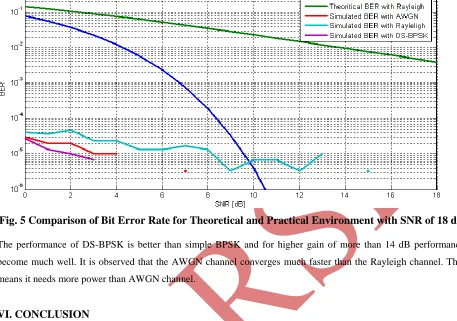
In the paper, theoretical bit error rate (BER) with Binary Phase Shift Keying (BPSK) modulation scheme in Additive White Gaussian Noise (AWGN) and Rayleigh channels are compared with practical BER. Here uncoded BER is simulated for BPSK modulated data as a function of SNR
In addition BER in an AWGN channel with direct sequence spreading is used and compare results to the theoretical ones. The coherent receiver and perfect synchronization is assumed for simulation. The BER results obtained using simulation scripts show good improvement over the derived theoretical results.
In AWGN channel, BER of 0.000033 is achieved for the SNR value of 3 dB using DS-BPSK. For Rayleigh channel, BER of 0.000033 is achieved for the SNR value of 13 dB using BPSK.
Fig. 5 Comparison of Bit Error Rate for Theoretical and Practical Environment with SNR of 18 db
The performance of DS-BPSK is better than simple BPSK and for higher gain of more than 14 dB performance become much well. It is observed that the AWGN channel converges much faster than the Rayleigh channel. That means it needs more power than AWGN channel.
VI. CONCLUSION
In the paper the performance of Additive White Gaussian Noise (AWGN) and Rayleigh channels are compared. Although, the simulated results present better BER performance but there is need to improve the power requirement of the modulation techniques. In the further future the performance will be evaluated under the multipath fading channel with Rayleigh and Racian channel. Also the performance will be evaluated by varing the various simulation parameters as Doppler shift and sampling time.
REFERENCES
[1] Theodore S. Rappaport, "Wireless Communication: Principle and Practice", Pearson Educational International, 2nd edition. 2002
[2] U.H. Rizvi,G.J.M. Janseen and J.H.Webber, “BER analysis of BPSK and QPSK constellations in the presence of ADC quantization noise”, Proceeding APCC, 2008.
[3] Hiroshima Harada, Ramjee Prasad, “Simulation & Software Radio for Mobile communication”, pp. 71-164,
2002.
[4] Suchita Varade, Kishore Kulat, “BER Comparison of Rayleigh Fading, Rician Fading and AWGN Channel
[5] Bernard Sklar, "Digital Communications: Fundamentals and Applications", Prentice- Hall, 2nd Edition 2005. [6] Md. Riaz Ahmed, Md. Rumen Ahmed, Md. Ruhul Amin Robin, “Performance analysis of different M-Ary
Modulation Techniques in Fading Channels using different Diversity”, Journal of Theoretical and Applied
Information Technology, 3(2), pp. 23-28, 2010.
[7] Sampei, S., Applications of Digital Wireless Technologies to Global Wireless Communications, Upper Saddle River, NJ: Prentice Hall, 1997.
[8] Dr Pao Lo Lui, Comparison of Single Carrier and carrier (OFDM) PSK transmission Schemes in Multi-path Wireless channel.
[9] Vikas Chauhan, Manoj Arora and R. S. Chauhan, “Comparative BER Performance of PSK based modulation Techniques under Multipath Fading”, Advances in Applied Science Research, Vol. 2 (4), pp. 521-527, 2011.
[10] Mayank Soni, Kunvar Devanshu Singh, Vikas Srivastava, “Performance of BPSK Modulation Scheme Using AWGN and Multipath Rayleigh Fading Channel for WCDMA System”, VSRD International Journal of

![Fig. 3 Multipath Fading Channel [9]](https://thumb-us.123doks.com/thumbv2/123dok_us/7750531.1270536/4.612.81.542.178.688/fig-multipath-fading-channel.webp)