CONTOURLET BASED IMAGE DENOISING
Sakthivel .K
1Prabhaa .N.M
21
PG scholar, Paavai College of Engineering, Namakkal (India)
2
Head of the department, ECE Dept, N.V Polytechnic College, Pethappampatty, udumalpet (India).
ABSTRACT
In this paper contourlet based image denoising algorithm which can restore the original image corrupted by
salt and pepper noise, Gaussian noise, Speckle noise and the poisson noise is proposed. The noisy image is
decomposed into sub bands by applying contourlet transform, and then a new thresholding function is used to
identify and filter the noisy co efficient and take inverse transform to reconstruct the original image. The
simulation result of the proposed method is compared with other simulation results which used the various
thresholding functions namely Bayes Shrink and Visu Shrink. From the simulation results it is observed that the
proposed algorithm can remove poisson and speckle noises effectively.
Keywords:
Salt & Pepper Noise, Poisson Noise, Speckle Noise, Contourlet Transform, Threshold Function, New Threshold FunctionI INTRODUCTION
Digital images are often corrupted by many types of noise including salt and pepper noise, Gaussian noise,
Poisson noise, Speckle noise which are normally acquired during image acquisition and transmission. Salt and
pepper noise is nothing but the random occurrences of black and white pixels in the images, Gaussian noise is
statistical noise that has its probability density function equal to that of the normal distribution, which is also
known as the Gaussian distribution, Speckle noise is a multiplicative noise i.e. it is direct proportion to the local
grey level in any area. It is essential to estimate and remove these noises in the image. The wavelet transform
performs quite well in image de-noising. In particular, the stationary wavelet transform (SWT) and the
translation invariant wavelet transform (TIWT) produce smaller mean-square-errors than the regular wavelet
transform, and the SWT or TIWT based image reconstruction are perceptually more delicate and smoother with
much less observable artifacts than the regular wavelet transform. However, the 2D wavelet transform used in
image processing is, basically, a tensor-product implementation of the 1D wavelet transform; therefore it does
not work well in retaining the directional edges in the images, and it is not efficient in representing the contours
(curves) not horizontally or vertically. As an attempt to represent the curves more efficiently curvelet is
developed. But the implementation of the curvelet transform in the discrete form is not a trivial issue. Thus to
overcome this new algorithm by using contourlet transform is proposed for the denoising of images. If the
image includes lots of edges, the contourlet transform performs better at retaining this edge information and the
output is better compared to the wavelet and contourlet transform. Contourlet transform is implemented by
Laplacian pyramid and two-dimensional directional filter banks that can simultaneously hold multiresolution,
of few steps; consider an input signal x(t) and noisy signal n(t).Add these components to get noisy data y(t)
i.e.y(t)=x(t)+n(t).
Here the noise can be Gaussian, Poisson’s, speckle and Salt and pepper, then apply Contourlet transform to get
c (t).
( ) ( ).
Modify the contourlet coefficient c(t)using different threshold algorithm and take inverse wavelet transform to
get denoising image ̂( )
( ) ̂( )
Image quality was expressed using signal to noise ratio of denoised image.
II NOISE MODEL
2.1. Gaussian Noise
Gaussian noise is statistical noise that has its probability density function equal to that of the normal
distribution, which is also known as the Gaussian distribution. In other words, the values that the noise can take
on are Gaussian-distributed. A special case is white Gaussian noise, in which the values at any pairs of times are
statistically independent (and uncorrelated). In applications, Gaussian noise is most commonly used as additive
white noise to yield additive white Gaussian noise. The probability density function of n-dimensional Gaussian
noise is
( ) (( ) ) ( ( ) ( )
Where x is a length-n vector, K is the n-by-n covariance matrix, µ is the mean value vector, and the superscript
T indicates matrix transpose.
2.2. Speckle Noise
Speckle noise is a multiplicative noise i.e. it is direct proportion to the local grey level in any area.
{
}
{ }
(
)
Where represents the phase noise component, z denotes amplitude component, denotes the coherence and
na1 is the zero mean random variable.
2.3. Salt and Pepper Noise
Salt and pepper noise is nothing but the random occurrences of black and white pixels in the images
2.4. Poisson Noise
The Poisson Integer Generator block generates random integers using a Poisson distribution. The probability of
( ) ( )
Where is a positive number known as the Poisson parameter. You can use the Poisson Integer Generator to
generate noise in a binary transmission channel. In this case, the Poisson parameter Lambda should be less than
1, usually much less.
III PROPOSED ALGORITHM
The block diagram for the proposed algorithm is shown in the figure1.
Figure1: Block Diagram of Image Denoising By Using Contourlet Transform
3.1. Contourlet Transform
The contourlet transform is applied for the noisy image to produce decomposed image coefficients. Basically
Contourlet transform is a double filter bank structure. It consists of a Laplacian pyramidal filter followed by a
directional filter bank. First the Laplacian pyramid (LP) is used to capture the point discontinuities. Then
directional filter bank (DFB) used to link point discontinuities into linear structures. Similar to wavelet,
contourlet decomposes the image into different scales.Unlike the wavelet contourlet decomposes each scale into
arbitrarily power of two’s number of directions.
The contourlet transformation expression is given by,
Where represents the contourlet transformation of the image. The ( ) and ( ) represents the
directional filter and the band pass filter in the equation. Thus j, k and n represent the scale direction and
location. Therefore l represents the number of directional filter bank decomposition levels at different scales j.
Thus the output of contourlet transform is a decomposed image coefficients.
3.2. Thresholding Functions
After the decomposition of the image in to the image coefficients, this image coefficient gets processed by using
the thresholding for the restoration of noiseless image coefficients. Here we use three types of thresholding
functions they are,
a. Bayes Shrink Input noisy
image
Contourlet transform
Estimating the threshold values and processing the coefficients
b. Visu Shrink
c.
New threshold function3.2.1. Bayes Shrink
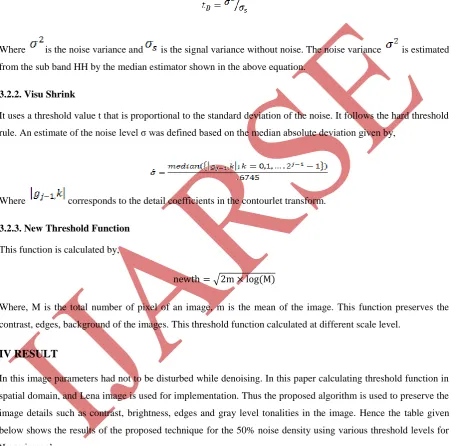
The goal of this method is to minimize the Bayesian risk, and hence its name, Bayes Shrink .The Bayes
threshold is defined as
Where is the noise variance and is the signal variance without noise. The noise variance is estimated
from the sub band HH by the median estimator shown in the above equation.
3.2.2. Visu Shrink
It uses a threshold value t that is proportional to the standard deviation of the noise. It follows the hard threshold
rule. An estimate of the noise level σ was defined based on the median absolute deviation given by,
Where corresponds to the detail coefficients in the contourlet transform.
3.2.3. New Threshold Function
This function is calculated by,
√ ( )
Where, M is the total number of pixel of an image, m is the mean of the image. This function preserves the
contrast, edges, background of the images. This threshold function calculated at different scale level.
IV RESULT
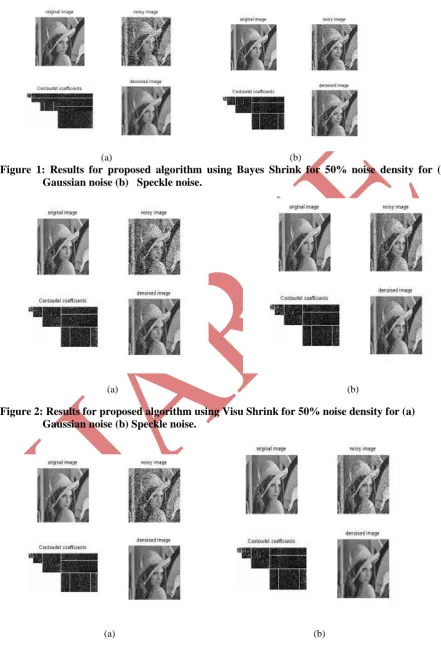
In this image parameters had not to be disturbed while denoising. In this paper calculating threshold function in
spatial domain, and Lena image is used for implementation. Thus the proposed algorithm is used to preserve the
image details such as contrast, brightness, edges and gray level tonalities in the image. Hence the table given
below shows the results of the proposed technique for the 50% noise density using various threshold levels for
‘Lena image’.
Table 1: Result of Different Technique with Lena For 50% Noise Densit
METHODS DENOISED IMAGE PSNR
Gaussian noise Speckle noise Poisson noise Salt& pepper noise Bayes shrink 17.762 18.5983 47.3452 13.1295
(a)
(b)
Figure 1: Results for proposed algorithm using Bayes Shrink for 50% noise density for (a)
Gaussian noise (b) Speckle noise.
(a) (b)
Figure 2: Results for proposed algorithm using Visu Shrink for 50% noise density for (a)
Gaussian noise (b) Speckle noise.
(a)
(b)
V CONCLUSION
[[
This contourlet technique is computationally faster and gives better results compared to the existing wavelet
technique. Some aspects that were analyzed in this paper that contourlet transform is well suited for images
containing more curves. This proposed method is not well suited for the removal of salt and pepper noise from
the original image. Therefore the proposed method is highly suited for Gaussian noise and speckle noise. Our
proposed threshold function gives better edge perseverance, background information, contrast stretching, in
spatial domain. In future we can use same threshold function for medical images as well as texture images to get
denoised image with improved performance parameter.
REFERENCES
[1] Do, M.N., and Vetterli, M.: ‘The contourlet transform: an efficient directional multi-resolution image
representation’, IEEE Trans. Image Process. , 2005, 14, (12), pp. 2091–2016
[2] Do, M.N.:‘Directional multiresolution image representation’. PhD dissertation, Swiss
Federal Institute of Technology, Lausanne, Switzerland, December 2001
[3] Po, D.D.-Y., and Do, M.N.: ‘Directional multi-scale modeling of images using the contourlet transform’,
IEEE Trans. Image Process., 2006, 15, (6), pp. 1610–1620
[4] Crouse, M., Nowak, R.D., and Baraniuk, R.G.: ‘Wavelet-based statistical signal processing using hidden
Markov model’, IEEE Trans. Image Process, 1998, 46, (4), pp. 886–902
[5] Shui, P.-L.: ‘Image denoising algorithm via doubly local Wiener filtering with directional windows in
wavelet domain,’ IEEE Signal Process. Lett. , 2005, 12, (10), pp. 681–684
[6] Kazubek, M.: ‘Wavelet domain image denoising by thresholding and Wiener filtering’, IEEE Signal
Process. Lett. , 2003, 10, (11), pp. 324–326
[7] Cunha, A.L., Zhou, J., and Do, M.N.: ‘The nonsubsampled contourlet transform: theory, design and
applications’, IEEE Trans. Image Process., 2006, 15, (10), pp. 3089–3101
[8] E. J. Candès and D. L. Donoho, “Ridgelets: A key to higher-dimensional intermittency,” Phil. Trans. R.
Soc. Lond. A., pp. 2495–2509, 1999.
[9] E. L. Pennec and S.Mallat, “Sparse geometric image representationwith bandelets,” IEEE Trans. Image
Process., vol. 14, no. 4, pp. 423–438,Apr. 2005.
[10] A. Cohen and B. Matei, “Compact representation of images by edge adapted multiscale transforms,”