169 |
P a g e
www.ijarse.com
HIGHER ORDER SQUEEZING IN SIXTH
HARMONIC GENERATION
Savita
1, Sunil Rani
2 1Department of Applied Science,
University Institute of Engineering and Technology, Kurukshetra 136 119, (India)
2Department of Applied Science,
S.K. Institute of Engineering and Technology, Kurukshetra 136 118, (India)
ABSTRACT
The quantum effect of squeezing is investigated in the higher order of field amplitude in sixth harmonic
generation under the short time approximation. Squeezing is found to be dependent on coupling constant g
and phase of the field amplitude. The effect of photon number on higher order squeezing and signal to noise
ratio has also been investigated.
Keywords
: Harmonic generation; Squeezing; Quantum opticsI INTRODUCTION
Since optical field obeys the laws of quantum mechanics, a minimum size of inherent quantum indeterminacy
is always present with each excitation for single mode fields even in the absence of any external field. These
are the vacuum fluctuations (zero–point fluctuations) of the electromagnetic field. The quantum limit can be
circumvented by the use of squeezed states of light. Squeezed states comprise phase-dependent distributions
of zero–point fluctuations such that the fluctuations in one quadrature are smaller than those of a coherent
state, at the expense of increased fluctuations in the canonically conjugate quadrature, while preserving the
Heisenberg limit on the uncertainty product. These states are called quadrature squeezed states of
electromagnetic field. The earlier work is mainly devoted to second-order quantum squeezing. However, with
the development of techniques for making higher-order correlation measurement in quantum optics, it was
quite natural to turn the attention towards higher-order squeezing. Hillery [1] in 1987 introduced the concept
of higher-order squeezing called ‘amplitude –squared squeezing’ different from that defined by Hong and
Mandel [2].
Squeezed states are a unique set of quantum states with no classical analogue. Many theoretical and
experimental developments on squeezed states have taken place in a number of optical processes such as
harmonic generation [4-6], multiwave mixing processes [7-9], parametric amplification [10], intermediate
states and superposed coherent states [11-13], Raman process [14] and optical Faraday rotation [15].
Squeezed states have become central to quantum optics through their promise of accuracy improved beyond
170 |
P a g e
www.ijarse.com
in ultra-precise measurements, squeezed states are also gaining relevance in quantum information science.
They have been used to construct entangled states of lights to demonstrate quantum teleportation [18],
quantum computation [19], optical storage [20], dense coding [21].
As the number of applications hitting the limit to their sensitivity set by quantum noise grows and as more
squeezing becomes possible, the breadth of potential of squeezed states can only continue to expand
higher-order squeezing. In the present work we have reported that the generation of higher higher-order squeezed state is
possible by using sixth harmonic generation.
II DEFINITION OF SQUEEZING AND HIGHER ORDER SQUEEZING
Squeezed states of an electromagnetic field are the states with reduced noise below the vacuum limit in one
of the canonical conjugate quadrature. Normal squeezing is defined in terms of the operators
†
†1 2
1
1
and
2
2
X
A
A
X
A
A
i
Where
X
1 andX
2 are the real and imaginary parts of the field amplitude, respectively.A
andA
† areslowly varying operators defined by
A
ae
i tand
A
†
a e
† i t The operatorsX
1 andX
2 obey the commutation relation
1,
2
2
i
X X
Which leads to uncertainty relation (
=1)
1 2
1
4
X
X
A quantum state is squeezed in
X
i variable if
1
for
1
2
2
i
X
i
or
III SQUEEZING OF FUNDAMENTAL MODE IN SIXTH HARMONIC GENERATION
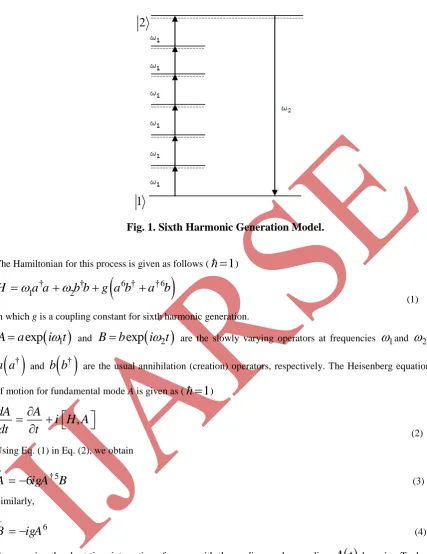
Sixth harmonic generation model has been adopted from the works of Zhou yong et al. [22] and G.Wang and
X. Wang et al. [23] is shown in figure 1. In this model, the interaction is looked upon as a process which
171 |
P a g e
www.ijarse.com
Fig. 1. Sixth Harmonic Generation Model.
The Hamiltonian for this process is given as follows (
1
)
†
†
6 †
†61 2
H
a a
b b
g a b
a b
(1)
in which g is a coupling constant for sixth harmonic generation.
1exp
A
a
i t
andB
b
exp
i
2t
are the slowly varying operators at frequencies
1and
2,
†a a
andb b
† are the usual annihilation (creation) operators, respectively. The Heisenberg equation of motion for fundamental mode A is given as (
1
)
,
dA
A
i H A
dt
t
(2)Using Eq. (1) in Eq. (2), we obtain
.
†5
6
A
igA B
(3)Similarly,
.
6
B
igA
(4)By assuming the short time interaction of waves with the medium and expanding
A t
by using Taylors series expansion and retaining the terms up tog t
2 2 as
†5 2 2 †4 †3 4 †2 3
†2 2 † †5 6
6
3
30(
5 10
40
60
24 )
A t
A
igtA B
g t
A A
A
A A
A A
A B B
A
A
(5)For squeezing of field amplitude in fundamental mode
A
, the real quadrature component is2
172 |
P a g e
www.ijarse.com
†
11
2
AX
A t
A t
(6)
Initially, we consider the quantum state of the field amplitude as a product of coherent state for the
fundamental mode A and the vacuum state for the harmonic mode B i.e.
0
(7)Using Eqs.(5) and (7), number of photons in mode
A
may be expressed as
† 1† †6 6 † 2 2 †6 6
6
6
A
N
t
A
t A t
A A
igt A B
A B
g t A A
(8)
2
1 1 1
†2 2 † 2 2 †7 7 †6 6
6
2
6
A A A
N
t
N
t N
t
A A
A A
g t
A A
A A
(9)and
3 21 1 1
†3 3
3
†2 2 †6
2 23
†8 827
†7 736
†6 6A A A
N
t
N
t N
t
A A
A A
A A
g t
A A
A A
A A
(10)Using Eqs.(5) and (7) the fourth-order amplitude of the fundamental mode is expressed as
4 4 †5 3 †4 2 †3 †2 2 2
†5 9 †4 8 †3 7 †2 6
6
4
30
80
60
3
4
30
80
60
A
t
A
igt
A A
A A
A A
A
B
g t
A A
A A
A A
A A
(11)
†4 †4 †3 5 †2 4 † 3 2 † 2 2
†9 5 †8 4 †7 3 †6 2
6
4
30
80
60
3
4
30
80
60
A
t
A
igt
A A
A A
A A
A B
g t
A A
A A
A A
A A
(12)For fourth order squeezing, the real quadrature component in fundamental mode is given as
4 †4
1
1
2
AF
t
A
t
A
t
(13)Using Eqs.(7) and (11) in Eq. (13), we get the expectation value as
2 8 10 8 6
8 8 2 2
1
4 8 8 18 16 14 12
1
2
6
( 4
30
80
4
60
)
8
60
160
120
}
A
F
t
g t
(14) and
8 6 4 2
2 8 8
1
10 8 6 4 2
2 2
18 16 14 12
8 8
1
2
16
72
96
24
4
6
(4
70
560
2100
3360
1680)(
) 8
108
544
896
}
A
F
t
g t
173 |
P a g e
www.ijarse.com
Therefore,
42 6 2 2 2 8 6
1
4 2 8 8 16 14
12
1
16
72
96
24 6
( 40
480
4
2040
3360
1680)(
) 48
384
776
}
A
F
t
g t
(16)
Using Eqs.(8) – (10), we get
6 4 2 16 14 1
1 2 3 2 1 1 2 2
1
[
72
96
24
1
16
24
56
24
6
(48
384
4
16
776
)]
4
A A A
N
t
N
t
N
t
g t
(17)
Subtracting Eq. (17) from Eq. (16), we obtain
3 21 1 1
2 1
16 14 12 10 8
2 2
1
16
24
56
24
4
120
12
51
84
42
cos 8
A A A
A
t
N
t
N
t
N
t
F
g t
(18)
The right hand side of Eq. (18) is negative and thus shows the existence of squeezing in the Fourth order
of the fundamental mode for which
cos8
0
.IV SIGNAL-TO-NOISE RATIO
Signal to noise ratio is defined as ratio of the magnitude of the signal to the magnitude of the noise. With
the approximations
0
andgt
2=
1
, the maximum signal to noise ratio (in decibels) in higher order of field amplitude, is given below.Signal-to-noise ratio in fourth order of field amplitude is defined as
2 1 10 2 120 log
[
]
(
A)
A
t
SNR
F
t
F
(19)Using Eqs. (14) and (16), SNR in fourth-order squeezing is expressed as
10 8 6 4
4 10 8 6 4 2
2
15
40
30
20 log
16
168
607
840
420
(
)
(
)
174 |
P a g e
www.ijarse.com
V RESULTS
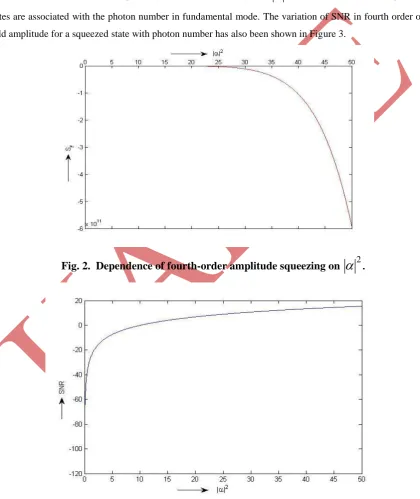
The results show the presence of squeezing in fourth order of field amplitude in sixth harmonic generation.
Taking
gt
2
10
4and
0
for maximum squeezing, the variations ofS
F is shown in Figure 2. Degree of squeezing is shown as a function of
2.It is clear from Figure 2 that the squeezing increases non-linearly with
2. This confirms that the squeezedstates are associated with the photon number in fundamental mode. The variation of SNR in fourth order of
field amplitude for a squeezed state with photon number has also been shown in Figure 3.
Fig. 2. Dependence of fourth-order amplitude squeezing on
2.175 |
P a g e
www.ijarse.com
VI CONCLUSION
It is shown that the selective phase values of field amplitude of fundamental mode during sixth harmonic
generation lead to squeezing up to fourth order. Further, Figures 2-3, show that the degree of squeezing
increases with increase in the order of field amplitude of the fundamental mode. This also establishes the
fact that processes with higher order non linearity are more suitable for generation of squeezed light which is
used in reducing noise in the output of certain non linear processes.
REFERENCES
[1] M. Hillery, Squeezing of the square of the field amplitude in second harmonic generation, Optics
Communications, 62 (2), 1987, 135–138.
[2] C.K. Hong and L. Mandel, Generation of higher order squeezing of quantum electromagnetic field,
Physical Review A, 32(2), 1985, 974-982.
[3] C.K. Hong and L. Mandel, Higher-order squeezing of a quantum field, Physical Review Letters, 54(4), 1985,
323- 325.
[4] S. Rani, J. Lal and N. Singh, Higher order squeezing and photon statistics in fourth harmonic generation,
Optics Communication, 277, 2007, 427.
[5] S. Gill, S. Rani and N. Singh, Higher order squeezing in seventh harmonic generation, International
Journal of Physics and Application, 3(2), (2011, 209-218.
[6] S. Gill, S. Rani and N. Singh, Squeezing and sub-poissonian effect in eighth harmonic generation, Journal
of Information Systems and Communication 3, 2012, 80-82.
[7] M.D. Reid and D.F. Walls, Generation of squeezed states via degenerate four wave mixing, Physical
Review A, 31, 1985, 1622.
[8] D.K. Giri and P.S. Gupta, The squeezing of radiation in four-wave mixing processes, Journal of Optics B:
Quantum and Semiclassical Optics, 6, 2004, 91-96.
[9] S. Rani, J. Lal and N. Singh, Higher order amplitude squeezing in six wave mixing process, International
Journal of optics, 2011, 2011, 629605-629614.
[10] H.Yonezawa, K. Nagashima and A. Furusawa, Generation of squeezed light with a monolithic optical
parametric oscillator, Optics Express, 18 (19), 2010, 20143-20150.
[11] A. Verma, N.K. Sharma and A. Pathak, Higher order antibunching in intermediate states, Physics letters
A, 372(34), 2008, 5542-5551.
[12] H. Prakash and P. Kumar, Amplitude-squared squeezing in superposed coherent states, Eur. Phys. J. D,
46, 2008, 359-363.
[13] T.M. Duc and J. Noh, Higher-order properties of photon-added coherent states, Optics Communication,
281 (2008) 2842-2848.
[14] D.K. Giri and P.S. Gupta, squeezing effects in the sum and difference of the field amplitude in the
176 |
P a g e
www.ijarse.com
[15] J.F Sherson and K. Molmer, Polarization squeezing by optical Faraday rotation, Physical Review Letters,
97 (2006) 143602.
[16] T. Eberle, S. Steinlechner, J. Bachrowitz, V. Handehen, H. Vahlbrch, M. Mehmet, H.M. Ebhardt and R.
Schnabel, Quantum enhancement of the zero-area sagnac interferometer topology for gravitational wave
detection, Physical Review Letters, 104(25), 2010, 251102.
[17] H. Vahlbruch, A. Khalaidovski, N. Lastzka, C. Graf, K. Danzmann and R Schabel, The GEO600
squeezed light source, Classical and Quantum Gravity, 27(8), 2010, 084027-084034.
[18] M. Yukawa, H. Benichi and A. Furusawa, High fidelity continuous variable quantum teleportation
toward multistep quantum operation, Physical Review A, 77 (2008) 022314-022318.
[19] A. Furusawa, Quantum teleportation of continuous variables and related quantum information
processing, Phys. Rep., 443 (2007) 97.
[20] G. Adesso and G. Chiribella, Quantum benchmark for teleportation and storage of squeezed states,
Physical Review Letters, 100, 2008, 170503.
[21] J. Zhang, H. Tao, C. Xie and K. Peng, Application of amplitude-squeezed state light from injection-
locked laser diode in quantum teleportation and dense coding, Physics Letters A, 290, 2001, 1-5.
[22] C. Li, Y. Zhou, N. Zong, Z. Xu, X. Wang, Y. Zhu, Sixth harmonic generation of 1064-nm laser in
KBBF prism coupling devices under two kinds of gas conditions, Chinese Optics Letters, 7(7), 2009,
621-623.
[23] G. Wang, X. Wang, Y. Zhou, Y. Chen, C. Li, Y. Zhu, Z. Xu, C. Chen, 12.95 Mw sixth harmonic