Neutron-capture cross sections from indirect measurements
J.E. Escher,a, J.T. Burke, F.S. Dietrich, J.J. Ressler, N.D. Scielzo, and I.J. ThompsonLawrence Livermore National Laboratory, Livermore, CA 94550, USA
Abstract. Cross sections for compound-nuclear reactions reactions play an important role in models of astrophysical environments and simulations of the nuclear fuel cycle. Providing reliable cross section data remains a formidable task, and direct measurements have to be complemented by theoretical predictions and indirect methods. The surrogate nuclear reactions method provides an indirect approach for determining cross sections for reactions on unstable isotopes, which are difficult or impossible to measure otherwise. Current implementations of the method provide useful cross sections for (n,f) reactions, but need to be improved upon for applications to capture reactions.
1 Introduction
Nuclear reaction data play an important role in nuclear physics applications. Cross sections for reac-tions of neutrons and light, charged particles with target nuclei across the isotopic chart, taking place at energies from several keV to tens of MeV, are required for nuclear astrophysics, national security, and nuclear energy applications. Not all relevant data can be directly measured in the laboratory as many important reactions involve unstable nuclei which are too difficult to produce with currently available techniques. Cross section calculations are nontrivial since they often require a thorough understanding of both direct and statistical reaction mechanisms (as well as their interplay) and a detailed knowledge of nuclear structure.
Several indirect methods are presently used to determine cross sections that are difficult to measure directly. The Asymptotic Normalization Coefficient (ANC), Coulomb-Dissociation, and Trojan-Horse methods aim at obtaining direct reaction cross sections1, while the surrogate nuclear reaction method is an indirect approach for determining compound-nuclear reaction cross sections. The method was first explored in the 1970s, when it was applied to estimate (n,f) cross sections. In the past several years, the approach has received renewed attention. Most of the applications so far have focused on obtaining cross sections for neutron-induced fission, but more recently attention has also turned to the question whether neutron capture cross sections can be obtained using this method.
The idea of applying the surrogate approach to neutron capture is certainly compelling, as capture cross sections play an important role in many applications, such as nuclear energy and nuclear astro-physics. Simulations of the evolution of stars and the synthesis of the heavy elements require capture cross sections as input. Many reactions involve unstable nuclei that cannot presently be measured in the laboratory. Even close to stability there are important reactions that are difficult or impossible to access directly. This includes selected neutron capture reactions that are relevant to the slow neutron capture process (s process) that, together with the rapid neutron capture process (r process) produces almost all the elements heavier than iron. The s process involves nuclei in and very near the valley of stability. Of particular interest are capture reactions on s process branch points, unstable nuclei with a life time long enough to allow the s process to proceed by either neutron capture orβdecay. The strength with which one path dominates over the other depends on environmental variables, such as neutron density, temperature, and pressure, as well as on nuclear properties, specifically capture rates
a e-mail:[email protected]
1 The Trojan-Horse method has recently also been explored for resonance reactions [1] DOI: 10.1051/
C
Owned by the authors, published by EDP Sciences, 2012
epjconf 20122101001/
and beta-decay life times. Information on the astrophysical conditions of the s process can be inferred if the nuclear properties are known. The desired accuracy for s-process cross sections used by stellar modelers lies in the single-digit percent range and is difficult to obtain, in particular for an indirect approach. However, in the absence of data, one finds that calculated cross sections exhibit large un-certainties. For instance, for s-process branch points95Zr and153Gd one finds that the evaluated (n,γ) cross sections in the literature differ by a factor of two or more.
The reason for the large differences between the evaluated cross sections can be found in the nu-clear structure input that is required for Hauser-Feshbach calculations. The expression for the cross sections involves, among others, transmission coefficients and level densities. To calculate the former, one needs optical potentials,γ-ray strength functions, and - when fission competes - fission barriers. For level densities, there exist several analytic functions, with parameters adjusted to available data, as well as data tables based on microscopic approaches. Much work has been done to develop models, codes and parameter recommendations (see, e.g. [2]) for use in Hauser-Feshbach calculations. How-ever, a given set of cross section data can often be reproduced by several parameter combinations. This ambiguity reflects our insufficient knowledge of the underlying nuclear structure properties at the en-ergies relevant to compound-nuclear reactions. Consequently, for cases where there is little or no data to constrain the structure models and cross sections, we find discrepant cross section predictions. The question we want to consider here is whether the surrogate method can possibly be used to provide meaningful constraints to the inputs for the calculations.
2 The surrogate idea
The appropriate formalism for the description of a compound-nuclear reactiona+A →B∗ →c+C is a statistical one [3]. Based on Bohr’s hypothesis of the independence of formation and decay of the compound nucleus (CN), the cross sections are calculated in the framework of the Hauser-Feshbach formalism, which properly takes account of the conservation of angular momentum and parity in the reaction:
σαχ(Ea)=
X
J,π σCN
α (Eex,J, π) GχCN(Eex,J, π), (1)
withαandχ denoting the relevant entrance and exit channels,a+A andc+C, respectively. The excitation energyEexof the compound nucleus,B∗, is related to the center-of-mass energyEa in the
entrance channel via the energy needed for separatingafromB:Ea =E−Sa(B). In many cases the
formation cross sectionσCN
α =σ(a+A → B∗) can be calculated to a reasonable accuracy by using optical potentials, while the theoretical decay probabilitiesGCN
χ for the different decay channels χ are often quite uncertain. The latter are difficult to calculate accurately since they require knowledge of optical models, level densities, and strength functions for the various possible exit channels. The objective of the surrogate method is to determine or constrain these decay probabilities experimentally. In the surrogate approach, the compound nucleusB∗is produced by means of an alternative
(“sur-rogate”), direct reaction,d+D→b+B∗, and the desired decay channelχ(B∗→c+C) is observed in coincidence with the outgoing particleb(see Fig. 1). The probability for formingB∗in the surrogate reaction (with specific values forEex,J,π) isFδCN(Eex,J, π, θb), whereδrefers to the entrance channel
reactionD(d,b) andθbis the angle of the outgoing direct-reaction particlebrelative to the beam axis.
The quantity
Pδχ,θb(Eex, θb)=
X
J,π
FδCN(Eex,J, π, θb) GCNχ (Eex,J, π), (2)
which gives the probability that the compound nucleusB∗was formed with energyEexand decayed
into channelχ, can be obtained experimentally, by measuringNδ, the total number of surrogate events, andNδχ, the number of coincidences between the direct-reaction particle and the observable that iden-tifies the relevant exit channel:Pexpδχ(Eex, θb)=Nδχ(Eex, θb)/Nδ(Eex, θb)δ(Eex).Here,δ(Eex) denotes
Fig. 1.Schematic representation of the “desired” (top) and “surrogate” (bottom) reaction mechanisms [4]. The basic idea of the surrogate approach is to replace the first step of the desired reaction,a+A, by an alternative (surrogate) reaction,d+D→b+B∗
, that is experimentally easier to access yet populates the same compound nucleus. The subsequent decay of the compound nucleus into the relevant channel,c+C, can then be measured and used to extract the desired cross section. Three typical decay channels are shown here: neutron evaporation, fission, andγemission.
The distributionFCNδ (Eex,J, π, θb), which may be very different from the CN spin-parity
popula-tions following the absorption of the projectileain the desired reaction, has to be determined theoret-ically, so that the branching ratiosGCN
χ (Eex,J, π) can be extracted from the measurements. In practice,
the decay of the CN is modeled and theGCNχ (Eex,J, π) are obtained by adjusting parameters in the
model to reproduce the measured probabilitiesPδχ(Eex, θb) [5, 6]. Subsequently, the sought-after cross
section can be obtained by combining the calculated cross sectionσCN
α (Eex,J, π) for the formation
of B∗(froma+A) with the extracted decay probabilitiesGCN
χ (Eex,J, π) for this state, see Eq. 1. To
simplify the notation, we suppress, in the remainder of the paper, the dependence of the coincidence probabilityPexpδχ(Eex, θb) on the angle θb of the outgoing direct-reaction particleb. The angular
de-pendence of Pexpδχ(Eex, θb) arises from the fact that the populationFδCN(Eex,J, π, θb) of the compound
nucleus depends on the angular-momentum transferred in the surrogate reaction, and hence onθb.
Weisskopf-Ewing Approximation.Under certain circumstances, the decay of the intermediate equi-librated system, the compound nucleus, becomes independent of its angular momentum and parity, and the cross section for the reaction factorizes into a simple product of a formation cross section and a decay probability for the exit channel of interest [3]:
σαχ(Ea)=σCNα (Eex) GCNχ (Eex,), (3)
whereσCN
α (Eex) =PJ,πσCNα (Eex,J, π) is the reaction cross section describing the formation of the
compound nucleus in the desired reaction andGCN
χ (Eex) denotes theJπ-independent decay probability
In the context of surrogate reactions, the Weisskopf-Ewing approximation greatly simplifies the ap-plication of the method: It becomes straightforward to obtain the Jπ-independent branching ratios GCNχ (Eex) from measurements of Pδχ(Eex) [= GCNχ (Eex) sincePJ,πFCNδ (Eex,J, π) =1] and to
calcu-late the desired reaction cross section. Calculating the direct-reaction probabilitiesFCN
δ (Eex,J, π) and
modeling the decay of the compound nucleus are no longer required. Most applications to date invoke the Weisskopf-Ewing approximation.
3 Neutron-induced fission reactions
The surrogate approach was first employed in the 1970s to estimate neutron-induced fission cross sections from transfer reactions. These early applications of the method made use of the Weisskopf-Ewing approximation: The transfer reactions of the 1970s [7, 8] produced (n,f) cross section estimates for various actinide targets which agreed with direct measurements (where available) to about 10-20% for incident neutron energies above 1 MeV. Discrepancies at lower energies were later attributed to large uncertainties in the low-energy optical model employed, and the use of the Weisskopf-Ewing approximation [5, 6].
More recently, a French group has carried out surrogate experiments at the Institut de Physique Nucl´eaire (IPN) in Orsay to determine cross sections for neutron-induced reactions on several minor actinide nuclei relevant to the thorium-uranium fuel cycle and the transmutation of nuclear waste [9– 11]. The transfer reactions232Th(3He,x) and243Am(3He,x), with x=α,t,d,p, were employed to obtain (n,f) and (n,γ) cross sections for Th and Pa targets [9, 10] and (n,f) cross sections for Cm and Am targets [11], respectively. The analyses assumed that the Weisskopf-Ewing approximation is valid. The extracted (n,f) cross sections were found to be consistent with known directly-measured cross section measurements, where these were available. They proved useful for resolving controversies between discrepant measurements and for providing data for previously unavailable energy regions.
The STARS/LiBerACE collaboration in the United States has carried out a number of experiments at the 88-inch cyclotron at Lawrence Berkeley National Laboratory. Light-ion beams have been used for inelastic scattering, charge exchange, and one- or two-neutron transfer reactions. Fission cross sections, e.g. the237Np(n,f) cross section [12], have been determined using the Weisskopf-Ewing ap-proximation or a variant thereof, the surrogate ratio method.
TheSurrogate Ratio approach[13–15] requires the (approximate) validity of the Weisskopf-Ewing limit. The ratio
R(E)= σα1χ1
σα2χ2
(4)
of the cross sections of two CN reactions is measured, using two surrogate experiments. An indepen-dent determination of the cross sectionσα2χ2can then be used to deduceσα1χ1. An advantage of using
the ratio method is the fact that it eliminates the need to accurately measure the total number of surro-gate reaction events (Nδ), since one determines the ratio of coincidence probabilitiesPδ1χ1/Pδ2χ2, rather
than an absolute probabilityPδχ=Nδχ/Nδ. Furthermore, there are indications that small to moderate deviations from the WE limit cancel in this approach [13]. Cross sections for (n,f) reactions extracted in the ratio approximation have been tested for consistency with results from direct measurements, complementary surrogate experiments [15, 16], and theoretical simulations [13]. For (n,f) reactions one typically finds that the spin-parity mismatch between the desired and surrogate reactions has a much smaller effect on the extracted cross section than in an approach that uses the WE approxima-tion and absolute probabilities. Also, deviaapproxima-tions caused by pre-equilibrium effects are diminished, thus improving the overall agreement between extracted and expected cross sections.
A recent applications of the ratio approach is shown in Figure 3. The238Pu(n,f) cross section, which is needed for reactor applications and for transmutation studies, was recently determined using inelastic scattering surrogate reactions [17]. Ressleret al. [17] produced the compound nuclei239Pu∗, 235U∗, and236U∗via inelasticαscattering. Surrogate ratio analyses yielded the desired238Pu(n,f) cross
Fig. 2.Fission cross sections obtained from surrogate ratio measurements. The238Pu(n,f) cross section was de-termined relative to the known 234U(n,f) and235U(n,f) cross sections [17]. The weighted average of the two measurements is compared to several evaluations; the solid line represents a calculation based on the new data.
in the left panel of Figure 3. The two measurements are in good agreement with each other for 5-20 MeV and the averaged cross section agrees well with previous, direct, measurements in the 5-10 MeV range; it is somewhat higher (by less than 20%) than those at about 15 MeV. The ratio measurement does not, and is not expected to, produce highly-accurate fission results at low energies (< 5 MeV here), due to the underlying Weisskopf-Ewing assumption. It does, however, provide continuous data for neutron energies from 5 to 20 MeV, and supplement earlier measurements, which were sparse in the energy regime around 10-15 MeV.
The literature and the above examples indicate that (n,f) cross sections extracted from surrogate data are typically consistent with direct measurements (where available) and/or other surrogate mea-surements, despite the approximations used. In addition, calculations, which test the approximation schemes employed in the analyses of surrogate fission data [13], illustrate the level of accuracy that one can under reasonable circumstances expect from the surrogate approach. Discrepancies between indirectly and directly measured cross sections are often less than 10%. The largest deviations are found at low energies, where the Weisskopf-Ewing approximation is not expected to be valid; in those cases, it becomes necessary to account for the differences in the spin-parity distributions occurring in the desired and surrogate reactions.
4 Capture reactions
Capture cross sections provide specific challenges for the surrogate approach. First, the level of preci-sion required for the cross section is often higher than in the fispreci-sion case: Recent advances in modeling the astrophysical s process have resulted in requests to determine capture cross sections within a few percent and nuclear-energy applications require cross sections to within 5-10% [18, 19]. Achieving an accuracy of a few percent is challenging, but constraining an unknown (n,γ) cross section to within 20-30% should be considered a meaningful improvement of the situation, in particular since current cross section evaluations often show large deviations from each other. Secondly, it is the low-energy regime that is relevant to many applications. For s-process applications, for example, one needs cross sections from a few keV to about 200 keV. Both calculations and measurements have shown that this is the energy range for which the Weisskopf-Ewing approximation typically breaks down.
The branching ratios (channel probabilities),GCN
χ (E,J, π) that enter Eqs. 1 and 2 can be calculated via this procedure; the Weisskopf-Ewing limit is reached when the branching ratios are approximately equal.
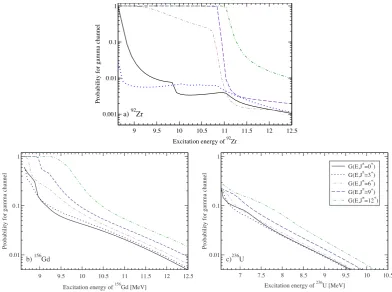
Overall, the studies show that the probability for a compound nucleus to decay viaγemission (χ=γ) depends sensitively on the spin-parity population of the nucleus prior to decay (see Fig. 3). The dependence of theγ-branching ratios on theJπdistribution is greater than that found previously for fission (χ= f ission). Calculations for representative Zirconium, Gadolinium, and Uranium nuclei showed a strong dependence of theγbranching ratios on the spins populated in the compound nucleus. The effect was particularly strong for the92Zr nucleus, which has a closed proton subshell (Z=40) and a nearly-closed neutron shell (N=52≈50) [20]. A comparison with the results for Gadolinium and Uranium confirms the notion that the higher level densities present in the deformed rare-earth and actinide regions do reduce the sensitivity of theγ-decay probabilities to compound-nuclear spin-parity distributions and nuclear-structure effects [21].
9 9.5 10 10.5 11 11.5 12 12.5
Excitation energy of 156Gd [MeV]
0.01 0.1 1
Probability for gamma channel
b) 156Gd
7 7.5 8 8.5 9 9.5 10 10.5
Excitation energy of 236U [MeV]
0.01 0.1 1
Probability for gamma channel
G(E,J!=0+)
G(E,J!=3+)
G(E,J!=6+)
G(E,J!=9+)
G(E,J!=12+)
c)236U
Fig. 3.Calculatedγ-decay probabilitiesGCN
γ (E,J, π), for92Zr,156Gd, and236U. Shown is the probability that
the compound nucleus, when produced with a specificJπcombination, decays via theγchannel. The excitation energies shown correspond to incident-neutron energies of 0-4 MeV. The decay probabilities also depend on parity, only positive-parity results are shown here. More results can be found in [20, 21].
The effects of the spin-parity mismatch can be further explored by using schematic spin-parity dis-tributions,FCN
δ (E,J, π), to simulate surrogate coincidence data via Eq. 2. The calculated Pδγsim(E)= P
J,πFCNδ (E,J, π) GCNγ (E,J, π) can be used in a WE ‘analysis’ to yield the desired cross section, σW E,sim
n,γ (E)=σCNn (E)Pδγsim(E), where σCNn (E) denotes the CN formation cross section. The range of
cross sections,σW En,γ,sim(E), obtained by varying the simulated spin distributions within reasonable
lim-its provides a measure of the uncertainty in the extracted cross section due to the use of the WE approximation. For the zirconium region such sensitivity analysis was carried out by Forss´en et al.
9 9.5 10 10.5 11 11.5 12 12.5
Excitation energy of 92Zr
0.001 0.01 0.1 1
Probability for gamma channel
[20]. An order-of-magnitude difference between the known reference cross section for91Zr(n,γ) and that extracted from the simulation was found, indicating that using the WE approximation for the this region of the nuclear chart is indeed not appropriate.
0.1 1
Neutron Energy [MeV] 0.01
0.1 1 10
Cross Section [b]
Surrogate measurement (2+! 0+)
Surrogate measurement (4+! 2+)
Reference cross section Distribution 1 Distribution 2 Distribution 3 Distribution 4
a) 155Gd(n,")
0.1 1
Neutron energy [MeV] 0.01
0.1 1 10
Cross section [b]
b) 235U(n,!)
0 0.2 0.4
0 0.2 0.4
0 0.2 0.4
0 1 2 3 4 5 6 7 8 9 10 11 12
Angular momentum J 0
0.2 0.4
Distrib. 1
Distrib. 2
Distrib. 3
Distrib. 4
Fig. 4.Left panel: Weisskopf-Ewing estimates for the a)155Gd(n,γ) and b)235U(n,γ) cross sections, extracted from analyses of simulated surrogate experiments, for the four different compound-nuclearJπdistributions shown in the right panel of the figure. For the gadolinium case, results from a Weisskopf-Ewing analysis of measured surro-gate156Gd(p,p’) data from Ref. [22] are also shown. The reference cross sections were obtained by adjusting the parameters for the Hauser-Feshbach calculation to reproduce direct (n,γ) measurements. Right panel: Schematic spin-parity distributions, selected to simulate the compound nucleus created in the surrogate reaction. Positive and negative parity states are assumed to be populated with equal probability.
Discrepancies between extracted and reference (i.e.evaluated) cross sections are expected to be smaller for the deformed rare-earth and actinide cases, since the level densities in those regions are much higher than in the zirconium region. We find that this is indeed the case. Results for the 155Gd(n,γ) and235U(n,γ) examples are shown in Fig. 4 (see also Ref. [21]). Plotted are the reference
cross sections, obtained by fitting Hauser-Feshbach calculations to direct measurements, and four cross sections extracted from simulated surrogate data; the spin distributions are shown in the right panel of the figure. For Gadolinium, we also included results from an actual surrogate experiment, carried out by the STARS/LBACE collaboration at the 88-inch cyclotron at Lawrence Berkeley National Laboratory [22]. The symbols with y error bars indicate the cross section obtained from a WE analysis of a156Gd(p,p0) measurement with 22-MeV protons. Protons were detected in coincidence with the
sec-tion extracted from the surrogate measurement is a factor of 2-3 larger than the reference cross secsec-tion. The range of cross sections,σW En,γ,sim(E), obtained by varying the simulated spin distributions within
reasonable limits provides a measure of the uncertainty in the extracted cross section due to the use of the WE approximation. Clearly, it is important to correct for the spin-parity mismatch.
For Uranium, we find that a Weisskopf-Ewing analysis of the simulated surrogate data leads to cross sections that are fairly similar to the reference cross section, see Fig. 4b. With the exception of distribution 3, the curves are seen to cluster around the (n,γ) reference result.
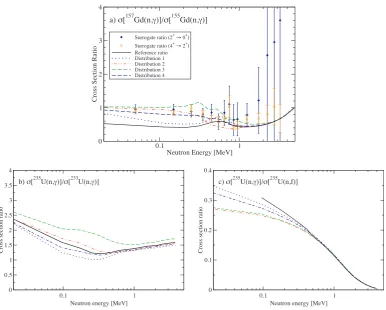
Surrogate Ratio approach.The studies of the Gadolinium region also show that the Weisskopf-Ewing approximation overestimates the (n,γ) cross section by factors which depend on the nucleus under consideration [21, 22]. For the 155Gd(n,γ) and 157Gd(n,γ) cross sections, the differences are large, despite the structural similarities of the relevant nuclei. Consequently, the ratio approach results in155Gd(n,γ) cross sections that are too large by up to a factor two for energies below aboutEn =
0.7 MeV (Fig. 5a). The effect is seen in both the theoretical sensitivity study and the experimental results. Overall, the ratio approach was found to reduce, but not eliminate, the effect of the spin-parity mismatch on the extracted cross sections for energies where the Weisskopf-Ewing assumption is a poor approximation.
0.1 1
Neutron Energy [MeV] 0
1 2 3 4
Cross Section Ratio
Surrogate ratio (2+! 0+)
Surrogate ratio (4+! 2+)
Reference ratio Distribution 1 Distribution 2 Distribution 3 Distribution 4
a) "[157Gd(n,#)]/"[155Gd(n,#)]
0.1 1
Neutron energy [MeV] 0
0.5 1 1.5 2 2.5 3 3.5 4
Cross section ratio
b) ![235U(n,")]/![233U(n,")]
0.1 1
Neutron energy [MeV] 0
0.1 0.2 0.3 0.4
Cross section ratio
c) ![235U(n,")]/![235U(n,f)]
Ratio results for Uranium are shown in Fig 5b and c. For actinides, two types of ratio measurements can be considered: A distinction is made betweeninternal andexternalsurrogate ratio approaches, based on whether the ratio under consideration involvesonecompound nucleus (but different decay channels) ortwo differentcompound systems, but identical exit channels. The more widely employed variant is the external surrogate ratio method. In this variant, the cross sections in the ratioR(E)=σCN1 α1χ1
/σCN2
α2χ2 of Eq. 4 refer to two reactions with the same type of entrance channel,α1 =α2(=n+target
here), and the same type of exit channel, χ1 =χ2 (=γdecay here), but different compound nuclei, CN1 , CN2. An example is shown in Fig 5b, where we consider σ[235U(n,γ)]/ σ[233U(n,γ)]. In
the internal surrogate ratio approach, the compound nuclei created in the two reactions of interest are identical,CN1 =CN2, the entrance channels are identical,α1 =α2, but the decay channels differ in type,χ1,χ2. In Fig 5c, we show results for the decay of a compound uranium nucleus byγemission relative to the decay by fission. We find that the internal ratio approach shows closer agreement than the external surrogate ratio approach. Experimentally, the internal ratio method has been explored by Bernsteinet al. [23] and by Allmondet al. [24].
5 Gamma-ray cascades
To improve the accuracy of the cross sections extracted from surrogate data and to reliably reliably apply it to neutron capture reactions, a more detailed description of the reaction mechanisms involved is required. Specifically, we have to quantitatively account for the fact that the weightsFCNδ (Eex,J, π), by which the decay probabilitiesGCNχ (Eex,J, π) are multiplied in Eq. 2, are different from the relative
formation cross sections fCN
α (Eex,J, π) ≡σCNα (Eex,J, π)/PJ0π0σCNα (Eex,J0, π0) of Eq. 1. Predicting these weights requires a framework for calculating cross sections of different reactions (stripping, pick-up, charge exchange, and inelastic scattering) to continuum states, for a variety of projectiles (p, d,t,α, etc.) and targets (spherical, deformed, and transitional).
0 1 2 3 4
Neutron energy [MeV] 2+! 0+ 4+! 2+ 6+! 4+ 8+! 6+ 10+! 8+
0 1 2 3 4
Neutron energy [MeV] 0
0.2 0.4 0.6 0.8 1 0 0.2 0.4 0.6 0.8 1
a) Distrib. 1
b) Distrib. 2
c) Distrib. 4
d) Distrib. 3
Theories describing transfer, inelastic scattering, and charge exchange reactions that lead to final states with low excitation energies are well established [25]. Many experiments have been carried out over the years to test the theoretical predictions against cross section measurements. The angular and energy dependences of the cross sections have been measured, for various projectile-target combina-tions and bombarding energies, and used to improve the theories. To use these theories to describe surrogate reactions they must be extended to treat highly-excited, overlapping, unbound final states in the residual nucleus. It is highly desirable that these extended theories be tested by measuring absolute cross sections for the energy and angular distributions of the ejectile, even though this is not strictly necessary to carry out a surrogate measurement.
For applications of interest here, it is not sufficient to calculate only the angular and energy depen-dence of the differential cross sections of the outgoing particle; reliable predictions for the spin-parity population of the residual compound nucleus are needed. Consequently, to test surrogate reaction mod-els it is necessary to also identify observables that are sensitive to theJπdistribution of the compound nuclei created. Candidates include the yields of discreteγ-ray transitions of the decaying compound nucleus, as well as angular distributions of fission fragments, for systems that decay via this mode.
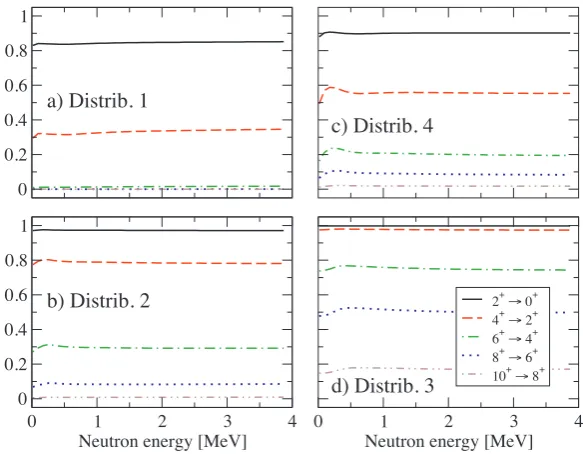
The path of theγ-cascade of a decaying compound nucleus is known to depend on the initial spin of the nucleus. While this fact can complicate the detection of the decay channel of interest in surrogate applications, it is also a source of useful information. Simultaneously measuring the yields of several suchγ-ray transitions can provide signatures for the spin-parity distribution of the compound nucleus prior to decay. An example for this is shown in Fig. 6, where we have plotted the relative yields of several ground-state band transitions for236U, for the four schematicJπdistributions shown in the right panel of Fig. 4. We find that differentJπdistributions lead to markedly different relative γ-ray yields. These observables can be employed to test and constrain theories that predict compound-nuclear spin-parity distributions. Relativeγ-ray yields for the decay of even-even gadolinium nuclei have recently been measured [22] and methods are being developed to use this information in order to improve the (n,γ) cross sections determined from surrogate experiments.
6 Concluding Remarks
Indirect approaches have to be developed in order to provide much-needed nuclear data, in particu-lar cross sections for reactions on unstable isotopes. We have discussed the surrogate nuclear reac-tion method, which aims at providing cross secreac-tion informareac-tion for compound nuclear reacreac-tions. Past applications of the method have demonstrated that it can provide useful cross section estimates for neutron-induced fission of actinides. Similar success in applications to neutron capture for a range of isotopes would be very valuable, as capture cross sections play an important role in nuclear astro-physics, national security, and nuclear energy. Most analyses of fission data carried out so far have made approximations that are likely to break down in situations relevant for extracting (n,γ) cross sec-tions from surrogate measurements, making this a more challenging reaction to tackle. The examples discussed illustrate this breakdown for capture reactions on Gadolinium isotopes and indicate that a similar breakdown can be expected for lighter nuclei near shell closures, while the situation for ac-tinides seems slightly better. We have also indicated how the method can be improved by taking into account the different spin-parity distributions that occur in the desired and surrogate reactions. In par-ticular, we have identified the role of gamma-ray cascades in testing theoretically predicted spin-parity distributions.
Acknowledgments
References
1. M.L. Cognata, C. Spitaleri, A.M. Mukhamedzhanov, The Astrophysical Journal 723(2), 1512 (2010)
2. R. Capote, M. Herman, P. Oblozinsk´y, P. Young, S. Goriely, T. Belgya, A. Ignatyuk, A. Koning, S. Hilaire, V. Plujko et al., Nuclear Data Sheets110(12), 3107 (2009)
3. E. Gadioli, P.E. Hodgson,Pre-Equilibrium Nuclear Reactions(Clarendon Press, Oxford, 1992) 4. J.E. Escher, J.T. Burke, F.S. Dietrich, N.D. Scielzo, I.J. Thompson, W. Younes, Rev. Mod. Phys.
in press(2011)
5. W. Younes, H.C. Britt, Phys. Rev. C67(2), 024610 (2003) 6. W. Younes, H.C. Britt, Phys. Rev. C68(3), 034610 (2003) 7. J.D. Cramer, H.C. Britt, Nucl. Sci. and Eng.41, 177 (1970) 8. H.C. Britt, J.B. Wilhelmy, Nucl. Sci. and Eng.72, 222 (1979) 9. M. Petit, M. Aiche, G. Barreau et al., Nucl. Phys. A735, 347 (2004)
10. S. Boyer, D. Dassie, J. Wilson, M. Aiche, G. Barreau, S. Czajkowski, C. Grosjean, A. Guiral, B. Haas, B. Osmanov et al., Nucl. Phys. A775, 175 (2006)
11. G. Kessedjian, B. Jurado, M. Aiche, G. Barreau, A. Bidaud, S. Czajkowski, D. Dassi´e, B. Haas, L. Mathieu, L. Audouin et al., Physics Letters B692(5), 297 (2010)
12. M. Basunia, R. Clark, B. Goldblum, L. Bernstein, L. Phair, J. Burke, C. Beausang, D. Bleuel, B. Darakchieva, F. Dietrich et al., Nuclear Instruments and Methods in Physics Research Section B: Beam Interactions with Materials and Atoms267(11), 1899 (2009)
13. J.E. Escher, F.S. Dietrich, Phys. Rev. C74(5), 054601 (2006) 14. C. Plettner et al., Phys. Rev. C71, 051602(R) (2005)
15. J.T. Burke, L.A. Bernstein, J. Escher, L. Ahle, J.A. Church, F.S. Dietrich, K. Moody, E.B. Norman, L. Phair, P. Fallon et al., Phys. Rev. C73, 054604 (2006)
16. S.R. Lesher, J.T. Burke, L.A. Bernstein, H. Ai, C.W. Beausang, D.L. Bleuel, R.M. Clark, F.S. Dietrich, J.E. Escher, P. Fallon et al., Physical Review C (Nuclear Physics)79(4), 044609 (2009) 17. J.J. Ressler, J.T. Burke, J.E. Escher, C.T. Angell, M.S. Basunia, C.W. Beausang, L.A. Bernstein,
D.L. Bleuel, R.J. Casperson, B.L. Goldblum et al., Phys. Rev. C83(5), 054610 (2011) 18. F. K¨appeler, A. Mengoni, Nuclear Physics A777, 291 (2006)
19. G. Aliberti, G. Palmiotti, M. Salvatores, T. Kim, T. Taiwo, M. Anitescu, I. Kodeli, E. Sartori, J. Bosq, J. Tommasi, Annals of Nuclear Energy33(8), 700 (2006), ISSN 0306-4549
20. C. Forss´en, F. Dietrich, J. Escher, R. Hoffman, K. Kelley, Phys. Rev. C75, 055807 (2007) 21. J.E. Escher, F.S. Dietrich, Phys. Rev. C81(2), 024612 (2010)
22. N.D. Scielzo, J.E. Escher, J.M. Allmond, M.S. Basunia, C.W. Beausang, L.A. Bernstein, D.L. Bleuel, J.T. Burke, R.M. Clark, F.S. Dietrich et al., Phys. Rev. C81(3), 034608 (2010)
23. L.A. Bernstein, J. Burke, L. Ahle, J.A. Church, J. Escher et al., Tech. rep., Lawrence Livermore National Laboratory, Livermore, CA (2006)
24. J.M. Allmond, L.A. Bernstein, C.W. Beausang, L. Phair, D.L. Bleuel, J.T. Burke, J.E. Escher, K.E. Evans, B.L. Goldblum, R. Hatarik et al., Physical Review C (Nuclear Physics)79(5), 054610 (2009)
![Fig. 1. Schematic representation of the “desired” (top) and “surrogate” (bottom) reaction mechanisms [4]](https://thumb-us.123doks.com/thumbv2/123dok_us/8086017.1349405/3.595.177.422.129.392/fig-schematic-representation-desired-surrogate-reaction-mechanisms.webp)
![Fig. 2. Fission cross sections obtained from surrogate ratio measurements. Thetermined relative to the known 238Pu(n,f) cross section was de- 234U(n,f) and 235U(n,f) cross sections [17]](https://thumb-us.123doks.com/thumbv2/123dok_us/8086017.1349405/5.595.170.429.92.286/fission-sections-obtained-surrogate-measurements-thetermined-relative-sections.webp)