I
Journal of
Volume 9, Klbmber 3 May, 1956
RANGE
MANAGEMENT
Integrated Management of Timber, Water,
Forage and Wildlife Experience as
Practiced by Lumber Companies
AL
MOLTKEVice Preside&, Pilot Rock Lumber Co., Pilot Rock, Oregon
Range management today is part of the responsibilities of all own- ers and managers of private forest lands. There was a time when a lumberman gave little thought to anything besides how much tim- ber was on the tract when evalu- ating a purchase. His primary ob- jective was, of course, to cut as many boards as possible from the land. Then, he was through with it. Also, his objective was to make as big a profit from the forest in the shortest possible time and that profit was only represented by timber. Many cut out and got out, made a good profit and that was all there was to it. When that stand was cut, they would get more timber and repeat the process.
In recent years, many lumber- men have come to realize that there are no forest frontiers left in America. If they hope to stay in business and, by so doing, support the towns that have grown up around them and have come to de- pend upon their industry for their existence, then they must stay in one place, get the most productiv- ity from the ground they own and manage. This happens to be the position of the Pilot Rock Lumber Company.
Many lumbermen have now taken a second look at the timber grow- ing potential of their lands for the first time. They have come to re- alize that timber could be looked upon as a crop, and economically
so, like any other crop. As much of the western forest lands could also grow grass-why not also get the most from the grass potential of those lands. Several lumbermen operate cattle ranches in conriec- tion with their lumber business. However, we at Pilot Rock are staying out of the cattle business and sticking to one headache at a time.
We are earnestly trying to get maximum utilization from every tree we cut. We are also retaining the maximum payroll from lumber processing for our community. Our grass and grazing permittees are watch e d zealously because we know that being lumbermen we are not supposed to know or care much about our grass. To disprove this theory, we have employed an expert with practical grazing and cattle business know-how. For that job, we selected a successful re- tired cat t 1 eman, who learned through experience that it does not pay to overgraze.
While I can’t say how many lumber operators are doing exactly as we are, I believe that today most timber operators of substan- tial size in the Pacific Northwest have grazing programs integrated into t h e i r forest management plans.
We are cutting our timber on a sustained-yield basis, leaving thrifty trees to grow the future crop for the future generation of
111
loggers. In this way, we get the maximum in wood growth from our lands. This is economically feasible in view of the collateral value incorporated in our cut-over lands. While consideration has been given to the wood productiv- ity of these lands, up until recent- ly not much thought was given to the grass productivity of the same land. We found that both crops do well together, so we have in- cluded grass in our forest man- agement plan.
Our range management starts with seeding our skid trails to a good, locally recommended range grass. We depend upon the Forest Service recommendations to be as near correct as is presently pos- sible in view of the fact that they have a special department set up for range management, and are familiar with our local conditions. Advice on the correct time to seed has also been taken from the For- est Service. In our area, this is considered to be either in late fall before the first snows, or on the first light snow. There is danger in waiting too long, as access to the area may become quite difficult if deep snow comes early. Thus, seeding, like burning brush, is lim- ited sometimes to a very short pe- riod.
112 AL MOLTKE
just referred to is in the John Day River country and is inside the national forest boundaries served by the Dale Ranger Station. Ap- proximately 30,000 acres are in- volved in our private forest lands in this area.
Outside the boundaries of the na- tional forest this cannot be done so we have employed a range manager to handle the grazing on some 60,- 000 company owned acres that lie outside the forest boundaries. His responsibility is to control size of herds that the various permittees wish to run on our lands. Also, it is up to him to decide range dis- putes. If a permittee persists on slipping in more cattle than the range will stand, then our range manager has the unpleasant job of cancelling his permit.
All of our range leases are so written that if overgazing is prac- ticed, then the next year’s lease will not be renewed. All leases with few exceptions are written for only one year with a promise of renewal at our company’s option. We have no trouble getting takers on that basis.
#In our business, we are using large numbers of forest weed trees for chips. These chips are con- verted to pulp and eventually fibreboard. Removal of these trees is of value in promoting better saw-timber growth, the major crop of the area.. This also aids in securing better snow compaction and thus creates a better watershed while conducting a sound logging program. Better forest watersheds aid much in controlling streamflow and thus contribute toward stabili- zation of our great hydroelectric plants now being built on the great river systems of the Northwest.
I would like to point out here that we believe that it is the duty of all conservation-minded people to protect the watershed value of their lands. It is my firm belief that the future economy of this
country can be maintained as it now is for the longest possible time only if we give serious considera- tion to maximum conservation and utilization of the water that falls on our forests from the skies through rain and snow.
Our forests comprise much of the area in which we live. They are the source of the water supply of the Columbia River and its trib- utaries. Agriculture is ba.sically fully developed. The lumbering business will have to decline to some extent as soon as all private forests are cut. There is not enough wood now growing in the western forest to maintain all mills now op- erating on their present annual cut- ting basis. Substitutes will have to be found to take the place of wood- en boards. These substitutes will be made because of available power from the river. This country’s population is mushrooming rap- idly. The potential of the river is the only remaining frontier to be claimed by the present and future population of the area. The water from the forest can play and will play an important part in their fu- ture standard of living.
As I have tried to point out, the forests have multiple uses. There is one important use yet that I have not mentioned, but it most certainly should be.
The rightful heritage of all red- blooded Americans is the recrea- tion incorporated within these for- ests. This can also be considered as an important factor in our present economy. Much of our present business is based on equip- ment and supply needed for recre- ation. It is the policy of our com- pany to contribute toward this use of our private lands by allowing free use of our logging road sys- tem under fair and wise control. Written permits are granted upon request. Keys to our locked gates are also issued without charge We know that the recreational use of
our forests would be wasted if not used. We do not wish to see waste of any kind. Thus, we have co- operated with our neighbors in this respect and I know of no fair request for such use that has been denied. Better public relations are our reward.
About 5,000 acres of our lands in the lower John Day river coun- try were found to be ideal for a winter refuge for wildlife. Upon request by the Oregon State Game Commission, we made this land available for its best use, a big game winter refuge since 1950. This was our major contribution toward wildlife protection and as I un- derstand from recent reports, it is proving to be all the Game Com- mission expected. Thus, I have endeavored to point out that tim- ber, cattle, watershed, wildlife and recreation are all an integrated part of a private forest, and can be managed without one interfer- ing with the other.
The Management of Livestock in the
Xerophytic Forest Region
of Central Argentina
JOHN BLYDENSTEIN
Former assiskxnt mawager of a ranch in ths Prowince of La Pa,mpa, Argentina; Senior Studen,t is Range Conserva- tion, State College of Washingtonn, P&main, Washington
_.
Much has been written about the region in Argentina around the city of Buenos Aires, the area better known as the “Pampas.” Another region, the high wind- swept plains of Patagonia have also excited the imagination solely by their extent of empty space. But between the humid but tree- less grassland of the Pampas of Argentina, and the desert in the rainshadow of the Andes moun- tains, lies a little known belt of xerophytic forest, commonly known as “monte,” which in the south blends into the highland pla.teau of Patagonia (Fig. 1).
Vegetation of the Area
In the province of La Pampa this forest is dominated by the c a 1 d 6 n tree (Prosop& calden) 7 which in the mature forest occurs in open stands with the individual trees from 30 to 50 feet apart
(Fig. 2). Besides the cald6n two other tree species occur in t,he as- sociation, the algarroba (Prosop/i.s jzcliflora), known in the IJnited States as mesquite, and the chafiar ( Gourliea decorticans > . To the north in the province of San Luis and C6rdoba the chafiar replaces the caldkn as the dominant spe- cies. Under the trees in the open forest an abundant cover of grasses occurs the most important of which are Trichloris mendotina, Melica macra and several Stipas.
_.
To the west of the caldhn-domi- nated forest, and stretching north into Perti, lies another vegetation type, commonly named “fachinal”. Here brush species dominate to the almost complete exclusion of a grassy understory. Algarroba and
jarilla (Larrea diwricata) are the dominant species with the widely distributed piquillin (Condaliu
microphylla). All these brush spe- cies are also found thinly scattered throughout the xerophytic forest.
Where caldknes have been killed by fire or removed by man for firewood or clearing of the land for agriculture, jarilla will multi- ply rapidly and form impenetra- ble stands, making the area almost useless for the grazing by live- stock.
Within the forest region lie large areas of rolling hills dominated by grass vegetation. Occasional thick- ets of caldhn, chacar, or isolated piquillin, or sombra de toro (Yo- dina rhombifolia) are the only taller plants found on the coarser sandy soil of this vegetation type dominated by cebadilla (Bromus catharticus), known in the Eng- lish-speaking world as rescue grass.
ARGENTINA
md area of detailed mapI
ka
IExtension OC Xerophytic Forest
D!l
and, “FachinaL”
Ezl
Xerophvtic Forest
L&i
W&l
FIGURE 1. Map of Central
and the fachinal. Argentina showing the extension of the xerophytic forest
114 LlVESTOCK MANAGERIEXT Ih’ CENTRAL ARGENTINA
Also in abundance is the unpal- atable olives (I’lazia arqenfee) which with its long root system ia an excellent soil binder. Together with tupe (Panicxm wwilleanzlm) it is the first to inxxle and fix the uncovered sand dunes in the area. Some of the other.grasses in the association nre Setaria geniculata, Pm longiligula, Cellchrzls pauci- florzcs, Hordeum brachyantherwn, Melica maera and several more Stipas. In Argentina only the more distinctive grasses have a common name; the rest we grouped together into “pasta bue- no” and “paja brava”, respectirely good grass and bad grass.
In low depressions where salts hare collected only Disfichlis stri- ata and other halophytic species will grow. On other areas the prox- imity of the water table is indi- cated by the .&l-known Pampas grass (Cortaderia) (Fig. 3). Sev- eral of thrsr areas have been plowed and seeded to rye or al- falfa as Tinter pastures (Fig. 4). Heavy grazing has allowed the in- vasion of Russian thistle (Salsola k&i) an,3 these pastures are useful to livestock only in early spring when the thistle is still succulent and green. Heary grazing of the Russian thistle at that time has been found to reduce the stand considerably and allow the reestab- lishment of the original grass eoY?r.
Utilization of the Range I’uhlic range is almost unknown in Argentina. The best land has long ago been granted to Spanish soldiers or else has been bought or occupied by other private inter- ests. Federal land has either re- verted to the government through non-payment of taxes o* is in sparsely populated and undevel- oped area like Patagonia. Almost all grazing land is fenced off in the basic land unit of one “legua”, a square of 3 by 3 miles enclosing an area of 2,500 hectares or ap- proximately 6,400 acres. Some- times these legnas are subdivided into smaller pastures depending on the intensity of the livestock oper- ation and th? developmmt of wa-
tering facilities for livestock. Most of the livestock operators have now recognized the beneficial as- pects of the shade and shelter pro- vided by trees and many fences have bepn deviated from their previous straight compass lines to inelude at least some shaded area in each pasture.
Both cattle and sheep graze in the forest and grassland area of the province of La Pampa. The sheep are rained as ~001 producers and the M&no breed predorn- nates. Catt,le are bred for sale as feeders to be fattened on the al- falfa pastures in the province of T%u~non Aires to the east. The Shorthorn is the dominant breed in Argentina, but both Herefords and Aberdeen Angus are found in increasing nnmbers on the range in addition to crosses of these brwds with the Shorthorn.
LIVESTOCK MANAGEMENT IN CENTRAL ARGENTINA 115
open grasslands. During the heat of the summer they seek the shel- ter of the forest and praze there for the most part. In some winters the seedpods of the calden tree can be depended on to provide an abundant feed in addition to the grasses that have cured on the stem. The bulls and part of the breeding herd are mostly over- wintered on pastures that have been seeded to rye or sorghums in the previous fall, but sheep are left to browse on the shrubs and to overwinter as well as they can.
The breeding season for the cat- tle starts in the spring (Septem- ber) when the bulls are taken out of their winter pastures and di- vided over the herds in the differ- ent leguas of the ranch. They re- main until the winter round-up, which takes place after the first frosts have killed off the flies. At this round-up the year’s calf crop is branded, dehorned and eas- trated, while those calves ready for weaning are separated. The cows and bulls are vaccinated against foot-and-mouth disease and the calves get a vaccination against blackleg. The older ani- mals are run through the chute and selection takes place according to age. Old cows are sold locally while the old bulls are shipped by railway directly to the packing houses in Buenos Aires. Heifers and steers are sold at the local markets to buyers from the prov- ince of Buenos Aires at ages m,ry- ing from 10 months to 2 years. Spring and fall are the best time for sales when the rains have greened up the pastures of the in- termediate buyers and have al- allowed them to overstock tempo- rarily. Sales take place in groups of 20 to 50 head. Prices are per- head, all animals in one group be- ing sold at the same price, which varies between 400 to 700 pesos, or $14 to $24 at the free exchange rate of 2g peos to the U. S. dollar. The sheep run in bands of ap- proximately 300 per legua. At the end of the winter they are rounded up and the lambs are docked, cas-
trated and earmarked. The sheep are counted at this time to estab- lish their exact number for the time of shearing a month later, and older sheep are culled and held separate for consumption on the ranch. Shearing takes place in October after the spring rains and is done by contract. After shear- mg, the sheep are held in forested pastures where they can find shel- ter against the detrimental effects of rain and frosts which are still a probability at this time of the year. A few weeks after shearing the sheep are dipped to control ex- ternal parasites. Lambs are weaned and put into separate pas- tures in readiness for shipping by railway to the market in the city of Buenos Aires, 500 miles to the east. The old equipment of the Argentine railways and the scar- city of ears has made it necessary to order railroad cars and fix ship- ping dates for lambs for months beforehand vhen the ranchers do not e”~n know the amount of lambs they mill ham available to send to market.
Prospects for Improvements Lack of appreciation for the problems of the range has caused this resource to be nrglected. Man- agement of the livestock is the base of the ranch operations in this part of Argentina, while the range is considered as a fixed item influenced only by the an-
nual rainfall. Range eonditiou is determined largely by the condi- tion of the livestock grazing on it. Bad distribution of the livestock over the range due to scarce water derelopments and faulty or eon,- plete absence of salting practices has caused overgrazing in many parts of the area. This is especi- ally noticeable in the pastures near the ranch headquarters and corrals where horses are kept throughout the year and which get heavy use at the time the livestock are worked.
Recent research in Argentina has concentrated on crop agricul- ture, sometimes practiced on defi- nitely sub-marginal land. Even there extension service and other met hods of disseminating the knowledge of modern agricultural practices are inadequate. Commer- cial quantities of grass seeds are available for only a few species, Crested wheatgrass became avail- able only in 1953. Experiments with this species began after its fame had spread from the United States. Little research has been conducted with native species on their adaptability to range reseed- ing or other improvement prae- tiees.
116 JOHN BLYDENSTEIN
and was one of the main causes for the slow recovery after the drought of 1950-52.
Conclusion
Introduction of modern range management methods is essential to stop the decline of the range in Argentina. Better animal hus- bandry practices such as shorter breeding season to insure a more uniform calf crop, better selection based on the culling of non-pro- ducing breeding stock, and the use of good bulls will lessen the graz- ing pressure on the range without appreciably lowering the repro- duction of the herds. The ranch operators should also be made aware of the value of plants as
indicators of range condition and the possibilities of range improve- ment through special grazing sys- tems.
Improvement of the range itself must wait until the cost of such a program comes more in line with the prices received for the products of the range. The following sta- tistics of the ranch in the neigh- borhood of Victorica where the writer worked will bear this out. This ranch had an income from sales of wool, cattle and sheep equivalent to $15,000 while annual costs amounted to $12,300. The ranch occupied a total area of 43,000 acres, of which 18,000 acres were open grassland, 14,000 acres
were forest and the rest bordered on fachinal. In 1954 the number of animals amounted to 1,300 head of cattle and 2,000 head of sheep. This was considered one of the richer ranches in the region.
BIBLIOGRAPHY
ALMANAQUE. 1951-52. Ministerio de Ag- ricultura y Gander& de la Repfiblica Argentina, Paseo Col6n 974, Buenos Aires.
MONTICELLI, JUAN V. 1938. Anotaciones fitogeogrhficas sobre la Pampa Central. Revista botanica de la Universidad de Tucuman Lilloa 3: 251-382.
STIEBEN, ENRIQUE. 1946. La Pampa. Ediciones Peuser, Buenos Aires. WILLIAMSON, JUAN. 1950. Sugestiones
sobre la sequia en la Pampa Central. Revista Argentina de Agronomia 17
(1) : 106-113.
Plant Counts and
Seed
Production on
California Annual-Type Ranges
H. H. BISWELL AND CHARLES A. GRAHAM
Professor of Forestry, Univwsi~ty of California, Berkeley; Range Conservationist, California Forest & Ra,mge Expe& ment Sta’tiod
California has about 22,000,OOO acres on which annual plants pre- dominate in the herbaceous cover. This is known as the California an- nual-type vegetation (Talbot, Bis- well and Hormay, 1939). The flora is made up of many different spe- cies, as many as 200 or 300 per square mile. As many as 35 and commonly 15 to 20 species have been recorded for a square foot of ground. Seed production is gener- ally high, even under adverse weather conditions and fairly close grazing. Burcham (1955) reported yields of 400 to 1,600 pounds per acre in open grassland ranges. The vegetational cover varies greatly from place to place and from sea- son to season depending upon such factors as variable weather, kind
IThe California Forest and Range Es- periment Station is maintained at Berke- ley, California by the Forest Service, U. S. Department of AgrimltuTe in co- operation with the Ukversity of Cal- if ornia.
of soil, degree and season of graz- ing, and occurrence of fire (Tal- bot and Biswell, 1942; Hervey, 19’49 ; Kadish, 1955 ; Biswell, 1955). To learn more about the ecology of the annual-type vegetation, counts were made of individual plants on 152 sample plots over a period of three years at the San Joaquin Experimental Range,2 in the Central Sierra Nevada foothills of California. This area is fairly representative of a vast portion of the 22,000,OOO acres of the annual- type vegetation. Another reason for making the counts was to test the practicability of this method of sampling yearly and seasonal changes in the resident annual-type vegetation.
Plant Numbers and %rvival
In Dense Bands
Soon after the first rains in the fall, ground that has been virtually zA branch of the California Forest and Range Experiment Station.
too dry during late summer for plants to, grow becomes literally covered with thousands of annual plants. Approximately 50 percent of those in dense stands die before reaching maturity, and one-half to three-fourths of those remaining are stunted plants. This sequence of development was followed for 4 three years by counting the indi- vidual plants on the 152 sample plots.
During the first year the young seedlings were counted on 0.2 x 0.2- foot square sods taken from the very densest stands obtainable of certain abundant range plants. Converted to a square-foot basis, four samples of soft chess (Bromus mollis) averaged 17,433 plants per square foot; four of foxtail fescue (Pestuca megalura) 20,875 ; and nine of broadleaf filaree (Erodium botrys) 1,048. Scattered in with the broadleaf filaree were about an equal number of other plants, mainly grasses. These averaged 1,600 per square foot for the nine plots.
116 JOHN BLYDENSTEIN
and was one of the main causes for the slow recovery after the drought of 1950-52.
Conclusion
Introduction of modern range management methods is essential to stop the decline of the range in Argentina. Better animal hus- bandry practices such as shorter breeding season to insure a more uniform calf crop, better selection based on the culling of non-pro- ducing breeding stock, and the use of good bulls will lessen the graz- ing pressure on the range without appreciably lowering the repro- duction of the herds. The ranch operators should also be made aware of the value of plants as
indicators of range condition and the possibilities of range improve- ment through special grazing sys- tems.
Improvement of the range itself must wait until the cost of such a program comes more in line with the prices received for the products of the range. The following sta- tistics of the ranch in the neigh- borhood of Victorica where the writer worked will bear this out. This ranch had an income from sales of wool, cattle and sheep equivalent to $15,000 while annual costs amounted to $12,300. The ranch occupied a total area of 43,000 acres, of which 18,000 acres were open grassland, 14,000 acres
were forest and the rest bordered on fachinal. In 1954 the number of animals amounted to 1,300 head of cattle and 2,000 head of sheep. This was considered one of the richer ranches in the region.
BIBLIOGRAPHY
ALMANAQUE. 1951-52. Ministerio de Ag- ricultura y Gander& de la Repfiblica Argentina, Paseo Col6n 974, Buenos Aires.
MONTICELLI, JUAN V. 1938. Anotaciones fitogeogrhficas sobre la Pampa Central. Revista botanica de la Universidad de Tucuman Lilloa 3: 251-382.
STIEBEN, ENRIQUE. 1946. La Pampa. Ediciones Peuser, Buenos Aires. WILLIAMSON, JUAN. 1950. Sugestiones
sobre la sequia en la Pampa Central. Revista Argentina de Agronomia 17
(1) : 106-113.
Plant Counts and
Seed
Production on
California Annual-Type Ranges
H. H. BISWELL AND CHARLES A. GRAHAM
Professor of Forestry, Univwsi~ty of California, Berkeley; Range Conservationist, California Forest & Ra,mge Expe& ment Sta’tiod
California has about 22,000,OOO acres on which annual plants pre- dominate in the herbaceous cover. This is known as the California an- nual-type vegetation (Talbot, Bis- well and Hormay, 1939). The flora is made up of many different spe- cies, as many as 200 or 300 per square mile. As many as 35 and commonly 15 to 20 species have been recorded for a square foot of ground. Seed production is gener- ally high, even under adverse weather conditions and fairly close grazing. Burcham (1955) reported yields of 400 to 1,600 pounds per acre in open grassland ranges. The vegetational cover varies greatly from place to place and from sea- son to season depending upon such factors as variable weather, kind
IThe California Forest and Range Es- periment Station is maintained at Berke- ley, California by the Forest Service, U. S. Department of AgrimltuTe in co- operation with the Ukversity of Cal- if ornia.
of soil, degree and season of graz- ing, and occurrence of fire (Tal- bot and Biswell, 1942; Hervey, 19’49 ; Kadish, 1955 ; Biswell, 1955). To learn more about the ecology of the annual-type vegetation, counts were made of individual plants on 152 sample plots over a period of three years at the San Joaquin Experimental Range,2 in the Central Sierra Nevada foothills of California. This area is fairly representative of a vast portion of the 22,000,OOO acres of the annual- type vegetation. Another reason for making the counts was to test the practicability of this method of sampling yearly and seasonal changes in the resident annual-type vegetation.
Plant Numbers and %rvival
In Dense Bands
Soon after the first rains in the fall, ground that has been virtually zA branch of the California Forest and Range Experiment Station.
too dry during late summer for plants to, grow becomes literally covered with thousands of annual plants. Approximately 50 percent of those in dense stands die before reaching maturity, and one-half to three-fourths of those remaining are stunted plants. This sequence of development was followed for 4 three years by counting the indi- vidual plants on the 152 sample plots.
During the first year the young seedlings were counted on 0.2 x 0.2- foot square sods taken from the very densest stands obtainable of certain abundant range plants. Converted to a square-foot basis, four samples of soft chess (Bromus mollis) averaged 17,433 plants per square foot; four of foxtail fescue (Pestuca megalura) 20,875 ; and nine of broadleaf filaree (Erodium botrys) 1,048. Scattered in with the broadleaf filaree were about an equal number of other plants, mainly grasses. These averaged 1,600 per square foot for the nine plots.
PLANT COUNTS AND SEED PRODUCTION ON CALIFORNIA RANGE 117
During the second season, 33 2 x 2-foot plots were staked out in dense stands, including soft chess, foxtail fescue, broadleaf filaree and whitetip clover (Trifolium varie- gatum). Density of vegetation was estimated for each of these plots, after which two 0.2-foot-square units of equal density were chosen in each plot for the plant counts. One unit was carefully removed, the sod torn apart and the seedlings counted; the second was staked for counting at the height of plant de- velopment, during the latter part of April. When the April counts were made, density was again es- timated for the two sets of plots. The results from these counts and estimates are summarized in Table 1.
The estimates of forage density on the 2 x 2-foot plots were consid- erably higher than over the experi- mental range as a whole: 56 per- cent as against 37 percent. The estimates of vegetation density on the 0.2 x 0.2-foot units were still higher, averaging almost 7’7 per- cent.
The greatest reduction in plants from the seedling stage to ma- turity occurred in the clover stands and the least reduction in the broadleaf filaree plots. The percentage reductions for each of the species were as follows: fox- tail fescue, 50 percent ; soft chess, 38 percent ; broadleaf filaree, 11 percent ; whitetip clover, 93 per- cent. The whitetip clover has a spreading habit of growth which may partly account for the greater mortality in stands of this species as it develops to maturity. The grasses in dense stands seldom de- velop tillers but in thinned stands
FIGURE 1. Annual plants comprise nearly all of the resident herbaceous vegetation in the lower portions of the Central Sierra Nevada foothills of California.
the tillers may be many. In a con- tiguous area where scraping the soil surface had greatly thinned the stand, foxtail fescue plants had developed as many as twenty till- ers. These added materially to the density of the vegetation in the mature stage.
In the spring of the third year, ten sods of one square-foot each of the four species were selected at random in mature stands of 90 per- cent density or better and counts made of all the plants. These sods showed the following numbers of plants per square foot: foxtail fescue-7,435, with 395 additional plants of other species; soft chess -5,075, with 525 additional plants of other species; broadleaf filaree
-1,002 with 1,002 additional plants of other species; and white- tip clover-705, with 1,085 addi- tional plants of other species. Another set of 10 sods per species selected at random in stands of about average density showed the following numbers at maturity : foxtail fescue-2,020, with 432 of other species ; soft chess-1,435, with 370 of other species; whitetip clover-347, with 150 of other spe- cies.
The sample sods each year showed wide range in number of plants per unit area.
Time required for the counts averaged 11, hours for each of the seedling plots and one hour for the mature plant sods. Because of the
Table 1. De,nsity and number of plants pelr square fooit on dense sample plolts in the amual-type vegetation.
Plant density No. of plants per square foot
No. ~ Seedlings Mature plants Dominant species Other plants Total of 2x2-ft. .2x.2-ft. 2x2-ft. .2x.2-ft. Seed- Mature Seed- Mature Seed- Mature Dominant species plots plots plots plots plots lings plants lings plants lings plants
$7 % % %
Foxtail fescue 10 40 60 60 74 15,625 7,435 332 395 15,957 7,830
Soft chess 9 46 58 58 77 8,638 5,075 438 525 9,076 5,600
Broadleaf filaree 10 45 76 53 77 1,210 1,002 1,032 1,002 2,242 2,004
118
H. H.variability in numbers of plants per sod and the time required to make the counts it was concluded that the count method of sampling resident annual vegetation as used here would likely be impractical where many plots are needed for a reliable sample. However, for cer- tain studies in which exactness is desired the count method may prove highly satisfactory. It has been used occasionally in reseeding studies.
Seed Prolduction
Annual plants usually produce an abundance of seed. Judging from the number of plants per unit area, no scarcity of seed existed on the ground in the areas where counts were made. Seed produc- tion insufficient for another year’s crop under normal conditions is usually not a particular problem on annual-type ranges.
As an indication of the number of seed produced per unit area, counts were made of the seed pro- duction of broadleaf filaree. The seeds were counted on 26 plots of 4-foot radius distributed along a one-mile fence line separating a heavily grazed pasture from one moderately to lightly grazed over a 7-month period. An average of
BISWELL AND CHARLES A. GRAHAM
537 broadleaf filaree seeds were produced per square foot in the heavily used pasture, and 683 in that moderately- to -lightly used. Four plots protected from grazing gave an average of 1,087 seeds, the number varying from 335 to 2,283. The forage density on all plots, grazed and ungrazed, averaged 33 percent with broadleaf filaree com- prising 41 percent of the plant cover. On the four protected plots the plant density averaged 41 per- cent, and broadleaf filaree made up 51 percent of the cover.
Summary
Counts were made of individual plants of several species in the seedling stage and at maturity on sample plots in the California an- nual-type vegetation to learn more of the ecology of this plant cover and to test the practicability of this method of sampling changes in the vegetation. Measurements were also made of the number of seed produced by plants of broad- leaf filaree.
Seedling numbers varied widely, being highest in foxtail fescue, a plant with small seedlings, with -20,875 per square foot in the densest stands. Approximately 50 percent of the seedlings in dense
stands die before reaching matu- rite and up to three-fourths of those remaining are stunted plants. Because of the great variability in number of plants per unit area and the time required for making counts, this method of sampling annual and seasonal changes in the vegetation has limited applica- tion.
Seed production in the annual vegetation type is high under nor- mal conditions of weather and grazing.
LITERATURE CITED
BISWEU, H. H. 1955. Ecology of Cal- ifornia grasslands. Jour. of Range Mangt. 9( 1) : 19-24.
BURCHAM, L. T. 1955. Recent trends in range improvement on California foothill ranges. Jour. Range Mangt. 8 : 121-125.
HERVEY, D. F. 1949. Reaction of a Cal- ifornia annual-plant community to fire. Jour. of Range Mangt. 2: 116- 121.
KADISH, AMRAM. 1955. Vegetation as related to soil type. Unpublished data. TALBOT, M. W., H. H. BISWELL AND A. L. HORMAY. 1939. Fluctuations in the annual vegetation of California. Ecology 20 : 394-402.
TALBOT, M. W. AND H. H. BISWELL~ 1942. The forage crop and its man- agement. In The San Joaquin Expt. Range. Calif. Agr. Expt. Sta. Bull. 663 : 13-49.
Effect of Sheep
and
Rabbit Digestion on the
Viability of Some Range Plant Seeds1
W. P. LEHRER JR. AND E. W. TISDALE
Associate Professor of Animal Husbandry and Professor of Range Matiagemsnt, respectively, University of Idaho, Mos- cow, Idaho
The role that animals play in attached to their bodies or by in- the dissemination of seeds has been gestion of seeds at one location the subject of speculation and lim-
ited study for many years. It has been established that -animals may spread plants when seeds become lP&lished with the approval of the Director as Research Paper No. 409 of the University of Idaho Agricultural Experiment Station.
and discharge at another. In many areas grazed by livestock, or used for trailing, plants formerly not common to the region have been introduced. It seems logical to assume that in many cases these plants may have been intro- duced by livestock coming from
areas where these species were present or by the use of imported feeds containing seeds of these spe- cies. Today, livestock, in addition to being trailed, are often carried great distances to grazing areas by railroads or trucks. Consequently, seeds of various species could be spread over distant areas by live- stock in a short period of time. In addition, rabbits and rodents may act as carriers of seed for shorter distances.
In view of these possibilities, the present study was undertaken to determine the viability of certain range plant seeds after passing through the digestive tract of sheep
118
H. H.variability in numbers of plants per sod and the time required to make the counts it was concluded that the count method of sampling resident annual vegetation as used here would likely be impractical where many plots are needed for a reliable sample. However, for cer- tain studies in which exactness is desired the count method may prove highly satisfactory. It has been used occasionally in reseeding studies.
Seed Prolduction
Annual plants usually produce an abundance of seed. Judging from the number of plants per unit area, no scarcity of seed existed on the ground in the areas where counts were made. Seed produc- tion insufficient for another year’s crop under normal conditions is usually not a particular problem on annual-type ranges.
As an indication of the number of seed produced per unit area, counts were made of the seed pro- duction of broadleaf filaree. The seeds were counted on 26 plots of 4-foot radius distributed along a one-mile fence line separating a heavily grazed pasture from one moderately to lightly grazed over a 7-month period. An average of
BISWELL AND CHARLES A. GRAHAM
537 broadleaf filaree seeds were produced per square foot in the heavily used pasture, and 683 in that moderately- to -lightly used. Four plots protected from grazing gave an average of 1,087 seeds, the number varying from 335 to 2,283. The forage density on all plots, grazed and ungrazed, averaged 33 percent with broadleaf filaree com- prising 41 percent of the plant cover. On the four protected plots the plant density averaged 41 per- cent, and broadleaf filaree made up 51 percent of the cover.
Summary
Counts were made of individual plants of several species in the seedling stage and at maturity on sample plots in the California an- nual-type vegetation to learn more of the ecology of this plant cover and to test the practicability of this method of sampling changes in the vegetation. Measurements were also made of the number of seed produced by plants of broad- leaf filaree.
Seedling numbers varied widely, being highest in foxtail fescue, a plant with small seedlings, with -20,875 per square foot in the densest stands. Approximately 50 percent of the seedlings in dense
stands die before reaching matu- rite and up to three-fourths of those remaining are stunted plants. Because of the great variability in number of plants per unit area and the time required for making counts, this method of sampling annual and seasonal changes in the vegetation has limited applica- tion.
Seed production in the annual vegetation type is high under nor- mal conditions of weather and grazing.
LITERATURE CITED
BISWEU, H. H. 1955. Ecology of Cal- ifornia grasslands. Jour. of Range Mangt. 9( 1) : 19-24.
BURCHAM, L. T. 1955. Recent trends in range improvement on California foothill ranges. Jour. Range Mangt. 8 : 121-125.
HERVEY, D. F. 1949. Reaction of a Cal- ifornia annual-plant community to fire. Jour. of Range Mangt. 2: 116- 121.
KADISH, AMRAM. 1955. Vegetation as related to soil type. Unpublished data. TALBOT, M. W., H. H. BISWELL AND A. L. HORMAY. 1939. Fluctuations in the annual vegetation of California. Ecology 20 : 394-402.
TALBOT, M. W. AND H. H. BISWELL~ 1942. The forage crop and its man- agement. In The San Joaquin Expt. Range. Calif. Agr. Expt. Sta. Bull. 663 : 13-49.
Effect of Sheep
and
Rabbit Digestion on the
Viability of Some Range Plant Seeds1
W. P. LEHRER JR. AND E. W. TISDALE
Associate Professor of Animal Husbandry and Professor of Range Matiagemsnt, respectively, University of Idaho, Mos- cow, Idaho
The role that animals play in attached to their bodies or by in- the dissemination of seeds has been gestion of seeds at one location the subject of speculation and lim-
ited study for many years. It has been established that -animals may spread plants when seeds become lP&lished with the approval of the Director as Research Paper No. 409 of the University of Idaho Agricultural Experiment Station.
and discharge at another. In many areas grazed by livestock, or used for trailing, plants formerly not common to the region have been introduced. It seems logical to assume that in many cases these plants may have been intro- duced by livestock coming from
areas where these species were present or by the use of imported feeds containing seeds of these spe- cies. Today, livestock, in addition to being trailed, are often carried great distances to grazing areas by railroads or trucks. Consequently, seeds of various species could be spread over distant areas by live- stock in a short period of time. In addition, rabbits and rodents may act as carriers of seed for shorter distances.
In view of these possibilities, the present study was undertaken to determine the viability of certain range plant seeds after passing through the digestive tract of sheep
A--
EFFECTS OF SHEEP AND RABBIT DIGESTION ON
excreted. Such information would be valuable in planning programs aimed to prevent the spreading of undesirable plant species and pos- sibly as an aid in the revegetation of ranges with acceptible species.
In selecting the plants for this study, an attempt was made to use representative species found in the sagebrush-grass and salt-desert shrub types of the intermountain region. Seeds of seven species, in- cluding two shrubs, two annual forbs, two annual grasses and one perennial grass were selected.
The species2 studied were: Nut- tall saltbush (At&$ex wuttallii) ; shadscale (A-triplex confertifolia) ; halogeton (Halogeton glomera- tus) ; Russian thistle (Scclsola kali
tenuifolia) ; cheatgrass (Bromus
tectorum) ; Medusa-head (Elymus
caput-medusae) ; and fairway crested wheatgrass (Agropyron cristatum).
Saltbush and shadscale were chosen for study because of their importance as browse plants and the need for further knowledge concerning their reproduction and spread. Halogeton was selected be- cause of its importance as a toxic range weed ; Russian thistle be- cause of its relationship to haloge- ton and its abundance on depleted ranges ; cheatgrass because of its status as an invader of former per- ennial ranges and medusa-head as a recent and less desirable invader. Crested wheatgrass was chosen as the principal species for range re- seeding in Idaho and other west- ern states.
Literature
Review
Many papers dealing with the relationship of animals to the dis- semination of ingested seeds have been published. In the following review only papers concerned with mammalian seed ingestion and having an experimental basis are considered.
Oswald (1908) fed 2,000 seeds elach of 21 different speciea of plants to
2Nomenclature follows that of R. J. Davis : Plora of Idaho, William C. Brown Co., Dubuque, Iowa, 195.2.
ye,arling oabves. An avera,ge germina- tion of 12.8 percent, was obltained after the seeds had passed through the digestive tract. Beach (1908) feld 6 pounds daily of flax feed containing 212,912 weed seeds per pound to a Jersey cow. Germination percentage of the check lot seeds was 2’6 perceat; 4 to 5 percent’ of recovered seeds were found to bei viable.
Harmon and Keim (1934) useid sev- eral species of domestic animals in seed viability studies. In respect to per- centage of whole seeds passejd, test animals weIre ranked in the follolwing order: hogs 24.1, calves 23.1, horses 12.9, sheep 10.7, and chickens 0.3. The effect of digestion on the viability of weed seeds was sufficiently different for each kind of animal so t,ha,t the order wa,s changeld wheln consideration was given to the percentage of viabilet seeds passed. The pereent’ages of viable seeds passed by te& animals, wore: calves 9.6, hogs 8.8, horses 8.7, sheep 6.4 and ehickelns 0.2. These1 workers state that, “an a,verage of 14.2 percent uninjure#d seeds was recovered from c&es, horses, sheep, hogs and chickens feid various weed seeds; an a,veraget of 6.7 pelrcent, viable seeds was recovered from ela,c$ 1,000 seeds feid to all the animals,.” Working with dairy crows, At$eson, Hulbert# and Warren (1934) recovelred several speciee of weed seeds a,fter 47, 59, 73 and 93 hours in the\ bovine diges- tive t,rac,t. GerminaLion te& showed that appaselntly the longer the seeds re- mained in the animal’s, digestive tract, ths greater was the reduction in germi- nation. Of 19 samples, representing 13 different, species studied, reduction in germinaLion due to digestive proc- esses was more than 90 perc,ent, in 6 samples and 80 percent or more in 11 samples.
Fisher (1947) has observed that mesquite infestation may be due to livestoak grazing on brush-infe&ed land aad sprea,ding the seed through fecal droppings. Ge,rmination studies of mesquite seed fed to mules, steer calves Iand lambs showed viablility of 54, 45 and 12 percent, respectively, after having passed through the diges- tive tracts.
Working with Ma.castney rose hips, McCully (1951) found tha,t slightly more! than 50 percent. oP the seed was recovered and of t.his a,pproximately 90 percent suffered no’ apparent, dam- age from pas’sing through the digestive system of nmturei CQTVS. Morel than 90 percent of the se& recovered was passed by the fourth day.
SEED VIABILITY 119
In a California st,udy using cattle as ths disseminators of eight. range forage, species, Jones and Carroll
(1953) oblserved lit,& difference in the controlled and reclaimed germination. These ge,rmination percent,ages aver- aged 88.8 and 85.7, respectively, for the eight species studied. No atltempt was ma,de to determine the percentage of ingested seeds which passed through the digestive tract.
In a Georgia study, Burton and An- drews (1948) used Jersey cows to stndy the rate of elimination and ger- mina,tion of seeds of lespedeza and various grass species. Although the bulk of seed wa,s passed in 72 hours, the time required varied fro,m 24 honrs to 10 days depending oa the plant species. Recovery of seeds varied from one-half to one-eighth of t,he a,mount fed in a lo-day co&&ion period. Paa- sage through the digestive tract re+ duced the, viability of most, seeds fed.
In w&-central Kansas, Timmons (1942) oherved jack rabbits ea,ting prickly-pear cactus fruit and dissemi- na,ting the1 seed in their fecal pellets. Germination of seeds found in the jack rabbit droppings was 62 percent in comparison to 44 percent in hand picked seeds. Extensive eating of cactus fruit by jack rabbits was report- ed by R&gel (1941, 1942). Most of the seeds passed unharmed &rough the digestive tracts of the rabbit,s. Brown
(1947), in Kansas, fonnd numerous seeds in fecal pellets of jack rabbits. Germinaftion tests showed thaf many of the seelds wme via,ble and that pas- sage throagh the digestive tract, in- creased the germina.tion percentage in baffalo grass, cactus and smooth sumac, whereas sand dropseed was affected very little.
Glendening and Pa.ulsen (1950 ) feld 5,950 seeds of velvet8 mesquite to two sheep in six tests and found that 68 percent of the seeds were destroyed beyond recognition by ma&i&ion and digest’ive processes. The greatest elimi- nation of seeds occurred the second day after ingestion, and approximately 95 percent of the seeds were eliminated by the fifth day. Of the total seeds fed, 27.3 percent were found to be immedi- a,tely or potentially via,ble.
Cook and Stoddart (1953) collected feces of sheep and jack rabbits on halo- geton-infelsted ranges in Utah. These workers found t.ha,t for every 500 grams of dry sheep feces and each 500 grams of dry jac,k rabbit feces, 14 and 18 halogeton seedlings were produced, re-
120
w.
Ping two quarts of halogetcm seeds (42,- 690 winged seeds) per day were equipped with fecal bags. The a,verags germination of halogeton seeds aft’er passing through the sheep was only 1.02 percent. Calcula;tions showed, however, that, 435 potential seedlings were excreted by ea,ch a,nimal each day and seeds were compl&ly &minatled from the digestive tract in 3 days.
In studying fecal pellets obtained from the colons of domestic shselp and deer, Heady (1954) stated that “a portion of the seeds cansamed pass throngh these mimals in viable condi- tion; the portion being dependent on the nature of the seed and chara,cter- istics of the animal-.”
Experimental
Pmcedure
Seeds of six range plant species were collected in southern Idaho during 1953 or 1954. The crested wheatgrass sample was of a 1953 commercial seed lot. The seeds were fed to domestic sheep and do- mestic rabbits to ascertain the ef- fect of animal digestion on viabil- ity.All seeds were cleaned by hand or mechanical means to remove f o r e i g n material. Nuttall salt- bush was cleaned by hand to re- move leaves and twigs. Shadscale was first run through a laboratory hammermill to remove bracts and then through a Clipper seed clean- er to separate foreign material. Halogeton was processed by roll- ing with a rubber roller to loosen seed from bracts ; manual fanning
LEHRER, JR. AND E. W. TISDALE
was used to remove chaffy bracts and the seed sifted through a 2 mm. soil screen to separate seed from foreign material. No at- tempt was made to separate the “black” and “brown” forms of s e e d s (Tisdale and Zappettini, 1953). Seeds of Russian thistle and cheatgrass were rolled with a rubber roller and then passed through the Clipper seed cleaner to separate seeds from foreign ma- terial. Medusa-head seeds were merely separated by hand from the spikes and given no further treatment.
The average number of seeds per gram was obtained for each species from three l-gram samples. Computation of the number of seeds in the 25-gram and 5-gram samples fed to sheep and rabbits, respectively, was made by means of these conversion factors.
The Hampshire and Rambouillet ewe lambs and New Zealand rab- bits used as experimental animals had free access to water and were fed constant, predetermined quan- tities of chopped alfalfa hay for 14 days prior to and throughout each trial. Animals were kept and fed in individual feeding cages which facilitated fecal collections.
The amount of feces excreted over a 24-hour period was deter- mined prior to each trial when the animals were fed at a constant
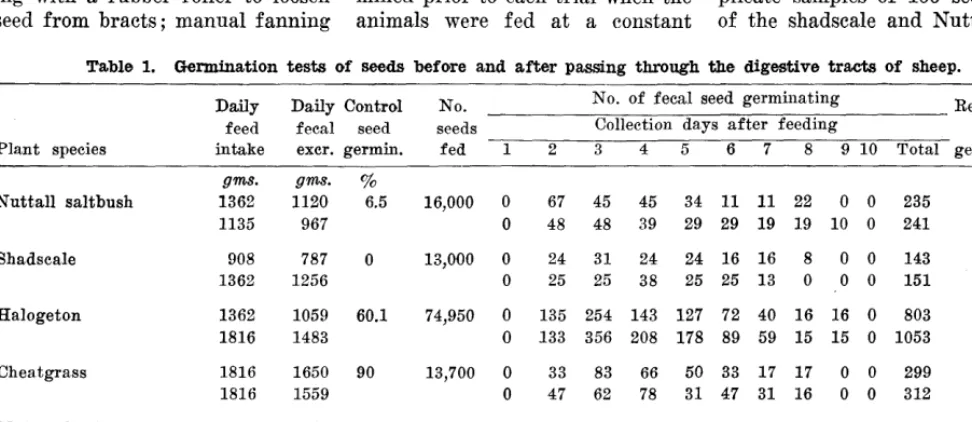
Table 1. Germination tests of seeds before and after pasting through the digetive tracts of sheep.
level. Fecal collections made over three 24-hour periods immediately prior to the feeding of the seeds under study served as a basis for calculated daily fecal excretions.
On the first day of each trial, the experimental animals were fed two portions of seeds, in the morn- ing (7 a.m.) and the afternoon
(4 p.m.). Sheep were fed two 25- gram portions of seeds and rabbits two 5-gram p o r t i o n s. Animals were fed pre-determined quanti- ties of alfalfa hay and continued to receive this amount daily throughout each trial.
The number of viable seeds re- covered in sheep feces was deter- mined on loo-gram fecal collec- tions made daily for 10 days after the seed were fed. Similar 40- gram fecal collections were made with the rabbits for a 5-day pe- riod. The total number of viable seeds excreted daily was computed from the daily fecal collections on the basis of the previously deter- mined total daily fecal excretion.
Germination studies were con- ducted with the control seed, fecal samples, and chopped alfalfa hay. The control samples consisting of 4 replicates of 100 seeds of each species were counted and spread on uncontaminated blotters in pe- tri dishes. In addition three du- plicate samples of 100 seeds each of the shadscale and Nuttall salt-
Plant species
Nuttall saltbush
Daily Daily Control No. No. of few1 seed germinating Recovered feed fecal seed seeds Collection days after feeding seed intake excr. germin. fed 1 2 3 4 5 6 7 8 9 10 Total germination
gms. gm. % %
1362 1120 6.5 16,000 0 67 45 45 34 11 11 22 0 0 235 1.47
1135 967 0 48 48 39 29 29 19 19 10 0 241 1.51
Shadscale 908 787 0 13,000 0 24 31 24 24 16 16 8 0 0 143 1.10
1362 1256 0 25 25 38 25 25 13 0 0 0 151 1.16
Halogeton 1362 1059 60.1 74,950 0 135 254 143 127 72 40 16 16 0 803 1.07 1816 1483 0 133 356 208 178 89 59 15 15 0 1053 1.40
Cheatgrass 1816 1650 90 13,700 0 33 83 66 50 33 17 17 0 0 299 2.18
1816 1559 0 47 62 78 31 47 31 16 0 0 312 2.28
Medusa-head 1362 1301 98.5 9,350 0 26 52 39 26 26 26 13 13 0 221 2.36
1135 1090 0 33 44 44 44 33 22 11 0 0 231 2.47
Fairway crested wheat- 908 787 97.5 18,000 0 31 47 47 31 24 24 8 8 0 220 1.22 9
EFFECTS OF SHEEP AND RABBIT DIGESTION ON SEED VIABILITY
Table 2. Germinatioa tests of seeds before and after passing through the digestive tra&s of rabbits.
121
Daily Daily Control No. feed fecal seed seeds
No. of fecal seed germinating
Collection days after feeding Recovered seed
Plant species intake excr. germin. fed. 1 2 3 4 5 Total germination
Nuttall saltbush
gms. gms. %
60 42 6.5 60 42
%
.28 .34
3,200 0 6 3 0 0 9
0 5 4 2 0 11
Shadscale 60 41 0 2,600 0 0 0 0 0 0
60 42 0 0 0 0 0 0
0 0
60 44 60.1 14,900 0 2 3 2 0 7 .05
60 42 0 3 4 2 0 9 .06
Halogeton
60 40 73 7,970 0 6 7 0 0 13 .16
60 43 0 9 6 0 0 15 -19
Russian thistle
Cheatgrass 60 44 90 2,740 0 3 2 0 0 5 .18
60 43 0 4 2 0 0 6 .22
Medusa-head 60 42 98.5 1,870 0 5 6 0 0 11 .59
60 44 0 7 5 0 0 12 .64
Fairway crested wheat- 60 46 97.5 3,600 0 1 5 2 0 8 .22
grass 60 42 0 2 6 3 0 11 .31
bush were treated with 10 percent hydrochloric acid for 5 minutes and an additional three samples of 100 seeds each of these two species were refrigerated at 25” F. for 6 days in an attempt to break seed dormancy. Seed from a single source was used in each study.
Fecal pellet samples and alfalfa hay samples were spread on and covered with large clean blotters in metal trays. Fecal pellets were broken apart with a putty knife prior to placing on the blotters. All samples were germinated in a room where daily temperatures al- ternated between 72 and 80” F. The humidity of the blotters was kept as high as possible. Seeds were considered to have germi- nated when definite seedlings de- veloped. The germination period for the control lots varied from 14 days to a maximum of 30 days. Seeds in the fecal samples were al- lowed 35 days to germinate.
Experimental Results The data for the trials with sheep (Table 1) indicate a consid- erable period following each feed- ing during which appreciable num- bers of viable seeds were excreted. In most cases this period was from the 2nd through the 8th day after feeding. Numbers of seeds ex-
creted were generally greatest on the 2nd through the 5th day.
The percentage of viable seeds passed by the sheep was similar for all species, despite marked dif- ferences in seed size, shape and na- ture of seed coat. The two annual grasses yielded the greatest germi- nation of total seeds fed. The two browse species gave the highest germination in relation to the lab- oratory germination of the control seed samples.
Results of the trials with rabbits (Table 2) were distinguished by the shorter period during which seeds were excreted following a feeding, and the lower percentage recovery of viable seeds of all spe- cies. No viable seeds of shadscale were recovered and recovery of halogeton seed was extremely lim- ited.
Special Seed Treatment The poor laboratory germination of the two browse species sug- gested further study to determine to what extent seed dormancy might be involved. Three loo-seed samples of Nuttall saltbush were treated with 10 percent hydro- chloric acid for 5 minutes prior to testing for germination but with no apparent effect on seed dor- mancy. Seeds receiving this prior
treatment had an average germi- nation of 6 percent as compared to 6.5 for untreated seed. Three ad- ditional samples of this species were subjected to 6 days of refrig- eration (25 O F.) prior to ger- mination. This treatment had an adverse effect on germination, as no seeds germinated during a 35- day test period. Examination of ungerminated seeds in these two studies showed that 21 percent had no embryos.
Treatment of three seed samples of shadscale for 5 minutes with 10 percent hydrochloric acid prior to germination s t u d i e s apparently aided in reducing seed dormancy. Five percent germination was ob- tained for seeds thus treated. How- ever, refrigeration treatment-25 O F. for 6 days-had no beneficial effects in increasing germination as seeds thus treated failed to ger- minate. An average of 23 percent of the ungerminated seeds in these two treatments were found to have no embryos.