© 2014, IJCSMC All Rights Reserved 691 Available Online at www.ijcsmc.com
International Journal of Computer Science and Mobile Computing
A Monthly Journal of Computer Science and Information Technology
ISSN 2320–088X
IJCSMC, Vol. 3, Issue. 6, June 2014, pg.691 – 699
RESEARCH ARTICLE
RESEARCH ON QOS BASED RESOURCE
AND IMAGE CAPTURING/RETRIEVING
FROM MOBILE PHONES USING MANET
Ms. Rajni
1, Ms. Sudha Bhati
21
Student, AITM, PALWAL, INDIA 2
Asst. Professor, Department of Computer Science Engineering, AITM, PALWAL, INDIA 1
[email protected], 2 [email protected]
Abstract: -
To get substantial resource {Like Images, and Files etc} in MANET and it usually affects the
communication operation in network. So, we should be well aware of energy consumption. We need to
see how each node can switch its state from power save mode to active modes and vice-versa. For e.g.
sleep/wake up mode. Ad hoc network enforces certain constraints on the communicating nodes, which
widely incorporates the node mobility which results in a constantly changing topology of the network, as
it is manet network so limited bandwidth, limited processing power due to its size and cost constraints. So,
we have proposed a new solution which performs communication with resource management.
Keywords:- MANET, Efficiency, Mobility, Android, HotSpot
1 INTRODUCTION
1.1 OVERVIEW
Reliable network performance has long been an important factor for many network applications. However, with an increasing amount of audio and video being sent over public, packet-switched networks, the ability to provide quality of service (QoS) guarantees may be more important in today's networks than it ever was. As such, a good deal of effort has been applied to the task of finding ways to provide reliable network performance while at the same time utilizing the total network resources in an efficient manner.
© 2014, IJCSMC All Rights Reserved 692
Project was designed and implemented on Android platform. So, first we discuss some of the features of Android as a mobile OS. Android is a vivid, intense, young and entirely open source mobile platform. It is the first or primary open-source software which is available for the mobile platform.
Android has positioned among toppers of mobile operating system just because of its huge sale, world class applications, its unique style, features and functionalities.
The whole process of development of android was initiated with a free mind set to build a open software environment which should be free of cost. Gradually as the time passes on it turns out to be a boon and embraced by members of OHA (Open Handset Alliance).
Android has changed the economic climate and android market is still motivating to explore some latest ideas for enhancing th e android platform. Due to android now most of the smart phones are obtainable at affordable prices. It is sponsored by the OHA, open-source community and supported by Google.
The fundamental blocks for building android operating system and its charm is open source and it is free of cost.
The development of recent mobile applications and that too on world class platform is always a daring work as users always seeking for more and more customizations and functionalities. Developers wanted to have their own authority and freedom for creating mobile applications. The main motive is to fulfill the requirements of users efficiently and effectively with less cost and efforts. All mobile operators are also leading in their races by providing lucrative and different facilities to their users in many exciting ways. Manufacturers are expecting an environment which is quite stable and affordable one for handsets.
2.1 WIDESPREAD MOBILE PLATFORM
Android influence hundreds of millions of mobile devices in additional many countries around the world. It's the greatest placed basis of platform of mobile which is growing quickly as every day additional million user’s boot up their Android based phones and begin looking for games, digital content and some other applications.
Android provide us a world-class platform for building games and applications for users. a) Universal collaboration
b) Dominant development framework
c) Marketplace available for distributing our applications d) Developer Tools
We are having a plugin as an Android developer tool for eclipse IDE, which provides a professional development environment for building android applications. It is a jam-packed IDE of java which is having some advance characteristics or features to create, package, test or debug our applications of android.
Full IDE of Java
Graphical User Interface Builders
Developer Options on device
Develop Hardware Devices
Develop Virtual Devices
Strong Debugging
Testing
Native Development e) Get the Android SDK
© 2014, IJCSMC All Rights Reserved 693 Organizing
Development
Establishment
Debugging & Testing
Publishing or Issuing
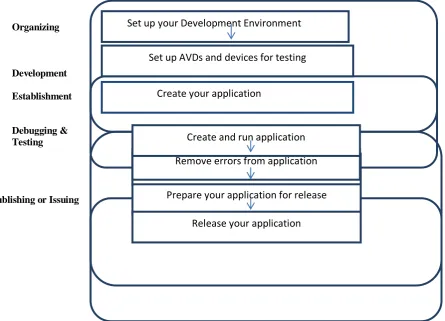
Figure 2.1 Step by step development of android applications.
For building an android application we are having some fundamental steps which are shown in figure 2.1. The development steps incorporates four stages:
Organizing
Throughout in this stage we organize and install our IDE i.e Integrated Development Environment. We also develop android virtual devices and associate them with hardware devices. With this we can download our application.
Establishment
In this stage we organize and create our android project which includes all resource files and source of our application.
Removing errors and Testing
In this stage we develop our android project in to a package which is quite debuggable and can also be downloaded and run on emulator. Now we can make our application bug free by debugging it using JDWP along with different debugging tools that are offered by android SDK.
At the end, we check our application with the help of different testing tools of Android SDK.
Issuing
Throughout in this stage we create and configure our request or application for the final release and spread our application among the users.
The second most important thing of our project is Tethering or Wi-Fi hotspot. Now we will discuss some of the most important features of Tethering.
Set up your Development Environment
Set up AVDs and devices for testing
Create your application
Prepare your application for release Test application
Remove errors from application Create and run application
© 2014, IJCSMC All Rights Reserved 694
Tethering introduces the concept of linking a single device with the other single device. It permit to allocates the internet connection of mobile phone or tab with another device like tabs or computer-laptops. Via manet LAN, Bluetooth or physical wire a connection can be established between tablet (or mobile phone) and another device.
If the tethering is performed via Wi-Fi, then this feature is marked as a Mobile Hotspot. The mobile phone which is connected through internet can work as a router and movable wire-less access-point for the devices which are associated to it.
The tethering is the one who is obtaining the Internet through our mobile phone's connection with any other device. Earlier, it was done either over USB or Bluetooth. Now days, however, the most popular technique for attaining this act of tethering is the mobile hotspot. The mobile hotspot imitate a Wi-Fi router so our other devices will connect to it just like they connect at home, and easily access the Internet through it.
Tethering is mostly replaced these days because almost each and everything has Wi-Fi built in or we can get a USB to manet net adapter.
Earlier mobile phones were just a device used for communication but now days they have become a whole computing and communication world to us, latest upcoming smart phones using modern technologies and providing world class platform are the best example of today’s computing and communication network.
As more and more users access the Internet on their phones, it may be difficult to justify an additional broadband subscription for their home computers, especially in the emerging markets of the world.
Even in developed countries where users subscribe to manet Internet access on their smartphones as well as wire-line Internet access for their home computers, users must rely on the spotty availability of Wi-Fi hotspots while on the go. It is in situations like this, where multiple users, such as family members or colleagues, want to access internet with single internet connection then we can use tethering or Wi-Fi hotspot. It would have the most convenient, by permit users to build high-speed on the Wi-Fi hotspots using multiple smartphones.
So, we are using Wi-Fi hotspot that is both energy-efficient and easy to use in Manet. Smartphones are a natural fit for serving as a communication gateway for other devices, given that they are typically equipped with both local area radio’s (such as Bluetooth, Wi-Fi) and wide area radio’s (such as GPRS, EDGE, and 3G).
A general solution that has acquired today is to utilize the tethered based action of mobile phones, permit them to use a devoted phone as a router to give connectivity to the other device. This involves making a wired connection (e.g., using USB) or to utilize Wi-Fi in adhoc mode or bluetooth to connect the client to the smartphone gateway.
But this Wi-Fi ad hoc mode solution ends up draining the battery of the smartphone very quickly. So, we are trying to make it Energy- Efficient. The Bluetooth solution incurs a high latency for discovery and connection setup and is less energy efficient than Wi-Fi for bursty data traffic such as Web browsing. The USB cable solution is not convenient and does not support the use of more than one smart phone or gateway device although, in numerous situations, to be used as a gateway more than one smart phone is available. We are using Wi-Fi hotspot for data transmission in our network.
2.3 ENERGY EFFICIENCY
The abrupt extension of manet services like Personal Communication Services, cellular services, mobile data services and Manet Local Area Networks services in current years indicating that considerable price is set on portability and achieve as main features of telecommunication.
All manet devices are having utmost efficacy due to which we can use them whenever we want and at any place. However, considerable shortcomings of that goal are its limited energy or power contribution. One of the most common limitations of manet communication is limited power back up of batteries. Therefore, management of power is the most daring problem in front of us in manet.
Recent research shows that the considerable users of power in a particular laptop are the CPU, LCD, DRAM, hard disk, keyboard, mouse, floppy drive, interface card and CDROM drive of manet network.
For eg: A mobile computer Toshiba indicates that display takes 36% of power, CPU takes 21%, Manet interface takes 18%, and hard drive takes 18% of power.
© 2014, IJCSMC All Rights Reserved 695 50
Mobile Data Traffic
40 Internet Backbone
30 Growing Gap
GROWTH
20
Mobile Efficiency
10
Wire line Efficiency
2005 2010 2015 2020 YEAR
Graph 2.1: Network Energy Graph
2.3.1 Energy Efficient MANET
Mobile adhoc Networks incorporates manet based nodes that create a communications network between them without having any stable infrastructure [1]. MANET usually used in unique cases like in unexpected situations for eg: earthquake or cyclone prone areas or man-made disasters, recovering or saving activities from dangerous situations, especially in areas where there is no stable infrastructure or such infrastructure has been destroyed [2].Modifications in topology of Manet usually happens because of engaging nodes who takes part in it but due to exhaustion of energy they generally got breakdown [3].
These conditions upset the easy communication between nodes in the network. Nodes in the Mobile Ad Hoc Network are usually battery-powered.
Conceptually, a node may either function as router who keep forwarding the data packets between the end nodes or as an end node in MANET [4]. A powerful routing process is needed to sustain required service quality throughout the communication [5]. Therefore, the most important thing is the fitness of the node including its power level throughout the choice of a mid-node. So that they can preserve the stable transfer of data in between the nodes.
Sustaining a optimal life time of a routing path in the network is a very daring work as the power or energy of the nodes relies on the property, capacity of the battery and model [3].
Depletion of power in the batteries are increasing day by day due to activities of the node like transmitting, receiving etc. Attenuation of power in the nodes mainly in the middle ones upset the communication and hence it changes the topology of the network. Although we can decrease the distraction through an effective choice of middle nodes. This kind of criteria of choosing should be the initial step in any path choosing process in order to retain a stable routing of data in between the nodes.
Many routing algorithms and skills have been used for the node selection process [4]. Therefore, the skills or techniques, algorithms have examine the service-quality which is one of the most important factor. But as we know that these skills and algorithms are suffering from many problems especially at the time of route searching process.
© 2014, IJCSMC All Rights Reserved 696
Choice regarding node having less energy level decreases the security of the communication path, communication can be break or lost at any time due to low energy or power of node.
3 PROPOSED ALGORITHM
To develop a path in manet our proposed Qos routing engage several tables in the Wi-Fi hotspot enabled devices. A link table is needed for each node in manet for Qos routing to develop a path. Each Master device retains the information regarding connection table and other necessary details like connected nodes, addresses of Master, slave and bridge. As Masters are generally having more memory than slave, so connection table will be saved in the Masters.
Suppose when we create the manet, the information got filled in the connection table and table is saved in each Master device. First the connection table is used by the Qos routing process in search of destination. When it finds the destination address either in the Master table or slave table then it find the data packet and routing table and send the data packet to its destination.
We require a routing table to retain few parameters for Qos routing. With the help of the routing table, source will determine the route that data packet can transfer and fulfill the requirements of Qos. Mostly the bandwidth is effectively used as the routing table helps the routing process dynamically to search the better route if master holds the less power or battery.
We can engage a Path Locating Protocol for the route development to fulfill the requirements of Qos. In case of the on demand routing protocol, we are having few Qos requirements and incomplete path details which can be used for routing.
Therefore, a Path Locating Packet (PLP) is overflowed into the network to find the destination. When we receive our first PLP, the destination delivers a Path Return Packet (PRP) backward to the source along the path. When the source acquired the first PRP, it understands that this is the smallest path.
3.1 ENERGY EFFICIENT ROUTING
Although the performance of the routes that cross or intersect each other would decreases if the routing process fails to retain all active paths to be disjoint.
Therefore, an energy efficient routing process is necessary to raise the performance of the manet route or path.
3.2 ENERGY EFFICIENT ROUTING MECHANISM
Assume that path
P
j is a new path that is built on demand and pathP
i already present in a manet. If source sends PLP (Path LocatingProtocol) packets to the destination and it reaches to the destination then it wait for PRP packets.
To assure the set-up of the path at each node on the new path, destination would respond by sending (PRP) Path Return Protocol packet
reverse to the source. When PRP packets reaches at slave node on
P
iandP
jthen the PRP packet move back to the last node. Suppose node m5 sends a Path Locating with Role Protocol (PLRP) packet to its adjacent nodes.
The PLRP packet will search a route that cut the existing path
P
i at a node whose role should be a Master and move towards the source.Therefore, using the energy efficient routing process can sure that the crossing of two paths is a Master device and stay away from building MRD or MRS -s paths, which have the worst result or performance. So, the energy efficient routing can enhance the performance of route or path in a manet.
4.3 PROCEDURE
1) Bridge_compare
First of all we compare the bridge, we implement this process at new bridge of 2 routes to offer a contrast between multi route role and settle when to initiate the energy-efficient routing.
In this bridge_compare (bj) function, we start if loop in which we check that if bi is a slave or not then we move back one hop on path or route j then we start energy_efficient (j) process with that if loop ends.
2) Energy_efficient( )
On two different routes the roles of a device get compared and after that we decide whether the device is a slave or not, or will it initiate the energy_efficient procedure.
In this procedure, first in if loop we check that the back hop node is a slave or not, if it is then
© 2014, IJCSMC All Rights Reserved 697 3) Examine_Master( )
Back hop slave device execute this process in search of a master who situated or present at that existing path. This process uses the PLRP Packet. In this our node j executes “Inquiry-Scan” then if the node jis communicated by a Master Mj+1 then node j send PLRP and wait for PRP after that when node j received PRP then node j waits for Mj+1 that send PRP in Page-Scan.
4) Search_slave( )
We implement this process at a back hop Master device in search of a slave that situated or present on that existing path. In this,node j executes “Inquiry” and if a slave Mj+1 is searched then node j send PLRP and wait for PRP after that when node j received PRP then node j links to slave Mj+1 that send PRP by “Page”.
4 SCREEN SHOTS
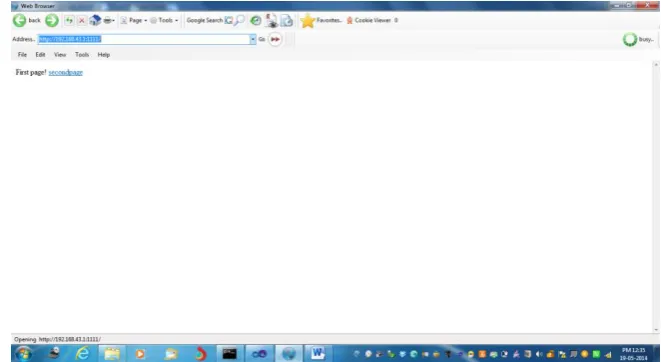
Figure 5.1: When we open the browser it first asks for the username and password then we have to connect all the nodes (mobile phones) including laptop with the same adhoc network via hotspot. It must be noted that each node should have same SSID but
different MAC.
Figure 5.2: After connecting all the nodes (Mobile phone) including laptop with the same adhoc network via hotspot, then a client node sends the request on the network. Laptop is acting like a client and sending request to the network with the help of the
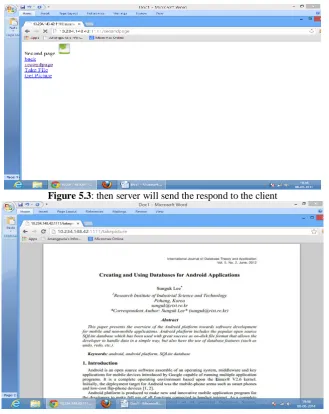
© 2014, IJCSMC All Rights Reserved 698 Figure 5.3: then server will send the respond to the client
Figure 5.4: when we click on the Get File option then it will access the file from server
Figure 5.5: If we click on the Take picture option then it will access the file from the server
CONCLUSION
We proposed the QoS routing and the energy-efficient routing mechanism. We are having few benefits of organizing a Qos path for the transmission of data which are as follows:
(1) To fulfill the Qos requirements of the application.
© 2014, IJCSMC All Rights Reserved 699
(3) To enlarge the flexibility for the purpose of routing in a manet.
(4) To redesign the scheduling algorithms so that they can fulfill the Qos demands.
However, there are so many researchers who all are working on the QoS domain, it is still not rectified completely and a new challenge for formatting Wi-fi hotspot Manet is the device mobility.
REFERENCES
[1] Perkins C.E., Ad Hoc Networking. Addison-Wesley, New York, 2001.
[2] Latiff N, and Fisal L,A., "Routing protocols in manet mobile ad hoc network - A Review," in Conference on Asia-Pacific Communications,(APCC2003), pp. 600-606, 2004.
[3] Zhao W., and Ammar, M.E.Z, "The energy-limited capacity of manet networks," in IEEE Communications Society Conference on Sensor andAd Hoc Communications and Networks, (IEEESECON2004), pp. 279-288, 2005.
[4] Shakkeera, "Optimal path selection technique for flooding in link state routing protocol using forwarding mechanisms in MANET," in International Conference on Communication andComputational Intelligence, (INCOCCI2010), Erode, India, pp.
318-323, 2011.
[5] El-Gamal A., Uysal-Bi C., Nair, and B. Prabhakar B., "Energy-efficient scheduling of packet transmissions over manet