Revisiting Cryptographic Accumulators, Additional
Properties and Relations to other Primitives
?David Derler, Christian Hanser, and Daniel Slamanig
Institute for Applied Information Processing and Communications (IAIK), Graz University of Technology (TUG), Inffeldgasse 16a, 8010 Graz, Austria
{david.derler|christian.hanser|daniel.slamanig}@tugraz.at
Abstract. Cryptographic accumulators allow to accumulate a finite set of val-ues into a single succinct accumulator. For every accumulated value, one can efficiently compute a witness, which certifies its membership in the accumu-lator. However, it is computationally infeasible to find a witness for any non-accumulated value. Since their introduction, various accumulator schemes for numerous practical applications and with different features have been proposed. Unfortunately, to date there is no unifying model capturing all existing features. Such a model can turn out to be valuable as it allows to use accumulators in a black-box fashion.
To this end, we propose a unified formal model for (randomized) cryptographic accumulators which covers static and dynamic accumulators, their universal fea-tures and includes the notions of undeniability and indistinguishability. Addi-tionally, we provide an exhaustive classification of all existing schemes. In doing so, it turns out that most accumulators are distinguishable. Fortunately, a sim-ple, light-weight generic transformation allows to make many existing dynamic accumulator schemes indistinguishable. As this transformation, however, comes at the cost of reduced collision freeness, we additionally propose the first indistin-guishable scheme that does not suffer from this shortcoming. Finally, we employ our unified model for presenting a black-box construction of commitments from indistinguishable accumulators as well as a black-box construction of indistin-guishable, undeniable universal accumulators from zero-knowledge sets. Latter yields the first universal accumulator construction that provides indistinguisha-bility.
1
Introduction
A (static) cryptographic accumulator scheme allows to accumulate a finite set X =
{x1, . . . , xn} into a succinct value accX, the so called accumulator. For every element
xi∈ X, one can efficiently compute a so called witnesswitxi to certify the membership of xi in accX. However, it should be computationally infeasible to find a witness for
witnesses, universal accumulators also support non-membership witnesses for values y6∈ X. Here, collision freeness also covers that it is computationally infeasible to create non-membership witnesses for valuesxi∈ X. Over time, further security properties, that
is,undeniabilityandindistinguishabilityhave been proposed. Undeniability is specific to universal accumulators and says that it should be computationally infeasible to compute two contradicting witnesses forz∈ X andz6∈ X. Indistinguishability says that neither the accumulator nor the witnesses leak information about the accumulated set X and, thus, requires randomized accumulator schemes.
Applications: Accumulators were originally proposed for timestamping purposes [5], i.e., to record the existence of a value at a particular point in time. Over time, other applications such as membership testing, distributed signatures, accountable certificate management [8] and authenticated dictionaries [24] have been proposed. Accumulators are also used as building block in redactable [35, 36], sanitizable [14],P-homomorphic signatures [2], anonymous credentials [40], group signatures [41], privacy-preserving data outsourcing [39] as well as for authenticated data structures [22]. Moreover, accumu-lator schemes that allow to prove the knowledge of a (non-membership) witness for an unrevealed value in zero-knowledge (introduced for off-line e-cash in [38]) are now widely used for revocation of group signatures and anonymous credentials [13]. Quite recently, accumulators were also used in Zerocoin [30], an anonymity extension to the Bitcoin cryptocurrency.
Since their introduction, numerous accumulator schemes with somewhat different fea-tures have been proposed. Basically, the major lines of work are schemes in hidden order groups (RSA), known order groups (DL) and hash-based constructions (which may use, but typically do not require number theoretic assumptions).
Hidden order groups: The original RSA-based scheme of Benaloh and de Mare [5] has been refined by Baric and Pfitzmann [4], who strengthen the original security notion to
collision freeness. In [37], Sander proposed to use RSA moduli with unknown factoriza-tion to construct trapdoor-free accumulators. Camenisch and Lysyanskaya [13] extended the scheme in [4] with capabilities to dynamically add/delete values to/from the accu-mulator, which constituted the first dynamic accumulator scheme. Their scheme also supportspublic updatesof existing witnesses, that is, updates without the knowledge of any trapdoor. Later, Li et al. [26] added support for non-membership witnesses to [13] and, therefore, obtaineduniversal dynamic accumulators. They also proposed an opti-mization for more efficient updates of non-membership witnesses, for which, however, weaknesses have been identified later [28, 34]. Lipmaa [27] generalized RSA accumula-tors to modules over Euclidean rings. In all aforementioned schemes, the accumulation domain is restricted to primes in order to guarantee collision freeness. In [41], Tsudik and Xu proposed a variation of [13], which allows to accumulate semiprimes. This yields a collision-free accumulator under the assumption that the used semiprimes are hard to factor and their factorization is not publicly known. Moreover, in [42] an accumula-tor scheme that allows to accumulate arbitrary integers and supports batch updates of witnesses has been proposed. Yet, this scheme was broken in [10].
Triandopoulos [17] as well as Au et al. [3] extended Nguyen’s scheme with universal fea-tures. Quite recently, Acar and Nguyen [1] eliminated the upper boundton the number of accumulated elements of thet-SDH accumulator. To this end, they use a set of accu-mulators, each containing a subset of the whole set to be accumulated. An alternative accumulator scheme for pairing friendly groups of prime order has been introduced by Camenisch et al. [12]. It supports public updates of witnesses and the accumulator and its security relies on the t-DHE assumption.
Hash-based constructions: Buldas et al. [8, 9] presented the very first universal dynamic accumulator that satisfies undeniability (termed as undeniable attester and formalized in context of accumulators in [27]). Their construction is based on collision-resistant hashing and the use of hash-trees. Another hash-tree based construction of a universal accumulator that satisfies a notion similar to undeniability has been proposed in [11] (the scheme is called a strong universal accumulator). Quite recently, another accumulator based on hash-trees, which uses commitments based on bivariate polynomi-als modulo RSA composites as a collision-resistant hash function, has been introduced in [7].
For the sake of completeness, we also mention the construction of static accumulators in the random oracle model based on Bloom filters, proposed by Nyberg [32, 33].
Contribution: The contributions of this paper are as follows:
– While some papers [3–5, 13, 31] do not explicitly formalize accumulator schemes, formal definitions are given in [1, 11, 12, 15, 21, 26, 27, 42]. However, these models are typically tailored to the functionalities of the respective scheme. While they widely match for the basic notion of (static) accumulators (with the exception of considering randomized accumulators), they differ when it comes to dynamic and universal accumulators. To overcome this issue, we propose a unified formal model for accumulators, which is especially valuable when treating accumulators in a black-box fashion. We, thereby, also include the notion of undeniability [8, 9, 27] and a strengthened version of the recent indistinguishability notion [18]. Besides, we also confirm the intuition and show that undeniability is a strictly stronger notion than collision freeness.
– We provide an exhaustive classification of existing accumulator schemes and show that most existing accumulator schemes are distinguishable in our model. To resolve this issue, we propose a simple, light-weight generic transformation that allows to add indistinguishability to existing dynamic accumulators and prove the security of the so-obtained schemes. As this transformation, however, comes at the cost of reduced collision freeness, we additionally propose the first indistinguishable scheme that does not suffer from this shortcoming. Note that due to the lack of space, the indistinguishable accumulator scheme is provided in the extended version of this paper.
2
Preliminaries
By acc we denote an accumulator and if we want to make the accumulated setX =
{x1, . . . , xn}explicit, we writeaccX. Given an accumulatoraccX, a membership witness
for an element xi ∈ X is denoted bywitxi, whereas a non-membership witness for an element yj ∈ X/ is denoted bywityj. The accumulator secret key (trapdoor) is denoted byskacc, while the public key is denoted bypkacc. Bya
R
←A, we denote thatais chosen uniformly at random from the setA.
A function : N → R+ is called negligible if for all c > 0 there is a k0 such that
(k) <1/kc for all k > k
0. In the remainder of this paper, we use to denote such a
negligible function.
Definition 1 (Bilinear map:).A bilinear map (pairing) is a mape:G1×G2→GT,
withG1,G2 andGT being cyclic groups of prime orderp. Letg1andg2generateG1and G2. We requireeto be efficiently computable and that the following conditions hold:
Bilinearity:e(g1a, gb2) =e(g1, g2)ab=e(g1b, g a
2) ∀a, b∈Zp
Non-degeneracy:e(g1, g2)6= 1GT, i.e., e(g1, g2)generatesGT.
If G1 = G2 we talk about symmetric pairings, whereas we talk about asymmetric
pairings otherwise.
Definition 2 (Strong RSA assumption (s-RSA) [4]). Given two appropriately chosen primes pandq such thatN =pq has bitlengthκand a randomu∈Z∗N, then it
holds for all PPT adversariesA that
Pr[(v, w)← A(u, N) :vw≡u (mod N)]≤(κ).
Definition 3 (t-SDH assumption [6]).Let pbe a prime of bitlengthκ,Gbe a finite cyclic group of order p,g be a generator of G,α∈RZ∗p andt >0. Then, for all PPT
adversaries Ait holds that
Prhc, gα1+c
← A(g, gα, . . . , gαt)i≤(κ) for some c∈Zp\ {−α}.
Definition 4 (t-DHE assumption [12, 23]).Letpbe a prime of bitlengthκ,Gbe a finite cyclic group of order p,g be a generator of Gand γ ∈R Z∗p. Then, for all PPT
adversaries Ait holds that
Prhgγt+1← A(g, gγ1, . . . , gγt, gγt+2, . . . , gγ2t)i≤(κ).
3
A Unified Model for Cryptographic Accumulators
In the original sense, accumulator schemes were defined by the following properties (see, e.g., [13, 26]). Thereby,ZI represents the domain of values to be accumulated andZA
the accumulator domain.
Efficient generation: There is an efficient probabilistic algorithm that, on input of a security parameterκ, defines a functionalityf :ZA× ZI → ZA, i.e., generates
Efficient evaluation: There is an efficient algorithm that computesf(acc,x).
Quasi-commutativity: It holds that f(f(acc, x1), x2) = f(f(acc, x2), x1) ∀x1,
x2∈ ZI,acc∈ ZA.
Assuming that it is computationally infeasible to invert f without knowing skacc, the
quasi-commutativity directly yields a way to define witnesses. For instance, f(acc, x1)
can serve as witness for the accumulation of x2. Nonetheless, it is more meaningful to
provide a more abstract algorithmic definition of accumulators as done subsequently, since there are several constructions that do not fit into this characterization (for in-stance, hash-tree constructions do not require the quasi-commutativity property).
Trusted vs. Non-Trusted Setup: Known accumulators that rely on number theo-retic assumptions require a trusted setup, i.e., a TTP runs the setup algorithmGenand discards the trapdoor skacc afterwards. Here, access to skacc allows to break collision
freeness (and its stronger form: undeniability). Consequently, correctness of the accu-mulator scheme also needs to hold ifskaccis omitted in all algorithms, which is the case
for all existing schemes. In contrast, in constructions relying on collision-resistant hash functions (not based on number theoretic assumptions) there is no trapdoor at all and, therefore, no trusted setup is required. In order to study number theoretic accumulators without trusted setup, Lipmaa [27] proposed a modified model which divides theGen
algorithm into a Setupand a Gen algorithm. In this model, the adversary can control the randomness used inside Setupand, thus, knows the trapdoor. Nevertheless, it can neither access nor influence the randomness of theGenalgorithm. This model, however, still requires a partially trusted setup and also does not fit to the known order group setting, which makes it not generally applicable.1 Consequently, when considering the
state of the art it seems most reasonable to define a security model with respect to a trusted setup as we will do subsequently. We emphasize that this model is compatible with all existing constructions. Nevertheless, it remains a challenging open issue to de-sign accumulators based on standard assumptions which are secure without any trusted setup.
3.1 Definitions
In the following, we provide a definition for (static) accumulators, which we adapt from [21, 42]. In contrast to previous models, we explicitly consider randomized accumulator schemes. Then, we extend this model in order to formalize dynamic accumulators. It is similar to [12, 15], but avoids shortcomings such as missing private updates. Based on this, we define universal and universal dynamic accumulators and propose a suitable security model. Furthermore, we discuss undeniable and indistinguishable accumulators, give formalizations for these properties, and, investigate relationships between security properties.
Genalgorithm takes an additional parametert, wheret=∞is used to indicate that the accumulator is unbounded. For the sake of completeness, we model the algorithms such that they support an optional input of the trapdoor (denoted assk∼acc) since this often allows to make the algorithms more efficient. However, we stress that we consider the trusted setup model and, hence, adversaries are not given access to the trapdoor skacc.
Consequently, if sk∼accis set, the party running the algorithm needs to be fully trusted. Definition 5 (Static Accumulator). A static accumulator is a tuple of efficient al-gorithms (Gen, Eval, WitCreate, Verify)which are defined as follows:
Gen(1κ, t): This algorithm takes a security parameter κand a parameter t. If t 6=∞,
thentis an upper bound on the number of elements to be accumulated. It returns a key pair(skacc,pkacc), whereskacc=∅ if no trapdoor exists.
Eval((sk∼acc, pkacc),X): This (probabilistic)2 algorithm takes a key pair (sk
∼
acc, pkacc) and a setX to be accumulated and returns an accumulatoraccX together with some
auxiliary informationaux.
WitCreate((sk∼acc, pkacc), accX,aux, xi): This algorithm takes a key pair (sk∼acc,pkacc), an accumulator accX, auxiliary information aux and a value xi. It returns ⊥, if
xi∈ X/ , and a witness witxi forxi otherwise.
Verify(pkacc, accX, witxi,xi): This algorithm takes a public key pkacc, an accumulator
accX, a witnesswitxi and a valuexi. It returnstrueifwitxi is a witness forxi∈ X
andfalseotherwise.
Henceforth, we call an accumulator randomized if the Eval algorithm is probabilistic. Based on Definition 5, we can now formalizedynamic accumulators. We widely align our definitions with [21, 42], but, in addition, we need to consider that the various dynamic accumulator schemes proposed so far differ regarding thepublic updatabilityof witnesses and the accumulator.
Definition 6 (Dynamic Accumulator). A dynamic accumulator is a static accu-mulator that additionally provides efficient algorithms (Add, Delete, WitUpdate)which are defined as follows:
Add((sk∼acc, pkacc),accX,aux,xi): This algorithm takes a key pair(sk∼acc,pkacc), an ac-cumulator accX, auxiliary information aux, as well as a value xi to be added. If
xi ∈ X, it returns ⊥. Otherwise, it returns the updated accumulator accX0 with
X0 ← X ∪ {xi} and updated auxiliary information aux0.
Delete((sk∼acc, pkacc), accX,aux, xi): This algorithm takes a key pair (sk∼acc, pkacc), an accumulator accX, auxiliary information aux, as well as a value xi to be removed.
If xi ∈ X/ , it returns ⊥. Otherwise, it returns the updated accumulatoraccX0 with
X0 ← X \ {xi} and auxiliary informationaux0.
WitUpdate((sk∼acc, pkacc),witxi,aux, xj): This algorithm takes a key pair(sk
∼
acc,pkacc), a witness witxi to be updated, auxiliary informationaux and a valuexj which was
added/deleted to/from the accumulator, whereauxindicates addition or deletion. It returns an updated witnesswit0x
i on success and⊥otherwise.
2
Below, we define universal accumulators and emphasize that features provided by uni-versal accumulators can be seen as supplementary features to bothstatic anddynamic
accumulators.
Definition 7 (Universal Accumulator). A universal accumulator is a static or a dynamic accumulator with the following properties. For static accumulator schemes the algorithms WitCreate andVerify take an additional boolean parameter type, indicating whether the given witness is a membership (type= 0) or non-membership (type= 1)
witness. For dynamic accumulator schemes this additionally applies to WitUpdate.
3.2 Security Model
Now, we introduce a security model for accumulators, which we adapt from [26] and further extend by undeniability and indistinguishability.
Classic notion: A secure accumulator scheme is required to becorrect and collision-free. Correctness says that for all honestly generated keys, all honestly computed ac-cumulators and witnesses, theVerifyalgorithm will always returntrue. We stress that correctness also needs to hold when all algorithms are executed withoutskacc. Since the
correctness property is straightforward, we omit its formal definition. Collision freeness informally states that it is neither feasible to find a witness for a non-accumulated value nor feasible to find a non-membership witness for an accumulated value. More formally:
Definition 8 (Collision Freeness). A cryptographic accumulator of typet∈ {static,
dynamic} andu∈ {universal, non-universal} is collision-free, if for all PPT adversaries
A there is a negligible function(·)such that:
Pr
(skacc,pkacc)←Gen(1κ, t), O ← {Ot,Ou},
(wit∗xi/wit∗xi, x∗i,X∗, r∗)← AO(pk
acc) :
(Verify(pkacc,acc∗,wit∗xi, x∗i,0) =true ∧ x∗i ∈ X/ ∗) ∨
(Verify(pkacc,acc∗,wit∗xi, x∗i,1) =true ∧ x∗i ∈ X∗)
≤(κ),
whereacc∗←Evalr∗((skacc,pkacc),X∗)andAhas oracle access toOtandOuwhich are
defined as follows:
Ot:=
{OE(·,·,·)} if t=static, {OE(·,·,·),OA(·,·,·,·),OD(·,·,·,·)} otherwise.
Ou:=
{OW(·,·,·,·),OW(·,·,·,·)} if u=universal,
{OW(·,·,·,·)} otherwise.
Thereby,OE,OA andODrepresent the oracles for the algorithmsEval,Add, andDelete,
respectively. An adversary is allowed to query them an arbitrary number of times. In case of randomized accumulators the adversary outputs randomness r∗, whereas r∗ is
omitted for deterministic accumulators. Likewise, the adversary can control the ran-domnessrused byOEfor randomized accumulators. Therefore,OEtakes an additional
and OW allow the adversary to obtain membership witnesses for members and
non-membership witnesses for non-members, respectively. Thereby, the environment keeps track of all oracle queries (and answers) and lets the respective oracle return⊥if calls to it are not consistent with respect to previous queries. Furthermore, we assume that the adversary outputs either a membership witnesswit∗xi or a non-membership witness
wit∗xi (denoted by wit∗xi/wit
∗
xi). If the accumulator is non-universal, one simply omits the non-membership related parts.
One distinction to previous models is that we model (non-)membership witness gen-eration via oracles. This way, we can ensure that security proofs take the simulation of (non-)membership witnesses into account, which is vital and could be overseen other-wise.
Definition 9 (Secure Accumulator). A cryptographic accumulator is secureif it is correct and collision-free.
Undeniable accumulators: In [27], Lipmaa formalized undeniability for accumula-tors. A universal accumulator isundeniable if it is computationally infeasible to find a membership as well as a non-membership witness for the same value – independently of whether it is contained in an accumulator or not. More formally undeniability is defined as:
Definition 10 (Undeniability). A universal cryptographic accumulator of type t ∈ {static,dynamic}is undeniable, if for all PPT adversariesAthere is a negligible func-tion(·)such that:
Pr
(skacc,pkacc)←Gen(1
κ, t),(wit∗
xi,wit
∗
xi, x
∗
i,acc∗)← AO t
(pkacc) :
Verify(pkacc,acc∗,wit∗xi, x
∗
i,0) =true ∧ Verify(pkacc,acc∗,wit∗xi, x
∗
i,1) =true
≤(κ),
where, Ahas oracle access to Ot which is defined as follows:
Ot:=
{OE(·,·,·),OW(·,·,·,·),OW(·,·,·,·)} ift=static, {OE(·,·,·),OA(·,·,·,·),OD(·,·,·,·),OW(·,·,·,·),OW(·,·,·,·)} otherwise.
Notice that the definition of the oracles is as in the definition of collision freeness for universal accumulators.
Definition 11. A universal accumulator is undeniable if it is a secure accumulator satisfying the undeniability property.
is chosen and accumulated within the security game. However, this non-determinism is not required to be part of the accumulator construction itself. Consequently, a deter-ministic accumulator can satisfy this notion while being trivially distinguishable. From this, we conclude that the non-determinism must be intrinsic to theEvalalgorithm.3
There are several ways to turn a deterministic scheme into a randomized one. As already discussed, indistinguishability can be achieved by adding a random value from the accumulation domain. Aside from this, it can also be obtained by randomizing the
Eval algorithm without modifying the set X (as, for instance, done in Section 5.1). Apparently, the latter option depends on the specific accumulator scheme, whereas the shortcomings in [18] can be addressed by introducing a generic transformation for the former approach (cf. Transformation 1).
Definition 12 (Indistinguishability).A cryptographic accumulator of typet∈ {sta
-tic, dynamic} and u ∈ {universal, non-universal} is indistinguishable, if for all PPT adversaries Athere is a negligible function(·)such that:
Pr
(skacc,pkacc)←Gen(1κ, t), b
R ← {0,1}, (X0,X1,state)← A(pkacc),(accXb,aux)←Eval((sk
∼
acc,pkacc),
Xb),O ← {Ot,Ou}, b∗← AO(pk
acc,accXb,state) :b=b
∗
≤
1
2 +(κ),
where X0 and X1 are two distinct subsets of the accumulation domain and Ot as well asOuare defined as follows:
Ot:=
{OE(·,·,·)} if t=static,
{OE(·,·,·),OA6∪(·,·,aux,·),OD∩(·,·,aux,·)} otherwise.
Ou:=
{OW(·,·,aux,·),OW(·,·,aux,·)} if u=universal,
{OW(·,·,aux,·)} otherwise.
If the probability above is exactly1/2we haveunconditionalindistinguishability, whereas
we have computationalindistinguishability if the probability is negligibly different from
1/2.
Here, OE is defined as before and all other oracles can only be called for the challenge
accumulator. We require that the input parameter aux for the oracles is kept up to date and is provided by the environment, since the knowledge of aux would allow the adversary to trivially win the game. Furthermore, note that this game does not allow the adversary to control the randomness used for the evaluation ofaccXb (while it can be controlled when calling OE). For the definitions of the remaining oracles, we use
X∪ :=X0∪ X1 andX∩:=X0∩ X1 to restrict the adversary from oracle queries which
would trivially allow to win the game.OA6∪as well asOD∩allow the adversary to execute the Add and Deletealgorithms. Thereby, OA6∪ allows only queries for values x
i ∈ X/ ∪,
whereasOD∩ allows only queries for valuesx
i∈ X∩. Furthermore, upon everyAddand
Deletethe setsX∪andX∩are updated consistently. OraclesOW andOW are as above,
with the difference that OW allows only queries for valuesx
i ∈ X∩, while OW allows
only queries for valuesyj ∈ X/ ∪.
Transformation 1. On input a set X, theEvalalgorithm samples an elementxr∈ X/
uniformly at random from the accumulation domain. Next, it computes and returns
(accX0,aux0)forX0← X ∪ {xr} andaux0←(aux, xr).
Note that aux needs to be kept consistent for all other algorithms that require this input parameter. As already noted above, collision freeness no longer holds for X but with respect toX ∪ {xr}. To draw a line between inherently randomized constructions
and such relying on Transformation 1, we differentiate between indistinguishability and collision-freeness-weakening (cfw) indistinguishability:
Definition 13 (Indistinguishability). Let X be the set in accXb. A cryptographic
accumulator is called indistinguishableif it is a secure, indistinguishable accumulator andX =Xb.
Definition 14 (cfw-Indistinguishability).LetX be the set inaccXb. A cryptographic
accumulator is called collision-freeness-weakening (cfw) indistinguishable if it is a se-cure, indistinguishable accumulator andX 6=Xb.
3.3 Relation Between Security Properties
Intuitively, undeniability seems to be a strictly stronger security requirement than col-lision freeness. We confirm this intuition below:
Lemma 1. Every undeniable universal accumulator is collision-free.
We prove the lemma above in Appendix C.1.
As mentioned in [27], a black-box reduction in the other direction is impossible. [9] provides a collision-free universal accumulator that is not undeniable. Therefore, this proves the following lemma by counterexample:
Lemma 2. Not every collision-free universal accumulator is undeniable.
4
State of the Art and Categorization
In this section we discuss the basic principles of existing constructions grouped by their underlying security assumptions. Subsequently, we provide a compact overview and exhaustive classification of existing approaches.
4.1 Strong RSA Setting
All schemes in this setting are extensions of [4,5]. Here, the accumulatoraccX is defined
to be accX ← g
Q
x∈XxmodN, where N is an RSA modulus consisting of two large safe primes p, q and g is randomly drawn from the cyclic group of quadratic residues moduloN. Thus, we have (skacc,pkacc) = ((p, q), N) and a witness for a valuexiis given
by witxi ← acc
x−i1
X modN. Clearly, if we were able to forge a witness witxi ≡ acc
x−i1
X
(mod N) for a value xi not contained in acc, then we would also be able to break
composite numbera=b·cwould allow to derive witnesses for each of its factors, when given a witness wita for a (i.e., witb ≡ (wita)c (mod N)). Hence, to accumulate sets
from more general domains, one needs a suitable mapping from these domains to prime numbers (e.g., [38]).
Some accumulator schemes in this setting [13, 26] also provide dynamic features. Adding a value to the accumulator can be done without any secret by a simple expo-nentiation of the accumulator and its witnesses. In contrast, if one wants to delete a valuexj, then one has to compute thexj-th root of the accumulator, which is intractable
without skacc under the strong RSA assumption. Yet, one can still use an arithmetic
trick to publicly update membership witnesses upon the deletion of a value. To update the witness for a value xi in accX \{xj}, one findsa, b∈Zsuch that axi+bxj = 1 and computes the new witness as wit0xi ←witxib·accX \{xj}
a modN from the old witness witxi [13].
Furthermore, the accumulator scheme in [26] also provides universal features as it supports non-membership witnesses: LetaccX be an accumulator to the set X and let
yj ∈ X/ . Now, it holds that gcd(Qx∈Xx, yj) = 1 or, equivalently,aQx∈Xx+byj = 1
for a, b ∈ Z. Consequently, we compute d← g−bmodN, where g is the initial value
of the empty accumulator, and form a non-membership witness wityj ← (a, d). The verification of non-membership witnesses is, then, done by checking whether accXa ≡
dyj ·g (mod N) holds. In a similar way as it is done for membership witnesses, also non-membership witnesses can be updated publicly (cf. [26]).
4.2 t-SDH Setting
All schemes in this settings are based on thet-bounded accumulator proposed by Nguyen [31], which uses a group G of prime order p generated by g with a bilinear map e : G×G→GT. Here, we havepkacc= (g, g
s, gs2
, . . . , gst, u) andskacc =s. An accumulator
accX to a setX ={x1, . . . , xn} ⊆Zp withn≤tis defined to beaccX ←gu
Q
x∈X(x+s)
and a membership witness for a valuexi∈ X is computed aswitxi←g
uQ
x∈X \{xi}(x+s), where u←R Z∗p. Then, one checks whether a valuexi is contained inaccX by verifying
whethere(accX, g) =e(gxigs,witxi) holds. This scheme allows to evaluate accumulators publicly, that is, by expanding the polynomial h(X) = Q
x∈X(x+X) ∈ Zp[X] and
evaluating it inGviapkacc, which results ingh(s). The public computation of a witness
forxiworks likewise with regard to the setX \ {xi}. Furthermore, these witnesses can
also be updated in constant time and without knowing the secret key (cf. [31]). In [3, 17], Nguyen’s scheme is extended by non-membership witnesses and the ran-dom value u is eliminated. The former work also shows how public updates of non-membership witnesses can be done in constant time. Note that these tweaks can also be applied to the latter. The computation of a non-membership witness for a value yj∈ X/ in [3] exploits the fact that the polynomial division ofh(X) =Qx∈X(x+X) by
(yj+X) leaves a remainder d∈Z∗p. Such a witness has the form (a, d) = (g
h(s)−d yj+s , d) and can be verified viae(accX, g)
?
=e(a, gyjgs)e(g, gd). In [17],dis set toh(−y
j), which
4.3 t-DHE Setting
In [12], Camenisch et. al give at-bounded accumulator scheme based on thet-DHE as-sumption. Like the accumulators in thet-SDH setting, it uses a groupGof prime order
pgenerated bygwith a bilinear mape:G×G→GT. In addition, it requires a signature
scheme with a corresponding keypair (sksig,pksig). Here, we have skacc =sksig and the
public key is pkacc = (g1, . . . , gt, gt+2, . . . , g2t, z,pksig) = (gγ 1
, . . . , gγt, gγt+2, . . . , gγ2t, e(g, g)γt+1,pk
sig) with γ
R
← Z∗p. We can accumulate a set X = {x1, . . . , xm} with
m ≤ t by computing accX ← Qmi=1gt+1−i and signing gi together with xi using sksig, which assigns the value of xi to gi. A witness witxj for xj ∈ X is given as
witxj ←Qm
i=1,i6=jgt+1−i+j. The membership ofxj can be verified by checking whether
e(gj,accX) = z·e(g,witxj) holds and by verifying the signature on gj and xj under
pksig.
This scheme enables public updates of the witnesses and the accumulator upon delete, since this requires only pkacc. If we, however, want to add a value xi to the
accumulator, then we need the secret signing keyskacc to create a signature ongi and
xi in order to link value xi with parameter gi. Consequently, public additions to the
accumulator require to include a signature for every potential value to be accumulated into the public parameters. Obviously, with the exception of very small accumulation domains this seems impractical.
4.4 Collision-Resistant Hash Setting
In this setting, accumulators are built from collision-resistant hash functions and (sorted) Merkle hash-trees. Here, each leaf node represents an accumulated value and is labeled with the corresponding hash value. Every inner node is labeled with a hash value formed from its children’s labels (and potentially some additional information). The accumu-lator acc itself is the root node label (root hash) and a membership witness for an accumulated value xi is its authentication path, i.e., all the labels of siblings on the
path of the leaf to the root node. Verification of witnesses is done the obvious way, i.e., by recomputing the hash tree and comparing the root hashes. To prove non-membership, such schemes exploit the order on the leaf nodes [8, 9, 11] (alternatively, an order can also be enforced by a suitable encoding on the accumulated values [11]). Proving non-membership of a value yj boils down to demonstrating membership witnesses for two
valuesxi, xi+1 corresponding to two consecutive leaves such thatxi< yj< xi+1holds.
4.5 Accumulators from Vector Commitments
Catalano and Fiore [15] proposed a black-box construction of accumulators from vector commitments. A vector commitment allows to form a succinct commitmentCto a vector
X = (x1, . . . , xn). Here, it should be computationally infeasible to open positioniofC
to a valuex0
idifferent fromxi. The accumulation domain in the black-box construction
4.6 Categorizing Cryptographic Accumulators
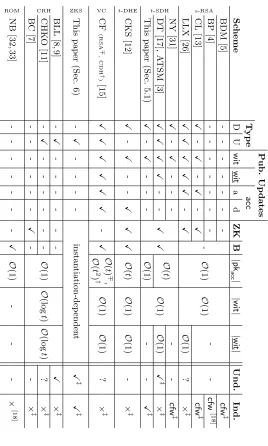
Now, we give a comprehensive overview of existing accumulator schemes in Table 1. We categorize them regarding their static or dynamic nature and universal features and provide a characterization of their public updating capabilities (of witnesses and of ac-cumulators, respectively). In particular, we tag an accumulator as dynamic, if witness and accumulator value updates can be performed in constant time, i.e., independent of the size ofX. If the same is possible without having access to the accumulator trapdoor, then we tag the accumulator aspublicly updatable. Furthermore, the properties undeni-ability and indistinguishundeni-ability have not been considered for most existing accumulator schemes so far. Therefore, we provide a classification regarding their indistinguishability (when using Transformation 1) and provide the respective proofs in Appendix B. Like-wise, we prove the undeniability of [3, 17] in Appendix B. For the sake of completeness, our comparison also includes static accumulator schemes [4, 5, 32, 33].
5
Commitments from Indistinguishable Accumulators
In [15], it has been shown that universal dynamic accumulators can be black-box con-structed from vector commitments. The question arises whether it is also possible to provide black-box constructions for certain types of commitments from indistinguish-able accumulators. It is apparent that it is not possible to build vector commitments solely from accumulators in a black-box fashion, since their position binding would at least require some additional encoding. Nevertheless, we will show how to construct non-interactive commitments from indistinguishable 1-bounded accumulators. We start by proposing the first indistinguishablet-bounded accumulator construction (for arbitrary t) and, then, provide the black-box construction based on any such scheme.
5.1 An Indistinguishable t-Bounded Dynamic Accumulator
Here, we will build an indistinguishable t-bounded accumulator from thet-SDH based dynamic accumulator in [31]. This construction already uses a randomizer (denoted as u) that is chosen byGen and added topkacc. As a consequence, the Evalalgorithm is still deterministic. In order to obtain indistinguishability, we modify the wayuis used and observe that randomly choosing it on each call to Evalyields an indistinguishable accumulator. In Appendix A, we present a modified version of [31] incorporating the aforementioned functionality and prove the following theorem.
Theorem 1. Under thet-SDH assumption, Scheme 3 (cf. Appendix A) is an indistin-guishable t-bounded dynamic accumulator.
5.2 Black-Box Construction of Non-Interactive Commitments
Before we can start, we present a standard formal definition of non-interactive commit-ment schemes.
Gen(1κ): This (probabilistic) algorithm takes input a security parameterκand outputs
the public parameterspp.
Commit(pp, m): This (probabilistic) algorithm takes input pp and a message m and outputs a commitmentC together with a corresponding opening information O.
Open(pp, C, O): This deterministic algorithm takes inputpp, a commitmentCwith cor-responding opening informationO and outputs ⊥if C is not a valid commitment to any message and messagem otherwise.
For security, a non-interactive commitment scheme is required to provide correctness,
binding andhiding. We omit a formal definition of correctness as it is straightforward. The remaining properties are defined as follows.
Definition 16 (Binding). A non-interactive commitment scheme is binding, if for all PPT adversariesA there is a negligible function(·)such that
Pr
pp←Gen(1κ),(C∗, O∗, O0∗)← A(pp), m←Open(pp, C∗, O∗), m0←Open(pp, C∗, O0∗) :m=6 m0 ∧ m6=⊥ ∧ m0 6=⊥
≤(κ).
Definition 17 (Hiding). A non-interactive commitment scheme is hiding, if for all PPT adversaries Athere is a negligible function(·) such that
Pr
pp←Gen(1κ),(m0, m1,state)← A(pp), b R ← {0,1}, (C, O)←Commit(pp, mb), b∗← A(pp, C,state) :
b=b∗
≤
1
2+(κ).
In Scheme 1, we present a black-box construction of commitments from indistinguish-able accumulators and prove the so obtained construction secure (Theorem 2). Before we continue, we want to recall that in the trusted setup model all algorithms can be correctly executed without skacc.
Gen(1κ): This algorithm runs (sk∼acc,pkacc)←Acc.Gen(1
κ
,1), discardsskacc and returnspp←
pkacc.
Commit(pp, m): This algorithm chooses randomnessr, runs (C,aux) ← Evalr((∅,pkacc), m), computeswitm←WitCreate((∅,pkacc), C,aux, m), setsO←(r, m,witm,aux) and returns
(C, O).
Open(pp, C, O): This algorithm checks whether Evalr((∅,pkacc), m)
?
= C and whether Verify(pkacc, C,witm, m)
?
=trueand returnsmon success and⊥otherwise.
Scheme 1:Commitment Scheme from Indistinguishable Accumulators
Theorem 2. If indistinguishable 1-bounded accumulators exist, then non-interactive commitments exist as well.
We prove Theorem 2 in Appendix C.2.
The black-box construction from Scheme 1 can easily be extended to support com-mitments to sets (where the opening is always with respect to the entire set) by setting the bound t of the bounded accumulator to the desired set size. Furthermore, using
We finally note that cfw-indistinguishable accumulators (and hence also Trans-formation 1) are not useful for constructing commitments. The reason for this is that the accumulation of the additional random value immediately breaks the binding property.
6
Zero-Knowledge Sets Imply Indistinguishable Undeniable
Accumulators
Zero-knowledge sets (ZK-sets) [29] allow to commit to a set X and then prove predi-cates of the form xi∈ X or xi ∈ X/ without revealing anything else about the set. We
observe that ZK-sets can be used to model indistinguishable, unbounded, undeniable ac-cumulators. Unfortunately, there is no formal security definition for zero-knowledge sets (in [25] only the algorithms are formalized, while security is stated informally). How-ever, zero-knowledge sets are a special instance of zero-knowledge elementary databases (ZK-EDB) [29]. ZK-EDBs store key-value pairs and when querying the database with a key, the respective value is returned (or⊥if the given key is not contained in the EDB). Thereby, no further information about the remaining EDB leaks. Therefore, ZK-sets are ZK-EDBs where the values for all contained keys are set to 1 (or the values are omitted at all). We can, thus, define the security on the basis of the models in [16, 29] as follows.
Definition 18 (ZK-set).A ZK-set is a tuple of efficient algorithms(Gen,Commit,Qu
-ery,Verify), which are defined as follows:
Gen(1κ): This (probabilistic) algorithm takes input a security parameterκand outputs
a public keypk.
Commit(pk,X): This algorithm takes input the public key pk and a set X and outputs
a commitmentC toX.
Query(pk,X, C, x): This algorithm takes input the public keypk, a setX, a correspond-ing commitmentC and and valuex. It outputs a proofπx ifx∈ X and a proof πx
ifx /∈ X.
Verify(pk, C, x, πx/πx): This algorithm takes input the public key pk, a commitment
C and a value x. Furthermore, it either takes a membership proof πx or a
non-membership proofπx(denoted byπx/πx). It outputstrueif the proof can be correctly
verified andfalseotherwise.
For security, ZK-sets require perfect completeness, soundness and zero-knowledge. Per-fect completeness requires that for every honestly generated key, every honestly com-puted commitment C, value x and corresponding proof πx/πx, the Verify algorithm
always returnstrue. Since this property is straightforward, we do not formally state it here. We formally define the remaining properties:
Definition 19 (Soundness). A ZK-set is sound, if for all PPT adversariesA there is a negligible function(·)such that
Pr
pk←Gen(1κ),(C∗, x∗, π∗
x, π∗x)← A(pk) :
Verify(pk, C∗, π∗x, x∗) =true ∧ Verify(pk, C∗, π∗x, x∗) =true
Definition 20 (Zero Knowledge). A ZK-set is zero-knowledge, if for all PPT ad-versariesA there is a negligible function(·)such that
Pr
pk←Gen(1κ),
(X,stateA)← A(pk),
C←Commit(pk,X),
AOQ(·,X,·,·)
(stateA,
pk, C) =true
−Pr
(pk,stateS)← SG(1κ),
(X,stateA)← A(pk),
(C,state0S)← SE(pk,state
S),
ASQ(state0
S,·,X,·,·)(stateA,
pk, C) =true
≤(κ).
Here,OQallows the adversary to execute theQueryalgorithm, whereasS= (SG,SE,SQ)
denotes a PPT simulator, which allows to execute the simulated Gen,Evaland Query
algorithms, respectively. We note that the definition above is tailored to cover compu-tational zero-knowledge. It could, however, easily be modified to also cover statistical or perfect zero knowledge.
In Scheme 2 we present a black-box construction of indistinguishable unbounded undeniable accumulators from ZK-sets.
Gen(1κ): This algorithm runspk←ZKS.Gen(1κ) and returns (sk
acc,pkacc)←(∅,pk).
Eval((∅,pkacc),X): This algorithm runsaccX ←ZKS.Commit(pkacc,X) and returnsaccX
to-gether withaux← X.
WitCreate((∅,pkacc),accX, aux, xi,type): This algorithm obtains X from aux and runs
πxi/πxi ← ZKS.Query(pk,X,accX, xi). If πxi/πxi conflicts with the requested witness type, it returns⊥. Otherwise it returnswitxi ←πxi orwitxi←πxi, respectively.
Verify(pkacc,acc, witxi, xi,type): This algorithm checks whether type conflicts with the type of the supplied witness and returns ⊥ if so. Otherwise it returns the result of ZKS.Verify(pk,acc, xi,witxi).
Scheme 2: Indistinguishable Unbounded Undeniable Accumulator from ZK-Sets
Theorem 3. If ZK-sets exist, then indistinguishable, unbounded, undeniable accumu-lators exist as well.
We prove Theorem 3 in Appendix C.3.
The above black-box construction yields the first construction of indistinguishable undeniable accumulators. We note that it is, however, questionable whether the two notions of ZK-sets and indistinguishable undeniable accumulators are equivalent (as the simulation based model of zero-knowledge appears to be stronger than the game based indistinguishability model).
In [25], Kate et al. introduced nearly ZK-sets. The difference to ordinary ZK-sets is that nearly ZK-sets have a public upper bound on the cardinality of setX. It is apparent that these constructions imply indistinguishable t-bounded undeniable accumulators. In further consequence, this means that nearly ZK-sets can also be used to construct commitments (cf. Section 5).
References
2. Jae Hyun Ahn, Dan Boneh, Jan Camenisch, Susan Hohenberger, Abhi Shelat, and Brent Waters. Computing on Authenticated Data. InTCC, volume 7194 ofLNCS, pages 1–20. Springer, 2012.
3. Man Ho Au, Patrick P. Tsang, Willy Susilo, and Yi Mu. Dynamic Universal Accumulators for DDH Groups and Their Application to Attribute-Based Anonymous Credential Sys-tems. In Marc Fischlin, editor,CT-RSA, volume 5473 ofLNCS, pages 295–308. Springer, 2009.
4. Niko Baric and Birgit Pfitzmann. Collision-free Accumulators and Fail-stop Signature Schemes Without Trees. InEUROCRYPT, pages 480–494, 1997.
5. Josh Benaloh and Michael de Mare. One-way Accumulators: A Decentralized Alternative to Digital Signatures. InEUROCRYPT, pages 274–285, 1993.
6. Dan Boneh and Xavier Boyen. Short Signatures Without Random Oracles. In EURO-CRYPT, pages 56–73, 2004.
7. Dan Boneh and Henry Corrigan-Gibbs. Bivariate Polynomials Modulo Composites and their Applications. InASIACRYPT, 2014. http://eprint.iacr.org/2014/719.
8. Ahto Buldas, Peeter Laud, and Helger Lipmaa. Accountable Certificate Management Using Undeniable Attestations. InACM CCS, pages 9–17. ACM, 2000.
9. Ahto Buldas, Peeter Laud, and Helger Lipmaa. Eliminating Counterevidence with Appli-cations to Accountable Certificate Management. Journal of Computer Security, 10:2002, 2002.
10. Philippe Camacho and Alejandro Hevia. On the Impossibility of Batch Update for Cryp-tographic Accumulators. In Michel Abdalla and PauloS.L.M. Barreto, editors, LATIN-CRYPT, volume 6212 ofLNCS, pages 178–188. Springer Berlin Heidelberg, 2010. 11. Philippe Camacho, Alejandro Hevia, Marcos A. Kiwi, and Roberto Opazo. Strong
Accu-mulators from Collision-Resistant Hashing. InISC, volume 5222 ofLNCS, pages 471–486. Springer, 2008.
12. Jan Camenisch, Markulf Kohlweiss, and Claudio Soriente. An Accumulator Based on Bilinear Maps and Efficient Revocation for Anonymous Credentials. InPKC, Irvine, pages 481–500, Berlin, Heidelberg, 2009. Springer-Verlag.
13. Jan Camenisch and Anna Lysyanskaya. Dynamic Accumulators and Application to Effi-cient Revocation of Anonymous Credentials. InCRYPTO, pages 61–76, 2002.
14. S´ebastien Canard and Amandine Jambert. On Extended Sanitizable Signature Schemes. InCT-RSA, volume 5985 of LNCS, pages 179–194. Springer, 2010.
15. Dario Catalano and Dario Fiore. Vector Commitments and Their Applica-tions. In PKC, volume 7778 of LNCS, pages 55–72, 2013. Extended version: http://eprint.iacr.org/2011/495.
16. Melissa Chase, Alexander Healy, Anna Lysyanskaya, Tal Malkin, and Leonid Reyzin. Mer-curial Commitments with Applications to Zero-Knowledge Sets. Journal of Cryptology, 26(2):251–279, 2013.
17. Ivan Damg˚ard and Nikos Triandopoulos. Supporting Non-membership Proofs with Bilinear-map Accumulators. Cryptology ePrint Archive, Report 2008/538, 2008. http://eprint.iacr.org/2008/538.
18. Hermann de Meer, Manuel Liedel, Henrich C. P¨ohls, and Joachim Posegga. Indistin-guishability of One-Way Accumulators. Technical Report MIP-1210, Faculty of Computer Science and Mathematics (FIM), University of Passau, 2012.
19. Hermann de Meer, Henrich C. P¨ohls, Joachim Posegga, and Kai Samelin. Redactable Sig-nature Schemes for Trees with Signer-Controlled Non-Leaf-Redactions. In Mohammad S. Obaidat and Joaquim Filipe, editors,E-Business and Telecommunications, volume 455 of
CCIS, pages 155–171. Springer, 2014.
21. Nelly Fazio and Antonio Nicolisi. Cryptographic Accumulators: Definitions, Constructions and Applications. Technical report, 2002.
22. Esha Ghosh, Olga Ohrimenko, and Roberto Tamassia. Verifiable Member and Order Queries on a List in Zero-Knowledge. Cryptology ePrint Archive, Report 2014/632, 2014. http://eprint.iacr.org/2014/632.
23. Philippe Golle, Stanislaw Jarecki, and Ilya Mironov. Cryptographic Primitives Enforcing Communication and Storage Complexity. In FC, volume 2357 ofLNCS, pages 120–135. Springer, 2003.
24. Michael T. Goodrich, Roberto Tamassia, and Jasminka Hasic. An Efficient Dynamic and Distributed Cryptographic Accumulator. In ISC, volume 2433 ofLNCS, pages 372–388. Springer, 2002.
25. Aniket Kate, Gregory M. Zaverucha, and Ian Goldberg. Constant-Size Commitments to Polynomials and Their Applications. In Masayuki Abe, editor,ASIACRYPT, volume 6477 ofLNCS, pages 177–194. Springer, 2010.
26. Jiangtao Li, Ninghui Li, and Rui Xue. Universal Accumulators with Efficient Nonmem-bership Proofs. InACNS, volume 4521 ofLNCS, pages 253–269. Springer, 2007.
27. Helger Lipmaa. Secure Accumulators from Euclidean Rings without Trusted Setup. In
ACNS, volume 7341 ofLNCS, pages 224–240, 2012.
28. Atefeh Mashatan and Serge Vaudenay. A Fully Dynamic Universal Accumulator. Proceed-ings of the Romanian Academy, 14:269–285, 2013.
29. Silvio Micali, Michael O. Rabin, and Joe Kilian. Zero-Knowledge Sets. In FOCS, pages 80–91, 2003.
30. Ian Miers, Christina Garman, Matthew Green, and Aviel D. Rubin. Zerocoin: Anonymous Distributed E-Cash from Bitcoin. In IEEE Symposium on Security and Privacy, pages 397–411. IEEE, 2013.
31. Lan Nguyen. Accumulators from Bilinear Pairings and Applications. InCT-RSA, LNCS, pages 275–292. Springer, 2005.
32. Kaisa Nyberg. Commutativity in Cryptography. In1st International Trier Conference in Functional Analysis. Walter Gruyter & Co, 1996.
33. Kaisa Nyberg. Fast accumulated hashing. In Dieter Gollmann, editor,FSE, volume 1039 ofLNCS, pages 83–87. Springer, 1996.
34. Kun Peng and Feng Bao. Vulnerability of a non-membership proof scheme. InSECRYPT, pages 1–4, July 2010.
35. Henrich C. P¨ohls, Stefan Peters, Kai Samelin, Joachim Posegga, and Hermann de Meer. Malleable Signatures for Resource Constrained Platforms. In WISTP, volume 7886 of
LNCS, pages 18–33. Springer, 2013.
36. Henrich C. P¨ohls and Kai Samelin. On Updatable Redactable Signatures. In ACNS, volume 8479 ofLNCS. Springer, 2014.
37. Tomas Sander. Efficient Accumulators Without Trapdoor. In ICICS, pages 252–262. Springer, 1999.
38. Tomas Sander, Amnon Ta-Shma, and Moti Yung. Blind, Auditable Membership Proofs. InFC, LNCS, pages 53–71. Springer, 2000.
39. Daniel Slamanig. Dynamic Accumulator based Discretionary Access Control for Out-sourced Storage with Unlinkable Access. InFC, LNCS. Springer, 2012.
40. Amang Sudarsono, Toru Nakanishi, and Nobuo Funabiki. Efficient Proofs of Attributes in Pairing-Based Anonymous Credential System. InPETS, pages 246–263, 2011.
41. Gene Tsudik and Shouhuai Xu. Accumulating Composites and Improved Group Signing. In Chi-Sung Laih, editor,ASIACRYPT, volume 2894 of LNCS, pages 269–286. Springer, 2003.
A
An Indistinguishable
t
-Bounded Dynamic Accumulator
Scheme 3 presents a modified version of [31]. Subsequently, we prove it to be a secure indistinguishablet-bounded dynamic accumulator. For sake of consistency, the valueu used in [31] will be denoted byr.
Gen(1κ, t): On input security parameter κ, this algorithm chooses two groupsG and GT of prime orderpsuch that log2p=κhaving a pairinge:G×G→GT. Additionally, it chooses a generatorgofG, as well ass←R Z∗p. Finally, it returns (skacc,pkacc)←(s,(g
si)t i=0). Evalr((sk∼acc,pkacc),X): On input a key pair (sk
∼
acc,pkacc) andX ={x1, . . . , xn}, this algorithm choosesr←R Z∗p. Ifskacc6=∅, it computesaccX←gr
Qn
i=1(xi+s). Otherwise, it expands the polynomialQ
x∈X(x+X) to
Pn
i=0ai·Xi and computesaccX ←(Qni=0(g si
)ai)r. Finally, it returnsaccX andaux←(r,X).
WitCreate((sk∼acc, pkacc),accX, aux, xi): On input a key pair (sk∼acc,pkacc), accX,aux= (r,X)
and xi, this algorithm checks whether xi ∈ X and returns ⊥ otherwise. If skacc 6= ∅,
it computes and returns witxi ← acc(xi+s)−1
X . Otherwise, it expands the polynomial
Q
x∈X \{xi}(x+X) to
Pn−1 i=0 ai ·X
i where X = {x
1, . . . , xn} and returns witxi ←
Qn−1 i=0(g
si )air
.
Verify(pkacc,accX, witxi,xi): This algorithm checks whether e(accX, g) = e(witxi, g xigs) holds. If so, it returnstrueandfalseotherwise.
Add((sk∼acc,pkacc), accX, aux, xi): On input a key pair (sk∼acc,pkacc), accX, aux = (r,X) and xi, this algorithm checks whether xi ∈ X/ and returns⊥otherwise. If skacc 6=∅ it
com-putes acc0 ← acc(xi+s)
X . Otherwise, with X = {x1, . . . , xn}, it expands the polynomial
Q
x∈X ∪{xi}(x+X) to
Pn+1 i=0 ai·X
i
and computes acc0 ← Qn+1 i=0(g
si )air
. Finally, it returnsacc0 andaux0← X ∪ {xi}.
Delete((sk∼acc, pkacc),accX, aux, xi): On input a key pair (sk∼acc,pkacc), accX, aux = (r,X)
and xi, this algorithm checks whether xi ∈ X or X 6= ∅ and returns ⊥ otherwise. If skacc 6= ∅ this algorithm computes acc0 ← acc(xi+s)
−1
X . Otherwise, it expands the polynomial Q
x∈X \{xi}(x+X) to
Pn−1
i=0 ai·Xi where X = {x1, . . . , xn} and computes acc0← Qn−1
i=0(g si
)air. Finally, it returnsacc0 andaux0← X \ {x i}.
WitUpdate(pkacc, witxi,aux,xj): This algorithm obtains as input a public key pkacc, witxi, aux= (acc0,acc, xi,op) andxj. Here,acc0represents the already updated accumulator and accthe accumulator before the update. Informationopdetermines whetherxjwas deleted or added to the accumulatoracc0. It returns the updated witnesswit0xi←acc·wit
xj−xi xi if op= 0 orwit0xi←(acc
0−1·
witxi)
1
xj−xi ifop= 1.
Scheme 3:Indistinguishablet-Bounded Dynamic Accumulator Scheme
A.1 Security Proofs of the Modified Scheme
The correctness proofs in [3, 31] also apply to our scheme, and, hence, we do not prove it explicitly here.
turned into an efficient adversary B against the t-SDH assumption. B gets a t-SDH instance (g, gs, . . . , gst) as input and starts the game by setting pk
acc= (g, gs, . . . , gs
t ) and handingpkaccover toA. Moreover,Bkeeps a mappingM of accumulatorsaccX to
their accumulated sets with corresponding randomizers, which is consistently updated with respect to the oracle queries.Bsimulates the oracles forAas follows:
OE: For a given pk
acc, setX = {x1, . . . , xn} and randomizer r, call (accX,aux) ←
Evalr((∅,pkacc),X), add (accX,X, r) toM and return (accX,aux).
OA: For a given pk
acc, accumulator accX and elementxi to be added, lookup the
setU ={u1, . . . , un} and randomizerr corresponding toaccX in M and return⊥
ifxi ∈U. We assume thatU =∅ andr R
←Zp when accX is not contained inM.
Compute (acc0X,aux0)←Add((∅,pkacc),accX,(r, U), xi), add (accX, U∪ {xi}, r) to
M and returnacc0X andaux0.
OD: For a given pk
acc, accumulator accX and element xi to be deleted, lookup
the set U = {u1, . . . , un} and randomizer r corresponding to accX in M and
return ⊥ if xi ∈/ U or accX is not contained in M. Compute (acc0X,aux0) ←
Delete((∅,pkacc),accX,(r, U), xi), add (accX, U\ {xi}, r) toM and returnacc0X and
aux0.
OW: For a given pk
acc, accumulator accX, and element xi, lookup the set U = {u1, . . . , un}and randomizerrcorresponding toaccX inM and return⊥ifxi∈/ U.
Otherwise, returnwitxi ←WitCreate((∅,pkacc),(r, U), xi).
Eventually,Aoutputs a membership witnesswit∗x
j for some valuex
∗
j ∈ X/ ∗, a setX∗and
a randomizerr∗ such that the verification relatione(wit∗x
j, g
x∗
j gs) =e(acc
X∗, g) holds, where (accX∗,aux) ← Evalr((∅,pkacc),X∗). Then, B knows the polynomial h(X) =
Q
x∈X∗(x+X) , the polynomialφ(X) anddsuch thath(X) =φ(X)(xj+X) +dholds
(because x∗
j ∈ X/ ∗). Then, B can computegr
∗
·φ(s) by expanding the polynomial φ(X)
to P|X∗|−1
i=0 ai·Xi and computinggr
∗·φ(s)
←(Q|X∗|−1
i=0 (g si
)ai)r∗. Thus,B can output
wit∗x
j · g
r∗·φ(s)−1r∗ ·1d
←g r∗ ·h(s)
x∗j+s g−
r∗ ·(h(s)−d)
x∗j+s
1
r∗ ·d =g
r∗ ·d x∗j+s
1
r∗ ·d =g
1
x∗j+s
together withx∗j as solution to thet-SDH problem. ut
Proof (Indistinguishability).We recall that the indistinguishability game is defined such that it is not possible to obtaingrasX06=X1and only values fromx∈ X0∩ X1can be
deleted viaOD. This means that it is impossible to extract the randomizerrused upon
Eval. The adversary seesaccXb =g
rQ
x∈Xb(x+s), and for valuesx
j∈ X0∩X1it is possible
to obtain witnesseswitxj =g
rQ
x∈Xb\{xj}(x+s). Furthermore, it is possible to add values x /∈ X0∪ X1to and to delete values x∈ X0∩ X1 from the challenge accumulatoraccXb. There exist randomizersr0 andr1 for both candidate setsX0 andX1, respectively,
such that accXb = g
r0Qx∈X0(x+s) = gr1Qx∈X1(x+s). Since it is not possible to obtain the randomness rused in Eval, even an unbounded adversary can not decide whether r=r0 orr=r1, meaning that it is not possible to distinguish whether X0 orX1 was
accumulated.
Likewise, for all witnesseswitxj, wherexj∈ X0∩X1, there are representations consis-tent with the valuesr0andr1such thatwitxj =g
r0Qx∈X0\{xj}(x+s)=gr1Qx∈X1\{xj}(x+s), which means that witnesses do not give an additional advantage. The same
B
Security of Existing Schemes in our Model
In the following, we will analyze the undeniability and (in)distinguishability of several constructions. We will not reconsider the collision freeness of these constructions in our model, as it is compatible with previous models.
B.1 Undeniability of Universal Accumulators
We will now prove the subsequent lemma:
Lemma 3. The universal accumulators in [3, 17] are undeniable.
Proof. We prove the undeniability of [3, 17] by showing that an efficient adversary A
against the undeniability can be turned into an efficient adversary B against t-SDH assumption. Note thatBcan simulate all oracles, since, due to the model, the accumu-lator and the witnesses can be generated without knowing the trapdoorskacc.Bgets a
t-SDH instance (g, gs, . . . , gst) as input, setspk
acc = (g, gs, . . . , gs
t
) and startsA with
pkacc.
Eventually, A outputs (wit∗xi,wit∗xi, x∗i,acc∗), with wit∗xi = (a, d) such that e(acc∗, g) = e(gx∗igs,wit∗
xi) and e(acc
∗, g) = e(gx∗igs, a)e(gd, g) holds. Then it holds that
e(gx∗igs,wit∗
xi) =e(g
x∗igs, a)e(gd, g). With,witx
i =g
X0
anda=ga0 for some unknown X0, a0, we know that the relation of the exponents is X0 = a0 + d
x∗
i+s. Thus, B can computeg
1
x∗i+s ←(wit∗
xi·a
−1)d−1 and output it as a solution to thet-SDH problem. ut
B.2 Indistinguishability of (Dynamic) Accumulators
We investigate the indistinguishability of [3–5, 8, 9, 11, 13, 15, 17, 26, 31]. As we will see, most existing dynamic accumulator schemes can be turned into cfw-indistinguishable accumulators under Transformation 1, whereas this does not work for existinguniversal
accumulators.
Lemma 4. Under Transformation 1, the schemes in [4], [5] and [13] are cfw -indist-inguishable.
Proof. De Meer et al. [18] proved a version of [4], whereEvalrandomly chooses a pri-vate starting value g, to be indistinguishable in their model.4 The random choice of
g is a way to apply Transformation 1. Thus, we can reuse the proof in [18] for cfw -indistinguishability.
The schemes in [4] and [5] are identical, with the only difference that the accumula-tion domain in [4] is restricted to prime numbers. Since the proof in [18] does not require this restriction, indistinguishability also holds for [5]. The difference from [13] to [4, 5] is that [13] supports dynamic updates. We, thus, need to show that access to OA and
ODdoes not give the adversary any advantage. The proof in [18] shows that the value
of the challenge accumulator is random, whenxis randomly sampled from the accumu-lation domain, i.e., it cannot be distinguished from a randomly sampled starting value of an empty accumulator. Taking this, together with the restriction that only elements
4
a /∈ X∪ can be added and only elementsa∈ X∩ can be deleted, the adversary does not
learn more than when dealing with an empty accumulator. Consequently, it can not win the indistinguishability game with a probability being non-negligibly greater than 1/2. The same argumentation also holds for [26] under the assumption that the universal
features, i.e., the non-membership witnesses/proofs, are not being used. ut Lemma 5. Under Transformation 1, the scheme in [31] is cfw-indistinguishable.
When applying Transformation 1, the accumulator in [31] is computed as accX ←
gu(x+s)Qni=1(xi+s), whereX ={x
1, . . . , xn}, uis a random value inZ∗p (chosen during Gen) andxis a random value from the accumulation domain (freshly chosen upon each call to Eval). As discussed in Section 5.1, slight changes to the accumulator scheme in [31] make it indistinguishable. In the following, we show thecfw-indistinguishability under Transformation 1.
Proof. It is easy to see that for a given accumulator accX to set X = {x1, . . . , xn},
that is, accX =gu(x+s)
Qn
i=1(xi+s) (after applying Transformation 1), another value x0 exists such that for an arbitrarily chosen set W ={wi, . . . wm} it holds that accX =
gu(x0+s)Qmi=1(wi+s). More precisely, this means that the accumulated set is uncondi-tionally hidden withinaccX. Moreover, since the witnesses have the same form as the
accumulator, they also do not reveal anything beyond the fact that an element has
indeed been accumulated. ut
Note that it is crucial that the random elements, which are inserted into the ac-cumulator, are not reused to reach this unconditional indistinguishability. Similarly, the schemes in [3, 17, 26], which extend [13] and [31] by universal features, are cfw -indistinguishable when solely used with membership witnesses. This is due to the fact that in these schemes non-membership witnesses leak information about the accumu-lated values (cf. Appendix B.3).
Lemma 6. Under Transformation 1, the scheme in [12] is distinguishable.
Proof. Here the accumulator acc is a product of generators contained in pkacc. Thus,
the size ofpkacc is linear in the maximum number of accumulated elements. This means that one can efficiently brute force the generators contained inaccXb and win the game ifX0andX1 are chosen such that||X0| − |X1|| ≥1. ut Lemma 7. Under Transformation 1, the scheme in [7] is distinguishable.
Here, the accumulator is the root of a perfect Merkle hash-tree, where a statistically hiding commitment is used as hash function. This implies that the accumulated values are statistically hidden in the accumulator. A witness for an accumulated valuexis the opening of the corresponding commitment together with its authentication path (the authentication path only contains commitments).
Proof. Transformation 1 inserts a random valuexfrom the accumulation domain into the accumulator. To win the game, the adversary chooses two arbitrary setsX0,X1such that 1≤ |X0|+ 1≤2t and 2t<|X1|+ 1 for arbitrary integerst >0. According to the
game, the adversary can now obtain a membership witness for an elementx0∈ X0∪ X1
Since the used commitments are statistically hiding, indistinguishability holds for sets
X0,X1 of size 2t≤ |X0|,|X1| <2t+1 with t ∈
N, where the hash-tree is filled up with
dummy elements if the set size is not a power of two. Thus, for sets of size|X0|=|X1|= 2twe have indistinguishability, whereascfw-indistinguishability holds for arbitrary sets meeting the aforementioned constraints.
B.3 Indistinguishability of Universal Dynamic Accumulators
Subsequently, we prove the following lemmas by providing adversaries that succeed with non-negligible probability better than 1/2.
Lemma 8. Under Transformation 1, the universal accumulator from [26] is distin-guishable.
Proof. Here, a non-membership witness for a valueyj not contained inaccX withX =
{x1, . . . , xn} is a tuple (a, d), whereaQni=1xi+byj = 1 andd≡g−b (modN). From
this, an adversary can compute a−1mody
j, i.e.,a−1≡Qni=1xi (mod yj). Whenyj >
Qn
i=1xi holds, then obviously also a
−1mody
j=Qni=1xi.
Transformation 1 inserts a random valuexfrom the accumulation domain into the accumulator. Suppose that the adversary chooses two arbitrary setsX0={x1, . . . , xn}
and X1 ={w1, . . . , wm} with X0 6=X1 and generatesk distinct non-membership
wit-nesses (yji)
k
i=1 = ((aji, dji))
k
i=1. The adversary can then computea
−1
ji modyji for i= 1, . . . , ksuch that, depending on whetherX0orX1was accumulated, eitherxQn
l=1xl≡
a−j1
i (modyji) orx
Qm
l=1wl ≡a−ji1 (modyji) holds fori= 1, . . . , k. In the attack, the adversary can compute a−CRT1 (mod Qk
i=1yji) using (a
−1
ji modyji)
k
i=1 and the Chinese
remainder theorem. Now, if Qk
i=1yji > x
Qn
i=1xi and Q k
i=1yji > x
Qm
i=1wi, it
ei-ther holds that a−CRT1 = xQn
i=1xi or a−CRT1 = x
Qm
i=1wi. These conditions can always
be ensured, since the adversary can generate an arbitrary number of non-membership witnessesyji. Next, the adversary can dividea
−1
CRTby an element being exclusively
con-tained inX0. If this division leaves a remainder,X1was accumulated, andX0otherwise. This attack succeeds with overwhelming probability, since only primes are accumulated and the probability that the randomly chosenxis also exclusively contained in one of
the setsX0 orX1is negligible. ut
Lemma 9. Under Transformation 1, the universal accumulator from [17] is distin-guishable.
Proof. Again, we show that the proposed non-membership witnesses leak information about the accumulated set. Here, non-membership witnesses are of the form (a, d) with a=g
h(s)−d yj+s =g
Qn
i=1(xi+s)−d
yj+s and d=h(−y
j) =Q n
i=1(xi−yj).
Transformation 1 inserts a random value x from the accumulation domain into the accumulator. Suppose w.l.o.g. that the adversary chooses X0 ={x1, . . . , xn} and X1={w1, . . . , wm}form > nand obtains accXb←g
h(s), whereh(s) is either equal to
(x+s)Qn
i=1(xi+s) or equal to (x+s)Q m
i=1(wi+s). The adversary is allowed to generate
n+2 distinct non-membership witnesses ((ai, di))n+2i=1 corresponding to the non-members
(yi)n+2i=1. Now, since di = h(−yi), one can simply recover a suspected polynomial of
degree n+ 1 by its evaluations (di)n+2i=1 at (−yi)n+2i=1 using polynomial interpolation.