140 |
P a g e
ESTIMATION OF FAT IN MILK: AN APPLICATION
OF DAQ
Amit Salunkhe
1, Mahesh Chavan
21
Research Scholar, JJT University, Rajasthan, (India)
2E&TC Department, Kolhapur Institute of Technology, Kolhapur (India)
ABSTRACT
Data Acquisition System (DAQ) plays a vital role where the analog environment needs to be sensed and controlled by digital system. Ultrasonic Fat detection in milk is implemented using ELVIS – II+ as DAQ. The system senses current sample temperature of milk and it is heated upto desired setpoint that is controlled through MATLAB based Neuro-Fuzzy System. Here analog and digital systems are in command of interfacing between both of them. Also different membership functions are tested and results shows triangular-shaped membership function is suitable for this application.
I
INTRODUCTION
Ultrasounds are pressure waves which can be propagated in materials, with frequencies ranging from 20 kHz to
few hundreds of megahertz[3]. Material sensors based on ultrasonic transducers often measure some wave
parameters, since these parameters are strongly dependent on the characteristics of the media the wave is
travelling through. Ultrasounds are widely used in sensing system due to its non-invasive measurements, rapid
response time, low power consumption etc., however substances under investigation must be acoustically
conductive and also signal may corrupt due to bubbles and attenuates at high frequency. The amplitude of an
ultrasound beam decreases exponentially as a function of distance that it travels through a medium[1].
where A is the attenuated amplitude of the ultrasonic beam, A0 is the initial amplitude of the beam at distance 0, z is the distance (thickness of the sample) and α is the amplitude attenuation coefficient.or by alternating solution
141 |
P a g e
The speed of propagation c and the spatial attenuation αare specific of the material which the wave propagates in. In detail, for simple liquids:With ρ the density of the liquid and K its bulk modulus (inverse of the compressibility β). The spatial attenuation on the contrary depends on several contributions: the absorption, the viscous, thermal and scattering
losses and the losses due to the relaxation processes; the latter, in turn, depend on other material-specific
parameters[9,11].
II
DAQ
SYSTEM
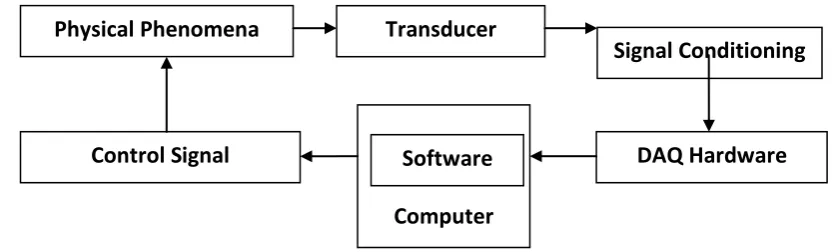
DAQ systems capture, measure, and analyze physical phenomena from the real world. Light, temperature,
pressure, and torque are examples of the different types of signals that a DAQ system can measure. Data
acquisition is the process of collecting and measuring electrical signals from transducers and test probes or
fixtures, and sending them to a computer for processing. Data acquisition can also include the output of analog
or digital control signals. The DAQ system includes[13,14]:
• Transducer—A device that converts a physical phenomenon such as light, temperature, pressure, or sound into
a measurable electrical signal such as voltage or current.
• Signal conditioning—Hardware that you can connect to the DAQ device to make the signal suitable for
measurement or to improve accuracy or reduce noise. The most common types of signal conditioning include
amplification, excitation, linearization, isolation, and filtering.
• DAQ hardware—Hardware used to acquire, measure, and analyze data. Also it works as bridge between
analog and digital system.
• Software—Application software that supports hardware and able to design and program measurement or
control applications.
2.1 Analog Input
The ELVIS system provides Analog Input (AI) channels 0 through 7 ± positive and negative input channels
lines to differential AI channels. These analog channels can be configured as Referenced Single Ended (RSE) or
Non-referenced single Ended (NRSE) modes. In RSE mode, each signal is referenced to AIGND. In NRSE
mode, each signal is referenced to the floating AISENSE line. The analog input channels are differential; hence
ground point needs to be established somewere in the signal path. As long as the signal you are measuring is
142 |
P a g e
measured such as battery of which one end of signal is connected to ground. The programmable gaininstrumentation amplifier is a measurement and instrument class amplifier that minimizes settling times for all
input ranges. The ELVIS II series can perform both single and multiple Analog to Digital conversions of a fixed
or infinite number of samples into 16-bit digital number. A large first-in-first-out (FIFO) buffer holds data
during AI acquisitions to ensure that no data is lost.
2.2 Analog Output
The hardware provides access to the two analog outputs (AO) at the AO 0 and AO 1 terminals controlled by a
single clock. These channels are used for arbitrary waveform generation. Digital-to-Analog converters (DACs)
convert digital codes to analog voltages. The AO FIFO enables analog output waveform generation. The FIFO
memory buffer between the computer and the DACs allows you to download the points of waveform to the
DACs without host computer interaction. Analog outputs are referenced to AIGND.
2.3 DAQ in MATLAB
Data Acquisition Toolbox provides functions for connecting MATLAB to data acquisition hardware. The
toolbox supports a variety of DAQ hardware, including USB, PCI, PCI Express, PXI, and PXI-Express devices,
from National Instruments, Measurement Computing, Advantech, Data Translation, and other vendors. The
DAQ can be performed using two different interfaces, based on the hardware and the platform: The
session-based interface, which works on both Windows 32-bit and 64-bit systems, and only works with National
Instruments devices, including Compact DAQ chassis and Counter/Timer modules. The other devices cannot be
used with this interface. Here an instant for a session is created and then the instructions add Analog Input
Channel, add Analog Output Channel, etc. reads and writes data to hardware.
The legacy interface, which works only on Windows 32-bit systems, and works with all other supported data
acquisition hardware. Hence cannot use Compact DAQ or Counter/timer devices with this interface. Proper
installation of DAQ mx driver can be check using daqhw info and Installed Adapters. These instructions
provides list of drivers that are installed in the system. Further analog input, analog output, add channel and put
sample instructions may be help full for reading and writing data to and from the DAQ hardware.
Computer
Transducer
Signal Conditioning
DAQ Hardware
Software
Control Signal
Physical Phenomena
143 |
P a g e
III EXPERIMENTAL SETUP
The measurement system consists of circular piston like transducers with diameter of 5mm and normal
frequency of 5MHz. The distance between transducers is maintained large enough i.e. 110mm to avoid
Fraunhofer diffraction zone.
The Fraunhofer diffraction zone is the region of the acoustic field produced by a transducer in which the beam
behaves as a simple exponentially decaying curve. Far field starts at the distance where near field or Frèsnel
zone finishes. Frèsnel diffraction zone is more complex than the far field and measurements carried out within
this zone require correction for diffraction losses. All measurement procedures have been made at a distance
corresponding to far field so that compensations are unnecessary. The distance where Fraunhofer zone starts
depends on the frequency and radius of the transducer as can be seen in
where Z0is that distance, λ is the wavelength associated to the frequency and r is the radius of the transducer.
This condition may result in major challenge when trying to determine attenuation for frequencies over 5 MHz.
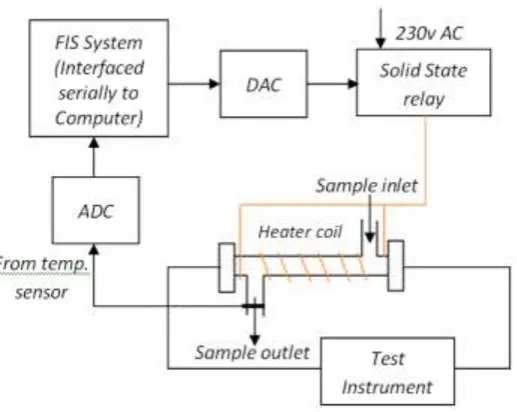
A heater coil is wound along the chamber. Milk sample at room temperature enters into chamber and controlled
milk sample at constant temperature is available at outlet. To analyze and control, the FIS based system is
developed. The control signal is available in the range of 0v to 5v. For solid state relay this signal is converted in
the range of 4mA – 20mA. Solid state relay (RM 1E23AA25 Industrial, 1-Phase Analog Switching Type) works
in accordance with the phase angle control principle. 4mA corresponds to no switching and 20mA corresponds
to full sine wave. The heater coil is controlled as per the sample temperature detected initially. The milk sample
144 |
P a g e
IV NEURO-FUZZY INFERENCE SYSTEM
Fuzzy if-then rules or fuzzy conditional statements are expressions of the form IF A THEN B, where A and B are labels of fuzzy sets characterized by appropriate membership functions[4,5,6]. Due to their concise form, fuzzy if-then rules are often employed to capture the imprecise modes of reasoning that play an essential role in the
human ability to make decisions in an environment of uncertainty and imprecision[2,7]. For example:
If pressure is high, then volume is small
The Fuzzy inference systems which are also known as fuzzy-rule-based systems, fuzzy models, fuzzy
associative memories (FAM), or fuzzy controllers when used as controllers [8,10,12].
The function of the neural fuzzy compensator is to compensate for any unsatisfactory performance of the basic
fuzzy controller.
Here a Neuro-Fuzzy Inference System is designed and implemented to control the temperature of milk sample
under test using ANFIS tool in MATLAB. Two Fuzzy Inference System are required, one is used for error input
and other is for change-in-error. The first FIS is called for first iteration in programming and for rest of
iterations the change-in-error FIS is used. The initial temperature of milk sample is detected and feed as input to
ANFIS through DAQ hardware. The error may be calculated using difference between setpoint and current
value of sample. This real time value is then converted to crisp value, which can be inputted to ERROR FIS.
According to initial input, heater is made ON with the output value (amount of heater to be made ON) provided
by FIS. From the second iteration the second error is available, so that change in error can be calculated. Know
the two values, ERROR and CHANGE-IN-ERROR works as input to FIS and intensity of heater is changed
accordingly.
V EXPERIMENTAL RESULTS & CONCLUSION
The whole system consists of two sub-systems: 1. Temperature controller for heating milk sample and 2.
Ultrasonic system that detects fat content in the milk. It is very important that sample under test should be
heated upto desired setpoint say 40oC. Here the fat globules get evenly distributed all over the milk sample.
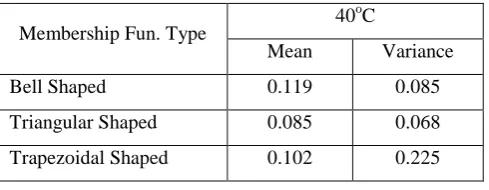
Know the Ultrasound Wave is fired and respective attenuation of signal is measured. For error and
change-in-error the mean and variance is calculated for three different shapes of membership function. The
Triangular-Shaped membership function is best suited for this application.
Membership Fun. Type 40
o
C
Mean Variance
Bell Shaped 0.119 0.085
Triangular Shaped 0.085 0.068
Trapezoidal Shaped 0.102 0.225
145 |
P a g e
REFERENCES
[1] Xuan Sun, Changsheng Ai, Yuzhen Ma, ―Milk Quality Automation Detecting Technology Based on
Dynamic Temperature‖, IEEE Chinese Control and Decision Conference (CCDC) May-2008.
[2] Marzuki Khalid and Sigeru Omatu ―A Neural Network Controller for a Temperature Control System‖,
IEEE Transaction on Control System, Jun 1992.
[3] Ekaterina А. Skiba, Vladimir N. Khmelev, ―Sterilization of Milk by Ultrasonics‖, 8th International
Siberian Workshop And Tutorials Edm’2007, Session V, July 1-5, Erlagol.
[4] Chuen Chien Lee, ―Fuzzy Logic in Control Systems: Fuzzy Logic Controller-Part I‖, 11th Transactions on
Systems Man, vol. 20. no. 2. March/April. 1990
[5] Chuen Chien Lee, ―Fuzzy Logic in Control Systems: Fuzzy Logic Controller-Part II‖, 11th Transactions
On Systems Man, vol 20. no. 2. Mar/Apr 1990
[6] Ahmad Johan Mahbob, Mahanijah Md Kamal and Faieza Hanum Yahaya, ―Water Temperature Using
Fuzzy Logic‖, 2009 5th International Colloquium on Signal Processing & Its Applications (CSPA), Apr.
2009.
[7] A.M.F. Fileti, A.J.B. Antunes, F.V. Silva and V. Silveira Jr, ―Experimental investigations on fuzzy logic
for process control‖, Control Engineering Practice 15 (2007) 1149–1160.
[8] C. Franco, M. Dall’Agnol, T.V. Costa, A.M.F. Fileti, F.V. Silva, ―A neuro-fuzzy identification of
non-linear transient systems: Application to a pilot refrigeration plant‖, International Journal of Refrigeration
May 2011.
[9] Rene Badertscher, Thomas Berger & Rolf Kuhn, ―Densitometric Determination of the fat content of milk
& milk products‖, International Dairy Journal 17 pp 20-30 2007
[10] Radu-Emil Precup and Hans Hellendoorn, ―A survey on industrial applications of fuzzy control‖,
Computers in Industry 213-226, 2011
[11] Anwar Sadat & Pallavi Gupta, ―Acoustic Attenuation Technique for the Detection of Adulteration in
Milk‖, International Journal of Computer Applications on Electronics, No. 02, Dec 2011
[12] Shakti Kumar Jaswinder Singh & Monika, ―Automatic Gain Setting of Fuzzy Logic Controller Using
Intelligent Technique‖, Asian Conference on Intelligent System & Networks, pp 167-173, 2006.
[13] User manual NI Elvis II.