Partial Key Exposure Attacks on RSA:
Achieving the Boneh-Durfee Bound
∗†Atsushi Takayasu and‡Noboru Kunihiro
May 25, 2018
Abstract
Thus far, several lattice-based algorithms forpartial key exposure attackson RSA, i.e., given the most/least significant bits (MSBs/LSBs) of a secret exponentdand factoring an RSA mod-ulusN, have been proposed such as Bl¨omer and May (Crypto’03), Ernst et al. (Eurocrypt’05), and Aono (PKC’09). Due to Boneh and Durfee’s small secret exponent attack, partial key expo-sure attacks should always work ford < N0.292 even without any partial information. However, it was difficult task to make use of the given partial information without losing the quality of Boneh-Durfee’s attack. In particular, known partial key exposure attacks fail to work for d < N0.292with only few partial information. Such unnatural situation stems from the fact that the additional information makes underlying modular equations involved. In this paper, we pro-pose improved attacks when a secret exponentsdis small. Our attacks are better than all known previous attacks in the sense that our attacks require less partial information. Specifically, our attack is better than all known ones for d < N0.5625 and d < N0.368 with the MSBs and the LSBs, respectively. Furthermore, our attacks fully cover the Boneh-Durfee bound, i.e., they always work ford < N0.292. At a high level, we obtain the improved attacks by fully utilizing
unravelled linearization technique proposed by Herrmann and May (Asiacrypt’09). Although Herrmann and May (PKC’10) already applied the technique to Boneh-Durfee’s attack, we show elegant and impressive extensions to capture partial key exposure attacks. More concretely, we construct structured triangular matrices that enable us to recover more useful algebraic struc-tures of underlying modular polynomials. We embed the given MSBs/LSBs to the recovered algebraic structures and construct our partial key exposure attacks. In this full version, we provide overviews and explicit proofs of the triangular matrix constructions. We believe that the additional explanations help readers to understand our techniques.
∗This is the full version of [TK14c].
†The University of Tokyo, National Institute of Advanced Industrial Science and Technology (AIST). e-mail:
Contents
1 Introduction 1
1.1 Background . . . 1
1.2 Our Results . . . 1
1.3 Technical Overview . . . 2
1.4 Related Works . . . 5
1.5 Roadmap . . . 6
2 Preliminaries 6 3 Revisiting Herrmann-May’s Matrix 7 3.1 Boneh-Durfee’s Attack . . . 8
3.2 Herrmann-May’s Matrix . . . 10
3.3 Herrmann-May’s Matrix with Additional Unraveling . . . 11
4 Partial Key Exposure Attacks with the MSBs 15 4.1 Formulation . . . 15
4.2 Previous Works . . . 16
4.3 Revisiting Ernst et al.’s Attack by Solving Modular Equations . . . 17
4.4 Our Attack . . . 21
5 Partial Key Exposure Attacks with the LSBs 28 5.1 Formulation . . . 28
5.2 Previous Works . . . 28
5.3 Our Attack . . . 30
1
Introduction
1.1 Background
RSA is one of the most famous public key cryptosystems and numerous papers have studied the
security. Let N = pq be a public modulus, where p and q are distinct primes with the same
bit-size. The bit-size of N should be sufficiently large so that the factorization is computationally
hard. There are a public exponent e and a secret exponent d that satisfy ed = 1 modϕ(N),
whereϕ(N) = (p−1)(q−1) is Euler’s totient function. During decryption/signing, heavy modular
exponentiationscd mod N should be computed. The most trivial way to reduce the computational
cost is using smalld. However, Wiener [Wie90] first reported that too smalldmakes RSA insecure.
He claimed that there is a polynomial time algorithm for factoring N when d < N1/4. Boneh and
Durfee [BD00] revisited the attack by using lattice-based Coppersmith’s method [Cop96b]. At first,
they proposed an improved attack that works for d < N(7−2√7)/6 = N0.284···. In the same work,
they further improved the bound tod < N1−1/√2 =N0.292···. Throughout the paper, we call these
bounds the Boneh-Durfee weaker and the stronger bound, respectively.
Boneh, Durfee, and Frankel [BDF98] introduced partial key exposure attacks on RSA, where
the attackers are given the most/least significant bits (MSBs/LSBs) of full size d. The attack
is theoretically interesting to study how many portions of secret information enable attackers to break the security of RSA. Although Boneh et al.’s partial key exposure attacks work only for small
e, several improvements have been proposed by using Coppersmith’s methods [Cop96a,Cop96b].
Bl¨omer and May [BM03] improved the bound to e < N7/8 with the LSBs of d. Ernst et al.
[EJMdW05] proposed the first attack for full size ewith the MSBs ofd.
In the same work [EJMdW05], Ernst et al. also studied the attacks with the MSBs/LSBs of small d. By definition, the attack scenario is an extension of Boneh-Durfee’s work [BD00]. Specifically, Boneh-Durfee’s small secret exponent attack is a special case of the partial key exposure attack when the given partial information is exactly zero. Hence, Boneh and Durfee’s result suggests that partial
key exposure attacks should always work for d < N0.292··· even without any partial information.
However, Ernst et al.’s attacks only cover the Boneh-Durfee weaker bound d < N0.284··· when the
given partial information is exactly zero. Aono [Aon09] proposed the first attack to cover the
Boneh-Durfee stronger bound with the LSBs of d. Aono’s attack requires less partial information
than Ernst et al.’s attack for d < N(9−√21)/12 =N0.368··· to factor a modulusN. Unfortunately, a
trick of Aono’s algorithm is not applicable to the MSBs case. Hence, extending the Boneh-Durfee
stronger attack with MSBs ofdis still an interesting open problem.
1.2 Our Results
In this paper, we propose improved partial key exposure attacks on RSA with the MSBs/LSBs
of d. Our attacks work with less partial information than the previous attacks [Aon09, BM03,
EJMdW05, SSM10] for d < N9/16 = N0.5625 and d < N(9−√21)/12 = N0.368··· with the MSBs
and the LSBs, respectively. Furthermore, the most impressive feature of our proposed attacks is
that they always work for d < N0.292··· even when the given partial information is exactly zero.
0 0.1 0.2 0.3 0.4 0.5 0.6 0.7
0.3 0.35 0.4 0.45 0.5 0.55
(
)
/
<latexit sha1_base64="0c5NwzOcfwdlSkA7lmD896Alg40=">AAACeXichVHLSsNAFD2N7/pofSwEN2pRqmC9UUFxJbpxWR9VwUpJ0lFD0yQk04IWf8AfcOFGBRH1M9z4Ay76CeJSwYUuvE0DoqLekJlzz9xz58yM7lqmL4mqEaWhsam5pbUt2t7R2RWLd/ds+E7JM0TGcCzH29I1X1imLTLSlJbYcj2hFXVLbOqFpdr6Zll4vunY6/LAFTtFbc82d01Dk0zl4n3JrC6kNpHNC0tqY5NBlosnKEVBDP4EaggSCCPtxK+QRR4ODJRQhIANydiCBp+/bagguMztoMKcx8gM1gWOEGVtiasEV2jMFnjc42w7ZG3Oaz39QG3wLhb/HisHMUIPdE3PdE+39Ejvv/aqBD1qXg541uta4eZix/1rr/+qijxL7H+q/vQssYu5wKvJ3t2AqZ3CqOvLhyfPa/OrI5VRuqAn9n9OVbrjE9jlF+NyRayeIsoPoH6/7p9gYyqlUkpdmUksLIZP0YoBDCPJ9z2LBSwjjQzve4gzXOMm8qYMKUllvF6qREJNL76EMv0BnRCRcg==</latexit><latexit sha1_base64="0c5NwzOcfwdlSkA7lmD896Alg40=">AAACeXichVHLSsNAFD2N7/pofSwEN2pRqmC9UUFxJbpxWR9VwUpJ0lFD0yQk04IWf8AfcOFGBRH1M9z4Ay76CeJSwYUuvE0DoqLekJlzz9xz58yM7lqmL4mqEaWhsam5pbUt2t7R2RWLd/ds+E7JM0TGcCzH29I1X1imLTLSlJbYcj2hFXVLbOqFpdr6Zll4vunY6/LAFTtFbc82d01Dk0zl4n3JrC6kNpHNC0tqY5NBlosnKEVBDP4EaggSCCPtxK+QRR4ODJRQhIANydiCBp+/bagguMztoMKcx8gM1gWOEGVtiasEV2jMFnjc42w7ZG3Oaz39QG3wLhb/HisHMUIPdE3PdE+39Ejvv/aqBD1qXg541uta4eZix/1rr/+qijxL7H+q/vQssYu5wKvJ3t2AqZ3CqOvLhyfPa/OrI5VRuqAn9n9OVbrjE9jlF+NyRayeIsoPoH6/7p9gYyqlUkpdmUksLIZP0YoBDCPJ9z2LBSwjjQzve4gzXOMm8qYMKUllvF6qREJNL76EMv0BnRCRcg==</latexit>
<latexit sha1_base64="0c5NwzOcfwdlSkA7lmD896Alg40=">AAACeXichVHLSsNAFD2N7/pofSwEN2pRqmC9UUFxJbpxWR9VwUpJ0lFD0yQk04IWf8AfcOFGBRH1M9z4Ay76CeJSwYUuvE0DoqLekJlzz9xz58yM7lqmL4mqEaWhsam5pbUt2t7R2RWLd/ds+E7JM0TGcCzH29I1X1imLTLSlJbYcj2hFXVLbOqFpdr6Zll4vunY6/LAFTtFbc82d01Dk0zl4n3JrC6kNpHNC0tqY5NBlosnKEVBDP4EaggSCCPtxK+QRR4ODJRQhIANydiCBp+/bagguMztoMKcx8gM1gWOEGVtiasEV2jMFnjc42w7ZG3Oaz39QG3wLhb/HisHMUIPdE3PdE+39Ejvv/aqBD1qXg541uta4eZix/1rr/+qijxL7H+q/vQssYu5wKvJ3t2AqZ3CqOvLhyfPa/OrI5VRuqAn9n9OVbrjE9jlF+NyRayeIsoPoH6/7p9gYyqlUkpdmUksLIZP0YoBDCPJ9z2LBSwjjQzve4gzXOMm8qYMKUllvF6qREJNL76EMv0BnRCRcg==</latexit>
<latexit sha1_base64="0c5NwzOcfwdlSkA7lmD896Alg40=">AAACeXichVHLSsNAFD2N7/pofSwEN2pRqmC9UUFxJbpxWR9VwUpJ0lFD0yQk04IWf8AfcOFGBRH1M9z4Ay76CeJSwYUuvE0DoqLekJlzz9xz58yM7lqmL4mqEaWhsam5pbUt2t7R2RWLd/ds+E7JM0TGcCzH29I1X1imLTLSlJbYcj2hFXVLbOqFpdr6Zll4vunY6/LAFTtFbc82d01Dk0zl4n3JrC6kNpHNC0tqY5NBlosnKEVBDP4EaggSCCPtxK+QRR4ODJRQhIANydiCBp+/bagguMztoMKcx8gM1gWOEGVtiasEV2jMFnjc42w7ZG3Oaz39QG3wLhb/HisHMUIPdE3PdE+39Ejvv/aqBD1qXg541uta4eZix/1rr/+qijxL7H+q/vQssYu5wKvJ3t2AqZ3CqOvLhyfPa/OrI5VRuqAn9n9OVbrjE9jlF+NyRayeIsoPoH6/7p9gYyqlUkpdmUksLIZP0YoBDCPJ9z2LBSwjjQzve4gzXOMm8qYMKUllvF6qREJNL76EMv0BnRCRcg==</latexit>
<latexit sha1_base64="8Y5XGkcC2kNWQPt7gXv4LujJi+I=">AAACaHichVFNLwNBGH66vuurOCAujYY4Ne+KhDgJF0dtVSU0ze4aTGx3N7vTJjT+gIsj4kQiIn6Giz/g0J+AI4mLg7fbTQTBO5mZZ555n3eemTE9WwaKqB7TWlrb2js6u+LdPb19/YmBwbXArfiWyFuu7frrphEIWzoir6SyxbrnC6Ns2qJg7i019gtV4QfSdVbVvieKZWPHkdvSMhRT+U1TKKOUSFGawkj+BHoEUohixU1cYxNbcGGhgjIEHCjGNgwE3Dagg+AxV0SNOZ+RDPcFDhFnbYWzBGcYzO7xuMOrjYh1eN2oGYRqi0+xufusTGKCHuiGXuiebumR3n+tVQtrNLzs82w2tcIr9R+N5N7+VZV5Vtj9VP3pWWEbc6FXyd69kGncwmrqqwcnL7n57ERtki7pmf1fUJ3u+AZO9dW6yojsOeL8Afr35/4J1qbTOqX1zExqYTH6ik6MYRxT/N6zWMAyVpDncyWOcYqz2JOW0Ia10WaqFos0Q/gS2vgHj+iLoA==</latexit>
<latexit sha1_base64="8Y5XGkcC2kNWQPt7gXv4LujJi+I=">AAACaHichVFNLwNBGH66vuurOCAujYY4Ne+KhDgJF0dtVSU0ze4aTGx3N7vTJjT+gIsj4kQiIn6Giz/g0J+AI4mLg7fbTQTBO5mZZ555n3eemTE9WwaKqB7TWlrb2js6u+LdPb19/YmBwbXArfiWyFuu7frrphEIWzoir6SyxbrnC6Ns2qJg7i019gtV4QfSdVbVvieKZWPHkdvSMhRT+U1TKKOUSFGawkj+BHoEUohixU1cYxNbcGGhgjIEHCjGNgwE3Dagg+AxV0SNOZ+RDPcFDhFnbYWzBGcYzO7xuMOrjYh1eN2oGYRqi0+xufusTGKCHuiGXuiebumR3n+tVQtrNLzs82w2tcIr9R+N5N7+VZV5Vtj9VP3pWWEbc6FXyd69kGncwmrqqwcnL7n57ERtki7pmf1fUJ3u+AZO9dW6yojsOeL8Afr35/4J1qbTOqX1zExqYTH6ik6MYRxT/N6zWMAyVpDncyWOcYqz2JOW0Ia10WaqFos0Q/gS2vgHj+iLoA==</latexit>
<latexit sha1_base64="8Y5XGkcC2kNWQPt7gXv4LujJi+I=">AAACaHichVFNLwNBGH66vuurOCAujYY4Ne+KhDgJF0dtVSU0ze4aTGx3N7vTJjT+gIsj4kQiIn6Giz/g0J+AI4mLg7fbTQTBO5mZZ555n3eemTE9WwaKqB7TWlrb2js6u+LdPb19/YmBwbXArfiWyFuu7frrphEIWzoir6SyxbrnC6Ns2qJg7i019gtV4QfSdVbVvieKZWPHkdvSMhRT+U1TKKOUSFGawkj+BHoEUohixU1cYxNbcGGhgjIEHCjGNgwE3Dagg+AxV0SNOZ+RDPcFDhFnbYWzBGcYzO7xuMOrjYh1eN2oGYRqi0+xufusTGKCHuiGXuiebumR3n+tVQtrNLzs82w2tcIr9R+N5N7+VZV5Vtj9VP3pWWEbc6FXyd69kGncwmrqqwcnL7n57ERtki7pmf1fUJ3u+AZO9dW6yojsOeL8Afr35/4J1qbTOqX1zExqYTH6ik6MYRxT/N6zWMAyVpDncyWOcYqz2JOW0Ia10WaqFos0Q/gS2vgHj+iLoA==</latexit>
<latexit sha1_base64="8Y5XGkcC2kNWQPt7gXv4LujJi+I=">AAACaHichVFNLwNBGH66vuurOCAujYY4Ne+KhDgJF0dtVSU0ze4aTGx3N7vTJjT+gIsj4kQiIn6Giz/g0J+AI4mLg7fbTQTBO5mZZ555n3eemTE9WwaKqB7TWlrb2js6u+LdPb19/YmBwbXArfiWyFuu7frrphEIWzoir6SyxbrnC6Ns2qJg7i019gtV4QfSdVbVvieKZWPHkdvSMhRT+U1TKKOUSFGawkj+BHoEUohixU1cYxNbcGGhgjIEHCjGNgwE3Dagg+AxV0SNOZ+RDPcFDhFnbYWzBGcYzO7xuMOrjYh1eN2oGYRqi0+xufusTGKCHuiGXuiebumR3n+tVQtrNLzs82w2tcIr9R+N5N7+VZV5Vtj9VP3pWWEbc6FXyd69kGncwmrqqwcnL7n57ERtki7pmf1fUJ3u+AZO9dW6yojsOeL8Afr35/4J1qbTOqX1zExqYTH6ik6MYRxT/N6zWMAyVpDncyWOcYqz2JOW0Ia10WaqFos0Q/gS2vgHj+iLoA==</latexit>
[EJMdW05]
0 0.05 0.1 0.15 0.2 0.25 0.3 0.35 0.4
0.28 0.29 0.3 0.31 0.32 0.33 0.34 0.35 0.36 0.37
<latexit sha1_base64="8Y5XGkcC2kNWQPt7gXv4LujJi+I=">AAACaHichVFNLwNBGH66vuurOCAujYY4Ne+KhDgJF0dtVSU0ze4aTGx3N7vTJjT+gIsj4kQiIn6Giz/g0J+AI4mLg7fbTQTBO5mZZ555n3eemTE9WwaKqB7TWlrb2js6u+LdPb19/YmBwbXArfiWyFuu7frrphEIWzoir6SyxbrnC6Ns2qJg7i019gtV4QfSdVbVvieKZWPHkdvSMhRT+U1TKKOUSFGawkj+BHoEUohixU1cYxNbcGGhgjIEHCjGNgwE3Dagg+AxV0SNOZ+RDPcFDhFnbYWzBGcYzO7xuMOrjYh1eN2oGYRqi0+xufusTGKCHuiGXuiebumR3n+tVQtrNLzs82w2tcIr9R+N5N7+VZV5Vtj9VP3pWWEbc6FXyd69kGncwmrqqwcnL7n57ERtki7pmf1fUJ3u+AZO9dW6yojsOeL8Afr35/4J1qbTOqX1zExqYTH6ik6MYRxT/N6zWMAyVpDncyWOcYqz2JOW0Ia10WaqFos0Q/gS2vgHj+iLoA==</latexit>
<latexit sha1_base64="8Y5XGkcC2kNWQPt7gXv4LujJi+I=">AAACaHichVFNLwNBGH66vuurOCAujYY4Ne+KhDgJF0dtVSU0ze4aTGx3N7vTJjT+gIsj4kQiIn6Giz/g0J+AI4mLg7fbTQTBO5mZZ555n3eemTE9WwaKqB7TWlrb2js6u+LdPb19/YmBwbXArfiWyFuu7frrphEIWzoir6SyxbrnC6Ns2qJg7i019gtV4QfSdVbVvieKZWPHkdvSMhRT+U1TKKOUSFGawkj+BHoEUohixU1cYxNbcGGhgjIEHCjGNgwE3Dagg+AxV0SNOZ+RDPcFDhFnbYWzBGcYzO7xuMOrjYh1eN2oGYRqi0+xufusTGKCHuiGXuiebumR3n+tVQtrNLzs82w2tcIr9R+N5N7+VZV5Vtj9VP3pWWEbc6FXyd69kGncwmrqqwcnL7n57ERtki7pmf1fUJ3u+AZO9dW6yojsOeL8Afr35/4J1qbTOqX1zExqYTH6ik6MYRxT/N6zWMAyVpDncyWOcYqz2JOW0Ia10WaqFos0Q/gS2vgHj+iLoA==</latexit>
<latexit sha1_base64="8Y5XGkcC2kNWQPt7gXv4LujJi+I=">AAACaHichVFNLwNBGH66vuurOCAujYY4Ne+KhDgJF0dtVSU0ze4aTGx3N7vTJjT+gIsj4kQiIn6Giz/g0J+AI4mLg7fbTQTBO5mZZ555n3eemTE9WwaKqB7TWlrb2js6u+LdPb19/YmBwbXArfiWyFuu7frrphEIWzoir6SyxbrnC6Ns2qJg7i019gtV4QfSdVbVvieKZWPHkdvSMhRT+U1TKKOUSFGawkj+BHoEUohixU1cYxNbcGGhgjIEHCjGNgwE3Dagg+AxV0SNOZ+RDPcFDhFnbYWzBGcYzO7xuMOrjYh1eN2oGYRqi0+xufusTGKCHuiGXuiebumR3n+tVQtrNLzs82w2tcIr9R+N5N7+VZV5Vtj9VP3pWWEbc6FXyd69kGncwmrqqwcnL7n57ERtki7pmf1fUJ3u+AZO9dW6yojsOeL8Afr35/4J1qbTOqX1zExqYTH6ik6MYRxT/N6zWMAyVpDncyWOcYqz2JOW0Ia10WaqFos0Q/gS2vgHj+iLoA==</latexit>
<latexit sha1_base64="8Y5XGkcC2kNWQPt7gXv4LujJi+I=">AAACaHichVFNLwNBGH66vuurOCAujYY4Ne+KhDgJF0dtVSU0ze4aTGx3N7vTJjT+gIsj4kQiIn6Giz/g0J+AI4mLg7fbTQTBO5mZZ555n3eemTE9WwaKqB7TWlrb2js6u+LdPb19/YmBwbXArfiWyFuu7frrphEIWzoir6SyxbrnC6Ns2qJg7i019gtV4QfSdVbVvieKZWPHkdvSMhRT+U1TKKOUSFGawkj+BHoEUohixU1cYxNbcGGhgjIEHCjGNgwE3Dagg+AxV0SNOZ+RDPcFDhFnbYWzBGcYzO7xuMOrjYh1eN2oGYRqi0+xufusTGKCHuiGXuiebumR3n+tVQtrNLzs82w2tcIr9R+N5N7+VZV5Vtj9VP3pWWEbc6FXyd69kGncwmrqqwcnL7n57ERtki7pmf1fUJ3u+AZO9dW6yojsOeL8Afr35/4J1qbTOqX1zExqYTH6ik6MYRxT/N6zWMAyVpDncyWOcYqz2JOW0Ia10WaqFos0Q/gS2vgHj+iLoA==</latexit>
(
)
/
<latexit sha1_base64="0c5NwzOcfwdlSkA7lmD896Alg40=">AAACeXichVHLSsNAFD2N7/pofSwEN2pRqmC9UUFxJbpxWR9VwUpJ0lFD0yQk04IWf8AfcOFGBRH1M9z4Ay76CeJSwYUuvE0DoqLekJlzz9xz58yM7lqmL4mqEaWhsam5pbUt2t7R2RWLd/ds+E7JM0TGcCzH29I1X1imLTLSlJbYcj2hFXVLbOqFpdr6Zll4vunY6/LAFTtFbc82d01Dk0zl4n3JrC6kNpHNC0tqY5NBlosnKEVBDP4EaggSCCPtxK+QRR4ODJRQhIANydiCBp+/bagguMztoMKcx8gM1gWOEGVtiasEV2jMFnjc42w7ZG3Oaz39QG3wLhb/HisHMUIPdE3PdE+39Ejvv/aqBD1qXg541uta4eZix/1rr/+qijxL7H+q/vQssYu5wKvJ3t2AqZ3CqOvLhyfPa/OrI5VRuqAn9n9OVbrjE9jlF+NyRayeIsoPoH6/7p9gYyqlUkpdmUksLIZP0YoBDCPJ9z2LBSwjjQzve4gzXOMm8qYMKUllvF6qREJNL76EMv0BnRCRcg==</latexit>
<latexit sha1_base64="0c5NwzOcfwdlSkA7lmD896Alg40=">AAACeXichVHLSsNAFD2N7/pofSwEN2pRqmC9UUFxJbpxWR9VwUpJ0lFD0yQk04IWf8AfcOFGBRH1M9z4Ay76CeJSwYUuvE0DoqLekJlzz9xz58yM7lqmL4mqEaWhsam5pbUt2t7R2RWLd/ds+E7JM0TGcCzH29I1X1imLTLSlJbYcj2hFXVLbOqFpdr6Zll4vunY6/LAFTtFbc82d01Dk0zl4n3JrC6kNpHNC0tqY5NBlosnKEVBDP4EaggSCCPtxK+QRR4ODJRQhIANydiCBp+/bagguMztoMKcx8gM1gWOEGVtiasEV2jMFnjc42w7ZG3Oaz39QG3wLhb/HisHMUIPdE3PdE+39Ejvv/aqBD1qXg541uta4eZix/1rr/+qijxL7H+q/vQssYu5wKvJ3t2AqZ3CqOvLhyfPa/OrI5VRuqAn9n9OVbrjE9jlF+NyRayeIsoPoH6/7p9gYyqlUkpdmUksLIZP0YoBDCPJ9z2LBSwjjQzve4gzXOMm8qYMKUllvF6qREJNL76EMv0BnRCRcg==</latexit>
<latexit sha1_base64="0c5NwzOcfwdlSkA7lmD896Alg40=">AAACeXichVHLSsNAFD2N7/pofSwEN2pRqmC9UUFxJbpxWR9VwUpJ0lFD0yQk04IWf8AfcOFGBRH1M9z4Ay76CeJSwYUuvE0DoqLekJlzz9xz58yM7lqmL4mqEaWhsam5pbUt2t7R2RWLd/ds+E7JM0TGcCzH29I1X1imLTLSlJbYcj2hFXVLbOqFpdr6Zll4vunY6/LAFTtFbc82d01Dk0zl4n3JrC6kNpHNC0tqY5NBlosnKEVBDP4EaggSCCPtxK+QRR4ODJRQhIANydiCBp+/bagguMztoMKcx8gM1gWOEGVtiasEV2jMFnjc42w7ZG3Oaz39QG3wLhb/HisHMUIPdE3PdE+39Ejvv/aqBD1qXg541uta4eZix/1rr/+qijxL7H+q/vQssYu5wKvJ3t2AqZ3CqOvLhyfPa/OrI5VRuqAn9n9OVbrjE9jlF+NyRayeIsoPoH6/7p9gYyqlUkpdmUksLIZP0YoBDCPJ9z2LBSwjjQzve4gzXOMm8qYMKUllvF6qREJNL76EMv0BnRCRcg==</latexit>
<latexit sha1_base64="0c5NwzOcfwdlSkA7lmD896Alg40=">AAACeXichVHLSsNAFD2N7/pofSwEN2pRqmC9UUFxJbpxWR9VwUpJ0lFD0yQk04IWf8AfcOFGBRH1M9z4Ay76CeJSwYUuvE0DoqLekJlzz9xz58yM7lqmL4mqEaWhsam5pbUt2t7R2RWLd/ds+E7JM0TGcCzH29I1X1imLTLSlJbYcj2hFXVLbOqFpdr6Zll4vunY6/LAFTtFbc82d01Dk0zl4n3JrC6kNpHNC0tqY5NBlosnKEVBDP4EaggSCCPtxK+QRR4ODJRQhIANydiCBp+/bagguMztoMKcx8gM1gWOEGVtiasEV2jMFnjc42w7ZG3Oaz39QG3wLhb/HisHMUIPdE3PdE+39Ejvv/aqBD1qXg541uta4eZix/1rr/+qijxL7H+q/vQssYu5wKvJ3t2AqZ3CqOvLhyfPa/OrI5VRuqAn9n9OVbrjE9jlF+NyRayeIsoPoH6/7p9gYyqlUkpdmUksLIZP0YoBDCPJ9z2LBSwjjQzve4gzXOMm8qYMKUllvF6qREJNL76EMv0BnRCRcg==</latexit>
[EJMdW05]
Figure 1: Comparison of attack conditions
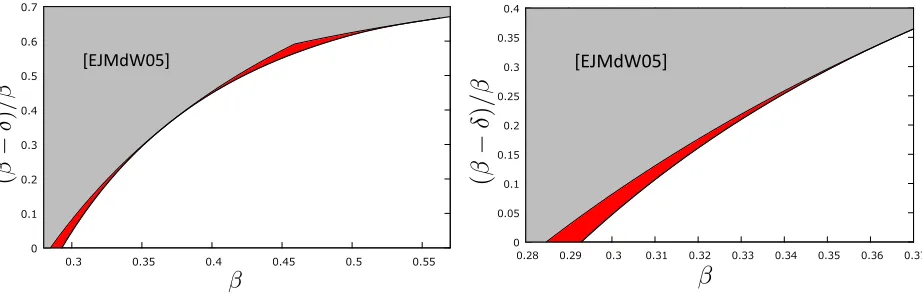
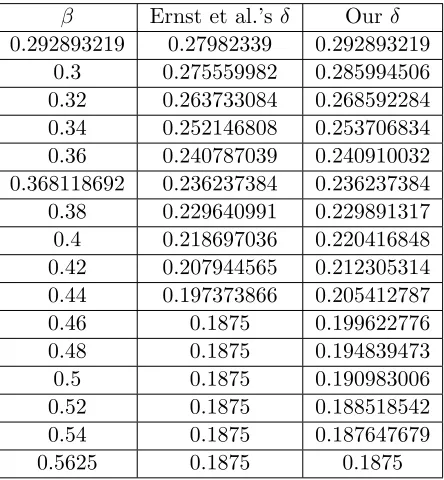
Figure 1 compares attack conditions with Ernst et al’s and ours. Since a condition of Aono’s
attack is close to ours, we do not compare it in the figure. The left and the right figure is for the MSBs and the LSBs, respectively. Horizontal axes and vertical axes represent sizes of secret
exponents β := logNd and ratios of exposed bits (β−δ)/β, whereδ represents sizes of d1 which
are unknown parts ofd, respectively. Ernst et al.’s attacks work in the gray areas while our attack
improve the red areas whenβ is small.
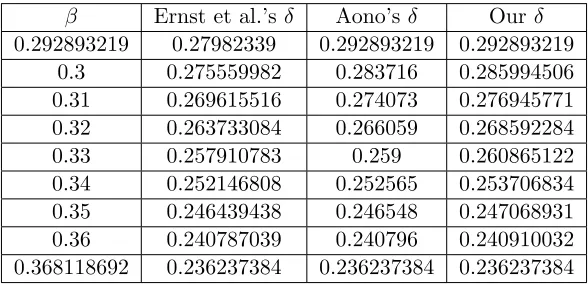
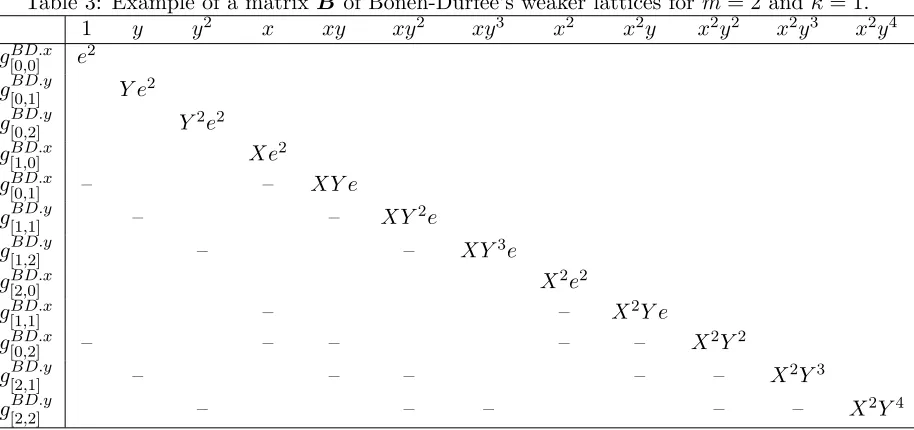
We also show numerical comparisons for attack conditions. Table 1 provides a comparison
between Ernst et al.’s attack and our attack with the MSBs for 1−1/√2 = 0.292· · · ≤β ≤9/16 =
0.5625. Table2 provides a comparison between Ernst et al.’s attack, Aono’s attack, and our attack
for 1−1/√2 = 0.292· · · ≤ β ≤(9−√21)/12 = 0.368· · ·. In such small β, our proposed attacks
are better than other ones.
1.3 Technical Overview
Here, we summarize technical background of the work. Then, we explain a technical overview of our improvements.
Coppersmith’s Methods. In 1996, Coppersmith [Cop96a, Cop96b] introduced lattice-based
methods for solving integer/modular equations with small solutions in polynomial time. The meth-ods first construct a matrix whose rows consist of coefficient vectors of polynomials that have the same roots as the original polynomials. Then, we apply the LLL reduction algorithm [LLL82] to the matrix. If the LLL outputs sufficiently short vectors, one can obtain the desired solutions. The methods are actively utilized to study the security of RSA including Boneh and Durfee’s small secret
exponent attack [BD00], and partial key exposure attacks [Aon09,BM03,EJMdW05,SSM10].
Some researchers believe that if there is an attack based on Coppersmith’s integer equation solving method, there should be an analogous attack based on the modular equation solving method,
and vice versa. For example, Bl¨omer-May’s [BM03] and Ernst et al.’s [EJMdW05] partial key
Table 1: Comparison of the recoverable bounds for partial key exposure attacks with the MSBs
β Ernst et al.’s δ Ourδ
0.292893219 0.27982339 0.292893219
0.3 0.275559982 0.285994506
0.32 0.263733084 0.268592284
0.34 0.252146808 0.253706834
0.36 0.240787039 0.240910032
0.368118692 0.236237384 0.236237384
0.38 0.229640991 0.229891317
0.4 0.218697036 0.220416848
0.42 0.207944565 0.212305314
0.44 0.197373866 0.205412787
0.46 0.1875 0.199622776
0.48 0.1875 0.194839473
0.5 0.1875 0.190983006
0.52 0.1875 0.188518542
0.54 0.1875 0.187647679
0.5625 0.1875 0.1875
there are several counterexamples. The most basic example is Boneh-Durfee’s attack [BD00]. Boneh and Durfee utilized Coppersmith’s modular equation solving method to construct their attack. After the proposal, numerous papers have studied several variants of the attack. Then, integer
equation solving analogue has been reported for the Boneh-Durfee weaker bound d < N0.284···.
However, such analogue has not been reported for the stronger boundd < N0.292···.
Due to the situation, solving modular equations seems an appropriate approach to construct partial key exposure attacks that cover the Boneh-Durfee stronger bound. Indeed, Aono [Aon09] took the approach and obtained the desired attack with the LSBs. Hence, Sarkar et al. [SSM10] tried to improve partial key exposure attacks with the MSBs by solving modular equations. However,
what they obtained is the same attack condition as Ernst et al. for N235/512 = N0.458··· ≤ d ≤
N11/16=N0.6875.
Unraveled Linearization. As we claimed above, Coppersmith’s methods can solve modular
equa-tions whose soluequa-tions are small in polynomial time. Constructing partial key exposure attacks with less partial information is equivalent to constructing modular equation solving algorithms that can find larger solutions. Technically, it is further equivalent to constructing basis matrices such that lattices spanned by the matrices have shorter vectors. How to construct such matrices is the most technical part in this research area. To resolve the technical issue, Jochemsz and May [JM06] intro-duced a strategy for the matrix construction. Since the strategy is easy to understand, most works
follow it including partial key exposure attacks of Bl¨omer-May [BM03], Ernst et al. [EJMdW05],
Table 2: Comparison of the recoverable bounds for partial key exposure attacks with the LSBs
β Ernst et al.’sδ Aono’sδ Our δ
0.292893219 0.27982339 0.292893219 0.292893219
0.3 0.275559982 0.283716 0.285994506
0.31 0.269615516 0.274073 0.276945771
0.32 0.263733084 0.266059 0.268592284
0.33 0.257910783 0.259 0.260865122
0.34 0.252146808 0.252565 0.253706834
0.35 0.246439438 0.246548 0.247068931
0.36 0.240787039 0.240796 0.240910032
0.368118692 0.236237384 0.236237384 0.236237384
always enables ones to construct optimal algorithms. For example, by following the strategy, we obtain the Boneh-Durfee weaker attack. Constructing the stronger one requires a more technical matrix construction. Matrices obtained by the Jochemsz-May strategy are always triangular. Since computing determinants of large matrices is essential task to obtain attack conditions of modular equation solving algorithms, triangular ones simplify the analyses. However, Boneh and Durfee constructed non-triangular matrices to obtain the stronger bound with highly technical analyses.
Due to the fact, there were several attacks [Aon13, DN00, Sar14, Sar16] that are extensions of
Boneh-Durfee’s attack, however, cover only the weaker attack.
In 2009, Herrmann and May [HM09] introduced a novel technique which they called unraveled
linearization. They aimed at introducing the technique to solve nonlinear modular equations.
For the purpose, the technique first applies linearization and obtain new linearized variables; the
linearization combines several monomials into one monomial. Although the linearization has been already taken by numerous papers, the unraveled linearization technique has an additional trick. Reducing the number of monomials has benefit in general, however, the linearization may lose some algebraic information. Hence, during the matrix construction, the technique also applies
unravelingthat cancels the linearization and separates the combined monomials as they were. The
unraveling enables ones to recover the lost algebraic structures. In other words, the unraveled linearization transforms non-triangular basis matrices to triangular ones. Furthermore, if we can apply appropriate unraveling, the matrices preserve useful algebraic structures. Indeed, Herrmann and May [HM10] provided a simpler proof of the Boneh-Durfee stronger attack. After the proposal, the unraveled linearization technique has been intensively utilized to improve several lattice-based
attacks on RSA [BVZ12, Her11, HM10, HHX14, Kun12, KSI14, TK14b, TK14c,TK16a,TK16c,
TK17a,TK17b].
Our Approach. In this paper, we fully utilize the unraveled linearization technique and improve
partial key exposure attacks with the MSBs/LSBs of dby solving modular equations. In this full
it enables readers to easily understand our subsequent matrix constructions of partial key exposure attacks. In the proof, we apply additional unraveling to Herrmann-May’s triangular matrix while the matrix is still triangular. It means that our triangular matrix recovers lost algebraic structures from Herrmann-May’s one. Although the recovered algebraic structures do not affect the attack condition of the Boneh-Durfee, they are useful for partial key exposure attacks. Specifically, the
recovered structures will enable us to embed the partial information of d.
We provide an improved partial key exposure attack with the MSBs of d by solving modular
equations. As we claimed above, Sarkar et al.’s attack [SSM10] is a modular equation solving
analogue of Ernst et al.’s attack [EJMdW05] forN0.458···≤d≤N0.6875. In this full version, before
providing our improved attack, we first construct modular equation solving analogue of Ernst et
al.’s attack forN0.284···≤d≤N0.458···. The analogous attack can be viewed as an extension of the
Boneh-Durfee weaker attack that utilize the given MSBs of d. We believe that the attack helps
readers to understand how to embed the partial information in Boneh-Durfee’s matrix. Then, we provide our main attack that can be viewed as an extension of the Boneh-Durfee stronger attack with the partial information. We construct the attack by embedding the partial information in Boneh-Durfee’s stronger matrix with additional unraveling. To this end, our additional unraveling becomes effective. Herrmann-May’s matrix does not preserve enough algebraic structures to embed the given partial information. On the other hand, by applying additional unraveling, we recovered lost algebraic structures that are useful to embed the partial information. As a result, we can successfully construct the partial key exposure attack that is an extension of the Boneh-Durfee stronger attack.
Next, we provide an improved partial key exposure attack with the LSBs ofdby solving modular
equations. As we suggested above, Bl¨omer-May’s attack [BM03] works for the same condition
as Ernst et al.’s attack [EJMdW05] and it can be viewed as an extension of the Boneh-Durfee
weaker attack that utilized the given LSBs of d. Hence, the result tells us how to embed the
given partial information in Boneh-Durfee’s weaker matrix. To improve the attack, Aono [Aon09]
constructed a matrix that has two layers. The first layer is the same as Bl¨omer-May’s matrix while
the second layer is the same as Boneh-Durfee’s stronger matrix. The second layer did not utilize
the partial information at all, however, it was effective to improve Bl¨omer-May’s attack. Although
Aono analyzed non-triangular basis matrices, we can obtain the same attack condition by using Herrmann-May’s matrix, which does not have much algebraic structures to embed the given partial information, in the second layer. In our attack, we construct a matrix, where the second layer is replaced by Boneh-Durfee’s stronger matrix with additional unraveling. Since the matrix has more algebraic structures to embed partial information than Aono’s one, we can successfully improve the attack.
1.4 Related Works
Boneh-Dufee’s small secret exponent attack [BD00] is one of the most famous application of
Cop-persmith’s methods [Cop96a, Cop96b]. Thus far, several variants of the attack has been
pro-posed. They include attacks on RSA variants, e.g., unbalanced RSA [DN00, TK16d], prime
power RSA [LZPL15,Sar14, Sar16, TK16a], Takagi’s RSA [IKK08, IKK09,TK16a], multi-prime
exten-sions [Kun11, Kun12, KSI14, TK17a]. Recently, Aono et al. [AASW18] found an optimality of the Boneh-Durfee stronger attack under heuristic assumptions. As similar settings, there are small CRT exponent attacks [TLP17]. Similarly, there are several partial key exposure on RSA variants,
e.g., prime power RSA [LZPL15,TK16a], Takagi’s RSA [TK16a], multi-prime RSA [Hin08,TK17b],
and RSA with multiple exponent pairs [TK14b,TK16c]. As similar settings, several papers study
partial key exposure attacks on CRT-RSA [SM09,LZL14,TK15,TK16b].
1.5 Roadmap
The organization of this paper is as follows. In Section2, we recall basic tools and an overview of
Coppersmith’s methods to solve modular equations. In Section 3, we provide an alternative proof
of the Boneh-Durfee stronger attack. In Sections 4 and 5, we study partial key exposure attacks
with the MSBs and the LSBs, respectively.
2
Preliminaries
In this section, we recall Coppersmith’s method to solve modular equations with small solu-tions [Cop96b]. Coppersmith’s method has been utilized to reveal several vulnerabilities of RSA.
See [Cop97,Cop01,May03,May10,NS01] for more information. In this paper, we use
Howgrave-Graham’s simpler reformulation of the method [How97]. At the end of the section, we summarize a basic approach to maximize solvable root bounds by utilizing a notion of helpful
polynomi-als [May10,TK14a].
For bivariate polynomialsh(x, y) =∑hiX,iYx
iXyiY, let∥h(x, y)∥:=√∑h2
iX,iY denote a norm
of the polynomial. The following Howgrave-Graham’s lemma [How97] enables us to solve modular equations by solving integer equations.
Lemma 1 (Howgrave-Graham’s lemma [How97]). Let h(x, y)∈Z[x, y]be a bivariate integer
poly-nomial that consists of at most n monomials. Let W, X, Y be positive integers. If the polynomial
h(x, y) satisfies
1. h(˜x,y) = 0 (mod˜ W), where |x˜|< X,|y˜|< Y,
2. ∥h(xX, yY)∥< W/√n.
Then h(˜x,y) = 0˜ holds over the integers.
Based on the lemma, solving bivariate modular equations is reduced to finding two low norm polynomials that has the same small solutions. To find the polynomials, we utilize the LLL
lat-tice reduction algorithm [LLL82]. Let b1, . . . ,bn be linearly independent k-dimensional vectors.
The lattice L(b1, . . . ,bn) spanned by the basis vectors b1, . . . ,bn is defined as L(b1, . . . ,bn) =
{∑n
j=1cjbj : cj ∈ Z}. When n = k, lattices are described as full rank. The basis matrix of the
lattice B is defined as the n×k matrix that has a basis vector b1, . . . ,bn in each row. In this
paper, we use only full rank lattices, i.e.,k=n. The determinant of a full rank lattice is computed
by vol(L(B)) = |det(B)|. A lattice has infinitely many bases. Finding a basis that contains low
norm vectors is a fundamental lattice problem. The LLL algorithm proposed by Lenstra, Lenstra
Proposition 1 (LLL algorithm [LLL82, May03]). Given k-dimensional basis vectors b1, . . . ,bn,
the LLL algorithm finds linearly independent lattice vectors v1 and v2 in L(b1, . . . ,bn) such that
∥v1∥ ≤2(n−1)/4(vol(L(B)))1/n and ∥v2∥ ≤2n/2(vol(L(B)))1/(n−1).
These norms are Euclidean norms. The running time is polynomial in k, n, and the maximum
input length of B.
We summarize how Coppersmith’s method finds a solution (˜x,y) of a bivariate modular equation˜
h(x, y) = 0 (modW) if |x˜| < X,|y˜|< Y. At first, we create n polynomialsh1(x, y), . . . , hn(x, y)
that have the root (˜x,y) modulo˜ Wmfor a positive integerm, and so do any integer linear
combina-tions ofh1(x, y), . . . , hn(x, y). Then, we generate basis vectorsb1, . . . ,bnthat are coefficient vectors
of h1(xX, yY), . . . , hn(xX, yY), respectively. All lattice points correspond to polynomials that are
integer linear combinations of h1(x, y), . . . , hn(x, y). Hence, applying the LLL algorithm to B, we
obtain two short vectors v1 and v2 along with their corresponding low norm polynomials ˜h1(x, y)
and ˜h2(x, y). If norms of the polynomials are enough small to satisfy Howgrave-Graham’s lemma,
they have the root (˜x,y) over the integers. The root can efficiently be recovered by computing the˜
Gr¨obner bases or resultants of the polynomials. The method is heuristic for the bivariate case since
the polynomials ˜h1(x, y) and ˜h2(x, y) have no assurance of algebraic independency. In this paper,
we assume that these polynomials are algebraic independent and the resultant will not vanish. This assumption should be reasonable since few negative cases have been reported.
To conclude this section, we briefly explain how to construct a better matrix to find larger
solutions. By using Coppersmith’s method, we can recover the root when |det(B)|1/n < Wm by
omitting small terms. Hence, we can recover larger solutions if we can construct a matrix B with
smaller |det(B)|1/n for a fixed m. Since matrices B usually tend to be triangular, |det(B)|1/n
is an absolute value of a geometric mean of all diagonals. Thus, May [May10] defined a notion
of helpful polynomials whose diagonals in B has smaller absolute values than the modulus Wm
since such polynomials reduce the quantity of |det(B)|1/n and contribute to recovering larger
solutions. Indeed, Takayasu and Kunihiro [TK14a] constructed matrices by collecting as many helpful polynomials as possible and as few unhelpful polynomials as possible, then improve several algorithms for solving multivariate modular equations.
In this paper, we follow the approach to improve partial key exposure attacks. Furthermore, we extend the definition of helpful to capture special matrices which we will use. Specifically, to recover algebraic structures of modular polynomials, several diagonals of our matrices will change
by adding a new polynomial. Hence, to minimize |det(B)|1/n for fixed m, we use the following
notion.
Definition 1 (Helpful Polynomials). Let B be a matrix to solve a modular equation h(x, y) = 0
(modW). Let B′ be a matrix that has the same polynomials as B except h′(x, y) and does not
have further polynomials. We call h′(x, y) a helpful polynomial if and only if
det(B′)
det(B) ≤W
m
3
Revisiting Herrmann-May’s Matrix
In this section, we recall Herrmann-May’s triangular matrix that provides a simpler proof for the Boneh-Durfee stronger attack. Then, we provide an alternative triangular matrix with additional unraveling. Although our matrix does not improve Boneh-Durfee’s attack at all, it will recover useful algebraic structures that will be essential to improve partial key exposure attacks in the subsequent sections.
3.1 Boneh-Durfee’s Attack
We first review the Boneh-Durfee weaker attack. Then, we explain how Boneh-Durfee improves it to the stronger attack.
Recall an RSA key generation
ed= 1 +ℓ(p−1)(q−1) = 1 +ℓ(N −p−q+ 1),
whereℓ is an unknown integer. Boneh and Durfee [BD00] solved the following modular equation
fBD(x, y) := 1 +x(N +y) = 0 (mode)
whose solution is (x, y) = (ℓ,−p−q+ 1). Let ebe full size andd=Nβ. Then, an absolute value of
the solution is bounded above by X := Nβ and Y := N1/2 within a constant factor, respectively.
To recover the solution, Boneh and Durfee utilized the following shift-polynomials
g[u,i]BD.x(x, y) :=xu−ifBD(x, y)iem−i and g[u,j]BD.y(x, y) :=yjfBD(x, y)uem−u. (1)
They first defined sets of indices
IBD,x:={u= 0,1, . . . , m;i= 0,1, . . . , u},
IBD,y1:={u= 0,1, . . . , m;j = 1,2, . . . , k}, (2)
where κ = k/m ≥ 0 is a parameter to be optimized. They constructed a matrix B that has a
coefficient vector ofgBD.x[u,i] (xX, yY) for (u, i)∈ IBD,xandgBD.y[u,j] (xX, yY) for (u, j)∈ IBD,y1 in each
row. Based on the construction, the matrixB becomes triangular as follows.
Lemma 2 (Boneh-Durfee Weaker Matrix [BD00]). Let shift-polynomials g[u,i]BD.x(x, y) and
gBD.y[u,j] (x, y), sets of indices IBD,x and IBD,y1, be defined as in (1), (2), respectively. Let B be
a matrix whose rows consist of coefficients of gBD.x[u,i] (xX, yY) for (u, i)∈ IBD,x and g[u,j]BD.y(xX, yY)
for (u, j)∈ IBD,y1. If the shift-polynomials are ordered as
• gBD.x[u,i] (xX, yY)≺g[u,j]BD.y(xX, yY),
• gBD.x[u′,i′](xX, yY)≺g[u,i]BD.x(xX, yY) for
Table 3: Example of a matrixB of Boneh-Durfee’s weaker lattices form= 2 and κ= 1.
1 y y2 x xy xy2 xy3 x2 x2y x2y2 x2y3 x2y4
g[0,0]BD.x e2
g[0,1]BD.y Y e2
g[0,2]BD.y Y2e2
g[1,0]BD.x Xe2
g[0,1]BD.x – – XY e
g[1,1]BD.y – – XY2e
g[1,2]BD.y – – XY3e
g[2,0]BD.x X2e2
g[1,1]BD.x – – X2Y e
g[0,2]BD.x – – – – – X2Y2
g[2,1]BD.y – – – – – X2Y3
g[2,2]BD.y – – – – – X2Y4
– u′ =u, i′< i,
• gBD.y[u′,j′](xX, yY)≺g[u,j]BD.y(xX, yY) for
– u′ < u,
– u′ =u, j′< j,
then the matrix B becomes triangular with diagonals
• XuYiem−i for gBD.x[u,i] (xX, yY),
• XuYu+jem−u for g[u,j]BD.y(xX, yY).
Table3shows1 an example of the triangular matrix. By optimizingκ= (1−2β)/2, the matrix
provides the Boneh-Durfee weaker attack that works whenβ <(7−2√7)/6 = 0.284· · ·.
To improve the weaker attack, Boneh and Durfee exploited sublattices. To be precise, they used a submatrix of the previous one as a lattice basis. For the purpose, they replaced a set of index
IBD,y1 by2
IBD,y2 :={u= 0,1, . . . , m;j= 1,2, . . . , k+⌊τ u⌋}, (3)
1“–” in matrices denote non-zero elements throughout the paper.
2
To be precise, the upper bound ofjinIBD,y2 was⌊τ u⌋in the original paper [BD00]. Indeed, the additionalk
is optimized tok = 0. We modify the upper bound since it will be convenient to explain our partial key exposure
whereτ is a parameter to be optimized such that 0≤τ ≤1. By optimizingk= 0 andτ = 1−2β,
the matrix B that has a coefficient vector of gBD.x
[u,i] (xX, yY) for (u, i)∈ IBD,x and g
BD.y
[u,j] (xX, yY)
for (u, j) ∈ IBD,y2 in each row provides the Boneh-Durfee stronger attack that works when β <
1−1/√2 = 0.292· · ·. Since the matrix does not become triangular, the analysis is involved.
3.2 Herrmann-May’s Matrix
Herrmann and May [HM10] revisited Boneh-Durfee’s work and provided a simpler proof. Specif-ically, they applied unraveled linearization [HM09] to the Boneh-Durfee’s stronger matrix and transformed it to be triangular. For the purpose, a new variable
z:= 1 +xy
plays an essential role, where an absolute value of the solution is bounded above by Z := XY =
Nβ+1/2within a constant factor. In the following lemma, we summarize Herrmann-May’s triangular
matrix.3
Lemma 3(Herrmann-May’s Triangular Matrix [HM10,TK17a]). Let shift-polynomialsg[u,i]BD.x(x, y)
and gBD.y[u,j] (x, y), sets of indices IBD,x and IBD,y2, be defined as in (1), (3), respectively. Let B be
a matrix whose rows consist of coefficients of gBD.x[u,i] (xX, yY) for (u, i)∈ IBD,x and g[u,j]BD.y(xX, yY)
for (u, j) ∈ IBD,y2. If the shift-polynomials are ordered as the same way in Lemma 2, then the
matrix B becomes triangular with diagonals
• Xu−iZiem−i for gBD.x
[u,i] (xX, yY),
• YjZuem−u for gBD.y[u,j] (xX, yY).
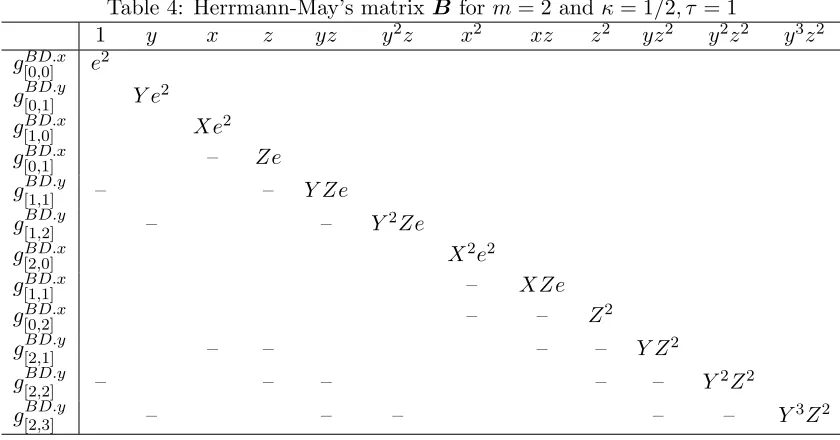
As the last statement suggests, all monomials do not have two variablesxandy, simultaneously.
Although the linearization z = 1 +xy loses the information of x and y, it can be recovered by
unraveling. Table 4 shows an example of the triangular matrix. The triangular matrix enables us
to analyze the structure easily. Indeed, the following lemma shows one evidence of the optimality of the Boneh-Durfee stronger attack.
Lemma 4. In the matrix B of the Boneh-Durfee stronger attack, polynomials gBD.y[u,j] (x, y) are
helpful if and only ifj ≤(1−2β)u for all u.
Proof of Lemma 4. Letg[uBD.y′,j′](x, y) be a polynomial with fixed indices (u′, j′), and B′ be a matrix
that is a matrix B without the polynomial gBD.y[u′,j′](x, y). As stated in Lemma3, a diagonal of the
polynomial g[uBD.y′,j′](x, y) inB isYj′Zu′em−u′. Hence,
det(B)
det(B′) =Y
j′Zu′em−u′
3
As we mentioned, the set of indicesIBD,y2is not the same as the the original one in [BD00]. Hence, it is not the
same as the one which Herrmann and May studied in [HM10]. However, Herrmann-May’s approach is also useful for
Table 4: Herrmann-May’s matrix B form= 2 andκ= 1/2, τ = 1
1 y x z yz y2z x2 xz z2 yz2 y2z2 y3z2
g[0,0]BD.x e2
g[0,1]BD.y Y e2
g[1,0]BD.x Xe2
g[0,1]BD.x – Ze
g[1,1]BD.y – – Y Ze
g[1,2]BD.y – – Y2Ze
g[2,0]BD.x X2e2
g[1,1]BD.x – XZe
g[0,2]BD.x – – Z2
g[2,1]BD.y – – – – Y Z2
g[2,2]BD.y – – – – – Y2Z2
g[2,3]BD.y – – – – – Y3Z2
that is smaller than or equal to the modulusem if and only if
Yj′Zu′em−u′ ≤em⇔Yj′Zu′ ≤eu′
⇔ 1
2j
′+(β+1
2
)
u′ ≤u′
⇔j′ ≤(1−2β)u′.
Hence, we conclude the proof.
The lemma suggests that the Boneh-Durfee stronger attack used only helpful g[u,j]BD.y(x, y) and
no unhelpful g[u,j]BD.y(x, y). That is why they could successfully improve their own weaker attack.
However, we should note that the lemma does not prove a rigorous optimality of the attack.
3.3 Herrmann-May’s Matrix with Additional Unraveling
In this subsection, we show a new triangular matrix for the Boneh-Durfee stronger attack. In short, we apply additional unraveling to Herrmann-May’s triangular matrix. Then, there are several
monomials which have two variables x and y, simultaneously, in our matrix. Before providing the
matrix, we introduce some functions that will be used to control the power of unraveling throughout the paper.
Definition 2. Let m and k be non-negative integers, τ be a real number such that 0 ≤ τ ≤ 1.
Table 5: Herrmann-May’s matrixB with additional unraveling by the functionlLSBsk,τ (j) form= 2
and κ= 1/2, τ = 1
1 y x xy xy2 y2z x2 x2y x2y2 x2y3 y2z2 y3z2
g[0,0]BD.x e2
g[0,1]BD.y Y e2
g[1,0]BD.x Xe2
g[0,1]BD.x – – XY e
g[1,1]BD.y – – XY2e
g[1,2]BD.y – Y2Ze
g[2,0]BD.x X2e2
g[1,1]BD.x – – X2Y e
g[0,2]BD.x – – – – – X2Y2
g[2,1]BD.y – – – – – X2Y3
g[2,2]BD.y – – – Y2Z2
g[2,3]BD.y – – – Y3Z2
integers:
lk,τM SBs(x) := max
{
0,
⌈
x−k
τ+ 1
⌉}
and lk,τLSBs(x) := max
{
0,
⌈
x−k
τ
⌉}
.
Then, we provide our matrix.
Lemma 5. Let shift-polynomials g[u,i]BD.x(x, y) and g[u,j]BD.y(x, y), sets of indices IBD,x and IBD,y2, a
function lLSBsk,τ (x), a matrix B be defined as in (1), (3), Definition 2, and Lemma 3, respectively.
If the shift-polynomials are ordered as the same way in Lemma 2, then the matrix B becomes
triangular with diagonals
• XuYiem−i for gBD.x[u,i] (xX, yY),
• Xu−lLSBsk,τ (j)Yu+j−lk,τLSBs(j)ZlLSBsk,τ (j)em−u for gBD.y
[u,j] (xX, yY).
In Herrmann-May’s matrix, two variables x and y does not appear in the same monomials.
Specifically, X does not appear in diagonals ofg[u,j]BD.y(x, y). However,X appears in our matrix. It
means that we apply less linearizationz= 1 +xy or more unraveling than Herrmann-May’s matrix.
How much we apply linearization/unraveling is controlled by a function lLSBsk,τ (j).
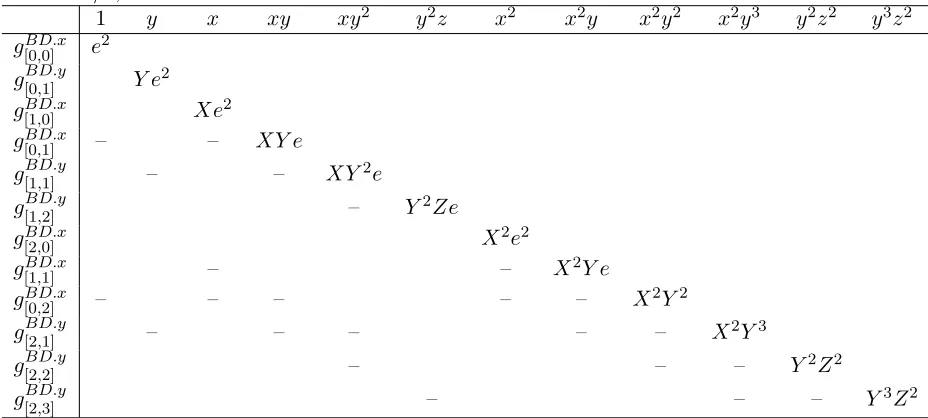
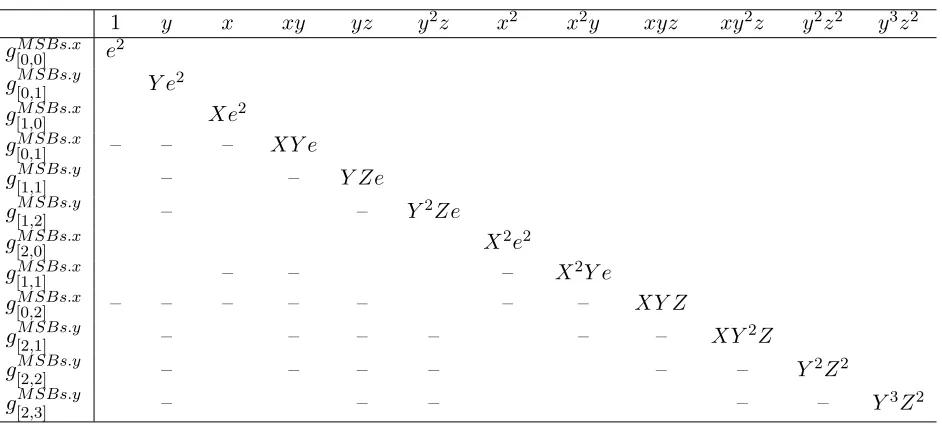
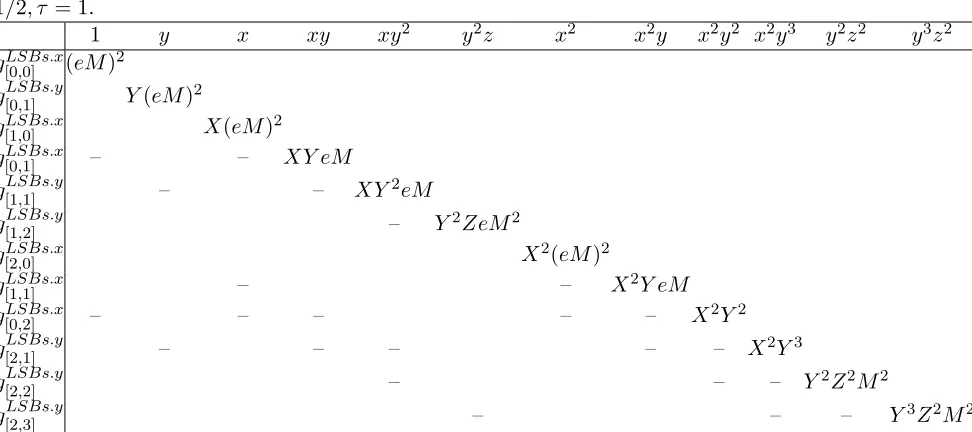
Table 5 shows an example of the matrix that has the same polynomials as Herrmann-May’s
matrix in Table 4. To illustrate our idea, we use the examples. Herrmann-May’s matrix has
x2y3 for the same polynomials. We apply additional unravelings z ⇒ 1 +xy and transform the former diagonals to the latter ones by using the following simple relations:
yz =y(1 +xy) =y+xy2 and yz2=y(1 +xy)2 =y+ 2xy2+x2y3.
The relation suggests that all integer linear combinations of (y, yz) and (y, yz, yz2) can be replaced
by those of (y, xy2) and (y, xy2, x2y3), respectively. Hence, the matrix is still triangular even if
we apply the additional unravelings. Here, we want to claim that integer linear combinations of
(yz) and (yz, yz2) cannot be rewritten as those of (xy2) and (xy2, x2y3), respectively. To apply the
additional unraveling, the existence of y was essential. Without the variable y, we cannot replace
yz by xy2. However, since yz exists, we can replaceyz2 by xy2zby using a relation
yz2=yz(1 +xy) =yz+xy2z.
Therefore, we define the function lLSBsk,τ (j) so that yjzlLSBsk,τ (j) exists, however,
yjzlLSBsk,τ (j)−1, yjzl
LSBs
k,τ (j)−2,· · · do not exist in Herrmann-May’s matrix B. In other words,
in the a set of indicesIBD,y2, there are indices (u, j) = (lLSBs
k,τ (j′), j′),(lk,τLSBs(j′) + 1, j′), . . . ,(m, j′)
whereas no indices (u, j) = (0, j′),(1, j′), . . . ,(lLSBs
k,τ (j′)−1, j′) for a fixed j′ ≥k. The fact follows
from that
• k+⌊τ u⌋< j′ foru < lLSBs
k,τ (j′) since k+⌊τ(lk,τLSBs(j′)−1)⌋< j′ holds,
• k+⌊τ u⌋ ≥j′ foru≥lLSBsk,τ (j′) since k+⌊τ lLSBsk,τ (j′)⌋ ≥j′ holds.
Therefore, the functionlLSBsk,τ (j) tells us the maximum unraveling which we can apply.
The matrix with additional unraveling does not provide any benefits in the context of Boneh-Durfee’s attack. We use the matrix to explain an overview of an unraveled linearization for our
partial key exposure attacks with the LSBs in Section 5.3.
Proof of Lemma 5. We apply unraveling z ⇒ 1 +xy to each variable of Herrmann-May’s
ma-trix B in Lemma 3 and obtain a claimed matrix in Lemma 5. Since the diagonals Xu−iZiem−i
of gBD.x[u,i] (xX, yY) and those YjZuem−u of g[u,j]BD.y(xX, yY) for (u, j) = (lLSBsk,τ (j), j) are the same
between Lemmas3 and 5, we focus on the other variables
• xu−lLSBsk,τ (j)yu+j−lLSBsk,τ (j)zlLSBsk,τ (j)forj= 1,2, . . . , k+⌊τ m⌋;lLSBs
k,τ (j) + 1, , lk,τLSBs(j) + 2, . . . , m.
We want to claim that a matrix B is still triangular when all variables yjzu are replaced by
xu−lk,τLSBs(j)yu+j−lLSBsk,τ (j)zlLSBsk,τ (j) by applying unravelingzu−lLSBsk,τ (j)⇒(1 +xy)u−lLSBsk,τ (j).
Here, we show an inductive proof that
yjzu=
u−lLSBs
k,τ (j) ∑
t=0
holds, where c0, c1, . . . , cu−lLSBs
k,τ (j) are integers and cu−lLSBsk,τ (j) = 1. The statement holds for u =
lLSBsk,τ (j). We assume that the statement holds for fixed (u′, j′) and prove that the statement also
holds for (u′+ 1, j′). It follows that
yj′zu′+1 =yj′zu′(1 +xy)
=
u′−lLSBs
k,τ∑(j′)
t=0
ctxtyj
′+t
zlLSBsk,τ (j′)
(1 +xy)
=
u′−lLSBs
k,τ (j′) ∑
t=0
ctxtyj
′+t
zlLSBsk,τ (j′)
+
u′−lLSBs
k,τ∑(j′)−1
t=0
ctxtyj′+tzlLSBsk,τ (j′)+xu′−lLSBsk,τ (j′)yu′+j′−lk,τLSBs(j′)zlLSBsk,τ (j′)
xy
=
u′−lLSBs
k,τ (j′) ∑
t=0
c′txtyj′+tzlLSBsk,τ (j′)+xu′−lk,τLSBs(j′)+1yu′+j′−lk,τLSBs(j′)+1zlLSBsk,τ (j′),
where c′0, c′1, . . . , c′u′−lLSBs
k,τ (j)
are integers. Hence, the statement holds for all (u, j). By
using the relation, we can replace all integer linear combinations of ∑uu=l′ LSBs
k,τ (j)duy
jzu
by ∑uu=l′ LSBs
k,τ (j)d
′
ux
u−lLSBs
k,τ (j)yu+j−lLSBsk,τ (j)zlk,τLSBs(j), where d
lLSBs
k,τ (j), dl LSBs
k,τ (j)+1, . . . , du′ and
d′lLSBs
k,τ (j)
, d′lLSBs
k,τ (j)+1
, . . . , d′u′ are integers such that du′ = d′u′. Thus, we can replace all
vari-ablesyjzu in diagonals of gBD.y
[u,j] (x, y) byx
u−lLSBs
k,τ (j)yu+j−lk,τLSBs(j)zlLSBsk,τ (j). Hence, we complete the
proof.
As we claimed, the function lLSBsk,τ (j) tells us the maximum unraveling which we can apply to
Herrmann-May’s matrixB. On the other hand, Herrmann-May’s matrixB is still triangular when
we apply less additional unraveling than the above one. For example, Herrmann-May’s matrix B
can be modified as a triangular matrix with diagonals
• Xu−lM SBsk,τ (i)Yi−l M SBs k,τ (i)Zl
M SBs
k,τ (i)em−i forgBD.x
[u,i] (xX, yY),
• Xu−lM SBsk,τ (u+j)Yu+j−lk,τM SBs(u+j)ZlM SBsk,τ (u+j)em−u forgBD.y
[u,j] (xX, yY).
Here, observe that
lk,τM SBs(u+j) = max
{
0,
⌈
u+j−k
τ+ 1
⌉}
≥max
{
0,
⌈
j−k
τ
⌉}
=lLSBsk,τ (j)
holds for (u, j) ∈ IBD.y2 since j ≤ k+τ u. Hence, when we apply an unraveling by the function
Table 6: Herrmann-May’s matrixB with additional unraveling by the function lM SBsk,τ (u+j) for
m= 2 and κ= 1/2, τ = 1
1 y x xy yz y2z x2 x2y xyz xy2z y2z2 y3z2
g[0,0]BD.x e2
gBD.y[0,1] Y e2
g[1,0]BD.x Xe2
g[0,1]BD.x – – XY e
gBD.y[1,1] – Y Ze
gBD.y[1,2] – – Y2Ze
g[2,0]BD.x X2e2
g[1,1]BD.x – – – X2Y e
g[0,2]BD.x – – – – – – – XY Z
gBD.y[2,1] – – – – – – XY2Z
gBD.y[2,2] – – – – – – Y2Z2
gBD.y[2,3] – – – – – Y3Z2
original matrix and a matrix with an additional unraveling by the function lk,τLSBs(j). We omit a
proof that a matrix with an unraveling by the function lM SBs
k,τ (u+j) is triangular with the above
diagonals since the proof is almost the same as the that of Lemma5. We use the matrix to explain
an overview of an unraveled linearization for our partial key exposure attacks with the MSBs in
Section4.4.
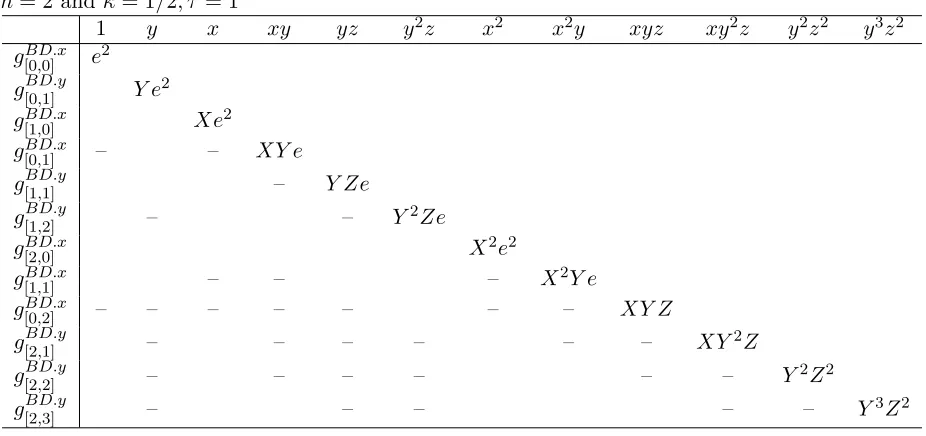
Table6shows an example of the matrix with an additional unraveling by the functionlM SBsk,τ (u+
j), where the matrix has the same polynomials as Tables4and5. Herrmann-May’s matrix in Table4
has diagonalsz, xz, z2,andyz2forgBD.x
[0,1] , gBD.x[1,1] , gBD.x[0,2] , andg
BD.y
[2,1] whereas our matrix has diagonals
xy, x2y, xyz, and xy2z for the same polynomials. Our matrix in Table 5 has diagonals xy2, x2y2,
and x2y3 for g[1,1]BD.y, g[0,2]BD.x, and gBD.y[2,1] whereas our matrix in Table 6 has diagonals yz, xyz, and
xy2z for the same polynomials.
4
Partial Key Exposure Attacks with the MSBs
In this section, we propose our improved partial key exposure attack on RSA with the MSBs ofd.
In Section 4.1, we formulate the attack scenario as a modular equation. In Section 4.2, we recall
previous attacks [EJMdW05,SSM10]. In Section4.3, we propose an attack that works in the same
condition as Ernst et al.’s attack [EJMdW05] by solving modular equations. In Section 4.4, we
4.1 Formulation
In this subsection, we formulate the attack scenario with the MSBs as modular equations. We
write a secret exponentd=Nβ asd=d0M+d1, whered0 > Nβ−δandd1< Nδdenote the known
MSBs and the unknown LSBs of d, respectively, with an integer M := 2⌊δlogN⌋. Recall an RSA
key generation
e(d0M +d1) = 1 +ℓ(p−1)(q−1) = 1 +ℓ(N−p−q+ 1) (4)
with an unknown integer ℓas in Section3.1. Let publicly computableℓ0 =⌊(ed0M−1)/N⌋ be an
approximation toℓsince
|ℓ−ℓ0|=e(d0M+d1)−1
N −p−q+ 1 −
⌊
ed0M−1
N
⌋
≤e(d0M+d1)N−N −(ed0M−1)(N−p−q+ 1)
(N−p−q+ 1)N −1
=ed1N−(ed0M−1)(−p−q+ 1)
(N −p−q+ 1)N −1
≤ ed1
N −p−q+ 1
+(ed0M−1)(p+q−1)
(N −p−q+ 1)N
+ 1
≤Nδ+Nβ−1/2+ 1.
Hence, we can bound unknown |ℓ−ℓ0| < Nγ such that γ = max{δ, β −1/2} within a constant
factor. By taking moduloeof the equation (4), we obtain a modular polynomial
fM SBs(x, y) := 1 + (ℓ0+x)(N +y) (mod e)
whose root is (x, y) = (ℓ−ℓ0,−p−q + 1). Absolute values of the root are bounded above by
X:=Nγ andY :=N1/2 within constant factors.
4.2 Previous Works
In this subsection, we briefly recall previous attacks proposed by Ernst et al. [EJMdW05] and Sarkar et al. [SSM10]. Ernst et al.’s attack, which solves integer equations, works when
(1) δ < 56 −13√1 + 6β,
(2) δ < 163 and β ≤ 1116,
(3) δ < 13 +13β−13√4β2+ 2β−2 andβ > 11
16.
The condition (1) is the best forβ <235/512. Ernst et al.’s attack can be viewed as an extension of
the Boneh-Durfee weaker attack since the condition (1) is the same asβ <(7−2√7)/6 = 0.284· · ·
Sarkar et al.’s attack, which solves the modular equation fM SBs(x, y) = 0, works in the above condition (2). To solve the modular equation, they used shift-polynomials
g[u,i]M SBs.x(x, y) :=xu−ifM SBs(x, y)iem−i,
g[u,j]M SBs.y(x, y) :=yjfM SBs(x, y)uem−u. (5)
Both shift-polynomials modulo em have the same root as the original solutions, i.e., g[u,i]M SBs.x(ℓ−
ℓ0,−p−q+ 1) = 0 (modem) andg[u,j]M SBs.y(ℓ−ℓ0,−p−q+ 1) = 0 (modem). They defined sets of
indices
ISSM,x:={u= 0,1, . . . , m;i= 0,1, . . . ,min{u, s}},
ISSM,y :={u= 0,1, . . . , s−1;j= 1,2, . . . , s−u},
and used shift-polynomials gM SBs.x[u,i] (xX, yY) for (u, i) ∈ ISSM,x and g[u,j]M SBs.y(xX, yY) for (u, j)∈
ISSM,y to construct a triangular matrix B. The definitions of ISSM,x and ISSM,y quite differs
from Boneh-Durfee’s one although Sarkar et al. solved the similar equation. Indeed, Sarkar et al.’s
attack is not an extension of the Boneh-Durfee attack since it does not work for small d.
4.3 Revisiting Ernst et al.’s Attack by Solving Modular Equations
In this subsection, we show that by solving modular equation fM SBs(x, y) = 0 as Sarkar et al., we
can obtain an attack that works in Ernst et al.’s condition (1). We believe that a content in this
subsection will be useful to understand our improved attacks in Section4.4.
Technically, we use the same shift-polynomials as Sarkar et al., however, we use sets of indices
IBD,xand IBD,y1 as the Boneh-Durfee weaker attack to construct a basis matrixB. Furthermore,
we employ the unraveled linearization to construct triangular matrices. Observe that the modular polynomial
fM SBs(x, y) = 1 + (ℓ0+x)(N+y) (mode)
becomes the same as Boneh-Durfee’s one
fBD(w, y) = 1 +w(N+y) = 0 (mode)
by introducing a linearized variable
w:=ℓ0+x,
where the absolute value of the solution w =ℓ is bounded above by W := Nβ within a constant
factor. Hence, our matrix construction starts from that of the Boneh-Durfee weaker attack in
Section3.1. Then, we partially apply unraveling w=ℓ0+x to utilize the given MSBs.
Proof of the Condition (1) of Ernst et al. As Sarkar et al., we solve the modular equation
fM SBs(x, y) = 0 and use the shift-polynomials g[u,i]M SBs.x(w, x, y) and g[u,j]M SBs.y(w, x, y) defined
in (5). As a lattice construction of the Boneh-Durfee weaker attack, we use shift-polynomials
of indices IBD,x and IBD,y1 were defined in Section 3.1, then construct a basis matrix B. As in
Lemma2, we can construct a triangular matrix if we only use a linearized variablewand do not use
x. To utilize the given partial information and equivalently a variable x, we construct a triangular
matrix as follows.
Lemma 6. Let shift-polynomials g[u,i]M SBs.x(w, x, y) and g[u,j]M SBs.y(w, x, y), sets of indices IBD,x and
IBD,y1, a function lM SBsk,0 (·) be defined as in (5), (2), and Definition 2, respectively. Let B
be a matrix whose rows consist of coefficients of g[u,i]M SBs.x(wW, xX, yY) for (u, i) ∈ IBD,x and
gM SBs.y[u,j] (wW, xX, yY) for (u, j)∈ IBD,y1. If the shift-polynomials are ordered as
• gM SBs.x[u′,i′] (wW, xX, yY)≺gM SBs.x[u,i] (wW, xX, yY) for
– u′ < u,
– u′ =u, i′< i,
• gM SBs.x[u′,i′] (wW, xX, yY)≺gM SBs.y[u,j] (wW, xX, yY) for u′ ≤u,
• gM SBs.y[u′,j′] (wW, xX, yY)≺g[u,i]M SBs.x(wW, xX, yY) for u′ < u,
• gM SBs.y[u′,j′] (wW, xX, yY)≺g[u,j]M SBs.y(wW, xX, yY) for
– u′ < u,
– u′ =u, j′< j′,
then the matrix B becomes triangular with diagonals
• Wlk,M SBs0 (i)Xu−l M SBs
k,0 (i)Yiem−i for gM SBs.x
[u,i] (wW, xX, yY),
• Wlk,M SBs0 (u+j)Xu−lk,M SBs0 (u+j)Yu+jem−u for gM SBs.y
[u,j] (wW, xX, yY).
If we apply linearizationℓ0+x⇒wto all terms,fM SBs(x, y) =fBD(w, y) holds. Hence, a basis
matrix B is the same as that of the Boneh-Durfee weaker attack in Lemma 2. To utilize partial
information ℓ0, we apply unraveling w⇒ℓ0+x and obtain a matrix as stated in Lemma6. How
much we apply linearization/unraveling is controlled by a function lk,0M SBs(·).
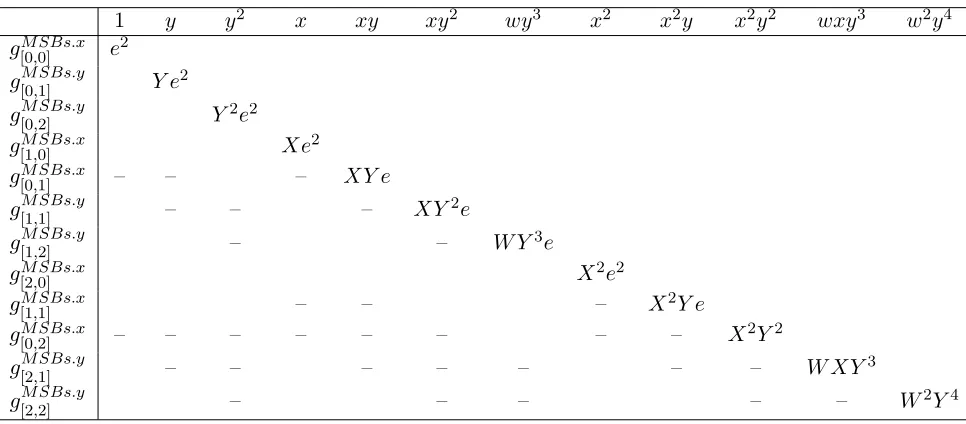
Table 7 shows an example of the matrix that has the same polynomials as Boneh-Durfee’s
weaker matrix in Table 3. To illustrate our idea, we use the examples. Here, please replace a
variable x, a polynomial gBD.x[u,i] and gBD.y[u,j] in Table 3 by w, g[u,i]M SBs.x, and gM SBs.y[u,j] , respectively,
in mind. Boneh-Durfee’s weaker matrix has diagonals y, wy, and w2y for gM SBs.y[0,1] , g[0,1]M SBs.x, and
gM SBs.x
[1,1] whereas our matrix has diagonals y, xy, and x2y for the same polynomials. We apply
unravelings w ⇒ ℓ0+x and transform the former diagonals to the latter diagonals by using the
following simple relations: