crystal lattice are described by the Debye approximation. The values of the parameters on the zero isotherm are calculated analytically from the generalized form of the Gruneisen function. Thermodynamic characteristics are calculated in wide ranges of densities and pressures. Extensive comparisons of theoretical results with experimental data available for high energy densities are performed for the materials considered. Two-dimensional problems of a high-velocity impact of a reactor of a nuclear powerplant with the Earth’s surface propulsion system are solved on the basis of Willkins’ method with allowance for the equation of state being derived.
1 Equation of state
We consider a three-term equation of state with the solid-phase free energy being determined as
F(V,T )=Ex(V)+cv,lT ln
θ(V)
T
−1
2cv,e0T
2
V V0
2/3
(1)
where V is the specific volume, Ex(V) is the “cold” energy, T is the temperature, cv,l = 3R/A is the
specific heat of the lattice at constant volume, A is the mean atomic weight, R is the gas constant,
θ(V) is the Debye temperature, and cv,e0is the experimental value of the electron heat capacity under
standard conditions.
The elastic (cold) component of energy Ex(V) is related exclusively to interaction forces between
the body atoms and is equal (including the energy of zero vibrations) to the specific internal energy at the absolute zero temperature.
The thermodynamic model of a few-parameter equation of state is based on the dependence of the Gruneisen coefficientγon the volume [1]
γ(V)=2 3 −
2
(1−aV0/V)a=1+
2 (γs−2/3) +
2Pt,0
Ks
(2)
whereγs =βKsV0/cv, Ksis the adiabatic modulus of volume compression, cv is the specific heat at
constant volume, and Pt,0is the thermal pressure in the initial state.
The general expression for the volume dependence of the Gruneisen coefficient has the form
γ(V)=−
2−t
3 −V 2 d2
d V2
PxV 2t
3 d
d V
PxV 2t 3
(3)
ae-mail:[email protected]
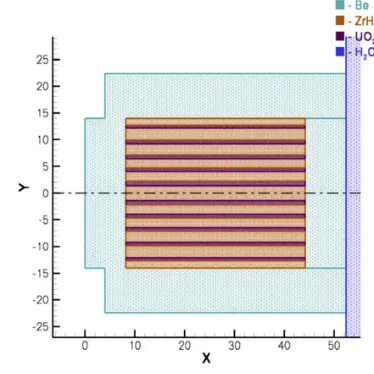
Fig. 1. Reactor with plane geometry. Fig. 2. Reactor with axial geometry.
In Eq. (3), the situation value corresponds to the Landau-Slater theory [2, 3] at t = 0, to the Dugdale-McDonald theory [4] at t=1,and to the free-volume theory [5] at t=2.
To determine the zero isotherm, we equated the expression for the Gruneisen coefficient (2) at the zero temperature (T =0 K) to the expression for the generalized Gruneisen coefficient (3):
2 3 −
2 1−axV0/V
=−
2−t
3 −V 2 d2
d V2
PxV 2t
3 d
d V
PxV 2t 3
(4)
Here, axis the value of the parameter a|T=0at the zero temperature in Eq. (2), which can be taken as
ax=a(0)=1+2/(γs−2/3) as the first approximation.
The differential equation (4) has an analytical solution for “cold” pressure and energy:
Px(V)=C1V−2t/3+C2H2(V), Ex(V)=−
C1V1−2t/3 (1−2t/3)+C2H1(V)
+C3 (5)
Using the definition of the Gruneisen coefficient in the Debye approximationγ =−(d lnθ/d ln V)|T
and Eq. (2), we obtain the characteristic Debye temperature on the volume:
θ(V)=θ0
(a−V/V0)
(a−1)
2
V0
V
2 3
whereθ0=θ(V0) is the Debye temperature at the initial conditions.
The constants for Eq. (5) were determined and calculated in [6]. It was also demonstrated there that the set of semi-empirical relations (1)–(5) describes the behavior of thermodynamic properties of solids within 5–10% in a wide range of pressures and temperatures. For the equation of state to be applied, it is sufficient to know only six constants V0,β, Kt, cv,Θ0, and cv,e0corresponding to the values
of these quantities under standard conditions, which can be found in reference books on physical and mechanical properties of substances.
2 Application of the few-parameter equation of state
As an example, let us consider a two-dimensional problem of the impact of a nuclear powerplant reactor on the Earth’s surface.
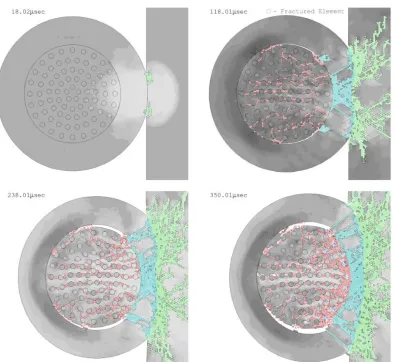
Fig. 3. Impact of a reactor model with a sandstone plate surface.
mechanical loads in dense atmospheric layers. The velocity of the impact of the remaining part of the reactor system can reach 400 m/s. As the Earth’s surface is fairly versatile, the reactor can hit a water surface, rocks, or soft soil.
It is next to impossible to solve impact problems of real engineering objects though the computa-tional engineering development level is rather high and fairly realistic mathematical models of material behavior are available. The reasons are the complicated spatial locations of the reactor fragments and the multiscale character of the problem. In such situations, the object considered is simplified, which makes it possible to construct a number of models aimed at studying the influence of the impact para-meters on particular basic fragment of the object.
The problem was solved in a simplified formulation. The simplification used implied that the materials of small-scale parts were averaged in terms of the additive approximation inside the reaction zone (the materials were Be, UO2, and ZrH, 95–97 wt.%). It was further assumed that the
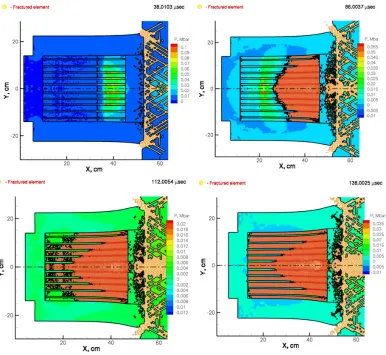
Fig. 4. Frames of the calculated side impact of the reactor model onto the granite plate surface with an impact velocity of 400 m/s.
Thus, the objective of the work was to study the processes of deformation and fracture of a rather complicated geometric object. The problem was solved in a formulation proposed by Willkins [7] with the use of a symmetric algorithm of contact boundary calculation [8]. Previously, we proposed the process of automatic construction of a triangular grid for an arbitrary multiply connected domain [9].
As the first example, we consider an impact of the reactor on sandstone with the initial velocity of 400 m/s in the axial formulation. In the case of the reactor impact onto sandstone, the wave pattern is complicated by the fact that sandstone is destroyed by compressive stresses. This specific feature is induced by the inner structure of sandstone where strong crystals of sand are bound with brittle cement mass. As sand and cement have different compressibilities, the shock wave forms shear stresses on interfaces between the media, which destroy the connections on the boundary, i.e., the resultant product is sand with a fine fraction of cement. Free sand exerts practically no resistance to shear strains.
1. A.M. Molodets, Zh. Eksp. Tekh. Fiz. 107, 824 (1995) (in Russian)
2. L.D. Landau, K.P. Stanyukovich, Dokl. Akad. Nauk SSSR 46, 399 (1945) (in Russian) 3. I.C. Slater, Introduction in the Chemical Physics (McGraw Book company, 1935) 4. J.S. Dugdale, D. McDonald, Phys. Rev. 89, 832 (1953)
5. V.N. Zubarev, V.Ya. Vashchenko, Fiz. Tv. Tela 5, 886 (1963) (in Russian) 6. E.I. Kraus, Vestnik NGU. 2, 65 (2007) (in Russian)
7. M. L. Wilkins, Computer Simulation of Dynamic Phenomena (Springer, 1999)
8. V. M. Fomin, A.I. Gulidov, G.A. Sapozhnikov, et al., High-Velocity Interaction of Solids (Publ. SB RAS, 1999) (in Russian)