
Mitigating Large Background in Jet Substructure Observables
DaekyoungKang1, Yang-TingChien2,KyleLee3,4, YiannisMakris5,
1Key Laboratory of Nuclear Physics and Ion-beam Application (MOE) and Institute of Modern Physics, Fudan University, Shanghai, China 200433
2Center for Theoretical Physics, Massachusetts Institute of Technology, Cambridge, MA 02139, USA 3C.N. Yang Institute for Theoretical Physics, Stony Brook University, Stony Brook, NY 11794, USA 4Department of Physics and Astronomy, Stony Brook University, Stony Brook, NY 11794, USA 5Theoretical Division T-2, Los Alamos National Laboratory, Los Alamos, NM, 87545, USA
Abstract.We discuss a new approach for jet physics analysis by using subtraction be-tween cumulants of jet substructure observables. The subtracted cumulants are insensi-tive to soft-particle background uncorrelated with the hard process and allow comparisons between theoretical results and experimental measurements without the complication of soft background like underlying and pile-up events. We find our method using jet mass cumulants efficiently eliminates the background in Monte Carlo simulations and ATLAS
jet mass measurements and they show a good agreement with our analytic calculations performed using soft-collinear effective theory.
1 Introduction
Jets produced everywhere in high-energy process are one of essential objects of study at high en-ergy colliders. However, theoretical predictions are many times limited by soft radiations such as multiparton interactions (MPI) in hadron collisions and pile-up (PU) events in high-luminosity (HL) collisions. The predictions cannot be compared with experiments without plugging in model for the soft radiations. Or, one has to adopt techniques [1–10] developed to remove these contributions. Ideal goal of these techniques would be to correct jets back to their pure signal jet but it is impossible due to the intrinsic ambiguity in distinguishing signal from the background. In Ref. [11], we pro-posed an alternative approach using subtraction between cumulants which cancel the contributions from soft uncorrelated emissions (SUEs) and applied for the transverse energy observable of Drell-Yan processes. Then, we further applied this method to jet substructure observables in [12]. For the observables to which SUEs additively contribute, their contributions are cancelled in the subtraction between two cumulants. As a concrete example for this, we used the classic jet observable, jet mass
mJ, and showed theoretical predictions for subtracted jet mass cumulant∆agree with Monte Carlo
simulations and with ATLAS measurements.
In this proceeding, we review and summarize of our result in [12]. In following sections we first define the subtracted cumulant∆, then show that in Monte Carlo simulations the subtraction is robust
against various SUE effect. We also show that our theoretical predictions are in a good agreement
with ATLAS measurements in subtracted cumulant space.
2 Definition of the observable
Let us consider a jet substructure observable,e, which can be expressed as an addition of individual particle contribution. Then, SUEs contribution can be separated from signal contribution as
e=eS+eB, (1)
whereeBis background contribution by SUEs and it is statistically independent ofeS. In other words,
their probability densities are uncorrelated each other by the definition of SUEs. The cumulantsκn(e) is defined by its generating function:∞
n=1κnt n
n! =logexp(te). The cumulants inherit the additivity
of observable and the background contribution remains separated.
κn(e)=κn(eS)+κn(eB) (2)
We use this property to cancel uncorrelated contributions in the subtraction between cumulants. Let us define an additive observable ˆτ
ˆ
τ=2 cosh(η)
i∈jet
p+
i =
m2
J pT
1+Om
2
J p2
T
, (3)
whereηis pseudorapidity of jet and pT is the jet transverse momentum. This can be written as an
addition of signal and background as in Eq. (1) and is equivalent to the jet invariant massm2
J/pTup to
relative corrections of (mJ/pT)2.
For the dimensionless versionτ=τ/pTˆ , the first cumulantτis given by
τ=
dσ
dpTdη
−1
dτ τ dσ
dτdpTdη =τcorr+ Ωf
pT , (4)
whereτcorr is the signal contribution correlated with hard scale, whileΩf is the background and
uncorrelated with hard scale.
For comparison with experimental results, we consider a binned cross sectionσ[i,j]where the first
index represents thei-th bin inτand the second represents j-th bin in jetpT. The cumulant at j-thpT
bin is denoted byτ[j]. Now let us define the subtracted cumulant ofτ
∆τjk=τ[j]− τ[k] p−1
T [j]
p−1
T [k]
=τcorr[j]− τcorr[k]p
−1
T [j]
p−1
T [k]
. (5)
Here the background contributionΩf is cancelled in the subtraction and the subtraction is rewritten
in terms of pure signal contributionτcorr.
3 Robustness of subtracted cumulant
3.1 Pythiasimulations
In this proceeding, we review and summarize of our result in [12]. In following sections we first define the subtracted cumulant∆, then show that in Monte Carlo simulations the subtraction is robust against various SUE effect. We also show that our theoretical predictions are in a good agreement with ATLAS measurements in subtracted cumulant space.
2 Definition of the observable
Let us consider a jet substructure observable,e, which can be expressed as an addition of individual particle contribution. Then, SUEs contribution can be separated from signal contribution as
e=eS+eB, (1)
whereeBis background contribution by SUEs and it is statistically independent ofeS. In other words, their probability densities are uncorrelated each other by the definition of SUEs. The cumulantsκn(e)
is defined by its generating function:∞
n=1κn
tn
n! =logexp(te). The cumulants inherit the additivity of observable and the background contribution remains separated.
κn(e)=κn(eS)+κn(eB) (2)
We use this property to cancel uncorrelated contributions in the subtraction between cumulants. Let us define an additive observable ˆτ
ˆ
τ=2 cosh(η)
i∈jet p+ i = m2 J pT
1+Om 2
J
p2
T
, (3)
whereηis pseudorapidity of jet and pT is the jet transverse momentum. This can be written as an
addition of signal and background as in Eq. (1) and is equivalent to the jet invariant massm2
J/pTup to
relative corrections of (mJ/pT)2.
For the dimensionless versionτ=τ/ˆ pT, the first cumulantτis given by
τ=
dσ
dpTdη −1
dτ τ dσ
dτdpTdη =τcorr+
Ωf
pT , (4)
whereτcorr is the signal contribution correlated with hard scale, whileΩf is the background and
uncorrelated with hard scale.
For comparison with experimental results, we consider a binned cross sectionσ[i,j]where the first index represents thei-th bin inτand the second represents j-th bin in jetpT. The cumulant at j-thpT
bin is denoted byτ[j]. Now let us define the subtracted cumulant ofτ
∆τjk=τ[j]− τ[k]
p−1
T [j]
p−1
T [k]
=τcorr[j]− τcorr[k]p
−1
T [j]
p−1
T [k]
. (5)
Here the background contributionΩf is cancelled in the subtraction and the subtraction is rewritten
in terms of pure signal contributionτcorr.
3 Robustness of subtracted cumulant
3.1 Pythiasimulations
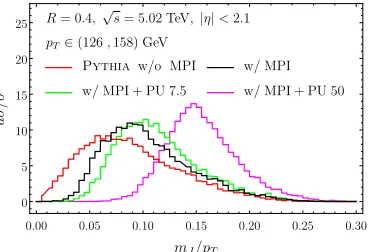
Here, we verify that the subtracted cumulants are robust again to the background such as MPI and PU by using Pythiasimulations inppcollisions. We also compare that the subtracted cumulants obtained
0.00 0.05 0.10 0.15 0.20 0.25 0.30 0 5 10 15 20 25
Figure 1. Jet mass distributions using Pythiaat parton level (red), hadron level with MPI (black), PU with NPU=7.5 (green) and 50 (magenta).
150 200 250 300 350 400 450 0 1 2 3 4 5 6
Figure 2.Subtracted cumulants∆τjkfor jet mass forpTbetween 126 and 500 GeV. perturbative calculation (blue
band) and Pythiasimulations.
by the simulation agree with theoretical predictions at next-to-leading logarithmic and next-to-leading order accuracy (NLL+NLO) using SCET.
FIG. 1 shows the jet mass distributions with and without MPI and PU effects. We find significant changes in the distribution by MPI and PU. On the other hand, subtracted cumulants in FIG. 2, remains almost same except for large PU (PU 50 curve). For the large PU,pTis also shifted by the SUEs and
to improved the results, a modified definition of pT robust against SUEs can be adopted [12]. The
simulation results also agree with theoretical prediction within perturbative uncertainty (blue band). This clearly verifies that our subtracted cumulants greatly mitigate MPI and PU contributions.
3.2 Comparison with experimental data
Here, we compare the theoretical predictions and simulations to LHC data measured by ATLAS col-laboration at 7 TeV [13] and 5.02 TeV [14]. FIG. 3 shows the results for the predictions at NLL+NLO
accuracy and Pythiasimulations with and without MPI. The data points are for ATLAS results. Note that in 7 TeV data [13] , the jet masss=m2Jis given rather thanτ=m2J/p2
T, we rescale the definition
of∆and denote it to∆s
∆sjk=s[j]− s[k]pT
[j]
250 300 350 400 450 500 550 0
1 2 3 4 5
150 200 250 300 350 400 450 0
1 2 3 4 5
Figure 3.subtracted cumulant results: ATLAS results (data points) computed using data in [13, 14], NLL+NLO
calculation (blue band), Pythiasimulations with and without MPI (black and red curves). The top and bottom panels are for√s=7 TeV and√s=5.02 TeV, respectively.
We find that both of 5 TeV and 7 TeV data points are in good agreement with our predictions as well as simulations.
4 Summary
In this proceeding, we review and summarize our results in [11, 12]. We introduce a new method for jet substructure observables called a subtracted cumulant. This quantity is insensitive to soft emissions uncorrelated with hard process hence, robust against multiparton interactions and pile-up effects. The is independent way of studying jet substructure from conventional techniques which either correct jets by removing soft constituents or use a model for soft emissions. In order to verify this method, we computed the subtracted cumulant of jet mass at NLL+NLO accuracy using SCET and compared
it to those obtained from Pythiasimulations. While in theoretical prediction the soft uncorrelated emissions is absent, in simulations those emissions are turned on and they induce significant changes in the jet mass distributions. However subtracted cumulants of theoretical predictions and simulations still remain in a good agreement. This verifies the subtraction method mitigates large background. Finally, we test it with ATLAS measurements and find a similar agreement with theory predictions.
References
[1] M. Cacciari, G.P. Salam, Phys. Lett.B659, 119 (2008),0707.1378
[2] I. Feige, M.D. Schwartz, I.W. Stewart, J. Thaler, Phys. Rev. Lett. 109, 092001 (2012),
1204.3898
250 300 350 400 450 500 550 0
1 2 3 4 5
150 200 250 300 350 400 450 0
1 2 3 4 5
Figure 3.subtracted cumulant results: ATLAS results (data points) computed using data in [13, 14], NLL+NLO
calculation (blue band), Pythiasimulations with and without MPI (black and red curves). The top and bottom panels are for√s=7 TeV and√s=5.02 TeV, respectively.
We find that both of 5 TeV and 7 TeV data points are in good agreement with our predictions as well as simulations.
4 Summary
In this proceeding, we review and summarize our results in [11, 12]. We introduce a new method for jet substructure observables called a subtracted cumulant. This quantity is insensitive to soft emissions uncorrelated with hard process hence, robust against multiparton interactions and pile-up effects. The is independent way of studying jet substructure from conventional techniques which either correct jets by removing soft constituents or use a model for soft emissions. In order to verify this method, we computed the subtracted cumulant of jet mass at NLL+NLO accuracy using SCET and compared
it to those obtained from Pythia simulations. While in theoretical prediction the soft uncorrelated emissions is absent, in simulations those emissions are turned on and they induce significant changes in the jet mass distributions. However subtracted cumulants of theoretical predictions and simulations still remain in a good agreement. This verifies the subtraction method mitigates large background. Finally, we test it with ATLAS measurements and find a similar agreement with theory predictions.
References
[1] M. Cacciari, G.P. Salam, Phys. Lett.B659, 119 (2008),0707.1378
[2] I. Feige, M.D. Schwartz, I.W. Stewart, J. Thaler, Phys. Rev. Lett. 109, 092001 (2012),
1204.3898
[3] A.J. Larkoski, J. Thaler, Phys. Rev.D90, 034010 (2014),1406.7011
[4] D. Krohn, M.D. Schwartz, M. Low, L.T. Wang, Phys. Rev.D90, 065020 (2014),1309.4777
[5] M. Cacciari, G.P. Salam, G. Soyez, Eur. Phys. J.C75, 59 (2015),1407.0408
[6] D. Bertolini, P. Harris, M. Low, N. Tran, JHEP10, 059 (2014),1407.6013
[7] P. Berta, M. Spousta, D.W. Miller, R. Leitner, JHEP06, 092 (2014),1403.3108
[8] A.J. Larkoski, S. Marzani, G. Soyez, J. Thaler, JHEP05, 146 (2014),1402.2657
[9] P.T. Komiske, E.M. Metodiev, B. Nachman, M.D. Schwartz, JHEP12, 051 (2017),1707.08600
[10] G. Soyez, Phys. Rept.803, 1 (2019),1801.09721
[11] D. Kang, Y. Makris, T. Mehen, JHEP09, 055 (2018),1803.04413
[12] Y.T. Chien, D. Kang, K. Lee, Y. Makris, Phys. Rev.D100, 074030 (2019),1812.06977
[13] G. Aad et al. (ATLAS), JHEP05, 128 (2012),1203.4606
![Figure 3. √+calculation (blue band), P √panels are for subtracted cumulant results: ATLAS results (data points) computed using data in [13, 14], NLL′NLOythia simulations with and without MPI (black and red curves)](https://thumb-us.123doks.com/thumbv2/123dok_us/8110694.1352402/4.482.148.335.78.307/figure-calculation-subtracted-cumulant-results-computed-nloythia-simulations.webp)
