University of Windsor University of Windsor
Scholarship at UWindsor
Scholarship at UWindsor
Electronic Theses and Dissertations Theses, Dissertations, and Major Papers
2011
An Interactive Approach of Ontology-based Requirement
An Interactive Approach of Ontology-based Requirement
Elicitation for Software Customization
Elicitation for Software Customization
Xieshen Zhang
University of Windsor
Follow this and additional works at: https://scholar.uwindsor.ca/etd
Recommended Citation Recommended Citation
Zhang, Xieshen, "An Interactive Approach of Ontology-based Requirement Elicitation for Software Customization" (2011). Electronic Theses and Dissertations. 347.
https://scholar.uwindsor.ca/etd/347
This online database contains the full-text of PhD dissertations and Masters’ theses of University of Windsor students from 1954 forward. These documents are made available for personal study and research purposes only, in accordance with the Canadian Copyright Act and the Creative Commons license—CC BY-NC-ND (Attribution, Non-Commercial, No Derivative Works). Under this license, works must always be attributed to the copyright holder (original author), cannot be used for any commercial purposes, and may not be altered. Any other use would require the permission of the copyright holder. Students may inquire about withdrawing their dissertation and/or thesis from this database. For additional inquiries, please contact the repository administrator via email
An Interactive Approach of Ontology-based Requirement Elicitation
for Software Customization
by
Xieshen Zhang
A Thesis
Submitted to the Faculty of Graduate Studies through Computer Science
in Partial Fulfillment of the Requirements for the Degree of Master of Science at the
University of Windsor
Windsor, Ontario, Canada
2011
An Interactive Approach of Ontology-based Requirement Elicitation
for Software Customization
by
Xieshen Zhang
APPROVED BY:
______________________________________________ Dr. G. Bhandari
Odette School of Business
______________________________________________ Dr. A. Mukhopadhyay
School of Computer Science
______________________________________________ Dr. X. Yuan, Advisor
School of Computer Science
______________________________________________ Dr. D. Wu, Chair of Defense
School of Computer Science
iii
DECLARATION OF ORIGINALITY
I hereby certify that I am the sole author of this thesis and that no part of this
thesis has been published or submitted for publication.
I certify that, to the best of my knowledge, my thesis does not infringe upon
anyone’s copyright nor violate any proprietary rights and that any ideas, techniques,
quotations, or any other material from the work of other people included in my thesis,
published or otherwise, are fully acknowledged in accordance with the standard
referencing practices. Furthermore, to the extent that I have included copyrighted
material that surpasses the bounds of fair dealing within the meaning of the Canada
Copyright Act, I certify that I have obtained a written permission from the copyright
owner(s) to include such material(s) in my thesis and have included copies of such
copyright clearances to my appendix.
I declare that this is a true copy of my thesis, including any final revisions, as
approved by my thesis committee and the Graduate Studies office, and that this thesis has
iv ABSTRACT
Software product lines allow reusing a collection of related software engineering
assets to develop custom-made high quality software with reduced time and cost. In this
thesis, an interactive approach of requirement elicitation for software customization is
presented. It first adopts an ontology-based requirement model to represent the
commonalities and variabilities among a group of related requirement artefacts. The
development of a dialogue system further enables users to interactively customize
software products by means of text-based dialogue. While the ontology model directs the
dialogue system to perform requirement elicitation, its instantiation is accomplished with
the support of decomposition-based requirement refinement in Service-Oriented
Architecture. Besides the design details, a case study is presented to demonstrate how
customizing an online book shopping system could be achieved with interactive
requirement elicitation. Finally, the reliability and efficiency of the proposed method are
v
DEDICATION
vi
ACKNOWLEDGEMENTS
First, I would like to express my deep and sincere gratitude to my supervisor Dr.
Xiaobu Yuan for the continuous support to my study and research, for his patience,
motivation, and wide knowledge. I could not have imagined accomplishing the thesis
without his guidance.
I am also heartily thankful to Dr. Asish Mukhopadhyay and Dr. Gokul Bhandari,
whose insightful comments and encouragement inspired me throughout the work.
Finally, I would like to thank my friends Xiewei and Yifeng. Their long-term
vii
TABLE OF CONTENTS
DECLARATION OF ORIGINALITY ... iii
ABSTRACT ... iv
DEDICATION ... v
ACKNOWLEDGEMENTS ... vi
INTRODUCTION ... 1
1.1 Introduction ... 1
1.2 Problem Statement... 1
1.3 Contribution ... 2
1.4 Structure of the Thesis ... 3
SOFTWARE PRODUCT LINE AND SERVICE-ORIENTED ARCHITECTURE ... 4
2.1 Software Product Line ... 4
2.2 Service-Oriented Architecture ... 5
INTERACTIVE REQUIREMENT ENGINEERING ... 8
3.1 Interactive Requirement Engineering ... 8
3.2 Dialogue System ... 9
3.3 Knowledge-based Requirement Engineering ... 13
3.4 Ontology ... 14
3.4.1 Overview ... 14
3.4.2 Ontology for Requirement Engineering ... 17
3.4.3 Ontology for SOA ... 18
PROPOSED ONTOLOGY-BASED REQUIREMENT MODEL ... 21
4.1 Introduction ... 21
4.2 Concepts ... 21
4.3 Relationships ... 23
4.4 Rules ... 28
4.5 Ontology Instantiation ... 29
PROPOSED REQUIREMENT ELICITATION METHOD ... 32
5.1 Introduction ... 32
5.2 Structure of the Proposed Dialogue System ... 32
5.3 Process of Requirement Elicitation ... 33
5.3.1 Machine-directed Requirement Elicitation ... 34
5.3.2 User Requirement Customization ... 37
5.4 Output of Requirement Elicitation ... 37
5.4.1 Output Overview ... 37
5.4.2 Output Generation ... 39
5.5 Considerations for System Implementation ... 43
IMPLEMENTATION AND CASE STUDY ... 45
viii
5.7 Case Study ... 49
5.7.1 Case Overview ... 49
5.7.2 Book Locating Service ... 50
COMPARISON ANALYSIS ... 58
7.1 Introduction ... 58
7.2 Problem Instance Generation ... 58
7.3 Experiment with the Proposed Method ... 60
7.4 Experiment with the Undirected Method ... 61
7.5 Results and Analysis ... 62
CONCLUSION AND FUTURE WORK ... 66
8.1 Conclusion ... 66
8.2 Future Work ... 66
REFERENCES ... 68
APPENDICES ... 73
The Complete Requirement Model for the Case Study ... 73
1 CHAPTER I
INTRODUCTION
1.1Introduction
Software product line (SPL) engineering is a paradigm to develop software
applications with reusable software assets, which are tailored to individual customers'
needs [1]. By reusing software engineering artefacts (e.g. software components) rather
than developing them from scratch, software systems are expected to be customized,
while the costs can be effectively cut down. Meanwhile, with the same primary goal of
software reuse, Service-Oriented Architecture (SOA) separates system functionalities
into loosely coupled and reusable services that communicate with each other via
autonomous messages [2]. Although SPL and SOA differ, as different software
engineering paradigms, in many respects, they actually complement each other [3]. By
reusing services, and adopting SOA-based methods in SPL engineering, especially the
Semantic Web Service techniques (e.g. automatic service discovery and composition) [4],
the goal of automating software development could be achieved. Furthermore, the main
focus of SPL engineering will then shift from repetitive system design and
implementation to functionalities (i.e. services) customization.
On the other hand, in order to actualize completely automated SPL engineering,
an approach is required for guiding human-machine interaction in software products
customization. However, managing the complexity and variability of product features
inherent in software product lines is very challenging [5]. In addition, a supporting tool
for directing the automatic and interactive product customization is still lacking [6].
1.2Problem Statement
A solution to automatic requirement elicitation is critical for the realization of
2
problem of automatic system implementation, few studies investigate the automation of
requirement engineering.
To automate the requirement engineering process, first of all, a supporting tool for
human-machine interaction is required, which is used to conduct the communications
during requirement elicitation. Meanwhile, it must be capable of managing the
knowledge related to SPL requirement engineering, thus the knowledge could be
naturally presented to users. Furthermore, the tool should be able to generate
service-oriented outputs for the automation of system implementation.
On the other hand, knowledge for automatic requirement elicitation is supposed
to be presented in formats understandable to machines. In other words, a semantic way to
represent the knowledge is required. Moreover, as a knowledge engineering solution to
SPL engineering, it must be suitable to describe the common and variable features of
requirement engineering artefacts of software systems that are given. Since the major
challenge rooted in requirement engineering lies in maintaining the completeness and
consistency of requirement products, it is necessary to tackle them properly. Last but not
the least, an approach to express the knowledge about human-machine interaction should
be investigated.
1.3Contribution
To facilitate the realization of automated SOA-based SPL, this thesis presents a
dialogue-based interactive approach for guiding software product customization. An
abstract ontology-based requirement model, which represents the knowledge of the
product features as well as their business logic, is developed. Besides, a frame-based
dialogue system [7] is designed based on the knowledge model. It helps elicit users'
requirements and then outputs service-oriented system description for the implementation
of the candidate applications.
3
specifically for customizing SOA applications. In other words, it first guides users to
order the services they need, and then generate corresponding service descriptions for
automatic service discovery and composition.
1.4Structure of the Thesis
The rest of the thesis is structured as follows. Chapter II presents the introduction
to SPL and SOA, while Chapter III outlines the work related to interactive requirement
engineering. The ontology model is proposed and explained in Chapter IV. Chapter V
reports the proposed dialogue system and the interactive requirement elicitation method,
followed by Chapter VI within which the implementation of the dialogue system and a
case study is presented. Chapter VII demonstrates a group of experimental comparisons
between the proposed machine-directed interactive requirement elicitation method and an
undirected method, and the results are also analyzed in this chapter. Finally, conclusion
4 CHAPTER II
SOFTWARE PRODUCT LINE AND SERVICE-ORIENTED ARCHITECTURE
2.1Software Product Line
The key idea of SPL engineering is gathering, analyzing and reusing the software
engineering artefacts of closely related software systems. These reusable artefacts
provide development options in each software engineering stage. Consequently, the
software development activities will mainly focus on system customization rather than
creation.
To develop an application with SPL framework, there are two processes: domain
engineering and application engineering [1]. During domain engineering process, the
commonalities and variabilities of the reusable artefacts are defined. Vertical tractability
links are established between artefacts of different software engineering phases. In the
application engineering stage, applications are developed. The variabilities that bind to
the candidate application are identified. Then based on these common and variable
artefacts, the development of the application is carried out.
In SPL, the products of the domain engineering process are supposed to be reused.
So the price of developing a new application is mainly charged at the application
engineering stage. By customizing rather than creating, the application engineering is
cost-effective compared to traditional software engineering approaches. Therefore, as
long as the domain engineering process is controllable, SPL can effectively reduce cost,
time and human effort in software engineering.
Nonetheless, Rabiser et~al. [6] point out that, compared to the effort spending on
developing and modeling the software product lines, little support is available for
enhancing their utilization in practice,. Without effective approaches to utilize the
product lines, particularly the automated approaches, SPL could not be widely accepted
in industry. In other words, they will be of more academic value than practical value. In
5 lines in practice:
Automated and interactive variability resolution
Adaptability and extensibility
Application requirements management support
Flexible and user-specific visualizations of variability
End-user guidance
Project management support
The idea of interactive requirement elicitation is inspired by these suggestions.
With an automated and interactive solution to requirement elicitation, the variability of
application requirements can be automatically managed and interactively elicited. The
by-product of a requirement knowledge base further enables applying the product lines
adaptively and extensively. Consequently, an approach to improve the practical value of
SPL is suggested.
2.2Service-Oriented Architecture
Since SOA captures many best practices from previous software engineering
experiences, and makes business systems more flexible and reusable, it has gained an
increasing popularity in industry as well as academic communities in the past decade.
Technically speaking, SOA represents a model in which the software systems are
decomposed into loosely coupled units of functionalities (i.e. services), while each of
these units must be autonomous, reusable, discoverable, and is able to communicate with
other units via autonomous messages [2]. Thus the units could be distributed, and
collaborate through message exchange.
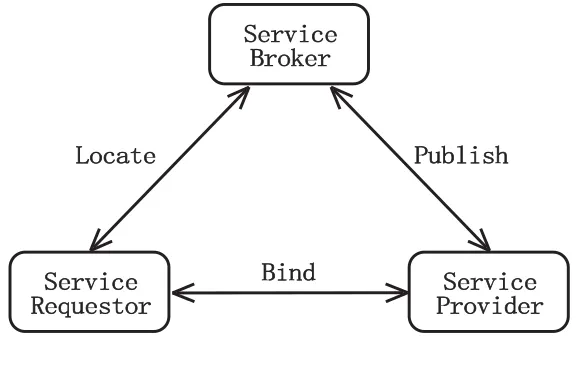
Typically, there are three roles involved in SOA engineering: provider, broker and
requestor (Fig. 2.1). Service provider develops services and publishes the services by
registering the service descriptions as well as corresponding access information in service
6
service broker. Service broker matches requestor’s demands with the services registered
in the depository, and return the appropriate service access information to the requestor.
Later on, requestor visits and retrieves the provider’s services according to the access
information. Therefore, to access certain services, the requestor must first discover the
services from broker’s registry, and then bind to the provider so as to invoke and
compose, if necessary, the services.
Fig. 2.1: Model of SOA
Service discovery is the process of finding appropriate services from brokers’
registry. Traditionally, UDDI mechanism is applied in publishing, matching and
discovering services. However, it only defines a set of syntactic search criteria. Matching
on semantic level is not supported, which results in unwanted feedbacks. Inspired by the
development of Semantic Web, the idea of Semantic Web Service comes out. Semantic
Web Service approaches offer semantics to web services. Consequently, they are
self-describable and machine-processable, and the discovery of these services is more
promising. [8] presents an Semantic Web Service solution as well as a list of its
applications in addressing the problem of matchmaking-based automatic service
discovery.
Moreover, in this thesis, a method which is the inversion of service composition
is adopted for the domain engineering of SPL. In other words, the functionalities of SOA
6
6HUYLFH %URNHU
6HUYLFH
5HTXHVWRU 3URYLGHU6HUYLFH
/RFDWH 3XEOLVK
7
systems are analyzed by decomposition. Then results of the decomposition are further
used to instantiate the proposed ontology-based requirement model.
Service composition is very significant in SOA engineering. The implementation
of a complex web service often involves the invocation of other services. However,
services are distributed. Their collaboration relies on exchanging autonomous messages.
Therefore, the syntax as well as semantics of the messages, particularly the order of their
exchanges, should be defined explicitly [9]. Message exchange in SOA is called service
composition. Service composition represents the process of combining certain services’
functionalities to implement a composite service’s functionalities [10]. It can be
performed by composing either primitive or composite services [10]. In this thesis,
composite services are decomposed into less complex services, in order to obtain the
knowledge related to systems’ functionalities and business logic.
In addition, nowadays, people are also working on automating the service
composition process. Semantic Web Service plus AI planning methodologies suggests
approaches to solve this problem. In spite of lacking a comprehensive solution,
successful improvement has been achieved [8].
Automatic service discovery and composition are critical to the realization of
automated SPL. While the interactive requirement elicitation method proposed in this
thesis is expected to automate the requirement engineering process, automated SOA
8
CHAPTER III
INTERACTIVE REQUIREMENT ENGINEERING
3.1Interactive Requirement Engineering
In conventional software engineering, computers are treated simply as impersonal
machines providing functions, objects or models, while their personality and
characterization are neglected. In [11], Knaus states: ''In the eyes of the software
developer, computer behaves more like a human with extreme skills and obedience. '' He
further asserts that an interactive software engineering paradigm, which redistributes
computers’ responsibilities, can overcome the long-term software development and
maintenance issues rooted in conventional programming paradigms. In addition, by
defining a metaphor for the computer, building a concept model as a programming
paradigm and designing an appropriate user interface, it is possible to find such an
interactive paradigm.
Though Knaus promises a bright future, little progress has been made. The task of
software engineering is very complicated. It is very challenging to redefine computers’
responsibilities. Machines cannot deal with the complexity of a specific software
component. Meanwhile, to build a concept model requires much effort from both
software engineering and human-computer interaction. Thus how to build the interactive
software engineering paradigm is still a question. Fortunately, some inspiring ideas came
out in recent studies. SOA encapsulates software functionalities into loosely coupled
services, which helps the machine software engineers get rid of the lower-level
complexity and simplify their jobs. On the other hand, with SPL paradigm, their
responsibilities are further specified as managing the variable software engineering
artefacts. Therefore, in interactive software engineering, machines can play the role in
directing users to select the reusable software assets and implementing the candidate
9
Since a relatively concrete specification to the machines’ responsibilities in
interactive software engineering is now available, this thesis further proposes a
requirement elicitation approach for SOA-based SPL engineering as a programming
model for realizing the interactive requirement engineering. A frame-based dialogue
system is applied as the interaction interface. Work related to dialogue systems will be
presented in the next section.
3.2Dialogue System
Dialogue systems are a kind of computer systems designed to communicate with
human beings, extracting and analyzing information from their dialogue-based
expressions, so as to accomplish certain tasks (e.g. exchanging information and providing
services) in relatively natural manners. Language is the most efficient way for human
beings to exchange information between each other. Most human communications in
history are based on dialogues. Thus dialogue system provides a more natural,
comfortable and convenient way for human-machine interaction.
10
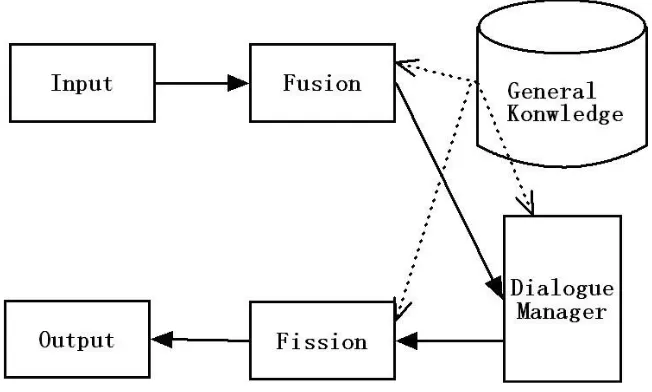
Typically, a dialogue system consists of six components (Fig. 3.1): Input, Fusion,
Dialogue Manager, Knowledge Base, Fission and Output [7].
Input:
Handle different modes of inputs.
Fusion:
Extract, recognize, interpret, and fuse information from different modes of
inputs.
Dialogue Manager:
Control the flow of the dialogue by deciding how the system should respond
to the inputs [12].
Knowledge Base:
Manage information like dialogue history, task knowledge, general dialogue
knowledge, domain specific knowledge and user information.
Fission:
Transform the responses to different modes of outputs.
Output:
Handle the outputs.
The core components of a dialogue system are dialogue manager and knowledge
base. Dialogue managers can be classified into four categories [7]:
Finite-state and frame-based:
Finite state-based dialogue managers are the simplest dialogue managers. The
dialogue structure is represented in the form of state transition network, and
the dialogue control is system-driven and all the system’s utterances are
predetermined [7]. As an extension of finite state-based dialogue managers,
frame-based models simulate the approach of form filling, which allows
some degree of flexibility. In this thesis, a frame-based dialogue system is
11
Information state and the probabilistic based:
For the information state-based approaches, a group of states are predefined,
and the state of the dialogue will be changed dynamically according to
certain interaction strategies. Some probabilistic techniques (e.g. partially
observable Markov decision process) are applied to manage the transition
strategies.
Plan based:
Plan-based dialogue managers are based on the plan-based theories of
communicative action and dialogue [2]. They are more complex than the
previous dialogue managers.
Collaborative agent based:
Collaborative agent-based approaches try to capture the motivation behind a
dialogue and the mechanisms of dialogue itself. As a result, managers based
on these approaches contribute to the most complicated dialogue systems,
which allow very high level of flexibility.
For the knowledge source in dialogue system, typically there are five different
models of knowledge [13]:
Dialogue Model:
Dialogue Model holds the general information about the construction of a
dialogue, which is used to control the dialogue. Grammar-based modeling
and Plan-based modeling are two main approaches to model the knowledge
for Dialogue Model.
Dialogue History:
Dialogue History records the history of the dialogue. It is used for dialogue
control, disambiguation of context dependent utterances, and context
12 Domain Model:
Domain Model holds the domain knowledge that will be referred to in the
conversations. Knowledge in Domain Model is mainly used to guide the
semantic interpretation of user’s utterances, find the relevant items and
relations that are under discussing, supply default responses and son on [13].
Domain Model usually contains the structure of the domain and comprises a
subset of the general world knowledge. Its simplification is Conceptual
Model, which represents the conceptual relationships between the objects in
the domain [13]. Often, Conceptual Model alone is enough for the domain
knowledge of the dialogue system.
Task Model:
Task Model, which often consists of a hierarchical representation structure,
describes how the system’s communicative and other tasks should be carried
out [13].
User Model:
User Model represents the user’s goal and plans, capabilities, attitudes,
knowledge and belief [13].
In this thesis, the knowledge base of the proposed dialogue system contains
domain knowledge of requirement elicitation and the task knowledge for guiding users to
customize a specific type of software applications.
In addition to the structure, by considering the source of information which
determines the interaction, tasks of dialogue systems can be classified into four
categories [14]:
Slot-filling task:
13 Database search task:
The user has his goal but needs to retrieve information for completing the
task.
Explanation task:
The user doesn’t have or has little knowledge about the task.
More complex tasks:
The task is a combination of the other three tasks.
In the proposed method, a slot-based dialogue system is adopted, and requirement
elicitation is modeled as a group of slot-filling tasks. These tasks will be performed
according to the knowledge related to requirement engineering, which is built in
knowledge base of the dialogue system. Work related to knowledge-based requirement
engineering will be introduced in the next section.
3.3Knowledge-based Requirement Engineering
Requirement engineering is recognized as the most critical stage of the entire
software development process [15]. Typically, over 40% of errors in a software project
are from requirement engineering, while they need 10 more times of costs to repair than
other errors [16].
Conventional process-based or scenario-based requirement engineering methods
predefine a group of processes and their corresponding guidelines. Accordingly, the
requirement engineering activities and deliverables are carried out following the
guidelines [17]. However, it is very often that when the processes are ongoing, some
important information is not yet available. So, engineers have to repeat the processes,
which results in project delay and additional cost [18].
Unlike traditional process-driven requirement engineering, knowledge-driven
requirement engineering, as a novel requirement engineering paradigm, is conducted
14
be retrieved without much help from domain experts. The information is further used to
guide the traditional requirement engineering process. As a result, the validity,
completeness as well as consistency of requirement engineering product are maintained.
Moreover, changes to the software development project will be detected and predicted in
an early stage, and fewer waste efforts will be made. Finally, the outcome of the project
is expected to be more mature and complete, while rework can be dramatically reduced
[18].
Furthermore, among the group of knowledge-driven requirement engineering
methods, ontology-based requirement engineering is very popular. It [19]:
Provides formal representation for both requirement documents and
knowledge.
Describes the problem domain with varying degrees of formalization and
expressiveness.
Is well suited as an evolutionary approach.
Is used to support requirements management and improve the traceability of
requirement artefacts.
Thus it outperforms other traditional knowledge-based approaches [19]. By now,
a number of ontology-based requirement engineering approaches have been proposed.
Detailed introduction will be presented in the next section.
3.4Ontology
3.4.1 Overview
In theory, an ontology is a formal, explicit specification of a shared
conceptualization [20]. In other words, ontology is used to represent the common
15
The reasons to develop an ontology can be roughly classified into five categories
[21]:
To share common understanding of the structure of information among
people or software agents
To enable reuse of domain knowledge
To make domain assumptions explicit
To separate domain knowledge from the operational knowledge
To analyze domain knowledge
They are all closely related to domain knowledge representation. Generally, an
ontology provides a shared vocabulary, which can be used to model a domain or a task.
Hereˈmodeling means constructing the concepts, objects as well as their properties and
relations that exist in the domain or in the solution to the task [22].
Conventionally, knowledge engineering methods, like propositional logic,
predicate logic and other rule-based methods, mainly investigate topics like logic,
knowledge representation, search, and so on [23]. They focus on how to solve the
problem rather than the knowledge itself. So the resulting knowledge is often implicit
and difficult to be maintained, shared or reused. On the contrary, the main concern of
ontology is the contents of knowledge and approaches to accumulate it. It builds the
foundation for common knowledge.
Moreover, roughly speaking, ontology consists of task ontology, which
characterizes the computational architecture of a knowledge-based system for certain
tasks, and domain ontology, which characterizes the knowledge of a specific task domain
[23].
To develop an ontology, typically, includes the following steps [21]:
1. Define classes (concepts in the domain) in the ontology
16
3. Define slots (properties of classes and instances) and describing allowed
values for these slots
4. Fill in instances
5. Fill in the values for slots of the instances
If all the classes, slots, instances and their relationships are properly defined, the
ontology for knowledge of a task or a domain is created.
There are many important benefits in applying ontology. First of all, the
knowledge is formal, explicit and shared, which means the knowledge is accessible to
everyone. With ontology, the common standards of a domain can be established by the
experts. People with different background will have opportunities to acquire the
knowledge without much professional training. Meanwhile, the taxonomy-based
representation is very concise and straight-forward, which decreases ambiguities and
errors. Finally, ontologies are machine-oriented. Some of the ontology languages are
XML-based, which can be easily shared among different machines. So, currently,
ontology is one of the most popular and powerful knowledge engineering methods
widely applied in different applications.
In this thesis, Web Ontology Language (OWL) [24], one of the most successful
ontology languages recommended by W3C, is adopted. OWL uses XML syntax and is
partially mapped to Description Logic, which is a subset of Predicate Logic. Thus OWL
provides users with various inference capabilities. Actually, the realization of some OWL
reasoners is based on tableau algorithms, which is an algorithm for Description Logic
reasoning. OWL consists of three sublanguages: OWL Lite, OWL DL and OWL Full.
OWL Full is the most expressive among the three. But there is not any reasoners
supporting its inference. In contrary, while promising the decidability, the expressiveness
of OWL DL and OWL Lite is sacrificed [25]. Thus Semantic Web Rule Language
(SWRL) [26], which supplements OWL DL and OWL Lite with Horn-like rules, was
17
Moreover, as explained above, ontology has mechanism to describe implicit
knowledge. In fact, methods for retrieving the implicit knowledge are based on ontology
reasoning. Some of these approaches are derived from Description Logic reasoning. For
example, OWL DL is based on SHIQ Description Logic. Thus algorithms for Description
Logic reasoning, such as tableau algorithms, can be used to infer with OWL DL ontology.
Furthermore, many stable reasoners are available for OWL DL reasoning. For example,
Protégé, an OWL ontology development platform, provides interfaces for plugging in
reasoners like Pellet, FaCT++, Jena and RACER. In this thesis, Pellet is used for
ontology reasoning. It supports reasoning with both OWL DL and the DL-safe version of
SWRL.
3.4.2 Ontology for Requirement Engineering
As discussed in section 3.3, ontology-base requirement elicitation is a popular
topic nowadays. However, there is a long history of applying ontology for requirement
engineering. The very first research effort dedicated to utilizing ontologies in the
requirement engineering can be dated back to the early 1980s [25]. Since then, a number
of ontology-based requirement engineering approaches have been studied, developed and
proposed. Among the most notable publications, [27] introduces an ontology-based
requirement model that facilitates detecting incompleteness and inconsistency of
requirement artefacts, measuring the quality of requirement engineering, and predicting
potential changes in later software engineering phases. A very complete group of
requirement engineering related ontological relationships is defined in the model. In [28],
a minimum model for describing requirement knowledge is presented. Goal, quality
constraint and softgoal are proposed as the fundamental ontology concepts in
requirement engineering. In addition, a framework for ontology-based requirements
elicitation is introduced in [29]. Types of functional requirements as well as their
18
Meanwhile, [15] presents a well-structured ontology-based requirement model called
SoftWiki, which is capable of capturing and managing the requirement engineering
artefacts for all stages of system development.
Although all the approaches introduced above make great contribution to
ontology-based requirement engineering, they are not suitable for representing
requirement knowledge for automated SPL. [27] places its emphasis on artefacts
verification, while the model proposed in [28] is more theoretical than practical. Besides,
the objective of the method from [29] is to ease the communication between requirement
engineers and clients in requirement elicitation. Similarly, SoftWiki [15] is developed for
supporting the collaboration of all stakeholders in all software engineering stages.
Actually, contributions from most ontology-based requirement engineering
studies fall into the following three categories:
Improving the quality of the requirement engineering artefacts (e.g. [27], [29],
[30]).
Defining a shared understanding among engineers and clients (e.g. [31], [32],
[33]).
Developing new knowledge-based requirement engineering methods (e.g.
[34], [35], [36]).
Issues critical to the realization of SOA-based automated SPL, like providing
automatic guidance for product customization and generating service-oriented system
specification, are not well covered by these approaches.
3.4.3 Ontology for SOA
As mentioned in Chapter II, the idea of Semantic Web Service is proposed for
automating SOA system implementation activities. Different from Feature Driven
Development [37] and Model-Driven Achitecture [38], where system functionalities are
19
application functionalities into loosely coupled services. Thus, instead of designing and
realizing the features or models, software applications can be implemented by
discovering, composing and invoking the services in SOA. Moreover, Semantic Web
Service methods further specify the web service descriptions on the semantic level, thus
suggest solutions for automatic service discovery and composition [4].
Semantic Web Service approaches are also based on ontology. Currently, there are
mainly three ontologies developed for Semantic Web Service: Web Service Modeling
Ontology (WSMO) [39], Semantic Markup for Web Services (OWL-S) [40] and SOA
Ontology [20].
WSMO is a conceptual model related to Semantic Web Service. It supports
the Semantic Web Service deployment and interoperation.
OWL-S is also an ontology for describing Semantic Web Service. It enables
automatically discover, invoke, compose, and monitor web services under
specified constraints.
''SOA Ontology defines the concepts, terminology and semantics of SOA in
both business and technical terms'' [41]. It creates a foundation for facilitate
SOA understanding, SOA related communication, and SOA system modeling.
Meanwhile, it potentially, contributes to model-driven SOA implementation
[41].
The first two ontologies are relatively low-level. They are techniques for
describing concrete Semantic Web Services.
In this thesis, OWL-S is applied. OWL-S is based on the ontology language OWL.
It is an ontology of services that makes automatic service discovery and composition
possible [40]. The instances of its class ServiceProfile describe the characteristics of the
services which are used to match clients’ requests, while information for service
composition is contained in instances of the class ServiceModel. When discovering the
20
providers’ ServiceProfiles through semantic capability matching [42]. If the matching
succeeds, the desired services are found. Then the ServiceModels, associated with the
discovered services, will carry information about the process of composing and invoking
the services. So by reasoning the knowledge contained in ServiceModels, automatic
service composition will be performed and the desired functionalities can be obtained [8].
On the other hand, although OWL-S provides descriptions for web service functionalities,
it has few mechanisms for non-functional service description [43]. Fortunately, [43]
proposes a quality extension for OWL-S to offset this drawback. It inherits from the class
ServiceParameter defined in OWL-S, which is designed for extending OWL-S with
21 CHAPTER IV
PROPOSED ONTOLOGY-BASED REQUIREMENT MODEL
4.1Introduction
This chapter reports the ontology-based requirement model. Different from the
ontology-based requirement engineering methods discussed in Chapter III, the model
developed in this research integrates the requirement engineering knowledge with
service-oriented knowledge. While the key concepts and relationships proposed in [27]
and [28] are kept for maintaining the completeness and consistency of the product
requirements, a service-oriented decomposition approach is applied for instantiating the
modeling, as well as organizing the commonalities and variabilities in SPL. Furthermore,
information for directing requirement elicitation, such as ranks of the requirements, is
also expressed in the ontology model. Therefore, knowledge contained in the model is
expected to guide the automatic product customization and facilitate generating
service-oriented system specification for system implementation.
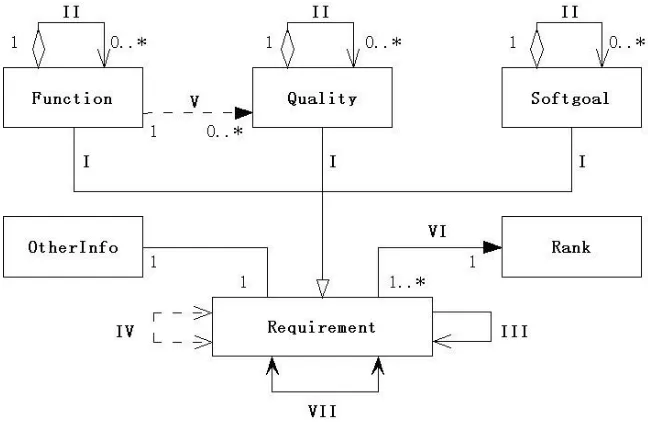
In this chapter, construction of the ontology-based requirement model (Fig. 4.1) is
presented according to the ontology engineering steps proposed in [21]. First, concepts of
the model are defined. Second, relationships describing the taxonomic hierarchy of the
ontology are outlined. Third, as supplement to OWL ontology, this chapter proposes a
group of SWRL rules for the model. Finally, instantiation of the ontology is discussed.
4.2Concepts
The concepts of the model are illustrated in Fig. 4.1 with class diagram notations.
In the domain of requirement elicitation, according to their different roles, Requirements
can mainly be classified into three categories: Function, Quality and Softgoal. Meanwhile,
Rank is used to represent the importance of the requirements with respect to the entire
22
describe detailed information about a requirement, which offers helps to clients’
evaluation.
Fig. 4.1: The proposed ontology-based requirement model
Requirement: An instance of Requirement is a system feature can be ordered
by users. There are three types of Requirement: Function, Quality and
Softgoal.
Function: An instance of Function represents a functionality that users can
order. It may be a primitive function offered by the product software or a
composition of several primitive functions. From the service-oriented point
of view, a function is actually a service. In this research, functions are
organized in forest-like structure, where composite functions decompose into
less complex composite functions or primitive functions.
Quality: An instance of Quality is a non-functional constraint imposed on a
function. Mainly, they are used to further specify a functionality. Therefore, a
quality instance is always related to a particular function. A quality cannot be
chosen if the corresponding function is dropped. Besides, a quality can also
23
Softgoal: Instances of Softgoal are also non-functional constraints. However,
instead of imposing on a particular function, they describe the global
environment within which the product software system works. They are often
very abstract, and may be related to a subset of the candidate functions and
qualities, but all selected requirements must submit to them. Similar to
instances of Quality, softgoals can also decompose into sub-softgoals.
Rank: Instances of Rank represent the importance of the requirements with
respect to the potential system. On the other hand, they also specify the
evaluation order of the requirements in the requirement elicitation process.
OtherInfo: Concepts generalized from OtherInfo may be general requirement
engineering related concepts (e.g. stakeholders) or specific concepts within a
domain. Instances of them are used to describe detailed information about the
requirements. Users can request such relevant information when evaluating
the requirements.
4.3Relationships
Fig. 4.2: Notation for the relationships
The relationships between the concepts are depicted in Fig. 4.1, and their
notations are outlined in Fig. 4.2. In the proposed method, these relationships not only
24
also facilitate machines to direct the requirement elicitation.
I. Generalize:
An instance of Function, Quality or Softgoal is also an instance of
Requirement. Generalize represents the IS-A relationship.
II. Decompose:
Requirement x decomposes into less complex requirement y of the same
type. y describes part of x’s characteristics or is a more detailed alternate
to x. x is called the parent, while y is called the child of x.
A requirement can decompose into zero children; otherwise it must
decompose into at least two children. A child has at most one parent.
Logically, a requirement cannot decompose into more complex
requirements (e.g. its parent or the parent of its parent). Thus the
decompose relationship forms decomposition trees. In practice, it is
possible that a requirement participates in the decompositions of several
more complex requirements. However, if a requirement is allowed to have
two parents, when it is picked up during requirement elicitation, the
composition that the requirement is supposed to join in the product
software will be unknown. Hence, in this case, two copies of the
requirement are required for participating in the two decompositions.
When functions decompose into sub-functions, the parent functions
represent functionalities that are the results of their children’s composition
(i.e. service composition). In other words, a parent implies a composition
strategy rather than any concrete functionalities. Only the leaves in a
function decomposition tree are primitive functionalities. Besides, it is not
necessary to select a composition strategy if one only needs some
primitive functionalities.
25
refinements to the parent. So logically, it actually doesn’t make any
difference to have a parent quality directly replaced by its children in an
instantiated ontology model. The decomposition relationship only eases
the requirement elicitation interaction or the ontology instantiation work.
III. Rely:
The realization of requirement x relies on the implementation of
requirement y. If x is ordered by the clients, y must also be selected;
otherwise the resulting system will not function properly.
So Rely describes the completeness of the requirement elicitation product.
In addition, when a requirement relies on two other requirements, this
implies it needs them both. In practice, it is possible that the requirement
only requires one of them. In this case, two copies of the same
requirement are created and a Contradict relationship is established
between them; then each of the two copies relies on one of the two
required requirements.
A parent function relying on its children or children of its children implies
the composition strategy requires the involvement of the corresponding
children. If a child function relies on its parent or parent of its parent, this
indicates the child function is designed deliberately for the composition.
Normally, a function relying on another function means the input of one
function is the output of the other function.
When a parent quality or softgoal relies on its children, it means the
children are essential to the parent constraint. In this research, children
qualities and softgoals are supposed to rely on their parents. This promises
that during the requirement elicitation process, children qualities and
softgoals will not be explored if their parents are abandoned.
26
the constraints requires the implementation of some functions. Functions
may also need some quality or softgoal constraints to function properly.
Moreover, if a function relies on a quality, it also relies on the function
associated with this quality constraint.
IV. Contradict:
Requirement x contradicts requirement y. Requirement x and requirement
y are not supposed to simultaneously realized in the product software.
Contradict describes the consistency of the elicited requirements. This
relationship is symmetric and non-reflective. A requirement cannot
contradict its children, parent or the requirements it relies on. A function
should not contradict the quality constraints associated with it.
Normally, if two requirements play the same role in the candidate
application, which means they represent the same functionality or
constraint, there is a Contradict relationship between them. In addition, if
two requirements cannot be met simultaneously in the product software,
they contradict each other.
V. Associate:
Function x is associated with quality constraint y. y is a quality constraint
that can be imposed on function x.
As a quality cannot be realized on the customized software if its
associated function is not implemented. Associate relationship also
implies the quality constraint relies on its corresponding function.
Moreover, with the same problem and solution as Decompose relationship,
two functions are not supposed to be associated with the same quality.
If a composite function is associated with a quality, this suggests the
quality constraint is imposed on the composition rather than any primitive
27
related to the concrete functions. Moreover, as children qualities are
refinements to their parents, if a function is associated with a parent
quality, it is also associated with the corresponding children qualities.
Therefore, if an Associate relationship is explicitly defined between a
function and a quality, the function is associated with the entire quality
decomposition sub-tree which is rooted on the quality. Meanwhile, the
parent of the root quality, if there is one, is not supposed to have Associate
relationship with any functions.
VI. hasRank:
Requirement x has a rank of r. A requirement can have exactly one rank.
During the requirement elicitation process, requirements with higher ranks
will be offered to users for evaluation before those with lower ranks.
Hence, if a requirement has strong influence on the candidate application
or other requirements, it should be assigned with a high rank. Besides, the
parent requirements should always have higher ranks than their children.
If several requirements are closely related and supposed to be evaluated
one after another, they should be of the same rank.
Furthermore, requirements of the highest rank are treated as essential
requirements. They represent the common features of the SPL artefacts.
As a result, they will be picked mandatorily before the evaluation of any
other non-essential requirements. In addition, no requirement should
contradict essential requirements.
VII. Invalid:
There is an invalid relationship between requirement x and requirement y.
Invalid relationships are used to denote the invalidity in the instantiated
ontology model. It is applied with rules, and can be generalized into types
28 presented in the next section.
4.4Rules
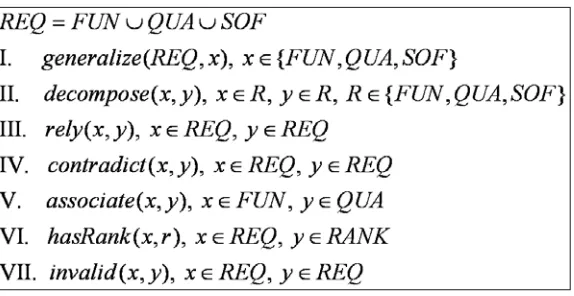
Fig. 4.3: Rules for the proposed ontology model
Fig. 4.3 illustrates the group of SWRL rules applied in the research. They adopt
horn-like presentation. By reasoning with these rules, implicit knowledge for requirement
elicitation and ontology instantiation can be retrieved. Followings are the explanations to
the rules.
i. Contradict relationship is non-reflective.
ii. Decompose relationship is non-reflective.
iii. Rely relationship is transitive.
iv. Contradict relationship is symmetric.
v. Contradict relationship and Rely relationship are disjointed.
vi. Contradict relationship and Decompose relationship are disjointed.
29
viii. Decompose relationship is asymmetric.
ix. Decompose relationship is transitive.
x. Decompose relationship is inverse-functional.
xi. Associate relationship is inverse-functional.
xii. Children qualities and softgoals rely on their parents
xiii. A quality relies on its corresponding function.
xiv. If requirement x relies on requirement y, x contradicts the requirements
that y contradicts.
xv. If function z is associated with quality x, z is associated with x’s children.
xvi. Requirements cannot contradict top rank requirements.
In fact, rules i-xi can be expressed with OWL elements. However, some of them
cannot be reasoned with available reasonors. Even if reasoners can deal with them, the
invalid relationships will not be explicitly pointed out by the reasoners. Thus rules are
applied here.
Rules iii, iv, xiii and xiv reflect the nature of the relevant relationships, while
rules xii is used to facilitate the requirement elicitation process.
Besides, rules i, ii, v, vi, vii, viii, ix, x, xi, xv and xvi are used to verify the
validity of an instantiated requirement model. During requirement elicitation, the
explicitly defined Decompose and Associate relationships determine the order of
requirement evaluation. Therefore, rule xv is not activated in requirement elicitation
process. Moreover, rule ix contradicts rule x, and it also violates the decomposition tree
structure. But rule ix facilitates discovering the invalidity that parents cannot contradict
the children of their children. Hence, it is applied but not activated together with rule x or
in requirement elicitation process.
4.5Ontology Instantiation
30 SPL engineering.
Before instantiating the ontology model for a specific type of software systems,
the requirement engineers must analyze this type of service-oriented applications.
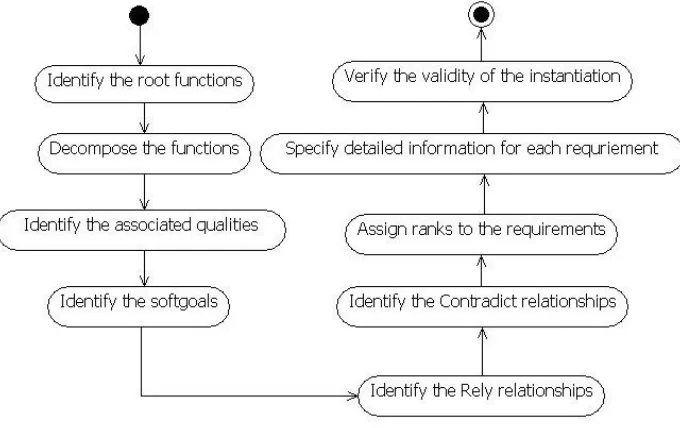
Decompose these systems into primitive services and find out the commonalities and
variabilities. Then they can instantiate the model according to the following procedure
presented in Fig. 4.4.
Fig. 4.4: Procedure of instantiating the ontology model
1. Identify the main functions which are roots of the decomposition trees.
2. For each of the roots, if it represents certain composition strategies, identify
the children that contribute to the composition. Then establish the Decompose
relationship between the parent and children. If the children are also
decomposable, repeat this decomposition process, until all primitive functions
are discovered.
3. Find the corresponding quality constraints that can be imposed on the
functions. Organize the qualities with decomposition trees. As all the qualities
constraints contained in a decomposition sub-tree are related with the same
31
function and the root of the sub-tree. Associate relationships between children
and the corresponding function are not supposed to be explicated defined. In
requirement elicitation process, when a function is picked by users, its
associated qualities will be pre-evaluated immediately. However, the children
qualities are expected to be explored in a later stage.
4. Identify the softgoals, and decompose them if necessary.
5. Establish the Rely relationship for the requirements.
6. Establish the Contradict relationships.
7. Identify the essential requirements, and assign ranks to the requirements with
respect to their importance and expected positions in the elicitation process.
8. Specify the detailed descriptions for each requirement. Bind each requirement
with the corresponding service description which will be used in generating
the service-oriented output. Details will be discussed in Chapter V.
9. Verify the validity of the instantiated ontology model. Make modifications if
necessary. Moreover, the generally acknowledged facts, like requirement
which could not decompose into exactly one child, should also be checked
manually.
Then a valid instance of the ontology model is built. Typically, for a type of
medium-sized software systems like online book shopping service, there will be dozens
of requirements and more than a hundred relationships created in the instantiated
32 CHAPTER V
PROPOSED REQUIREMENT ELICITATION METHOD
5.1Introduction
A frame-based dialogue system is developed in this thesis, which takes the
instantiated ontology model as knowledge base. It is applied to elicit users’ demands
through human-machine interaction. Though to maintain the completeness and
consistency of the customized requirements is very complicated and requires ontology
reasoning, interactions for requirement elicitation are actually a group of slot-filling tasks.
Questions such as whether users need a specific requirement will be proposed by the
machine, and users will respond with their decisions on the very requirement. Therefore,
users know what they are going to do and how it is going to be done, which means the
requirement elicitation process can be modeled as a set of slot-filling subtasks, while the
utterances, slots as well as value options for each slot will be retrieved from the
knowledge base, hence a framed-based dialogue system is capable of handling the
interactions for requirement elicitation, in spite of its limited communication ability.
In this chapter, the structure of the dialogue system, the requirement elicitation
process and the output of the elicitation will be discussed.
5.2Structure of the Proposed Dialogue System
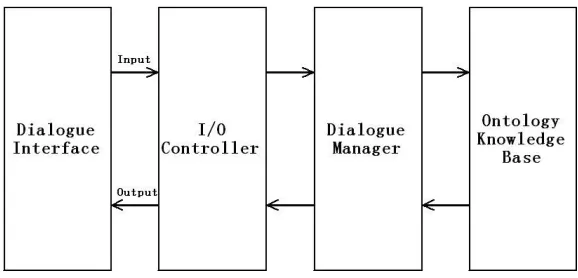
The frame-based dialogue system designed in this research consists of four
components: interface, I/O controller, dialogue manager and knowledge base (Fig. 5.1).
The dialogue interface is text-based. It displays machine generated utterances and
provides one slot for users to fill in. Typically, the utterances will be questions like
''Would you like to select the requirement …?''. Users are expected to answer ''Yes'' or
''No''. Then the users’ response will be passed onto the I/O controller. It will try to match
33
asks users to correct their response will be generated by the I/O controller, sent to the
interface and get displayed as the output of current interaction. Otherwise, the input will
be converted into format processable to machines and passed onto the dialogue manager.
The dialogue manager then knows users’ decision on the requirement currently being
evaluated. It will consult the ontology knowledge base with the decision, and customize
the requirements based on the related requirement knowledge as well as the input. After
that, an output will be generated by the dialogue manager according to the result of the
customization and sent to the I/O controller. The I/O controller will convert the output
into natural language and have it displayed by the interface, which will initiate the next
round of interaction.
Fig. 5.1: Structure of the proposed dialogue system
5.3Process of Requirement Elicitation
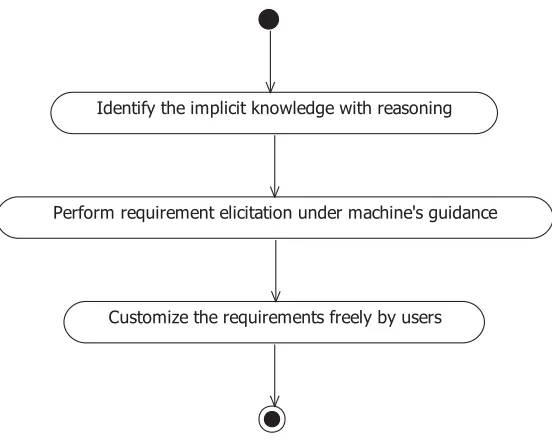
Before the commencement of requirement elicitation, the implicit knowledge (e.g.
indirect relationships) contained in the instantiated ontology model will be extracted by
reasoning.
The requirement elicitation process (Fig. 5.2) is divided into two stages. First,
requirement elicitation will be conducted under the guidance of machine. Then users will
have chances to change their decisions made in the first stage and further customize the
34
Fig. 5.2: Process of interactive requirement elicitation
5.3.1 Machine-directed Requirement Elicitation
During the first stage, each requirement will be offered to users for evaluation in
turns. At the beginning, all essential requirements will be picked automatically without
being evaluated. Then the functions will be evaluated, and the evaluation of qualities will
follow. Finally, the softgoals will be customized. Among the requirements of the same
category, one with higher rank will be evaluated before those with lower ranks.
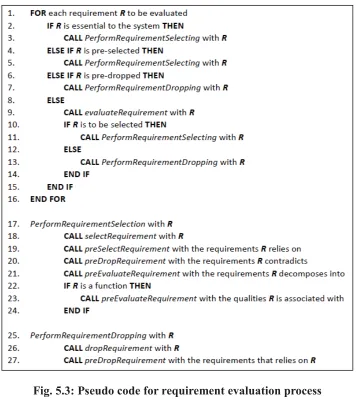
Fig. 5.3 presents the pseudo code for evaluating the requirements. When
evaluating a requirement, there could be four cases.
1. If a requirement R is essential to the system, actions for selecting the
requirement will be performed.
2. If the requirement R is non-essential and pre-selected, actions for selecting a
requirement will be performed. These actions include call selectRequirement
to have R selected; call preSelectRequirement to have the requirements that R
relies on pre-selected; call preDropRequirement to have the requirements that
R contradicts pre-dropped; call preEvaluateRequirement to have the
Identify the implicit knowledge with reasoning
Perform requirement elicitation under machine's guidance
35
requirements that R decomposes into pre-evaluated; and if R is a function, call
preEvaluateRequirement to have the qualities that R is associated with
pre-evaluated.
Fig. 5.3: Pseudo code for requirement evaluation process
3. If the requirement R is non-essential and pre-dropped, action for dropping a
requirement will be performed. These actions include call dropRequirement to
have R dropped and call preDropRequirement to have the requirements that
rely on R pre-dropped.
4. If the requirement R is non-essential and has not been pre-selected or
pre-dropped, evaluateRequirement will be called to have R evaluated by users.
36
performed. Otherwise, actions for dropping a requirement will be performed.
Followings are the explanations to the subroutines used in the pseudo code.
selectRequirement will put the requirement to a set to have it labelled as
''selected'' if it is unlabelled.
droptRequirement will put the requirement to a set to have it labelled as
''dropped'' if it is unlabelled.
evaluationRequirement will present the requirement to users through
dialogue interface. Users can choose to select or drop the requirement, or
request detailed description to the requirement before making the decision.
preSelectRequirement will put the requirement to a set to have it labelled as
''pre-selected'' if it is unlabelled.
preDropRequirement will put the requirement to a set to have it labelled as
''pre-dropped'' if it is unlabelled.
preEvaluateRequirement will first call evaluateRequirement to have the
requirement evaluated if it haven’t been evaluated yet. Then based on users’
choice, preSelectRequirement or preDropRequirement will be called.
Moreover, if the requirement is to be pre-selected, pre-select the requirements
it relies on, and pre-drop the requirements contradicting it. Otherwise,
pre-drop the requirements relying on it.
During the requirement elicitation process, all requirements will be expanded at
most once (in pre-evaluation or in formal evaluation). Here, expanding a requirement
means retrieving the detailed information of the requirement. Besides, each Decompose
and Associate relationship will be visited at most once by the parents. Each Rely and
Contradict relationship will be visited at most twice by the two involved requirements.
Therefore, let V be the number of requirement instances in the ontology and E be the
37
5.3.2 User Requirement Customization
During the second stage, users can order the machine to select or drop an arbitrary
requirement. In other words, they can change their decisions made in the first stage. If a
selected requirement is to be dropped, the selected requirements that rely on it will also
be dropped. If a dropped requirement is to be selected, the selected requirements that
contradict it will be dropped and the dropped requirements that it relies on will be
selected. Therefore, the completeness and consistency of the customization are
maintained all over the two stages.
5.4Output of Requirement Elicitation
5.4.1 Output Overview
To build software with SOA methods, the services must first be discovered. Thus
the output of the requirement elicitation process is a set of service descriptions which can
be used to discover the services satisfying the selected requirements.
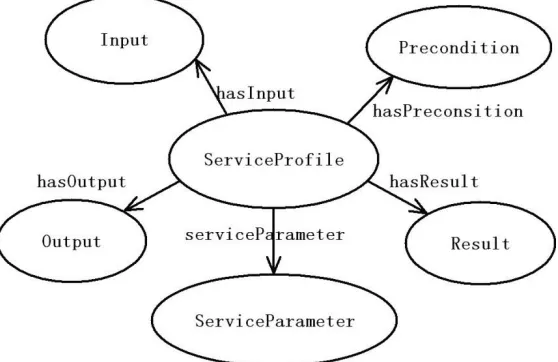
Fig. 5.4: Selected classes and properties in OWL-S functionality description
In this research, OWL-S is used to describe the services. OWL-S makes use of an
instance of ServiceProfile to represent the information needed to discover a service.
38
hasPrecondition and hasResult. They associate an instance of ServiceProfile with
respective instances of Input, Output, Precondition and Result. And an instance of Input,
Output, Precondition and Result would respectively represent: the information the
service requires to work, the message the service returns, the condition within which the
service executes properly and the effects as well as outputs of the service execution.
Quality constraints to services are not explicitly defined in OWL-S. The
extension proposed in [43] is used to describe the qualities and softgoals. In this
extension, Quality_Property which is generalized from OWL-S class ServiceParameter
is used to represent a constraint. For those measurable qualities, instances of Attribute,
inherited from Quality_Property, can be used to express them as well as their metrics.
For those abstract constraints (e.g. softgoals), Quality_Model, which connects
Quality_Property via property defined_by, can be used to specify their standards.
Instances of ServiceProfile are associated with instances of Quality_Property through
property serviceParamter.
Fig. 5.5: OWL-S quality extension proposed in [43]
39
information: either functionalities represented with Input, Output, Precondition and
Result, or quality constraints represented by Quality_Property. Converting requirements
into service descriptions is actually to combine the information that belongs to the
selected requirements. As requirements are organized in decomposition trees, the selected
requirements also form a group of selected sub-trees. The integration process can be
carried out in a way of merging nodes in the selected sub-trees.
5.4.2 Output Generation
The output generation process (Fig. 5.6) is divided into four phases.
Fig. 5.6: Procedure of generating service description
1. Retrieve the selected primitive functions. Normally, primitive functions have
information about input and output of the service. If there is a Rely
Retrieve the selected primitive functions
Attach the quality constraints to the corresponding function roots
Attach the softgoals to the selected function roots Merge primitive functions to their parents
Merge primitive sibling functions
If there are mergeable functions Yes
40
relationship between two selected sibling primitive functions, it implies that
some inputs of one primitive function are from the outputs of the other
function. Then those relevant inputs and outputs are not necessarily to be
expressed in the service description. So merge the two siblings with algorithm
outlined in Fig. 5.7.