LAL, AKSHAY. Dgoogle: A Full-Text Search Engine in Large-Scale Peer-to-Peer Systems. (Under the direction of Professor Khaled Harfoush).
Full-text search engines like Google serve an important role in accessing Internet resources. In such engines, a search for web pages, matching a user’ s query, are typically carried on a set of co-administered, physically co-located clusters of servers. Full-text search capabilities are also needed in distributed, peer-to-peer systems. Such systems are inherently not co-administered due to the limited capacity and the instability of their members, and to provide censorship resilience and member anonymity. Full-text search in large-scale peer-to-peer systems is challenging since the search can potentially span millions of peer-to-peers in different administrative domains.
SYSTEMS
by AKSHAY LAL
A thesis submitted to the Graduate Faculty of North Carolina State University
in partial fulfillment of the requirements for the Degree of
Masters of Science
COMPUTER SCIENCE
Raleigh 2006
APPROVED BY:
Dr. Khaled Harfoush Chair of Advisory Committee
Biography
Table of Contents
List of Figures………..vi
List of Tables………viii
1. Introduction……… 01
1.1Contributions ……….………02
1.2Thesis Organization ………...03
2. Related Work..………...05
2.1Summary Representations..………05
2.2Trends in Service Discovery.……….06
2.3Content Location in P2P Systems..……….………...07
3. The Text Encoding Function – Ħ……….………10
3.1Motivation.………10
3.2Encoding Function Design………12
3.3Reducing the size of m to mc ………..………..15
4. The DGoolge Search Engine….………..………..18
4.1Motivation for the Dgoogle Overlay ...……….………...18
4.2Dgoogle Overlay Structure……….………...19
4.3.1 Publishing a Document .……….………...26
4.3.2 Querying the Network……….27
4.3.3 Dealing with Node Failures………..…...27
4.3.4 Load Distribution in the Network………....28
5. Experimental Results and Inferences.………30
5.1Objective of the Simulation………...30
5.2Simulation Test Bed Design.……….…31
5.3The Data Set………..…33
5.4Accuracy of the Text Encoding Function …..………...33
5.5Experimental Setup for Dgoogle ……….………….38
5.5.1 Storage Overhead………..………..39
5.5.2 Messaging Overhead……….………..41
5.5.3 Average Time in Network.………..…49
6. Conclusions and Future Work………..……….53
List of Figures
3.1 The conversion of human readable text into a bit signature……….…………..13
3.2 Pseudo code for Ħ using CE and a group size of 3……….……….15
3.3 Pseudo code for Converting m to mc ………..17
3.4 Pseudo code for Ħ……….………..17
4.1 A » B (A derives to B)……….………...21
4.2 Transition diagram for hash range 0000 to 1111………...………….21
4.3 Transition diagram for a 1-dimensional network…………..………..23
4.4 Transition diagram for a 2-dimensional network………23
4.5 Transition diagram for a 3-dimensional network………24
5.1 Accuracy of using trigrams (ordering of 3) with varying # Symbol Table Elements and Group Size………....36
5.2 Accuracy of using digrams (ordering of 2) with varying # Symbol Table Elements and Group Size………....36
5.3 Storage overhead per node with and without caching ………...….40
5.4 Average # of unique nodes visited – One word queries ………...42
5.5 Average # of unique nodes visited – Two word queries ……….……43
5.6 Average # of unique nodes visited – Three word queries ………...44
5.7 Messaging overhead – One word queries ………..……….47
5.8 Messaging overhead – Two word queries ………...47
5.9 Messaging overhead – Three word queries.………48
List of Tables
4.1All possible results for search query 010 011 ……….……….……….26 5.1Symbol Table for English with 10 Elements…..………….………..34 5.2Symbol Table for English with 37 Elements..………...………35 5.3Accuracy of our Hash function (Ħ) with varying # Symbol Table Elements, Group
Section 1
Introduction
Peer-to-peer (P2P) systems are a class of distributed systems that are very versatile and robust wherein each workstation in the network is treated as having equivalent capabilities and responsibilities. They offer an alternative to the traditional client/server network model. Every node acts both as a client and a server and pays its participation by providing access to its computing resources. Usually there is no central control or administration hence, the effectiveness of the network is totally dependent on the level of participation amongst the nodes. There are many traits that make P2P systems attractive. These traits include self-organization, fault tolerance, redundancy, and a nearly limitless capacity to store data. However, the same traits that make these systems attractive complicate the task of locating content. The decentralization of content that is inherent to P2P systems makes the direct application of traditional searching mechanisms like algorithms (e.g. merge sort) and data structures (e.g. B-trees) difficult because of the omnipresent delay between peers that are maintaining the content.
The fact that a search can potentially span millions of peers in different administrative domains makes P2P search engines inherently more complex than searching co-administered clusters of servers. Also, the variability in the number of search attributes, their ordering, and the fuzziness in their wording contributes significantly to the difficulty of the problem.
stress the system’s resources with non-productive communication between peers. Current research is focused on searching for content by specifying its full identity (eg: file name), which is not flexible or even sufficient for many applications. Others target an organization of files based on this semantics which do not have the flexibility of a full text search or construct inverted indices which are typically costly in communication bandwidth and disk storage.
1.1 Contributions
In this thesis we present a full text search engine, Dgoogle, suitable for large scale P2P systems. We define a Full Text as means that only text documents are considered and any word in a document is searchable. The intention is to retrieve all documents that include the searched words. Implementing this functionality in a distributed system has the following benefits; (1) avoids the single point of failure of centralized systems and thereby making them more robust to failures and resilient to denial-of-service attacks; (2) avoids censorship by authorities; (3) offers more service capacity.
Dgoogle also provides for, (1) Bounded response time to user queries; (2) Bounded storage and network bandwidth consumption budget; (3) Load balancing for all system resources.
As opposed to the current day techniques we do not rely on managing keywords; instead we manage sequences of character datagrams. Essentially we define a text encoding function that converts all the datagrams in a file, into a binary sequence such that documents with similar content have a similar sequence. This is the exact opposite of what is desired from hash functions such as MD5[7] or SHA-1[6], which are in essence cryptographic hashes, which scatter the values in the signature such that even the smallest change in the text causes a significant difference in the signature. This approach departs from earlier approaches but renders the full-text search manageable in a distributed environment.
1.2 Thesis Organization
Our aim is to build an off-the-shelf system which does not have pre-knowledge about keywords or documents in the system. In Section 3 we describe the Text Encoding function (Ħ) we use to encode documents and queries. Section 4 puts forth the description of the
Dgoogle Network Overlay. This is an overlay architecture we feel will be most profitable when used along with the encoding function. We demonstrate, based on the encoding scheme presented, how documents are distributed in a DHT hash space and how appropriate documents are identified and retrieved upon queries. We also explain the design of a DHT system capable of putting together these ideas to carry full-text searches.
tests are performed on real world data obtained from the Search Engine Optimization Resources [14].
Section 2
Related Work
In this section we present a survey of the past and current research in distributed systems in relation to (1) Content encoding schemes, (2) Service discovery in general and (3) Peer-2-Peer systems.
2.1 Summary Representations
2.2 Trends in Service Discovery
Anycast [18], [19], Service Location Protocol (SLP) [21], Lightweight Directory Access Protocol (LDAP) [21], and others are examples of such protocols. Secure Service Discovery Service (SDS) [22] and Intentional Name System (INS) [23] have addressed the issue of service representation and retrieval. There have also been some standardization efforts on how to address services. Uniform Resource Names (URNs) [24] have been proposed to serve as persistent, location independent identifiers for Internet services.
[25] Suggests a Resolver Discovery Service (RDS) through which the Domain Name System (DNS) is used to identify resolvers that can provide information about individual services. The Service Location Protocol (SLP) [21] provides a flexible and scalable framework for providing hosts with access to information about the existence, location, and configuration of networked services within an enterprise. The user supplies the desired type of service and a set of attributes that describe the service. Based on that description, the SLP resolves the network address of a service for the user. Anycasting [18], [19] provides service location. An IP anycast address is used to define a group of servers that provide the same service. A request for an anycast address is routed to at least one of the servers identified by this address.
style data structures for maintaining attribute-value pairs used to bind a user specified name to an appropriate instance of the target service. Sun’s Jini [28] technology also locates software and hardware resources.
2.3 Content Location in P2P Systems
Content-Addressable Network (CAN) [2] and Chord [3] assume file names are known. In Chord the system assigns numeric identifiers to all of its peers and arranges them in a ring. Peers are responsible for maintaining information about content whose hash value that is between their own identifier and the identifier of its predecessor in the ring. Peers maintain an incomplete list of the other peers in the ring. This list (i.e. finger table) is used to propagate search queries to other candidate nodes in the ring. It has been shown that the average cost of a search query in Chord in, units of messages, is Θ(log(n)) where n is the number of peers. In relation the CAN system organizes peers in a d-dimensional Cartesian space. Peers are assigned zones in the space and a specialized hash function is used to map content into the coordinate space. It has been shown that the average cost of a search query in CAN, in units of messages, is Θ (dn1/d) where n is the number of peers and d is the number of dimensions. (4) Other approaches extend the idea of inverted indices (deployed by web search engines) to distributed setups [15].
Section 3
The Text Encoding Function -
Ħ
In this section we describe the features of an encoding scheme for text content. The basic motivation for a new encoding function is outlined in sub-section 3.1 followed by a detailed description of its features and implementation in the subsequent sections.
3.1 Motivation
to have similar bits set that are also set in all documents with the same query word. In this way we can correlate files and queries based on the common bits set between the two signatures.
Our definition of content is human readable text which includes MP3 ID-tags, filenames, Exif tags in images, and ordinary text within human readable files. Our hash functions forms the core of our research. Its roots stem from the basic theories of cryptography, particularly in relation to frequency analysis of the English language, and also from early methodologies for substring pattern matching [1].
The prime objective we aimed to achieve is the development of an encoding function that produces a fixed length hash signature based on the symbol ordering of the content. The size (in bits) of a signature produced from our algorithm is a function of a particular language’s alphabet set and any other important/commonly used symbol. It should be noted that symbol selection is an important precursor to our design.
Popular hash algorithms such as SHA-1 or MD5 have the property that a small change in the input string content can cause a dramatic change in the hash value. This implies that two documents with similar content, but not exact, will be scattered randomly (close by or far apart), unless they are exact replicas of each other. This defeats the purpose for which we intend to encode the text.
versatile as it can be used as a standalone hash function for compression and also as pattern recognition tool.
3.2 Encoding Function Design
Unlike MD5 or SHA-1, our hash function needs to be tuned for each language that it will be applied to because the number of symbols that constitute a language’s alphabet is not constant. For example, there are 26 symbols in the English alphabet while there are more than a thousand in Kanji.
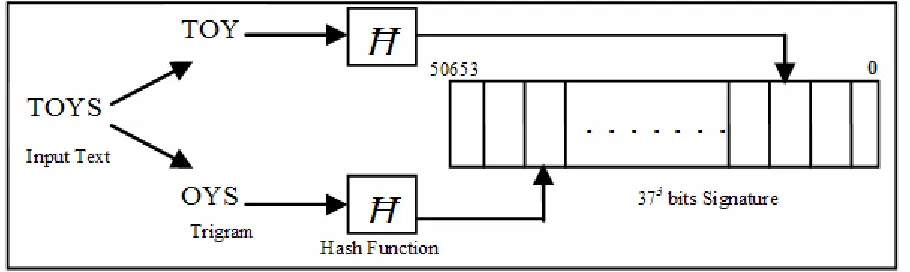
We initially divide the file content into several contiguous character sets, the size of each set being defined by the Group Size of the hash function. We define two group sizes for our hash function, a group size of 3 (trigram) and a group size of 2 (digram). Each contiguous set of characters is assigned a unique integer I, based on a certain symbol table. The symbol table consists of a specific language’s alphabets in some order each with a monotonically increasing value beginning with 0. We have tested our hash function with two different symbol tables and two different group sizes and present comparative results in section 5.
Each character set, sets a bit I of an m-bit hash signature. m is defined as the maximum length of the signature and depends on the number of elements in the symbol table and group size. We define a general formula for the size of m as follows,
k
C m=
m. We provide various optimizations so as to reduce the overall length of the hash that needs to be sent across the network. The final value of the m-bit hash signature is used to identify that file and assign it to point in the overlay.
Figure 3.1: The conversion of human readable text into a bit signature
The formula defined for computing the hash is:
)
(
)
(
1
0
∑
−=
=
ki
i i
k
C
T
y
Y
h
Where:
k:defines the group size of the hash function Yk : defines a specific group of characters
h(Yk) : is the hash signature obtained for the character group Yk
C: defines the # elements in the symbol table. For English language - CE yi : defines each of the characters present in Yk
The first step to produce a function Ħ for a particular language is to identify the smallest set, C, of symbols necessary to construct the majority of that language’s words. Each symbol is then assigned a monotonically increasing value beginning with 0. For now, we will assume that the smallest set for the English language, CE, constitutes the set {[A-B], [0-9], ‘.’}. This implies that the character ‘A’ is assigned a value of 0 and ‘.’ has a value of 36. Also we will assume that for maximum accuracy and efficiency the group size should be defined to be of size 3 (trigrams).
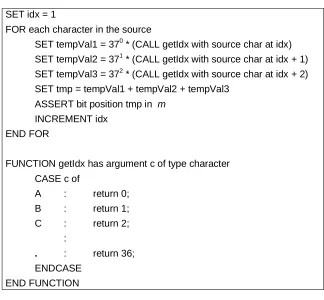
Ħ maintains a bit vector, m, that is (370*num1) + (371* num2) + (372* num3) (where
num1, num2 and num3 are the unique numbers associated with each element in the symbol
SET idx = 1
FOR each character in the source
SET tempVal1 = 370 * (CALL getIdx with source char at idx) SET tempVal2 = 371 * (CALL getIdx with source char at idx + 1) SET tempVal3 = 372 * (CALL getIdx with source char at idx + 2) SET tmp = tempVal1 + tempVal2 + tempVal3
ASSERT bit position tmp in m INCREMENT idx
END FOR
FUNCTION getIdx has argument c of type character CASE c of
A : return 0; B : return 1; C : return 2;
:
. : return 36; ENDCASE
END FUNCTION
Figure 3.2: Pseudo code for Ħ using CE and a group size of 3
3.3 Reducing the size of m to m
cWithout reduction, m is 50652 bits long (373) when produced by an Ħ constructed for the English language. This is 406% larger than MD5 which produces hashes that are exactly 16 bytes. Furthermore, transmitting a hash that is 50652 bits between two IP hosts would be quite inefficient because it would require approximately 5 packets using TCP, assuming a 1500 byte payload.
This is accomplished by applying frequency analysis techniques that cryptanalysts have been using for centuries to decode messages.
The first step is to determine the number of group 3 permutations (trigrams) that exist in our set C. For CE, this is P(37,3) which is 46620. Many of these trigrams are not relevant in the English language. For example, the trigram “zeg” may not exit, but it is represented in m. We will prune these types of trigrams from m and produce a shorter fixed length hash, mc.
To prune trigrams from m, we need to identify the trigrams that are relevant to a given language. This simple task can be performed by determining what m would be for a language’s dictionary. In simple terms, if we compute m on a file containing all of the documented words in a given language, we will have a fairly good idea of the relevant trigrams. In this manner we separate the wheat from the chaff.
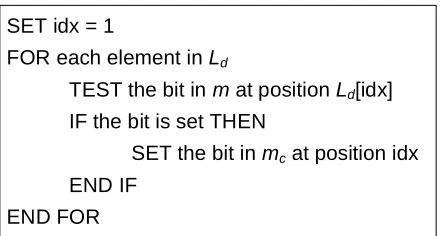
For our Ħ, which is based on the English language, we use an English language Aspell [8] dictionary file to derive m. The m resulting from this task has 7804 bits set. This means 85% of the bits in m correspond to trigrams that are not relevant in the English language. With this information we produced a compression scheme that transforms a 50652 bit long m
into a 7804 bit mc.
SET idx = 1
FOR each element in Ld
TEST the bit in m at position Ld[idx] IF the bit is set THEN
SET the bit in mc at position idx END IF
END FOR
Figure 3.3: Pseudo code for Converting m to mc
To summarize all of the stages in Ħ, we present the Pseudo code for it below.
FUNCTION H
SET m to be 50652 bits long SET idx = 1
FOR each character in the source
SET tempVal1 = 370 * (CALL getIdx with source char at idx) SET tempVal2 = 371 * (CALL getIdx with source char at idx + 1) SET tempVal3 = 372 * (CALL getIdx with source char at idx + 2) SET tmp = tempVal1 + tempVal2 + tempVal3
ASSERT bit position tmp in m INCREMENT idx
END FOR
SET mc to be 7804 bits long
SET idx = 1
FOR each element in Ld
TEST the bit in m at position Ld[idx]
IF the bit is set THEN
SET the bit in mc at position idx
END IF END FOR RETURN mc
END FUNCTION
Section 4
The Dgoogle Search Engine
The Text Encoding methodology outlined in the previous section lays the foundations for a full text search wherein the results returned for a query are based on the signature of the query. In this section we describe the DGoolge architecture which is an overlay structure appropriate for marinating the encoded text.
4.1 Motivation for the Dgoogle Overlay
The Text Encoding methodology basically fosters the congregation of files with similar content. Hence, we desire a network overlay that is easily adaptable to this property. The navigation is desired to be easy as well as fast. For this reason we believe a Hypercube of N- dimensions is most applicable. Employing this structure we are able to ensure that:
(a) All nodes maintain a uniform number of files. However, the number of signatures managed by nodes may vary.
(b) The number of incoming and outgoing connections to or from a node is uniform across the network and is dependent on the dimension of the network.
(c) Each node is responsible for replying to a query, if a matching result is found.
possible by the unique structure of the hash function, and can be used by clients to limit the breadth of their search by specifying a TTL (time to live) or even the range of hash values to search.
The hash function ensures that when two similar (not exactly similar) queries are hashed, the signature of the two resemble in some aspects, making identification and co-relation easier. This, along with the directional property of the Hypercube, helps increase the efficiency of the system as a whole and also reduce the number of messages sent between nodes. This is much more efficient than Gnutella which floods the network with queries. Flooding on every request is not scalable [9] and is also an immense strain on bandwidth wasted searching looking for files that may or may not exist. More current research [10] however, does put forth ideas of a more controlled flooding; however, the bandwidth utilization in these methodologies is still quite high.
4.2 Dgoogle Overlay Structure
Our goal is to have a network overlay wherein files are distributed uniformly amongst nodes and the number of outgoing connections managed by nodes is the same for all nodes in the system.
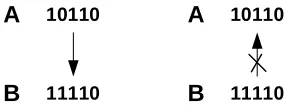
Consider two signatures A and B formed by using the hash function outlined in the previous section. We say that A » B (A derives to B) if and only if A has potentially all/some of the 1’s that are set in B and no other. Another way of saying this is that if A » B, then A
10110
11110
A
B
10110
11110
A
B
Figure 4.1: A » B (A derives to B)
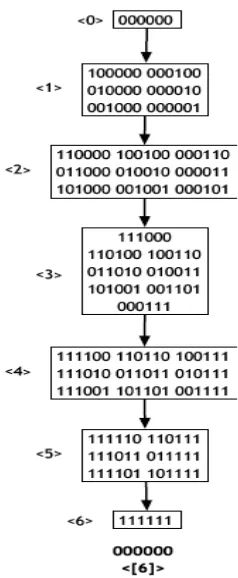
Hence, we can say that if a search query hashes to A, then B (from above figure) would be one of the solutions for the query. Taking this as a base, assume that values in the hash table range from 0000 to 1111. Then the transition diagram for this range can be depicted as follows:
0 0 0 0
0 0 0 1 0 0 1 0 0 1 0 0 1 0 0 0
0 0 0 1 0 0 0 1 0 0 0 1 0 0 0 1 0 0 0 1 0 0 0 1
0 1 1 1 1 0 1 1 1 1 0 1 1 1 1 0
1 1 1 1 Level 0
Level 1
Level 2
Level 3
Level 4
Figure 4.2: Transition diagram for hash range 0000 to 1111
If we assume that each node in the network takes control of each level in the above diagram we notice the following:
(a) Some nodes need to maintain more outgoing links than others.
To overcome these pitfalls we propose to break each signature into N parts, where N
is the number of dimensions in the system. Now if each part of the signature were to represent the distance from the origin, we in essence divide the co-ordinate into an N
dimensional hash space. For example:
Dimension : 3
Signature : 11 00 11 Derived Co-ordinate : < 2, 0, 2 >
Figure 4.3:.Transition diagram for a 1-dimensional network
Figure 4.5:.Transition diagram for a 3-dimensional network
Notice from the above state transition diagrams, as the dimensions increase, so do the number of nodes in the system and also the number of connections. This means that the number of immediate neighbors per node increases as the dimension of the network increases. This can cause huge network traffic if the query needs to search the either breath of the network in order to get a few results. In any case, each node in the network will always have to manage a constant (similar) number of outgoing connections.
increase in the number of files maintained by a node and the dimensions of a network, the number neighbors visited by a query is not large at all. It is important to note, however, that given any signature, we can always define its exact position in the hash space, and hence the node that is responsible for it. Also, if we were to locate all the possible signature that have similar bits on, we need only follow the path from the node that contains the signature onto the end of the network, i.e. the node responsible for signature 111111. In other words, once a node in the network is found that is responsible for a signature that is exactly similar to a search query, we can accurately define all the nodes that will contain signature that are possible results for the given query. Hence, only a subset of all the nodes present in the network need to be queried in order to get all results to a certain query. This reduces the total time spent in the network and also the total number of messages sent per query.
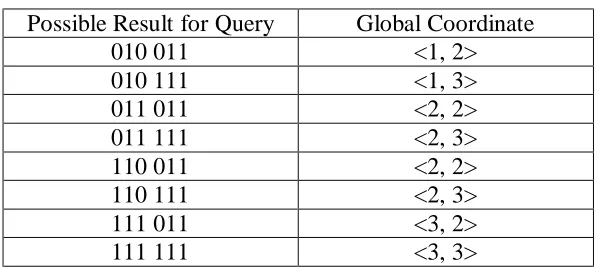
Theoretically this concept can be proved as follows; consider a 2-Dimensional Hypercube network with a signature ranging from 000000 to 111111 as shown in figure 4.4. If the search query, when hashed, resulted to the signature 010011, then the node responsible for this signature would be <1, 2>. The following table defines all the possible results for this query.
Table 4.1: All possible results for search query 010 011
Possible Result for Query Global Coordinate
010 011 <1, 2>
010 111 <1, 3>
011 011 <2, 2>
011 111 <2, 3>
110 011 <2, 2>
110 111 <2, 3>
111 011 <3, 2>
Notice how all the nodes that contain possible matches for the search query lie in the range between the node responsible for the query and the last node of the network. A similar table can be drawn for any query, and the same trend will persist.
A useful application of this approach is that, a node can always tell how many more node a query will need to visit before it reaches the end of the network. This is extremely useful when a query is randomly sent into the network and needs to (initially) locate the node responsible for its signature. Also, by knowing the distance that needs to be traversed by the query, it is possible to limit its scope and lessen the network congestion by setting a TTL, which can also aid in limiting the number of results returned per query.
4.3 The Dgoogle Operations
adds the entry to its list, so that in future when it is queried for K1, the IP address V1 is returned.
A bootstrap program is used, similar to that used by CAN, which is essentially a program that maintains a partial list of all nodes it believes are currently in the system. Also like CAN, it is assumed that the Hypercube has an associated DNS domain name and this resolves to the IP address of one or more Hypercube bootstrap servers.
4.3.1 Publishing a Document
4.3.2 Querying the Network
On querying the Hypercube a similar processes takes place. The search query (which on an average has been proved to be about 2.5 [16]) is sent to the bootstrap server with a QUERY request. Again, the bootstrap randomly sends the query into the Hypercube. As with the PUBLISH request the QUERY request also needs to be routed to the node that is responsible for a signature which is an exact match as that of the query. Once the appropriate node has been reached, all nodes that lie in the path between itself and the end of the network need to be queried. It is the responsibility of each node to return to the client a result constituting the IP address of the node containing a matching file along with a 128 byte abstract. Search time can be further lessened if each node in the network were to cache all the hash values, and abstracts, of all its first hop neighbors. This will, no doubt decrease the overall search time and also the number of nodes that need to be visited and hence the number of messages sent into the network, however, it does increase the storage overhead for a node.
It is possible for a node to be responsible for a signature for which there maybe no file in the system, so even though theoretically every node in the path should return a result, it is possible that a query could travel to the end of the network and not have any file returned as a possible match. To overcome this problem we can set a TTL, which would prevent unnecessary flooding of data in the system.
4.3.3 Dealing with Node Failures
In this case, the two hash regions are merged and the neighbors are sent an UPDATE message informing them about the merge. However, in the case of a node failure, an immediate TAKEOVER algorithm can be initiated that ensures that the failed nodes region is taken over by a neighboring node. This however, does have a pitfall that all information at that node (all key-value pairs and outgoing links) will be lost. To prevent this scenario it is possible to keep a backup repository at all or some of the neighbors in parts or in full respectively. Detecting whether a node has failed can also be a problem. Under normal working conditions, every node needs to send a KEEPALIVE message, periodically, to its neighbors. A prolonged absence of a KEEPALIVE message will alert a neighboring node to start the takeover algorithm of the node’s hash space from which a KEEPALIVE message wasn’t received. Other techniques to stabilize the network and to recover successfully from node failures are outlined by [11] [12] [13] can also be applied.
4.3.4 Load Distribution in the Network
We distinguish between files and signatures as follows:
- Signature: A calculated hash value for a file. The DHT constitutes every possible hash in 7804-bit hash range.
- File : Actual content. Files are hashed into signatures and distributed amongst nodes.
Initially a single node manages the entire Hypercube (all possible signatures in the hash space). As files keep joining the network, they keep getting associated with their corresponding signatures. A threshold is set for the maximum number of files a node should manage, MAXFILES. This is a variable threshold but holds constant for the entire lifetime of the network. Once the threshold has been reached, a new node from the pool of nodes that want to be part of the network is chosen, at random. The hash space is then split between the two, similar to CAN. However, the links are maintained similar to that of the transition diagram for that dimension. Similar to the MAXFILES threshold, the dimension of the Hypercube is predefined and constant throughout the life of the network. This process continues until the network stabilizes. Hence, nodes are added to the network only when needed.
Section 5
Experimental Results and Inferences
The design of the network as described in sections 3 and 4, provide some insight into the potential benefits of our approach. However, the actual benefits and tradeoffs depend heavily upon the target system characteristics and access patterns. To test the validity of our approach under a range of realistic circumstances, we have developed a simulation infrastructure that successful implemented our previously described techniques. In this section we discuss the details of the simulation test bed before proceeding to the results obtained and inferences made.
5.1 Objective of the Simulation
With respect to the network overlay our main objective was to test our system with real world data and workload, and to test the effects of varying the parameters such as Dimensions of the network and the Max Files limit per node, in order to get a more detailed understanding of the effect of both on the defined network.
5.2 Simulation Test Bed Design
Verification of the encoding function was performed using the test bed thus far described. All queries were matched against each file in the database (as if it were a centralized database) and probable results were show. The authenticity of each result was checked. We defined the accuracy of the function on the basis of the number of accurate results (authentic results) returned per query. On the basis of this a conclusion was drawn as to the accuracy the hash algorithm.
5.3 The Data Set
As mentioned before we use a test bed of a 100318 popular files, all relating to a variety of different subjects, largest being about 23.991MB and the average being about 32.3285KB. The number of bits set per file also varies the maximum being about 4228 bits and the average being about 1029 bits. This basically tells us that about 54% of the hash space is actually used; however, since we base our hash algorithm off the English dictionary, it is possible that many words that are present in the dictionary do not occur in everyday speech. We still maintain our signature length of 7804 bits because we aim to encompass the entire English language, thereby making our approach more scalable.
5.4 Accuracy of the Text Encoding Function
We begin by tests by first verifying the accuracy of our encoding function. At this point we define the # of elements in the symbol table and the Group Size for the function
Taking each group of 1000 queries (based on the query length) we evaluate the accuracy of the encoding function (Ħ) by verifying whether the query word actually exists in the corresponding html file. Once the verification for all queries (1 and 2 words) has been made, we increment the # of elements in the symbol table and the Group Size and repeat the experiment again.
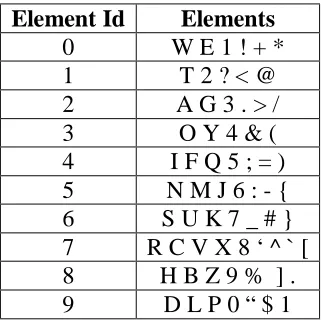
In our experiments, we varied the Group Size between 2 and 3 words. We also defined two different symbol tables. The first symbol table constituted of 10 elements where the likelihood of occurrence of each element was approximately the same [37] [38]. This stems from the analysis that alphabets in the English languages occur with varying frequencies.
Table 5.1: Symbol Table for English with 10 Elements
Element Id Elements
0 W E 1 ! + * 1 T 2 ? < @ 2 A G 3 . > / 3 O Y 4 & ( 4 I F Q 5 ; = ) 5 N M J 6 : - { 6 S U K 7 _ # } 7 R C V X 8 ‘ ^ ` [ 8 H B Z 9 % ] . 9 D L P 0 “ $ 1
Table 5.2: Symbol Table for English with 37 Elements
Element Id
Character Set
0 A
1 B
2 C
. .
.
25 0
26 1
. .
.
36 .
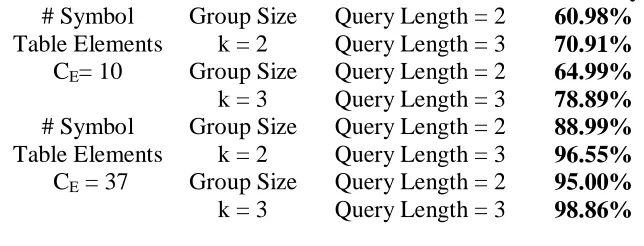
The results of our experiments have been tabularized and presented below.
Table 5.3: Accuracy of our Hash function (Ħ) with varying # Symbol Table Elements, Group Size and Query length
Accuracy
Query Length = 2 60.98%
Group Size
k = 2 Query Length = 3 70.91%
Query Length = 2 64.99%
# Symbol Table Elements
CE= 10 Group Size
k = 3 Query Length = 3 78.89%
Query Length = 2 88.99%
Group Size
k = 2 Query Length = 3 96.55%
Query Length = 2 95.00%
# Symbol Table Elements
CE = 37 Group Size
k = 3 Query Length = 3 98.86%
0 10 20 30 40 50 60 70 80 90 100
Class Size of 10 Class Size of 36
Variation in Class Size
A c c u ra c y P e rc e n ta g e
Query Length = 3 Query Length = 2
Figure 5.1: Accuracy of using trigrams (ordering of 3) with varying # Symbol Table Elements and Group Size
0 10 20 30 40 50 60 70 80 90 100
Class Size of 10 Class Size of 36
Variation in Class Size
A c c u ra c y P e rc e n ta g e
Query Length = 3 Query Length = 2
It should be noted that the accuracy of the Text Encoding function (Ħ) never really reaches 100%. This can be attributed to two reasons.
1. False Positives: Some files are returned as matches because some trigrams found within the matching file returned the same hash value, as a trigram contained in at least one of the keywords.
For instance: Query – fire
File Contains – hire.
Using our encoding function (Ħ) with a Group Size 3 or trigrams, we notice that from fire and hire Ħ(ire) = Ħ(ire) will be the same. If the symbol table has be defined such that Ħ(fir) = Ħ(hir) i.e. h and f are in the same class, then both fire and hire will get the same hash signature and hence the file hire will be returned in response to keyword fire. This was mostly seen when we used a symbol table that consisted of 10 elements.
2. False Order: Some files can contain the trigrams in different orders. Such files should contain ALL the trigrams found in the keyword in order for them to be return as a match.
For instance: Query – boys
File Contains – That boy has toys
the hash signature of the file will match that of the keyword and hence will be returned as a match.
In conclusion we can safely say that our Text Encoding function (Ħ) could correctly filter out most (upto 98.86%) of the irrelevant files. In the small portion it returned incorrectly as a match, the errors were mostly False-Orders with very few (almost negligible) false positives (only with a symbol table with 10 elements). As mentioned in previous sections our encoding function (Ħ) needs to be tuned for each language that it will be applied to because the number of symbols that constitute a language’s alphabet is not constant. Hence, based on our results we fell that for the English language, a symbol set constituting
{[A-B], [0-9], ‘.’}, is sufficient for both accuracy. In other words we have decided to set our hash algorithm to run with the # Symbol Table Elements as 37 and a Group Size of 3 i.e. a signature of 7804 bits.
5.5 Experimental Setup for Dgoogle
5.5.1 Storage Overhead
We begin our evaluation of the network overlay by investigating the storage overhead at each node. As per our description of the Dgoogle network overlay, we define an upper bound on the number of files (MAXFILES) that need to be maintained by each node in the network. In our experiments we vary this limit between 3 values.
(a) Max Files = 200 (b) Max Files = 500 (c) Max Files = 100
We vary the dimension of the network between 2D and 11D. Along with this we also investigate the storage overhead if caching is desired. The data that needs to be stored by the nodes basically constitutes the 7804 bit hash of the file along with a 128 byte abstract (about 1103.5 bytes).
0 2000 4000 6000 8000 10000 12000 14000
2D 3D 4D 5D 6D 7D 8D 9D 10D 11D
No Caching Caching Caching Caching Caching Caching Caching Caching Caching Caching Caching
S to ra g e i n K il o b y te s
Max Files = 200 Max Files = 500 Max Files = 1000
Figure 5.3: Storage overhead per node with and without caching
As can be seen from the graph, when the system doesn’t cache any information from its immediate neighbors, the storage overhead is mainly the cost of storing a 7804 bit signature and a 128 byte abstract of all the files present at the node. This value when Max Files is set to 1000 is about 1103.5Kb. However, if the system does cache the information stored at its immediate neighbors, we see that for an 11D network with Max Files set to 1000, the storage overhead is about 13.242MB.
returned as a result to the query thereby make decisions about which of the results to access impossible. For our network, without caching we will only need to store 1.1MB of data (Max Files = 1000) which is inclusive of the abstract. We also do not suffer from the situation wherein we need to store multiple version of an abstract or maintain multiple links to the same abstract on the same nodes, since we define the content in a node based on the hash of the entire file, and not just the keywords. This makes storage much more convenient and access much faster.
5.5.2 Messaging Overhead
We initially define messaging overhead in terms of the number of unique nodes that need to be visited in order for the client to receive at least 10 results. We state 10 results as a base line since as per [16] 85% of all users only look at the first page of results put forth by Google.com and Yahoo.com, which by default is set to 10. This value can be altered; however, all our tests are based on fact that the client making the query request only desires 10 results. Since we already know the path the query will take before it reaches the end of the network, in a real world scenario we can set a TTL to prevent flooding the entire network.
dimensions of the network. So for instance an in an 11D network 11 messages would be sent out simultaneously. These messages constitute the 7804 bit signature, a query ID which is a random number that uniquely identifies the query, and the IP of the client making the request. Since some nodes may be contacted multiple times, using the query ID, a node can verify whether it has already serviced the request for that query or not. If so, the query request is dropped.
As always we query our network by varying the dimensions between 2D and 11D, varying the Max Files between 200, 500 and 1000, and also by varying the query length between 1 and 3 words per query. The results for the various network configurations follow.
0 5 10 15 20 25 30 35 40 45
0 1 2 3 4 5 6 7 8 9 10 11 12
Dim ensions # o f U n iq u e N o d e s V is it e d
Max Files = 200 Max Files = 500 Max File s = 1000
0 5 10 15 20 25 30 35 40 45
0 1 2 3 4 5 6 7 8 9 10 11 12
Dim ens ions
# o f N o d e s V is it e d
Max File s = 200 Max Files = 500 Max Files = 1000
Figure 5.5: Average # of unique nodes visited – Two word queries
0 5 10 15 20 25 30 35 40 45
0 1 2 3 4 5 6 7 8 9 10 11 12
Dimension # o f U n iq u e N o d e s V is it e d
Max Files = 200 Max Files = 500 Max Files = 1000
Consider graph 5.4, the least number of nodes that would need to be visited before a client receives 10 results given that the query length is one word, is about 12 nodes. Looking at graphs 5.5 and 5.6, the least number of nodes that would need to be visited before the client receives 10 results give that the query length is two words and three words respectively, is about 13 nodes. These results can be achieved if the network consisted of 11D and had Max File limit of a 1000 files. This basically means that any node would only need to contact its immediate neighbors, and in some cases a few of their immediate neighbors, before 10 results were returned to the client. If caching were enabled in the network, then the query message for the most part, would not need to be forwarded to any other node, since the originating node would already know about the information stored at its immediate neighbors. On the flipside however, if we were to look at a 2D network with Max Files limit as 200, the number of nodes that would need to be visited for a single, double and triple word query are 26, 19 and 17 respectively.
neighbors, thereby increasing the number of messages in the network by an order of the dimension of the network. So if the network consisted of 11D then at the first hop, 11 nodes (111) would be contacted, at the second hop 121 nodes (112), and at the third hop 1331 nodes (113). If low network utilization were a major concern, then choosing a dimension that lies between 2D and 11D would be more profitable, since both dimensions lie on the two extremities of the scale.
It should also be noted that just by increasing the dimension of the network or the Max File limit, doesn’t reduce the number of nodes visited by a large amount. A simultaneous increase in both these values would result in substantial decrease in the number of nodes visited. Both these values can be tweaked as per the requirements of the system.
Hence, in conclusion we well that for small queries (one word queries) and larger queries (two and three word queries), which formally constitute more than 85% of the queries searched for today, our system will at best need to contact 12, 13 and 13 nodes respectively.
Taking the above into consideration we can say that the size of the messages sent within the network = # of unique nodes contacted * ( 7804 bits signature + 2 bits Query Id + 4 bytes clients IPv4 address). The following graphs depict the message overhead in the network for a query word of length one, two and three.
0 5 10 15 20 25 30 35 40 45
2D 3D 4D 5D 6D 7D 8D 9D 10D 11D
Dim ensions M e s s a g e O v e rh e a d i n K il o b y te s
Max Files = 200 Max Files = 500 Max Files = 1000
0 5 10 15 20 25 30 35 40 45
2D 3D 4D 5D 6D 7D 8D 9D 10D 11D
Dimension M e s s a g e O v e rh e a d i n K il o b y te s
Max Files = 200 Max Files = 500 Max Files = 1000
Figure 5.8: Messaging overhead – Two word queries
0 5 10 15 20 25 30 35 40 45
2D 3D 4D 5D 6D 7D 8D 9D 10D 11D
Dimension M e s s a g e O v e rh e a d i n K il o b y te s
Max Files = 200 Max Files = 500 Max Files = 1000
As can be seen from the above graphs, based on the number of query words, at best we would need to send only 12.9KB messages for a Max File count of 1000, 17.04KB messages for a Max File count of 500 and 34.1903KB messages for a Max File count of 200, for a query length of 3 words. When compared to a system that is implemented using the Inverted Indices we find that our message overhead is much lesser. On a best case (without caching) they need to send an excess of about 17KB over and above the cost incurred in moving the query between nodes. This also however, doesn’t include the cost of sending abstracts between nodes (since we do not know whether they store abstracts along with keywords). If they did store abstracts, this value would increase dramatically based on the number of files sent between nodes before an intersection is made which decides the subset of results that need to be sent to the client. On a worst case we need only send a total of 45KB messages. The Inverted Indices system would need to send an excess of 50KB message, however, this is again not including the multiple abstracts that would need to be exchanged between nodes for every keyword.
5.5.3 Average Time in Network
We now try to estimate the total time a query will need to spend in the network before 10 results are found for it. As mentioned in the previous section, we forward the query into the network at a random position and calculate the time it takes from then until 10 results are returned. Since we do not simulate actual network traffic, we estimate time taken as the number of hops made before the client receives 10 results from the network. Some queries however, did not return 10 results. These results are excluded from these results since they would have traveled the entire length of the network and in a real world scenario can be curtailed by defining a TTL.
0 1 2 3 4 5 6
0 1 2 3 4 5 6 7 8 9 10 11 12
Dim ensions A v e ra g e H o p s
Max Files = 200 Max File s = 500 Max Files = 1000
Figure 5.10: Average hops made – One word queries
0 1 2 3 4 5 6
0 1 2 3 4 5 6 7 8 9 10 11 12
Dim e ns ions
A v e ra g e H o p s
Max File s = 200 Max File s = 500 Max Files = 1000
0 1 2 3 4 5 6
0 1 2 3 4 5 6 7 8 9 10 11 12
Dimension
A
v
e
ra
g
e
H
o
p
s
Max Files = 200 Max Files = 500 Max Files = 1000
Figure 5.12: Average hops made – Three word queries
Section 6
Conclusions and Future Work
Peer-to-peer (P2P) systems are distributed systems with all nodes equal in functionality. There are two types of P2P systems: unstructured ones such as Gnutella and structured ones based on distributed hash tables (DHTs), such as Chord, Pastry, and CAN, each with its own merits and pitfalls.
This thesis research was aimed at finding a solution to one of the major pitfalls faced by current P2P systems, i.e. lack of a full text search methodology. To the best of our knowledge there is only one other paper that deals with a similar topic [14]. We have benched marked our architecture with theirs as best we could.
encoding function in its completeness is a very power and accurate tool in compressing a text document into a constant length bit signature and also for not spreading files with similar content to far from each other.
We now come to the Dgoogle network overlay architecture. Multiple tests were performed by varying the dimensions in the range of 2D and 11D, the Max Files limit between 200 files, 500 files and 1000 files, and also the query length in the range of 1 word and 3 words. The first conclusion that can be drawn is regarding the Storage Overhead of the system. When compared to the storage overhead of a P2P system implemented using the Inverted Indices, we find that our architecture performs significantly better since without caching we would only need to store about 1.1MB of data per node, and this is inclusive of the 128 byte abstract. They on the other hand do not store the abstract which makes deciding upon an appropriate result from the returned set, impossible. If they did store the abstract they would need to have an advanced data structure that would maintain all the abstracts co-relating each to a specific keyword and sometime to more than one keyword. Hence we can safely say that the storage overhead of our system is much better than that of the Inverted Index and is also much faster to access and easier to implement.
amongst nodes and finally to the client would increase drastically since they would need to send at least one abstract per file sent between nodes. Also this process is done in a serialized manner. We on the other hand perform all operations in parallel. Hence, we prove that not only is our system better in terms of the total messaging overhead but also proves to be more configurable and manageable. It is also more efficient as a search methodology due to the fact that we perform a Full Text Search rather than just a keyword search and also return a 128 byte abstract, all of which is done in parallel.
Another test performed was to estimate the Total Hops (Time) a query would take to return 10 results. We measured time taken to return 10 results in hops within the network since we do not simulate the architecture over the network, but use advanced data structures to emulate the system. We concluded that our worst case time given that 10 results are eventually returned is again better than that of the Inverted Index since their methodology is based on a serialized approach and ours is performed in parallel. This makes our system faster and hence for the same amount of time, more nodes are queried and lesser messages are exchanged.
However, if 10 results were not returned, the query would need to search the entire breadth of the network that would not only take a lot of time, but also flood the network with unnecessary messages. For this purpose we set a Time to Live (TTL).
In summary we can say that:
b. Using this property of the hash function, we find that arranging the files in an overlay network of high degree and high Max File limit does give much better results than a system implemented under the Inverted Index theory.
c. Using the Dgoogle overlay we are also able to define the path followed by any query before hand, hence we can also define other overlays above the base network overlay that deal with file popularity, location etc.
d. We can also define an upper bound on the total hops a query must make before it returns back to the client. This in no way hinders the searching abilities of the network, unlike an Inverted Index which needs to search all the nodes that contain the keywords queried.
Bibliography
[1] M. Harrison. Implementation of the Substring Test by Hashing, Communications of the ACM. December 1971 Volume 14 Number 12.
[2] S. Ratnasamy, P. Francis, M. Handley, R. Karp, and S. Shenker. A scalable content addressable network, In ACM SIGCOMM’01, August 2001.
[3] Ion Stoica et al. Chord: A Scalable Peer-to-peer Lookup Service for Internet Applications, ACM SIGCOMM 2001, San Diego, CA, August 2001.
[4] Antony Rowstron, Peter Druschel. Pastry: Scalable, decentralized object location and routing for large-scale peer-to-peer systems, ACM SIGCOMM 2001.
[5] Wikipedia - http://www.wikipedia.com
[6] US Secure Hash Algorithm 1, IETF RFC 3174 - September 2001
http://www.faqs.org/rfcs/rfc3174.html
[7] The MD5 Message-Digest Algorithm, IETF RFC 1321 - April 1992
http://www.faqs.org/rfcs/rfc1321.html
[8] Aspell: http://aspell.sourceforge.net/
[9] J. Guterman. Gnutella to the Rescue ? Not so Fast, Napster fiends. Link to article at http://gnutella.wego.com, Sept.2000.
[10] Y. Chawathe, S. Ratnasamy, L. Breslau and S. Shenker. Making Gnutella-like P2P Systems Scalable. ACM SIGCOMM 2003.
[11] James Salter, Nick Antonopoulos. ROME: Optimizing Lookup and Load Balancing in DHT-Based P2P Networks – 2005.
unstructured peer-to-peer networks. In ICS ’02: Proceedings of the 16th international conference on Supercomputing, pages 84–95. ACM Press, 2002.
[13] Mario Schlosser, Michael Sintek, Stefan Decker, Wolfgang Nejdl. HyperCuP – Shaping Up Peer-to-Peer Networks – 2002.
[14] http://seopen.com
[15] Patrick Reynolds and Amin Vahdat, "Efficient Peer-to-Peer Keyword Searching," to appear in Middleware 2003.
[16] Silverstein et al. Analysis of a Very Large Web Search Engine Query Log. Compaq Systems Research.
[17] M. Xie. P2P Systems Based on Distributed Hash Table. University of Ottawa, September 2003.
[18] An Anycast Prefix for 6to4 Relay Routers, IETF RFC 3068 - June 2001.
http://www.ietf.org/rfc/rfc3068.txt
[19] Reserved IPv6 Subnet Anycast Addresses, IETF RFC 2526 - March 1999.
http://www.ietf.org/rfc/rfc2526.txt
[20] DHCP Options for Service Location Protocol, IETF RFC 2610 - June 1999.
http://www.ietf.org/rfc/rfc2610.txt
[21] Lightweight Directory Access protocol, IETF RFC 1777 - March 1995
http://www.ietf.org/rfc/rfc1777.txt
[23] William Adjie-Winoto, Elliot Schwartz, Hari Balakrishnan, Jeremy Lilley, The design and implementation of an intentional naming system, Proc. 17th ACM SOSP, Kiawah Island, SC, Dec. 1999.
[24] Uniform Resource Names, IETF RFC 2141 - May 1997
http://www.ietf.org/rfc/rfc2141.txt
[25] Resolution of Uniform Resource Identifiers using the Domain Name System, IETF RFC 2168 - June 1997.
http://www.ietf.org/rfc/rfc2168.txt
[26] Amin Vahdat, Michael Dahlin, Thomas Anderson, and Amit Aggarwal, Active Names: Flexible Location and Transport of Wide-Area Resources. Proceedings of the USENIX Symposium on Internet Technologies and Systems (USITS), October 1999.
[27] Clifford Neuman. Prospero: A base for building information infrastructure. In Proceedings of INET'93, August 1993.
[28] Sun Microsystems. Jini technology architectural overview. White paper.
http://www.sun.com/jini/whitepapers/architecture.html
[29] Burton H. Bloom. Space/time trade-offs in hash coding with allowable errors. Communications of the ACM, 13(7):422–426, 1970.
[30] Li Fan, Pei Cao, Jussara Almeida, and Andrei Broder. Summary cache: A scalable wide-area web cache sharing protocol. In Proceedings of ACM SIGCOMM’98, pages 254–265, 1998.
[31] James Mullin. Optimal semijoins for distributed database systems. IEEE Transactions on Software Engineering, 16(5):558–560, May 1990.
[33] Luiz Barroso, Jeffrey Dean, and Urs Hoelzle, Web Search for a Planet: The Google Cluster Architecture.
[34] Sanjay Ghemawat, Howard Gobioff, and Shun-Tak Leung, The Google File System - 19th ACM Symposium on Operating Systems Principles, Lake George, NY, October, 2003. [35] FreeNet White Paper: Original white paper by Ian Clarke, Division of Informatics, University of Edinburgh 1999.
[36] L. P. Cox and B. D. Noble. Samsara: Honor Among Thieves in Peer-toPeer Storage. In Proceedings of the Nineteenth ACM Symposium on Operating Systems Principles, pages 120--132, Bolton Landing, NY, USA, Oct. 2003.
[37] D. Knuth. The Art of Computer Programming, Volume 1, Fundamental Algorithms. Addison-Wesley, Cambridge, MA, 1973.