CLIENT SATISFACTION ON CONTRACTORS’ WORK PERFORMANCE
HADIATUL AIDA BINTI ADANAN
A project report submitted in partial fulfillment of the
requirements for the award of the degree of
Master of Science Construction Management
Faculty of Civil Engineering Universiti Teknologi Malaysia
iii
iv
ACKNOWLEDGEMENT
First and foremost the author would like to thank Allah s.w.t for the entire
blessing of her whole life. It is really a great pleasure after working on this study
completely. Alhamdulillah.
The author owes a particular debt of gratitude to her supervisor, Dr. Arham
Abdullah for his encouragement and invaluable guidance throughout his supervision.
Without his continued support and interest, this thesis would not have been the same as
presented here.
Special thanks to all organizations and individuals who involved directly or
indirectly for their assistance and cooperation in supplying the relevant information in
turning this into success.
The author would like to express her eternally gratitude to her beloved husband
– Rydzuan who has sacrificed so much and being patient bore the brunt of the last
stressful year so magnificently for her to achieve her goal, family – abah, mama, angah
and adik for their courage, support and advice every time she needs them. Without their
love and support she would not have been where she is today.
Last but not least, the author would like to extend her sincere appreciation to all
her entire colleagues of MIA 5 and others who have provided assistance at various
v
ABSTRACT
vi
ABSTRAK
vii
TABLE OF CONTENT
CHAPTER TITLE PAGE
TITLE i
DECLARATION PAGE ii
DEDICATION iii
ACKNOWLEDGEMENT iv
ABSTRACT v
ABSTRAK vi
TABLE OF CONTENT vii
LIST OF TABLES xi
LIST OF FIGURES xiii
LIST OF APPENDICES xix
1 INTRODUCTION 1
1.1 Introduction
1.2 Problem Statement
1.3 Aim and Objectives
1.4 Scope of Study
1.5 Methodology
1.5.1 Archiving Data
1.5.2 Literature Review
1.5.3 Questionnaire
1.5.4 Data Analysis
1
2
3
3
4
4
5
5
viii
2 LITERATURE REVIEW 7
2.1 Client Satisfaction
2.2 Contractor Performance
2.3 Performance Indicators
2.3.1 Schedule Performance
2.3.2 Cost Performance
2.3.3 Quality and Safety Performance
2.4 Process Improvement
2.5 Client, Consultant and Contractor’s Relationship
2.5.1 Client 2.5.2 Consultant 2.5.3 Contractor 7 8 10 10 11 11 12 13 14 15 15
3 METHODOLOGY 17
3.1 Introduction
3.2 Methodology
3.2.1 Data Collection
3.2.2 Archiving Data
3.2.3 Literature Review
3.2.4 Questionnaire
3.3 Data Analysis
3.4 Conclusion 17 17 19 19 19 20 21 22
4 ANALYSIS OF DATA 23
4.1 Introduction
4.2 Respondents’ Background
4.3 Analysis of Data
4.3.1 Existing level of Client Satisfaction towards
contractor’s performance
23
23
24
ix
4.3.2 The Suitable and Appropriate Criteria as a
Measurement Tool for Client Satisfaction
4.3.2.1 Clients’ Respond on the Important Criteria
in Planning
4.3.2.2 Clients’ Respond on the Important Criteria
in Contract Administration
4.3.2.3 Clients’ Respond on the Important Criteria
in Pre Construction
4.3.2.4 Clients’ Respond on the Important Criteria
in Construction
4.3.2.5 Clients’ Respond on the Important Criteria
in Quality
4.3.2.6 Clients’ Respond on the Important Criteria
in Safety and Health
4.3.3 The Level of Clients’ Satisfaction Towards
Contractors’ Performance
4.3.3.1 Clients’ Respond on Satisfaction level of
Contractors’ Planning Performance
4.3.3.2 Clients’ Respond on Satisfaction level of
Contractors’ Contract Administration
Performance
4.3.3.3 Clients’ Respond on Satisfaction level of
Contractors’ Pre Construction Performance
4.3.3.4 Clients’ Respond on Satisfaction level of
Contractors’ Construction Performance
4.3.3.5 Clients’ Respond on Satisfaction level of
Contractors’ Quality Performance
4.3.3.6 Clients’ Respond on Satisfaction level of
Contractors’ Safety and Health
x
4.3.4 Identification of Possible Ways in Improving
Client Satisfaction Levels for Continuous
Improvement
4.3.4.1 Clients’ Respond on Possible Ways of
Improvement the Contractors’ Performance
4.3.4.2 Clients’ Areas of Satisfaction or
Dissatisfaction
4.3.4.3 Clients’ respond on Possible Ways in
Improving Client Satisfaction
70
71
72
73
5 DISCUSSION OF RESULTS 74
5.1 Results
5.1.1 Objective 1 : To investigate the existing level of
Client Satisfaction towards contractor’s
performance
5.1.2 Objective 2 : To determine the suitable and
appropriate criteria as a measurement tool for
client satisfaction
5.1.3 Objective 3 : To propose the possible ways of
improving client satisfaction level for continuous
improvement
5.2 Conclusion
5.3 Recommendation for Future Studies
74
74
75
76
78
78
REFERENCES 80
xi
LIST OF TABLES
TABLE NO. TITLE PAGE
3.1 Average Index Analysis Rating Scale 22
4.1 Existing measurement analysis of Client satisfaction for
the past four (4) years
25
4.2 Clients’ Respond on the Important Criteria in Planning 27
4.3 Clients’ Respond on the Important Criteria in Contract
Administration
30
4.4 Clients’ Respond on the Important Criteria in Pre
Construction
33
4.5 Clients’ Respond on the Important Criteria in Construction 37
4.6 Clients’ Respond on the Important Criteria in Quality 43
4.7 Clients’ Respond on the Important Criteria in Safety and
Health
46
4.8 Clients’ Respond on Satisfaction Level of Contractors’
Planning Performance
49
4.9 Clients’ Respond on Satisfaction Level of Contractors’
Contract Administration Performance
52
4.10 Clients’ Respond on Satisfaction Level of Contractors’ Pre
Construction Performance
56
4.11 Clients’ Respond on Satisfaction Level of Contractors’
Construction Performance
59
4.12 Clients’ Respond on Satisfaction Level of Contractors’
Quality Performance
xii
4.13 Clients’ Respond on Satisfaction Level of Contractors’
Safety and Health Performance
68
4.14 Clients’ Respond on Possible Ways of Improvement the
Contractors’ Performance
71
4.15 Clients’ Areas of satisfaction or Dissatisfaction 72
4.16 Clients’ Respond on Possible Ways of Improving Client
Satisfaction
xiii
LIST OF FIGURES
FIGURE NO. TITLE PAGE
1.1 Research Methodology Flowchart 6
2.1 Client Assessment of Contractors’ Performance
(Kirmani and Baun, 1992)
9
2.2 Deming’s Plan-Do-Check-Act (PDCA) diagram
(Malaysian Standard, ISO 9001:2000)
13
2.3 Contractual and Functional Relationship (Masterman,
1992)
14
4.1 Comparison of client satisfaction survey 2002 - 2005 25
4.2 (a) Planning Criteria: Efficiency and effectiveness in
preparation of construction schedules and execution of
works
27
4.2 (b) Planning Criteria: Ability to develop a realistic schedule 28
4.2 (c) Planning Criteria: Carry out works according to the
schedule
28
4.2 (d) Planning Criteria: Timely completion of project phase 28
4.3 Importance Level of Criteria in Planning by Average
Index.
29
4.4 (a) Contract Administration Criteria: Strong financial ability
– Project cost within the budget
30
4.4 (b) Contract Administration Criteria: Adequacy of
Resources – Manpower, Material, Money, Machinery
and Method
xiv
4.4 (c) Contract Administration Criteria: Adequacy of Sub
Contractor Selection – Competency, Financial Ability,
Experiences
31
4.4 (d) Contract Administration Criteria: Competency to get the
work done – Previous Track Records
32
4.5 Importance Level of Criteria in Contract Administration
by Average Index
32
4.6 (a) Pre Construction Criteria: Competency of Staff –
Knowledgeable, Skills, Experiences, Qualification
34
4.6 (b) Pre Construction Criteria: Timely Delivery of
Submission – Required documentation submission
34
4.6 (c) Pre Construction Criteria: Adequacy of Logistical
Arrangement – Storage, Access, Delivery and
Maintenance
35
4.7 Importance Level of Criteria in Pre Construction by
Average Index.
35
4.8 (a) Construction Criteria: Adequacy of Work Supervision –
Controlling and monitoring of works
38
4.8 (b) Construction Criteria: Coordination of works internally
and externally with clients
38
4.8 (c) Construction Criteria: Communication Process – All
relevant information were correctly transferred and
communicated
39
4.8 (d) Construction Criteria: Act to the Instruction / Enquiries /
Concerns by Clients
39
4.8 (e) Construction Criteria: Good Interaction with Clients –
Knowledge and attention to clients’ priorities
40
4.8 (f) Construction Criteria: Knowledgeable – Practical /
technical skills and information used during coursework
40
4.8 (g) Construction Criteria: Ability to control / monitor sub
contractors’ performance
xv
4.8 (h) Construction Criteria: Ability to handle / resolve
problems : Suggestion / proposal to overcome problems
41
4.9 Importance Level of Criteria in Construction by Average
Index
42
4.10 (a) Quality Criteria: Quality of work is always emphasized
during the execution
43
4.10 (b) Quality Criteria: Control of Material Quality – Meeting
standards / specifications / requirement
44
4.10(c) Quality Criteria: Satisfactory Workmanship –
Acceptability of work / product quality
44
4.11 Importance Level of Criteria in Quality by Average
Index
45
4.12 (a) Safety and Health Criteria: Execution of work is
according to the prevalent OSH procedures
46
4.12 (b) Safety and Health Criteria: Site safety is always
prioritizes at site
47
4.12 (c) Safety and Health Criteria: Site Cleanliness and
Satisfactory Housekeeping
47
4.13 Importance Level of Criteria in safety and Health by
Average Index
48
4.14 (a) Client Satisfaction on Planning Performance: Efficiency
and effectiveness in preparation of construction
schedules and execution of works
49
4.14 (b) Client Satisfaction on Planning Performance: Ability to
develop a realistic schedule
50
4.14 (c) Client Satisfaction on Planning Performance: Carry out
work according to the schedule
50
4.14 (d) Client Satisfaction on Planning Performance: Timely
completion of project phases
51
4.15 Client Satisfaction Level on Planning Performance by
Average Index.
xvi
4.16(a) Client Satisfaction on Contract Administration
Performance: Strong financial ability – Project cost
within the budget
53
4.16 (b) Client Satisfaction on Contract Administration
Performance: Adequacy of Resources – Manpower,
Material, Money, Machinery and Method
53
4.16 (c) Client Satisfaction on Contract Administration
Performance: Adequacy of sub Contractor Selection –
Competency, Financial ability, Experiences
54
4.16 (d) Client Satisfaction on Contract Administration
Performance: Competency to get the work done –
Previous Track Record
54
4.17 Client Satisfaction Level on Contract Administration
Performance by Average Index.
55
4.18 (a) Client Satisfaction on Pre Construction Performance:
Competency of staff – Knowledgeable, skills,
experiences, qualification
56
4.18 (b) Client Satisfaction on Pre Construction Performance:
Timely delivery of submission – Required
documentation submission
57
4.18 (c) Client Satisfaction on Pre Construction Performance:
Adequacy of logistical arrangement – Storage, Access,
Delivery, Maintenance
57
4.19 Client Satisfaction Level on Pre Construction
Performance by Average Index.
58
4.20 (a) Client Satisfaction on Construction Performance:
Adequacy of supervision – controlling and monitoring
works
60
4.20 (b) Client Satisfaction on Construction Performance:
Coordination of works internally and externally with
clients
xvii
4.20 (c) Client Satisfaction on Construction Performance:
Communication process – All relevant information were
correctly transferred and communicated
61
4.20 (d) Client Satisfaction on Construction Performance: Act to
the instruction / enquiries / concerns by clients
61
4.20 (e) Client Satisfaction on Construction Performance: Good
interaction with clients – Knowledge and attention to
client prioritize
62
4.20 (f) Client Satisfaction on Construction Performance:
Knowledgeable – Practical / technical skills and
information used during coursework
62
4.20 (g) Client Satisfaction on Construction Performance: Ability
to / monitor sub contractor performance
63
4.20 (h) Client Satisfaction on Construction Performance: Ability
to handle / resolve problems – suggestion / proposal to
overcome problems
63
4.21 Client Satisfaction Level on Construction Performance
by Average Index.
64
4.22 (a) Client Satisfaction on Quality Performance: Quality of
work is always emphasized during the execution
65
4.22 (b) Client Satisfaction on Quality Performance: Control of
material quality – Meeting standards / Specifications /
Requirement
66
4.22 (c) Client Satisfaction on Quality Performance: Satisfactory
workmanship – Acceptability of work / product quality
66
4.23 Client Satisfaction Level on Quality Performance by
Average Index
67
4.24 (a) Client Satisfaction on Safety and Health Performance:
Execution of work according to prevalent OSH
procedures
xviii
4.24 (b) Client Satisfaction on Safety and Health Performance:
Site safety is always prioritized at site
69
4.24 (c) Client Satisfaction on Safety and Health Performance:
Site Cleanliness and Satisfactory Housekeeping
69
4.25 Client Satisfaction Level on Safety and Health
Performance by Average Index
xix
LIST OF APPENDICES
APPENDIX TITLE PAGE
CHAPTER 1
INTRODUCTION
1.1 Introduction
Client satisfaction and continuous improvement are the fundamental goals of construction processes. Client satisfaction in the construction industry can be defined as how well a contractor meets the client’s expectation. Satisfaction can be viewed in terms of a process of “expectancy disconfirmation” that is, the confirmation or disconfirmation of an expectation in which satisfaction is based largely on meeting or exceeding expectations (Maloney, 2002). An expectation is a belief or anticipation of what will happen as a result of an action. A client makes a decision to select a particular contractor to provide construction services. In making that selection decision, the client formulates expectations as to what will happen as a result of that decision.
Improving client’s satisfaction has received considerable attention in recent years. Client satisfaction has become one of the key issues for companies in their efforts to improve the performance in the competitive marketplace.
2
by doing so, deliver satisfactory outcomes. This study would contribute knowledge area by identifying the constituents of clients’ satisfaction, criteria for assessment, and actual levels of satisfaction and performances, as perceived by clients. The need of the identification and possible criteria of client’s satisfaction is to ensure that the contractor and the client are aiming at the same targets and perceptions.
1.2 Problem Statement
The need to improve contractor’s work performance in order to meet client’s satisfaction is highly in demand. The client’s expectation plays an important role in the evaluation of contractor’s work performance. Contractors should periodically measure client satisfaction in order to learn how satisfied their clients are.
The worse thing is the contractor was unable to identify the weaknesses and key factors in improving the most important construction processes which resulting of failure in meeting client satisfaction. Once the attributes of a service or product affected client satisfaction are determined, they should modify their current offering in a way that would lead to maximum client satisfaction.
3
The key to understand is that the client is now a moving target – their expectations and requirements are constantly changing. To keep up with their ever-hanging goals, the contractors need to have in place a system of identifying, measuring and continuously improving their tangible and intangible products or services.
1.3 Aim and Objectives
As mentioned earlier, client satisfaction should be considered as an additional and most crucial project objective (i.e in addition to time, cost and specification targets), which should be measured and monitored in the construction process. In specific terms, the aim of this study would be to improve the method of identification & measurement of contractor’s work performance for optimal customer satisfaction and continuous improvement.
To achieve the aim of the study, three (3) objectives were set:
1) To investigate the existing level of Client Satisfaction towards contractor’s performance;
2) to determine the suitable and appropriate criteria as a measurement tool for client satisfaction; and
3) to propose the possible ways of improving client satisfaction levels for continuous improvement
1.4 Scope of Study
4
to identify “WHAT” are the processes that can be measured and “HOW” they are measured.
The scope of the investigations is limited to the main contractor performance towards client satisfaction that is defined to be among the consultants and clients’ perspective that are at the forefront of innovation in construction industry during construction process. The case study has taken place at Sunway Construction Sdn Bhd. as the contractor and the clients were among the clients and consultants who have involved with construction projects by the contractor. The selection of the contractor is based on the availability of data related to the client satisfaction and recommended for continuous improvement towards the successful of company surviving in the construction industry.
1.5 Methodology
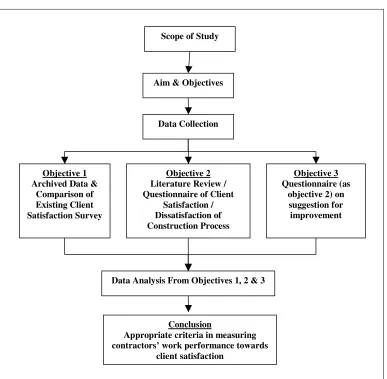
Methodological approaches to client satisfaction assessment and measurement towards contractor performance in completing the construction projects are investigated based on the objectives determined earlier. There are four (4) methodological approaches involved which were from the archiving data, literature review, questionnaire and analysis of data.
1.5.1 Archiving Data
5
1.5.2 Literature review
Information shall be gathered through literature review of journals, reference books, research papers, magazines and also information via electronic sources such as internet and related websites. Further research shall be conducted to support the data collected and significantly helps in the analysis.
1.5.3 Questionnaire
A set of questionnaire was created to and distributed among the clients, consultants and contractor. Feedback from the questionnaire will be used as basis information to the data collection and analysis towards the findings which resulting in achieving the objectives determined.
1.5.4 Data Analysis
Subsequently from the data collected, analysis shall be done to conclude the findings of the study. As a conclusion, it is expected that the appropriate criteria of assessing the contractors’ performance were identified with the proposed ways of improvement towards client satisfaction.
6
Figure 1.1: Research Methodology Flowchart Scope of Study
Aim & Objectives
Objective 3 Questionnaire (as
objective 2) on suggestion for
improvement Objective 1
Archived Data & Comparison of Existing Client Satisfaction Survey
Data Collection
Data Analysis From Objectives 1, 2 & 3 Objective 2
Literature Review / Questionnaire of Client
Satisfaction / Dissatisfaction of Construction Process
Conclusion
Appropriate criteria in measuring contractors’ work performance towards