Comparison between Speed Control DC
Motor Using Fuzzy PID and PSO-PID
Technique
Manikant Kumar 1, Geeta Kumari2
Ph.D Scholar, Department of Electrical Engineering Sam Higginbottom Institute of Agriculture and Technology
Science, Allahabad, India1
M.Tech, Department of Electrical Engineering, Sam Higginbottom Institute of Agriculture and Technology
Science, Allahabad, India2
ABSTRACT: - DC motor speed control in this paper papers fuzzy logic controller and particle swarm optimization
technique has been compared. The application of particle swarm optimization for adjusting the gains of proportional-integral-derivative (PID) controller parameters of a DC motor is presented and Fuzzy logic controllers are the successful applications of fuzzy set theory. Here, the model of a DC motor speed control is considered as a second order system. Guests use their linguistic variables, which are defined as variables whose values are fuzzy sets in natural language sentence can be represented. This paper details how efficiently DC motor parameters for optimal PID controller and fuzzy method employs the PSO performed. The proposed approach improved features including easy implementation and good computational efficiency, said. PID controller tuning parameters for optimal yields of high quality solutions faster
I. INTRODUCTION
The DC motors are in general much more adaptable speed drives than AC motors which are associated with a constant speed rotating field. It is observed that most of the industry is operating under stress condition further load parameter and control variable exhibit uncertainness in real practice and in fact these are random variables. Calculated values of load variable normally contain various inaccuracies. It has been observed that error may vary in the range of 5-10%. A few percentage error may be required tolerable in the area of the load speed controlling where these inaccuracies in the entire controller. In such situation minor inaccuracy in speed control are of little concern. Further the speed controller can always be designed to have sufficiently low effect on the non linearity of DC motor; so as to worst effect of parameter uncertainty can be accounted. In real time operation, the situation is different; design controller may encounter situation never imagined by designer before it took its present shape. Hence, in real time operation condition, risk of affecting nonlinearity of motor is always present. Here it is designed a controller which not affects the nonlinearity in DC motor.
II. DC MOTOR
The stator of the DC motor has poles, which are excited by DC current to produce Magnetic fields. The rotor has a ring-shaped laminated iron-core with slots. Coils with several turns are placed in the slots. The distance between the two legs of the coil is about 180 electric degrees. DC motors are characterized by their versatility. By means of various combinations of shunt, series and separately excited field winding they can be designed to display a wide variety of volt ampere or speed torque characteristics for both dynamic and steady state operation. The separately excited dc motor model is chosen for its good electrical and mechanical performances rather than other DC motor models. The DC motor is driven by applied voltage. In DC motor, the torque may be controlled by varying the armature current or field current. One of these is varied to control the torque while the other is held constant.
Fig. 1: Basic diagram of DC motor
III. FUZZY LOGIC CONTROLLER
Fuzzy logic controllers have the following advantages over the conventional controllers that they are cheaper to develop, they cover a wide range of operating conditions, and they are more readily customizable in natural language terms.
In Mamdani type FIS the crisp result is obtained by defuzzification, in the Mamdani FIS can be used for both multiple input and single output and multiple inputs multiple outputs system
Figure2: Arrangement of fuzzy logic controller
IV. PID CONTROLLER
robustness of this controller, optimally tuning gains of PI controllers have been quite difficult. When the control problem is to regulate the process output around a set point, it is natural to consider error as an input, and it follows that the integral of the error.
The PID controller has the following form in the time domain μ(t) = k e(t)+k ∫ e(t) dt + k ( ) (1)
Proportional Control μ(t) = k e(t)
Integral Control
μ(t) = k e(t) dt
Derivative Control
μ(t) = k de(t) dt
Particle swarm Optimization (PSO) Algorithm
Since the introduction of the particle swarm optimizer by James Kennedy and Russ Eberhart in 1995, numerous variations of the basic algorithm have been developed in the literature. Each researcher seems to have a favorite implementation - different population sizes, different neighborhood sizes, and so forth. In this paper we examine a variety of these choices with the goal of defining a canonical particle swarm optimizer, that is, an off-the shelf algorithm to be used as a good starting point for applying PSO. The original PSO formulae defined each particle as a potential solution to a problem in D-dimensional space,
With particle i represented Xi=(xi1,xi2,...,xiD). Each particle also maintains a memory of its previous best position, Pi=(pi1,pi2,...,piD), and a velocity along each dimension, represented as Vi=(vi1,vi2,...,viD).At each iteration the P vector of the particle with the best fitness in the local neighborhood, designated g, and the P vector of the current particle are combined to adjust the velocity along each dimension, and that velocity is then used to compute a new position for the particle. The portion of the adjustment to the velocity influenced by the individual’s previous best position (P) is considered the cognition component, and the portion influenced by the best in the neighborhood is the social component.
In Kennedy’s early versions of the algorithm, these formulae are:
vid=vid+j1*rand()*(pid-xid)+j2*rand()*(pgd-xid) (2)
xid=xid+vi (3) Constants j1 and j2 determine the relative influence of the social and cognition components, and are often both set to
the same value to give each component (the cognition and social learning rates) equal weight.
Angeline, in [1], calls this the learning rate. A constant, Vmax, was used to arbitrarily limit the velocities of the particles and improve the resolution of the search.
In [9] Eberhart and Shi show that PSO searches wide areas effectively, but tends to lack local search precision.
Their solution in that paper was to introduce w, an inertia factor that dynamically adjusted the velocity over time, gradually focusing the PSO into a local search:
vid=w*vid+j1*rand()*(pid-xid)+j2*rand()*(pgd-xid) (4) More recently, Maurice Clerc has introduced a constriction factor K, that improves PSO’s ability to Constrain and
control velocities. In , Shi and Eberhart found that K, combined with constraints on Vmax Significantly improved the PSO performance. K is computed as:
K = 2
| 2 - j - j 2 - 4j |
Where j=j1+j2,j>4, and the PSO is then:
vid = K(vid+j1*rand()*(pid - xid)+j2*rand()*(pgd - xid))
To test the various parameter settings, we start with the PSO settings Shi and Eberhart used in :
At first we control the DC motor by PID controller in
Figure 3.The block diagram of a PID controller dc motor
Implementation of Fuzzy-PID and PSO-PID Controller
Figure 4.The diagram of Fuzzy-PID and PSO-PID Controller dc motor
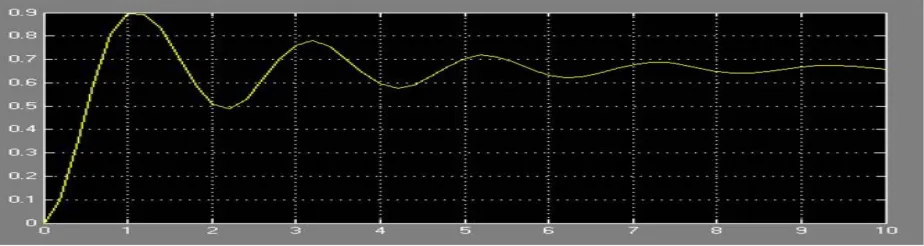
Figure 5.Simulated results Fuzzy-PID controller of DC motor
Implementation of PSO-PID Controller
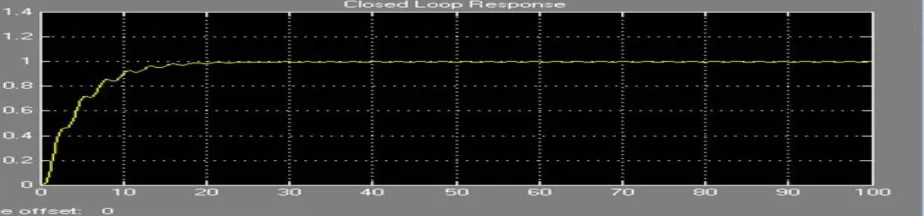
In this paper, a PID controller using the PSO algorithm is developed to improve the results of speed control of DC motor. The PSO algorithm is mainly utilized to determine three optimal controller parameters kp, ki, and kd, such that the controlled system could obtain a desired step response output
Figure 6.Simulated results PID controller of DC motor
V. CONCLUSION
This paper shows two different methods of determining the PID controller parameters using PSO algorithm and Fuzzy Controller. While comparing with both the results the PSO-PID shows better output as compared to Fuzzy-PID.
REFERENCES
[1] Trapti Yadav, Deepti yadav, Nidhi Singh”Self Tuning PID Controller using Fuzzy Inference Mamdani and Sugeno method on the AVR System”. International Journal of Applied Engineering Research ISSN: 0973-4562, Volume 8 No.12, 2013
[2] J. N. Rai, Mayank Singhal, Mayank Nandwani” Speed Control of Dc Motor Using Fuzzy Logic Technique” IOSR Journal of Electrical and Electronics Engineering (IOSR-JEEE) ISSN: 2278-1676 Volume 3, Issue 6, PP 41-48, 2012
[3] Mohammad Sadegh Rahimian and Kaamran Raahemifar” Optimal PID Controller Design for AVR System using Particle Swarm Optimization Algorithm” Electrical and Computer Engineer Department, Ryerson University Toronto, Ontario, Canada. IEEE CCECE 2011.
[4] Horng-Lin Shieh, Cheng-Chien Kuo, Chin-Ming Chiang” Modified Particle Swarm Optimization Algorithm with Simulated Annealing Behavior and its Numerical Verification” Applied Mathematics and Computation 218, 4365– 4383, 2011.
[5] Adel A. A. El-Gammal, ”A Modified Design of PID Controller For DC Motor Drives Using Particle Swarm Optimization PSO” March, 2009. [6] Girish K. Jha, Ruppa K. Thulasiram, Parimala Thulasiram” Comparison of Adaptive Neuro-Fuzzy and Particle Swarm Optimization based Neural Network Models for Financial Time Series Prediction ” asac Niagara Falls, Ontario 2009 .
[7]Boumediene ALLAOUA*, Abdellah LAOUFI, Brahim GASBAOUI, and Abdessalam ABDERRAHMANI ''Neuro-Fuzzy DC Motor Speed Control Using Particle Swarm Optimization'' Issue 15, July-December 2009
[8]. M.Fallahi, Member, IAENG, S.Azadi, Member, IAENG.“Robust Control of DC Motor Using Fuzzy Sliding Mode Control with PID Compensator” Proceedings of the International Multi Conference of Engineers and Computer Scientists 2009 Vol II IMECS 2009, March 18 - 20, 2009, Hong Kong J.Tang and R.Chassaing
[9] Kennedy, J. and Eberhart, R. (1995). Particle Swarm Optimization, IEEE International Conference on Neural Networks (Perth, Australia), IEEE Service Center, Piscataway, NJ, IV: 1942-1948.
[10] Eberhart, R. and Kennedy, J. (1995). A New Optimizer Using Particle Swarm Theory, Proc. Sixth International Symposium on Micro Machine and Human Science (Nagoya, Japan), IEEE Service Center, Piscataway, NJ, 39-43.
[11] Kennedy, J. (1997), the Particle Swarm: Social Adaptation of Knowledge, IEEE International Conference on Evolutionary Computation (Indianapolis, Indiana), IEEE Service Center, Piscataway, NJ, 303-308
[12] Clerc, M. (1999) the swarm and the queen: towards a deterministic and adaptive particle swarm optimization. Proceedings, 1999 ICEC, Washington, DC, pp 1951-1957.
[13] Eberhart, R.C., and Shi, Y. (2000), Comparing Inertia Weights and Constriction Factors in Particle Swarm Optimization, 2000 Congress on Evolutionary Computing, vol. 1, pp. 84-88.
BIOGRAPHY
Geeta Kumari Completed B.Tec. in Electrical & Electronics Engineering in 2012 and M.Tech in Power System in 2014 from Sam Higgan Bottom Institute Of Agriculture, Technology And Sciences-Deemed University Allahabad,