University of Windsor University of Windsor
Scholarship at UWindsor
Scholarship at UWindsor
Electronic Theses and Dissertations Theses, Dissertations, and Major Papers
2013
Designing and Handling Failure issues in a Structured Overlay
Designing and Handling Failure issues in a Structured Overlay
Network Based Grid
Network Based Grid
Amar Bahadur Patel
University of Windsor
Follow this and additional works at: https://scholar.uwindsor.ca/etd
Recommended Citation Recommended Citation
Patel, Amar Bahadur, "Designing and Handling Failure issues in a Structured Overlay Network Based Grid" (2013). Electronic Theses and Dissertations. 4994.
https://scholar.uwindsor.ca/etd/4994
This online database contains the full-text of PhD dissertations and Masters’ theses of University of Windsor students from 1954 forward. These documents are made available for personal study and research purposes only, in accordance with the Canadian Copyright Act and the Creative Commons license—CC BY-NC-ND (Attribution, Non-Commercial, No Derivative Works). Under this license, works must always be attributed to the copyright holder (original author), cannot be used for any commercial purposes, and may not be altered. Any other use would require the permission of the copyright holder. Students may inquire about withdrawing their dissertation and/or thesis from this database. For additional inquiries, please contact the repository administrator via email
Designing and Handling Failure issues in a Structured Overlay Network Based Grid
by
Amar Bahadur Patel
A Thesis
Submitted to the Faculty of Graduate Studies through the School of Computer Science
in Partial Fulfillment of the Requirements for the Degree of Master of Science at the
University of Windsor
Windsor, Ontario, Canada
2013
Handling of Failure issues in a Structured Overlay Network Based Grid
by
Amar Bahadur Patel
APPROVED BY:
______________________________________________ External Reader
Dr. Kemal Tepe
Department of Electrical and Computer Engineering
_____________________________________ Internal Reader
Dr. Arunita Jaekel School of Computer Science
______________________________________________ Advisor
Dr. Robert D. Kent School of Computer Science
______________________________________________ Chair of Defense
Dr. Subir Bandyopadyhay School of Computer Science
iii
DECLARATION OF ORIGINALITY
I hereby certify that I am the sole author of this thesis and that no part of this thesis has been published or submitted for publication.
I certify that, to the best of my knowledge, my thesis does not infringe upon anyone’s copyright nor violate any proprietary rights and that any ideas, techniques, quotations, or any other material from the work of other people included in my thesis, published or otherwise, are fully acknowledged in accordance with the standard referencing practices.
iv ABSTRACT
Grid computing is the computing paradigm that is concerned with coordinated resource
sharing and problem solving in dynamic, autonomous multi-institutional virtual
organizations. Data exchange and service allocation between virtual organizations are
challenging problems in the field of Grid computing, due to the decentralization of Grid
systems. The resource management in a Grid system ensures efficiency and usability. The
required efficiency and usability of Grid systems can be achieved by building a
decentralized multi-virtual Grid system.
In this thesis we present a decentralized multi-virtual resource management
framework in which the system is divided into virtual organizations, each controlled by a
broker. An overlay network of brokers is responsible for global resource management
and managing the allocation of services. We address two main issues for both local and
global resource management: 1) decentralized allocation of tasks to suitable nodes to
achieve both local and global load balancing; and 2) handling of both regular and broker
failures. Experimental results verify that the system achieves dependable performance
with various loads of services and broker failures.
v
DEDICATION
vi
ACKNOWLEDGEMENTS
I would first like to express my sincere gratitude and appreciation to Dr. Robert Kent, my
supervisor, for his support and guidance throughout the course of this research.
My sincere appreciation goes to my parents for their unconditional support, and
also to my wife Seema for her encouragement and support in all these years.
I would also like to thank Dr. Arunita Jaekel and Dr. Kamal Tepe for serving on
my thesis committee.
Lastly, I would like to thank all my colleagues in the Computer Science
vii
TABLE OF CONTENTS
DECLARATION OF ORIGINALITY ... iii
ABSTRACT ... iv
ACKNOWLEDGEMENTS ... vi
LIST OF TABLES ... ix
LIST OF FIGURES ... x
CHAPTER 1 Introduction ... 1
1.1 Introduction to research topic area ... 1
1.1.1 Grid Computing ... 1
1.1.2 Cloud Computing ... 6
1.1.3 The comparison between Cloud Computing and Grid Computing ... 8
1.1.4 Resource management in both Grid and Cloud Computing ... 11
1.2 Motivation towards building a decentralized multi virtual Grid System ... 19
1.3 Problem statement ... 19
1.3.1 Main issues ... 20
1.3.2 Main Challenges ... 20
1.4 Hypothesis ... 20
1.5 Research Objectives ... 21
1.6 Research Contributions... 21
1.7 Thesis organization... 22
CHAPTER 2 Background studies, Related works and Identified issues and problems ... 23
2.1 Background Studies ... 23
2.2 Related Works ... 25
2.2.1 Condor:Cycle stealing technology for high throughput computing ... 27
2.2.2 Globus:A toolkit for Grid computing ... 29
2.2.3 Nimrod/G: Resource broker and economy Grid ... 30
viii
2.2.5 Comparison between Arigatoni Model and OGSA Architecture ... 34
2.3 Identified Issues and Problems... 36
2.3.1 Identified Issues ... 36
2.3.2 Problems ... 38
CHAPTER 3 Overview of the Proposed Architecture and Related mechanism ... 41
3.1 Proposed Architecture ... 41
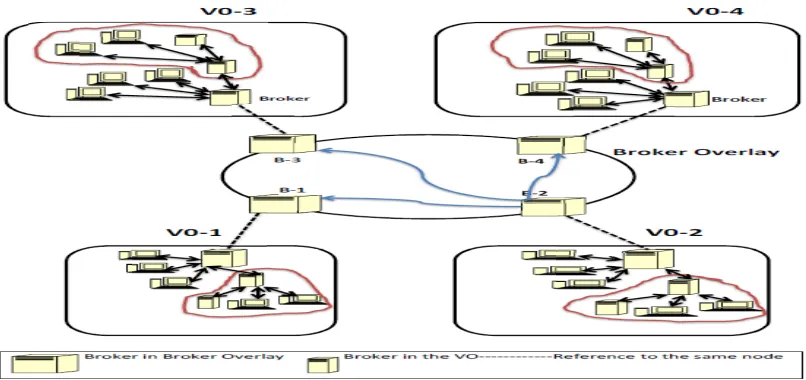
3.1.1 Components Description ... 42
3.2 Resource Information exchange mechanism ... 45
3.2.1 Resource Information exchange between broker to broker in broker overlay and between nodes and broker (i.e. within organization) ... 45
3.3 Service Allocation model and Mechanism ... 47
3.3.1 Service Validation Parameters ... 49
3.4 Broker Failure Handling mechanism ... 50
CHAPTER 4 Simulation Model, Performance Evaluation, and Comparison of various research works with Proposed Framework ... 53
4.1 PeerSim ... 53
4.2 Simulation Model ... 54
4.2.1 Simulation Model Life-cycle ... 54
4.2.2 The purpose of using Simulation Model ... 57
4.3 Performance factors ... 57
4.3.1 Validity of the stored resource information ... 58
4.3.2 Efficiency of Service Allocation ... 59
4.3.3 Impact of Broker Failure on Resource Information Updating ... 61
4.4 The Summary and Comparison of various research works ... 63
CHAPTER 5 Conclusions and Future Work ... 66
5.1 Conclusions ... 66
5.2 Future work ... 67
REFERENCES ... 68
ix
LIST OF TABLES
Table 1: Summary of Identified Issues and Problems………...40
Table 2:Summary of the experimental results 1………...63
Table 3: Table 2. Summary of the experimental results 2……….64
x
LIST OF FIGURES
Figure 1: Illustrating the Grid computing paradigm with an example of Use
Management Resource interaction……….2
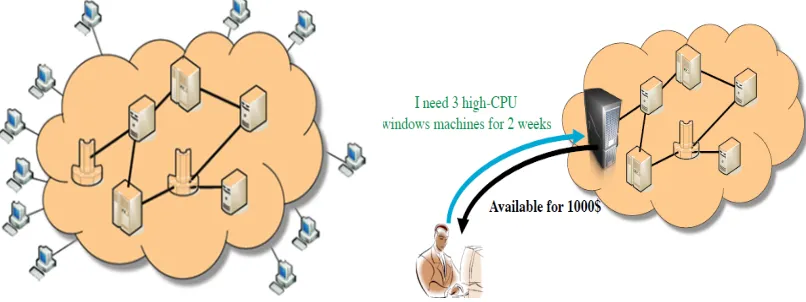
Figure 2: Illustrating the Cloud computing paradigm with an example of User Management-Resource interaction……….6
Figure 3: Different types of Distributed Systems...26
Figure 4: Condor work as a central manager………...28
Figure 5: Globus-a toolkit for grid computing……….30
Figure 6: The Architecture of Nimrod/G………...………..31
Figure 7: Arigatoni Model………...33
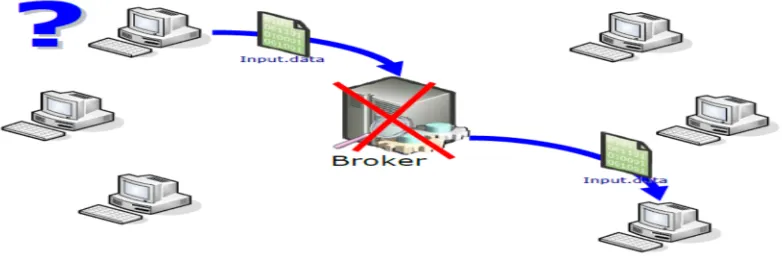
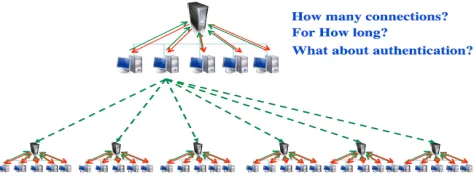
Figure 8: Failure services issues in centralized broker systems...37
Figure 9: Proposed Grid Architecture………..41
Figure 10: Some Colony’s Example………..44
Figure 11: The resource information mode………...46
Figure 12: Resource information exchange algorithm………..46
Figure 13: Grid Service allocation Model……….47
Figure 14: Grid Service allocation Model algorithm………48
Figure 15a: Service broker failure occurs……….51
Figure 15b: Detached Grid node sends a membership request to the first broker in the List...51
Figure 15c: When a nodes granted membership request………..51
Figure 15d: Failure handling and resource information sending algorithms………51
Figure 16: Shows Grid simulation model………56
xi
Figure 18: Shows Deviation of resource information reading time from the current cycle among simulation cycles………58
Figure 19: Shows Number of waiting services plotted against simulation cycles for periodic allocation using a fully connected broker overlay topology, for 10 and 20 services per 10 cycles...60
1
CHAPTER 1
Introduction
1.1 Introduction to research topic area
A distributed network computingsystem [1] is a virtual computer formed by a networked
set of heterogeneous machines that agree to share their local resources with each other.
Distributed Computing is being transformed to a model consisting of services that are
commoditized and delivered in a manner similar to traditional utilities such as water,
electricity, gas, and telephony. In such a model, users access services based on their
requirements without regard to where the services are hosted or how they are delivered.
Several computing paradigms [2] have promised to deliver this utility computing
vision that includes Cluster computing, Grid computing and, more recently, Cloud
computing. The latter term denotes the infrastructure as a somewhat diffuse and
transparent entity, hence “Cloud”, by which businesses and users are able to access
applications from anywhere in the world on demand, using virtualization of management.
Thus, the computing world is rapidly transforming towards developing software for
millions to consume as a service rather than to run on their individual computers.
1.1.1 Grid Computing
Grid computing is the computing paradigm that is concerned with “coordinated resource
sharing and problem solving in dynamic, multi-institutional virtual organizations” [1, 2].
2
each participating node can acquire or provide services from/to other nodes inside/outside
the organization [3]. Grid computing uses middleware
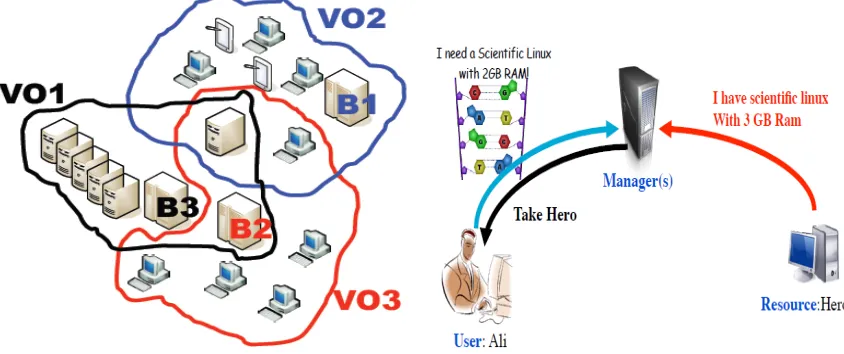
Figure 1. Illustrating the Grid computing paradigm with an example of User Management-Resource interaction.
to coordinate disparate IT resources across a network, allowing them to function as a
virtual whole. Grids address two distinct but related goals: providing remote access to IT
assets, and aggregating processing power. The most obvious resource included in a grid
is a processor, but grids also encompass sensors, data-storage systems, applications, and
other resources. The Grid computing paradigm with an example of user management-
resource interaction are depicted in Figure 1.
The grid provides a series of distributed computing resources through LAN or
WAN. It is using a super virtual computer as terminal user of the application. This idea
will not only realize safe and coordinate resource sharing among persons, organizations,
and resources, but also create a virtual and dynamic organization. Grid computing is a
method of distributed computing. It includes location and organization, software, and
3
cloud computing is better; it has many advantages over grid computing in many ways.
Cloud computing evolves from grid computing and provides on-demand resource
provisioning. Grid computing may or may not be in the cloud depending on what type of
users who are using it. If the users are systems administrators and integrators, what they
care is how things are maintained in the cloud. They upgrade, install, and virtualize
servers and applications. If the users are consumers, they do not care how things are
running in the system. Grid computing requires the use of software that can divide and
form the pieces of a program from different resources as one large system image . One
concern about the grid is that if one piece of the software on a node fails, then other
pieces of the software on other nodes may also fail. This is alleviated if that component
has a failover component on another node, but problems can still arise if components rely
on other pieces of software to accomplish one or more grid computing tasks. Large
system images and associated hardware to operate and maintain them can contribute to
large capital and operating expenses [4].
1.1.1.1 Brief Description of Resource Management Concepts in Grid
A grid-computing system makes use of computer resources from multiple administrative
domains that are applied collectively to solve a problem that has demanding requirements
such as a large amount of processing power, storage space, bandwidth and so on.
However, a more generalized and formal definition of a Grid system can be described as
“a large-scale, geographically distributed, hardware and software infrastructure composed
of heterogeneous networked resources owned and shared by multiple administrative
organizations, which are coordinated to provide transparent, dependable, pervasive, and
4
perform distributed computing, high throughput computing, on-demand computing,
data-intensive computing, collaborative computing or multimedia computing”[5].
From the definitions above, it can be clearly seen that the base of grid technology
is the concept of resource sharing/management. The term resource management in grid
computing can be defined as those operations that control the way that grid resources and
services are made available for use by entities like users, applications, and services [6] to
ensure efficient utilization of computer resources and for optimal performance of specific
tasks. Due to the complexity, heterogeneity, and the dynamic nature of grid computing
environments, resource management is faced with challenges making it a complex task to
match the capabilities of available resources to the needs of the entities listed above [6,
7]. Some grid resource classifications are storage resources, network resources, and
computational resources which have capabilities like storage capacity available on disk,
bandwidth of the network, and processor speed [8]. To handle the wide variety of the
software applications and hardware’s used in grid environments over different forms of
grid networks, software known as middleware is used. One of the most important
components of the middleware is the resource manager which handles resource selection
and job scheduling [9, 10].
The discovery of resources becomes more difficult when resources owned by
many organizations having different resource management policies and cost models are
distributed over a wide geographic area and are heterogeneous in nature. To handle these
problems, a number of different scheduling and resource management algorithms and
5
Resource Manager as Middleware: Middleware, which does not have a
unanimous definition [11], can generally be described as a layer of software that handles
the heterogeneous functions of a distributed system like in grids or clouds. It exists
between the application and the underlying components such as the operating system,
networks, and hardware connecting them together and creating a useful environment.
There are a number of different grid middleware kits such as Globus toolkit, ARC, gLite,
UNICORE etc.
Resource Discovery: As one of the key issues in a grid system is how to manage
all types of distributed resources for job executions. A mechanism should be provided by
the grid infrastructure to discover the relevant resource for its corresponding requests. In
relation to this [12], pointed that one of the main capabilities of a grid infrastructure is the
need to support a resource discovery mechanism which in turn plays an important role in
the management of grid resources. Resource discovery mechanisms in grid systems,
which make use of trust relationship between resource requesters and providers prevent
malicious attempts in the environment and also reduce extra overhead in the existing
complex grid systems. An efficient trust based resource discovery mechanism ensures a
safer environment for communication; enhance the quality of service (QoS) and also
easier decision making for allocating resources between the requesters and providers.
Resource Allocation and Scheduling: Grid resources are distributed
heterogeneously over a large geographical area to numerous users simultaneously. To
manage the use of these resources and others properly, tasks need to be scheduled
precisely and allocated the corresponding demanded resources accordingly. Grid is a
6
such as availability of new resources, system/resource failure, new requests, completion
of an executing task etc. When any of these occurs, there is a need for jobs to be
rescheduled or re-allocation of resources for execution.
1.1.2 Cloud Computing
Cloud computing provides a large-scale distributed computing paradigm that is driven by
economics of scale [13, 14], in which a pool of abstracted, virtualized, dynamic, scalable,
managed computing power, storage, platform, and services are delivered on demand to
external customers over the Internet. The Cloud computing paradigm with an example of
user management- resource interaction are depicted in Figure 2.
Figure 2. Illustrating the Cloud computing paradigm with an example of User Management-Resource interaction.
Following are a few key points for defining cloud computing. 1) it is massively
scalable,which driven by the economics of scale [13, 14], 2) it can be encapsulated as an
abstract entity that delivers different levels of services to customers outside the Cloud, 3)
the services can be dynamically configured (via virtualization or other approaches) and
7
Governments, research institutes, and industry leaders have rushed to adopt Cloud
Computing in order to solve their ever increasing computing and storage problems arising
in the Internet Age. There are three main factors contributing to the surge and interests in
Cloud Computing: 1) rapid decrease in hardware cost and increase in computing power
and storage capacity, and the advent of multi-core architecture and modern
supercomputers consisting of hundreds of thousands of cores; 2) the exponentially
growing data size in scientific instrumentation/simulation and Internet publishing and
archiving, and 3) the wide-spread adoption of Services of Computing and Web
applications
1.1.2.1 Cloud Computing Economics
Based on recent work by Haas et al [15] and Sharma et al [16], we make the following.
Observations about Cloud Computing economic models: 1) In deciding whether hosting a
service in the cloud makes sense over the long term, the fine grained economic models
enabled by Cloud Computing make tradeoff decisions more fluid and, in particular, the
elasticity offered by clouds serves to transfer risk as well. Although hardware resource
costs continue to decline, they do so at varying rates; for example, computing and storage
costs are falling faster than WAN costs. Cloud Computing can track these changes and
potentially pass any derived benefits through to the customer more effectively than
building one’s own data center, resulting in a closer match of expenditure to actual
resource usage. 2) In making the decision about whether to move an existing service to
the cloud, one must additionally examine the expected average and peak resource
utilization, especially if the application may have highly variable spikes in resource
8
various operational costs that vary depending on the type of cloud environment being
considered.
1.1.3 The comparison between Cloud Computing and Grid Computing
First, we can compare those from job scheduling of grid computing. Job scheduling is the
core value and aim of grid technology, its aim is to use all kinds of resources. It can
divide a huge task into a lot of independent and no related sub tasks, and then let every
node do the jobs. Even any node fails and doesn’t return a result, it doesn’t matter; the
whole process will not be affected. Even one node crashes, the task should be reassigned
to other nodes. Just like grid computing, cloud computing will make a huge resource pool
through grouping all the resources. But the resource provided by the cloud is to complete
a special task. For example, a user may apply resource from the resource pool to deploy
its application, not submit its task to the grid and let grid complete it [17]. From this
point, the construction of the grid is to complete a specified task, and then there will be
biology grid, geography grid, and national educational grid and so on. Cloud computing
is designed to meet general application requirement.
Second comparison, the cloud will have effects in three aspects: the application in
internet, product application model, and IT product development direction [18]. Of
course, this change is not subversion but some new characters that have been added. This
advantage is a challenge to grid technology. When grid come it into being, it has some
advantages, such as: you can provide unlimited compute power through any computer,
and can get a great deal of information. This environment can help an enterprise to
complete tasks that are very hard before use their systems efficiently to meet the user’s
9
advantages. More and more applications will be completed through the internet by cloud
computing. Cloud computing will extend the application of hardware and software, and
will change the application model of hardware and software. Users can get an application
environment or the application itself not buying new servers and new software. To the
users, the hardware or the software need not on his side or only used by himself, it can be
available and virtual resources. And available resources are not limited inside the
enterprise, it can be extended hardware and software attained through the internet.
The development direction of IT product will be changed to meet the above two
conditions. Cloud computing provides services in the following ways: 1) SAAS
(Software as a service). This kind of cloud computing transfer programs to many users
through a web browser. In the user’s eyes, he/she can save a lot of money in the servers
and the authorization of software. In the supporters’ eyes, he needs to maintain only one
program, which will also save costs [19]. 2) Utility Computing. This is an old idea; but, it
is used by Amazon, IBM, Sun and other companies that provide storage services and
virtual servers in recent years. This cloud computing creates virtual data centers for IT
business to collect memory, IO device, storage and computing power to make a huge
virtual resource to serve the whole net [20]. 3) Network service. It has a close relation
with SAAS, network service providers provide API to make developers develop more
applications based on the internet, not only the PC program. 4) Platform as a service. This
kind of cloud computing provides a development environment. You can use the
middleman’s device to develop your own program and deliver it to users through the
internet and servers. 5) Management Service Provider. It is one of the oldest application
10
often used virus scanning and program monitoring. 6) Business Service Platform. It is the
mixture of SAAS and MSP. This kind of cloud computing provides a platform for the
interaction between users and providers, such as personal budget management system, it
can manage his budget and coordinate all the services he has booked according to the
user’s setup. 7) Integration of internet. It is to integrate all the companies that are doing
the similar jobs. That will make it easier for users to choose and select the service
providers. 8) Infrastructure as a Service and more a consumer can get the service from a
full computer infrastructure through the Internet [21]. This type of service is called
Infrastructure as a Service (IaaS). Internet-based services such as storage and databases
are part of the IaaS. Other types of services on the Internet are Platform as a Service
(PaaS) and Software as a Service (SaaS). PaaS offers full or partial application
development that users can access, while SaaS provides a complete turnkey application,
such as Enterprise Resource Management through the Internet. The IaaS divides into two
types of usage: public and private. Amazon EC2 uses public server pools in the
infrastructure cloud [22]. A more private cloud service uses groups of public or private
server pools from an internal corporate data center. You can use both types to develop
software within the environment of the corporate data center with EC2, temporarily
extend resources at low cost say for testing purposes. The mix may provide a faster way
of developing applications and services with shorter development and testing cycles. To
grid computing, though its resources have been pooled, it looks like a huge resource pool
from outside. But to the user who has submitted a special task, he doesn’t know which
node will complete his job. What he need do is to submit his job to the grid according to a
11
schedule system will look for the resource that is matched to job, and find idle physical
node, send out the job until the job will be finished. Though grid can realize parallel job
processing, the user has to prepare the algorithm himself, and send them to different
physical nodes. This process is a little complicated, that is why many grid computing is
built to complete special requirements. Cloud computing will cut the physical resource
through virtual method. From this point it can realize allocate resource according to the
need and increase automatically. This kind of increase can’t exceed the up limit of the
physical nodes. Though from the view of a control point, the cloud will look all the IT
resources as a resource pool, different physical node will be divided within different
resource pool. That is the difference between grid computing and cloud computing in the
allocation of resource. From the concept, cloud computing is actually a kind of
distributed computing; this computing model has advantages and huge potential over the
compute model in traditional databases. At the same time, some experts have pointed out
that automation technology is the base of any cloud computing infrastructure.
Automation technology is also the base of any advanced computing technology. If you
want to use cloud computing in any case, it means you have no reusable process, and it
also means you are trying to let others do the job that you are not qualified to do.
1.1.4 Resource management in both Grid and Cloud Computing
This section describes the resource management found in Grids and Clouds, covering
topics such as the compute model, data model, virtualization, and monitoring. These
topics are extremely important to understand the main challenges that both Grids and
12
Compute Model: Most Grids use a batch-scheduled compute model, in which a
local resource manager (LRM), such as PBS, Condor, SGE manages the compute
resources for a Grid site and users submit batch jobs (via GRAM) to request some
resources for some time. Many Grids have policies in place that enforce these batch jobs
to identify the user and credentials under which the job will run for accounting and
security purposes, the number of processors needed, and the duration of the allocation.
For example, a job could say, stage in the input data from a URL to the local storage, run
the application for 60 minutes on 100 processors, and stage out the results to some FTP
server. The job would wait in the LRM’s wait queue until the 100 processors were
available for 60 minutes, at which point the 100 processors would be allocated and
dedicated to the application for the duration of the job. Due to the expensive scheduling
decisions, data staging in and out, and potentially long queue times, many Grids don’t
natively support interactive applications; although there are efforts in the Grid
community to enable lower latencies to resources via multi-level scheduling, to allow
applications with many short-running tasks to execute efficiently on Grids [23]. Cloud
Computing compute model will likely look very different, with resources in the Cloud
being shared by all users at the same time (in contrast to dedicated resources governed by
a queuing system). This should allow latency sensitive applications to operate natively on
Clouds, although ensuring a good enough level of QoS is being delivered to the end users
will not be trivial, and will likely be one of the major challenges for Cloud Computing as
the Clouds grow in scale, and number of users.
Data Model: While some people boldly predict that future Internet Computing
13
of other resources will mainly be provisioned by the Cloud. The Internet Computing will
be centralized around Data, Clouding Computing, as well as Client Computing. Cloud
Computing and Client Computing will coexist and evolve hand in hand while data
management (mapping, partitioning, querying, movement, caching, replication, etc.) will
become more and more important for both Cloud Computing and Client Computing with
the increase of data-intensive applications. The critical role of Cloud Computing goes
without saying, but the importance of Client Computing cannot be overlooked either for
several reasons: 1) For security reasons, people might not be willing to run
mission-critical applications on the Cloud and send sensitive data to the Cloud for processing and
storage, 2) Users want to get their things done even when the Internet and Cloud are
down, or the network communication is slow, 3) With the advances of multi-core
technology, the coming decade will bring the possibilities of having a desktop
supercomputer with 100s to 1000s of hardware threads/cores. Furthermore, many
end-users will have various hardware driven end-functionalities, such as visualization and
multimedia playback, which will typically run locally. The importance of data has caught
the attention of the Grid community for the past decade; Data Grids [24] have been
specifically designed to tackle data intensive applications in Grid environments, with the
concept of virtual data [25] playing a crucial role. Virtual data capture the relationship
between data, programs and computations and prescribes various abstractions that a data
grid can provide: location transparency where data can be requested without regard to
data location, a distributed metadata catalog is engaged to keep track of the locations of
each piece of data (along with its replicas) across grid sites, and privacy and access
14
fly or transferred upon request, depending on the availability of the data and the cost to
re-compute. There is also representation transparency where data can be consumed and
produced no matter what their actual physical formats and store are, data are mapped into
some abstract structural representation and manipulated in that way.
Data Locality: As CPU cycles become cheaper and data sets double in size every
year, the main challenge for efficient scaling of applications is the location of the data
relative to the available computational resources – moving the data repeatedly to distant
CPUs is becoming the bottleneck. [26] There are large differences in IO speeds from
local disk storage to wide area networks, which can drastically affect application
performance. To achieve good scalability at Internet scales for Clouds, Grids, and their
applications, data must be distributed over many computers, and computations must be
steered towards the best place to execute in order to minimize the communication costs
[26]. Google Map Reduce [27] system runs on top of the Google File System, within
which data is loaded, partitioned into chunks, and each chunk replicated. Thus, data
processing is collocated with data storage: when a file needs to be processed, the job
scheduler consults a storage metadata service to get the host node for each chunk, and
then schedules a “map” process on that node so that data locality is exploited efficiently.
In Grids, data storage usually relies on a shared file system (e.g. NFS, GPFS, PVFS,
Luster), where data locality cannot be easily applied. One approach is to improve
schedulers to be data-aware, and to be able to leverage data locality information when
scheduling computational tasks; this approach has shown to improve job turnaround time
15
Combining computer and data management: Even more critical is the
combination of the computer and data resource management, which leverages data
locality in access patterns to minimize the amount of data movement and improve end
application performance and scalability. Attempting to address the storage and
computational problems separately forces much data movement between computational
and storage resources, which will not scale to tomorrow’s peta-scale datasets and millions
of processors, and will yield significant underutilization of the raw resources. It is
important to schedule computational tasks close to the data, and to understand the costs
of moving the work as opposed to moving the data. Data-aware schedulers and dispersing
data close to the processors are critical in achieving good scalability and performance.
Finally, as the number of processors-cores is increasing (the largest now a days
supercomputers have over 200K processors and Grids surpassing 100K processors),
there is an ever-growing emphasis for support of high throughput computing with high
sustainable dispatch and execution rates. We believe that data management architectures
are important to ensure that the data management implementations scale to the required
data set sizes in the number of files, objects, and dataset disk space usage while at the
same time, ensuring that data element information can be retrieved fast and efficiently.
Grids have been making progress in combining computing and data management with
data-aware schedulers [28], but we believe that Clouds will face significant challenges in
handling data-intensive applications without serious efforts invested in harnessing the
data locality of application access patterns. Although data-intensive applications may not
be typical applications that Clouds deal with today, as the scales of Clouds grow, it may
16
Virtualization: Virtualization has become an indispensable ingredient for almost
every cloud; the most obvious reasons are for abstraction and encapsulation. Just like
threads were introduced to provide users the “illusion” as if the computer were running
all the threads simultaneously, and each thread was using all the available resources,
Clouds need to run multiple (or even up to thousands or millions of) user applications,
and all the applications appear to the users as if they were running simultaneously and
could use all the available resources in the Cloud. Virtualization provides the necessary
abstraction such that the underlying fabric (raw compute, storage, network resources) can
be unified as a pool of resources and resource overlays (e.g. Data storage services, Web
hosting environments) can be built on top of them. Virtualization also enables each
application to be encapsulated such that they can be configured, deployed, started,
migrated, suspended, resumed, stopped, etc., And thus provides better security,
manageability, and isolation.
There are also many other reasons that Clouds tend to adopt virtualization: 1)
server and application consolidation, as multiple applications can be run on the same
server, resources can be utilized more efficiently; 2) configurability, as the resource
requirements for various applications could differ significantly, some require large
storage, some compute, in order to dynamically configure and bundle (aggregate)
resources for various needs, virtualization is necessary as this is not achievable at the
hardware level; 3) increased application availability, virtualization allows quick recovery
from unplanned outages as virtual environments can be backed up and migrated with no
interruption in service; 4) improved responsiveness: resource provisioning, monitoring
17
these features of virtualization provide the basis for Clouds to meet stringent SLA
(Service Level Agreement) requirements in a business setting, which cannot be easily
achieved with a non-virtualized environment in a cost-effective manner as systems would
have to be over provisioned to handle peak load and waste resources in idle periods. After
all, a virtualization infrastructure can be just thought as a mapping from IT resources to
business needs. Grids do not rely on virtualization as much as Clouds do, but that might
be more due to policy and having each individual organization maintain full control of
their resources (i.e. by not virtualizing them). However, there are efforts in Grids to use
virtualization as well, such as Nimbus [29] (previously known as the Virtual Workspace
Service [30]), which provide the same abstraction and dynamic deployment capabilities.
A virtual workspace is an execution environment that can be deployed dynamically and
securely on the Grid. Nimbus provides two levels of guarantees: 1) quality of life: users
get exactly the (software) environment they need, and 2) quality of service: provision and
guarantee all the resources the workspace needs to function correctly (CPU, memory,
disk, bandwidth, availability), allowing for dynamic renegotiation to reflect changing
requirements and conditions. In addition, Nimbus can also provision a virtual cluster for
Grid applications (e.g. A batch scheduler, or a workflow system), which is also
dynamically configurable, a growing trend in Grid Computing. It is also worth noting that
virtualization – in the past – had significant performance losses for some applications,
which has been one of the primary disadvantages of using virtualization. However, over
the past few years, processor manufacturers such as AMD and Intel have been
18
gap between application performance on virtualized resources as it compares with that on
traditional operating systems without virtualization.
Monitoring: Another challenge that virtualization brings to the Clouds is the
potential difficulty with fine-control over the monitoring of resources. Although many
Grids (such as TeraGrid) also enforce restrictions on what kind of sensors or
long-running services a user can launch, Cloud monitoring is not as straightforward as in Grids
because Grids in general have a different trust model in which users via their identity
delegation can access and browse resources at different Grid sites, and Grid resources are
not highly abstracted and virtualized as in Clouds; for example, the Ganglia [31]
distributed (and hierarchical) monitoring system can monitor a federation of clusters and
Grids and has seen wide adoption in the Grid community. In a Cloud, different levels of
services can be offered to an end user the user is only exposed to a predefined API, and
the lower level resources are opaque to the user (especially at the PaaS and SaaS level,
although some providers may choose to expose monitoring information at these levels).
The user does not have the liberty to deploy her own monitoring infrastructure, and the
limited information returned to the user may not provide the necessary level of details for
her to figure out what the resource status is. The same problems potentially exist for
Cloud developers and administrators as the abstract/unified resources usually go through
virtualization and some other level of encapsulation, and tracking the issues down the
software/hardware stack might be more difficult. Essentially monitoring in Clouds
requires a fine balance of business application monitoring, enterprise server management,
virtual machine monitoring, and hardware maintenance, and will be a significant
19
hand, monitoring can be argued to be less important in the Clouds as users are interacting
with a more abstract layer that is potentially more sophisticated; this abstract layer could
respond to failures and quality of service (QoS) requirements automatically in a
general-purpose way irrespective of application logic. In the near future, user-end monitoring
might be a significant challenge for Clouds, but it will become less important as Clouds
become more sophisticated and more self-maintained and self-healing.
1.2 Motivation towards building a decentralized multi virtual Grid System
The main aspect for both Grid and cloud computing (i.e. decentralized multi virtual grid
System): 1) Cloud computing provides transparency.2) Grid computing provides
coordinated resource sharing. The common aim of both paradigms is to achieve a
decrease in the need for additional expensive hardware and increase in computing power
and storage capacities. Building a decentralized system for both Grid and Cloud
computing (i.e. building a decentralized multi virtual Grid system), it is required to
implement both, local resource management within each virtual organization and global
resource management among the grid.
1.3 Problem statement
Building a decentralized multi-virtual grid system, which fulfills the requirements of both
Grid computing and cloud computing, faces a number of issues and challenges for
resource management. I consider the following main issues and challenges in my
20 1.3.1 Main issues
It is very essential for both local and global resource management that:
1) How can we assign decentralized allocation of tasks to suitable nodes to achieve both
local and global load balancing?
2) How we can handle both regular node and broker failures?
1.3.2 Main Challenges
1) Stability with Scalability: How the system can achieve dependable performance with
various loads of services and broker failure?; How the systems can maintain throughput
under failure with the bigger environment to achieve load balancing and avoid job
starvation?
2) System Transparency: How system can achieve transparency in a multi-virtual
organization system in which the complexity of the entire system must be transparent to
regular participants?
1.4 Hypothesis
Building a decentralized system for both Grid and Cloud computing can achieve both
local and global load balancing and handle both regular node and broker failures by
implementing both local resource management within each virtual organization, and
global resource management among the grid. Moreover, decentralized systems can solve
problems based stability and scalability and can achieve system transparency: 1) by
21
resource management (i.e. Efficient job scheduling). 2) By implementing efficient failure
handling algorithm. 3) By choosing appropriate topologies at broker overlay.
1.5 Research Objectives
Design, implement and simulate a decentralized computing infrastructure that maintains
stability with scalability, together with achieving system transparency for resource
management. Develop two algorithms for both local and global resource management in
order to achieve local and global load balancing and handling of both regular and broker
failures. Two main algorithms are: 1) Service allocation algorithm. 2) Failure handling,
and resource information sending/exchange algorithm. To evaluate the performance of
both algorithms with a different broker overlay topologies in the presence of broker
failures.
1.6 Research Contributions
The main contributions to this proposed framework are: 1) I have designed and proposed
architecture as an infrastructure to maintain stability with scalability. 2) The proposed
model retains the system decentralization and increase the scalability. 3) I have addressed
the issue, based on decentralized allocation of the task to suitable nodes to achieve local
and global load balancing and handling of both regular node and broker failures. For this,
I have described two main algorithms: resource information exchange and service
allocation algorithms.
Moreover, my proposed framework provides a cost effective alternative to
22
exploring the whole overlay without the need for hierarchical systems due to one broker
periodical allocation.
1.7 Thesis organization
The remainder of the thesis is organized as follows; Chapter 2 provides background
studies, related works and identified issues and problems. Chapter 3 describes a brief
overview of the proposed architecture by discussing services and several components
involved in architecture design. It also describes the resource information exchange
mechanism, service allocation model and failure handling mechanism. Chapter 4
describes the simulation model and presents the performed experiments and discussion of
the results. Chapter 5 concludes the thesis, and as a future work, we propose other
23 CHAPTER 2
Background studies, Related works and Identified issues and problems
2.1 Background Studies
We studied the OGSA vision [32] of a broadly applicable and adopted framework for
distributed system integration, virtualization, and management that requires the definition
of a core set of interfaces, behaviors, resource models, and bindings. This document,
produced by the OGSA working group within the Open Grid Forum (OGF) [33],
provides a first version of this OGSA definition. It focuses on the requirements and the
scope of important capabilities required for supporting Grid systems and applications in
both e-science and e-business. The capabilities described are Execution Management,
Data, Resource Management, Security, Self-Management, and Information. The
description of the capabilities is at a high-level and includes, to some extent, the
interrelationships between the capabilities. Grid systems and applications aim to
integrate, virtualize, and manage resources and services within distributed,
heterogeneous, dynamic “virtual organizations” [Grid Anatomy] [3], [Grid Physiology]
[1]. The realization of this goal requires the disintegration of the numerous barriers that
normally separate different computing systems within and across organizations so that
computers, application services, data, and other resources can be accessed as and when
required, regardless of physical location.
Further we studied a service-oriented architecture, the OGSA [32] that addresses
this need for standardization by defining a set of core capabilities, and behaviors that
24
How do I establish identity and negotiate authentication? How is policy expressed and
negotiated? How do I discover services? How do I negotiate and monitor service level
agreements? How do I manage the membership of, and communication within, virtual
organizations? How do I organize service collections hierarchically so as to deliver
reliable and scalable service semantics? How do I integrate data resources into
computations? How do I monitor and manage collections of services?
Furthermore, we studied the above compared infrastructure services and
assumptions that constrain the development of the OGSA design, in particular it was
explaining how OGSA builds on, and is contributing to the development of the growing
collection of technical specifications that form the emerging Web Services Architecture
[34, 35].
We also studied the current state of any work known to be underway to define
such extensions or definitions. In [32], information is provided to the community
regarding the specification of the Open Grid Services Architecture (OGSA). It does not
define any standards, or technical recommendations i.e. distribution is unlimited.
Finally, we studied that the Open Grid Forum (OGF) [33] has embraced the Open
Grid Services Architecture as the industry blueprint for standards-based grid computing.
“Open” refers to the process used to develop standards that achieve interoperability.
“Grid” is concerned with the integration, virtualization, and management of services and
resources in a distributed, heterogeneous environment. It is “service-oriented” because it
delivers functionality as loosely coupled interacting services aligned with
25
organizations, interactions, and the design philosophy used. OGSA-WG manages an
architectural process of OGSATM 1 standards by working to collect requirements,
evaluate the maturity of specifications, and produces periodic updates to OGSA
informational documents and OGSA recommendation profiles.
The purpose for studying OGSA and others to understand their architectures. For
example, OGSA does not denote a decentralized non-exclusive policy model and it
provides information to the community but does not define any standards or technical
recommendations.
2.2 Related Works
The resource management system is the central component of distributed network
computing systems. There have been many frameworks [36, 37, 38, 39, 40, 41, 42, 51,
52, 53, 54, 55, 56, 57] that have focused on network computing, and have designed and
implemented resource management systems with a variety of architectures and services.
Basically, there are three types of distributed systems in most existing Grid systems: a)
flat, b) Hierarchical and c) Interconnected. The three types of distributed systems are
depicted in Figure 3.
In a flat organization, all distributed systems can directly communicate with each
other without going through an intermediary. In a hierarchical organization, distributed
systems at the same level can directly communicate with the distributed system directly
above them or below them, or peer to them in the hierarchy. The fan out below a
distributed system in the hierarchy is not relevant to the classification. Most current Grid
26
a) Figure shows: Centralized system b) Figure shows: Hierarchical system
c) Figure shows: Interconnected system
Figure 3. Different types of distributed system.
structure, the distributed systems within the cell to communicate between themselves
using flat organization.Designated distributed systems within the cell function act as
boundary elements that are responsible for all communication outside the cell. The
internal structure of a cell is not visible from another cell; only the boundary distributed
systems are visible. Cells can be further be organized into flat or hierarchical structures.
A Grid that has a flat cell structure has only one level of cells whereas a hierarchical cell
structure can have cells that contain other cells. The major difference between a cell
structure and hierarchical structure is as follows: a) an interconnected structure has a
designated boundary with a hidden internal structure, b) whereas in a hierarchical
structure, the structure of the hierarchy is visible to all elements in the Grid.
The resource model determines how applications and the resource management
system (RMS) describe Grid resources. Distributed Systems, in most existing Grid
27
35] in a single VO. Multi-VO model is implemented in some Grid systems: Arigatoni
[40, 41, 42 44, 45 46, 47, 48] and interconnected systems [40, 42, 44, 45, 49, 50], and
EGEE [51], and D4Science [52] implements centralized task allocation using a central
broker. Grid3 [53], which is based on VOMS [54], implements centralized RM through
management servers. DEISA [55] uses a central batch scheduler for task allocation. In
[56], each VO implements the local RM model, and the framework implements
centralized global RM. In NorduGrid [57], information about available resources is
stored on dedicated database servers, and task allocation is carried out by local brokers on
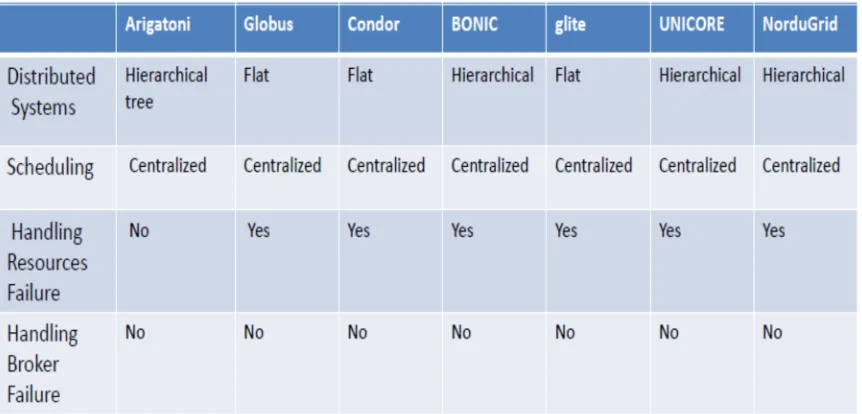
client nodes. None of these systems provide an efficient failure handling for both regular
nodes and brokers. A detail description of some other most related resource management
models is given below.
2.2.1 Condor: Cycle stealing technology for high throughput computing
Condor [36] is a high-throughput computing environment that can manage a large
collection of diversely owned machines and networks. Although it is well known for
harnessing idle computers, it can be configured to share resources. The Condor
environment follows a layered architecture and supports sequential and parallel
applications. The Condor system allocates the resources in the Condor pool as per the
usage conditions defined by resource owners. Through its remote system call capabilities,
Condor preserves the job’s originating machine environment on the execution machine,
even though if the originating and execution machines do not share a common file system
and/or user ID scheme. Condor jobs with a single process are automatically check
pointed and migrated between workstations as needed to ensure eventual completion.
28
The Condor collector, which provides the resource information store, listens for
advertisements of resource availability. A Condor resource agent runs on each machine
periodically advertising its services to the collector. Customer’s agents advertise their
requests for resources to the collector. The Condor matchmaker queries the collector for
resource discovery which it uses to determine compatible resource requests and offers.
Compatible agents contact each other directly and if they are satisfied the customer
agents initiate computation on the resources. Resource requests and offers are described
in the Condor classified advertisement (ClassAd) language [58]. ClassAds uses a
semi-structured data model for resource description. The ClassAd language includes a query
language as part of the data model, allowing advertising agents to specify their
compatibility by including constraints in their resource offers and requests. Condor can
be considered a computational Grid with a flat organization. It uses an extensible schema
with a hybrid namespace. It has no QoS support, and the information store is a network
directory that does not use X.500/LDAP technology. Resource discovery which is
centralized queries with periodic push dissemination. The scheduler is centralized.
29 2.2.2 Globus:A toolkit for Grid computing
The Globus system [59] enables modular deployment of Grid systems by providing the
required basic services and capabilities in the Globus Metacomputing Toolkit (GMT).
This toolkit consists of a set of components that implement basic services, such as
security, resource location, resource management, data management, resource
reservation, and communications. Globus is constructed as a layered architecture in
which higher level services can be developed using the low-level core services [60]. Its
emphasis is on the hierarchical integration of Grid components and their services. Globus
offers Grid information services via an LDAP-based network directory called
Metacomputing Directory Services (MDS) [61]. MDS currently consists of two
components: Grid Index Information Service (GIIS) and Grid Resource Information
Service (GRIS). GRIS provides resource discovery services on a Globus based Grid. The
directory information is provided by a Globus component running on a resource or other
external information providers. The resource information providers use a push protocol to
update GRIS periodically. GIIS provides a global view of the Grid resources and pulls
information from multiple GRIS to combine into a single coherent view of the Grid.
Globus is placed into the push resource dissemination category since the resource
information is initially periodically pushed from the resource providers. Resource
discovery is performed by querying MDS. Globus supports soft QoS via resource
reservation [62]. The predefined Globus scheduling policies can be extended by using
application level schedulers such as Nimrod/G, AppLeS, and Condor/G. The Globus
scheduler in the absence of application level scheduler has a decentralized organization
30
Figure 5. Globus- a toolkit for grid computing [59].
2.2.3 Nimrod/G: Resource broker and economy Grid
Nimrod/G [63, 64] is a Grid resource broker for managing and steering task farming
applications such as parameter studies on computational Grids. It follows a computational
market-based model for resource management. Nimrod/G provides support for the
formulation of parameter studies, a single window to manage and control experiments,
resource discovery, resource trading, and scheduling. The task farming engine of
Nimrod/G coordinates resource management and results gathering. This engine can be
used for creating user-defined scheduling policies. For example, Active Sheets are used
to execute Microsoft Excel computations/cells on the Grid [65]. Nimrod/G is being used
as a scheduling component in a new framework called Grid Architecture for
Computational Economy (GRACE), which is based on using economic theories for a
Grid resource management system. Nimrod/G has a hierarchical machine organization
and uses a computational market model for resource management [66]. It uses the
services of other systems such as Globus and Legion for resource discovery and
dissemination. State estimation is performed through heuristics using historical pricing
user-31
defined requirements such as deadline and budget limitations. Load balancing is
performed through periodic rescheduling.
Figure 6. The Architecture of Nimrod/G[63].
2.2.4 Arigatoni Overlay Network: Super Broker and multi-virtual Grid system
Arigatoni [40], a light weight model and a communication network called ArigatoNet
that is suitable to deploy the Global Computing Paradigm over the Internet. I defined a
simple but very efficient communication protocol, called Global Internet Protocol (GIP)
on the top of TCP or UDP protocol [19]. Basic global computers and colonies of global
computers can communicate by first registering to a brokering service and then by
mutually asking for, or offering services. In this model, the resources are encapsulated in
the colony in which they reside, and request for resources located in another colony
traverse a broker-2-broker negotiation using a P2P overlay network. The model is
suitable to fit with various global scenarios for classical P2P applications, like file
sharing, band-sharing, memory space, to more sophisticated GRID applications like
32
migration (i.e. ask to transfer one non completed the local run in another global computer
unit(GCU) saving the partial results, under the case of a catastrophic scenario, like, e.g.,
fire, terrorist attack, earthquake etc., e.g. truly mobile ubiquitous computations) and
Human computer interaction.
Compared to OGSA-based middleware [32] (e.g. Globus [33]), the Arigatoni
model is much simpler and exploits the lower levels of the OSI stack. In principle, it
could be deployed firstly in an intranet and further from intranet to intranet by
overlapping an Overlay Network on the top of the actual network. For this, I could
consider the Arigatoni model, with related middleware, as one prototypical example of
overlay networks. Recall that an overlay network is an abstraction that can be
implemented on top of a Global network to yield another global network. Overlay
examples are resource discovery services (notion of resource sharing in distributed
networks), search engines (abstraction of informal repository) or systems of trusted
mobile agents (notion of autonomic, exploratory behavior) [67]. Since the Arigatoni
model is P2P, it is worth noticing that a global computer unit (GCU) can also be a
resource provider (or play both roles). Hence, a GCU can also be a supercomputer, a high
performance visualizer (e.g. connect to a virtual reality center), or any particular resource
provider that is linked to the Internet. This symmetry is another key feature of the
Arigatoni model. Typically, a global computer unit (GCU) could ask for big
computational power as when Grid users ask for memory space or for a particular piece
33
a) ArigatoNet.
b) Arigatoni model based on Hierarchical tree.
Figure 7. Arigatoni Model [40].
Summarizing, the original contributions of the work are: a) A simple distributed
communication model that is suitable to make resource discovery transparent; b) A
Global Internet Protocol that allows Global Computers to negotiate resources; c)
Complete independence with the classical scenarios of the arena, i.e. Grid, memory
space, file/band sharing, web services, etc. This domain independence is a key feature of
the model and for the protocol since it allows a complete abstraction from any given
34
2.2.5 Comparison between Arigatoni Model and OGSA Architecture
OGSA Architecture [32] proposes high level mechanisms or algorithms and does not
address the overlaying Internet low level network protocols as I intend in my Arigatoni
model [40]. Compared to OGSA-based architecture [32], the Arigatoni model is much
simpler and exploits the lower levels of the OSI stack. In principle, at first it could be
deployed in an intranet and then from intranet to intranet by overlapping an Overlay
Network on the top of the actual network. Since the Arigatoni model is P2P, It is worth
noticing that a global computer unit (GCU) can also be a resource provider (or plays
both roles). Hence, a GCU can also be a supercomputer, and high performance visualizer
(e.g. connected to a virtual reality center), or any particular resource provider which is
linked to the Internet. This symmetry is another key feature of the Arigatoni model.
Typically, a GCU could ask for big computational power, e.g. the Grid, ask for a
particular piece of software or ask for memory space etc. However, OGSA architecture
could not ask for big computational power. OGSA architecture [32] does not define a
mechanism for devices to interoperate by offering services. However, Arigatoni model
defines a mechanism for devices to interoperate by offering services. This way to
understand common behavior of virtual organization has some theoretical basis on Game
theory. Classical results from Game Theory are based on the assumption that basic shared
currency connectivity (i.e. different resources such as CPU, Memory, Bandwidth, Data,
etc.) is available and then the task is to design trustful mechanisms where users have an
incentive to collaborate. Moreover, OGSA architecture [32] does not denote a
decentralized non-exclusive policy model, and it provides information to the community
![Figure 4. Condor work as a central manager [42].](https://thumb-us.123doks.com/thumbv2/123dok_us/1422945.1174829/40.612.138.515.486.666/figure-condor-work-central-manager.webp)
![Figure 5. Globus- a toolkit for grid computing [59].](https://thumb-us.123doks.com/thumbv2/123dok_us/1422945.1174829/42.612.108.523.77.216/figure-globus-toolkit-grid-computing.webp)
![Figure 6. The Architecture of Nimrod/G [63].](https://thumb-us.123doks.com/thumbv2/123dok_us/1422945.1174829/43.612.111.535.127.346/figure-the-architecture-of-nimrod-g.webp)
![Figure 7. Arigatoni Model [40].](https://thumb-us.123doks.com/thumbv2/123dok_us/1422945.1174829/45.612.108.529.80.441/figure-arigatoni-model.webp)