Effective potentials in the integral quantum Hall effect
F. Lado*
Department of Physics, North Carolina State University, Raleigh, North Carolina 27695-8202, USA
共Received 29 September 2002; revised manuscript received 14 November 2002; published 26 June 2003兲
The exact n-body distribution functions are calculated for a two-dimensional, noninteracting quantum elec-tron gas in an external magnetic field for any temperature and density. At low temperature and filled lowest Landau level, these functions are identical to the exact distribution functions obtained by Jancovici关Phys. Rev. Lett. 46, 386共1981兲兴for the classical two-dimensional one-component plasma共2DOCP兲at the special plasma parameter⌫⫽2. This establishes that the quantum state with filling factor⫽1, associated with the integral quantum Hall effect, is precisely described by an effective classical potential(r)⫽⫺2 ln r, so that a classical Boltzmann factor of 2DOCP form can replace the quantum Slater sum. Further, this Boltzmann factor exactly matches that constructed by Laughlin关Phys. Rev. Lett. 50, 1395共1983兲兴to account for the fractional quantum Hall effect. Additional effective potentials for higher filling factors⫽2,3, . . . are obtained semianalytically from the exact Yvon-Born-Green integral equation and numerically from the approximate hypernetted-chain integral equation. They have the asymptotic form(r)⬃⫺(2/)ln r.
DOI: 10.1103/PhysRevB.67.245322 PACS number共s兲: 73.43.⫺f, 71.10.Ca, 61.20.Gy
I. INTRODUCTION
A system of noninteracting electrons in a plane subject to an external magnetic field, first studied by Landau1 in 1930 to account for diamagnetism, became the basis for under-standing the integral quantum Hall effect,2discovered by von Klitzing et al.350 years later. The discovery of the fractional quantum Hall effect4 not long after called for a different explanation and an important contribution was made by Laughlin,5,6who invoked the classical two-dimensional one-component plasma7in constructing his solution.
In this work, we report a surprising connection between the same two-dimensional one-component plasma共2DOCP兲 and the integral quantum Hall effect, as modeled by the sim-plest system, Landau’s noninteracting electrons in a plane. The connection is made after calculating the exact n-body distribution functions of this system, carried out in Sec. II, and realizing that, in a regime of low temperature and Landau-level filling factor ⫽1, they are identical to the exact distribution functions of the 2DOCP found by Jancovici8for plasma parameter⌫⫽2. This establishes that the quantum state with filling factor ⫽1 is precisely de-scribed by an equivalent classical potential (r)⫽⫺2 ln r. Effective potentials that apply to the integral quantum Hall effect at larger filling factors ⫽2,3, . . . are then found semianalytically from the exact Yvon-Born-Green integral equation9 in Sec. III and numerically from the approximate hypernetted-chain integral equation9 in Sec. IV. They have the asymptotic form(r)⬃⫺(2/)ln r.
II. GENERAL n-PARTICLE DISTRIBUTION FUNCTION
We consider N electrons at temperature T in area A. A uniform magnetic field B0 is applied perpendicular to the plane of A. The canonical partition function QNfor this sys-tem can be written
QN⫽ 1
N!⌳2N
冕
WN共r N兲dr1•••drN, 共1兲
where WN(rN) is the 共antisymmetrized兲Slater sum,
WN共rN兲⫽⌳2N
兺
P 共⫺ 1兲兩P兩
兺
k ⌿k
*共PrN兲e⫺H⌿k共rN兲, 共2兲
which plays the role of Boltzmann factor. The conventional introduction of the thermal de Broglie wavelength ⌳ ⫽(h2/2mekBT)1/2in Eq.共1兲serves to make the Slater sum dimensionless, but has no effect on the results reported be-low. Here, the⌿k is a complete set of N-particle states dis-tinguished by an index k representing 2N quantum numbers; the sum over permutations P, with even or odd parity兩P兩and antisymmetric weighting, accounts for the Fermi-Dirac sta-tistics of the indistinguishable electrons. The HamiltonianH for noninteracting electrons in an external magnetic field is
HN⫽2m1 e
兺
j⫽1N
关⫺iប“j⫹eA共rj兲兴2, 共3兲
where meis the electron mass,⫺e is its charge, and A(r) is a vector potential that yields a uniform magnetic field B0 共which we shall take to define the z direction兲,
B0⫽B0kˆ⫽“⫻A共r兲. 共4兲
As usual,⫽1/kBT is the inverse temperature, with kB Bolt-zmann’s constant. The system is taken to be fully spin polar-ized, so that spin degrees of freedom may be ignored.
WN共rN兲⫽共⌳2/4l 0 2sinh
BB0兲N
兺
P 共⫺1兲兩P兩
⫻exp
再
⫺兺
j⫽1 N
关共rj⫺Prj兲2/4l 0 2tanh
BB0
⫺i共xjPyj⫺yjPxj兲/2l0
2兴
冎
, 共5兲where rj locates electron j in the xy plane,B⫽eប/2me is the Bohr magneton, and l0⫽(ប/eB0)1/2 is the characteristic magnetic length. Letting the external field B0 vanish recov-ers the Slater sum of ideal fermions,
WN共rN兲cB0⫽0⫽
兺
P 共⫺1兲兩P兩exp
冋
⫺ ⌳2兺
j⫽1N
共rj⫺Prj兲2
册
. 共6兲 A derivation of Eq.共5兲using the asymmetric Landau gauge for A(r) is given in the Appendix.With the Slater sum in hand, we seek to determine the n-body distribution function
N (n)共r
1, . . . ,rn兲⫽
1
共N⫺n兲!⌳2NQN
冕
WN共rN兲drn⫹1•••drN
共7兲 for any n. One notes that each permutation P in Eq. 共5兲 produces a disjoint set of ring-type integrands, with each particle appearing in one and only one ring. Particle posi-tions 1,2, . . . ,n are not integrated out and will be called root points. The remaining N⫺n particle positions are variables of integration, to be called field points. The bond linking adjacent particles i and j in a ring is
f共ri,rj兲⫽共4l0 2
sinhBB0兲⫺1
⫻exp关⫺共ri⫺rj兲2/4l02tanhBB0 ⫹i共xiyj⫺yixj兲/2l0
2兴
. 共8兲
Let Ik(ri,rj) be a chain of links beginning at root point riand ending at root point rj with k field points in between, i.e.,
Ik共ri,rj兲⫽
冕
f共ri,rn1兲f共rn1,rn2兲•••f共rnk,rj兲drn1•••drnk. 共9兲 The canonical distribution function N(n)(r1, . . . ,rn) then becomes10N (n)共
r1, . . . ,rn兲⫽ 1
共N⫺n兲!QN
兺
P 共⫺ 1兲兩P兩兺
m⫽0 N⫺n
共⫺1兲m
⫻共N共⫺N⫺n⫺n兲m!兲!
兺
k1,k2, . . . ,kn ␦冉
m,
兺
jkj
冊
⫻Ik1共r1, Pr1兲Ik2共r2, Pr2兲•••Ikn共rn, Prn兲
⫻共N⫺n⫺m兲!QN⫺n⫺m. 共10兲
Now the permutations P are among the n root points only, while m is the total number of field points in the rooted rings. The sums over number of field points kjin individual chains are collectively constrained by the requirement 兺jn⫽1kj⫽m, expressed by the Kronecker delta ␦(i, j) in the summand. This constraint can be removed, and the individual sums over the kjfactored, by transforming these expressions from particle number N to chemical potentialas an independent variable using the grand canonical formalism. We have then
⌶⫽
兺
N⫽0
⬁
eNQN 共11兲 for the partition function and
(n)共r
1, . . . ,rn兲⫽⌶⫺ 1
兺
N⫽n
⬁
eNQNN(n)共r1, . . . ,rn兲 共12兲
for the n-body distribution function. Using Eq. 共10兲 in the latter, we now get simply
(n)共r
1, . . . ,rn兲
⫽
兺
P 共⫺ 1兲兩P兩
兿
j⫽1 n
冋
k兺
⫽0⬁
共⫺1兲ke(k⫹1)Ik共rj, Prj兲
册
. 共13兲Starting from I0(ri,rj)⫽f (ri,rj), one finds by induction that
Ik共ri,rj兲⫽关4l0 2
sinh共共k⫹1兲BB0兲兴⫺1 ⫻exp关⫺共ri⫺rj兲2/4l0
2
tanh„共k⫹1兲BB0…
⫹i共xiyj⫺yixj兲/2l02兴 共14兲
so that finally,
(n)共r
1, . . . ,rn兲⫽
兺
P 共⫺1兲兩P兩
兿
j⫽1 n兵共兩rj⫺Prj兩兲
⫻exp关i共xjP yj⫺yjPxj兲/2l0 2兴
其, 共15兲 with
共r兲⫽ 1 4l02 j
兺
⫽1⬁ 共⫺1兲j⫺1ej sinh共jBB0兲
⫻exp关⫺r2/4l0 2
tanh共jBB0兲兴. 共16兲
This key result can be rewritten in a form that more directly displays the familiar Fermi degeneracy at low temperatures. We use the generating function of Laguerre polynomials,
e⫺xz/(1⫺z)
1⫺z ⫽k
兺
⫽0⬁
Lk共x兲zk, 共17兲
with x⫽r2/2l 0
2 and z⫽exp(⫺2j
共r兲⫽e
⫺r2/4l02 2l02 k
兺
⫽0⬁ Lk共r2/2l 0 2兲
1⫹e⫺[⫺(2k⫹1)BB0]
, 共18兲
where now the summation is over Landau levels, of energy
⑀k⫽(2k⫹1)BB0.
The first of the distribution functions共15兲,
(1)共r
1兲⫽共0兲, 共19兲 is just the uniform density⫽N¯ /A expressed in terms of the chemical potential ,
⫽ 1 2l02 k
兺
⫽0⬁ 1
1⫹e⫺[⫺(2k⫹1)BB0]. 共20兲
This result is more familiarly obtained directly from the par-tition function ⌶, where
ln⌶⫽ A 2l02 k
兺
⫽0⬁
ln兵1⫹e[⫺(2k⫹1)BB0]其, 共21兲
using the thermodynamic relation N¯⫽kBTln⌶/. The dimensionless forms
g(n)共r1, . . . ,rn兲⬅(n)共r1, . . . ,rn兲/n 共22兲 are preferable in writing out higher distribution functions. Explicitly, we have for the next three,
g(2)共r1,r2兲⫽1⫺D2共r12兲, 共23兲
g(3)共r1,r2,r3兲⫽1⫺关D2共r12兲⫹D2共r13兲⫹D2共r23兲兴 ⫹2D共r12兲D共r23兲D共r31兲
⫻cos共兩r12⫻r13兩/2l0 2兲
, 共24兲
g(4)共r
1,r2,r3,r4兲⫽1⫺关D2共r12兲⫹D2共r13兲⫹D2共r14兲⫹D2共r23兲⫹D2共r24兲⫹D2共r34兲兴 ⫹关D2共r12兲D2共r34兲⫹D2共r13兲D2共r24兲⫹D2共r14兲D2共r23兲兴 ⫹2关D共r12兲D共r23兲D共r31兲cos共兩r12⫻r13兩/2l0
2兲⫹
D共r13兲D共r34兲D共r41兲cos共兩r13⫻r14兩/2l0 2兲
⫹D共r12兲D共r24兲D共r41兲cos共兩r12⫻r14兩/2l0 2兲⫹
D共r23兲D共r34兲D共r42兲cos共兩r23⫻r24兩/2l0 2兲兴
⫺2关D共r12兲D共r23兲D共r34兲D共r41兲cos共兩r13⫻r24兩/2l0 2兲⫹
D共r12兲D共r24兲D共r43兲D共r31兲cos共兩r14⫻r23兩/2l0 2兲
⫹D共r13兲D共r32兲D共r24兲D共r41兲cos共兩r12⫻r34兩/2l0
2兲兴, 共25兲
where D(r)⫽(r)/(0). The three-body distribution func-tion is the first to show correlafunc-tions due to phase.
For low temperatures and large magnetic fields, i.e., for
BB0Ⰷ1, the summand in Eq. 共20兲 acts like a discrete unit-step function, so that for共integer兲n filled Landau levels one has 2l02⫽n; similarly, using Eq.共18兲, the pair distri-bution function g(2)(r12)⫽g(2)(r1,r2) simplifies in this limit to
g(2)共r兲cT⫽0⫽1⫺e⫺r
2/2l 0 2
冋
1n k
兺
⫽0 n⫺1Lk共r2/2l02兲
册
2, 共26兲
a result that has been obtained by Ciftja and Fantoni11,12and Kamilla et al.13
More generally, the pair function g(2)(r) from Eq.共23兲is calculated for density and arbitrary temperature T from
FIG. 1. Pair distribution functions of a two-dimensional, nonin-teracting quantum electron gas in a magnetic field at a high tem-perature and reduced densities 2l0
2⫽
1,2,3,4,5, read from right to left.
FIG. 2. Pair distribution functions of a two-dimensional, nonin-teracting quantum electron gas in a magnetic field at a low tempera-ture and reduced densities 2l0
2⫽
g(2)共r兲⫽1⫺e⫺r2/2l0 2
冋
12l02 k
兺
⫽0⬁ Lk共r2/2l 0 2兲
1⫹e⫺[⫺(2k⫹1)BB0]
册
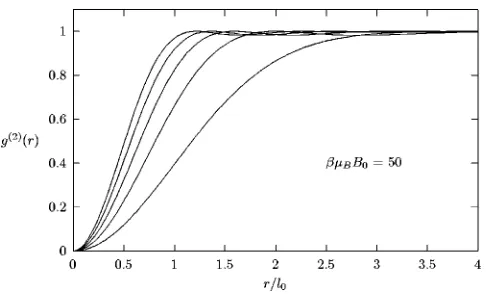
2 , 共27兲 with chemical potential found by numerical inversion of Eq.共20兲. The controlling free parameter is thenBB0. Fig-ure 1 displays g(2)(r) for reduced densities 2l02 ⫽1,2,3,4,5 atBB0⫽1, while Fig. 2 shows the same func-tions atBB0⫽50. The latter are clearly longer ranged and have more structure 共though neither set has much兲. For ref-erence, Fig. 3 shows ⫽() from Eq. 共20兲 for the two parameter values. Note that at low temperatures, the chemi-cal potential computed at a discontinuity falls midway be-tween its upper and lower limits: /BB0⫽2n when 2l02⫽n forBB0Ⰷ1.
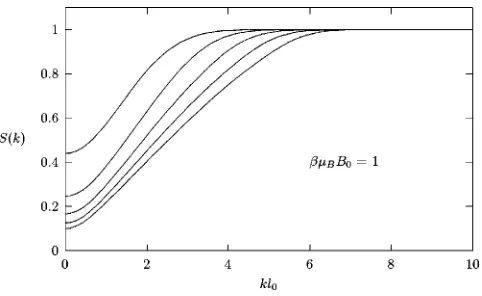
The structure factors S(k)⫽1⫹˜ (k) for the noninteract-h ing electrons are now readily obtained by the Fourier trans-formation of h(r)⫽g(2)(r)⫺1. For circularly symmetric functions such as these, the two-dimensional Fourier trans-form h˜ (k) and its inverse h(r) become Hankel transforms,
h
˜共k兲⫽2
冕
0⬁
dr rh共r兲J0共kr兲, 共28兲
h共r兲⫽ 1 2
冕
0⬁
dk kh˜共k兲J0共kr兲, 共29兲
where J0(x) is the Bessel function of order zero. Structure factors for the pair distribution functions at BB0⫽1 and 50 that appear in Figs. 1 and 2 are displayed, respectively, in Figs. 4 and 5. The vanishing of S(0) for all densities at low temperatures, seen in Fig. 5, signals the incompressibility of the quantum states with the filled Landau levels. The quadra-tures needed here for the transforms h˜ (k) are performed nu-merically as described in Sec. IV.
We close this section by noting a remarkable fact. For physical conditions such that this noninteracting quantum electron system just fills the lowest Landau level, i.e., for
BB0Ⰷ1 and 2l0
2⫽1, so that D(r)⫽exp(⫺r2/2), the exact distribution functions g(n)(r1, . . . ,rn) displayed above are identical to the exact distribution functions
g(n)(r1, . . . ,rn) of a classical two-dimensional one-component plasma obtained by Jancovici8for the plasma pa-rameter value⌫⫽2. Working backwards, we may then con-clude that the quantum state for the filled lowest Landau level is precisely described by an effective classical pair po-tential (r)⫽⫺2 ln(r/l0). More generally, in the following section, we calculate effective potentials for a low-temperature system with n⬎1 Landau levels filled and find that their long-range form is(r)⬃⫺(2/n)ln(r/l0).
III. AN EFFECTIVE PAIR POTENTIAL
The Fermi statistics result in a well-known yet still curi-ous ‘‘statistical repulsion’’ between noninteracting identical particles, as is evident in Figs. 1 and 2. The mathematical expression of this property through antisymmetrization of the wave function, however, often makes it awkward to work with. An explicit effective interaction between the fermions, which could produce the same effects as antisymmetrization, would considerably simplify the situation. This notion was first discussed by Uhlenbeck and Gropper,14,15who carried out calculations for quantum gases in three dimensions at
FIG. 3. Chemical potential as a function of density calculated by numerical inversion of Eq.共20兲at high and low temperatures.
FIG. 4. Structure factors S(k)⫽1⫹˜ (k) of a two-dimensional,h
noninteracting quantum electron gas in a magnetic field at a high temperature and reduced densities 2l02⫽1,2,3,4,5, read from left to right.
FIG. 5. Structure factors S(k)⫽1⫹˜ (k) of a two-dimensional,h
noninteracting quantum electron gas in a magnetic field at a low temperature and reduced densities 2l0
2⫽
high temperatures and low densities. A more general proce-dure suitable for any temperature and density, based on the exact Yvon-Born-Green hierarchy 共YBG兲, was proposed by the author10for the quantum gases with no external magnetic field. Stevens and Pokrant16 later noted that other familiar integral equations of classical liquids,9 such as Percus-Yevick and hypernetted-chain 共HNC兲, though approximate, could also be used for this purpose. In this section and the next, we examine the extension of these techniques to the present case of a two-dimensional electron gas in a magnetic field.
The surprising conclusion of the preceding section is that the quantum correlation effects of antisymmetrization of the wave function can indeed be replicated by an effective clas-sical pair potential for at least the case of filled lowest Lan-dau level, ⫽2l02⫽1, at low temperatures. We continue here by assuming that there exists, for any state, a pair func-tion (r) such that the Slater sum, Eq.共2兲, may be written
WN共rN兲⬇exp
冋
⫺兺
i⬍j 共ri j兲
册
. 共30兲Given that assumption, the YBG hierarchy9 then offers an exact route to such a function. The second member of this hierarchy, connecting the two-body and three-body distribu-tion funcdistribu-tions, reads
“1ln g(2)共r1,r2兲⫽⫺“1共r12兲
⫺
冕
dr3“1共r13兲g(3)共r1,r2,r3兲 g(2)共r1,r2兲
,
共31兲
where now (r) is the only unknown. Dotting rˆ12 into Eq. 共31兲gives a scalar equation,
⫺ddr共r兲⫽d ln gdr共r兲⫺g共r兲
冕
ds cosd共s兲 ds⫻
冋
D2共t兲⫺2D共r兲D共s兲D共t兲cos冉
rs2l02sin
冊
册
, 共32兲where cos⫽rˆ•sˆ, t⫽(r2⫹s2⫺2rs cos)1/2, and we have dropped those terms of g(3)(r
1,r2,r3) that do not contribute because of symmetry. The superscript on the pair function is also omitted for simplicity. Then, with the substitutions
u共r兲⫽⫺d共r兲
dr , 共33兲
v共r兲⫽d ln g共r兲
dr , 共34兲
W共r,s兲⫽1
冕
0
dcos
冋
D2共t兲⫺2D共r兲D共s兲D共t兲cos
冉
rs2l02sin
冊
册
, 共35兲 Eq. 共32兲becomes an integral equationu共r兲⫽v共r兲⫹2 g共r兲
冕
0⬁
ds su共s兲W共r,s兲 共36兲
that can be solved iteratively for u(r); a final integration
共r兲⫽
冕
r⬁
ds u共s兲 共37兲
yields the effective potential. The integral for the array W(r,s) in Eq. 共35兲is evaluated using the Gauss-Chebyshev quadrature.
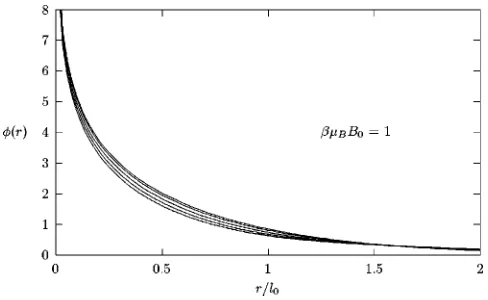
For the high-temperature states displayed in Fig. 1, this straightforward procedure works well. The effective poten-tials found in this way for the states of Fig. 1 at BB0 ⫽1 are shown in Fig. 6. As the density increases, the ampli-tude of the effective potential decreases, but the changes are not large.
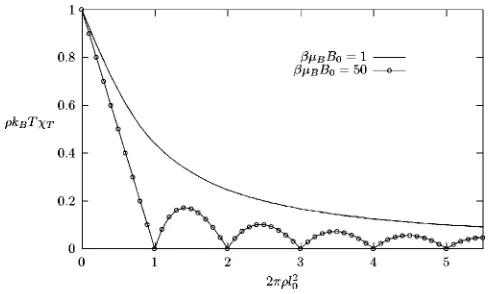
When applied at low temperatures, however, the simple procedures, both here and in the HNC solutions of the fol-lowing section, become problematical as divergences make an appearance. Their source is not hard to find.共The isother-mal compressibilityT, given exactly by
kBTT⫽ 1 2l02 k
兺
⫽0⬁ e⫺[⫺(2k⫹1)BB0] 共1⫹e⫺[⫺(2k⫹1)BB0]兲2
, 共38兲
is relevant here and is plotted in Fig. 7.兲 Expanding the Bessel function J0(kr) in Eq. 共28兲 and evaluating term by term, we get
h˜共k兲⫽⫺1⫹1 2共kl0兲
2⫹••• 共39兲
FIG. 6. Effective potentials obtained by numerical solution of the YBG equation for a two-dimensional, noninteracting quantum electron gas in a magnetic field at a high temperature and reduced densities 2l0
2
for BB0Ⰷ1 and 2l0 2⫽
n, physical conditions that will hold for the remaining section. Then, S(0)⫽1⫹˜ (0)⫽h 0, the compressibility T⫽S(0)/ vanishes, and the trans-form of the direct correlation function c(r),9
˜c共k兲⫽ h ˜共k兲
1⫹˜h共k兲, 共40兲 acquires a k⫺2 divergence at the origin. The long-range be-havior of (r) follows that of ⫺c(r) and so ˜ (k) ⬇2/(kl0)2 for a small k, independent of density, and we fi-nally get the asymptotic forms
共r兲⬃⫺共2/n兲ln共r/l0兲, 共41兲
u共r兲⬃2/nr. 共42兲
These are troublesome functions for any numerical proce-dure restricted to a finite range. Fortunately, it turns out that, in this low-temperature regime, many needed integrals can be evaluated analytically. Thus, using
D共r兲⫽1 ne
⫺r2/4l02
兺
k⫽0 n⫺1Lk
冉
r22l02
冊
,⫽1ne⫺r2/4l0 2
Ln1⫺1
冉
r 22l0
2
冊
, 共43兲we find, for example,
W共r,s兲⫽e⫺(rˆ2⫹sˆ2)/2关2I1共rˆsˆ兲⫺rˆsˆ兴/2 共44兲 for n⫽1,
W共r,s兲⫽e⫺(rˆ2⫹sˆ2)/2关32共8⫺4rˆ2⫺4sˆ2⫹6rˆ2sˆ2⫹rˆ4 ⫹sˆ4兲I1共rˆsˆ兲⫹128rˆsˆ共3⫺rˆ2⫺sˆ2兲I0共rˆsˆ兲⫺rˆsˆ共4
⫺rˆ2兲共4⫺sˆ2兲共32⫺4rˆ2⫺4sˆ2⫹rˆ2sˆ2兲兴/512 共45兲
for n⫽2, and
W共r,s兲⫽e⫺(rˆ2⫹sˆ2)/2关1152共192⫺192rˆ2⫺192sˆ2⫹688rˆ2sˆ2⫹96rˆ4⫹96sˆ4⫺272rˆ4sˆ2⫺272rˆ2sˆ4⫺16rˆ6⫺16sˆ6 ⫹28rˆ6sˆ2⫹28rˆ2sˆ6⫹70rˆ4sˆ4⫹rˆ8⫹sˆ8兲I1共rˆsˆ兲⫹9216rˆsˆ共96⫺72rˆ2⫺72sˆ2⫹50rˆ2sˆ2⫹15rˆ4⫹15sˆ4
⫺7rˆ4sˆ2⫺7rˆ2sˆ4⫺rˆ6⫺sˆ6兲I0共rˆsˆ兲⫺rˆsˆ共24⫺12rˆ2⫹rˆ4兲共24⫺12sˆ2⫹sˆ4兲
⫻共1728⫺480rˆ2⫺480sˆ2⫹192rˆ2sˆ2⫹24rˆ4⫹24sˆ4⫺12rˆ4sˆ2⫺12rˆ2sˆ4⫹rˆ4sˆ4兲兴/663 552 共46兲
for n⫽3, where Ik(x) is the modified Bessel function of order k and we are using rˆ⬅r/l0 and sˆ⬅s/l0 for brevity. Even with analytic kernels, however, Eq. 共36兲 cannot be handled within a finite numerical range without first analyti-cally extracting the asymptotic关long-range共LR兲兴behavior of u(r). For this purpose, we set uLR(r)⫽2/nr, so that with u(r)⫽uSR(r)⫹uLR(r), Eq.共36兲becomes an equation for the short-range共SR兲part,
uSR共r兲⫽vSR共r兲⫹2 g共r兲
冕
0⬁
ds suSR共s兲W共r,s兲, 共47兲
which contains only well-behaved, short-range functions. Here,
vSR共r兲⬅v共r兲⫺uLR共r兲⫹2 g共r兲
冕
0⬁
ds suLR共s兲W共r,s兲
共48兲
must be evaluated analytically. We find vSR(r)⫽0 for n⫽1 关so that uSR(r)⫽0, u(r)⫽2/r, and(r)⫽⫺2 ln (r/l0) is the anticipated exact solution for this case兴,
vSR共r兲⫽e⫺rˆ2/2rˆ共32⫺14rˆ2⫹rˆ4兲/32g共r兲 共49兲 for n⫽2, and
vSR共r兲⫽e⫺rˆ2/2rˆ共1728⫺1440rˆ2⫹360rˆ4
⫺34rˆ6⫹rˆ8兲/864g共r兲 共50兲
FIG. 7. Isothermal compressibilityTat high and low
tempera-tures, calculated from Eq. 共38兲. The vanishing of T at low
tem-perature for integral values of the reduced density 2l0 2
for n⫽3. The computed results for these three cases are shown in Fig. 8 as ru(r); for n⫽1, the solution is, of course, a constant, ru(r)⫽2, while for n⫽2 and 3, ru(r) makes a smooth transition from 2 at the origin to its long-range constant value of 2/n over a distance r⬇5l0, by which point particle pairs are essentially uncorrelated.
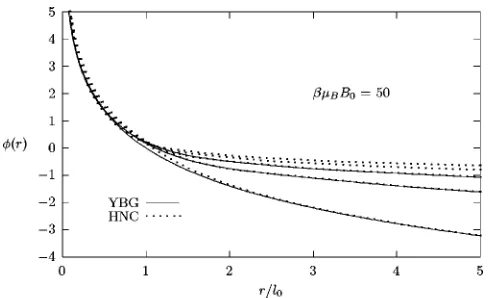
Evidently, equations for higher indices n quickly become intricate to solve by this route, but these results are readily supplemented with the approximate HNC equation described in the following section. We show in Fig. 9 the effective potentials (r) obtained with both these methods, at
BB0⫽50. Agreement between the approximate HNC(r) and the exact YBG(r) solutions for n⫽1, 2, and 3 is rea-sonably good, especially at a large r.
Adapting to the present notation the total potential V quoted by Jancovici8for 2DOCP particles confined to a disk of radius R, we get a system potential, for large interparticle separations ri j,
⌽N(n)共rN兲⬃⫺2 n
兺
i⬍jln
冉
ri j l0冊
⫹1
2
兺
i冉
ril0
冊
2⫹N
2
n
冉
ln Rl0
⫺3
4
冊
, 共51兲 or, equivalently, a Boltzmann factor W⫽exp(⫺⌽) given byWN(n)共rN兲⬃
兿
i⬍j冉
ri j
l0
冊
2/nexp
冋
⫺1 2兺
i冉
ri
l0
冊
2册
, 共52兲 neglecting multiplicative constants, where riis the radial dis-tance from the disk center. The noninteracting electron gas in two dimensions is the basis for understanding the integral quantum Hall effect;2 we find that for the relevant incom-pressible states at low temperatures, this system is asymptoti-cally described by the effective Boltzmann factor written above. For n⫽1, the Boltzmann factor is exact for all ri j.IV. HNC APPROACH TO THE EFFECTIVE POTENTIAL
As noted earlier, the HNC integral equation of classical liquids has been used to model an effective potential for the free electron gas in three dimensions17as well as in two.18,19
In this approach, one uses the equations9
␥
˜共k兲⫽ ˜h 2共k兲
1⫹˜h共k兲, 共53兲
共r兲⫽␥共r兲⫺ln g共r兲⫹B共r兲, 共54兲 which are exact, to first obtain the indirect correlation func-tion ␥(r) from the known pair function h(r)⫽g(r)⫺1 and then to arrive at a solution for the effective potential (r) after an approximation is made for the so-called bridge func-tion B(r). In the HNC approximafunc-tion, B(r) is simply ne-glected, so that
HNC共r兲⫽␥共r兲⫺ln g共r兲. 共55兲 The calculation involves computing only transforms of pair functions and is noniterative. The HNC effective potentials obtained in this way at BB0⫽1 are graphically not very distinct from the YBG solutions of Fig. 6 and are not dis-played.
As with the YBG calculation, numerical problems arise at low temperatures, where we have already found that the ef-fective potential for the filled Landau levels evolves asymp-totically into the 2DOCP interaction. Hansen and Levesque20 have reported numerical solutions of the HNC equation for the 2DOCP, specifically adapted to its long-range potential. We follow a similar procedure of extracting the divergence analytically with a long-range function
LR共r兲⫽⫺1 n
冋
2ln冉
r
l0
冊
⫹E1冉
r2
2l02
冊
册
, 共56兲 whose dimensionless transform is˜LR共k兲⫽ 2 共kl0兲2
exp
冋
⫺1 2共kl0兲2
册
, 共57兲so that numerical routines deal only with well-behaved functions.21 In Eq. 共56兲, E1(x) is the exponential integral. Then, starting with the known function h(r)⫽g(r)⫺1, the steps of the solution are the following:
共1兲˜h共k兲⫽2
冕
0⬁
dr rh共r兲J0共kr兲, 共58兲
共2兲 ␥˜SR共k兲⫽ h ˜2共k兲
1⫹˜h共k兲⫺
˜LR共k兲, 共59兲
共3兲 ␥SR共r兲⫽ 1 2
冕
0⬁
dk k␥˜SR共k兲J0共kr兲, 共60兲
共4兲 HNC共r兲⫽␥SR共r兲⫹LR共r兲⫺ln g共r兲. 共61兲 The numerical calculations now proceed smoothly. The HNC potentials atBB0⫽50 have already been displayed in Fig. 9, along with the YBG potentials from the preceding section. The deviations between the two for a small r are a measure of the missing B(r), a short-range function, inHNC(r).
FIG. 8. Logarithmic derivative of the effective potentials,
ru(r)⫽⫺d(r)/dln r, obtained from the YBG equation for a two-dimensional, noninteracting quantum electron gas in a magnetic field at a low temperature and reduced densities 2l0
2⫽
The Hankel transforms needed in these calculations are evaluated numerically. The discrete versions22 of the inte-grals共28兲and共29兲used in this work,
h
˜共kj兲⫽4 K2 i
兺
⫽1Nr⫺1 h共ri兲
J0共kjri兲
J12共Kri兲, 共62兲
h共ri兲⫽ 1
R2
兺
j⫽1 Nr⫺1h
˜共kj兲J0共kjri兲 J12共kjR兲
, 共63兲
preserve the orthogonality of the continuous Hankel trans-forms. In these expressions, Jn(x) is the Bessel function of the order n and the numerical grids are defined by ri ⫽i/K, kj⫽j/R, where j is the j th root of J0(x), K ⬅kNr, and R⬅rNr; the range R and number of grid points Nr are free choices. In the present calculations, we have used R/l0⫽20 and Nr⫽1000.
V. CONCLUSIONS
The electric potential due to an infinite line charge23is, in Gaussian units, v(r)⫽⫺2ln(r/L), where is the linear charge density and L is an arbitrary length. Then, with L ⫽l0, the energy w(r) associated with lengths l0, containing charge q⫽l0, of each of the two interacting infinite line charges is
w共r兲⫽⫺共2q2/l0兲ln共r/l0兲⫽⫺⌫ln共r/l0兲, 共64兲 which is the defining potential of the 2DOCP.7
In this work, we have found that the two-dimensional one-component plasma interaction also functions as an effec-tive potential(r) for the simple quantum model of nonin-teracting electrons in a plane, subject to an external magnetic field, when they are taken to low temperatures and form incompressible states. The potential model is exact,
共r兲⫽⫺2 ln共r/l0兲, 共65兲
for the filling factor ⫽2l02⫽1, and asymptotic,
共r兲⬃⫺共2/n兲ln共r/l0兲, 共66兲 for filling factors ⫽n⬎1. The physical conditionsBB0 Ⰷ1 and 2l02⫽n apply to the integral quantum Hall effect, and so we find that, for ⫽1, the noninteracting electron model for the integral quantum Hall effect maps into the classical two-dimensional one-component plasma through an effective Boltzman factor
WN(1)共rN兲⫽
兿
i⬍j冉
ri j
l0
冊
2exp
冋
⫺1 2兺
i冉
ri
l0
冊
2册
. 共67兲 It is, of course, well known that the 2DOCP has previ-ously been invoked by Laughlin5,6to construct an N-particle wave function mthat accounts for the principal features of the fractional quantum Hall effect. Expressed as an equiva-lent Boltzman factor W⫽兩兩2, Laughlin’s solution isWN(1/m)共rN兲⫽
兿
i⬍j
冉
ri jl0
冊
2mexp
冋
⫺1 2兺
i冉
ri
l0
冊
2册
, 共68兲 with m an odd integer, including m⫽1.The coincidence of form in these effective Boltzmann fac-tors for⫽n⫽1/m⫽1 in mathematical models for the inte-gral and fractional quantum Hall effects is remarkable and nontrivial, since the two results arise from quite distinct ori-gins.
共1兲Laughlin presents Eq.共68兲in the context of a system of electrons interacting through the Coulomb e2/r potential. Further, the result is constructed as the squared amplitude of a single ground-state wave function, which requires an ex-plicit antisymmetrization, so that m must be an odd integer in general.
共2兲 In this paper, Eq. 共67兲 is obtained explicitly and ex-actly for a noninteracting system of electrons. Further, it is a sum over states, rather than the amplitude squared of a single wave function. The fact, that the quantum number n⫽1 is odd has here nothing to do with antisymmetrization; this property is built into the Slater sum from the very beginning, Eq. 共2兲, and is reflected in its vanishing whenever two par-ticles approach each other, which is the signature of ‘‘fermi-onicity.’’
One concludes that, at least for the filled lowest Landau level, ⫽1, Laughlin’s variational wave function actually describes a noninteracting system. This is consistent with the fact that the electronic charge e does not appear in these solutions unless multiplying the magnetic field, as eB0, re-flecting just the magnetic force on the electron.
ACKNOWLEDGMENTS
It is a pleasure to thank Professor George Parker for valu-able discussions and an initiation into the ways of MATHEMATICA and Professor Charles Johnson for computer help over many years.
APPENDIX: THE ONE-BODY SLATER SUM
The vector potential in the Landau gauge is A⫽⫺B0y ıˆ, so the one-electron Hamiltonian becomes
FIG. 9. Effective potentials for a two-dimensional, noninteract-ing quantum electron gas in a magnetic field at a low temperature, obtained from the YBG equation at reduced densities 2l0 2
⫽1,2,3 and the HNC equation at reduced densities 2l02
H1⫽ 1 2me
冋冉
iប
x⫹eB0y
冊
2⫹
冉
iប y
冊
2册
. 共A1兲 The Schro¨dinger equationH1⫽⑀ is then solved by2n共x,y兲⫽
An
Lx1/2exp
冋
ix⫺共y⫺l02兲2 2l02
册
Hn冉
y⫺l02
l0
冊
,共A2兲 with⫽2j/Lx for j⫽0,⫾1,⫾2, . . . , l0⫽(ប/eB0)1/2, and An⫽(l02)⫺1/4(2nn!)⫺1/2. Further, Hn(x) is the Hermite polynomial of the order n and Lx is the edge length of the rectangular area A in the x direction. The corresponding en-ergy eigenvalues are ⑀n⫽(2n⫹1)BB0, n⫽0,1,2, . . . , whereB⫽eប/2meis the Bohr magneton.
We seek to determine the one-body Slater sum
W1共x,y兲⫽⌳2
兺
,n
e⫺⑀n
n
*共Px, Py兲n共x,y兲⫽ ⌳ 2
共l02兲1/2Lx
⫻
兺
e
i(x⫺Px)e⫺( Py⫺l02)2/2l02e⫺(y⫺l02)2/2l02
⫻
兺
n
e⫺(2n⫹1)BB0
2nn! Hn
冉
P y⫺l02
l0
冊
Hn冉
y⫺l02
l0
冊
.共A3兲 First we note that24
兺
n⫽0
⬁ e⫺n␣
2nn!Hn共x兲Hn共y兲
⫽
冉
2 sinhe␣ ␣冊
1/2exp
冋
⫺共x2⫹y2兲e⫺␣⫹2x y 2 sinh␣
册
.共A4兲
Using this in Eq.共A3兲with␣⫽2BB0and simplifying, we arrive at
W1共x,y兲⫽关⌳2/共2l0 2
sinh␣兲1/2Lx兴
兺
exp关i共x⫺Px兲
⫺共y⫺P y兲2/2l 0
2tanh␣⫺tanh共␣/2兲共y⫺l 0 2兲
⫻共Py⫺l02兲/l02兴. 共A5兲
The second sum, over , is effected as an integral. For a large Lx, Lx⫺
1兺
→(2)⫺1兰d and we get
1 2
冕
⫺⬁⬁
dexp关i共x⫺Px兲⫺tanh共␣/2兲
⫻共y⫺l02兲共Py⫺l02兲/l02兴
⫽关4l02tanh共␣/2兲兴⫺1/2exp关⫺共x⫺Px兲2/4l02tanh共␣/2兲 ⫹tanh共␣/2兲共y⫺P y兲2/4l02⫹i共x⫺Px兲共y⫹Py兲/2l02兴,
共A6兲
and so finally,
W1共x,y兲⫽关⌳2/4l0 2
sinh共␣/2兲兴
⫻exp关⫺共r⫺Pr兲2/4l02tanh共␣/2兲
⫹i共x⫺Px兲共y⫹Py兲/2l02兴 共A7兲
after some further simplification.
*Electronic address: [email protected] 1L.D. Landau, Z. Phys. 64, 629共1930兲.
2T. Chakraborty and P. Pietila¨inen, The Quantum Hall Effects
共Springer-Verlag, Berlin, 1995兲.
3K. von Klitzing, G. Dorda, and M. Pepper, Phys. Rev. Lett. 45, 494共1980兲.
4D.C. Tsui, H.L. Sto¨rmer, and A.C. Gossard, Phys. Rev. Lett. 48, 1559共1982兲.
5R.B. Laughlin, Phys. Rev. Lett. 50, 1395共1983兲.
6R.B. Laughlin, in The Quantum Hall Effect, edited by R.E. Prange and S.M. Girvin 共Springer-Verlag, New York, 1990兲, p. 233.
7J.M. Caillol, D. Levesque, J.J. Weis, and J.P. Hansen, J. Stat. Phys. 28, 325共1982兲.
8B. Jancovici, Phys. Rev. Lett. 46, 386共1981兲.
9J.P. Hansen and I.R. McDonald, Theory of Simple Liquids共 Aca-demic, London, 1986兲.
10F. Lado, J. Chem. Phys. 47, 5369共1967兲.
11O. Ciftja and S. Fantoni, Phys. Rev. B 56, 13 290共1997兲. 12O. Ciftja, Phys. Rev. B 59, 8132共1999兲.
13R.K. Kamilla, J.K. Jain, and S.M. Girvin, Phys. Rev. B 56, 12 411
共1997兲.
14G.E. Uhlenbeck and L. Gropper, Phys. Rev. 41, 79共1932兲. 15
K. Huang, Statistical Mechanics 共Wiley, New York, 1987兲, Chap. 9.
16F.A. Stevens and M.A. Pokrant, J. Chem. Phys. 61, 3768共1974兲. 17F.A. Stevens and M.A. Pokrant, Phys. Rev. A 8, 990共1973兲. 18T. Chakraborty, Phys. Rev. B 57, 8812共1998兲.
19O. Ciftja and S. Fantoni, Phys. Rev. B 58, 7898共1998兲. 20J.P. Hansen and D. Levesque, J. Phys. C 14, L603共1981兲. 21J.F. Springer, M.A. Pokrant, and F.A. Stevens, J. Chem. Phys. 58,
4863共1973兲.
22F. Lado, J. Chem. Phys. 49, 3092共1968兲; Comput. Phys. 8, 417
共1971兲.
23W.K.H. Panofsky and M. Phillips, Classical Electricity and Mag-netism共Addison-Wesley, Reading, MA, 1962兲, Chap. 4. 24I.S. Gradshteyn and I.M. Ryzhik, Table of Integrals, Series,