Efficient VM Load Balancing Algorithm for
Dynamic Allocation of Resources in Cloud
Computing Environment
Radha1, Dr. Vivek Kumar2
Ph.D. Scholar, Department of CSE & Singhania University, Pacheri Bari, Distt. Jhunjhunu, Rajasthan, India1
Principal, Department of CSE & Singhania University, Pacheri Bari, Distt. Jhunjhunu, Rajasthan, India 2
ABSTRACT: Cloud computing is an evolving technique which offers efficient facilities to the clients. The main enabling technique for cloud computing is virtualization, which create the physical infrastructure and the ease of administration and usage. It allows clients to scale up and down their resources utilization based upon their requirements due to this, over provision and under provision problems may take place. To overcome this migration of service usage Our Paper concentrates on overcoming this issue by allocating the resource to numerous clients through virtualization technique to improve their returns. In this paper virtualization is utilized to assign resources depending on their requirements, and also supports green computing idea. The term "skewness" is proposed in which the same is decreased by integrating several work tasks to enhance server usage.
KEYWORDS: Cloud computing, under provision, over provision, skewness, virtualization, green computing.
I. INTRODUCTION
Many organizations indicate interest on cloud, because with low cost we can access resources from cloud in a reliable and secure way. Cloud shares their resource to numerous customers. Cost of resources changes significantly based on configuration for utilizing them. Thus effective resources management is of main interest to both Cloud Users and Cloud Providers. The success of any cloud management software severally based on the scale, flexibility and efficiency with which it can use the specified hardware resources whereas offering essential performance isolation. Successful resource management solution for cloud atmosphere requires offering a large set of resource controls for better isolation. Here dynamic resource assignment and load balancing is the challenging issue to offer efficient facility to clients. Because of high requirements for a resource in the server, resource is over used by clients by virtualization. This may reduce the server performance. In under utilization, usage of resource is very poor as compared to over utilization, for this we are shifting client processing from VM to other VM [1].
Virtual machine monitors (VMMs) offer a technique for mapping virtual Machines (VM) to physical resources in Physical Machine (PM). But mapping is hidden from the cloud. Cloud supplier should assure that physical machine have enough resource to satisfy client requirement. When an application is operating on VM mapping between PMs and Ms is performed by migration technique. Since, policy issue remains in each aspect to decide the mapping adaptively so that the requirements of VM were satisfied and the no. of PM utilized is decreased. Though it is a challenging one when the resource requirement of VM is heterogeneous because of the various set of applications their requirement might change with time as the workloads goes ups and down. The PM capacity can also be Heterogeneous because several generations of hardware coexist in a data centre [2].
Here we have two significant objectives to offer dynamic resource allocation
based on greatest priority in hot spot list that is in descending order. Server Responsibility has to examine before shift the VM from one server (source server) to another server (target server). Source server has to examine whether the target server is appropriate, if it offers all his resource or not and after accepting this VM it does not go to hotspot. While viewing all these aspect then we are shifting the VM to another server. In this manner we are analysing the server temperature as low as possible [11].
B. Green Computing: The prime objective of “Green computing algorithm” is to use the peak level of resources on server and also it analyse the no. of active servers running with less weight it does not decrease its performance now or in future. Our objective is to analyse the server resources by shifting VM’s to another appropriate server which are underutilized its resources. By performing this we can save the server’s energy. To neglect this green computing algorithm request’s periodically to obtain the information of underutilized resources which meets green computing threshold from all servers in cloud also called cold spot. By gathering this information we are shifting the VM’s in ascending order depending on size of memory [5].
II. SYSTEM OVERVIEW
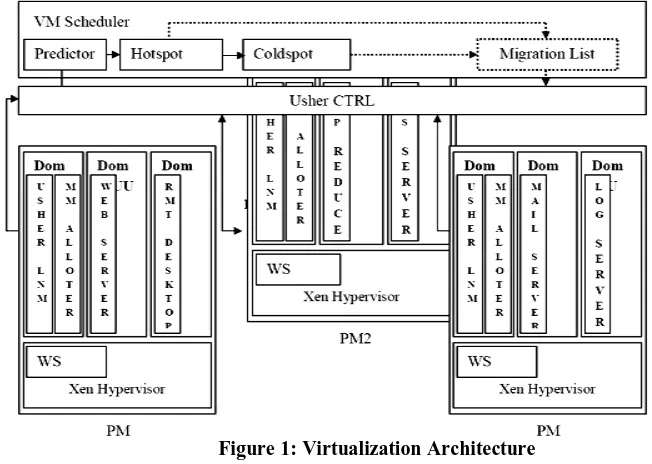
Virtualization is the generation of a virtual version of the hardware platform, network resource and operating system. Here the CPU is shared among operating systems. Memory is shared utilizing more indirections level. Virtualization architecture offers the illusion through the hypervisor. The Architecture shown in Figure 1, Every PM runs with xen hypervisor Processor with domain 0 and one or more domain U in this system. In every domain U ‘n’ number of resource are there to offer service to clients. All PM’s are linked to backend databases for saving information’s. Sharing of PM’s resources to VM’s is
Figure 1: Virtualization Architecture
Managed by Usher centre controller (Usher CTRL). Every processing on usher local node Manager (LNM) in domain 0 which collects the resource utilization information i.e. CPU and network in every VM monitoring the action performing in xen. Memory utilization in VM is highly hidden to hypervisor. VMM or hypervisor is a program that permits a host computer to support several identical execution surroundings.
There are two kinds of hypervisors present
VM operate directly on the same hardware host that controls and maintains the operating system.
Hypervisor running under an operating system atmosphere
characteristic resource requirements by resource forecasting algorithm. CPU and Memory assignments are changing in xen, when a new need came for processing LMN has to meet those requests by adjusting the old one.
Hotspotsolver in VM Scheduler determines the utilization of resources from PM. If its utilization is high then we can call it as “Hot threshold”. VM scheduler shifts those VM to decrease the burden on PM. If the VM utilizes resources averagely from PM’s it is below the “Green Computing Threshold or Cold Threshold”. We are shut downing PM’s to save the energy those are in under utilization list. Shift all the listed VM to Usher CTRL for execution.
III. SKEWNESS ALGORITHM
We are proposing conceptual skew that would be useful to the measurement variable server usage. This decreases skew can determine a variety of server usage. A hot spot is a small region in which it is comparatively higher as compared to ambient temperature. The cold spot is an area in which there is a reduction in ambient temperature. To avoid the overload, green computing concept is utilized for accurately making the resource management.
Fig. 2 Hotspot and cold spot
Our algorithm estimates the resources assignment depending on the VM requirements. Here we describe the server a hotspot and if the usage exceeds the above the hot threshold then it shows that the server is overloaded and VM' s are moved away. The temperature is zero when the server is not a hot spot. We describe a cold spot when the resource usage are below the clod threshold which shows that the server is idle and it has to be turned off for saving energy. This is performed when mostly all servers are actively utilized below the green computing threshold else it is made inactive. A. Hot Spot Mitigation: In sorted lists of hot spots are arranged in chronological order so that we can remove else to manage low temperature. Our objective is to leave a VM that can decrease the temperature servers. Among all, we select the one that can decrease skewness.
basic resources. VM live migration is a broadly utilized method for dynamic assignment of resources in a virtualized surrounding. The procedure of running two or more logical computer system so that one set of physical hardware.
IV. MODELING THE VM ALLOCATION
Cloud computing infrastructure is the massive deployment of virtualization tools and methods as it has an additional layer such as Virtualization layer that behaves as a creation, execution, management, and hosting atmosphere for application facilities. The simulated VMs in the above virtual atmosphere are contextually isolated but still they require to share computing resources- system bus, processing cores etc. Thus, the amount of hardware resources existed to every VM is restrained by the total processing power such as memory, CPU, and system bandwidth present within the host. The choice of virtual machine, meaning that you can choose a configuration of memory, CPU, bandwidth, storage etc. which is optimum for an application [5].
Cloud Sim [1]: Cloud Sim is a framework formulated by the GRIDS laboratory of University of Melbourne which enables continuous modelling, simulation and experimenting on planning Cloud computing infrastructures. Cloud Sim is a self-contained platform which can be utilized to model host, data centres, service brokers, scheduling and allocation schemes of a huge scaled Cloud platform. This Cloud Sim framework is made on Grid Sim framework top which is also formulated by the GRIDS laboratory. Thus, the researcher has utilized Cloud Sim to model hosts, data centres, VMs for experimenting in simulated cloud atmosphere [6].
Cloud Sim supports VM provisioning at two levels:-
At the host level – It is possible to mention how much of the total processing power of every core will be allocated to every VM called VM policy Allocation
At the VM level – the VM allocates a static amount of the existed processing power to the individual application facilities (task units) that are hosted within its execution engine called VM Scheduling. Observe that at every level Clouds implements the space-shared and time-shared provisioning schemes.
V. CONTEMPORARY VM LOAD BALANCERS
Virtual machine makes enable the abstraction of an OS and Application operating on it from the hardware. The interior hardware infrastructure facilities associated to the Clouds is simulated in the Cloud sim modeller by a Data centre element for managing service requests. These requests are application elements sandboxed within VMs, which require to be assigned a share of processing power on Data centre’s host components. Data Centre object handles the data centre management services i.e. VM creation and destruction and does the routing of subscriber requests obtained from User Bases through the Internet to the VMs. The Data Centre Controller [7], utilizes a VM Load Balancer to find which VM should be allocated the next request for processing. The contemporary VM load balancer is throttled; Round Robin and active monitoring load balancing algorithms.
A. Round Robin Load Balancer (RRLB): In this, the data centre controller allocates the requests to a VMs list on a rotating basis. The first request is assigned to a VM- picked arbitrarily from the group and then the Data Centre controller allocates the subsequent requests in a circular order. Once the VM is allocated the request, the VM is moved to the list end. In this RRLB; there is a better allocation idea called Weighted Round Robin Allocationin which one can allocate a weight to every VM so that if one VM is able of managing twice as much load as the other, the potential server achieves a weight of 2. In such situations, the Data Centre Controller will allocate two requests to the potential VM for every request allocated to a weaker one.The significant issue in this assignment is that it does not consider the modern load balancing needs i.e. processing times for every individual requests.[1]
B. Throttled Load Balancer (TLB): The TLB manages a record of the state of every virtual machine (busy/ideal). If a request reached concerning the assignment of virtual machine, the TLB forwards the ID of ideal virtual machine to the data centre controller and data centre controller assigns the ideal virtual machine.
VI. PROPOSED –WEIGHTED ACTIVE MONITORING LOAD BALANCING ALGORITHM
The ‘Weighted Active Monitoring Load Algorithm’ is implemented; changing the Active Monitoring Load Balancer by allocating a weight to every VM as explained in Weighted Round Robin Algorithm of cloud computing for achieving better processing time and response time.
In this introduced Load balancing algorithm utilizing the weights concept in active monitoring, the VM are allocated changing (different) amount of the existed processing power of server/ physical host to the individual application facilities. To these VMs of several processing powers; the tasks/requests (application services) are allocated or assigned to the most potential VM and then to the lowest and so on according to its availability and its weight.
VII. A WEIGHTED ACTIVE MONITORING LOAD BALANCER ALGORITHM
STEP 1: Generate VM’s of several Data centre according to computing power of host/physical server in terms of its
processing speed, core processor, storage, memory etc.
STEP 2: Assign weighted count according to the VM’s computing power in Data centre. If one VM is capable of
having twice as much load as the other, the potential server achieves a weight of ‘2’ or if it can take four times load
then server achieves a weight of ‘4’ and so on.
STEP 3: Weighted Active VM Load Balancer manages a VMs index table, associated weighted count and the no. of
requests currently assigned to the VM. At start all VM's have 0 assignments.
STEP 4: When a request to assign a new VM from the Data Centre Controller reaches, it parses the table and
determines the minimum loaded VM.
STEP 5: After determining the minimum loaded VM’s in different data centres, it assign requests to the most potential
VM according to the weight allocated. If there are more than one, the first identified is chosen.
STEP 6: Weighted Active VM Load Balancer returns the VM id to the Data Centre Controller.
STEP 7: The Data Centre Controller forwards the request to the VM determined by that id.
STEP 8: Data Centre Controller observes the Weighted Active VM Load Balancer of the new assignment.
STEP 9: Weighted Active VM Load Balancer updates the allocation table increasing the allocations count for that VM.
STEP 10: When the VM completes request processing, and the Data Centre Controller obtains the response cloudlet, it
observes the Weighted Active VM Load Balancer of the VM de-allocation.
STEP 11: The Weighted Active VM Load Balancer updates the allocation table by reducing the allocation count for
the VM by one.
STEP 12: Continue from step 4.
The objective of algorithm is to determine the expected Response Time of every Virtual Machine because virtual
machine are of heterogeneous capacity with regard to its processing performance, the required response time can be
determined with the support of the following formulas:
VIII. SIMULATION SETUP & RESULTS
deployed in one data centre having 3 virtual machines operating on every physical host (3 in no.); then the Parameter Values are as under:
Table 1: Simulation Parameter
Device Type Virtual or Physical Resources VMware View
Administrator Server
Virtual - 4 Processors, 4 GB RAM, Windows 2008 Server, VMware Software
Virtual Client Server
Virtual - 1 Processor, 2 GB RAM, VMware View Agent Active Directory
Server
Virtual - 1 Processor 512 MB RAM Windows 2008 Server, DNS and Active Directory Router (2) Physical - Cisco 3600
Switch Physical - Cisco 3500
Virtual Client Virtual - 1 Processor, 512 MB RAM Windows 7 ,VMware View Client
IX. RESULT AND ANALYSIS
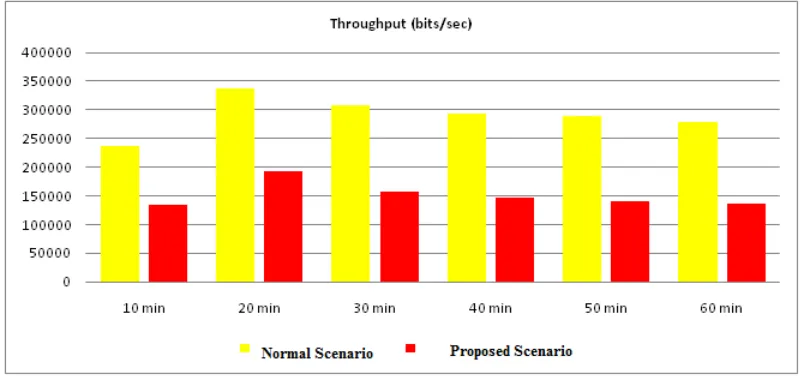
Throughput can be defined as the ratio of the total amount of data reaches a destination from the source. The time it takes by the destination to receive the last message is called as throughput. It can express as bytes or bits per seconds (byte/sec or bit/sec). There are some factors that affect the throughput such as; changes in topology, availability of limited bandwidth, unreliable communication between nodes and limited energy. A high throughput is absolute choice in every network.
Fig. 3- Throughput of cloud computing with & without VMLoad Balancing Algorithm
In figure 3, the graph represents the throughput in bits per seconds. The x-axis denotes the simulation time in minutes and the y-axis denotes throughput in bits per seconds. In this graph compare throughput data in cloud computing with virtualization and cloud computing without virtualization. In this the blue bar indicates cloud with virtualization and red bar indicate the cloud computing without virtualization in both bar the throughput value flow in bit per second.
IX. CONCLUSION
powers, the requests/ tasks (application services) are allocated or assigned to the most potential VM and then to the lowest and so on. Thus we have optimized the provided performance parameters i.e. data processing time and response time, providing an effective VM Load Balancing algorithm such as ‘Weighted Active Load Balancing Algorithm’ in the Cloud Computing atmosphere.
REFERENCES
[1] Nisha Peter, ”Cloud Computing and Real time Application”, International Journal of Emerging Technology and Advanced Engineering, Vol. 5, Issue 6, pp 266-269, June 2015.
[2] Kc gounda, Anurag Patro, Dines Dwivedi and Nagaraj Bhat ”Virtualization approaches in cloud computing” International Journal of Computer Trends and Technology (IJCTT), Vol. 12, Issue 4, pp161-166, June 2014.
[3] Ivan Stojmenovic and Sheng Wen,” The Cloud Computing Paradigm: Scenarios and Security Issues”, In the Proceedings of Federated Conference on Computer Science and Information Systems, Vol. 2, pp. 1–8, 2014.
[4] Swati Agarwal, Shashank Yadav and Arun Kumar Yadav,” An Efficient Architecture and Algorithm for Resource Provisioning in Cloud Computing”, I.J. Information Engineering and Electronic Business, pp 48-61, January 2016
[5] Clinton Dsouza, Gail-Joon Ahn and Marthony Taguinod,” Policy-Driven Security Management for Cloud Computing: Preliminary Framework and A Case Study”, IEEE IRI 2014, No. 13, pp 16-23, August 2014.
[6] K.P.Saharan and Anuj Kumar,” Cloud in Comparison to Cloud: A Survey”, International Journal of Computer Applications (0975 – 8887), Volume 122 – No.3, pp 10-12, July 2015.
[7] T.Rajesh Kanna, M. Nagaraju and Ch.Vijay Bhaskar,” Secure Cloud Computing: Providing Data Security”, International Journal of Research in Computer and Communication Technology, Vol 4, Issue 1, pp 53-55, January– 2015.
[8] D.C.Saste, P.V.Madhwai, N.B.Lokhande and V.N.Chothe,” CLOUD COMPUTING: Comprehensive Approach for Avoiding Data Theft Attack Using Decoy Technology”, International Journal Computer Technology and Application, Vol 5(5), pp 1768-1771, Sept.-Oct. 2014.
[9] Tom H. Luan, Longxiang Gao, Zhi Liz, Yang Xiang, Guiyi Wey, and Limin Sunz,” Cloud Computing: Focusing on Mobile Users at the Edge”, arXiv:1502.01815v3 [cs.NI] , pp 1-11, 30 Mar 2016.
[10] Rajesh Bose, Murari Krishna Saha and Debabrata Sarddar,” Cloud Computing Made Easy with the Help of Citrix and Billboard Manager”, International Journal of Computer Applications (0975 – 8887), Volume 121 – No.7, pp 19-23, July 2015.
[11] Viraj G. Mandlekar, VireshKumar Mahale, Sanket S.Sancheti and Maaz S. Rais,” Survey on Cloud Computing Mitigating Data Theft Attacks in Cloud”, International Journal of Innovative Research in Computer Science & Technology, ISSN: 2347-5552, Volume-2, Issue-6, pp 13-16, November 2014.
[12] Durairaj. M and Kannan.P,” A Study On Virtualization Techniques And Challenges In Cloud Computing”, International Journal of Scientific & Technology Research, ISSN 2277-8616 , Volume 3, Issue 11, pp 147-151, November 2014
[13] Kamyab Khajehei,” Role of virtualization in cloud computing”, International Journal of Advance Research in Computer Science and Management Studies, ISSN: 2321-7782, Volume 2, Issue 4, pp 15-23, April 2014.
[14] Thogaricheti Ashwini and Mrs. Anuradha.S.G,” Cloud Computing to protect real and sensitivity information in Cloud”, International Journal of Electronics and Computer Science Engineering, ISSN- 2277-1956, Volume 4, Number 1, pp 19-29
[15] Divya Shrungar J, Priya M P and Asha S M,” Cloud Computing: Security in Cloud Environment”, International Journal of Advanced Research in Computer Science and Software Engineering, ISSN: 2277 128X, Volume 5, Issue 8, pp 803-807, August 2015.
[16] http://blogs.cisco.com/perspectives/iot-from-cloud-to-cloud-computing [17]http://www.webopedia.com/quick_ref/cloud_computing.asp
[18] Cisco, “Cisco delivers vision of cloud computing to accelerate value from billions of connected devices,” Cisco, Tech. Rep., Jan. 2014.