University of Windsor
University of Windsor
Scholarship at UWindsor
Scholarship at UWindsor
Electronic Theses and Dissertations
Theses, Dissertations, and Major Papers
1-1-1970
Concept identification as a function of the conceptual rule and
Concept identification as a function of the conceptual rule and
length of the post-informative feedback interval.
length of the post-informative feedback interval.
Robert N. Carey
University of WindsorFollow this and additional works at: https://scholar.uwindsor.ca/etd
Recommended Citation
Recommended Citation
Carey, Robert N., "Concept identification as a function of the conceptual rule and length of the post-informative feedback interval." (1970). Electronic Theses and Dissertations. 6848.
https://scholar.uwindsor.ca/etd/6848
CONCEPT IDENTIFICATION AS A FUNCTION OF THE
CONCEPTUAL RULE AND LENGTH OF THE
POST-INFORMATIVE FEEDBACK INTERVAL
by
ROBERT N. CAREY
B.A., York University, 1969
A Thesis
Submitted to the Faculty of Graduate Studies through the Department of Psychology in Partial Fulfillment
of the Requirements for the Degree of Master of Arts at the University of
Windsor
Windsor, Ontario, Canada 1970
U M I N um ber: E C 5 2 7 9 1
IN F O R M A T IO N T O U S E R S
T h e quality of this reproduction is d ep e n d e n t upon th e quality of th e copy
subm itted. B roken or indistinct print, colored or poor quality illustrations and
photographs, print bleed-through, sub standard m argins, and im proper
alig n m en t can a d versely a ffect reproduction.
In the unlikely e v e n t that the auth o r did not send a co m p lete m anuscript
and th e re are missing pages, th e s e will be noted. Also, if unauthorized
copyright m aterial had to be rem o ved , a note will indicate th e deletion.
®
UMI
U M I M icroform E C 5 2 7 9 1
C opyright 2 0 0 8 by P ro Q u e s t LLC.
All rights reserved . This m icroform edition is protected again st
unauthorized copying u n d er Title 17, United S ta te s C ode.
P ro Q u e s t LLC 7 8 9 E. E ise n h o w e r P arkw ay
/I 3 5
^
31
*?
APPROVED BY:
iSMT
321804
ABSTRACT
Each of 144 _Ss solved one of two rule learning problems in
a study which combined four conceptual rules and three (l, 8 or
15 sec.) post-informative feedback intervals in an orthogonal
design. Visual stimuli varying in three (2 relevant and 1 irrele
vant) tri-level dimensions were sorted into one of two response
categories with the restriction that each successive block of 12
stimuli would have an equal number of positive and negative instances.
The restriction necessitated the duplication of some stimulus
patterns. A criterion of 16 consecutive correct responses or a
total of 96 trials was used. The task was paced with no correction
permitted and no delay in the presentation of informative feedback.
Both errors-to-criterion and trials-to-criterion data indicated
a hierarchy of problem difficulty running in the following order
from the easiest to most difficult: conjunctive, inclusive disjunc
tive, exclusive disjunctive and biconditional rules. It is of
interest to note that the latter two are complementary rules,
however, the exclusive disjunctive rule was found to be significantly
easier to learn than the biconditional rule. The range of post-
informative feedback intervals used in the study did not produce
differential performance on the task.
PREFACE
The current study began mhen the author became interested
in concept acquisition tasks, especially those involving the
identification of conceptual rules. Specifically, interest
centered on mhat effect increasing the length of the post-informa
tive feedback (PIF) interval mould have on the identification of
concepts based on different conceptual rules. It mas felt that
such research mould add further important information on the
effect of the PIF interval in concept learning tasks.
I mould like to express my gratitude to Dr. G. Namikas, my
director, mhose helpful suggestions and lasting guidance made this
paper possible. Thanks must also go to Dr. A. Kobasigama and
Dr. R. Orr for their valuable suggestions and criticisms. Finally,
mords of appreciation must be extended to Bill Somes, the laboratory
technician, to George Andreoff mho assisted in the experiment, and
to all those subjects mho kindly participated in the study.
iii
TABLE OF CONTENTS
Page
P R E F A C E ... iii
LIST OF T A B L E S ...v
LIST OF F I G U R E S ... vi
Chapter I REVIEUJ OF THE L I T E R A T U R E ...1
Purpose of the Present Research . • 10 II METHODOLOGY AND PROCEDURE . . . . 13
Subjects A pparatus Stimuli Design Procedure 13 13 14 16 18 III R E S U L T S ... 21
Number of Failing Subjects . . . 21
Trials to Criterion . . . 21
Total Errors . . . 23
IV D I S C U S S I O N ...34
BIBLIOGRAPHY ... 41
APPENDIX A Stimulus Patterns Used . . . 43
APPENDIX B Problems and Corresponding Attributes . . 44
APPENDIX C Problems Used for Different Treatment Conditions . . . 45
APPENDIX D Instructions to Subjects . . . . 46
APPENDIX E Trials-to-Criterion, Total Errors and Ability to Verbalize the Rule for Each Subject as a Function of the Rule Used . . . 48
LIST OF TABLES
Table
1
2
3
4
5
6
Page
Number of Failures as a Function of the
Conceptual Rule Used . . . . 22
Summary of an Analysis of Variance on
Trials to Criterion . . . 24
Nemman-keuls qr Values for Differences B8tuieen Pairs of Ordered Wean Trials-to-
Criterion Scores for Rules . . . 25
Wean Errors for Successive Blocks of 12 Trials as a Function of the Conceptual
Rule Used in the Task . . . . 26
Analysis of Variance for Repeated Measures on Error Scores for Blocks
of Trials . . . 27
Neuiman-keuls qr Values for Differences Between Pairs of Ordered Mean Error Scores
for the Rule Variable . . . . 29
LIST OF FIGURES
Figure Page
1 Diagramatic Representation of Time
Intervals Controlled by the GLA • . 17
2 lYlean Error Scores for the Four Conceptual Rules Used Shouin in
Blocks of 12 Trials Each . . . . 31
3 Average Mean Error Scores of the Four Conceptual Rules Used Shou/n
CHAPTER I
REVIEW OF THE LITERATURE
Bourne (1966) defines a concept as a category of things which
are perceptible and have a real existence in the organism's
environment; things being referred to as stimuli or stimulus objects.
Stimuli vary along dimensions; however, not all of the dimensions
on which the stimuli belonging to a certain conceptual class vary,
are important in defining the concept. As Bourne (1966) points
out, we refer to those dimensions which are important in delineating
the concept as 'relevant' and those which are not important as
'irrelevant'. Furthermore, a dimension has (by definition) at
least two and usually more discriminably different values or
attributes. For example, red, green, blue, etc., are different
values within the dimension of colour (or hue). Finally, some
stimuli illustrate the concept and others do not. UJe refer to
those stimuli which illustrate or exemplify the concept as
'positive instances' and those which do not exemplify the concept
as 'negative instances'.
It is evident from the literature on concept learning, that
the majority of studies in this area have concentrated on attribute
identification (AI) problems, in order to determine if the complexity
of the stimuli used affects problem acquisition when rule difficulty
is held constant.
1
2
In attribute identification studies, the complexity of stimuli
used (complexity determined by the number of relevant and irrelevant
dimensions) varies, while the rule combining the attributes is held
constant.
A second type of concept learning task is referred to as
'rule learning' (RL) . The complexity of stimuli is held constant,
uihile the conceptual rule varies in this task. The subject (S) is
told the relevant attributes or dimensions and must attempt to
identify the rule by which the attributes are combined.
If tuio attributes "red" and "square" are arbitrarily designated
as relevant, then a conjunctive conceptual rule would be exemplified
by all stimulus patterns which contain both the attributes 'red'
and 'square' together. For inclusive disjunction ("and/or"), all
stimulus patterns which are 'red' or 'square' or both are examples
of this conceptual rule. In the case of exclusive disjunction ("or"),
all patterns which are 'red' or 'square' but not both are examples
of the rule. For the conditional rule ("if-then"), if a pattern is
'red' then it must also be 'square', for it to be an example of the
rule. Finally for the bi-conditional rule, ("if and only if"), 'red'
patterns are examples if and only if they are 'square'; while at
the same time patterns which are not 'red' are examples if and only
if they are not 'square' (Bourne, 1967).
Rule Learning
It is important to realize, as Haygood and Bourne (1965) have
3
centered primarily on the discovery or identification of relevant
attributes (i.e., attribute identification problems). In studies
of this sort, the typical procedure is to describe and illustrate
the general form of the solution with preliminary instructions and
practice problems. That is, the _S is given the relevant rule or
form of solution and must attempt to discover or identify the
relevant attributes required for problem solution. As Haygood and
Bourne (1965), point out, however, little concern has been fostered
for the study of conceptual rule learning as a variable, for the
purpose of determining whether rules are intrinsically different
in difficulty when the subject is not required to identify relevant
attributes. In conceptual rule learning or rule identification
tasks, therefore, the _S is told the relevant attributes and must
thereby attempt to identify the rule by which these attributes are
combined.
Bruner, Goodnow and Austin (1956) upon examination of their
own studies and data provided by Hovland and Uleiss (1953) for AI
tasks, suggest that disjunctive conceptual rules may be more difficult
to learn or identify than conjunctive conceptual rules, possibly
as a result of the way in which _Ss utilize positive and negative
instances. They state that _Ss do not seem to be as willing or able
to use negative instances telling what the concept is not, as opposed
to positive instances in attaining a concept. This reluctance
appears to carry over to disjunctive categorizing.
The results of a study by Bourne and Guy (1968) show that in
4
AI tasks, performance tuith positive instances is best for conjunctive
concepts. Ulhen a mixture of both positive and negative instances
ujas used for both AI and RL tasks, the order of difficulty of the
rules studied ujas: conjunction, inclusive disjunction and conditional,
from easiest to hardest.
Neisser and Uleene (1962) , found that the difficulty of
conceptual problems depended upon the rule used and that conceptual
rules differed in difficulty according to the number of relevant
and irrelevant dimensions. Conceptual rules consisting of univari
ate attributes, i.e., those defined by the presence or absence of
a single attribute (redness, for example), constituted the first
level of rule complexity or difficulty. The second level of con
ceptual rule complexity mas the bi-variate group, consisting of
six rules which involve single conjunctions or disjunctions of two
relevant attributes (for example, red and square). Finally, the
most complex rules, of level three, involved both conjunctive and
disjunctive operations in a single conceptual problem, (e.g., "red
and not square" or "not red and square") .
No prediction was made concerning the relative difficulty of
rules within a single level. However, it was observed that, within
the second level of rule complexity, conjunctive problems were
found to require fewer trials to criterion that disjunctive prob lems.
Additional evidence of the greater difficulty of learning or
identifying disjunctive concepts as compared to conjunctive concepts,
5
mean number of instances chosen to problem solution was greater for
the inclusive disjunctive (D) set, than for the conjunctive (C) set,
although the difference was not significant. They also found in
summing the mean number of instances chosen over all problems, that
Ss learned to select, within a problem, a positive instance under
* C * conditions more rapidly than a negative instance under * D '
conditions. They state that _Ss appear to solve 'C' concepts sooner
since they learn to choose positive instances within a ' C' problem
more rapidly than negative instances within a ’D ’ problem. An
informational analysis was performed on card choices with respect
to the number of redundant and nonredundant card selections to
solution; a card being defined as redundant if it could not elimin
ate at least one further incorrect solution beyond those already
eliminated by the example card or proceeding card choices.
The mean number of nonredundant choices were nearly equal for
* C* and 'D 1 problems; however, the mean number of redundant choices
was significantly greater in the case of 1D ' than for ' C problems.
Haygood and Bourne (1965) described three levels of conceptual
problem difficulty as did Neisser and UJeene (1962). In addition
they conducted some experiments on rule learning in order to
determine if rules did in fact differ in difficulty. They found
that conjunctive problems required fewer t rials to s o l u t i o n than
inclusive disjunctive and conditional problems.
In another series of experiments, Bourne (1967) again showed
that, with regard to rule learning problems, rules do indeed differ
6
in difficulty, the order of increasing difficulty being; conjunctive,
inclusive disjunctive, conditional and bi-conditional.
Furthermore, Bourne, Ekstrand and Montgomery (1969), have shown
in a study involving attribute identification problems based on
four different conceptual rules (conjunctive, inclusive disjunctive,
conditional and bi-conditional) each combined factorially with four
levels of feedback availability (feedback retained for all instances,
for positive instances only, for negative instances only, and no
feedback retained) , that the order of problem difficulty varied
with the rule used, that order remaining precisely the same as that
reported in earlier work cited above (Bourne, 1967).
Some interesting results have been obtained by Bourne and Guy
(1968), however, in relation to conceptual rules. Three types of
concepts; conjunctive, inclusive disjunctive, and conditional were
used, with two different task requirements; attribute identification
(fil) and rule learning (RL). These authors found that AI tasks were
more difficult that RL tasks and that performance was affected by
the type of concept instance presented during the training series;
mixed positive and negative instances being associated with fewest and
all negative with most trials to solution. UJhen a mixture of both
positive and negative instances was used, the order of difficulty
of the rules studied was: conjunction, inclusive disjunction and
conditional from easiest to hardest for both RL and AI problems.
However when only negative instances were used in AI problems this
order was reversed: conditional, inclusive disjunction, conjunction
7
The evidence indicates, therefore, that there is a consistent
hierarchy of rule difficulty when both positive and negative instances
are used for RL problems. The order of difficulty has been shown
to be conjunctive, inclusive disjunctive, conditional and bi-condi
tional.
The Post-Informative Feedback (PIF) Interval
The recent interest in the RL aspect of concept acquisition
has been paralleled by an increase in concern with informative
feedback conditions. One aspect of such conditions is the infor
mative feedback interval, (i.e., the time between the subject's
response and the presentation of feedback). Another is the post-
informative feedback interval (i.e., the time between the presentation
of feedback and the occurrence of the next stimulus pattern) .
In a study by Bourne (1957), _Ss learned to solve one of three
conjunctive problems, (A) orientation-form, (B) vertical position-
size and
(c)
colour-number; each problem being defined as fourcombinations of two particular attributes of two relevant dimensions.
Subjects were presented with a series of geometric patterns and were
required to identify a category to which each pattern belonged by
pressing one of four unlabelled response keys. Utilizing an
informative feedback (IF) interval ranging from 0.0 to 8.0 seconds,
Bourne concluded that performance was degraded as a function of
increases in the length of the (IF) interval. As Bourne later
indicated (Bourne and Bunderson, 1963) the conclusion was question
able since the study confounded the duration of the IF interval
with the duration of the post-informative feedback (PIF) interval.
Since the screen upon which a stimulus pattern had been presented
became blank for 10.0 seconds, following _S's response, the
intertrial interval (i.e., IF interval plus PIF interval) used was
10.0 seconds. Since the informative feedback interval varied from
0.0 to 8.0 seconds, this meant that the PIF interval would also
vary in length from 2.0 to 10.0 seconds.
In another study, Bourne and Bunderson (1963), used three
conjunctive type problems, in a 3 x 3 x 2 factorial design with
three delays of IF interval (0, 4 and 8 seconds), three lengths of
post-IF interval (l, 5 and 9 seconds) and two degrees of task
complexity (l and 5 irrelevant dimensions). They found that
performance improved linearly as the post-IF interval increased,
with 5 seconds being the optimum for problems with one irrelevant
dimension; while 9 seconds seemed best for problems with five
irrelevant dimensions.
It was further shown in a study using conjunctive type
conceptual problems with one and five irrelevant dimensions
(Bourne, Guy, Dodd and Dustesen, 1965), that errors to solution
were reliably affected by three factors; number of irrelevant
dimensions, length of the PIF interval, and the interaction of
these two variables. For relatively easy problems with one
irrelevant dimension, the optimum PIF interval was 9.0 seconds,
while for relatively difficult problems, having five irrelevant
moderate increases in the length of the PIF interval (to 9.0
seconds) resulted in reliable improvements in overall performance
for both easy and difficult conceptual identification problems
(difficulty being defined in terms of the number of irrelevant
dimensions).
Finally, Roujeton and Davis (1968), in a study of conjunctive
problems in which _S was presented a series of geometric-patterned
stimuli, each pattern representing a combination of the levels of
two relevant plus two or four irrelevant binary stimulus dimensions,
found that a l t h o u g h p e r f o r m a n c e g e n e r a l l y i mp ro ved with longer PIF
intervals (up to 20 seconds), the effect was non-significant.
It would appear, therefore, on the basis of the above studies
(Bourne & Bunderson, 1963; Bourne et al., 1965; Roweton & Davis,
1968), that increases in the PIF interval facilitate performance
on conceptual learning tasks, as a direct function of problem
complexity. Roweton & Davis (1968), however, found that although
performance generally improved with longer PIF intervals, the effect
was non-significant. For relatively easy problems having one
irrelevant dimension, the optimum PIF interval appears to be in
the range of 5 to 9 seconds; while for more difficult problems with
five irrelevant dimensions, the optimum PIF interval seems to be
in the range of 9 to 15 seconds.
As indicated previously, the above functional relationship
has been investigated by using differences in stimulus complexity
to obtain differences in problem difficulty. In each case, the
task given to the _S was an AI task with the RL variable being held
constant through the use of a single rule (conjunction) for all
problems.
10
The data from RL studies have shomn that problem difficulty
may be varied through the use of conceptual problems requiring
different rules. Moreover, a rather consistent hierarchy of rule
difficulty has been observed, suggesting the extension of the
study of PIF duration to concept acquisition situations in rnhich
problem difficulty is defined by the relative difficulty of the
conceptual rule. In such a design, stimulus complexity mould be
held constant uihile the conceptual rules mould differ for different
problems.
The Present Study
The purpose mas to study the effect of PIF interval length
on concept acquisition tasks in mhich problem difficulty mas a
function of the relative difficulty of the conceptual rule, mith
stimulus complexity held constant.
As previously stated (Neisser & UJeene, 1962; Conant & Trabasso,
1964) the acquisition of conjunctive problems requires femer trials
to solution than disjunctive problems. Furthermore, mhen a mixture
of positive and negative instances mas used in RL problems, the
order of conceptual rule difficulty from easiest to hardest mas
conjunctive, inclusive-disjunctive, conditional and bi-conditional
(Haygood & Bourne, 1965; Bourne, 1967; Bourne & Guy, 1968; Bourne
et al., 1969).
On the basis of these findings, therefore, it mas hypothesized
11
mould differ in difficulty (measured in terms of mean number of
trials and mean errors to criterion), the order being from easiest
to hardest: conjunction, inclusive disjunction and bi-conditional.
A condition utilizing an exclusive disjunctive rule was also
included in the present study for comparative purposes, however,
this condition was not expected to differ in objective difficulty
from the bi-conditional rule condition, since these two rules are
complementary to each other.
Secondly, it was stated above (Bourne & Bunderson, 1963;
Bourne et al., 1965; Roweton & Davis, 1968) that increases in the
PIF interval facilitate performance on conceptual tasks as a direct
function of problem complexity; complexity measured in terms of
the number of relevant and irrelevant dimensions. On the basis
of the findings from these studies, two additional hypothesis were
formulated.
It was hypothesized that increases in the length of the PIF
interval would facilitate performance on concept identification
tasks requiring a conjunctive, inclusive disjunctive, exclusive
disjunctive and bi-conditional type of solution.
Finally, it was hypothesized that performance (measured in
terms of both mean number of errors and trials to criterion) would
improve for conjunctive, inclusive disjunctive, exclusive disjunctive
and bi-conditional conceptual rule learning, as a function of
moderate increases in the PIF interval. That is, it was hypothesized
that optimal performance (measured in terms of both the mean number
12
of errors and mean trials to criterion) mill be associated with
shorter PIF intervals for easier (conjunctive) conceptual rule
learning task whereas the acquisition of more difficult conceptual
rules (inclusive disjunction, exclusive disjunction and bi
conditional) u/ill require longer PIF intervals for optimal perfor
CHAPTER II
METHODOLOGY AND PROCEDURE
Subjects. The _Ss were 144 first and second year psychology
students from the University of Windsor, assigned in order of
appearance to one of 24 treatment conditions.
Apparatus. The Generalized Learning Apparatus (GLA) described
in detail by Cervin et al., (1965), was used in the present
experiment. Briefly, the GLA consists of a master control panel
(19 in. x 86 in.) and six subject panels (19 in. x 14 in.) mounted
on wooden frames and inclined at approximately 30° towards the _S.
The master control panel is located in a sound-proof room separated
from the _Ss room by a wall containing a one-way mirror.
□ n each of the_S's panels there is a blue warning light
(6.3 v., blue jewel) at the top, six white stimulus (CS) lights
(NE 51 neon bulbs, white jewel) in a row across the middle of the
panel, and a bottom row of six response buttons with an orange cue
light (NE 51 neon bulbs) directly above each response button. On
the left of each panel is a column of 7 green (positive reinforce
ment) lights (6.3 v., green jewel), and on the right a column of
7 red (negative reinforcement) lights (6.3 v., No 47 red jewel).
For the purposes of the present experiment, the following
lights and buttons were exposed to the _S: the blue warning light
(6.3 v., blue jewel) at the top of the panel, a single white stimulus
(CS) light (NE 51 neon bulb, white jewel) in the middle of the
13
14
panel which served as a cue light, ttuo response buttons located at
the middle of the bottom row of response buttons. These two
buttons were labelled with a positive (+) or a negative (-) sign
to indicate a positive instance category (example) and a negative
instance category (non-example), with which to classify the stimulus
patterns. In addition, a single green (positive reinforcement)
light on the left (6.3 v., green jewel) and a single red (negative re
inforcement) light on the right (6.3 v., No. 47 red jewel) was
exposed, through which feedback was presented to the _S. All
remaining lights not used in the experiment were taped over.
Stimuli. The stimulus patterns were geometric designs, pre
pared on photographic slides and varying along three tri-level dimen
sions. Dimensions and their corresponding attributes were: colour
(red, yellow and blue), form (star, triangle and circle), and
number (1, 2 or 3 identical figures), All possible combinations
of these three tri-level dimensions result in 27 separate stimulus
3
patterns (3 = 27). These 27 stimulus patterns (see Appendix A)
were used in making up 24 different stimulus series, one series
corresponding to each of the problems to be used in the 24 different
treatment conditions.
UJith the GLA used in the present experiment the maximum number
of trials which could be executed prior to the recycle phase was
36. UJhen 36 trials had been executed, therefore, the machine
15
series used in this experiment consisted of 96 stimulus patterns
chosen from the original 27 patterns shown in Appendix A. That is,
each stimulus series consisted of 96 tirals, a number felt to be
adequate for the level of problem complexity used in the present
study (see Haygood and Bourne, 1965). In order to equalize the
number of positive and negative instances within each stimulus
series (i.e., 96 trials), 6 positive and 6 negative instances were
randomly assigned to each block of 12 stimulus patterns (i.e., 12
trials). In so doing, this held constant the number of positive
and negative instances (examples, and non-examples) for each pair
of relevant attributes chosen, over all rule-learning conditions.
The number of positive and negative instances for all
treatment conditions, were equalized in an attempt to minimize the
differential facilitating effects which might have resulted for
the different rule-learning conditions, were positive and negative
instances not equalized (Bourne and Guy, 1968). Equalizing positive
and negative instances within blocks of 12 trials, however,
necessitated replication of certain stimulus patterns shown in
Appendix A.
The GLA was used to control the presentation of stimuli to the
_5s, the length of time that the stimulus pattern remained on
(stimulus interval), the presentation of a cue light to the _s for
3.0 seconds during which time the _S was required to respond (the
response interval), the time between the _S's response and the
presentation of feedback (the informative feedback (IF) interval)
and the length of time between feedback and the presentation of
16
the next stimulus pattern (the post-informative feedback interval;
PIF interval) (See figure l ) . In addition the GLA was used to
automatically record the _S's response by means of an Esterline
Angus Event Recorder. Responses were also recorded manually by
the experimenter (E).
Colour slides u/ere made to provide the complete stimulus series.
The stimulus patterns were projected onto a white viewing screen
centrally placed on the one-way mirror separating the E's control
room from the _S's experimental room. The stimulus patterns (colour
slides) were projected onto this screen from the control room by
means of a slide projector. Both the control room and the experi
mental room were semi-dark in order to produce a clear image for
the _Ss, since the one-way mirror cuts down considerably the trans
mitted light. The slide projector was controlled through the GLA
control panel. Wooden partitions were placed on either side of
_S's panel so that no _S could see the responses given by or the
feedback presented to any other _S. The _S's panel was situated so
that he could clearly see the viewing screen.
Design. A 4 x 3 x 2 orthogonal design was used. Four types
of conceptual rules (conjunctive, inclusive disjunctive, exclusive
disjunction and bi-conditional) x three durations of post-
informative feedback interval (1 second, 8 seconds, and 15 seconds)
x two types of problems (Colour - Form and Number-Form).
Within each of these two problems; colour-form and number-form,
there were nine different pairs of relevant attributes (see Appendix B ) .
R e pr od uc ed w ith p e rm is s io n of th e c o p y rig h t own er. F u rt h e r re p ro d u c tio n p ro h ib ite d w ith o u t p e rm is s io n .
BLUE L IG H T
BLUE L I G H T
6 sec.
S T IM U L U S
STIMULUS
I N T E R V A L
IN T E R V A L
6 sec.
WHITE
RESP.
L I G H T
I N T R L .
3 sec.
P I F
I N T E R V A L
( v a r i a b l e
l e n g t h )
FIG. I. Diagramatic representation of time intervals controlled by the GLA.
18
in order to reduce the possible effect that the transmission of
information from the experienced to the naive _Ss might have had on
the experimental results. That is, each of the 24 experimental
groups (6 _Ss per group) was assigned a single rule-learning
problem, each of these problems based on a different pair of
relevant attributes, whenever possible.
Procedure. The task required the _S to classify a series of
96 stimulus patterns into either of two categories (positive or
negative instances) according to some conceptual rule unknown to
the _S. The correct classification for any stimulus pattern was
determined both by the pair of attributes relevant in the particular
problem and by the conceptual rule which specifies the relationship
between these attributes.
At the outset, all _Ss were given detailed oral instructions
describing the stimulus population and the task (see Appendix D ) .
They were told that the stimulus patterns would be presented one
at a time and that they must be classified into either of two
categories (i.e., those thbt are and those that are not examples
of the rule they are required to learn) . All _Ss were told that the
stimulus patterns would vary along three dimensions, each dimension
containing three attributes. The dimensions and their corresponding
attributes were described. The _Ss panel and the use of the various
buttons on the panel which were pertinent to the experiment were
explained to the S. Since this experiment consisted of rule
19
beginning of each problem but no instructions or explanation con
cerning the rule (that is, the may in mhich the attributes mere
to be combined), mas given. A set of standard instructions mas
read to all _Ss (see Appendix D) .
For all _Ss each stimulus pattern remained on for 6.0 seconds.
A blue marning light appeared on the_S's panel simultaneously mith
the presentation of the stimulus pattern on the screen. Three
seconds after this blue light and the stimulus pattern appeared,
a rnhite cue light came on and remained on for 3.0 seconds. All _Ss
mere instructed to place their finger on the response button of
their choice (one of turn buttons) but to respond only during the
3.0 second interval that the rnhite cue light remained on. Folloming
this three second response interval the blue light ment off, the
projector mas advanced to a blank slide (no stimulus pattern) , and
the informative feedback lights came on. These IF lights remained
on through the duration of the PIF interval. At the end of the
PIF interval the blue light came on causing the feedback lights
to go off, mhile at the same time the projector mas advanced to
the next stimulus pattern. The only interval that varied, therefore,
mas the PIF interval, taking on lengths of 1, 8, or 15 seconds.
Six _Ss mere run simultaneously on the GLA. UJhen one or more
of the subjects failed to shorn up they mere run at a later time
under the conditions specified for that treatment. In case of a
single non-shom _S, an attempt mas made to run two _Ss at the same
time; aftermhich one mas discarded at random if only a single _S mas
needed, in order to make the condition more analagous to the group
20
situation in tuhich the other _Ss had been run.
The Ss mere asked at the conclusion of the
down the rule they had arrived at in responding
experiment to write
CHAPTER III
RESULTS
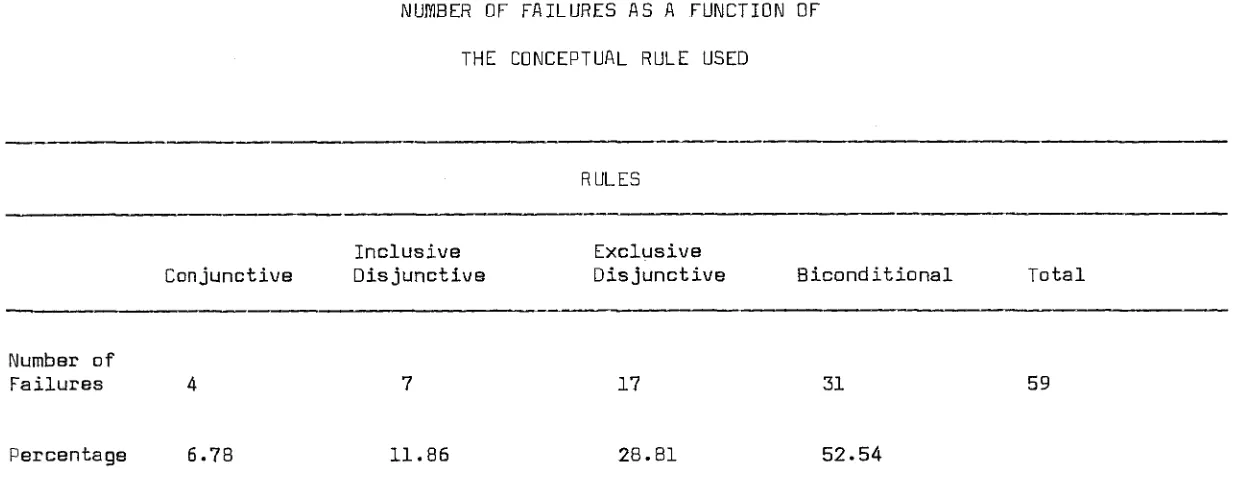
Number of Failing Subjects. One hundred and forty-four _Ss
were used in the present experiment, 36 being assigned to each of
the four rule learning conditions. Of these 1 4 4 _Ss, 59 (i.e., 41^)
failed to reach the criterion of 16 consecutive correct responses
within the 96 allotted trials.
Obtained frequencies for the number of failures for the rule
variable are shown in Table 1. Chi-square analyses on the frequency
of failures indicated that the rule variable was a significant
2
determiner of failure (X = 30.153, df = 3; p<.0l). The signifi
cant chi-square is due primarily to the larger than expected
number of failures in the biconditional group and the smaller than
expected number of failures in the conjunctive group.
Of the 59 _Ss who failed to reach the criterion (of 16 consecutive
correct responses) the percentages accounted for by each of the
rules was: biconditional, 52.54; exclusive disjunctive, 28.81;
inclusive disjunctive, 11.86 and conjunctive, 6.78.
A chi-square analysis on the frequency of failures indicated
that the PIF interval variable was not a significant determiner
of failure (X2 = 2.576, df = 2;,10>p>.05).
Trials to Criterion.'1' Data on trials-to-criterion, total
1. _Ss who did not reach the criterion of 16 consecutive correct responses were assigned a score of 96. The criterion run of 16
trials was not included in the total for each _S.
21
R e pr od uc ed w ith p e rm is s io n of th e c o p y rig h t own er. F u rt h e r re p ro d u c tio n p ro h ib ite d w ith o u t p e rm is s io n .
TABLE I
NUJY1BER OF FAILURES AS A FUNCTION OF
THE CONCEPTUAL RULE USED
RULES
Conjunctive
Inclusive Disjunctive
Exclusive
Disjunctive Biconditional Total
Number of
Failures 4 7 17 31 59
Percentage 6.78 11.86 28.81 52.54
23
errors and the ability to verbalize the correct rule are shown
(Appendix E) for each _5 as a function of the rule used. An analysis
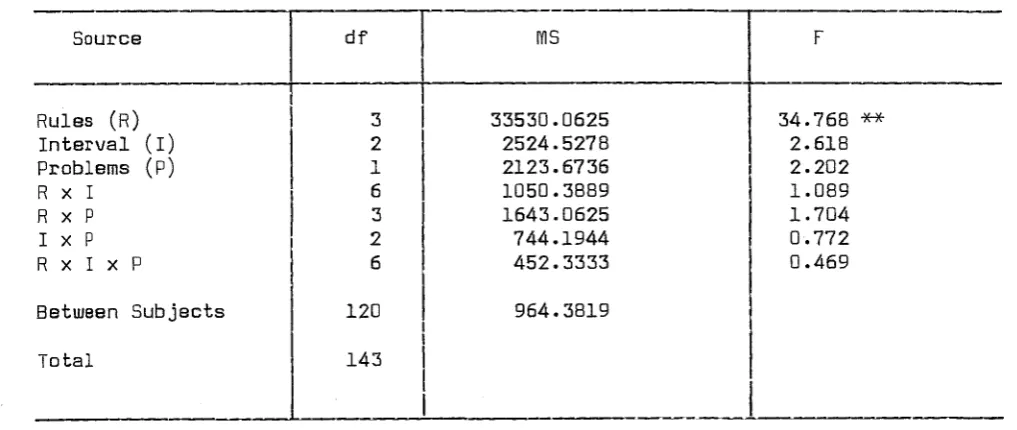
of variance on the trials-to-criterion data (Table 2), revealed
a significant main effect for rules (F = 34.77, df = 3/l20; p<.0l)
indicating that tasks based on conjunctive, inclusive disjunctive,
exclusive disjunctive and biconditional conceptual rules differ
in ease of acquisition. No other effects were found to be signi
ficant on the trials-to-criterion data.
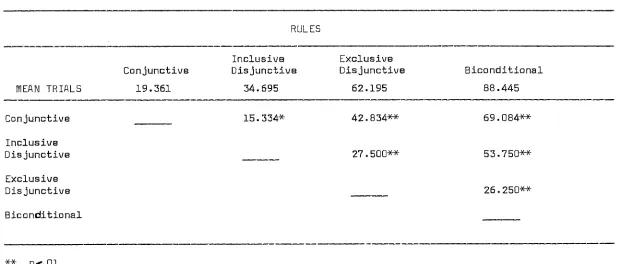
Comparisons among the mean trials-to-criterion scores for
rules were made, using the Newman-Keuls procedure (UJindr, 1962),
to determine which of the possible differences were significant.
Table 3 shows the results of these comparisons.
All rules differed significantly from each other at the .01
level of significance with the exception of the inclusive disjunctive
rule which differed significantly from the conjunctive rule at the
.05 level of significance.
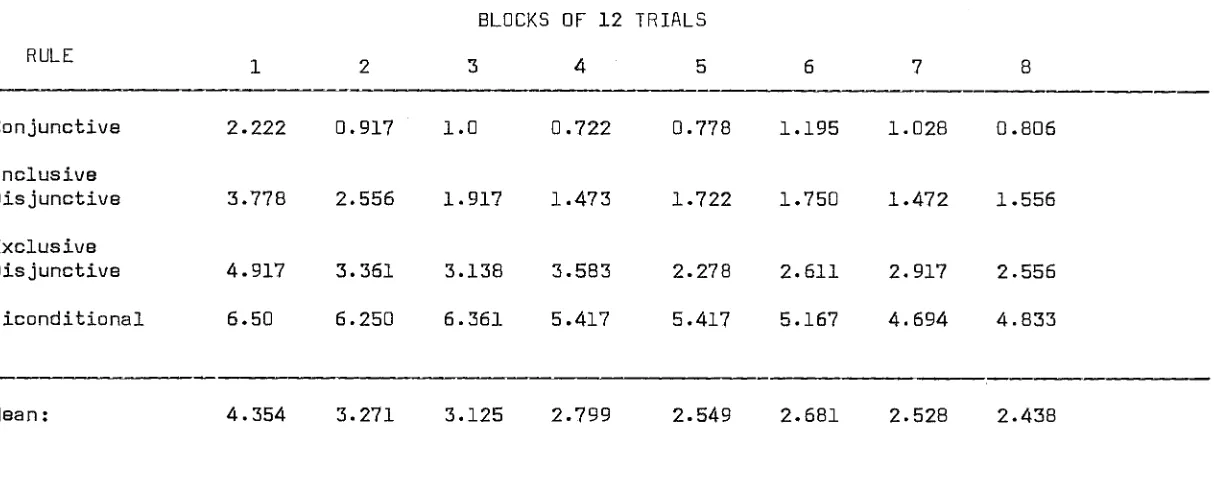
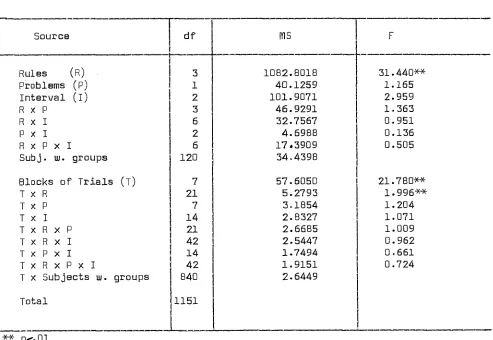
Total Errors. It was considered worthwhile to look at error
scores as a function of length of practice on the task for the
different rules used. The trials were then grouped into blocks
to twelve (see Table 4). An analyses of variance on error scores
for Blocks of Trials (Table 5) confirmed the previous findings in
that again a significant main effect for Rules (F = 31.44, df = 3/l20;
p<.0l) was found. It is interesting to observe in Table 4, that
for each of the 8 blocks of 12 trials mean errors increase from
the conjunctive rule through the biconditional rule.
R e pr od uc ed w ith p e rm is s io n of th e c o p y rig h t own er. F u rt h e r re p ro d u c tio n p ro h ib ite d w ith o u t p e rm is s io n .
TABLE 2
SUMMARY OF AN ANALYSIS OF VARIANCE ON
TRIALS TO CRITERION
Source df MS F
Rules (R) 3 33530.0625 34.768 **
Interval (i) 2 2524.5278 2.618
Problems (P) 1 2123.6736 2.202
R x I 6 1050.3889 1.089
R x P 3 1643.0625 1.704
I X P 2 744.1944 0.772
R x I X P 6 452.3333 0.469
Betmeen Subjects
Total
120
143
964.3819
R e pr od uc ed w ith p e rm is s io n of th e c o p y rig h t own er. F u rt h e r re p ro d u c tio n p ro h ib ite d w ith o u t p e rm is s io n .
TABLE 3
NEUJIYIAN-KEULS qr VALUES FOR DIFFERENCES BETWEEN PAIRS OF ORDERED IYIEAN TRIALS-TO-CRITERION
SCORES FOR RULES
RULES Conjunctive Inclusive Disjunctive Exclusive Disjunctive Biconditional
IYIEAN TRIALS 19.361 34.695 62.195 88.445
Conjunctive 15.334* 42.834** 69.084**
Inclusive
Disjunctive 27.500** 53.750**
Exclusive
Disjunctive 26.250**
Biconditional
** p<.Ql * p<.05
to
R e pr od uc ed w ith p e rm is s io n of th e c o p y rig h t own er. F u rt h e r re p ro d u c tio n p ro h ib ite d w ith o u t p e rm is s io n . TABLE 4
IYIEAN ERRORS FOR SUCCESSIVE BLOCKS OF 12 TRIALS
AS A FUNCTION
USED
OF THE
IN THE
CONCEPTUAL
TASK
RULE
BLOCKS OF 12 TRIALS
RULE
1 2 3 4 5 6 7 8
Conjunctive 2.222 0.917 1.0 0.722 0.778 1.195 1.028 0.806
Inclusive
Disjunctive 3.778 2.556 1.917 1.473 1.722 1.750 1.472 1.556
Exclusive
Disjunctive 4.917 3.361 3.138 3.583 2.278 2.611 2.917 2.556
Biconditional 6.50 6.250 6.361 5.417 5.417 5.167 4.694 4.833
Hflean: 4.354 3.271 3.125 2.799 2.549 2.681 2.528 2.438
R e pr od uc ed w ith p e rm is s io n of th e c o p y rig h t own er. F u rt h e r re p ro d u c tio n p ro h ib ite d w ith o u t p e rm is s io n .
TABLE 5
ANALYSIS OF VARIANCE FOR REPEATED 1Y1EASURES
ON ERROR SCORES FOR BLOCKS OF TRIALS
Source df IY1S F
Rules (R) 3 1082.8018 31.440**
Problems (P) 1 40.1259 1.165
Interval (i) 2 101.9071 2.959
R x P 3 46.9291 1.363
R x I 6 32.7567 0.951
P x I 2 4.6988 0.136
R X P X I 6 17.3909 0.505
Subj. uj. groups 120 34.4398
Blocks of Trials (T) 7 57.6050 21.780**
T X R 21 5.2793 1.996**
T x P 7 3.1854 1.204
T x I 14 2.8327 1.071
T x R X P 21 2.6685 1.009
T x R x I 42 2.5447 0.962
T x P x I 14 1.7494 0.661
T X R X P x I 42 1.9151 0.724
T X Subjects u/. groups 840 2.6449
Total 1151
28
A Newman-Keuls test (see Table 6) showed that all rules differed
significantly from each other (p<.0l).
The analysis of variance on error scores for Blocks of Trials
(Table 5) also revealed a significant main effect for Blocks of
Trials (F = 21.78, df = 7/840; p<,0l) and a significant Rules X
Blocks of Trials interaction (F = 1.996, df = 2l/840; pc.Ol) was
obtained. No other significant effects were found on the total
errors data.
Comparisons among mean error scores for Blocks of Trials using
the Newman-Keuls method (UJiner, 1962) showed that there were
significantly more errors in the first block of trials than in all
other blocks (p<;.0l); that there were significantly more errors in
the second block than in blocks 8, 7 and 5 (p<.0l) and finally that
there were a significantly greater number of errors in block 3
than in block 8 (p<.0l). It was also shown that block 2 differed
significantly from blocks 6 and 4, and that block 3 differed
significantly from blocks 7 and 5 (p<.05). In addition it was found
that of the 85 _Ss who attained the criterion of 16 consecutive
correct responses, 46(54.76%) did so during the first block of 12
trials, while 61 (71.76%) did so during the first 24 trials. Only
24 _Ss (28.24%), however, attained the criterion of 16 consecutive
correct responses in blocks 3 through 7.
The significant Trials main effect, therefore, is due mainly
to the reduction in errors which occurs from the first block to
R e pr od uc ed w ith p e rm is s io n of th e c o p y rig h t own er. F u rt h e r re p ro d u c tio n p ro h ib ite d w ith o u t p e rm is s io n .
TABLE 6
NE1M1AN-KEULS qr VALUES FOR DIFFERENCES BETUJEEN PAIRS OF ORDERED IYIEAN ERROR SCORES
FOR THE RULE VARIABLE
RULES
IYIEAN ERRORS
Conjunctive 8.667 Inclusive Disjunctive 16.306 Exclusive Disjunctive 25.361 Biconditional 44*639
Conjunctive 7.639** 16.694** 35.972**
Inclusive
Disjunctive 9.055** 28.333**
Exclusive
Disjunctive 19.278**
Biconditional
** p<.01
N>
30
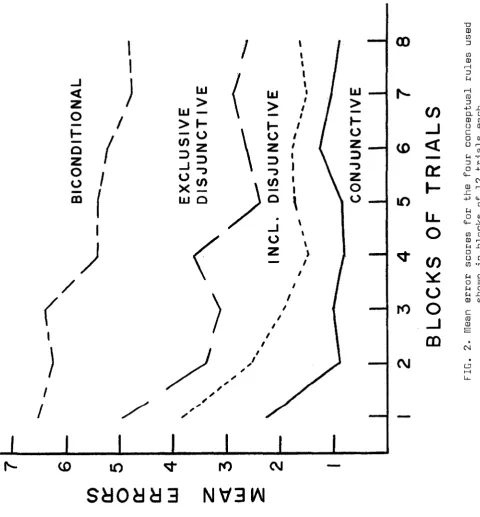
mean errors for the Rules X Blocks of Trials interaction are
shown in Figure 2, while Figure 3 shows average mean error scores
of the four conceptual rules used in Blocks of Trials. The
significant difference between the first Block of Trials and the
other 7 Blocks of Trials is evident in Figure 3. It is further
evident from Figure 2 that for all rules except the biconditional,
the greatest decrease in mean number of errors occurs in the first
Block of Trials.
Finally, the verbal responses obtained from all 144 _Ss at
the conclusion of the experiment showed that of the 36 _Ss who worked
on one of the 4 RL tasks, the number of _Ss who were able to verbalize
the rule correctly were 27, 7, 11 and 1 for the conjunctive,
inclusive disjunctive, exclusive disjunctive and biconditional
rule tasks respectively.
In summary, the findings from the chi-square analyses and the
analyses of variance on trials-to-criterion and error scores show
that rules do differ in difficulty. The significant main effect
for Rules was mainly due to the significant difference in difficulty
between the biconditional rule learning task and the conjunctive
rule learning task, although the biconditional rule task also
differed in difficulty from both the inclusive and exclusive dis
junctive rule learning tasks. In addition the exclusive disjunctive
rule task was shown to differ significantly in difficulty from
both the conjunctive and inclusive disjunctive rule learning tasks.
Finally, the inclusive disjunctive rule task differed significantly
3.1
I
1
I
I
__ I
__ I
__I
N-
CD
lO
^
ro
CM
—
S U 0 U U 3
NV3IAI
Reproduced with permission of the copyright owner. Further reproduction prohibited without permission.
33
An analysis of variance for repeated measures on errors for
Blocks of Trials, revealed a significant main effect for Blocks of
Trials and a significant Rules X Blocks of Trials interaction.
The significant Trials main effect was due mainly to the reduction
in errors which occurred from the first block to the successive
blocks of trials.
CHAPTER IV
DISCUSSION
The preliminary analysis outlined in this paper revealed
a significant main effect for both Rules and Blocks of Trials.
A significant Rules X Blocks of Trials interaction was also found.
No significant main effects mere found, hotuever, for the PIF
interval variable.
Regarding conceptual rule difficulty the results of the
present study are consistent with the previous finding that when
a mixture of positive and negative instances are used in RL problems
the order of conceptual rule difficulty is conjunctive, inclusive
disjunctive and biconditional (Haygood and Bourne, 1965; Bourne,
1967; Bourne and Guy, 1968; Bourne et al., 1969).
Contrary to expectation the biconditional rule was found to
be significantly different from the complementary exclusive disjunc
tive rule, in the current study, based on both the mean trials-
to-criterion and mean error score data.
— - 2
The greater difficulty of the biconditional [ (R(1S) U(RflS)]
as compared to the exclusive disjunctive [ (RC1S)U(RflS)] rule, may hav
resulted from difficulty in the formulation of the biconditional
rule because of its hierarchical organization as outlined by Neisser
and IJJeene (1962) . These authors state that conceptual rules can
2. R and S stand for red and star (relevant attributes) respectively. Symbolic descriptions using only three basic oper ations, (1 ? U and negation (-) , are given in brackets, w h e r e H = and, U = or and negation (-) = not (e.g., R = not red).
35
be arranged in a hierarchy according to three distinct levels of
difficulty. The simplest conceptual rules, those of level I, have
one relevant dimension (e.g., R ) . Conceptual rules of level II
involve single conjunctions or disjunctions of tuio relevant attri
butes (e.g., the inclusive disjunctive rule). Finally, level III
conceptual rules have two relevant dimensions involving both
conjunctive and disjunctive operations (e.g., the biconditional
rule).
The possibility remains that _Ss find the biconditional rule
more difficult since they must have both the components RflS and
RflS available for problem solution. If ^Ss are not aware that both
components are essential, problem solution is not possible.
The conjunctive rule [RflSj, the inclusive disjunctive rule
[RUS] and the exclusive disjunctive rule [RUS] also require two
components for problem solution.
For the conjunctive rule [RDS] solution involves single
conjunctions of both relevant attributes R and S, while solution
for the inclusive disjunctive rule [RUS] involves single disjunctions
of both relevant attributes R and S.
The exclusive disjunctive rule [ (Rf|S) U (RDS) ] and the biconditional
rule [ (RflS)U(RflS)],however, involve both conjunctive and disjunc
tive operations in their symbolic descriptions.
The verbal responses obtained from _Ss who were assigned to
the biconditional Rl_ tasks, indicate that they found it difficult
to formulate the RilS component. Of the 36 Ss who worked on a
35
biconditional RL task, 13 _Ss (36^) mere able to verbalize the RflS
component at the conclusion of the experiment. Of those 13 _Ss only
1 acquired both components of the biconditional rule, which was
necessary for correct solution. No such difficulty existed for the
exclusive disjunctive rule, however, since _Ss either verbalized
both components or none at all. This may possibly explain the
greater difficulty of the biconditional as compared to the exclu
sive disjunctive rule, observed in the present study.
The high failure rate for the biconditional rule (86.1^)
indicates that there may be some special source of difficulty in
this rule. Although no failure rates were given in the studies
of Haygood and Bourne (1965); Bourne (1967), these authors found
that conditional and biconditional rules differed significantly in
difficulty from conjunctive and inclusive disjunctive rules. They
stated that there may be some inherent difficulty in the conditional
and biconditional rules and that a training series longer than
their's(i.e., 5 successive problems) may be necessary to facilitate
problem solution.
Neisser and U/eene (1962) also found that some _Ss failed to
attain their criterion (i.e., 25 consecutive correct responses with
only a single error) for the biconditional rule.
Perhaps the special difficulty with the biconditional rule
can be found in the apparent inability of _5s to realize that a
rule may be comprised of two essentially different operations
(i.e., conjunctive and disjunctive).
37
main effect for Blocks of Trials and a significant Rules X Blocks
of Trials interaction was found. The significance found for Blocks
of Trials was shou/n to be due mainly to the reduction in errors
which occurred from the first block to the successive blocks of
trials. In fact, it was found that of the 85 _Ss who attained the
criterion of 16 consecutive correct responses, 46 (54.12/6) did so
during the first block of 12 trials, while 61 (71.76^) did so
during the first 24 trials. Only 2 4 _Ss (28.24^), however, attained
the criterion of 16 consecutive correct responses in blocks 3
through 7. Therefore, while the majority of _Ss who reached the
criterion did so in the first 12 trials, some learning did occur
after the first block of trials was over.
In addition, the significant Rules X Blocks of Trials inter
action is interesting in view of Figure 2. The fact that this
interaction is significant must be due in large part to the signi
ficant reduction in errors which occurs from the first block to
successive blocks of trials. Figure 2 shows that for all rules
except the biconditional, the greatest decrease in mean number of
errors occurs in the first block of trials.
Another important variable in the present study was the PIF
interval. The trend for mean trials-to-criterion and mean error
scores indicated that a PIF interval of 8 seconds was best for
performance while poorest performance seemed to occur at a 1 second
PIF interval (e.g., mean error scores were 28.23, 20.13 and 22.88
for the 1, 8 and 15 second PIF intervals respectively).
3B
Although the results were non-significant, the trend was in
the same direction as that observed by Bourne and Bunderson (1963)
and Bourne et al., (1965). They found that moderate increases
in the length of the PIF interval (to 9 sec.) produced reliable
improvement in overall performance on concept identification tasks.
Bourne et al., (1965) showed that for complex problems with
five irrelevant dimensions, optimal performance was obtained at
a PIF interval length of approximately 17 seconds. Simpler problems
having one irrelevant dimension were best at a 9 second PIF interval.
Roweton and Davis (1968) also studied the effect of PIF
interval length in concept acquisition tasks. They ran 36 _Ss at
each of 3 PIF interval lengths (□, 10 and 20 sec.) and found that
performance generally improved with PIF interval lengths up to 20
seconds, although the results were not significant. Similarly,
no significant interval main effect was found in the present study,
using 48 _Ss at each of the PIF interval lengths 1, 8 and 15 seconds.
The findings of this and the Roweton and Davis study (1968)
suggest that PIF interval must be a relatively weak variable in
concept acquisition tasks. It may be, however, that use of a greater
range of intervals may result in significant effects for the PIF
interval variable in concept acquisition tasks. In fact, Roweton
and Davis (1968) stated that one reason for the non-significant
main effect of the PIF variable may have resulted from the possi
bility that optimal PIF interval lengths simply were not included
in their study. This possibility may also exist in the present
39
Another explanation of uihy the PIF interval variable may turn
out to be non-significant was offered by Bourne et al., (1965).
They state that interference through loss of memory (for information
provided by previously displayed pattern stimuli) may result in
poor performance on concept identification tasks. Indeed, they
showed that fewest mean errors occurred in the condition where both
stimulus and IF signal were on display throughout a 29 second PIF
interval. They suggest that _Ss deprived of stimuli during PIF
intervals may retain but a fraction of the total information
available from previous stimulus and feedback presentations. Since
stimuli were not present during PIF intervals in the study presented
here, this may possibly explain why the PIF interval variable was
not significant.
No significant effects were found in the present study for
the Pule X PIF interval interaction. It is possible, however, that
PIF interval lengths in excess of 15 or 20 seconds may result in
facilitating effects for difficult rules such as the biconditional
RL task.
The findings of the current study immediately suggest that
more research is needed on the effect of PIF interval lengths in
concept acquisition tasks. A far greater range of PIF intervals
are needed before any definitive statements can be made regarding
the effect of this variable on concept acquisition tasks.
Finally, it remains to be investigated whether PIF intervals
in excess of those used in previous research (i.e., 20 seconds
40
or greater) mill result in facilitating effects for rules compar
BIBLIOGRAPHY
Bourne, L.E., Or. Effects of delay of informative feedback and task complexity on the identification of concepts. 0. Exp. Psychol., 3.957, 54(3) , 201-207.
Bourne, L.E., Or. Human Conceptual Behavior. Boston: Allyn & Bacon, Inc., 1956.
Bourne, L.E., Or. in B. Kleinmuntz (Ed.). Concepts and the Structure of [Tlemory. New York: Oohn Wiley & Sons, Inc., 1967.
Bourne, L.E., Or., & Bunderson, C.V. Effects of delay of informative feedback and length of post-feedback interval on concept
identification. 0. Exp. Psychol., 1963, 65(1), 1-5.
Bourne, L.E., Or., Ekstrand, B. R., & Montgomery, B. Conceptual learning as a function of the conceptual rule and the
availability of positive and negative instances. 3. Exp. Psychol. 1969, J32(3) , 538-544.
Bourne, L.E., Dr., & Guy, D.E. Learning conceptual rules 11: the role of positive and negative instances. 3. Exp. Psycho l ., 1968, 77(3), 488-494.
Bourne, L.E., Dr., Guy, D.E., Dodd, D. H., & Dustesen, D.R. Concept identification: The effects of varying length and informational components of the intertrial interval. 3. Exp. Psychol., 1965, 69(6), 624-629.
Bruner, 3. S., Goodnow, 3. 3., & Austin, G. A. A Study of Thinking. New York: llliley, 1956.
Cervin, V. B., Smith, A. A., & Kabish, C. H. Multiple S-R apparatus for individual and social learning. Psychol. Reports, 1965, 17, 499-510.
Conant, M. B., & Trabasso, T. Conjunctive and disjunctive concept formation under equal-information conditions. 3. Exp. Psychol., 1964, 67(3), 250-255.
Haygood, R. C., & Bourne, L. E., Dr. Attribute and rule-learning aspects of conceptual behavior. Psychol. Review, 1965, 72(3), 175-195.
Hovland, C. I., & UJeiss, 111. Transmission of information concerning concepts through positive and negative instances. 3. Exp. Psychol., 1953, 45(3), 175-182.
Neisser, U., & UJeene, P. Hierarchies in concept attainment. 3. Exp. Psychol. , 1962, 64, 640-645.
41
42
Roweton, IIJ.E., & Davis, G.A. Effects of pre-response interval, post-informative feedback interval and problem difficulty on the identification of concepts. 3. Exp. Psychol., 1968, 78(4), 642-645.
APPENDIX A
STIMULUS PATTERNS USED
1. 1 red star
2. 1 red triangle
3. 1 red circle 4. 1 yellow star 5. 1 yellow triangle 6. 1 yellow circle 7. 1 blue star 8. 1 blue triangle 9. 1 blue circle 10. 2 red stars
11. 2 red triangles
12. 2 red circles 13. 2 yellow stars
14. 2 yellow triangles
15. 2 yellow circles 16. 2 blue stars
17. 2 blue triangles
18. 2 blue circles
19. 3 red stars
20. 3 red triangles
21. 3 rdd circles
22. 3 yellow stars
23. 3 yellow triangles
24. 3 yellow circles 25. 3 blue stars 26. 3 blue triangles 27. 3 blue circles
43
APPENDIX B
PR0BLEIY1S AND CORRESPONDING ATTRIBUTES
Problems
(A) Colour-Form (1
( 2
(3
(4
(5
(6
(7
(8
(9
(B) Number-Form (l
(2
(3
(4
(5
(6
(7
(8
(9
Attributes
red;star
redjcircle
red;triangle
yellouj;star
yellouj;circle
yellow;triangle
blue;star
b.lue;circle
bluejtriangle
1 ;star
1 ;circle
1; triangle
2;stars
2;circles
2;triangles
3;stars
3;circles
3;triangles