A Review on Extended Golay Encoder and
Decoder Design
Dhanraj Singh Yadav[1], Aman Saraf[2], Pushpraj Tanwar[3]
P. G. Scholar, Dept. of ECE, RITS, Ratibad, Bhopal, India[1]
Assistant Professor, Dept. of ECE., RITS, Ratibad, Bhopal, India [2]
Assistant Professor, Dept. of ECE., RITS, Ratibad, Bhopal, India[3]
ABSTRACT: An proficient implementation in the area of field programmable gate array (FPGA) by using both binary
Golay code (G23) and extended binary Golay (G24) can be performed with the help of number of encoding scheme such
as block code, Turbo codes, Hamming code, CRC-cyclic redundancy check-based etc. High speed with less complexity and low-latency architecture is the main concern area when working on FPGA. To avoid the complexity and for the accomplishment of the need of the system this paper present a review on number of scholars and on the bases of that a new scheme is proposed in future for FPGA using both binary Golay code (G23) and extended binary Golay (G24).
KEYWORDS: FPGA, CRC cyclic redundancy check, Golay code, Extended Golay code, Encoding, Decoding,
Hardware optimization.
I. INTRODUCTION
In communication system which is wireless in nature the signal travel in the atmosphere will be scattered, reflected, diffracted and refracted because of the difficulty introduced by the obstacle presents in the atmosphere which simply defines the system is in a non-Line-of-sight (NLOS) environment. On the other hand when passing through different environment of atmosphere the signal gets distorted and there may be error present in the information. So the main area to work is to reduce the error probability of digital signal in real time communication system. The distortions that are introduced here is due to the noise that are received at the time of transmission and multipath interference. To overcome this problem channel coding technology is better option. In view of the fact that this technology must add some extra bits to the original data at the time of transmission the channel coding must add extra bits to the original data called parity bit or redundant bits, as a consequence of that we can detect and correct the error bits of signal. By appending the additional bit to the data as parity energy of the symbol gets reduces of the received signal as an effect of that receivers symbol error rate increase. Although more error bits can be corrected to compensate for the symbol error rate that increases by the decreasing the energy of the symbol, the bit error rate of the entire received signal still can be reduced. By dropping the power efficiency Eb/N0 of the received digital signal after decoding will be the condition for achieving the same bit error rate.
By avoiding more number of addition parity bits we can receive reduced symbol error rate of the received signal. To achieve this we have to set threshold value of signal to noise ratio and to achieve the coding gain, this the signal-to-noise (SNR) of the received signal Eb/N0 should reach to that threshold. The decoding mechanism is not accountable for this reduction in the symbol rate and cannot reimburse for this loss. As a result, the selection of coding rate is very important; or we can say that for every system having its unique specification requirement for different encoding modes and different coding rates should be adopted. The decoding ability of the channel code is affected by the coding rate that determined by the number of information bits and parity bits.
channel environment is the noise and interference from different environments, obstacles and user moving. Accordingly, problems in coding is encountered due to the event encountered of the burst errors to solve this problem block interleaving is one of the most suitable method to break up the burst error in to discontinuous random error to bring the ability of channel coding to correct errors. One more difficulty encountered at the time of coding and decoding that appending of more redundant bits increases the system complexity and the need of storing that bits is also become complicated for the large memory, complex buffers, software and hardware design is become very complicated. One of the best possible ways to present the coder and decoder and a new advance way to remove the errors is use Golay code to encrypt the data the main idea of using this code is to controlled the amount of errors as much as possible. For that additional bits were appended to the messages is one of the best idea by which facilitate to find out or correct the errors that may have occurred. This paper presents a specific type of error-correcting codes, Golay codes (23) and the extended Golay code (G24). Three steps to transfer the data, a channel transmit, and a receiver. At the time of transmission the data is changed to noise so to avoid this condition use error correction codes.
Fig: 1 Message Encoder
Fig. 1 show that a message is encoded into a codeword by appending extra bits, and that codeword it is sent to the receiver through a channel, And during the transmission process the possibility of introducing an error increases, and the receiver want to obtain the original message by decoding the word. The transmission of message depends on what we have received and what is send. Some important properties that give a complete description of the extended Golay are described as follows:
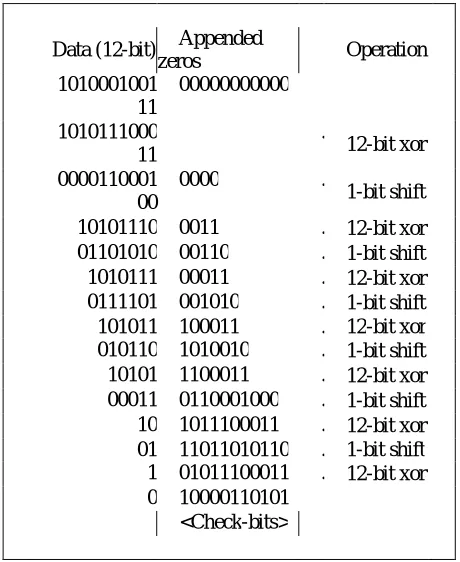
Fig 2 Long Division of Data for Check bits generation Data (12-bit) Appended
zeros Operation 1010001001
11
00000000000
1010111000 11
…
12-bit xor
0000110001 00
0000 …
1-bit shift
10101110 0011 … 12-bit xor 01101010 00110 … 1-bit shift 1010111 00011 … 12-bit xor 0111101 001010 … 1-bit shift 101011 100011 … 12-bit xor 010110 1010010 … 1-bit shift 10101 1100011 … 12-bit xor 00011 0110001000 … 1-bit shift 10 1011100011 … 12-bit xor 01 11011010110 … 1-bit shift 1 01011100011 … 12-bit xor 0 10000110101
<Check-bits>
Message Codeword Information Received Message
1) First property shows that a message m of length k out of some finite field F generates sequence of k symbols, so m = (m1: mk) belongs to Fk. Then an n-code Cover a finite field F is a set of vectors in Fn, where n ≤ k. Since we will be
commerce with a binary code only.
2) Second property defines that the error of p probability introduced only when 0 is received in place 1that was send by the sender was sent, or 1 is received when 0 was sent.
3) Third property says that the function Fn is a non-zero elements and hamming weight of a vector belongs to that function.
4) Fourth property says that the humming distance of two vectors is part of function Fn is the number of place where they differ. The scheme is that an n-code C is a strict subset of Fn in which we expect the Hamming distance between any two vectors to be as large as possible. As a result, the minimum Hamming distance is a main characteristic of the code.
5) Fifth property says that the minimum Hamming distance d of a code C is defined as d = min {dist(x, y) I x, y belongs to C} where c is the code.
Golay Code Encoder Algorithm
The Golay code encoding is explained using example in fig. 2
The encoding procedure depends on the following steps that are used for the encoding procedure: 1) Characteristic polynomial is preferred for check bits generation.
2) Long division method is use to contribute ‘M’ bit data with the characteristic polynomial. So, 11 zeros are added to the right of data message M.
3) The check bits for G (23) are generated by the most significant bit (MSB)obtained at the end of the division operation.
4) The encoded Golay code (23, 12, 7) codeword are generated by adding check bits with the message.
5) For conversion of binary Golay code into extended binary Golay code (24, 12, 8) a parity bit is appended. If the weight of binary Golay code is odd, then parity bit 1 is appended, otherwise 0 is appended.
Golay Code Decoder Algorithm
Steps that are used for the decoding procedure tis enlisted as follows:
1) For the received codeword ‘W’ and matrix ‘H’, where H = [ I / B ] Compute the Syndrome ‘S’. 2) Error vector, E = [S, 0], wt(S) ≤ 3.
3) If wt(S+Bi) ≤ 2, then E = [S+Bi, Ii].
4) In this step second syndrome SB can be computed 5) If wt(SB) ≤ 3, then E = [0, SB]
6) If wt(SB+Bi) ≤ 2, then E = [Ii, S+Bi]
If E is still not determined then it is required to be retransmitting the data.
The first section presents an introduction about the problem encounter at the time of transmission and the reason why they occur and also give the solution to resolve it to achieve high performance system. The second section presents the literature review that presents the work of others. Third section is conclusion and forth is the last section is about the reference paper.
II. RELATED WORK
Reference [3] this paper presents a hard decision decoding to outperformance the extended Golay code. And compare the performance of the binary Golay code and extended binary Golay code under the ML (maximum likelihood) conditions. Reference [4] presents the overview about the Golay codes and their properties. This paper also gives the comparative study of (G11) is ternary Golay code and (G23) binary cyclic code. Reference [5] presents GF (2m) Galois field encoder & decoder and its implementation on FPGA using the NIST chosen irreducible polynomial. Software used to do this is Xilinx ModelSim 10.0 that simulated complete verification of multiplication & implemented on FPGA. The paper proposed a simple circuit and performs high speed operation by increases protection during communication dialogue and decreasing the number of logic gates. Reference [6] proposed an algorithm depends on simplified soft decoding that is used to correct up to four errors for extended binary Golay code .The results achieved by this process shows the less complex calculation were required with this method and also work on the efficiency hardware implementation on FPGA platform. This paper also presents the detailed architecture of soft decoder and also gives the comparative study with the other algorithms in terms of power, cost, gain, and hardware complexity. Reference [7] proposed a method to build a concept of the binary Golay code (24, 12, 8) by using two array codes involving four component codes. Two of them are symmetric code and its extended version and two are simple linear block codes.
Reference [8] presents review on Golay Complementary Sequence. These sequences are introduced by Marcel Golay in the perspective of infrared spectrometry and also give the properties and applications in different fields. Reference [9] proposed a new algorithm that algorithm is used to decode the binary systematic (23, 12, 7) and (14, 21, 9) QR codes. The proposed method by using lookup table directly determines the error locations without the operation of multiplication over a finite field. The explanation why this paper presents the use of FLTD because with this CPU time is half of the LTD algorithm. In terms of both speed and memory need in real time system FLTD algorithm is better approach as compare to the existing ones. Reference [10] proposed a symbol –by –symbol soft in/ soft out APP decoding algorithm for the Golay code. This decoding algorithm is appropriate for convolution codes and block code with simple trellis structure.
Reference [11] proposed block product turbo code (BPTC) and simulated its efficiency. The proposed method used hamming (15, 11), hamming (13,9) and block channel code in combination with the construct a BPSK modulation . With this combination obtain results are better and robust against BPSK Golay code and MSK Golay. Application based on proposed algorithm is in the wireless communication system. Reference [12] proposed scheme which is just opposite to the conventional Golay code (24, 12, 8) which maps 24- bit vector into 12 bits message words. In this method each information is represented by 24 bit vector at the same time we consider 1 bit probability distortion through bit modification. As a result, this work proposed a hash table of 4096 entries that is fault-tolerant. This allows organizing a direct recovery of a neighbourhood of 24-bit vectors with two or possibly more mismatches. A recovery capability of the proposed system and the expected hash distribution is achieved by the simulation experiments. Reference [13] proposed a methodology of constructing a sequence of phase-coded waveform for which ambiguity function is free of ranges side lobes along doper shift. The problem introduced with Golay code is that it has ideal ambiguity along zero Doppler-axis but is very much responsive to nonzero Doppler shifts. And the application of pulse coded waveform is communication using radar.
Reference [14] proposed an error correction Golay code for clustering large amount of Big data Streams by using error correction Golay codes and this approach is applicable in the field where the requirement to accumulate multidimensional data. In Reference [15] the proposed methodology in combination with the special Fractional Fourier Transform (FRFT) to fulfill the requirement reducing the peak to average ratio (PTAR). This can be achieve to obtain low complicity Golay sequence coder in order to provide optimal de-correlation between signal and noise. Reference [16] proposed an algorithm based on FPGA for the hardware implementation of (24, 12, 8) Golay code. To overcome the complexity of arithmetic operations this arises in the existing algorithm. The proposed algorithm chooses the absolute value in place of bit error probability to obtained better results as compared to the existing algorithms. Reference [17] proposes a method to fulfill the requirement of faster responsive decoding for the Gosset Lattice, Leech Lattice and Golay code. The proposed design introduced two different method to first when charge in of length n and taking soft decoding algorithm at an arbitrary point Rn in to the adjacent code word and second a decoding algorithm for a lattice A in Rn changes an arbitral point of Rn into a neighbouring lattice point.
III.CONCLUSION AND FUTURE WORK
This paper presents a review on different research work presented in the field FPGA based speed optimization bust error reduction etc. Different coding and decoding methods were introduced in the reference papers to control the errors and for the speed optimization. Here, the main aim is to present systems which remove the complexity of system on fulfillment the requirement of high speed application and low latency data. So that a new scheme is proposed in future for FPGA using both binary Golay code (G23) and extended binary Golay (G24).
REFERENCES
[1] Satyabrata Sarangi and Swapna Banerjee, “Efficient Hardware Implementation of Encoder and Decoder for Golay Code”, IEEE Transaction on very large scale Integration (VLSI) system, Vol.23 Issue No.9, pg.1965-1968, September 2015.
[2] Marcel J. E. Golay, “Notes on Digital Coding”, Reprinted from proc. IRE, Vol.37, pg-657 June 1949.
[3] Jon Hamkins, “The Golay Code Outperforms the Extended Golay Code”, IEEE Transactions on Information Theory, February 19, 2016. [4] Mario de Boer and Ruud Pellikaan, “The Golay codes” Springer, pg.338-347, September 1995.
[5] Dr. Ravi Shankar Mishra, Prof Puran Gour and Mohd. Abdullah, “Design and Implementation of 4 bits Galois Encoder and Decoder in FPGA”, International Journal of Engineering Science and Technology (IJEST), Vol.3 No.7, pg.5724-5732, July 2011.
[6] Dongfu Xie, “Simplified algorithm and hardware implementation for the (24,12,8) Extended Golay soft Decoder up to 4 Errors”, The International Arab Journal of Information Technology, Vol.11 No.2, pg.111-115, March 2014.
[7] Xiao-Hong Peng and Paddy G. Farrell, “On Construction of the (24, 12, 8) Golay Codes”, December 2005.
[8] Matthew G. Parker, Kenneth G. Paterson and Chintha Tellambura, “Golay Complementary Sequences”, January 2004.
[9] Yan-Haw Chen, Chih-Hua Chine, Chine-Hsiang Huang, Trieu-Kien Truong And Ming-Haw Jing, “Efficient Decoding of schematic (24,12,7) and (41,21,9) Quadric Residue codes”, Journal of Information science And Engineering Vol.26, pg.1831-1843, December 2010.
[10] Li Ping and Kwan L. Yeung, “Symbol-by-Symbol APP Decoding of the Golay Code and Iterative Decoding of Concatenated Golay Codes”, IEEE Transaction on Information theory, Vol.45, No.7, pg.2558-2562, November 1999.
[11] Yihua Chen, Juehsuan Hsiao, Pang Fu Liu and Kunfeng Lin, “Simulation and Implementation of BPSK BPTC of MSK Golay code in DSP chip”, Communications in Information Science and Management Engineering, Vol.1 No.4, pp.46-54, Nov.2011
[12] Eyas El-Qawasmeh, Maytham Safar and Talal Kanan, “Investigation of Golay code (24,12,8) Structure in improving search techniques”, The International Arab Journal of Information Technology, Vol.8, No.3, pg.265-271, July 2011.
[13] Ali Pezeshki, A. Robert Calderbank, William Moran and Stephen D. Howard, “Doppler Resilient Golay Complementary Waveforms”, IEEE Transaction on Information Theory, Vol. 54, NO. 9, SEPTEMBER 2008.
[14] Faisal Alsaby, KholoodAlnoowaiser and Simon Berkovich, “Golay code Transformation for ensemble clustering in application of medical Diagnostics”, International Journal of Advanced Computer Science and Applications (IJACSA), Vol.6 No.1, pg.49-53, 2015.
[15] V. Bhushan Kumar and K. Yoga Prasad, “Reduction of PAPR and BER by Using Golay Sequences for OFDM System”, International Journal of Emerging Engineering Research and Technology, Volume 2, Issue 7, PP 191-198, October 2014.
[16] Dongfu Xie, “Simplified Algorithm and Hardware Implementation for the (24, 12, 8) Extended Golay Soft Decoder Up to 4 Errors” The International Arab Journal of Information Technology, Vol. 11, No. 2, PP-111-115 March 2014.
[17] John H. Conway and N. J. A. Slpane, “Soft Decoding Techniques for Codes and Lattices, Including the Golay Code and the Leech Lattice”, IEEE Transaction on Information Theory, PP-41-51VOL.32, NO. 1, JANUARY 1986.