University of Windsor University of Windsor
Scholarship at UWindsor
Scholarship at UWindsor
Electronic Theses and Dissertations Theses, Dissertations, and Major Papers
2012
Development of a Cell-Centred Finite Difference Numerical
Development of a Cell-Centred Finite Difference Numerical
Methodology on Triangulated Domains
Methodology on Triangulated Domains
James Situ
University of Windsor
Follow this and additional works at: https://scholar.uwindsor.ca/etd
Recommended Citation Recommended Citation
Situ, James, "Development of a Cell-Centred Finite Difference Numerical Methodology on Triangulated Domains" (2012). Electronic Theses and Dissertations. 210.
https://scholar.uwindsor.ca/etd/210
This online database contains the full-text of PhD dissertations and Masters’ theses of University of Windsor students from 1954 forward. These documents are made available for personal study and research purposes only, in accordance with the Canadian Copyright Act and the Creative Commons license—CC BY-NC-ND (Attribution, Non-Commercial, No Derivative Works). Under this license, works must always be attributed to the copyright holder (original author), cannot be used for any commercial purposes, and may not be altered. Any other use would require the permission of the copyright holder. Students may inquire about withdrawing their dissertation and/or thesis from this database. For additional inquiries, please contact the repository administrator via email
Development of a Cell-Centred Finite Difference
Numerical Methodology on Triangulated Domains
by
JAMES J. SITU
A Thesis
Submitted to the Faculty of Graduate Studies
through Mechanical, Automotive and Materials Engineering
in partial fulfillment of the requirements for
the Degree of Master of Applied Science at the
University of Windsor
Title Page
Windsor, Ontario, Canada
2011
© 2011
James Jianmin Situ
All Rights Reserved
Development of a Cell-Centred Finite Difference Numerical Methodology on
Triangulated Domains
by
James J. Situ
Approval Page
APPROVED BY:
_____________________________________________________ Dr. M.S. Monfared, External Department Reader
Department of Mathematics and Statistics University of Windsor
_____________________________________________________ Dr. N.G. Zamani, Internal Department Reader
Department of Mechanical, Automotive and Materials Engineering University of Windsor
_____________________________________________________ Dr. R.M. Barron, Advisor
Department of Mechanical, Automotive and Materials Engineering / Department of Mathematics and Statistics
University of Windsor
_____________________________________________________ Dr. V. Stoilov, Chair of Defence
iv
Author’s Declaration of Originality
I, James Jianmin Situ, hereby certify that I am the sole author of this thesis. This thesis
includes original research that has been previously published/submitted for publication in
peer reviewed conference proceedings, as follows,
Thesis Chapter Publication title/full citation Publication status
Chapter 2 & 4 Situ, J.J. and Barron, R.M. Development of a Cell-Centred Finite Difference Scheme for Numerical Simulations on Triangulated
Domains. 19th Annual Conf. of the CFD
Society of Canada, Montreal, April 2011.
Presented
Chapter 2 & 4 Situ, J.J. and Barron, R.M. Cell-Centred Finite Numerical Methodology for Solving Partial Differential Equations on Triangulated
Domains. Applied Mathematics, Modeling and
Computational Science Conference, Waterloo, July 2011.
Under review
I certify that the above material describes work completed during my registration as a
graduate student at the University of Windsor.
I declare that, to the best of my knowledge, my thesis does not infringe upon anyone’s
copyright nor violate any proprietary rights and that any ideas, techniques, quotations, or
any other material from the work of other people included in my thesis, published or
otherwise, are fully acknowledged in accordance with the standard referencing practices.
Furthermore, I certify that I have not included copyrighted material that surpasses the
bounds of fair dealing within the meaning of the Canada Copyright Act.
Provisional Patent Application 61/457,589 has been filed on April 22, 2011 for Patent
Protection for: “Cell-Centered Finite Difference Method for Numerical Solution of
Partial Differential Equations on Arbitrary Mesh Systems”
I declare that this is a true copy of my thesis, including any final revisions, as approved
by my thesis committee and the Graduate Studies office, and that this thesis has not been
v
Abstract
A cell-centred finite difference (CCFD) method for unstructured mesh topology is
proposed and applied to model partial differential equations (PDEs) governing fluid flow
and solid mechanics phenomena. The numerical method implements a finite difference
approximation at cell centroids by taking differencing points along orthogonal Cartesian
axes localized within each cell. The predominant advantage of this method is that it can
be applied to arbitrary mesh topologies, including structured, unstructured and hybrid
meshes. Either a direct or iterative approach is used to solve the system of equations
developed by the proposed method. The numerical method is designed to solve a variety
of physical phenomena governed by PDEs, such as electrostatic potential in
electromagnetic fields, stress and strain in structural mechanics and wave phenomena in
physics. The focus of the thesis research is to investigate the application of this
methodology in heat transfer and fluid mechanics problems. This new finite difference
methodology is applied to typical “benchmark” problems in such fields, covering the
representative of different types of PDEs with initial and boundary conditions. Solutions
obtained are compared to exact solutions if available from analytical methods or to the
vi
Acknowledgement
It is a pleasure to thank many people who made this thesis possible.
I am indebted in the preparation of this thesis to my supervisor, Dr. Ronald M. Barron of
University of Windsor, whose patience and kindness as well as his indepth academic
knowledge, have been invaluable to me. With his enthusiasm, his inspiration and his
great efforts to explain concepts effectively, he helped me expand my knowledge greatly
in the engineering numerical analysis field. Throughout the period of writing this thesis,
he provided encouragement, advice and lots of innovative ideas. Without him, I would
not have been able to complete my thesis.
I would like to thank my committee members, Dr. Nader G. Zamani and Dr. Mehdi S.
Monfared, who are always available to provide support to my research when I needed it.
Also, lots of constructive suggestions from their feedbacks help improve the quality of
my thesis.
Lastly but not least, I wish to thank many friends, and especially my parents, who give
vii
Table of Contents
TITLE PAGE ... I COPYRIGHT PAGE ... II APPROVAL PAGE ... III AUTHOR’S DECLARATION OF ORIGINALITY ... IV ABSTRACT ... V ACKNOWLEDGEMENT ... VI TABLE OF CONTENTS ... VII LIST OF FIGURES ... X LIST OF TABLES ... XII NOMENCLATURE ... XIII
CHAPTER 1 – OVERVIEW OF PARTIAL DIFFERENTIAL EQUATIONS AND NUMERICAL TECHNIQUES ... 1
1.1 PRELIMINARY CONCEPTS OF PARTIAL DIFFERENTIAL EQUATIONS ... 1
1.2 CLASSIFICATION OF PDES ... 1
1.3 ANALYTICAL SOLUTION METHOD ... 2
1.4 EXPERIMENTAL SOLUTION METHOD ... 3
1.5 NUMERICAL SOLUTION METHOD ... 3
1.5.1 Finite Difference Method ... 3
1.5.2 Finite Volume Method ... 4
1.5.3 Finite Element Method ... 5
1.5.4 Mesh-Free Numerical Method ... 5
1.6 THESIS OVERVIEW ... 6
CHAPTER 2 – DEVELOPMENT OF CCFD NUMERICAL METHOD ... 7
2.1 ALGORITHM FOR PDENUMERICAL METHOD ... 7
2.2 IMPLEMENTATION OF FINITE DIFFERENCE FORMULA IN CCFDNUMERICAL SCHEME ... 7
2.3 FDSTENCIL POLYNOMIAL TRANSFORMATION ... 8
2.4 EVALUATING DIFFERENCING POINTS ... 10
2.4.1 Approximation Scheme at Interior Line Segment ... 12
2.4.1.1 End Node Weighted Average Approximation ... 12
2.4.1.2 Approximation by Interior Triangular Interpolation Function ... 13
2.4.1.3 Centroid and Nodal Weighted Average Approximation ... 14
2.4.1.4 Approximation by Quadrilateral Interpolation Function ... 15
2.4.2 Differencing Points Evaluated at a Dirichlet Boundary... 16
2.4.3 Differencing Points Evaluated at a Neumann Boundary ... 17
2.4.3.1 First-Order Backward Differencing Approximation ... 17
2.4.3.2 Second-Order Backward Differencing Approximation ... 18
2.5 CENTRAL FINITE DIFFERENCING AT CELL CENTROID ... 19
viii
2.7 DEVELOPMENT OF SYSTEM OF EQUATIONS ... 21
2.8 SUMMARY OF CCFDFORMULATION ... 22
CHAPTER 3 – PRELIMINARY OVERVIEW ... 23
3.1 MESH OVERVIEW ... 23
3.1.1 Mesh Quality ... 23
3.1.2 Mesh Classification ... 24
3.1.2.1 Conformality ... 25
3.1.2.2 Surface or Body Alignment ... 25
3.1.2.3 Mesh Topology ... 26
3.1.2.4 Mesh Element ... 27
3.2 SOLUTION OF SYSTEM OF EQUATIONS ... 27
3.2.1 Direct Solvers ... 27
3.2.2 Iterative Solvers ... 28
3.2.2.1 Jacobi Iterative Method ... 28
3.2.2.2 Gauss-Seidel Iterative Method ... 29
3.2.2.3 Successive Over-Relaxation (SOR) Iterative Method ... 30
3.3 MANUFACTURED SOLUTIONS ... 31
3.4 INTERPOLATION LINE POST-PROCESSING ... 31
3.5 ASSESSMENT CRITERIA ... 33
3.6 VARIATIONS OF CCFDNUMERICAL METHOD ... 33
CHAPTER 4 – APPLICATIONS TO PDES GOVERNING PHYSICAL PHENOMENA ... 34
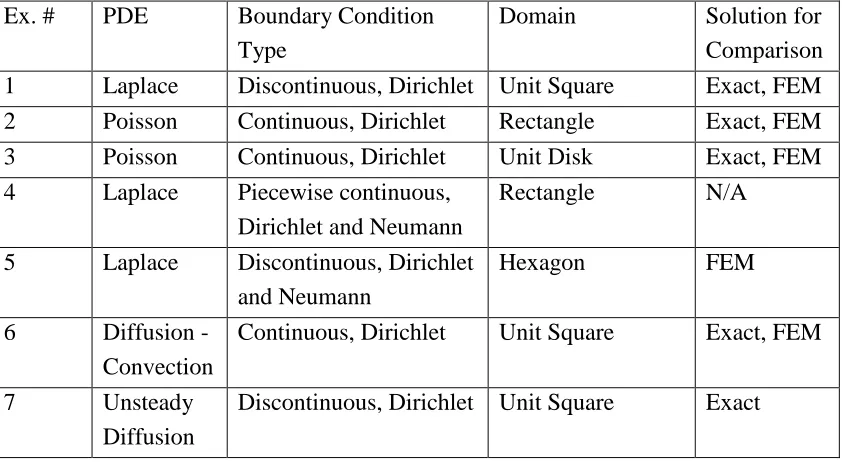
4.1 OVERVIEW OF BENCHMARKED EXAMPLES ... 34
4.1.1 Unit Square Discretisation ... 35
4.2 EXAMPLE 1:LAPLACE EQUATION WITH DISCONTINUOUS BOUNDARY CONDITIONS ... 36
4.2.1 Direct CCFD Approach ... 38
4.2.2 FEM Solution ... 41
4.2.3 Numerical Solution by CCFD Method ... 42
4.3 EXAMPLE 2:POISSON EQUATION IN A RECTANGLE WITH DIRICHLET BC ... 48
4.3.1 Numerical Solution by FEM ... 49
4.3.2 CCFD Solution ... 50
4.4 EXAMPLE 3:POISSON EQUATION IN A DISK WITH DIRICHLET CONDITIONS ... 51
4.4.1 Solution by FEM ... 53
4.4.2 Solution by CCFD ... 54
4.5 EXAMPLE 4:LAPLACE EQUATION FOR POTENTIAL FLUID FLOW ... 56
4.5.1 CCFD Solution ... 57
4.6 EXAMPLE 5:HEAT TRANSFER IN HEXAGONAL DOMAIN ... 59
4.6.1 FEM Solution ... 62
4.6.2 CCFD Solution ... 63
4.7 EXAMPLE 6:DIFFUSION-CONVECTION IN A UNIT SQUARE WITH DIRICHLET BC ... 65
4.7.1 CCFD Solution ... 66
4.8 EXAMPLE 7:UNSTEADY DIFFUSION IN A UNIT SQUARE WITH DIRICHLET BC ... 69
4.8.1 CCFD Solution ... 70
ix
5.1 DISCUSSION OF CCFDRESULTS ... 74
5.2 ERROR AND UNCERTAINTIES ANALYSIS ... 74
5.3 ADVANTAGE OF CCFDNUMERICAL METHOD ... 76
5.4 CCFDMETHOD FUTURE IMPROVEMENT ... 77
5.5 CONCLUSIONS ... 78
REFERENCES ... 79
APPENDIX A – MATLAB PDE TOOLBOX OVERVIEW ... 80
APPENDIX B – CCFD PROGRAM CODE OVERVIEW ... 81
APPENDIX C – DATA STORAGE ALLOCATION ... 83
x
List of Figures
Figure 2.1 Algorithmic process for solving PDE by numerical method ... 7
Figure 2.2 Differencing points in second order central FD stencil ... 8
Figure 2.3 Quadratic map transformation ... 9
Figure 2.4 Process of evaluating a differencing point ... 11
Figure 2.5 Parametric representation of a line segment AB ... 12
Figure 2.6 Differencing point approximation ... 14
Figure 2.7 Quadrilateral interpolation scheme ... 15
Figure 2.8 Four nodal quadrilateral element and master element [10] ... 16
Figure 2.9 Normal gradient in Neumann boundary bondition ... 17
Figure 2.10 2nd order and 4th order finite difference scheme ... 18
Figure 2.11 Process of forming system of equations by CCFD scheme ... 22
Figure 3.1 Non-conformal mesh ... 25
Figure 3.2 Examples of surface aligned and non-surface aligned meshes ... 26
Figure 3.3 Micro-structured, micro-unstructured and macro-unstructured, micro-structured meshes ... 26
Figure 3.4 Iteration process of Jacobi method ... 29
Figure 3.5 Iteration process of Gauss-Seidel method ... 29
Figure 3.6 Interpolation points for post-processing ... 32
Figure 4.1 Coarse mesh and refined mesh ... 35
Figure 4.2 Quality of coarse and refined meshes ... 36
Figure 4.3 Example 1 – Description ... 36
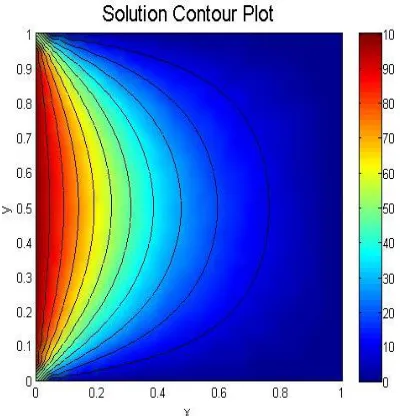
Figure 4.4 Example 1 – Analytical solution contour plot ... 37
Figure 4.5 Example #1 – Mesh #1... 38
Figure 4.6 Example #1 – Mesh 2... 39
Figure 4.7 Example 1 – FEM RE contour plots on coarse and refined meshes ... 41
Figure 4.8 Example 1 – CCFD solution contour plots on coarse and refined meshes ... 42
Figure 4.9 Example 1 – CCFD RE contour plots on coarse and refined meshes ... 43
Figure 4.10 Example 1 – Comparison of exact, FE and CCFD solutions along y = 0.05 on coarse and refined meshes ... 44
Figure 4.11 Example 1 – Comparison of exact, FE and CCFD solutions along y = 0.5 on coarse and refined meshes ... 44
Figure 4.12 Example 1 – Comparison of exact, FE and CCFD solutions along y = 0.95 on coarse and refined meshes ... 45
Figure 4.13 Example 1 – Absolute error contour plots on coarse and refined mesh ... 46
Figure 4.14 Example 2 – Description ... 48
Figure 4.15 Example 2 – Contour plot of analytical solution ... 48
Figure 4.16 Example 2 – Mesh discretisation ... 49
Figure 4.17 Example 2 – Mesh quality in coarse and refined discretisation ... 49
Figure 4.18 Example 2 – FEM RE contour plots on coarse and refined meshes... 50
Figure 4.19 Example 2 – CCFD solution contour plots on both coarse and refined meshes ... 50
Figure 4.20 Example 2 – CCFD RE contour plots on coarse and refined meshes ... 51
Figure 4.21 Example 2 – AE contour plots in both coarse and refined meshes ... 51
Figure 4.22 Example 3 – Description ... 52
xi
Figure 4.24 Example 3 – Coarse and refined mesh quality ... 53
Figure 4.25 Example 3 – FEM RE contour plots on coarse and refined meshes... 54
Figure 4.26 Example 3 – CCFD solution contour plots on coarse and refined meshes ... 54
Figure 4.27 Example 3 – RE contour plots on coarse and refined meshes ... 55
Figure 4.28 Example 3 – AE contour plots on coarse and refined meshes ... 56
Figure 4.29 Example 4 – Description ... 56
Figure 4.30 Example 4 – Mesh discretisation ... 57
Figure 4.31 Example 4 – CCFD stream function contours by approximation scheme a) ... 58
Figure 4.32 Example 4 – CCFD stream function contours by approximation scheme b) ... 58
Figure 4.33 Example 4 – CCFD stream function contours by approximation scheme c) ... 58
Figure 4.34 Example 5 – Description ... 59
Figure 4.35 Example 5 – Coarse, clustered and refined mesh topologies ... 60
Figure 4.36 Example 5 – Quality of coarse, clustered and refined meshes ... 60
Figure 4.37 Example 5 – Coarse, clustered and refined meshes in half model ... 61
Figure 4.38 Example 5 – Coarse, clustered and refined meshes in quarter model ... 61
Figure 4.39 Example 5 – Full model FEM solution contours on coarse, clustered and refined meshes ... 62
Figure 4.40 Example 5 – Half model FEM solution contours on coarse, clustered and refined meshes ... 62
Figure 4.41 Example 5 – Quarter model FEM solution contours on coarse, clustered and refined meshes 62 Figure 4.42 Example 5 – Full model RD on coarse, clustered and refined meshes ... 64
Figure 4.43 Example 5 – Half model RD on coarse, clustered and refined meshes ... 64
Figure 4.44 Example 5 – Quarter model RD on coarse, clustered and refined meshes ... 64
Figure 4.45 Example 6 – Exact solution contours for different P values ... 66
Figure 4.46 Example 6 – RE contours for P = 10 on coarse and refined meshes ... 68
Figure 4.47 Example 6 – RE contours for P = 40 on coarse and refined meshes ... 68
Figure 4.48 Example 6 – RE contours for P = 100 on coarse and refined meshes... 68
Figure 4.49 Example 7 – RE contours on coarse mesh with time step sizes of 20, 10, 5 and 2.5 ms ... 71
Figure 4.50 Example 7 – RD contours on coarse mesh with time step sizes of 20, 10, 5 and 2.5ms ... 72
Figure 4.51 Example 7 – RE contours on refined mesh with time step sizes of 20, 10, 5 and 2.5ms ... 73
Figure 4.52 Example 7 – RE contours 0n refined mesh with time step sizes of 20, 10, 5 and 2.5ms ... 73
Figure 5.1 Fishbone diagram of errors and uncertainties analysis ... 75
Figure 5.2 Neumann boundary not aligned with Cartesian axes ... 78
xii
List of Tables
Table 4.1 Application examples list ... 34
Table 4.2 Coefficients of CCFD equations for mesh 1 ... 38
Table 4.3 Coefficients of CCFD equations for mesh 2 ... 40
Table 4.4 FEM results for Example 1 ... 41
Table 4.5 Performance of CCFD solver for Example 1 ... 42
Table 4.6 Effect of relaxation parameter (coarse mesh) ... 46
Table 4.7 Effect of relaxation parameter (refined mesh) ... 47
Table 4.8 Example 2 – General result by FEM solver ... 49
Table 4.9 Example 2 – General result by CCFD solver ... 50
Table 4.10 Example 3 – General result by FEM solver ... 53
Table 4.11 Example 3 – General result by CCFD solver ... 55
Table 4.12 Example 5 – Mesh information ... 60
Table 4.13 Example 5 – Half model and quarter model mesh information ... 61
Table 4.14 Example 5 – General result by CCFD solver ... 63
Table 4.15 Example 6 – General result by CCFD solver ... 67
Table 4.16 Example 7 – General result by CCFD solver ... 70
xiii
Nomenclature
CC Cell centroid; cell centre
IP Interpolation point
OA Order of accuracy
RE Relative error
RD Relative difference
RMSE Root mean square error
RMSD Root mean square difference
SOR Successive over-relaxation scheme
ζ Spatial coordinate in computational stencil η Spatial coordinate in computational stencil
ai Coefficients of polynomial transformation from x to ζ
bi Coefficients of polynomial transformation from y to η
γi Coefficients in finite difference equation ω Relaxation parameter
For all points
Interior of a domain Boundary of a domain
Union of sets
Dependent variable at node/cell centroid index i at kth iteration
Exact value at index i
kth spatial derivative of Φ with respect to x at node/cell centroid index i
kth time derivative of Φ at time step n g(x,y) Neumann boundary condition function
x Independent variable
y Independent variable
xiv
t Time variable
Ni Test function
Wi Weight function
Ni(x,y) Shape function
L Operator
α General differencing point index
S South differencing point
N North differencing point
W West differencing point
E East differencing point
M Mid differencing point
LAB Distance between two points A and B
1
CHAPTER 1 – OVERVIEW OF PARTIAL DIFFERENTIAL EQUATIONS AND
NUMERICAL TECHNIQUES
Partial differential equations (PDEs) arise in connection with various thermofluid and
solid mechanics problems. The governing PDEs are derived from physical principles and
lead to initial and boundary value problems in both time and spatial domains.
1.1 Preliminary Concepts of Partial Differential Equations
A partial differential equation is defined as an equation involving one or more partial
derivatives of a function of two or more independent variables. The order of the highest
derivative is called the order of the equation [1]. The solution of a PDE in a domain is
a function that has all partial derivatives appearing in the equation and satisfies the
equation everywhere in . However, a solution of a PDE is generally not unique. A
unique solution may be obtained by the use of additional information imposed by the
physical conditions, i.e. boundary conditions that give the values of the required solution
on the boundary and/or initial conditions that prescribe the value of the solution at initial
time t = 0. Some mathematical theorems describe the criteria for solution existence and
uniqueness of linear PDEs, but these theorems do not generally apply to nonlinear PDEs.
1.2 Classification of PDEs
A PDE for the function (x1,..xn) has the form
(1.1)
The PDE is linear if it is of the first degree in the dependent variable and its partial
derivatives . The independent variables xi’s can represent spatial
coordinates, time or other physical parameters, such as pressure, temperature, etc. A
nonlinear PDE contains the product of the dependent variable with itself or one of its
derivatives. If each term of the equation (1.1) contains either the dependent variable or
one of its derivatives, the equation is said to be homogeneous; otherwise it is said to be
2
In addition to the distinction between linear and nonlinear PDEs, further classification of
PDEs is essential for computational scientists and engineers working on numerical
simulation. Linear, second order PDEs can be classified as parabolic, hyperbolic or
elliptic based on the characteristic curves associated with the equation. Consider the
following second order linear PDE
(1.2)
Discontinuities in the second order derivatives of the dependent variable may arise across
the characteristics. Characteristic curves can be real or imaginary depending on the
discriminant value of the second order derivative coefficients. The second order PDE (1.2)
is classified according to the sign of the expression (B2 – 4AC) as follows:
1. Elliptic if B2 – 4AC < 0. An elliptic PDE has no real characteristic curves and any
disturbance is propagated instantly in all direction within the region [2]. The
solution domain is a closed region. This type of PDE usually arises in physical
application of diffusion processes into an equilibrium state, such as a steady state
temperature distribution or fluid motion at subsonic speed.
2. Parabolic if B2 – 4AC = 0. The solution domain is an open region and such PDEs
only exhibit one characteristic curve. The solution marches downstream within
the domain from prescribed initial conditions while satisfying the specified
boundary conditions [2]. For a physical interpretation, parabolic PDEs arise in
time-dependent diffusion problems, such as unsteady heat conduction.
Mathematically, parabolic PDEs serve as a transition from hyperbolic PDEs to
elliptic PDEs.
3. Hyperbolic if B2 – 4AC > 0. A hyperbolic PDE has two real characteristic curves
and the solution domain exhibits a disconnected conic section. Hyperbolic PDEs
usually arise in connection with mechanical oscillations, such as a vibrating string
or plate, or in convection driven transport problems.
1.3 Analytical Solution Method
Although analytical solutions for most PDEs are not obvious and may not even exist,
3
general analytical approaches to solve such PDEs include separation of variables,
conformal mapping, infinite series, coordinate and dependent variable transformations
and perturbation methods. Analytical solutions are available for some of the problems
considered in this thesis, and will be used as needed.
1.4 Experimental Solution Method
Experiments, as an alternative to numerical simulation, are often used for validation of
simulation results for a physical problem governed by PDEs. Experimental fluid
mechanics provides information regarding a particular flow field and thus experimental
data is used along with computational solutions of the equations for design purposes.
Nevertheless, limitations on hardware, such as wind tunnel size and measurement
resolution, sometimes make it impractical to perform an experiment. Huge costs may also
be encountered and some experiments are not possible to conduct, such as solar or
galactic events and nuclear explosions. For these reasons, numerical simulations are used
by engineers to reconstruct the physical condition under the appropriate boundary and
initial conditions.
1.5 Numerical Solution Method
Numerical methods specify a finite discretized domain from the continuum physical
domain and each finite discretization unit is analyzed individually. From a numerical
methods perspective, there are three well-established primary methodologies for solving
PDEs in a pre-defined mesh topology; finite difference, finite volume and finite element
methods. Finite difference (FD) and finite element (FE) methods are usually applied in
solid or fluid mechanics, while the finite volume (FV) method is popular in fluid
mechanics. Lohner [3] has classified the three numerical methods by choice of the trial
and test functions Ni and Wi based on a weighted residual formula.
1.5.1 Finite Difference Method
The FD method takes Ni as a polynomial and Wi = δ(xi), where δ is the delta function,
such that the operator approximation is enforced at a finite number of locations in
4
stencil of the operation. The traditional FD methods are commonly used in
Computational Fluid Dynamics (CFD) for problems that exhibit a moderate degree of
geometrical complexity, or within multiblock solvers. The discretization stencils are
derived for structured grids with uniform element size h. For this reason, for complex
geometries, FD methods usually require transformation from an arbitrary physical
domain to a structured and uniform computational domain.
1.5.2 Finite Volume Method
The FV (and FE) methodologies on the other hand have the capability of handling
unstructured or hybrid mesh systems. Most commercial and research CFD codes for
solving fluid flow and heat transfer problems are based on the FV methodology because
of the clear relationship between the numerical algorithm and the underlying physical
conservation principle [3]. The FV method employs integration of the governing
equations over all finite control volumes of the domain. In Lohner’s definition, FV
methods are obtained by taking polynomial Ni and Wi = 1 if integration is within the
element and 0 otherwise. Since the test function is set in Kronecker delta form in each of
the respective elements, any integration by parts over the control volume reduces to
element boundary integrals. This implies that only the normal fluxes through the element
faces appear in the discretization [4]. However, discretization in the time domain for
time-dependent problems is one of the limitations in FV because of global conservation.
Some revised FV techniques handle this problem, such as the integrated space-time (IST)
FV method proposed by Zwart [5]. In his dissertation, a space-time meshing algorithm
and a solver were developed for the IST FV method. Particular application of this method
is when conservation in time is important, such as moving boundary problems involved
free surface flow. Other limitations involve the development of higher-order methods,
such as the use of compact Hermitian schemes available in a FD formulation.
Higher-order methods are particularly important where very high solution accuracy is needed,
such as in computational aeroacoustics and direct numerical simulation of turbulent flows.
It is also difficult to implement the FV method on higher-order PDEs. One popular
5
a pass over the mesh and then obtain the next order derivative in the subsequent pass,
until the highest-order derivative has been reached [4].
1.5.3 Finite Element Method
In comparison, the FE method develops an equilibrium equation by inputting element
shape functions into the weak formulation of the PDEs. The FE method can be
summarized as the projection of the weak form of the differential equation onto a
finite-dimensional function space, as a combination of linear piecewise basis functions [5]. In
Lohner’s definition of the Galerkin FE method, the polynomial trial function Ni
is set to
be the test function, i.e. Ni = Wi [4]. This method is widely used for thermal problems,
structural dynamics, potential flows and electrostatics. However, special treatments are
needed to ensure a conservative solution. Lube and Rapin [6] presented different
techniques to handle the mass conservation in advection-diffusion problems, such as
higher-order approximations and constructing Scott-Vogelius elements. Surana et al. [7]
presented k-version of the FE method in gas dynamics for higher-order global
differentiability numerical solutions. The article addressed a FE approximation scheme of
differential equations by space-time coupled processes in order to preserve the physics
and mathematics of the initial/boundary value problem.
1.5.4 Mesh-Free Numerical Method
Besides the numerical methods based on a pre-generated mesh structure, there are
methods that do not require mesh generation, such as smoothing particle hydrodynamics
(SPH) and material particle semi-implicit (MPS) formulations. Regarding the SPH
method, it was developed to avoid the limitation of mesh tangling encountered in extreme
deformation problems. Absence of grid generation is the major advantage for the SPH
formulation compared to the traditional ALE (Arbitrary-Lagrangian-Eulerian)
formulation used in many fluid-structure problems. The SPH technique allows to obtain
numerical solutions of the continuum equations by defining the variables at a set of
suitable moving points and reconstructing the continuous field by means of interpolation
functions centred on each moving points [8]. However, there are limited actual
6
fluid-strucutre interaction problems with large deformation. It has difficulty to capture
turbulence effect in high Reynolds number flows. Also, some drawbacks need to be
further investigated, such as uneven particle distribution determined by characteristic
length and inter-particle distance discrepancies caused by large variations [9].
1.6 Thesis Overview
In the present research work, a cell-centred finite difference (CCFD) method is developed
for 2D arbitrary unstructured and hybrid mesh topologies. The primary objective of this
thesis is to develop the necessary equations, discuss the important features of the method
and demonstrate its potential applicability. Chapter 2 describes the algorithmic
development of the methodology and formulation of specific approximation schemes.
Chapter 3 provides a preliminary overview of related subjects, including mesh topology
information, methods of solving systems of equations, manufacturing of solutions,
assessment criteria for the CCFD method and post-processing interpolation. Chapter 4
applies the developed formulation to benchmarked two-dimensional PDE problems with
Dirichlet and Neumann boundary conditions, covering a spectrum of typical equations
and boundary conditions with different geometric domains. The last chapter summarizes
all the findings, analyzes sources of error and concludes with proposed future
7
CHAPTER 2 – DEVELOPMENT OF CCFD NUMERICAL METHOD
2.1 Algorithm for PDE Numerical Method
Specific numerical methods for PDEs involve formulation of the problem in particular
differential equation forms. The FE method develops the weak form of the differential
equation onto a finite-dimensional space, while the FV method applies integration over
the finite control volume based on laws of conservation of mass, momentum and energy.
The formulation is then applied to a predefined mesh structure or particles over the
interior domain. This leads to solving a system of algebraic equations to reach the final
solutions, either by direct or iterative methods. The general numerical process is shown in
the following figure:
PDE Problem Definition
Mesh Discretsation
Applying Boundary/Initial
Conditions
Applying Formulation on Predefined Mesh
Structure
Solving by Iterative Method
Solving by Direct Method
Solution Converge?
Final Solution Yes
No Updating Solution
Numerical Method Formulation
Developing System of Equations
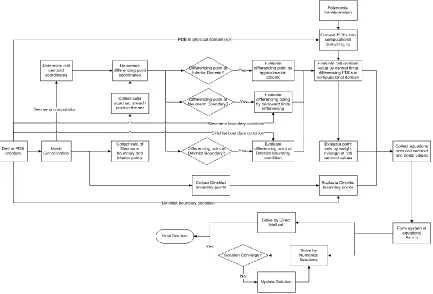
Figure 2.1 Algorithmic process for solving PDE by numerical method
The CCFD formulation is first tested by direct scheme using Gaussian elimination in a
predefined simple mesh structure. Once results are validated by comparing to the exact
solution, an arbitrary mesh topology can be solved by Jacobi iterative scheme. Point
Gauss-Seidel and Successive Over-Relaxation (SOR) methods are also used to further
improve the convergence rate.
2.2 Implementation of Finite Difference Formula in CCFD Numerical Scheme
In the CCFD method, the PDE is evaluated at the centroid of each cell. Second order
partial derivatives are approximated using a central finite difference formula at the cell
centre. The order of accuracy of the differencing formulae depends on the number of
8
differencing at a cell centroid in the spatial domain, the expression for the second
derivative with respect to x is
(2.1)
where the y value is held constant, i.e., y = yj. Equation (2.1) approximates the second
order derivative at (xi, yj) by taking forward and backward differencing point values at
(xi+1, yj) and (xi–1, yj) and is of the order of O(Δx)2, provided the points (xi+1, yj), (xi, yj)
and (xi–1, yj) are equally spaced. For derivatives with respect to y, a similar finite
difference approximation is applied. In the CCFD formulation, the finite differencing
points are confined to remain within each cell. This can be achieved by setting up a local
Cartesian system with cell centroid at the origin and differencing points at the
intersection between the axes and cell edges. The figure below illustrates the localized
finite difference stencil in an element ΔABC:
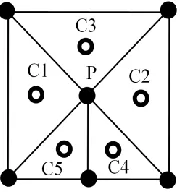
Figure 2.2 Differencing points in second order central FD stencil
The differencing points are denoted as west (W), east (E), south (S) and north (N) relative
to the cell centroid, following the usual notation of the FV method.
2.3 FD Stencil Polynomial Transformation
Equation (2.1) presented in the previous section requires equally spaced grid points.
However, in general, for the numerical procedure depicted in Fig. 2.2, the differencing
point locations on a FD stencil are not uniformly distributed, eg., length of line segment
from CC to W is not the same as from CC to E. For this reason, a transformation is
9
one can use the polynomial transformation which maps the spatial variables
independently and is expressed by the following equations:
(2.2)
The coefficients s and s depend on the coordinates of the differencing points
referenced to a fixed global coordinate system, and localized Cartesian axes are aligned
along each FD stencil. The order n of the polynomial expression depends on the order of
approximation for each cell-centred finite difference expression. For example,
second-order central differencing at the cell centre requires a quadratic transformation, while a
fourth-order FD scheme uses a quartic transformation. The polynomial mapping is
applied to the PDE as well as the FD stencil, i.e., the PDE is transformed from the (x, y)
physical domain to the (ζ, η) computational domain. The major advantage of
implementing this polynomial transformation is that the same order of accuracy can be
maintained in the (ζ, η) FD equation as in the original (x, y) FD approximation formula.
Let’s consider second-order central FD scheme in a 2D steady problem. Quadratic
transformation is sufficient to bring physical coordinates (x, y) into the
computational coordinates (ζ, η) with equally spaced grid points. The origin in the local
Cartesian plane is set at the cell centroid and all the differencing points are mapped
within a unit square domain in a localized computational stencil (ζ, η). The quadratic
transformation maps the three differencing points in each direction independently, i.e. W,
CC and E in x-direction and S, CC and N in y-direction. The transformation of the stencil
is illustrated in the following figure:
10
By substituting the coordinates of the differencing points into the transformation
equations (2.2) in quadratic form (n = 2), the coefficients are determined as follows:
(2.3)
Similarly, a fourth-order central differencing approximation at the cell centroid employs a
quartic transformation. Five differencing points are taken in each direction, which are
classified as W, MW, CC, ME and E in x-direction and S, MS, CC, MN and N in y
-direction. The coefficients of the transformation are determined by substitution of the
differencing points’ coordinates into eqn. (2.2) in quartic form (n = 4) and the result in x
-direction transformation is:
(2.4)
Coefficients in y-direction have corresponding pattern with E replaced by N and W by S,
which gives,
(2.5)
2.4 Evaluating Differencing Points
A system of equations is to be developed from the finite difference formulation of the
11
discretised domain. In addition to parameter inputs, the values of the dependent variables
at the differencing points will be needed during the calculations. These values are
expressed in terms of neighbouring nodal values or cell centroid values, or a combination
of both. The locations of the differencing points for each cell are determined first. There
are three different possibilities where a differencing point might lies: at an interior edge,
coinciding exactly at an interior node, or at a boundary edge or boundary node. To
determine a differencing point condition, the boundary and the interior domain are
identified first. If a differencing point lies at a Dirichlet boundary, it is evaluated directly
from the specified boundary value. On the other hand, differencing points that lie on a
Neumann boundary are evaluated by the Neumann boundary point approximation scheme,
which will be discussed in section 2.7. For differencing points located in the interior
domain, the value of the dependent variable is expressed in terms of nodal and centroid
values based on an approximation scheme (discussed in section 2.4.1), if it is located on a
line segment. If a differencing point coincides at an interior node, then the nodal value is
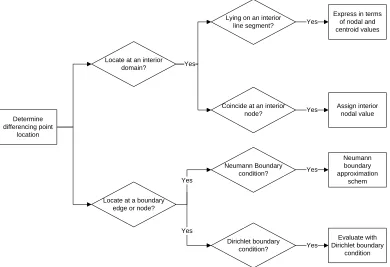
assigned to the differencing point. The following figure illustrates the process of
evaluating a differencing point:
Determine differencing point
location
Locate at an interior domain?
Locate at a boundary edge or node?
Yes
Assign interior nodal value Coincide at an interior
node? Lying on an interior
line segment?
Yes
Yes Yes
Express in terms of nodal and centroid values Dirichlet boundary condition? Neumann Boundary condition? Yes Evaluate with Dirichlet boundary condition Yes Neumann boundary approximation schem Yes
12
Parametric equations are used to determine if a differencing point lies on a line segment.
In Fig. 2.5, the relationship between a differencing point α and a line segment AB can be
expressed as
Figure 2.5 Parametric representation of a line segment AB
(2.6)
where represents any differencing point in any cell, and LAα and LBα are distances from
to A and B, respectively. Each differencing point in the interior domain is checked
using these parametric equations to determine its location relative to the nodes and edges
of the cell being considered, and its value is evaluated accordingly based on the process
chart, Fig 2.4 above.
2.4.1 Approximation Scheme at Interior Line Segment
If a differencing point lies at an interior line segment, it must be expressed in terms of
nodal and centroid values based on some approximation scheme. The approximation can
be solely confined within the cell or accompanied with effect from the neighbouring cell.
Several approximation schemes are illustrated in the following sections.
2.4.1.1 End Node Weighted Average Approximation
The value at a differencing point in a finite stencil can be evaluated by a weighted
average of the two end nodal values on an edge where the differencing point lies. In this
approximation scheme, values at differencing points are solely determined within the cell.
The general formula for this approximation scheme can be represented as a piecewise
13
(2.7)
where t is determined from parametric equations (2.6) This approximation using the
length-weighted average of the two end nodal values on the line segment is first order
accurate. In this case, the entire computation is confined within the cell. However,
neighbouring effects from boundary conditions and/or adjacent cells have no direct
influence in approximating differencing point values. Thus, the inaccuracy in this
approximation scheme has more significant effect when a discontinuity arises or large
gradient takes place. The results of the approximation will be discussed with examples in
later sections.
2.4.1.2 Approximation by Interior Triangular Interpolation Function
To perform approximation within the cell, a three-point triangular interpolation function
can be developed to evaluate differencing point values. The method is taken from the
finite element numerical method in approximating a functional value at an arbitrary point
within a cell, using the following equation [10]
(2.8)
where the variable are the nodal values and the functions Ni(x, y) are referred to as
shape functions that depend on the geometry of a cell. In the first-order triangular
element, the shape functions are determined as follows
14
where (i,j,k) is the cyclic permutation of (1,2,3) for the nodal index of a triangle and i≠j
≠ k, and A is the area of the triangle. In this approximation scheme, differencing point
value at a cell boundary (i.e. lying on an interior line segment) has the same value as
computed by the length-weighted average of end nodal values in the previous
approximation scheme discussed in section 2.4.1.1. Nevertheless, function values at
points that lie in the interior region of the cell generally have better approximation than
the length-weighted average scheme. This method is especially beneficial to approximate
higher-order derivative terms or higher-order accurate approximations for low order
derivatives that involve differencing points in the interior region of the cell.
2.4.1.3 Centroid and Nodal Weighted Average Approximation
In order to consider the neighbouring effect in approximating the differencing point
values, both inscribed and adjacent cell centroid values are taken into account in addition
to the two end nodal values. Location of the differencing point on a line segment is
determined by the parametric equation (2.6). Each interior line segment will have two
cells attached to it and both cell centroid values are used in the approximation of the
differencing point value. The approximation scheme is illustrated in the following figure
for a differencing point S lying on a line segment AB.
Figure 2.6 Differencing point approximation
Figure 2.6 considers the south differencing point S for ∆ABC. The south point lies on the
line segment AB and ∆ABD is the adjacent triangle with the common edge AB. In this
approximation scheme, four distances are required; distances to the two end nodes LAS
15
length-weighted average formula as eqn. (2.7) is used to approximate the function value
at the differencing point lying on an interior line segment:
(2.10)
Recall that if the differencing point locates at a node instead of on the line segment, the
nodal value is assigned to the differencing point. In this approximation scheme, the
adjacent centroid value is included in the evaluation of the differencing point to account
for the neighbouring cell effect. In general, such an approximation scheme is more
accurate than the two end node weighted average scheme, as demonstrated in later
examples.
2.4.1.4 Approximation by Quadrilateral Interpolation Function
For better accuracy to approximate a differencing point value, a quadrilateral
interpolation function can be constructed by taking the two edge end nodes, inscribed
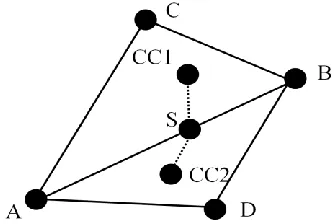
centroid and adjacent centroid as vertices. This approximation scheme is illustrated in Fig.
2.7.
Figure 2.7 Quadrilateral interpolation scheme
In this figure, the south differencing point of ∆ABC is taken as an example. The
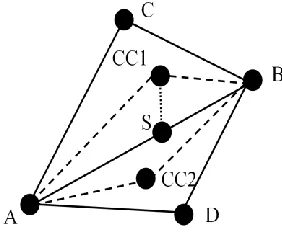
quadrilateral constructed to evaluate the south point involves two end nodes, A and B, as
well as two centroids CC1 and CC2. The value at the differencing point is determined
from equation (2.8) as a linear combination of interpolation functions. Because of the
16
quadrilateral element to a unit square master element with origin at the centroid, which is
illustrated in Fig. 2.8.
Figure 2.8 Four nodal quadrilateral element and master element [10]
The interpolation functions can be simply constructed in the master element as:
(2.11)
The idea behind the mapping is to transform (x, y) domain into (s, t) master domain by
the following equations,
(2.12)
Given the coordinates (x, y) of the differencing point, new coordinates (s, t) in the master
domain are required to be determined from equation (2.12). The system of equations is
nonlinear, involving two equations and two unknowns. Extensive computation is needed
to calculate the new coordinate (s, t) of the differencing point. Thus, this approximation
scheme will not be investigated in the current research. Once having the differencing
point coordinates determined in the master element, the differencing point value can be
determined in a similar way as eqn. (2.8):
(2.13)
2.4.2 Differencing Points Evaluated at a Dirichlet Boundary
The values of the dependent variables at points that lie on a boundary on which Dirichlet
17
Dirichlet boundary conditions may represent streamfunction or velocity values in fluid
mechanics or temperature distribution in heat transfer. In solid mechanics, zero Dirichlet
boundary condition can be interpreted as the boundary being clamped without
displacement under loading conditions. If a differencing point lies at a Dirichlet boundary,
it is directly evaluated from the Dirichlet boundary condition based on its position.
2.4.3 Differencing Points Evaluated at a Neumann Boundary
The Neumann boundary condition involves specification of the value of the first
derivative at the boundary. In thermal-fluid applications, Neumann boundary conditions
represent flux across the boundary, while it represents distributing load in solid
mechanics.
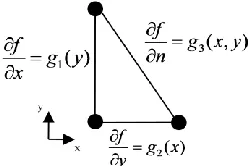
Figure 2.9 Normal gradient in Neumann boundary bondition
In Fig. 2.9, a Neumann boundary condition in a right triangle is taken to illustrate the
procedure. Normal gradients, ∂f/∂x and ∂f/∂y on the two edges are included in the
consideration since the Neumann boundaries are along one of the Cartesian axes. The
normal gradient on the hypotenuse, on the other hand, involves components in x- and y
-direction and the formulation for this kind of Neumann boundary condition is not
included in this thesis.
For Neumann boundaries aligned with the Cartesian axis, the function value at the
differencing point can be approximated by first-order or second-order one-sided finite
difference approximation schemes.
2.4.3.1 First-Order Backward Differencing Approximation
To illustrate the procedure, suppose the east differencing point lies on a Neumann
boundary. As a simple approximation, the first derivative can be evaluated by a
18
adjacent differencing point in the finite stencil. The first-order backward difference
formula in x-direction is
(2.14)
Since the Neumann boundary condition is along the x-axis, the normal gradient
can be expressed as a function of y, g1(y). Then the value for fij can be written as
(2.15)
Note that fi-1,j represents the backward differencing point value. In a second-order central
FD stencil, fi-1,j can be defined as the centroid value, while fi-1,j represents the adjacent mid
differencing point in a fourth-order central FD stencil. Similar formulae can be used to
approximate the normal gradient to the y-direction by substituting into
the backward finite difference equation.
2.4.3.2 Second-Order Backward Differencing Approximation
For a more accurate approximation, a second-order three-point backward finite
differencing scheme can be used to approximate the value at differencing points lying on
a Neumann boundary. The second-order backward differencing formula in x-direction is
(2.16)
Note that fi-1,j and fi-2,j represent the adjacent backward differencing point value. In the
second-order central differencing scheme on the finite stencil, fi–1,j represents the value at
the cell centroid and fi–2,j is the differencing point value intersecting at an interior edge
along the differencing direction. In a fourth-order central differencing on the finite stencil,
fi–1,j represents the mid differencing point and fi–2,j represents the cell centroid value along
the differencing direction. The figure below illustrates the second-order and fourth-order
central differencing within a cell.
19
Note that the spacing Δx between two neighbouring points are equal after the finite
stencil polynomial transformation, which was mentioned in section 2.3. Given the normal
gradient function value as , the equation (2.16) can be rearranged to solve
for fij as the following
(2.17)
For the differencing points lying on a Neumann boundary perpendicular to the y-axis,
similar formulae apply. Generally, the second-order backward differencing
approximation scheme is more accurate than the first-order approximation.
2.5 Central Finite Differencing at Cell Centroid
Once differencing points have been determined within each cell, the cell centroid value
can be evaluated by applying the governing PDEs at the cell centroid and using an
appropriate finite difference formula on the Cartesian system in the computation domain.
The governing PDEs are rewritten in terms of computational coordinates (ζ, η) which are
related to the physical coordinates (x, y) by the polynomial transformation discussed in
section 2.3. The general second order PDEs in (1.2) can be rewritten in terms of ζ and η
as:
(2.18)
where the coefficients etc., depend on the metrics of the transformation. Other PDEs
can be converted in a similar way to (ζ, η). Once the PDEs are converted into the
computational coordinates (ζ, η), the central finite difference formula can be applied at
each cell centroid with equal spacing between grid points. Depending on the
approximation scheme employed for differencing points, the cell centroid values can be
evaluated, but the values are solely dependent upon the neighbouring cell centroid values
and the nodal values (the vertices of the triangular cell), which is expressed by the
following relation:
20
where are all the associated adjacent cell centroid values of a specific triangle,
are the vertices values and are corresponding differencing point values. In
particular, applying the second-order central finite difference scheme to a Poisson
equation, the cell centroid values can be expressed as differencing point values in the
following generalized equation,
(2.20)
where rhscc is the right-hand-side of the Poisson equation evaluated at the cell centroid
and are coefficients determined from the quadratic transformation,
and are given by
(2.21)
Similarly, a fourth-order central finite difference scheme at cell centroids yields the
following generalized equation:
(2.22)
The coefficients γi depended on the quartic transformation coefficients, the ai’s and bi’s
given by eqns. (2.4) and (2.5). After some calculations, we obtain
21
2.6 Interior Nodes and Neumann Boundary Points Approximation
Having determined all cell centroid values as in the previous section, nodal values are to
be evaluated next. Nodal points on a Dirichlet boundary have specific fixed values
evaluated in terms of their coordinates. Nodal points in the interior domain and along a
Neumann boundary can be evaluated by the length-weighted average approximation of
all the neighbouring cell centroid values. The equation used to determine an interior or
Neumann boundary nodal value is
(2.24)
where is the set of all interior and Neumann boundary nodes. The index k
represents the cell centroid index of a cell attached to node i and Ni is the maximum
number of cells attached to node i. Alternatively, for a structured mesh, Neumann
boundary points can be evaluated by the first-order or second-order one-sided finite
difference formulae as in eqn. (2.15) or (2.17).
2.7 Development of System of Equations
A system of linear algebraic equations can now be developed to solve the governing
PDEs by combining the generalized cell-centred equations (2.20) or (2.22) and the nodal
value equations (2.24).
Suppose a mesh contains M triangular cells and N nodes (including interior and boundary
nodes). A system of N+M equations can be assembled and expressed in matrix form as:
(2.25)
where A is the coefficient matrix, is a column vector containing the constant values in
each equation (boundary values and rhs), and is a
variable vector containing all cell centroid and nodal values to be determined. The
column vectors of the coefficient matrix are linearly independent in N+M dimensional
space and therefore has a unique solution from the system of equations (2.25). Either a
22
2.8 Summary of CCFD Formulation
Sections 2.2 – 2.6 outline the derivation procedures for developing the system of
equations and the flow chart in Fig. 2.11 summarizes the development process.
Figure 2.11 Process of forming system of equations by CCFD scheme
The system of equations consists of equations for cell centroid values and equations for
nodal values. Cell centroid values are illustrated along the top branch in Fig. 2.11 and are
derived from finite difference approximations of the PDEs being solved. Nodal values are
shown along the bottom two branches with Dirichlet boundary points and the combined
set of interior and Neumann boundary points. The dependent variables at Dirichlet
boundary points are evaluated from the Dirichlet boundary conditions defined by the
PDE problem. In comparison, function values at the set of interior and Neumann
boundary points are determined by the length-weighted average of surrounding cell
centroid values. Once both cell centroid and nodal equations have been derived, the
system of equations is developed by formulating the coefficient matrix A and constant
column vector in the matrix form. The next chapter introduces a preliminary overview
23
CHAPTER 3 – PRELIMINARY OVERVIEW
3.1 Mesh Overview
Numerical methods based on the spatial subdivision of a domain into polyhedra imply the
need to generate a mesh. The mesh topology being studied in this thesis is based on a
triangulated domain created by Delaunay triangulation, which maximizes the minimum
angle of each triangle in the domain. Compared with the advancing front triangulation
technique, Delaunay triangulation generally yields a better quality mesh due to two main
reasons [4]:
1. Iteratively checks the discrepancy between the desired and actual element shape and
size of the current mesh.
2. Points are introduced into the regions where the discrepancy exceeds a user-defined
tolerance.
Delaunay triangulation in a plane ensures that the circumcircle associated with each
triangle contains no other mesh points in its interior domain [11]. Note that triangular
elements may create problems in structural loading applications, such as plane stress
problems. One problem is the geometric modeling of curved edges. The surface of a
model with a large curvature may appear reasonably modeled, whereas the surface of a
hole is poorly modeled. A second problem is that the strains in various regions of the
actual structure may be changing rapidly and the constant strain element will only
provide an approximation of the average strain at the centre of the element. For example,
loading in a nutshell will have poor approximation result when using triangular elements.
This problem can be solved either by increasing the number of elements (i.e. mesh
density), or alternatively replacing the triangular element with a better element, such as
an eight-noded quadrilateral [12].
3.1.1 Mesh Quality
The mesh quality can be evaluated with respect to two parameters: skewness and aspect
ratio. Skewness of a cell can be determined by the deviation from a normalized angle as
24
(3.1)
where is the normalized angle of a cell (i.e. 60o for
tetrahedral and triangular elements and 90o for quadrilateral and hexagonal elements).
Equation (3.1) implies that good cell quality results when skewness is close to 0 and bad
cell quality results when skewness is close to 1. For example, perfect cells with zero
skewness are equilateral triangles in a triangulated domain and rectangles in a
quadrilateral domain. As a general rule for acceptable mesh quality, skewness of
hexagonal, triangular and quadrilateral elements should not exceed 0.8.
Aspect ratio on the other hand is defined as the ratio of the longest side to the shortest
side of a mesh element. For an acceptable range of the aspect ratio, it should not be
greater than a value of 40, but the range can vary based on the characteristics of a
physical problem. By combining the effects of skewness and aspect ratio, the quality of a
triangle can be measured by the following equation [5]
(3.2)
where A is the triangle area and h1, h2 and h3 are the side lengths of the triangle. If q > 0.6,
the triangle is of acceptable quality. Note that an equilateral triangle has perfect quality
with q = 1 when h1 = h2 = h3.
3.1.2 Mesh Classification
Mesh types can be classified according to the following categories [4]:
1. Conformality
2. Surface or body alignment
3. Topology
4. Element Type
In principle, any of the four classifications can be combined randomly. However, only a
few main combinations are normally considered in the discretisation, which are as
25
a) Multiblock grids: Conformal, surface-aligned, macro-unstructured and
micro-structured grids consisting of quadrilaterals or bricks.
b) Adaptive Cartesian grids: Non-conformal, non-surface-aligned,
micro-unstructured grids consisting of quadrilaterals or bricks.
c) Unstructured uniform-element grids: Conformal, surface-aligned,
micro-unstructured grids consisting of triangles or tetrahedra.
In this thesis, an unstructured uniform-element mesh is implemented in solving physical
problems by the Cell-Centred Finite Difference scheme and other types of numerical
methodologies.
3.1.2.1 Conformality
Conformal meshes are characterized by continuous neighbouring elements across all
edges and faces [4]. Non-conforming meshes exhibit edges and faces that do not match
perfectly between neighbouring elements, which results in hanging nodes or overlapped
zones, as illustrated in Fig. 3.1.
Figure 3.1 Non-conformal mesh
Note in Fig. 3.1, that node A is a hanging node and face F1 becomes an overlapped zone
since the quadrilateral element does not match with the triangular elements at node A.
3.1.2.2 Surface or Body Alignment
Surface or body alignment refers to boundary faces matching exactly with grid points in
the surface domain [4]. If faces are crossed by the surface, the mesh is referred to as
being aligned. The following figures illustrated examples of surface aligned and
26
Figure 3.2 Examples of surface aligned and non-surface aligned meshes
Note that edges crossing the curve γ will create a node in the surface aligned mesh, but
not in the non-surface aligned mesh.
3.1.2.3 Mesh Topology
Mesh topology refers to the structure or order of the elements [4]. Three types of mesh
topology are:
1. Micro-structured: each interior node has the same number of neighbours.
2. Micro-unstructured: each interior node may have a different number of
neighbours.
3. Macro-unstructured, micro-structured: also refer as a staggered grid system. Mesh
is assembled from groups of micro-structured subgrids.
The following figure shows the three types of mesh topology.
Figure 3.3 Micro-structured, micro-unstructured and macro-unstructured, micro-structured meshes
Note that each interior node in the micro-structured mesh at the left of Fig. 3.3 has six
neighbouring cells and degrees. Interior nodes in the micro-unstructured mesh in the
middle figure have an arbitrary number of neighbouring cells and degrees. The figure on
![Figure 2.8 Four nodal quadrilateral element and master element [10]](https://thumb-us.123doks.com/thumbv2/123dok_us/1439029.1176279/31.612.234.418.117.213/figure-nodal-quadrilateral-element-master-element.webp)