Sentiment Classification Based on Adaboost
Algorithm for Product Aspect Ranking
Shahuraj Patil, Jyoti Raghatwan
P. G. Student, Dept. of Computer Engineering, RMD Sinhgad College of Engineering, Savitribai Phule Pune, India
Assistant Professor, Dept. of Computer Engineering, RMD Sinhgad College of Engineering, Savitribai Phule Pune,
India
ABSTRACT: The purpose of the work is to identify the important product aspect from consumer reviews. Consumer reviews can play vital role in the world of online shopping. The consumer review contain very valuable information about the product and it is very helpful to others to know about the details of particular product and its aspects and make them to take proper decision before they purchase the product. Consumers can make wise purchasing decision by paying more attentions to the important aspects, while firms can concentrate on improving the quality of these aspects and thus improve product reputation effectively. From the consumer review the important features of the products i.e. aspects are identified by using pos tagging method. The Adaboost algorithm is used to classify the sentiment or opinion on that particular aspects. And after that we rank the aspect by calculating overall rating of that aspect by considering the aspect frequency, overall rating and sentiment on that aspect.
KEYWORDS:e-commerce, consumer reviews, product aspect, sentiment analysis, aspect ranking.
I. INTRODUCTION
Years ago most people shopped in their local stores. Even when online shopping was available, Because of peoples are not comfortable using their credit cards and giving their private information to cyber-shops. That has all changed.Now days the peoples trend towards online shopping increases day by day. In last five years there is fast growth in e-commerce. Throughout the world online shopping has grown exponentially. In India e-commerce market was worth about 3.9 billion dollar in 2009, it went up to 12.6 billion dollar in 2013. In 2013, the e-retail segment was worth US 2.3 billion dollar. As per survey conducted by the Internet and Mobile Association of India the e-commerce sector is projected to reach Rs. 211,005 by December 2016. By 2020, India is probable to generate 100 billion dollar online retail revenue [19]. Biggest e-commerce companies in India are Flipkart, Myntra, Snapdeal, Amazon India, Paytm. In India the smartphone and tablet shoppers will be strong growth drivers. Mobile phones shares is about 11 percent of e-commerce sales, and their share will growth up to 25 percent by 2017. In overall there is rapid expansion in online shopping and people’s trends towards online shopping increases day by day. To encourage consumers to online shopping and encourage people to post their opinion or sentiment on product or on feature of that product. Number retail website provide a platform for consumers to post reviews on numbers of products. The consumer reviews play very important role while buying product, because of by paying more attention towards important aspect of product and consumer can make wise purchasing decision.[1][3]
beneficial while taking decisions about product. Aspect and sentiment on that aspect also beneficial for firm. Because firm will focus on important aspect while improving the quality. By recognizing aspect and sentiment Firms can focus on improving and enhancing the quality of product aspect.
There are lots of websites available for consumer reviews. But problem is that the reviews are not properly organized. And there are thousands of reviews on each product so by reading each and every review its take lots of time. It is very time consuming process. So to overcome this problem in our proposed work, based on consumer reviews of product first we identify the important features of product. Then we classify the sentiment on that aspect. And then by using aspect ranking algorithm for providing the rating to particular product.
II. RELATED WORK
III.PROPOSED METHODOLOGY
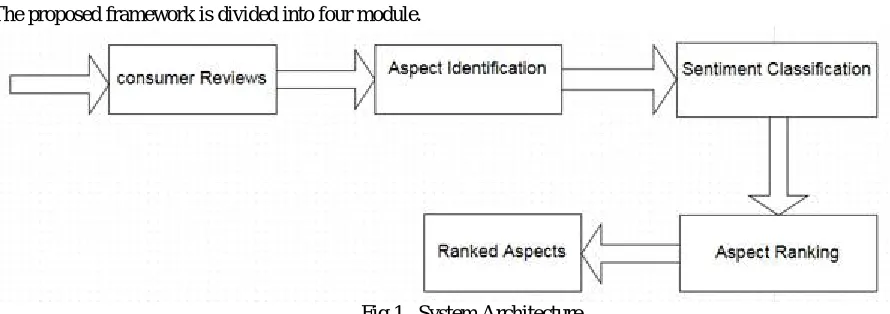
The proposed framework is divided into four module.
Fig 1 . System Architecture
1. Data Preprocessing. 2. Aspect Identification. 3. Sentiment Classification. 4. Aspect Ranking.
Data Preprocessing:
As compare to regular text document the reviews written by consumer are generally formal and not written in formal way i.e. they are written in ad-hoc manner. If we use the raw reviews the performance of the system very poor. So to obtain the satisfactory result Dataset must be preprocessed. So first we have to preprocess the data before it use. In data preprocessing there are four tasks i.e. Stemming, Tokenization, remove the Stop-Word, and remove Emotion Icons[8]. After data preprocessing all preprocessed data we passed for aspect identification.
Aspect Identification:
Aspects are generally Noun terms.[13][14] We identify the aspects by extracting the noun terms from the reviews. For identifying exact aspect of the product we consider the aspect frequency. So we can find highly accurate aspects by mining frequent noun terms from the reviews.[1][13][16] To find out Noun terms from the reviews we use POS tagging method. POS stands for part of speech tagging. It classify the words into noun, pronoun, and verb, adjective. After pos tagging we are considering only frequent noun term as an Aspect.[1]
Sentiment Classification:
In sentiment Classification we are going to find out the opinion of people about the product or product aspect. We classify the sentiment into two type i.e. Positive and Negative [2]. In the proposed work for sentiment classification we are going to use the Ada-Boost Algorithm. [7]
Algorithm: INPUT:
1) D, a set of d class labeled training tuples;
2) K, the number of rounds (one classifier is generated per round); 3) a classification learning scheme.
OUTPUT:
A composite model [7]. Method:
1. initialize the weight of each tuple in D ; 2. for i = 0 to k do;
4. use D to drive a model; 5. compute error Mi
6. if error Mi is greater than 0.5 then ; 7. go to step 3 and try again;
8. end if
9. for each tuple Di that was correctly classified do 10. update weight;
11. normalize the weight of each tuple; 12. end
Aspect Ranking:
In this module we rank the aspect of the product by considering the aspect frequency and opinion on that aspect. We are considering aspect frequency because of important aspect are commented by the consumer again and again.[1] Input: Consumer review dataset R, each review r ∈ R is associated with an overall rating Or and a vector of opinions or on specific aspects.
Step 1.Create Opinion Vector.
Step 2.Calculate ork , which is the opinion on aspect ak. Step 3. Calculate the importance weight ωrk
Step 4. Calculate Or which is overall rating in each review r is generated based on the weighted sum of the opinions on specific aspects.
In this way we calculate the overall rating and rank the aspect based on overall rating.[1]
IV.SIMULATION RESULTS
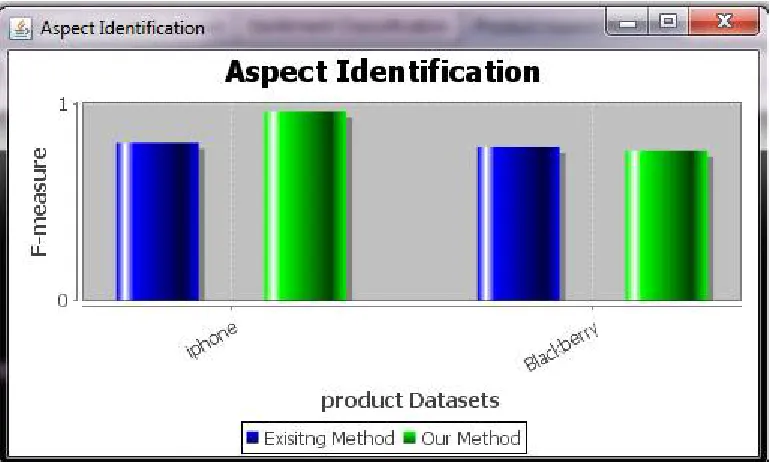
As we can see in figure it shows the graph of aspect identification using existing method and our method. Our method achieves more accuracy while aspect identification.
Fig 2. Aspect Identification Result
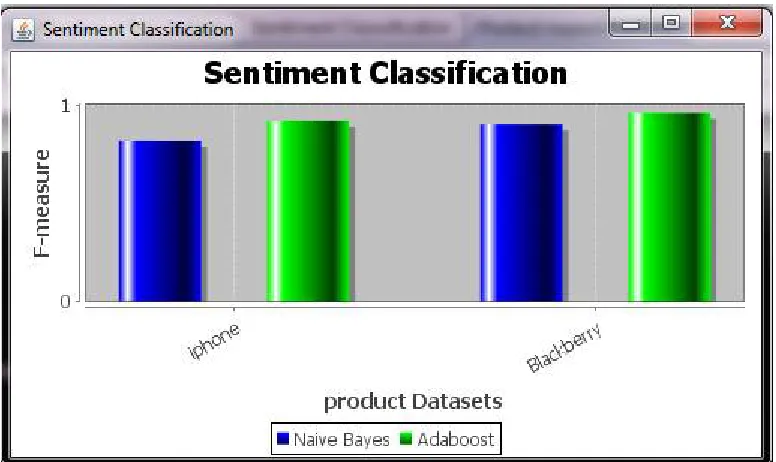
are 2 methods use for classification. First is naive Bayes based sentiment classification method and second is our proposed work method i.e. Adaboost algorithm which shows that our proposed method achieves highest accuracy of 95% and existing method achieves accuracy near about of 80%. Here we have used 2 different product reviews i.e. iphone and blackberry products.
Fig 3. Sentiment Classification
V. CONCLUSION AND FUTURE WORK
This Product Aspect Ranking application is used to find out the aspect ranking based on the aspect frequency and the opinion on that particular aspect from consumer reviews. I divide the system into four modules. They are Data Preprocessing, Aspect Identification, Sentiment Analysis and Aspect Ranking. To improve the performance of the system first we preprocess the data then we use the pos tagging method to find out the aspect from the consumer review. After that we use adaboost algorithm to classify the sentiment. And at last we rank the aspect based on overall rating of the aspect. In future work we are going to find out sentiment variation on product aspect and its reasons.
REFERENCES
1. Zheng-Jun Zha, Jianxing Yu, Jinhui Tang, Meng Wang, Tat-Seng Chua, Product Aspect Ranking and Its Applications.IEEE2014.
2. B. Liu, Sentiment analysis and subjectivity, in Handbook of Natural Language Processing, New York, NY, USA: Marcel Dekker, Inc., 2009. 3. B. Ohana and B. Tierney, Sentiment classification of reviews using SentiWordNet, in Proc. ITT Conf., Dublin, Ireland, 2009.
4. M. Hu and B. Liu, Mining and summarizing customer reviews, in Proc. SIGKDD, Seattle, WA, USA, 2004, pp. 168177. 5. J. R. Jensen, Thematic information extraction: Image classification, in Introductory Digit. Image Process., pp. 236238.
6. Andres Cassinelli, Chih-Wei Chen CS 224N Final Project Boost up! Sentiment Categorization with Machine Learning Techniques. 7. Jiawei Han,Micheline kamber,Jian pei ”Data mining concepts and techniques”. Third Edition.
8. Vishal Gupta,Gurpreet S. Lehal,”A Survey of Text Mining Techniques and Applications ”.JOURNAL OF EMERGING TECHNOLOGIES IN WEB INTELLIGENCE, VOL. 1, NO. 1, AUGUST 2009.
9. Kessler, B., Nunberg, G., and Schutze, H. 1997. Automatic Detection of Text Genre. In Proc. of 35th ACL/8th EACL.
10. Esuli A, Sebastiani F. (2006). SentiWordNet: A Publicly Available Lexical Resource for Opinion Mining. Proceedings from International Conference on Language Resources and Evaluation (LREC), Genoa, 2006.
11. B. Ohana and B. Tierney, Sentiment classification of reviews using SentiWordNet, in Proc. ITT Conf., Dublin, Ireland, 2009.
12. B. Pang, L. Lee, and S. Vaithyanathan, Thumbs up? Sentiment classification using machine learning techniques, in Proc. EMNLP, Philadelphia, PA, USA, 2002, pp. 7986.
14. B. Liu, M. Hu, and J. Cheng, Opinion observer: Analyzing and comparing opinions on the web, in Proc. 14th Int. Conf. WWW, Chiba, Japan, 2005, pp. 342351.
15. A. M. Popescu and O. Etzioni, Extracting product features and opinions from reviews, in Proc. HLT/EMNLP, Vancouver, BC, Canada, 2005, pp. 339346.
16. Bing Liu Sentiment Analysis and Subjectivity Handbook of Natural Language Processing, Second Edition,2010 .
17. Aspect Ranking: Identifying Important Product Aspects from Online Consumer Reviewsby Zheng-Jun Zha, Jianxing Yu, Jinhui Tang, Meng Wang, Tat-Seng Chua Proceedings of the 49th Annual Meeting of the Association for Computational Linguistics, pages 14961505, Portland, Oregon, June 19-24, 2011.
18. Jiawei Han,Micheline kamber,Jian pei ”Data mining concepts and techniques”.Third Edition. 19. https://en.wikipedia.org/wiki/E-commerce_in_India.
BIOGRAPHY
Shahuraj Patil is a PG Student in Department of Computer Engineering, RMD Sinhgad School of Engineering, Savitribai Phule Pune University, India. He has received B.E. in Computer Engineering from Mumbai University,India. His Research interest is in Data Mining.