ISSN(Online): 2320-9801
ISSN (Print): 2320-9798
I
nternational
J
ournal of
I
nnovative
R
esearch in
C
omputer
and
C
ommunication
E
ngineering
(An ISO 3297: 2007 Certified Organization)
Vol. 4, Issue 8, August 2016
Electronic Voice to Deaf & Dumb People
Using Flex Sensor
P. Vamsi Praveen1, K. Satya Prasad2
M. Tech Student, Department of E.C.E, University College of Engineering, JNTUK, Kakinada, A.P, India1
Professor, Department of E.C.E, University College of Engineering, JNTUK, Kakinada, A.P, India2
ABSTRACT: Communications between deaf-mute and a standard person have invariably been a difficult task. The
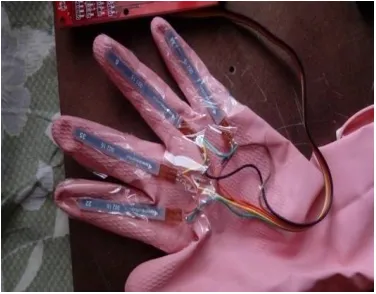
project aims to facilitate individuals by means of a glove based mostly deaf-mute communication interpreter system. The glove is internally equipped with four flex sensors. For every specific gesture, the flex detector produces a proportional amendment in resistance and measures the orientation of hand. The process of those hand gestures is finished in controller. The glove includes 2 modes of operation- coaching mode to learn of each user associate degree an operational mode. The concatenation of letters to create words is additionally drained controller. Additionally, the system conjointly includes a Text to Speech conversion (TTS) block that interprets the matched gestures i.e. text to voice output.
KEYWORDS: Flex detector, ARM7-LPC2148 Analysis Kit, LCD, TTS module, Speaker.
I. INTRODUCTION
As we tend to all grasp that communication plays a really outstanding role in our human lives. At this gift innovative world, there square measure most of individuals World Health Organization (WHO) square measure deaf and dumb ought to have a tiny low dream on communicate as traditional people with others is not a straight forward task. An electronic glove is developed for deaf-mute communication interpreter system that helps out the deaf and dumb individuals to speak with dependability. Here only 1 hand is employed .There is four flex detectors are employed and every square measure fitted with length of every finger of glove. The hand gesture plays a key role. The gestures are decoded by microcontroller. By the every specific gesture (i.e. creating completely different positions of fingers) of the flex sensors, the Indian linguistic communication alphabets/letters square measure to be created off. The concatenation of letters to create words is finished in Controller. Message is shown in alphanumeric display and voice output is produced from speaker.
II. RELATED WORK
From the References [1][10], the work that related to the project such as of gesture recognition that plays a key role. In this one of the method is glove based systems, the data gloves are used which can archive the accurate positions of hand gestures as its positions are directly measured. The Data-Glove based methods use sensor devices for digitizing hand and finger motions into multi-parametric data. The extra sensors make it easy to collect hand configuration and movement. However, the devices are quite expensive and bring much cumbersome experience to the users some of the earlier gesture recognition systems attempted to identify gestures using glove-based devices that would measure the position and joint angles of the hand is studied from references [2][3][6]. However, these devices are very cumbersome and usually have many cables connected to a computer. This has brought forth the motivation of using non-intrusive, vision-based approaches for recognizing gestures Also the sensors used for the detection of the sign language and the gesture recognition in the system that are available in the market are quite costly. In computer recognition of spoken language, speech data is captured using a microphone connected to an ADC, is [11]. Similarly a data-capturing device is also required in order to recognize sign language; in this case measuring the position and movement of the signer's hands. From below mentioned references the project was developed.
ISSN(Online): 2320-9801
ISSN (Print): 2320-9798
I
nternational
J
ournal of
I
nnovative
R
esearch in
C
omputer
and
C
ommunication
E
ngineering
(An ISO 3297: 2007 Certified Organization)
Vol. 4, Issue 8, August 2016
III.SYSTEM PRACTICALITY
As the FLEX detector output is analog form, thus on convert to digital kind there’s Analog to Digital converter (ADC). Then ADC’s output goes in microcontroller module wherever programming is finished. And therefore the output is shown on alphanumeric display. Because the output of alphanumeric display that is in digital sort of information is reborn to analog sort of signal is thru Digital to Analog converter (DAC). Where the ADC, MICROCONTROLLER, Liquid Crystal Display (LCD),DAC of all square measure built-in of ARM7-LPC2148 analysis kit. The output analog signal of DAC is given as input to the TTS converter block (aPR33A3 module), wherever the text to speech conversion is finished. Because the reborn signal is given to the speaker, there the speaker amplifies the signal and produces output as voice. Then the voices square measure held on in memory that is built-in within the voice module. Finally the message text is shown in alphanumeric display and therefore the message of voice from speaker must be same. As this above practical process of system block diagram shown in below Fig1.
Fig 1: System Block Diagram
IV.FLOW METHOD OF SYSTEM
ISSN(Online): 2320-9801
ISSN (Print): 2320-9798
I
nternational
J
ournal of
I
nnovative
R
esearch in
C
omputer
and
C
ommunication
E
ngineering
(An ISO 3297: 2007 Certified Organization)
Vol. 4, Issue 8, August 2016
Fig 2: Flow Process of System Practicality
Fig 3: Handglove Equipped With Flex Detector Fig 4: Message displaying on LCD
Fig 5: Hardware Kit
V. FLEXDETECTOR
ISSN(Online): 2320-9801
ISSN (Print): 2320-9798
I
nternational
J
ournal of
I
nnovative
R
esearch in
C
omputer
and
C
ommunication
E
ngineering
(An ISO 3297: 2007 Certified Organization)
Vol. 4, Issue 8, August 2016
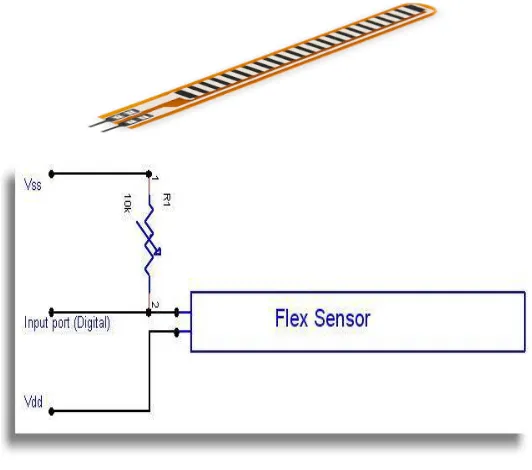
a resistance output correlated to the bend radius-the smaller the radius, the higher the resistance price. Flex sensors square measure analog resistors. They work as of variable analog voltage dividers, within the flex detector square measure carbon resistive parts inside a skinny versatile substrate. A lot of carbon means that less resistance. Once the substrate is bent the detector produces a resistance output relative to the bend radius. With a typical flex sensor of Fig 6, a flex of zero degrees can provide 10K resistance can a flex of ninety can provide 30-40 K ohms. The Bend detector lists resistance of 30-250 K ohms. The Flex detector also called as Flex sensor.
Fig 6: Flex Detector Circuit Diagram
VI. ARM7-LPC2148ANALYSISKIT
ARM analysis Kit is planned to smooth the progress of developing and debugging of various assorted styles encompassing of High speed 32-bit Microcontrollers. It integrates on board 2 UARTs provision to attach LCD/GLCD show, LEDs, ADC inputs and Wireless Modules to form a complete versatile test take a look at platform. User can easily engage in development in this platform, or use it as regard to application development.
FEATURES:
• Wireless Module I/F: Bluetooth (SENA-ESD200 | two hundred luminous flux unit 400) • MEMS Module I/F: MMA7260A
• Show Interface: 2X16 Character alphanumeric display, 128x64 GLCD (Touch Panel Driver) • Digital Output: four Nos. Point LEDs
• Digital Inputs: four Nos. Digital Input • On-Board ADC take a look at (Potentiometer) • On-Chip RTC (Battery-Backup)
• 2 Nos. UART (RS232) | USB a pair of.0 Device (Virtual Port) • DAC output Termination
• 10-pin FRC Connector (Serial Ethernet) • a pair Nos. of 20-pin growth Connective • JTAG Header (Program/Debug) | ISP engineer • General Purpose Solder space.
BENEFITS:
ISSN(Online): 2320-9801
ISSN (Print): 2320-9798
I
nternational
J
ournal of
I
nnovative
R
esearch in
C
omputer
and
C
ommunication
E
ngineering
(An ISO 3297: 2007 Certified Organization)
Vol. 4, Issue 8, August 2016
Evaluate Real Time Applications ISP Programming / JTAG Debugging Facility to interface external devices LPC2148:
Devices: LPC2148 (ARM7TDMI-S Core) Memory: 512K FLASH | 32K+8K SRAM Clock: 12MHz crystal (On-board).
VII. LCD
Innovative{alphanumeric display or LCD} 2x16 A Module provides versatile display functions. Through its straight forward connections, it may be controlled by Innovative BASIC Commander for a good vary of alphanumeric applications. During this module, 2 show lines, each with sixteen characters on every line may be displayed. By exploitation the indicator management command, the position of the character to be displayed on the screen may be arbitrarily modified. During this module, the backlight operate may be accustomed modification the backlight to permit the message to be browse simply.
VIII.TTS BLOCK (VOICE MODULE)
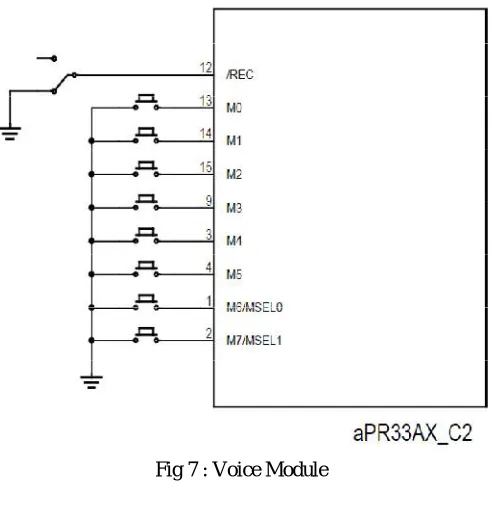
This is a brand new and increased eight channel recordable voice module. every channel of Fig 7, stoppage to one minute of recorded voice and/or music with a combined total record time of eight minutes. Recording is fast and simple exploitation the designed - in mike and push to record button. A line-level output jack permits association to external amplifiers, audio instrumentation, and paging systems.
• Eight Channels of Recordable Voice/Music.
• Most record time is eight minutes which can be divided between the quantity of channels needed.
• Recordings are hold on in non-volatile memory.
• Every channel selectable for "+" or "-" triggering.
• Every channel can settle for a fugitive trigger.
• Continuous playback or "One Shot" settings.
• Intrinsic microphone for recording.
• Adjustable speaker volume and current draw.
• Powerful twenty four watt amplifier for Speakers.
ISSN(Online): 2320-9801
ISSN (Print): 2320-9798
I
nternational
J
ournal of
I
nnovative
R
esearch in
C
omputer
and
C
ommunication
E
ngineering
(An ISO 3297: 2007 Certified Organization)
Vol. 4, Issue 8, August 2016
Fig 7 : Voice Module
IX.SPEAKER
This is associate degree analog speaker which merely amplifies the analog magnetism waves into sound waves. So, the aim of speaker is to provide audio output that may be detected by the individual.
X.RESULTS
ISSN(Online): 2320-9801
ISSN (Print): 2320-9798
I
nternational
J
ournal of
I
nnovative
R
esearch in
C
omputer
and
C
ommunication
E
ngineering
(An ISO 3297: 2007 Certified Organization)
Vol. 4, Issue 8, August 2016
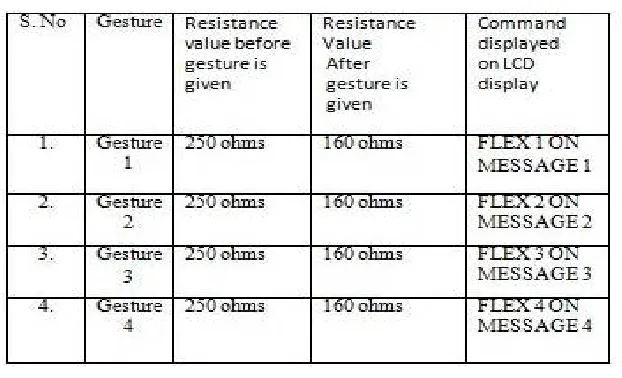
Table 1: System Results
XI. CONCLUSION
• This project is helpful for deaf and dumb Individuals people who cannot communicate among themselves or with normal person. It’s additionally helpful in creating of communication responsibility cherish language translation & effective communication between the deaf/dumb & traditional individuals.
• This project is helpful for further additional help of developing mobile communication for deaf &dumb individuals.
REFERENCES
[1]. Solanki Krunal M, submitted Report on “Indian sign languages using flex sensor glove” , Department of Biomedical Engineering, Govt. Engineering faculty, Gandhinagar, India, vol. 4,no. 6,june 2013.
[2]. Zhaojie Ju, Member, IEEE, and Honghai Liu, Senior Member, IEEE,” Human Hand Motion Analysis With Multisensory Information”, IEEE transactions on mechatronics, vol. 19, no. 2, April 2014.
[3]. Zhou Ren, Junsong Yuan, Member, IEEE, Jingjing Meng, Member, IEEE, and Zhengyou Zhang, Fellow, IEEE,“Robust Part-Based Hand Gesture Recognition Using Kinect Sensor”, IEEE transactions on multimedia, vol. 15, no. 2, August 2013.
[4]. Gunasekaran. K, Mnikandan. R, “Sign Language to Speech Translation System Using PIC Microcontroller, International Journal of Engineering and Technology (IJET)”, Vol 5 No 2 Apr-May.
[5]. K.C.Sriharipriya, “Flex sensor based non-specific user hand gesture recognition”, Interantional journal of innovative research and studies, vol. 2 issue 5, May 2013.
[6]. Prapat Parab1, Sanika Kinalekar, Rohit Chavan, Deep Sharan, Shubhadha Deshpande, “Hand Gesture Recognition using Microcontroller Flex Sensor”, International Journal Of Scientific Research And Education Volume 2 Issue 3 March 2014.
[7]. HarishKumar Kaura, Vipul, Honrao, Sayali Patil, Pravish Shetty,” Gesture controlled Robot using Image Processing” (IJARAI) International Journal of Advanced Research in Artificial Intelligence, Vol. 2, No. 5, 2013.
[8]. Miss. Kawade Sonam P, Prof. V. S. Ubale, “Gesture Recognition-A Review”, IOSR Journal of Electronics and Communication Engineering (IOSR-JECE),2012.
[9]. Anupma Yadav, “Gesture recognition technology”, The Journal of Computer Science and Information Technology , ISSN 0973-4872, Vol. 3, No.1 (2006) pp. 86-88.
[10].Ajinkya Raut, , Vineeta Singh,, Vikrant Rajput, , Ruchika Mahale, “Hand sign interpreter”, The International Journal of Engineering And Science (IJES) , Volume-1 , Issue-2 2012.
[11].Fels and G Hinton submitted a report on , “Glove-Talk: A Neural Network Interface Between a Data-Glove and a Speech Synthesiser”, IEEE Transactions on Neural Networks, 4, 1, pp. 2-8 [3],1993.
[12].Johnston , Auslan submit a report on “The Sign Language of the Australian Deaf Community”, PhD thesis, Department of Linguistics, University of Sydney, 1989.
ISSN(Online): 2320-9801
ISSN (Print): 2320-9798
I
nternational
J
ournal of
I
nnovative
R
esearch in
C
omputer
and
C
ommunication
E
ngineering
(An ISO 3297: 2007 Certified Organization)
Vol. 4, Issue 8, August 2016
BIOGRAPHY
K. Satya Prasad, Awarded with 16 Ph. D scholars currently working as Professor of ECE Department with 36 years of teaching experience and 30 years of R&D experience. His Area of interests include signals & systems, DSP, communications and Radar telemetry.
P. Vamsi Praveen, received a B. Tech Degree under the stream of ECE from Kakinada Institute of Engineering and Technology. Currently pursuing the