INTELLIGENT ACTIVE FORCE CONTROL OF A VEHICLE SUSPENSION SYSTEM
GIGIH PRIYANDOKO
BAHAGIAN A – Pengesahan Kerjasama*
Adalah disahkan bahawa projek penyelidikan tesis ini telah dilaksanakan melalui kerjasama antara ________________________ dengan _______________________
Disahkan oleh : ... Tarikh: ... Tanda tangan : ...
Jawatan : ... (Cop rasmi)
*Jika penyediaan tesis/projek melibatkan kerjasama
===========================================================
BAHAGIAN B – Untuk Kegunaan Pejabat Sekolah Pengajian Siswazah
Tesis ini telah diperiksa dan diakui oleh:
Nama dan Alamat Pemeriksa Luar : Prof. Ir. Hj. Abdul Rahman bin Omar
Dekan
Fakulti Kejuruteraan Mekanikal Universiti Teknologi MARA (UiTM)
40450 Shah Alam, Selangor.
Nama dan Alamat Pemeriksa Dalam : Prof. Madya Dr. Mohd Azman bin Zainul Abidin Fakulti Kejuruteraan Mekanikal
UTM, Skudai
Nama Penyelia Lain (jika ada) : ...
... ... Disahkan oleh Timbalan Pendaftar di SPS
INTELLIGENT ACTIVE FORCE CONTROL OF A VEHICLE SUSPENSION SYSTEM
GIGIH PRIYANDOKO
A thesis submitted in fulfilment of the requirements for the award of the degree of Doctor of Philosophy (Mechanical Engineering)
Faculty of Mechanical Engineering Universiti Teknologi Malaysia
iii
iv
ACKNOWLEDGEMENT
All praise and glory is to almighty ALLAH subhanahu wa ta'ala who gave me the courage and patience to carry out this work, and peace and blessings of Allah be upon his last prophet Mohammad sholallohu alaihi wassalam.
I would like to express my deep gratitude to my thesis supervisor Prof. Dr. Musa Mailah and co-supervisor Prof. Dr. Hishamuddin Jamaluddin for their unconditional help, encouragement and valuable suggestions during the preparation of my thesis. They were patient with me and did not hesitate in helping me by all means. There critical views helped me in forming a strong research perspective. I am also indebted to Mr. Mohamad Akmal Baharain who helped me substantially in the practical development of the test rig, and to all my colleagues who gave me support in technical issues, discussion and so on.
I would like to thank the Malaysian Ministry of Science, Technology and Innovation (MOSTI), Universiti Teknologi Malaysia (UTM) and Universitas Widyagama for their continuous support in the research work. This research was supported by an e-Science fund grant (No. 03-02-06-0123EA001).
v
ABSTRACT
vi
ABSTRAK
vii
TABLES OF CONTENTS
CHAPTER TITLE PAGE
DECLARATION ii
DEDICATION iii
ACKNOWLEDGEMENT iv
ABSTRACT v
ABSTRAK vi
TABLE OF CONTENTS vii
LIST OF TABLES xi
LIST OF FIGURES xiii
LIST OF ABREVIATIONS xviii
LIST OF SYMBOLS xix
LIST OF APPENDICES xxi
1 INTRODUCTION 1
1.1 Introduction 1
1.2 Research Background 2
1.3 Problem Statements 5
1.4 Objectives and Scope of the Research 6
1.5 Research Contributions 7
1.6 Organization of the Thesis 8
2 LITERATURE REVIEW 11
2.1 Introduction 11
2.2 Classification of Vehicle Suspension Systems 12
2.2.1 Passive Suspension 12
2.2.2 Semi-Active Suspension 13
2.2.3 Active Suspension 15
2.3 Performance Index 16
2.4 Pneumatic Active Suspension Control Strategies 18
2.5 Active Force Control 19
viii
3 METHODOLOGY 25
3.1 Introduction 25
3.2 Modelling and Simulation 25
3.3 Experimental Study 31
3.4 Summary 33
4 SKYHOOK ADAPTIVE NEURO ACTIVE FORCE
CONTROL 34
4.1 Introduction 34
4.2 The SAFAFC Scheme 35
4.2.1 Adaptive Fuzzy System 35 4.2.2 Pneumatic Actuator System 39
4.2.2.1 Load Dynamics 40 4.2.2.2 Cylinder Chambers Dynamics 41 4.2.2.3 Valve Model Dynamics 42
4.2.3 Controller Design 43
4.2.3.1 Innermost Control Loop (PI Control) 43 4.2.3.2 Outermost Control Loop (PID
Control) 45 4.2.3.3 Intermediate Control Loops
(Skyhook and AFC) 47
4.3 Stability Analysis 54
4.4 Simulation 56
4.4.1 Road Profiles as Disturbances 59
4.5 Results and Discussions 60
4.5.1 Sinusoidal Wave Road Profile (Frequency 1.5 Hz, Amplitude 3.5 cm) 61 4.5.2 Other Results for Different Road Profiles 65 4.5.3 Effect of Load Variation 68
4.6 Summary 71
5 SKYHOOK ADAPTIVE FUZZY ACTIVE FORCE
CONTROL 72
ix
5.2 The SANAFC scheme 72
5.3 Neural Network Model 73
5.4 Controller Design 77
5.4.1 Adaptive Neural Network and Its Application in
the AFC Loop 77
5.5 Simulation 82
5.6 Results and Discussion 83
5.6.1 Simulation Results in Time Domain 84 5.6.2 Simulation Results in Frequency Domain 96
5.7 Summary 104
6 EXPERIMENTAL IMPLEMENTATION OF THE
SANAFC SCHEME 106
6.1 Introduction 106
6.2 Quarter Car Suspension Test Rig 106
6.2.1 Passive Suspension 108
6.2.2 Data Acquisition System 109
6.2.3 Sensors 110
6.2.3.1 Accelerometer 111
6.2.3.2 Displacement Sensor 112 6.2.3.3 Pressure Sensor 113 6.2.4 Pneumatic Actuator System 114
6.3 Controller Development 115
6.3.1 Force Tracking Controller 115 6.3.2 Outermost Loop Controller 116 6.3.3 Intermediate Loop Controller 117
6.3.3.1 Skyhook 118
6.3.3.2 AFC scheme 118
6.5 Results and Discussions 122 6.5.1 Time Domain Response 123 6.5.2 Frequency Domain Response 131
x
7 DISCUSSION ON SIMULATION AND
EXPERIMENTAL DIFFERENCES 135
7.1 Introduction 135
7.2 General Findings of the Study 136 7.3 Main Simulation and Experimental Differences 140 7.3.1 Values of the Car Model Parameters 141
7.3.1.1 Sprung Mass 141
7.3.1.2 Unsprung Mass 141 7.3.2 Force Tracking Control of the Pneumatic
Actuator 142 7.3.4 Relative Measurement Performance of the
Various Control Schemes Compared to the
Passive Suspension 143
7.4 Summary 143
8 CONCLUSION AND RECOMMENDATIONS 144
8.1 Conclusion 144
8.2 Recommendations for Future Works 146
REFERENCES 147
xi
LIST OF TABLES
TABLE NO. TITLE PAGE
2.1 The summarised literature review of the active suspension
control strategy 20
2.2 The summarised literature review of the AFC strategy 23
3.1 The vehicle data 33
3.2 The pneumatic data 33
4.1 The RMS error values of the inverse dynamic model
response 54 4.2 Open loop characteristic of a quarter car model 59
4.3 RMS error values of the model response 63 4.4 Percentage improvement of the model compared with passive
suspension 63 4.5 A summary of results RMS error values of the model
response with different road profiles 67 4.6 A summary of percentage improvement results of the model
compared with passive suspension with different road
profiles 68 4.7 A summary of results for the SAFAFC scheme with different
road profiles
Error! Bookmark not defined.
5.1 RMS error values of the inverse actuator model response
using adaptive NN 81
5.2 RMS error values for the parameters of interest of the
SANAFC and SANAFC schemes 90
5.3 Percentage RMS error values for the parameters of interest of the SANAFC and SANAFC schemes compared with passive suspension apply different road profiles 91 5.4 A summary of results for the SANAFC scheme with different
xii
6.1 Responses of the SANAFC, PID and passive suspension
schemes 129 6.2 Percentage responses of the SANAFC and PID compare with
passive suspension schemes 130
6.3 A summary of results for the SANAFC scheme with different
road profiles 131
7.1 A summary of average percentage improvement results for the SAFAFC and SANAFC schemes compared with passive suspension using different road profiles 138 7.2 A summary of results for the SANAFC scheme with different
xiii
LIST OF FIGURES
FIGURE NO. TITLE PAGE
1.1 AFC concept applied to an active suspension system 5
2.1 Passive suspension system 13
2.2 Semi-active suspension system 14
2.3 Active suspension system 16
2.4 Power spectral density of various terrains 17 2.5 Human tolerance limits for vertical vibration 18 3.1 The flowchart of the research methodology 26
4.1 The proposed SAFAFC scheme 36
4.2 The structure of a fuzzy logic controller 38 4.3 A representation of the Gaussian membership function 39
4.4 The adaptive fuzzy structure 39
4.5 The pneumatic system 41
4.6 Force tracking control pneumatic actuator 44 4.7 Force tracking control pneumatic actuator 45 4.8 Outermost loop PID controller configuration 47 4.9 Fine tuning the PID controller 48 4.10 The intermediate loops comprising the skyhook and AFC
sub-schemes 49
4.11 Skyhook damper configuration 49
4.12 The skyhook in the intermediate loop controller scheme 50 4.13 Tuning Bsky for the skyhook method 50 4.14 Inverse dynamic of the pneumatic actuator using AF 52 4.15 Membership functions for the input and output parameters of
AF 53 4.16 Response of the identified inverse dynamic model of the
pneumatic actuator 53
xiv
4.18 The SAFAFC block diagram 55
4.19 Simplification of the SAFAFC block diagram 56 4.20 Simulink block diagram of a passive suspension 58 4.21 Bode plot of a passive suspension 59 4.22 Simulink diagram of the SAFAFC 60 4.23 Road profile inputs as disturbances 61 4.24 The time response simulation of all the control schemes 63 4.25 The frequency domain results for all the control schemes 65 4.26 Desired and actual forces of the SAFAFC scheme 66 4.27 The computed estimated mass of the body of the SAFAFC
scheme 66 4.28 The time domain results of the SAFAFC strategy with load
variation and sinusoidal road profile using f = 1.5 Hz and am =
3.5 cm 70
4.29 The frequency domain results of the SAFAFC strategy with load variation and sinusoidal input road profile with f = 1.5 Hz
and am = 3.5 cm 71
5.1 The proposed SANAFC scheme 73
5.2 Model of an artificial neuron 74
5.3 The structure of a three-layered multilayer perceptron 75 5.4 The intermediate loop controller scheme 78 5.5 The structure of adaptive NN to identify the inverse
dynamics of the pneumatic actuator 79 5.6 Response of the adaptive NN to estimate the actuator force 80 5.7 Response of the error values the actuator force 81 5.8 A Simulink diagram of the SANAFC scheme 83 5.9 The time domain response of SANAFC scheme compared to
SAFAFC scheme subjected to sinusoidal road profile, f =
1.5Hz, am = 3.5 cm 85
5.10 The time domain response of SANAFC scheme compared to SAFAFC scheme subjected to sinusoidal road profile, f = 0.8
Hz, am = 1.25 cm 86
xv
5.12 The time domain response of SANAFC scheme compared to SAFAFC scheme subjected to sinusoidal wave hole test road
profile 88 5.13 The time domain response of SANAFC scheme compared to
SAFAFC scheme subjected to sleeper-plate test road profile 89 5.14 The time domain response of half-laden condition for the
SANAFC SAFAFC schemes subject to sinusoidal road
profile, f = 1.5 Hz, am = 3.5 cm 93 5.15 The time domain response of half-laden condition for the
SANAFC SAFAFC schemes subject to sinusoidal road
profile, f = 1.5 Hz, am = 3.5 cm as road profile 94 5.16 The actual force generated by the SANAFC and SAFAFC
schemes for various road profiles 95 5.17 The computed estimated mass the body of the SANAFC and
SAFAFC schemes for various road profiles 96 5.18 The frequency domain response of the SANAFC and
SAFAFC schemes subject to sinusoidal road profile, f = 1.5
Hz, am = 3.5 cm 98
5.19 The frequency domain response of the SANAFC and SAFAFC schemes subject to sinusoidal road profile, f = 0.8
Hz, am = 1.25 cm 99
5.20 The frequency domain response of the SANAFC and
SAFAFC schemes subject to chirp signal as road profile 100 5.21 The frequency domain response of the SANAFC and
SAFAFC schemes subject to a half sinusoidal wave hole test
road profile 101
5.22 The frequency domain response of the SANAFC and
SAFAFC schemes subjected to sleeper-pate test road profile 102 5.23 The frequency domain results for a half-laden condition for
the SANAFC SAFAFC schemes subject to sinusoidal road
profile, f = 1.5 Hz, am = 3.5 cm 103 5.24 The frequency domain results for a full-laden condition for
the SANAFC SAFAFC schemes subject to sinusoidal road
xvi
6.1 A quarter car suspension test rig 107 6.2 Configuration of the hardware-in-the-loop simulation 108
6.3 Passive suspension test rig 109
6.4 Pin assignments for the analog and digital I/O connector pins 110
6.5 The DAS1602 card in the PC 110
6.6 Signal conditioning interface 110 6.7 Accelerometer attached to the sprung mass of the rig 111 6.8 Accelerometer attached to the tyre (unsprung mass) of the rig 111 6.9 Simulink and RTW block diagram of the sprung and
unsprung mass accelerometers to measure the acceleration,
velocity and displacement 112
6.10 Suspension deflection sensor attached to the end of actuator 113 6.11 Tyre deflection sensor attached to the base of tyre 113 6.12 Simulink and RTW block diagram of the two LVDTs used
tomeasure the suspension deflection and road profile 113
6.13 The pressure sensor 114
6.14 Simulink and RTW block diagram of the pressure sensor to
measure indirectly the actuated force 114
6.15 Pneumatic actuation system 115
6.16 Simulink and RTW block diagram of the pneumatic actuation
system 115 6.17 Results for the force tacking controller 116
6.18 Tuning of the PID Controller 117 6.19 Intermediate loop configuration 117
6.20 Tuning skyhook parameter Bsky 119
6.21 Identification of the inverse dynamic model of the pneumatic
actuator 120 6.22 Inverse dynamic pneumatic actuator using adaptive NN 120
6.23 The PLC system to generate the road profiles 121 6.24 Simulink and RTW block diagram of the LVDT to measure
the road profile 122
6.25 Road profiles (a) sinusoidal wave f = 1.1 Hz, am = 1.0 cm (b) chirp signal (c) a half sinusoidal wave hole test (d)
xvii
6.26 The time domain response of the passive suspension subject
to sinusoidal wave road profile, f = 1.1 Hz, am = 1.0 cm 124 6.27 The time domain response of the PID and SANAFC active
suspensions subject to sinusoidal wave road profile, f = 1.1
Hz, am = 1.0 cm 124
6.28 The time domain response of the SANAFC scheme with 40 kg load variation subject to sinusoidal wave road profile, f =
1.1 Hz, am = 1.0 cm 125
6.29 The time domain response of the SANAFC scheme with 75 kg load variation subject to sinusoidal wave road profile, f =
1.1 Hz, am = 1.0 cm 126
6.30 The actual force required by the PID and SANAFC schemes
for various road profiles 127
6.31 The computed estimated mass for various road profiles 128 6.32 The frequency domain response of the vehicle suspension
subject to sinusoidal wave road profile, f = 1.1 Hz, am = 1.0
cm 132 6.33 The frequency domain response of the SANAFC scheme
with 40 kg as load variation 133 6.34 The frequency domain response of the SANAFC scheme
xviii
LIST OF ABBREVIATIONS
A/D : Analogue to Digital converter AFC : Active Force Control
AF : Adaptive Fuzzy BP : Back Propagation DOF : Degree of Freedom
D/A : Digital to Analogue converter EC : Evolutionary Computation FFT : Fast Fourier Transform FLC : Fuzzy Logic Controller
HILS : Hardware-in-the-loop Simulation LQR : Linear Quadratic Regulator LQG : Linear Quadratic Gaussian LM : Levenberg-Marquardt MF : Membership Functions
MRAC : Model Reference Adaptive Control NN : Neural Network
PI : Proportional Integral
PID : Proportional Integral Derivative RTW : Real Time Workshop
RMS : Root Mean Square
xix
LIST OF SYMBOLS
Aa - Piston effective areas a
Ab - Piston effective areas b
am - Amplitude
b - Bias
bs - Damping coefficient
Bsky - Constant value of skyhook
f - Frequency
fs - Semi-active damper force
fa - Active damper force
g - Gravitational acceleration
I - Identity matrix
J - Jacobian Matrix
Kp - Proportional gain
Ki - Integral gain
Kd - Derivative gain
ks - Spring stiffness coefficient
kt - Tyre stiffness coefficient
M - Mass of the air in the cylinder
ms - Sprung mass
mu - Unsprung mass
P - Pressure of the air in the cylinder
Pa - Absolute pressures in actuator’s chambers a
Pb - Absolute pressures in actuator’s chambers b
Q - Disturbance
R - Ideal gas constant
T - Temperature
V - Volume of the air in the cylinder
xx
xil - Centre of Gaussian antecedent MF at rule l and input i
yl - Centre of l of consequence fuzzy set
zs - Sprung mass displacement
zu - Unsprung massdisplacement
zr - Road profile
zs–zu - Suspension deflection
zu – zr - Tyre deflection
s
z& - Sprung mass velocity
s
z&& - Sprung mass acceleration
u
z& - Unsprung mass velocity
ψ
- Cost functionσil - Width of Gaussian antecedent MF at rule l and input i
xxi
LIST OF APPENDICES
APPENDIX TITLE PAGE
A List of Publications 154
B Results for the SAFAFC Scheme Subjected to Various 156
Road Disturbances
CHAPTER 1
INTRODUCTION
1.1 Introduction
A suspension system is one of the essential components of any vehicle that carries passenger in its body compartment. It is primarily used to provide the absorption and/or isolation of undesirable vibration and load in the event the vehicle travels on a rough road, thereby, providing some comfort to the passenger in the vehicle (Ellis, 1994). Most vehicle suspension systems are typically made-up of a spring and a shock absorber. When a car hits a bump or a hole, the spring is used to temporarily store the energy generated by the disturbance force and resist the motion that tends to change the car body height level. The shock absorber acts to quickly dissipate the energy stored in the spring and damp out the vibration. Without the shock absorber, the spring will cause the vehicle to vibrate continuously over a certain period of time after the tyre passes over a bump or a hole. Darling and Dorey (1992); Ellis (1994) outlined the requirements for a suspension system as follows:
1. Isolate the passenger from the road irregularities (ride) 2. Maintain contact between the tyre and the road
3. Provide safe handling during manoeuvres 4. React to changes in the load
5. Contain the suspension displacements within the limits of travel 6. Provide control over the pitch and roll motion of the vehicle body.
2
1.2 Research Background
The main idea of a suspension system is to absorb the shock caused by the irregularities on a road surface. Ideally, the suspension should isolate the body from road and inertial disturbances that are typically associated with the acts of cornering and braking or acceleration. In addition, the suspension must also be able to minimize the vertical force transmitted to the passengers of the vehicle for their comfort. This objective can be directly achieved by minimizing the vertical car body acceleration. In any vehicle suspension system, there are a number of performance parameters that need to be optimized to achieve acceptable specification and compromise in ride comfort performance. In literature, the important parameters are (Gaoa et al., 2006; Gillespie, 1992; Wong, 2001):
1. Body acceleration
Ride comfort is related to the acceleration sensed by passenger in the vehicle when passing over a rough road surface. It is well-known that ride comfort is an important performance specification for vehicle design, which is typically evaluated by the body acceleration in the vertical direction. Therefore, one of the main objectives in controller design is to minimize the vertical body acceleration.
2. Tyre deflection
Tyre deflection can be attributed to the contact between the tyre and road surface. In order to ensure a firm uninterrupted contact of the wheels to the road surface, the dynamic tyre load should not exceed the static ones, that is, ) ( 8 . 9 )
( u r s u
t z z m m
k − < + (1.1)
where ms, mu, kt, zs, zu, are the sprung mass, unsprung mass, tyre stiffness, displacement of the sprung mass, displacement of unsprung mass, respectively.
3. Suspension deflection
3
constraint, the maximum allowable suspension stroke should be taken into consideration to avoid excessive suspension bottoming, which can possibly result in deterioration of the ride comfort and even structural damage.
4. Actuator saturation
Saturation effect of actuator should be taken into account in view of the limited power of the actuator, implying that the active force for the suspension system should be confined to a certain range, that is,
max u
u ≤ (1.2)
where u is the active force input of the suspension system.
It is well-known fact that improving the ride quality has always been one of the objectives of vehicle manufacturers. When designing a standard passive suspension system, the trade-offs mentioned above is made upfront (fixed) depending on the types of applications and cannot be easily changed. To overcome this seemingly complex problem, many researchers have studied, proposed and implemented various semi-active and active vehicle suspension systems both theoretically as well experimentally (Appleyard and Wellstead, 1995).
4
The use of pneumatic actuator as an active suspension device is a relatively new concept and has not been thoroughly explored. Pneumatic actuators demonstrate highly nonlinear characteristics due to the compressibility of air, friction and the nonlinearity of the valves. Thus, they are traditionally used for simple position and speed control applications in industry, automation, being a prime example. In recent years, low cost microprocessors (microcontrollers) and pneumatic components are available which make it possible to adopt a more complex control strategy in pneumatic actuator system control (Wang et al., 2001). Hence, investigations have been carried out, employing pneumatic actuators to accomplish a large number of motion control tasks.
The intent of the study is an attempt to introduce a new robust control strategy of a suspension system that is based on active force control (AFC) approach. The AFC has been recognized to be simple, robust and effective compared with conventional methods in controlling dynamical systems, both in theory as well as practice (Hewit and Burdess, 1981; Mailah, 1998; Kwek et al., 2003; Mailah et al.,
5
1.3 Problem Statements
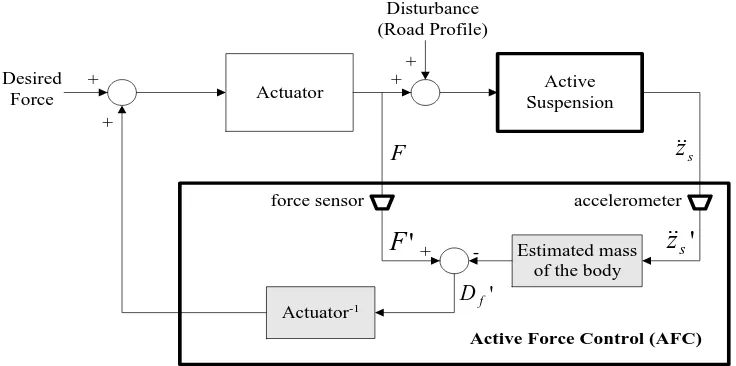
The idea of AFC is first coined by Hewit and Burdess (1981). The goal of this control scheme is to ensure that a system remains stable and robust even in the presence of disturbances. The underlying principle of AFC involves direct measurement and estimation of a number of identified parameters to predict its compensation action namely the actuated force, vertical body acceleration and estimated mass of the body. The main computational burden in AFC is the multiplication of the estimated mass of the body with the acceleration of the body. Many control approaches using a simple gain of the actuator have been investigated to obtain the appropriate estimated mass of the body (Mailah and Rahim, 2000; Hussein et al., 2000; Kwek et al., 2003; Mailah et al., 2005). Another problem is associated with acquiring inverse dynamic of the pneumatic actuator as shown in
Figure 1.1. The signal values Df′ must be multiplied by inverse dynamic of the pneumatic actuator before being fed into the AFC feed-forward loop. Thus, a suitable method to obtain the inverse dynamics of the pneumatic actuator and estimated mass of the body in the AFC scheme should be appropriately acquired to provide maximum disturbance compensation of the control strategy.
Actuator Active
Suspension +
Estimated mass of the body
+
-Actuator-1
Active Force Control (AFC)
Disturbance (Road Profile)
F
Desired Force
force sensor accelerometer
' f D s z&& + + +
'
sz
&&
'
F
Figure 1.1 AFC concept applied to an active suspension system
6
vehicle system for active suspension design, a new control strategy is proposed in the undertaken research using a combined and integrated control scheme. The scheme should exhibit practical viability based on the theoretical framework and sufficient robustness in the wake of a number of introduced disturbances, nonlinearities and uncertainties. The proposed control system essentially comprises four feedback control loops, namely the innermost loop for the force tracking control of the pneumatic actuator using a PI controller, the intermediate loops applying skyhook and AFC strategy to reduce disturbances and the outermost loop for the computation of the desired force using the PID controller. Artificial intelligence (AI) method shall be incorporated and embedded into the system to enhance the system performance.
1.4 Objectives and Scope of the Research
The main objectives of this research are stated as follows:
1. To design and analyse the implementation of adaptive fuzzy (AF) and neural network (NN) methods in the computation of the inverse dynamics of the actuator and estimated mass parameter in the AFC scheme to improve the ride performance of the active suspension system by simulation study.
2. To evaluate and validate the performance of an AFC-based controller for the active suspension system through an experimental study.
The scope of this research covers the followings:
1. A two degree-of-freedom (DOF) quarter car suspension model is considered. It is assumed that there is no slipping between the tyre and road surface and only the vertical movement of the system is considered. The actuator used in the study is a nonlinear pneumatic type.
2. The theoretical framework involves the study of various principles related to the AFC-based methods, proportional-integral-derivative (PID) control, skyhook method, the adaptive neural network (NN) and the adaptive fuzzy (AF) techniques.
7
suspension deflection and tyre deflection. In addition, the sprung mass displacement parameter is also considered for useful observation. The effect of load variation pertaining to the sprung mass is also investigated. Results shall be presented and analysed both in time and frequency domains.
4. The parameters of both quarter car model and quarter car test rig are selected based on a Malaysian National car, namely, the Kelisa.
5. An experimental quarter car suspension test rig shall be designed and developed to verify a selected proposed control scheme through a hardware-in-the-loop simulation (HILS).
1.5 Research Contributions
The main research contributions from this study are as follows:
1. Two new robust AFC-based control schemes were proposed, designed and implemented for the control of a vehicle suspension system using skyhook adaptive neuro active force control scheme (SANAFC) and skyhook adaptive fuzzy active force control (SAFAFC).
2. New approximation methods that could make decision to compute continuously and adaptively the appropriate estimated mass of the AFC strategy of the active suspension in order to improve the performance were employed using adaptive NN and AF techniques.
3. New approximation methods to identify the inverse dynamics of the pneumatic actuator in the AFC strategy using the adaptive NN and AF schemes were proposed and implemented.
8
1.6 Organization of the Thesis
Chapter 2 presents the literature review on related subjects concerning this thesis. In this chapter, the classification of vehicle suspension system, performance index to be considered in suspension system design, properties of pneumatic actuator, review on recently published articles related to pneumatic active suspension control strategies and application of the active force control strategy are described.
In Chapter 3, the methodology of the research is presented. This methodology is divided into a number of stages describing the corresponding tasks that need to be carried out plus the tools that are associated with them. Essentially, there are two main research activities to be accomplished, namely, the theoretical modelling and simulation of the suspension system and the practical implementation of the proposed methods for validation purpose.
Chapter 4 describes the general introduction and principle of adaptive fuzzy system. Then, the simulation study of the new proposed scheme namely Skyhook Adaptive Fuzzy Active Force Control (SAFAFC) is presented. The overall proposed control system essentially comprises of four feedback control loops, namely the innermost loop for force tracking of the pneumatic actuator performance using PI controller, intermediate loops applying skyhook and AFC strategy for compensation of the disturbances and outermost loop for the computation of the desired force using PID controller. The parameter gains of PID controller are determined using Ziegler-Nichols method. Adaptive fuzzy (AF) with back-propagation (BP) training algorithms are used to approximate the inverse dynamic model of the pneumatic actuator and to approximate the estimated mass in the AFC loop. Performance of the suspension system is evaluated in terms of the sprung mass acceleration, sprung mass displacement, suspension deflection and tyre deflection, both in time and frequency domains. A measure of performance improvement has been included in this chapter to benchmark all the five control schemes considered in the study.
9
consists of four feedback control loops, but in this case, adaptive neural networks (NN) are used to approximate the estimated mass and the inverse dynamics of the pneumatic actuator. The adaptive NN uses modified Levenberg-Marqurdt (LM) training algorithms. Performance of the suspension system is evaluated both in time and frequency domains. Finally, the results of the proposed scheme are presented and compared with those obtained using the SAFAFC method.
Chapter 6 describes the design and development of the experimental quarter car suspension test rig that incorporates the proposed SANAFC scheme. Mechatronic system design approach is adopted to realize the suspension test rig prototype. The specifications of the active suspension system, PC-based controller and its instrumentation system are described at length with particular emphasis on the implementation of the HILS setting. The experimental results are presented both in time and frequency domains and a comparative study is made between the proposed SANAFC, PID controller and passive suspensions.
Chapter 7 discusses the differences that can be highlighted between the simulation and experimental works that have been carried out in the research study. The issues associated with implementing intelligent active force control on a quarter car active suspension system using pneumatic actuator.