A Survey on New and Enhanced
Exemplar-Based Image Inpainting Algorithm
Almas Shaikh1, Danish Tamboli2, Seema Vanjire3
UG Student, Dept. of CS, Sinhgad Academy of Engineering, Pune, Maharashtra, India1,2
Assistant Professor, Dept of CS, Sinhgad Academy of Engineering, Pune, Maharashtra, India3
ABSTRACT: Inpainting is the task of reconstructing or repainting damaged regions of an image in a visually reasonable way. Recently, digital image inpainting has been an active field of research in the domain of processing images. Meanwhile, exemplar-based techniques have had a huge contribution in the development of this field of research. The main idea in these methods is based on copying and pasting similar textures. This project introduces a new exemplar-based inpainting frame-work. A coarse version of the input image is first inpainted by a non-parametric patch sampling. As Compared to the current techniques, a few enhancements have been done (e.g. computation of the filling order, combining K nearest neighbors). The inpainting of a coarse version of the input image facilitates reduction of the computation complexity, to be immensely less sensitive to the inherent noise and to work with the dominant portions of image components. Experimental results on natural images and texture synthesis demonstrate the effectiveness of the proposed method.
KEYWORDS: Exemplar-based; Image Inpainting; texture synthesis; object removal; region filling
I. INTRODUCTION
Image Inpainting [1] is the technique of rebuilding or remaking missing or damaged components of pictures and videos. In the world of museums, in the context of a priceless painting or image, this work would be implemented by a skilled artist or an art restorer. In the digital domain however, image-inpainting (also called image or video interpolation) points to the utilization of highly complex digital algorithms to repaint or reconstruct missing or corrupted parts (Also called target regions) of the image (mainly tiny regions or to remove small imperfections) [2].
We should know that there’s a difference between inpainting and denoising. Denoising [3] is the process of removing additive unnecessary information from the data, while inpainting is a process constructing the missing region of image.
Exemplar-based inpainting pursues to automatically perform the clone tool process. It replaces "holes" in the original image by finding the similar patches in a neighbouring source areas of the orginal image, and copies the pixels from the most similar patch onto those holes. By performing the patch level exemplar filling instead of pixel level filling, the approach reduces the blurring of objects resulted from older algorithms. [4]
Exemplar-based methods have made a major contribution in developing this domain of research. The main idea in these methods is based on copy-and-paste texture synthesis. The time-complexity of these methods is rather high. So, many different approaches were introduced to tackle this problem. This project presents a new algorithm for reconstructing missing parts in an image based on exemplar-matching methods which give an increase in speed and performance.
II. LITERATURE SURVEY
papers based on studies that were both recent and old also information serving websites mentioned in the references section. Following are the techniques we learnt in the survey.
A. DIFFUSION-BASED ALGORITHM:
The first digital inpainting approach was Diffusion-based inpainting algorithm. In this approach missing region is filled by diffusing the image information from the known region into the missing region at the pixel level. Basically, these algorithms are based on the theory of variation method [5] and Partial Differential equation (PDE). This algorithm returned substantially good results while filling the non-textured or smaller regions. The major disadvantage of the diffusion-based approach is that it introduced some blur, which became prominent in larger regions. The PDE-based models are more suitable for small, non-textured target region.
B. TEXTURE SYNTHESIS BASED INPAINTING:
One of the earliest methods of image inpainting were based on Texture synthesis approach. And these algorithms are used to complete the missing areas using similar neighborhoods of the target region. In texture synthesis algorithms the new image is synthesized from an initial seed. And then strives to preserve the local structure of the image. Initially, all Inpainting techniques used these approaches to fill the target area by sampling and copying pixels from the neighboring area. For example, Markov Random Field (MRF) is used to model the local distribution of the pixel. And the new texture is synthesized by querying existing texture and finding all similar neighbourhoods. The ways in which continuity was maintained in existing pixels and the target region, were the major differences. The main objective of texture synthesis based Inpainting is to generate texture patterns, which is similar to a given sample pattern, in such a way that the reproduced texture retains the statistical properties of its root texture. [6]
C. PDE BASED INPAINTING:
This algorithm is the iterative algorithm. The main idea behind this approach is to continue geometric and photometric information that arrives at the border of the occluded area into area itself. This is achieved by extending the information in the direction of less change using isophote lines. This algorithm will produce good results if missed regions are small. But when the target regions are big this algorithm will be slow and it will not produce good results. Then inspired by this work proposed the total variation (TV) [7] Inpainting model. This model uses the equation by Euler-Lagrange and also the anisotropic diffusion based on the strength of the isophotes. This model performs reasonably well for small regions and noise removal applications. But the major disadvantage of this algorithm is that it neither creates texture patterns nor does it connects broken edges. These algorithms were focused on maintaining the structure of the Inpainting area. And hence these algorithms caused blurred result image. Another drawback of these algorithms is that the large textured regions are not well reproduced.
D. EXEMPLAR BASED INPAINTING:
Another important class of Inpainting algorithms is the exemplar-based approach. And they have proved to be very effective. Basically, it consists of two basic steps [8]: in the first, priority is assigned and in the second is selecting the best matching patch. In the exemplar-based algorithm, the best matching patches are sampled from the known region, whose similarity is measured by certain metrics and then copied into the target patches in the missing region. In this, iterative synthesis of the target region is done by the most similar patch in the source region. In accordance with the filling order, the algorithm fills the missing regions using spatial information from neighboring regions. This method is an efficient approach for reconstructing large target regions.
E. NON-UNIFORM INTERPOLATION SR TECHNIQUE:
F. SPARSE REPRESENTATION METHOD:
This method is based on super resolution. Sparse signal representation is used in the super-resolution. Many researchers in this field suggest that image patches can be well represented as a sparse linear combination of elements from an appropriately chosen over-complete dictionary.[10] Learning an over-complete dictionary capable of optimally representing broad classes of image patches is a difficult problem. It is challenging to learn such a dictionary or using a generic set of basis vectors, therefore to simplify it, one can generate dictionaries by simply sampling raw patches in arandom order from training images of similar statistical nature. Researchers suggest that simply prepared dictionaries are already capable of generating high-quality reconstructions when used together with the sparse representation prior.
III.HISTORY OF EXEMPLAR-BASED ALGORITHMS
In 2004, Criminisi [4] developed an innovative technique for image inpainting in which filling order is influenced by the linear structure of the image. It was based on texture synthesis. Basically, he combined both, textural and structural synthesis to fill the missing regions of the image.
A. CRIMINISI’S ALGORITHM
This algorithm is based on two basic principles. First, the filling sequence of the patches in very important. Second, texture synthesis using exemplar-based method is enough to propagate extended linear structures.
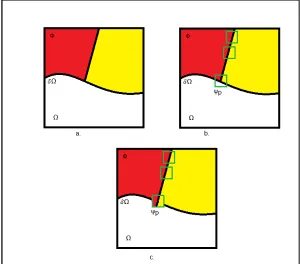
Fig. 1.Structure propagation in Criminisi’s algorithm (a). Original image with target region. (b). Image with most similar canditate patches. (c). Best matching patch has been copied to target portion in consideration
Fig 1, depicts a part of an image. The source region is denoted by Φ, the target region is denoted by Ω, and the
border line is denoted by δΩ. The target region is the one that should be filled. The source region is the one which
remains constant throughout the algorithm. It acts as a source of information for filling the target region.
The algorithm starts at patch Ψp which is at center, at the point p where p is on the borderline. The main problem is
Criminisi's algorithm suffers from two major drawbacks. First, with the increase in the size of the image the computational complexity increases exponentially. This is because the algorithm looks for a proper patch in the entire image. Second, the algorithm may produce undesired artifacts, as its texture dependent.
B. FAST EXEMPLAR-BASED INPAINTING ALGORITHM:
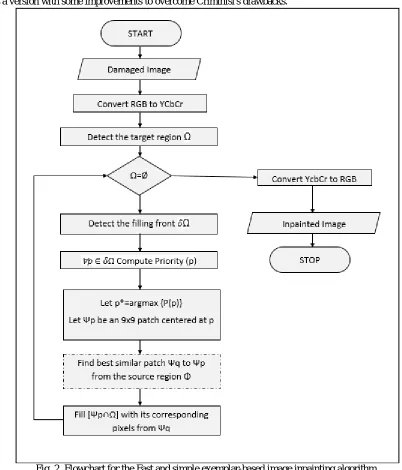
This is a version with some improvements to overcome Criminisi's drawbacks.
Fig. 2. Flowchart for the Fast and simple exemplar-based image inpainting algorithm.
For a patch Ψp at the borderline δΩ, we need to find Ψq, such that the distance between two patches is minimal. So,
The second improvement in the search strategy relies on the fact that the distance between two patches cannot be smaller than zero. Therefore if Best-Distance achieved until the current iteration becomes zero. So, it stops the process immediately and returns the best matching patch. [11]
IV.OUR IMPROVEMENTS
In the New Fast Exemplar-Based Inpainting Algorithm the patch size is kept constant i.e. 9x9, which is 81 pixels in a patch. This patch size can be very big for images with low resolution, thus resulting in poor Inpainting of the target region of the image. This patch can be too small for images with high resolution, thus making the Inpainting process slow.
Therefore we came up with an approach with variable patch size. The patch size will be dependent on the resolution of the image.
Also, the patches obtained are distinct. Thus the possibility of finding a patch with maximum matching pixels decreases.
Therefore another improvement is to implement overlapping patches so as to find maximum matching pixels in a patch. The patch matching technique is implemented using K-nearest neighbor [12, 13] algorithm.
V. CONCLUSION AND FUTURE WORK
We presented a fast and simple algorithm for Inpainting images with small to large missing regions or damaged portions which we call the target regions. The result the algorithm generated is a reconstructed and repainted image in which the missing or target regions are filled with a background that is visually acceptable even if it not entirely accurate on pixel by pixel basis. This algorithm performs as accurately as the previously presented methods in its precision and quality of result and is very much faster than them in its computation-time or time complexity which is of prime importance in this age of advanced and speed oriented algorithms, processes and technologies.
Basically, the proposed method along with its algorithm is capable of Inpainting images in a highly efficient manner as opposed to the existing standard exemplar based algorithms. As it is highly tedious and difficult to be able to estimate the computational complexity, in terms of time and space, of the proposed algorithm theoretically, we calculate its complexity with respect to the worst and the best case scenarios.
REFERENCES
1. Bertalmio M., Sapiro G., “Image Inpainting,”, University of Minnesota 2. https://en.wikipedia.org/wiki/Inpainting
3. http://math.uib.no/BBG/RESEARCH/denoising.html
4. Criminisi A., Perez P., Toyama K., “Region filling and Object Removal by Exemplar-Based Inpainting”, IEEE Commun Mag, vol 13, pp. 1200-1212, Sept. 2004.
5. Li S., Wang H., ”Image Inpainting Using Curvature-Driven Diffusions Based on P-Laplace Operator,”, IEEE Commun Mag , pp. 323-325, Dec 2009
6. Mahajan K., Vaidya M.., “Image in Inpainting techniques a survey,” IOSRCommun. Mag., vol. 5, pp. 45-49, Oct. 2012.
7. Joo K., Kim S., “PDE-based image restoration: A hybrid model and color image denoising,”, IEEE Commun Mag, vol 15, issue 5, pp. 1163-1170 , 2006
8. Sun F., Quin K., Sun W., “Fast Two-Step Exemplar-Based Image Inpainting,”, IEEE Commun Mag, pp. 99-105, 2013
9. Savdas P., Hardeep P., Joshi M., “A survey on techniques and challenges in image super resolutions,” IJCSMC, vol. 2, no. 4, pp. 317-325, 20013.
10. Yang J., Wright J., Huang T., Ma Y. “.Image super resolution via sparse,”
11. Alilou V., Yaghmaee F., “Introducing A New Fast Exemplar-Based Inpainting Algorithm,” IEEE Commun Mag, vol 31, pp. 874-878, 2014 12. https://en.wikipedia.org/wiki/K-nearest_neighbors_algorithm