ISSN(Online): 2320-9801
ISSN (Print): 2320-9798
I
nternational
J
ournal of
I
nnovative
R
esearch in
C
omputer
and
C
ommunication
E
ngineering
(An ISO 3297: 2007 Certified Organization)
Vol. 4, Issue 10, October 2016
Compression of Medical Images Using
Bi-orthogonal CDF Waveletwith Modified
SPIHT Algorithm
Surekha Koshti1, Jyoti Kendule2
PG Student, Department of E&TC, Sveri’s College of Engg., Pandharpur, India.1
Assistant Professor, Department of E&TC, Sveri’s College of Engg., Pandharpur, India2
ABSTRACT: Medical images requires large amount of storage space.They utilize maximum bandwidth for
transmission that often results in degradation of image quality. For better image compression Bi-orthogonal CDF wavelet is introduced. As coming era is that of digitized medical information data, an important challenge to deal with is the storage and transmission of enormous data including medical images. Compression is one of the indispensable techniques to solve this problem. This paper proposed modified SPIHT (set partitioning in hierarchical trees) algorithm to provide good image quality. This paper introduced lifting based bi-orthogonal CDF wavelet with modified SPIHT algorithm that gives better result in case PSNR and CR.
KEYWORDS: Bi-orthogonal CDF wavelet; MSPIHT; Compression of image; Lifting Scheme; Split; Predict; Update
I. INTRODUCTION
The popular 9/7 filter is one of the bi-orthogonal wavelet filters which is proposed in 1992.Medical images such as computed tomography (CT), positron emission tomography(PET) images, magnetic resonance (MR) images and ultrasound imagesrequires large amount of storage space. Compression of medical images is an emerging need for storage of medical imaging and for fast communication system.To achieve the high peak signal to noise ratio and high compression ratio lifting based Bi-orthogonal CDF wavelet transform coupled with modified SPIHT encoding algorithm is used.
During this process, the input image is decomposed into wavelet coefficients using Lifting Based Wavelet Transform and the resultant form is encoded using modified SPIHT algorithm with certain modifications based on prior scanning of the coefficients.
SPIHT algorithm on wavelet transform which gives better simplicity and better compression compared to the other techniques. But to scale the image more so as to get better compression we used the Lifting-based Wavelet transform (LWT) because it requires lower memory without affecting the result of Wavelet transform. Lifting scheme thus consists of three steps split, predict, update.
1. Split phase in which original data split into odd and even sets. 2. Predict step, in which odd set is predicted from even set.
3. Update phase, which will update even set using wavelet coefficient to calculate scaling function.
II. RELATED WORK
ISSN(Online): 2320-9801
ISSN (Print): 2320-9798
I
nternational
J
ournal of
I
nnovative
R
esearch in
C
omputer
and
C
ommunication
E
ngineering
(An ISO 3297: 2007 Certified Organization)
Vol. 4, Issue 10, October 2016
Huffman coding are used. The transform and encoding scheme has been implemented using MATLAB. The gray scale digitized fingerprint image of size 300x300 is used as a test image.In [4] authors both classicaland lifting based wavelets are considered.Large number of images, including both color and monochrome images are considered. The lifting based wavelets outperform the classical wavelets. In [5] authors used the Biorthogonal CDF9/7 wavelet compressionbased on lifting scheme, coupled with the SPIHT coding. He found that SPIHT algorithm gives better results than the other compression techniques .In [6] authors considered wavelet techniques using traditional mother wavelets and lifting based Cohen-Daubechies-Feauveau wavelets with the low-pass filters of the length 9 and 7 (CDF 9/7) wavelet transform with Set Partition in Hierarchical Trees (SPIHT) algorithm.The index will be used in place ofexisting traditional Universal Image Quality Index (UIQI) “in one go”. In [7] authors considered an algorithm for medical image compression based on the quincunx wavelets coupled with SPIHT coding algorithm, of which he applied the lattice structure to improve the wavelet transform shortcomings. In [8] authors,he scrutinize the role of dual tree complex wavelet transform. This Dual tree complex wavelet transform (DT-CWT) is slightly short of shift invariant and directionally selective in two or rise up dimensions.In the results of proposed preliminary plan gives higher rate of squeezing and lower mean square error(MSE) compared to plan of DWT.In[9] authors considered the main contribution of theproposed approach consists of cdf97 and legall53 wavelet filters. For image compression and performance isanalyzed with PSNR and visual quality.In[10] authorspresentedLifting based wavelets are constructed using Haar, Dubieties, Bi-orthogonal, Cohen-Dubieties- Feauveau (CDF), Symlet wavelets. Set Partitioning In Hierarchical Trees (SPIHT) algorithm was utilized to encode the transformed image, as well as to decode the coded version of transformed image. In[11] authors proposed a framework for constructing adaptive wavelet decompositions using the lifting scheme.Artificial Bee Colony algorithm which is a recent and successful optimization tool is used to determine the directional window size to produce the best compressed image in terms of both compression ratio and quality. In[12] authors novel 2 D Adaptive Directional Lifting based on SPL 5/3 has analyzed, structured and tuned with improved SPIHT based on adaptive coding for lossless JPEG 2000 image coding. The proposed 2D ADL based on SPL5/3 scheme followed by ASPIHT codec significantly reduce edge artifacts and ringing and outperformsthe conventional 1D lifting scheme.
III.SPIHT ALGORITHM
A. DESCRIPTION OF THE PROPOSED ALGORITHM:
Aim of the proposed algorithm is to obtain high peak signal to noise ratio.The SPIHT image coding algorithm was developed by Said and Pearlman in 1996. SPIHT algorithm is another more efficient implementation of the embedded zero tree wavelet (EZW) algorithm by Shapiro. SPIHT achieves better performance by exploiting the spatial dependencies of the wavelet coefficients in different sub bands.
SPIHT captures the current bit-plane information of all the wavelet coefficients and organizes them into three ordered lists:
1. List of significant coefficients (LSC). 2. List of insignificant coefficients (LIC). 3. List of insignificant sets of coefficients (LIS).
LSC constitutes the coordinates of all coefficients which are significant. LIS contains the roots of insignificant sets of coefficient. They can be two different types; the first type known as TYPE A has all the descendants insignificant within a given bit-plane, the second type known as TYPE B excludes the four children of the root node. Finally, LIC contains a list of all the coefficients that do not belong to either LIS or LSC and are insignificant. The operation of SPIHT can be grouped into three sequential steps: initialization, sorting pass (SP) and refinement pass (RP) & threshold update.
ISSN(Online): 2320-9801
ISSN (Print): 2320-9798
I
nternational
J
ournal of
I
nnovative
R
esearch in
C
omputer
and
C
ommunication
E
ngineering
(An ISO 3297: 2007 Certified Organization)
Vol. 4, Issue 10, October 2016
as a TYPE B entry or removed from the LIS if it does not have any grandchildren. For TYPE B entries, if any member in the hierarchical tree is found to be significant, the immediate children are removed and added as TYPE A entries to the end of LIS. Processing continues till the end of LIS is reached. SP also records the position of the coefficients that are found significant during the current pass.
3) Refinement pass and threshold update: Refinement pass adds precision to the LSP entries obtained before the current sorting pass by outputting the most significant bit corresponding to the existing threshold. On completion of the refinement, the threshold is halved and the cycle is repeated starting from step 2.
IV.MSPIHT ALGORITHM
In the proposed MSPIHT algorithm, the sorting pass and the refinement pass are combined as one scan pass. If a coefficient is significant at a certain threshold then its neighbours will be significant at the next threshold with a high probability. So we can scan the neighbours of significant coefficients in advance, so that more significant coefficients can be encoded at a specified bit rates.
V. SIMULATION RESULTS
The simulation studies involve the deterministic peak signal to noise ratio, compression ratio. The proposed MSPIHT algorithm is implemented with MATLAB. First raw image is loaded, which is in raw short format which is shown in fig.1. After thatwe calculated row and columnwhich is shown in fig.2. The sub band of image obtained by applying bi-orthogonal CDF 9/7 wavelet is shown in fig.3. Compressed image is obtained is shown in fig.4.
Fig.1.Input Raw Image Fig.2. Row (3000) and column (3000)
Fig.3. The sub band of image obtained Fig.4.Compressed Image
ISSN(Online): 2320-9801
ISSN (Print): 2320-9798
I
nternational
J
ournal of
I
nnovative
R
esearch in
C
omputer
and
C
ommunication
E
ngineering
(An ISO 3297: 2007 Certified Organization)
Vol. 4, Issue 10, October 2016
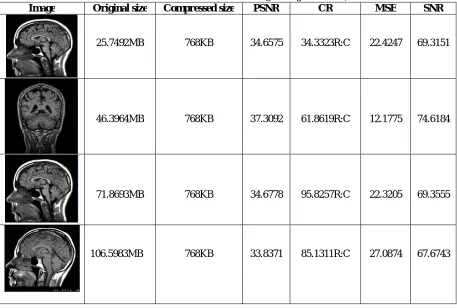
The above techniques are applied on medical images.The values of Peak Signal to Noise Ratio (PSNR), Compression Ratio (CR), Mean Square Error (MSE), Original image size, Compressed image size, signal to noise ratio were obtained from the experimental results, and summarized in table below.Original image size is in MB.
Table 1: PSNR and CR of medical images are given below;
Image Original size Compressed size PSNR CR MSE SNR
25.7492MB 768KB 34.6575 34.3323R:C 22.4247 69.3151
46.3964MB 768KB 37.3092 61.8619R:C 12.1775 74.6184
71.8693MB 768KB 34.6778 95.8257R:C 22.3205 69.3555
106.5983MB 768KB 33.8371 85.1311R:C 27.0874 67.6743
VI.CONCLUSION AND FUTURE WORK
The simulation results showed that the proposed algorithm performs better Compression. The proposed algorithm provides high peak signal to noise ratio and compression ratio. As the performance of the proposed algorithm with lifting based wavelet transform gives better compression results. In perspective, we aspire to apply our algorithm to compress video sequences.
REFERENCES
1. E. Anitha, S.Kousalya Devi “Squeezing of Medical Images Using Lifting Based Wavelet Transform coupled with Modified SPIHT Algorithm”International Journal of Innovative Research in Science, Engineering and Technology Vol. 4, Special Issue 6, May 2015
2. G.chenchu krishnaiah, T.jayachandraprasad M.N.giri prasad. “Efficient Image Compression Algorithms Using Evolved Wavelets” International Journal of ISSN 0974-2107 Systems and Technologies Vol.4, No.2, pp 127-146
ISSN(Online): 2320-9801
ISSN (Print): 2320-9798
I
nternational
J
ournal of
I
nnovative
R
esearch in
C
omputer
and
C
ommunication
E
ngineering
(An ISO 3297: 2007 Certified Organization)
Vol. 4, Issue 10, October 2016
7. M. Beladgham†, A. Bessaid, A. Taleb-Ahmed and I. Boucli Hacene “Medical Image Compression Using Quincunx Wavelets and SPIHT Coding”Journal of Electrical Engineering & Technology Vol. 7, No. 2, pp. 264~272, 2012
8. Nitin Sharma, Anupam Agarwal and Pawan Kumar Khyalia “Squeezing Of Color Image Using Dual Tree Complex Wavelet Transform Based Preliminary Plan” Signal & Image Processing : An International Journal (SIPIJ) Vol.5, No.3, June 2014.
9. Mrs. Satpute Jaymala Nikhil “Image Compression using Lifting Based Wavetet Transform” Internatioal Journal of Engineering Research & Technology (IJERT) ISSN: 2278-0181 Vol. 3 Issue 2, February – 2014
10. M. Santhosh, B. Stephen Charles, Dr. M N Giriprasad “Image Decomposition and Compression by using Lifting Scheme” International Journal of Engineering and Innovative Technology (IJEIT) Volume 3, Issue 2, August 2013.
11. R.Ramanathan ,K.Kalaiarasi,D.Prabha “Improved wavelet based compression with adaptive lifting scheme using Artificial Bee Colony algorithm”International Journal of Advanced Research in Computer Engineering & Technology (IJARCET) Volume 2, Issue 4, April 2013. 12. Sanjay H. Dabhole, Sharad T. Jadhav “An Efficient Codec of 2D Adaptive Directional Lifting based SPL5/3 with Improved SPIHT Algorithm
for Lossless Image Coding” International Journal of Innovative Technology and Exploring Engineering (IJITEE)ISSN: 2278-3075, Volume-4 Issue-7, December 2014.
BIOGRAPHY
Surekha Koshtiis a PG student in Electronics and telecommunication Department, College of Shri Vithal Education& Research Institute’s, College of Engineering, Pandharpur, India. She received BE inElectronics in 2006 from Dr.JJMCOE,Jaysingpur, India.