University of Windsor University of Windsor
Scholarship at UWindsor
Scholarship at UWindsor
Electronic Theses and Dissertations Theses, Dissertations, and Major Papers
2013
Study of the Scalability of Modified AODV-UU Routing Protocol for
Study of the Scalability of Modified AODV-UU Routing Protocol for
the Smart Grid Application
the Smart Grid Application
Jahangir Md. Toimoor
University of Windsor
Follow this and additional works at: https://scholar.uwindsor.ca/etd
Recommended Citation Recommended Citation
Toimoor, Jahangir Md., "Study of the Scalability of Modified AODV-UU Routing Protocol for the Smart Grid Application" (2013). Electronic Theses and Dissertations. 4736.
https://scholar.uwindsor.ca/etd/4736
Study of the Scalability of Modified AODV-UU Routing
Protocol for the Smart Grid Application
By
Md. Jahangir Toimoor
A Thesis
Submitted to the Faculty of Graduate Studies through the Department of Electrical and Computer Engineering
in Partial Fulfillment of the Requirements for the Degree of Master of Applied Science at the
University of Windsor
Windsor, Ontario, Canada
2012
Study of the Scalability of Modified AODV-UU Routing Protocol for
the Smart Grid Application
By
Md. Jahangir Toimoor
APPROVED BY:
______________________________________________ Dr. N Zamani, Outside Department Reader
Mechanical, Automotive & Materials Engineering
______________________________________________ Dr. M. Khalid, Departmental Reader
Department of Electrical & Computer Engineering
______________________________________________ Kemal E. Tepe, Advisor
Department of Electrical & Computer Engineering
______________________________________________ Dr. J. Wu, Chair of Defense
DECLARATION OF ORIGINALITY
I hereby certify that I am the sole author of this thesis and that no part of this thesis has
been published or submitted for publication, and to the best of my knowledge, my
thesis does not infringe upon anyone’s copyright nor violate any proprietary rights and
that any ideas, techniques, quotations, or any other material from the work of other
people included in my thesis, published or otherwise, are fully acknowledged in
accordance with the standard referencing practices. Furthermore, to the extent that I
have included copyrighted material that surpasses the bounds of fair dealing within the
meaning of the Canada Copyright Act, I certify that I have obtained a written permission
from the copyright owner(s) to include such material(s) in my thesis and have included
copies of such copyright clearances to my appendix.
I declare that this is a true copy of my thesis, including any final revisions, as approved
by my thesis committee and the Graduate Studies office, and that this thesis has not
ABSTRACT
Smart grid (SG) is said to be the grid of the 21st century. In SG, networking and
communication facilities are included with the conventional grid system, and it allows
the flexibilities of distributed control, power generation and load management. All of
these issues can suitably be controlled by the efficient design of SG. The success of SG
depends on the success of efficient networking of connected nodes and loads. In this
thesis, wireless sensors has been considered as SG sensing nodes, and adhoc on demand
distance vector (AODV) routing has been considered as the networking protocol for SG.
The scalability of AODV has been studied in the simulation environment. We have
proposed a modified AODV protocol for the SG application which is based on the
concept of making some nodes more intelligent than others. The obtained simulation
ACKNOWLEDGEMENTS
I would like to express my gratitude to my supervisor Dr. Kemal E. Tepe for his
supervision, counselling, and assistance during my research work. It was a great
opportunity for me to work with him, and I highly appreciate his great personality,
plentiful patience and motivating advice for me to do the research and writing the
thesis. I would also like to express thanks to my thesis committee members, Dr. Khalid
and Dr. Zamani for their valuable contributions and suggestions.
I would also like to thank Khaja Mohammad Shazzad, Kazi Atiqur Rahman for their useful
contribution and discussion on AODV and OMNeT++. I would like to thank all the staff
members of the Department of Electrical and Computer Engineering. I would also like to
thank Andria for her gentle and supportive attitude throughout my study period at the
university. I would like to acknowledge the valuable support by the Ministry of Colleges
and Universities, Ontario, Canada for my research. Especially, I am grateful to my
affectionate parents for their encouragement, and motivation. I am forever grateful to
them for my upbringing. I am also appreciative to my wife Ireen for her compassionate
Table of Contents
ABSTRACT ... iv
ACKNOWLEDGEMENTS ... vi
Table of Contents ... vii
List of Figures ... ix
List of Tables ... x
Abbreviations ... xi
1 Introduction ... 1
1.1 Motivation ... 2
1.2 Significant Contribution ... 5
1.3 Thesis organization ... 6
2 Smart Grid ... 7
2.1 What is Smart Grid?... 7
2.2 Measurements and Metering of SG ... 9
2.2.1 Smart Meters for Metering ... 9
2.2.2 Monitoring and Measurement ... 10
2.3 Power System Communication Development History ... 11
2.4 Communication Requirements for the Smart Grid ... 12
2.4.1 Network Latency ... 12
2.4.2 The Criticality of Data Delivery ... 12
2.4.3 The Data Reliability ... 13
2.4.4 Security ... 13
2.4.5 Time Synchronization... 14
2.4.6 Multicast Support ... 14
2.5 Wireless Technologies for the Smart Grid ... 14
2.5.1 Wireless Networks ... 15
2.6 Wired Technologies for SG ... 18
2.6.1 Optical Fibre ... 18
2.6.2 Power Line Communication (PLC)... 18
2.7 Wireless Sensor Networks for the Smart Grid Automation ... 18
2.7.1 Wireless Sensor Networks Benefits in SG ... 19
2.7.2 Design Factors for Wireless Sensor Networks ... 21
2.7.3 Wireless Sensor Networks for the Electric System Monitoring ... 23
2.8 IEEE Standards for the Smart Grid (SG) ... 23
2.9 IEC Standards ... 26
2.10 Routing in Smart Grid ... 26
2.11 Smart Grid Routing Factors to be Considered ... 27
2.11.1 Interoperability between Smart Grid Nodes ... 27
2.11.2 Placement of Smart Grid Nodes ... 27
2.11.3 Smart Grid Node Mobility ... 28
2.11.4 Scalability of Smart Grid ... 28
2.12.1 Mobile Ad hoc Network Background ... 28
2.12.2 Ad hoc Routing Protocols ... 29
2.13 Overview of Some Smart Grid Routing Protocols ... 32
2.13.1 An Overview of Ad hoc On-demand Distance Vector (AODV) ... 35
2.14 An Overview of AODV Uppsala University (AODV-UU) ... 36
3 Proposed Works... 38
3.1 Calibration of the Simulation Setup: Comparison of AODV-UU in the Test-bed and Simulation Environment (OMNeT++) for Small Scale Scenario ... 39
3.2 Scalability Test of AODV UU in Large Scale String and Grid SG Scenario Using OMNeT++ ... 40
3.3 Proposed Modified AODV-UU for SG Application ... 40
3.3.1 Grid Scenario ... 42
3.4 Overview of the Simulation Environment: OMNeT++ ... 43
3.4.1 OMNeT++ User Interface ... 44
3.4.2 INET Framework ... 46
3.4.3 INETMANET ... 46
4 Result analysis ... 47
4.1 Calibration of the Simulation Setup: Comparison of AODV-UU in the Test-bed and Simulation Environment (OMNeT++) for Small Scale Scenario ... 47
4.2 Scalability Test of AODV-UU in Large Scale SG Scenario Using OMNET++ ... 50
4.2.1 String Scenario ... 50
4.2.2 Grid Scenario ... 51
4.3 Modified AODV-UU for SG Application ... 53
4.3.1 String Scenario ... 53
4.3.2 Grid Scenario ... 55
5 Conclusion and Future Work ... 56
References ... 58
Appendix ... 67
List of Figures
Figure 2.1 Smart grid conceptual models...8
Figure 2.2 Smart grid sensor based network architecture...19
Figure 2.3 AODV routing protocol...35
Figure 3.1 Regular AODV-UU with all nodes are equal...41
Figure 3.2 Modified AODV-UU with every fifth node is more intelligent than other nodes after source node ...41
Figure 3.3 Grid networks of 12 nodes...42
Figure 4.1 String topology of six nodes...47
Figure 4.2 Comparison of test-bed and simulation results...49
Figure 4.3 Scalability of nodes in the string scenario...50
Figure 4.4 Variation of throughput with network size...50
Figure 4.5 A Grid scenario of 5 x 6 (30) nodes...51
Figure 4.6 Throughput with various numbers of nodes in grid scenario...52
List of Tables
Table 2.1 Comparison between the present grid and the smart grid...7
Table 2.2 Communication technologies of smart grid...9
Table 2.3 Communication system development summary for the Power system...11
Table 2.4 IEEE 1646 standard: communication timing requirements for electric substation automation...25
Table 2.5 Ad hoc routing protocol classification...30
Table 4.1 Simulation parameters AODV-UU...48
Table 4.2 Simulation and experimental data for the six nodes... 48
Table 4.3 Throughput with various numbers of nodes in grid scenario...52
Table 4.4 Simulation Parameters of modified AODV-UU...53
Table 4.5 Delay in string scenario...54
Table 4.6 Delay in grid scenario...55
Abbreviations
ABR Associativity based routing
AMI Advanced metering infrastructure
AODV Adhoc on demand distance vector
AODV-UU Adhoc on demand distance vector – Uppsala University
ART Active route timeout
BLR Beacon-less routing
BVR Beacon-vector routing
CGSR Clustered gateway switch routing
CIM Common information model
DG Distributed generation
DSDV Destination sequenced distance vector routing
DSDV Destination sequenced distance vector
DSR Dynamic source routing
EG Electric grid
EV Electric vehicles
GPS Global positioning system
GPL General Public License
GPSR Greedy perimeter stateless routing
HEV Hybrid electric vehicle
HWMP Hybrid wireless mesh protocol
IEC International electromechanical commission
IEDs Intelligent electronic devices
IGF Implicit geographic forwarding
IPAODV Improved on demand distance vector
LMR Light weight mobile routing
LLN Low power lossy network
MANET Mobile Ad hoc network
MAODV-UU Modified Adhoc on demand distance vector – Uppsala University
M2P Multipoint to point
NIST National Institute of standard and technology
PMU Phasor measurement unit
PLC Power line communication
PMR Power line multipath routing
P2P Point to point
P2M Point to multipoint
RREP Route reply
RREQ Route request
RPL Routing protocol for low power and lossy networks
SEP Smart energy profile
SERM Secure energy routing mechanism
SG Smart grid
SMR Split multipath routing
SSA Signal stability adaptive routing
WAMR Wireless automatic meter reading system
WMN Wireless mesh network
1
Introduction
Electric power is one of the most important commodities of modern society. The
electrical power distribution system design has not been changed since its inception and
significant amount of energy is lost during distribution and delivery. The development of
information and communication technologies (ICT) has opened a new era of
modernizing the power delivery systems, hence, the concept of smart grid (SG) arises
from the idea of adding communication and control facilities with the present grid. SG
can be considered as a large network and it needs two-way efficient communication.
Another notable point is that the efficient use of energy will reduce the emissions
caused by the power generating units. When the renewable energy resources, like wind
turbines and solar cells are generating power, and the operators at bulk power
generation facilities such as nuclear or fossil fuel burning plants have little control over
the smaller generating units. Consequently, it is quite evident that the grid needs to
integrate a large amount of variable power with bulk generation systems and there is
also a need for addressing management of these resources. Incorporation of the SG can
save billions of dollars by increasing efficiency and controlling power disruption. In this
thesis, we have simulated the test-bed implementation of AODV-UU using simulation
with OMNeT++ for the smart grid application and we also have compared the test-bed
AODV-UU implementation with the simulation and it strongly supports the test-bed
implementation. We have observed the scalabilities of AODV protocols for the SG
the grid topology. In this thesis, we have proposed a way of reducing the delay of
routing by the modified AODV-UU protocol. In the regular AODV-UU, all the nodes are
equal, with routes being made when needed. In modified AODV-UU (MAODV-UU), we
have made some nodes more intelligent than the others, also the result of the
simulation environment shows a decrease of delay, this is why it can be said that the
MAODV-UU can reduce the delay for the real world applications and will be useful for
the realization of SG for increasing the energy efficiency.
1.1
Motivation
The national academy of engineering science has declared electric grid (EG) as the
supreme engineering achievements of twentieth century [1]. The grid has gained a little
change from the original grid designed by Thomas Edison and Nicola Tesla back in
1880’s and to the point of functionalities, this is mainly one way flow of power from the
generation to the loads. The benefits of modernizing the grid can be summarized as
follows
1. To economize the production and delivery of power,
2. To increase the consumer awareness for better energy consumption and control,
3. To use renewable resources in order to reduce emission,
4. To increase the service reliability, and
5. To accommodate the grid with the increasing demand of electric vehicle (EV) for
reducing the oil dependency of automobiles. [2]
not for a long time. By using the communication facilities of SG, the load can be
redistributed, as a result the power supply system does not depend on any major
generating units and small generating units can also contribute to the grid. Seamless
integration of power from small generating units like solar energy and wind turbines can
also be done by using SG. At present, the electricity is being used by the conventional
flat metering system, and consumers are less concerned about the unit price of
electricity. For better control of the operation, smart appliances will have controller
units which will let the user know about the price of using the electricity at that specific
time. For example, a refrigerator could run the defrost cycle to save power when there
is a peak demand of electricity. Eventually, power consumed by many refrigeration units
will be reduced at this peak time, saving energy that can be used for another much
needed load.
Now, with the invention of electric vehicle (EV) the future demands of electricity will
raise while also providing an increase in distributed power storage because of their
batteries. The electric car loads are variable and the system has to be capable of
meeting the needs. If, most of the cars, start charging during peak hours, the generating
stations have to add more units to meet the demand. Off peak time charging provides
the flexibilities of better power distribution, and the SG is envisioned to control these
kinds of load management i.e. addition of sudden load changing scenarios.
In SG, sensors will be installed along the grid systems which are able to forecast any
anomalies in the grid, for example, malfunction or a deteriorating transformer can be
beforehand and it will increase the power supply reliability. The modern communication
and information technologies will play an important role for the functionality of SG. SG
will be a vast networking of sensors, advanced metering infrastructure (AMI) and
devices at home, and also a central data center is required for managing this vast
amount of real time data. Technical committee’s of IEC, IEEE, ISO etc. are working for
the standardisation of SG. The invention of microprocessor, networking and control has
opened the opportunities of grid modernization, thus, it can be said that the full
capabilities of smart grid will take decades to achieve.
In some parts of the SG, ad hoc networks are considered suitable for communication. As
SG is a large communication network, it requires highly scalable and delay efficient
routing protocols for efficient routing. Literature review shows that ad hoc on demand
distance vector (AODV) is a better choice for ad hoc routing in SG. But the scalability of
AODV in SG is not tested till now, moreover, testing scalability requires large number of
nodes in a scenario. It is not feasible to have a real-time test-bed with hundreds of
nodes, and for this reason we calibrated a small simulation scenario considering a small
real-time test-bed scenario. We have a real-time test-bed which has the implementation
of AODV Uppsala University (AODV-UU) with six nodes in a small SG scenario. We used it
for calibrating our simulation scenario, then we have evaluated the same AODV-UU in
OMNeT++ in larger scale (i.e. with 10, 20, 30, etc. nodes) to justify its scalability. The
average throughput follows the similar trends as in the real-time implementation. Then
we proposed modified AODV-UU (MAODV-UU) to make it more delay efficient, and the
Moreover, Canada ranks second among the electricity exporting countries [3]. In 2009,
USA has imported 51,108,502 Megawatthours electricity from Canada and has exported
17,490,264 Megawatthours to Canada [3]. In USA half of the electric power is generated
by using coal and half of these generating units are above 40 years old [2].
One of the major causes of green house effect is emission. In USA, 41% of the
emission is caused by the power generating units [4]. Brattle group has estimated that
by the year 2030, the electric utility industries of USA require an infrastructure
investment of $1.5 trillion to 2.0 trillion [5]. If the power grid is made 5% more efficient,
the saved energy will be equivalent to eliminating the fuel and emission reduction from
53 million cars [6].
From these reports, it is quite evident that improvement of transmission and
distribution of power and integration of renewable energy can increase efficiency and
save billions of dollars. This will also help in reducing emission by increasing
renewable energy resources which is going to mitigate the green house effect.
1.2
Significant Contribution
SG is a large network of distributed nodes and subsequently the efficiency of SG
depends on the successful communication among these nodes. The grid should be
capable of integrating small power units and distribution of the power to the loads
efficiently, thus it requires quick response from the control point of view. The data
transfer among the nodes of any network requires efficient routing with minimum
the scalabilities of AODV-UU protocols for the SG application using simulation with
OMNeT++, and have also observed the throughput for the increasing number of nodes.
The obtained simulation result strongly supports that the throughput of the string
topology of nodes is better than the grid topology. We have also modified the AODV-UU
protocol. In the regular AODV-UU, all the nodes are equally intelligent, and it makes the
routes when needed. In modified AODV-UU (MAODV-UU), we have made some nodes
more intelligent than the others. The intelligent nodes can retain the routing
information of the previously made routes, thus, when an application requires making
route the intelligent nodes helps to reduce the route set up time. The simulation result
shows a significant decrease of delay which is a very useful contribution for the
application of MAODV-UU for the SG.
1.3
Thesis organization
Chapter 2 discusses about the SG, measurements and metering of SG, power system
communication development history, SG communication requirement, various
communication technologies of SG, standards of SG, routing, adhoc routing and SG
routing protocol overview. Chapter 3 discusses about the simulation setup, scalability
test of AODV-UU, proposed work of modified AODV-UU and the simulation
environment. Chapter 4 discusses about the result analysis in string and grid scenario.
2
Smart Grid
2.1
What is Smart Grid?
The conventional grid is made by interconnecting distributed power plants. SG is the
addition of bidirectional flows of information and power to the grid system, thus it
provides a better control of the power system by incorporating digital system,
automation and self healing capabilities. SG also enhances the efficiency, security and
reliability of the power system by the application of better communication technologies.
The authors in [7] presented a comparison of the conventional grid and SG as in Table
2.1.
Existing Grid Smart Grid
Electromechanical Digital
One way communication Two Way communication Centralized generation Distributed generation Few sensors Sensors are integrated Manual monitoring Self monitoring Manual restoration Self – healing
Failures and blackout Adaptive and islanding Limited control Pervasive control Few customer choices Many customer choices
Table 2.1 Comparison between the present grid and the smart grid [7].
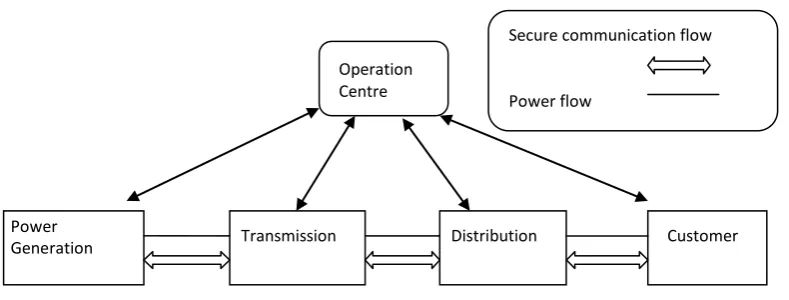
SG is called by many names i.e. intelligent grid, future grid, intergrid or intragrid and an
improvement of twentieth century power grid [10]. National institute of standard and
technology (NIST) has created a conceptual model of SG as shown with modification in
Figure 2.1 Smart grid conceptual models.
In the traditional grid, power is transmitted from the generating unit to the load,
whereas in smart grid, any amount of power, small or large, generated by the household
or other units including from solar cell or wind turbine is added to the grid. This
distributed generation (DG) of power has to be accommodated in SG. Though, at
present, the numbers of DGs are small, it is going to be larger and decentralized in the
future SG. The future SG has been predicted to
1. Accommodate DGs in present grid,
2. Introduce a decentralised DG system that work with centralized generation
system, and
3. DGs will supply most of the power than the centralized generation [9].
Largely deployed sensors in SG will play a vital role for the information monitoring and
measurement, moreover, these sensors need to be connected with the other units with
networking and communication technologies. The communication technologies for the
SG can be classified as follows.
Operation Centre
Power
Generation Transmission Distribution Customer Secure communication flow
Table 2.2 Communication technologies of smart grid [10].
2.2
Measurements and Metering of SG
Information monitoring and measurement can be divided into two sub categories e.g.
metering by smart meter and monitoring by advanced technologies.
2.2.1
Smart Meters for Metering
These meters function as two way communication between the meter and the central
subsystems. Smart meters collect the real time data of household appliances and send it
to an access point, as well as this real time data consisting of voltage, current and
consumed power can also be routed to the distribution center. Smart meters can
connect or disconnect and control the appliances remotely, in addition the consumers
can differentiate each appliance’s consumed power, and take the right decision for
Communication Technologies
Wireless Wired
Wireless Mesh Network
Cellular Communi cation
Cognitive Radio
IEEE 802.15
Satellite Communication
Power line Communication Fiber – optic
Communication
operating the appliances at the right time (off peak hour) for reducing bills. Smart
meters can inform the user to use the appliances at off peak hour for reducing bills [10].
2.2.2
Monitoring and Measurement
SG needs a continuous real time information of the grid status. Leon et al [11] has
proposed that the grid should be embedded with the sensor networks and it should
help to determine the real time electrical and mechanical status of the grid. The collapse
of towers, disconnected conductors, line faults or other mechanical failures can be
detected by the sensor networks and also can help to determine the real time control
measures for ensuring uninterrupted power supply. The sensor networks of SG should
fulfill the following requirements [12, 13, 14]:
Quality of service
The sensor networks will generate a lot of information, thus the connectivity of
the network should support the high reliability, low latency and high throughput.
The controller at the control center should receive the data in a timely manner.
Remote access
The sensor networks must be accessed remotely and should have remote
configuration facility.
Environment withstanding
The SG environment is mostly outdoor type. The sensors must be able to
2.3
Power System Communication Development History
The research on communication technologies of SG has passed through a considerable
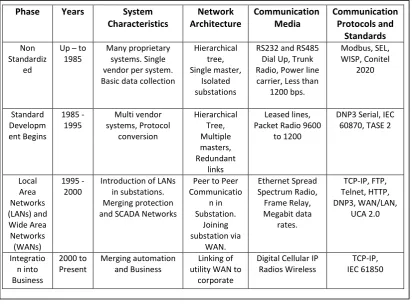
development in the course of time. Table 2.3 shows the communication system
development summary [12].
Table 2.3 Communication system development summary for the power system.
SG will encompass various small renewable energy resources i.e. solar cells, wind
turbines, tidal waves, small hydro power generating units, geothermal heat and the
energy from the wastes. Basically, these are small power generating units that can be
used for meeting the local needs or can be added to the grid for organized distribution.
These small units manifold the complexities of power management, furthermore, the
Phase Years System
Characteristics Network Architecture Communication Media Communication Protocols and Standards Non Standardiz ed
Up – to 1985
Many proprietary systems. Single vendor per system. Basic data collection
Hierarchical tree, Single master,
Isolated substations
RS232 and RS485 Dial Up, Trunk Radio, Power line carrier, Less than
1200 bps. Modbus, SEL, WISP, Conitel 2020 Standard Developm ent Begins 1985 - 1995 Multi vendor systems, Protocol conversion Hierarchical Tree, Multiple masters, Redundant links Leased lines, Packet Radio 9600
to 1200
DNP3 Serial, IEC 60870, TASE 2
Local Area Networks (LANs) and Wide Area Networks (WANs) 1995 - 2000
Introduction of LANs in substations. Merging protection and SCADA Networks
Peer to Peer Communicatio n in Substation. Joining substation via WAN. Ethernet Spread Spectrum Radio, Frame Relay, Megabit data rates. TCP-IP, FTP, Telnet, HTTP, DNP3, WAN/LAN, UCA 2.0 Integratio n into Business 2000 to Present Merging automation and Business Linking of utility WAN to
corporate
Digital Cellular IP Radios Wireless
communication and control of smart grid must be capable enough to address all these
needs.
2.4
Communication Requirements for the Smart Grid
Communicating among systems of various functionalities is the foundation of smart
grid. Poor communication will disrupt the essence of smart grid, and it may also disrupt
the grid system. The communication needs to maintain the following factors for the
efficient operation of an SG [15, 18].
2.4.1
Network Latency
The latency of a network is defined as the maximum time required for a message to
reach from the source to the destination. The latency requirements among the various
types of functionalities are different. For example, the message exchange between
intelligent electronic devices (IEDs) requires less time compared to the supervisory
control and data acquisition (SCADA) message exchange between the electrical sensors
and the control centre. The data rate of the network and number of hops required for
sending the data also affects the latency.
2.4.2
The Criticality of Data Delivery
The protocols used for the smart grid applications should provide the criticality of
different data delivery depending on the applications. This can be taken into account at
the time of designing an application. The criticality of data delivery may be classified
i) Highly critical: If the system needs a confirmation of the end to end delivery of any
sensitive data (i.e. switchgear position changing information), the criticality level of the
communication is considered very high. As this kind data is very sensitive in SG, this is
required for ensuring a successful delivery.
ii)Medium critical: When there is no need for the end to end delivery confirmation of
data, it can be considered as medium critical. For example, measurement data of
voltages and currents.
iii)Non critical: When the loss of data is acceptable to the receiver, it can be considered
as non-critical. The message repetition can improve the data reliability in these cases.
For example, the loss of some monitoring data of certain interval can be considered as
this type.
2.4.3
The Data Reliability
In the SG, the functional devices rely on the communication backbone network for the
reliable data delivery, and the backbone network should be capable to meet all the
needs. The communication network or the resources can affect because of improper
data delivery. If the time of detecting, assembling and monitoring of a control message
exceeds the time limit, it can be treated as a timeout failure. The failure of any layer of
the "protocol suites" will be treated as network failure.
2.4.4
Security
important. Spoofing of data may affect the SG systems, and consequently, for the
secured delivery of data, access should be limited to the authorised personnel and
encryption of data may be adopted.
2.4.5
Time Synchronization
There are some devices of SG which requires time synchronization. For example, the
phasor measurement unit (PMU) needs the time synchronized data for providing the
real time electrical measurements. This data is used for the controlling, analysis and
measurements of the power system.
2.4.6
Multicast Support
Sometimes, the system needs to send the same information to various resources.
Instead of sending the message individually, the message is sent to a switch and it is
retransmitted to all the outgoing ports [15, 18].
2.5
Wireless Technologies for the Smart Grid
Wireless technologies has the advantages of rapid installation, lower cabling cost,
increased mobility than over wired ones and it also supports remote end applications
2.5.1
Wireless Networks
a)
Wireless Mesh Networks
Wireless mesh network (WMN) is one of the promising technologies for the next
generation wireless networking [17]. It can offer the networking requirements
and the benefits of WMN are described below [10].
Reliability of communication and connectivity
In WMN redundant path offer greater flexibility for communication, also the
key feature is that WMNs are self organized and self configured and useful for
the electric power system automation.
Larger coverage and high data rates
The smart meters, sensors and other SG equipments will generate a high
volume of data which has to be transferred all the way down to the control
center for monitoring and other applications. WMN has the capabilities of
addressing this requirement [10].
b)
Cellular Communication for the SG Applications
Cellular communication is a terrestrial radio communication and it performs the
networking services from the Cell/Base station. Researchers have studied on the
applicability of this technology for the SG. The study of Hung et al. [18] proposes
that the communication of the sensor nodes with the backend nodes by cellular
c)
Cognitive Radio
Ghassemi et al. [19] has proposed that cognitive radio’s can be used for the SG
applications and this is based on IEEE 802.22 protocol. The communication by the
cognitive radio between the SG control center and the consumer has been proposed
by Ma. et al. [20].
d)
802.15.4 Standard Based Wireless Communication for SG
This standard is used in three component technologies as described in [21]. Those
are WirelessHART, ZigBee and ISA100.11a. ZigBee is suitable for the low data rate,
low energy consumption and secured communication. U.S. national institute of
standard technology (NIST) [8] has selected ZigBee smart energy profile (SEP) as
communication standard for the SG customer premise network. Many companies
selected ZigBee as smart metering devices communication technology [7]. The
ZigBee smart energy profile (SEP) supports the features like pricing at the real time,
response according to demand, enhanced support of metering and the control of
load [23]. Self organised and time synchronised mesh architecture is used by the
WirelessHART system. It operates on 2.4 GHz band and uses the 802.15.4 based
standard radios. International society of automation has developed ISA100.11a
standard and this is an open standard for the wireless networking. For the power
generation plant and substation WSN applications, the WirelessHART or ISA100.11a
e)
Satellite Communication for the SG
The lack of communication structure has made it difficult to communicate with the
remote power generating units and substations. Satellite communication can be
used for this type of communication. The wind energy based remote deployment
units can be communicated by the global coverage of satellite communication
system as stated by Deep et al. [24] and this can also be cost effective. The
terrestrial system of communication may be disrupted by natural disasters, hence,
for valuable and necessary data transfer satellite communication may be used as the
backup system. There are two short comings of satellite communications, first is
large delay and second vulnerability to fading due to the weather condition which
can profoundly degrade the total performance of satellite communication [22, 10].
f)
Microwave or Free Space Optical Communication for the Smart Grid
Microwaves systems work with the line of sight communication systems.
Microwaves are field proven technologies for the telecommunication, and have
been in use for decades. Microwaves are suitable for the rural communication
where the infrastructure is not available or it is difficult to install. The disadvantage
of the microwave communication is that the signal is heavily attenuated by any
obstruction on the path of communication. Another way of communication, called
free space optical communication uses the propagation of light through free space,
and is a point-to-point communication with a very narrow beam. This is a directional
2.6
Wired Technologies for SG
2.6.1
Optical Fibre
Optical fibre communication has been in use for the communication between the power
generation and network control centre for a long time [10]. Optical fibers are immune to
interference and this property has made it suitable for the uses in high voltage
environment [25]. Optical fibre’s can carry a high volume of data, so it can be used as
the communication medium for automation application [12].
2.6.2
Power Line Communication (PLC)
The electric power transmission cables are used for the transfer of data in PLC
technology. PLC has the minimum cost due to the use of established power lines. PLC is
subjected to noisy medium, interference, emission and change of impedances. The data
security is also low in PLC [10].
2.7
Wireless Sensor Networks for the Smart Grid Automation
Wireless sensor networks (WSN) can be used for SG networking nodes. This WSN may
be thought of as low power, low cost functional nodes. The nodes are small in size and
communicate with each other over short distances [12]. These small nodes can read the
various forms of physical information such as temperature, vibration, noise radiation. It
can also transform these measured parameters into electrical signals [12]. Tiny nodes of
WSN can route or relay the data packets to the sink in multi hop, infra structure less
alone sensors with the sensor network using wireless adhoc networking for its
application [29]. WSN may be used as reliable system for electric system automation. It
has various uses i.e. WSN can be used in wireless automatic meter reading (WAMR)
system for the real time energy consumption reading. In WSN the network topology
depends on application requirements [12].
A sample network is shown in Figure 2.3. This tiny sensor’s can collect data and route to
the sink node [26].
Figure 2.2 Smart grid sensor based network architecture.
The measured data is then transferred by the backbone nodes to the control centre.
2.7.1
Wireless Sensor Networks Benefits in SG
WSN offers a real time and trusted network monitoring for the electric systems. The
major benefits are described below. A monitoring system integrated with the sensors
can reduce the fault detection time and recommencement of power supply service [12].
Large area coverage
Sink Backbone
Control Centre
A large number of sensor nodes cover a large area of monitoring, and after the
installation of WSN the human intervention is almost negligible [12].
More fault tolerant capacity
In WSN, the nodes are densely deployed and the correlation of data is high. The WSN is
a large distributed network with redundant routes. It allows the monitoring and
maintenance information to be transported in case of route or sensor node failure [12].
Accuracy of data measurement
The different physical phenomena of the electric system are sensed by the multiple
sensors [12], and it can be said that a sensor based network is more accurate because of
multiple sensors.
Necessary data processing
Sensor nodes can filter data according to the application. This reduces the unnecessary
processing and only the required information is transmitted to the data centre. It helps
to reduce the communication overhead [12].
Self maintenance
The sensor nodes have self configuration capabilities, and it offers very rapid
deployment. The sensor nodes can make ad hoc networks which does not have the
conventional topological architecture of the nodes. Faulty sensors can be removed or
new sensors can be added easily without compromising the fundamental objective of
electric power system monitoring [12].
WSN is a low cost device and it consumes low power, thus, it provides a cost effective
way of networking than the other sensors [12].
2.7.2
Design Factors for Wireless Sensor Networks
WSN can be used for system automation of the SG. For the cost effective solution of SG,
supporting the existing structure and fulfilling the application need, designers need to
consider the following factors [12].
a) Topology and network architecture
The topology of WSN has notable effects on the routing protocols, lifetime and the
network ranges. The architecture includes the physical and logical organization of
the sensor nodes and its density. The WSN nodes need to effectively cover the
networking area. Network organization impacts the energy consumption of the
nodes and protocol of communication [12].
b) The application program
The sensor nodes transmit and relay lots of data. These data needs to be quantified
and classified [27]. It can be achieved by analyzing applications used for electric
system automation [12].
c) Limitation of resources
The design and implementation of wireless sensor networks is limited by the –
energy, processing and memory resources. The battery lifetime of the sensor nodes
limits the lifetime of sensor networks [28]. This is why, the communication protocol
d) Timing requirements
This is very important that the control centre should receive data at the right time
for the requested operation of the SG. The delay of data communication mainly
composed of processing and transmission delay. If the data takes a long time for the
processing and transmission, it becomes outdated and may results in a wrong
decision. Hence, the communication protocol used in WSN should be able to support
the efficient communication system [12].
e) Fault tolerance
Interference of another signal, lack of power or damage may trigger the failure of
the sensor nodes. The design should be such that failure of some nodes does not
affect the network parameters. Reliability is very important for sensor networks
[26]. Fault tolerant capacity of the sensor networks is being considered now and the
fault tolerance of the sensor networks has been modelled in [30]. The probability of
not failing within the time interval ( ), can be expressed by the Poisson
distribution
...(1)
Failure rate of the sensor node is and the fault tolerance or reliability is
denoted by and the time period by [26].
f) Scalability
A large number of sensor nodes may be deployed in an area. The density of the
...(2)
Where is the number of sensor nodes in a specific region and is the Radio
transmission ranges [31].
2.7.3
Wireless Sensor Networks for the Electric System Monitoring
Natural disasters, equipment malfunction or failure, or accidents may results electric
power outages. That is why, this is very crucial that the electric systems should be
controlled and monitored and the power supply authority should get the monitoring
information at the right time for taking necessary precaution [11]. Wind turbines and
photovoltaic cells are distributed resources which can potentially compensate the
power supply shortage. But, the integration of large number of these types of resources
with the existing power system is a challenging task. These integrations can be solved by
sensing, metering, communication and IT services [32].
A well designed sensor based network with the appropriate protocol can be used for the
fault detection and other monitoring purposes. WSN provides the opportunities of real
time and reliable monitoring of power supply system [12].
2.8
IEEE Standards for the Smart Grid (SG)
IEEE has released a group of standards for the power system communications. These are
briefly described below [15].
a)
IEEE C37.1
specification, definition and SCADA application for electric substations. The electric
substation system architecture and function is discussed in this standard.
b)
IEEE 1379
IEEE 1379 [34] is the recommendation of implementation guideline and
communication of intelligent electronic devices (IED) and remote terminal unit (RTU)
of the electric substation. Existing protocols has been used for the communication
support.
c)
IEEE 1547
IEEE 1547 proposes about the electric power system which connects the distributed
resources. This protocol consists of three sections.
i) Power system [35]
ii) Exchange of information [36]
iii) Test compliance [37]
The power system standard discusses about the power conversion technology
requirement and their inter-connection for providing quality services. The
information exchange standard discusses about the power system monitoring and
control through the data communication networks. The test compliance tells about
the procedure for verifying the compliance of an interconnection system with the
standards [15].
d)
IEEE 1646, IEEE Standard for the Delay in the Smart Grid
IEEE 1646 [36] specifies about the standards of communication delivery time for the
exchanged information of internal and external electric substation protection,
control and data acquisition systems. This standard categorizes the substation
categories. Timing is one of the most important factors for SG communication. The
IEEE and International electrotechanical commission (IEC) has guidelines for the
communication delay requirements for the different information exchange. The end
to end delay is the sum of processing and transmission delay of each traversed
node. The source generates delay due to message format and transmission. The
intermediate nodes add delay by processing and retransmission of the message.
The destination adds delay by decoding and presenting to the application.
Information types Internal to substation External to substation
Protection information,
High speed
1/4 cycle 8 to 12 ms
Monitoring and control Information, medium speed
16 ms 1 s
Operations and maintenance
information, low-speed
1 s 10 s
Text strings 2 s 10 s
Processed data files 10 s 30 s
Program files 1 min 10 min
Image files 10 s 1 min
Audio and Video data streams
1 s 1 s
Table 2.4 IEEE 1646 standard: communication timing requirements for electric substation automation [36].
e)
IEEE P1901
IEEE P1901 is a standard for high speed power line communication for the utility, in
f)
I
EEE P2030
IEEE P2030 proposes the interoperability’s of the SG. This protocol ensures the
seamless data transfer of a two way communication for the electric power
generation, power delivery and customer side application [39].
2.9
IEC Standards
For the control and communication of electric power systems the International
Electrotechnical Commission (IEC) has submitted a number of standards. Standard
61850 defines communication between the transmission, distribution and substation
system automation [39]. Standard 61870-6 defines data exchange between utility
control centre and utilities, power pools and regional control centers [39]. IEC 61970
and IEC 61969 define the common information model (CIM). This is necessary for data
communication between devices and networks. IEC 61970 is a transmission domain and
IEC 61969 is a distribution domain standard [39]. For the smart grid application, CIM
standards are integral and it connects many devices to a single network [39].
2.10
Routing in Smart Grid
SG is considered as a blend of interconnecting communication technologies with various
devices. This is a large network of routers, switches, computers, smart meters, house
appliances, sensors, renewable energy resources and electrical vehicles. Each of these
devices has different CPU capacity, memory usage and storage ability, and, the routing
protocol has to consider all these factors. In order to cope with various communication
rather than a single interface. Hence, the nodes can operate with multiple radios and
channels. These types of flexibilities will enhance the opportunities of alternate routes.
The same functional devices can be grouped in a network, and may be used with
different protocols. Therefore, the interoperability of the nodes is highly desirable [40].
2.11
Smart Grid Routing Factors to be Considered
2.11.1
Interoperability between Smart Grid Nodes
SG is a complex system of interconnected devices. Different equipments need to use the
information efficiently and securely. The network and nodes needs to be managed with
high efficiency to prevent blackout and network failure. The different networks which
have been grouped according to their functionality can communicate with other
network by the gateway services. These gateway nodes can support t interoperability by
adapting different protocols. Deployment of such gateways on every part of the
network may not be cost effective, and there is a need for new protocols to support
home area network (HAN), neighborhood area network (NAN) and wide area network
(WAN) environments [40].
2.11.2
Placement of Smart Grid Nodes
SG will have various network topologies. Hundreds of gateways, sensors and smart
meters are fixed and deployed in the network as needed. The transmission range and
density will be varying and requires a variety of network topologies needs to be
additional relay nodes. The nodes placement needs careful planning for reducing the
bottlenecks and packet loss [40].
2.11.3
Smart Grid Node Mobility
Most smart grid nodes of NAN, HAN and WAN’s are static. The maintenance vehicle,
electric vehicles can be considered as mobile nodes. Mobility of these nodes adds new
challenges to the routing protocol. Sensors are a part of the smart grid network and
should be able to communicate with the mobile maintenance work force. The efficient
routing with low latency and reliability is highly desirable. The disturbing factors like
interference and node failure also needs to be considered [40].
2.11.4
Scalability of Smart Grid
Supporting the scalability is one of the key factors for the SG application. Thousands of
smart meters will send real time data to the utility companies. The electric power user
density will decide the no. of nodes used. The user densities of electric power of the city
will be more than the rural areas. The factors like discovery of new route(s), and
efficient distribution of packets will grow with the increasing network. The routing
protocol needs to support the scalability of the nodes as per requirements [40].
2.12
Ad hoc Routing Protocols for the Smart Grid
2.12.1
Mobile Ad hoc Network Background
Mobile ad hoc network (MANET) is formed by a group of mobile nodes. This is a
word ad hoc is derived from the Latin origin and it means ‘for this’ or ‘for this only’.
MANET is very suitable for military application and it seems to be very appropriate for
this because at the military environment, where infrastructure based network is difficult
to install and maintain. In MANET each node can serve as both a node and a router.
MANET is very helpful where there is need to make a network without any established
infrastructure. It can make a network at any time at any place into reality. MANET
permits the dynamic topology and any node is free to join or exit the network, meaning
the network topology can change in unpredictable manners. Information is transferred
in a peer to peer mode and it uses the multihop routing, also maintaining the route in
dynamic topology requires a lot of challenges. MANET also has the civil application like
smart grid, process control, disaster management and peer communications etc [41].
The discussion in Section 2.7 reveals that WSN is very effective for SG, and this WSN can
be effectively implemented using ad hoc communication.
2.12.2
Ad hoc Routing Protocols
Ad hoc routing protocol classification
Table 2.5 Ad hoc routing protocol classification [41].
Some of the routing protocol categories related to SG are briefly described below.
Hierarchical routing
The nodes of the networks have the different roles in hierarchical routing. Wireless
hierarchical routing organizes nodes in groups and assigns the nodes with different
function inside and outside of the group [41].
Geographical position assisted routing
In this routing each node is integrated with the Global positioning system (GPS). The
reduction of GPS price has opened the opportunity of using the GPS with the nodes
and it provides excellent precision [41].
Dynamic source routing (DSR) maintains information on multiple routes in route
cache and does not work well with the large network. Thus, the source node can
GPSR GEOCAST
LAR DREAM
M Ad hoc Routing protocols
Proactive (Table Driven)
Geographic position
Assisted Routing Flat Routing Hierarchical Routing
Reactive (On-demand) LANMAR ZRP CGSR HSR DSR AODV VVVV V TBRF F FSLS
FSR OLSR
check the route cache for routing information before initiating the routing request.
The DSR protocol does not maintain the routine connectivity message with the
neighbourhood nodes. The major difference between the DSR and AODV is that in
DSR each packet contains the complete routing information and in AODV each packet
carries only destination address.
AODV has less routing overhead than the DSR and AODV is also adaptable to dynamic
networks. In the Light weight mobile routing (LMR) protocol routes are determined
by the flooding techniques. LMR nodes maintain multipath routes to each
destination. LMR has the limitation of producing invalid routes and caused extra
delays. Temporarily ordered routing algorithm (TORA) is derived from the LMR
protocol and it supports multicasting. TORA also has the probabilities of making the
invalid routes. Associativity based routing (ABR) is a source initiated routing protocol
where a route is selected principally on the basis of stability using query-reply
technique for route determination. Signal stability adaptive routing (SSA) is derived
from ABR and it determines a route on the basis of signal strength and the stability of
the location. In SSA the intermediate nodes cannot reply to the route request, and it
creates long delays [42].
Flat routing
Flat routing functions with a flat addressing scheme, where each node of the network
has the equal role [41].
As my research is related to the reactive routing protocols, proactive and reactive
Proactive routing protocol
In the proactive routing protocol each node maintains the routing information of all
other nodes of the network. This routing information is stored in a number of tables
which are updated with the change of topology or in a regular basis. For example,
Destination sequenced distance vector routing (DSDV) and Clustered gateway switch
routing (CGSR) etc. are proactive protocols [42].
Reactive routing protocols
Reactive routing protocols maintain the information of only the active routes of the
network. It reduces the overhead of the proactive routing protocol. Routes are
determined and maintained for the nodes that want to send data to a particular
destination. The example of reactive routing protocols is AODV and DSR [42]. Most of
the protocols of this type perform their operations broadly in two phases e.g. route
discovery and route maintenance. Our proposed mechanism is also based on this
category. The routing mechanism of this type of protocol is described in more detail
in the next sub-sections.
2.13
Overview of Some Smart Grid Routing Protocols
There are lot of proposed protocols designed for multihop communication in different
applications. Some of these previously proposed protocols are investigated for smart
grid, and some are modified to fit with smart grid. This section contains a brief
An improved routing protocol based on AODV for power line communication has been
proposed in [43]. The improved on demand distance vector (IPAODV) routing cope with
the topology changes of power line communication networks. Two changes have been
proposed from the conventional AODV
a) Stable neighbours are selected during the route discovery
b) Over head is reduced by improving the route maintenance.
IPAODV determines the link quality by the received Hello messages. If the number of
received Hello message is less than a threshold, then the link quality is assumed to be
low i.e. a threshold value is used for the link quality assessment. If the link quality goes
below the threshold than the neighbourhood entry is deleted. When the link quality is
higher than the threshold, the neighbourhood is considered valid. Accordingly, in
IPAODV regular Hello messages is not sent like conventional AODV. These unused Hello
message slots are used for data packets in IPAODV [43].
The geographic Routing Protocol has been proposed in [44]. It has considered the static
nature of SG and the WSN. Two other methods i.e. beacon-less routing (BLR) uses the
location information for the reduction of routing overhead [45] and beacon-vector
routing (BVR) [46] and implicit geographic forwarding (IGF) [47] has been considered.
Greedy perimeter stateless routing (GPSR) techniques can be used in wireless networks
[48].
In [49] Power line multipath routing (PMR) is used as source routing protocol which
[51] the routing protocol for low power lossy network (LLN) has been proposed by the
Internet engineering task force (IETF). Routing protocol for low power and lossy
networks (RPL) is based on IPV6. It can support point-to-point (P2P), point-to-multipoint
(P2M) and multipoint-to-point (M2P) communication. This protocol supports message
confidentiality and integrity.
Performance comparison of RPL and geographical routing protocol [52] has been
conducted. Both can be used for smart utility networks. Hydro is another routing
protocol [53] which supports the point-to-point (P2P) communication. This is a hybrid
protocol and it supports the centralized control.
The secure energy routing mechanism (SERM) was proposed in [54]. SERM provides
security by using secure key management. For the smart metering application wireless
mesh based networks are being used in North America and other parts of the world
[55]. For the neighbourhood area networks (NAN) energy management RF mesh based
network is being used in [55]. For the smart grid back bone networks IEEE 802.11s is
proposed in [56]. This protocol supports hybrid wireless mesh protocol (HWMP). HWMP
is useful for static mesh networks.
In this sub-section, we discussed some routing protocols proposed for SG applications.
Our research in this thesis is mostly related to AODV and AODV-UU. So, we briefly
2.13.1
An Overview of Ad hoc On-demand Distance Vector (AODV)
We proposed the modified AODV (MAODV) routing protocol, which is based on some
changes of the mechanism of AODV, for the SG application. The mechanism of AODV is
briefly discussed in this sub-section. AODV protocol is derived from the DSDV algorithm.
AODV is an on-demand routing protocols in which the nodes maintain routing
information which lie on an active path. The main phases of AODV are discussed below.
AODV creates route when needed and this is a reactive routing protocol. It has been
shown in Figure2.3. Connection with the neighboring nodes is detected and maintained
by the use of hello messages. Each active node broadcasts the hello message; hence,
failure to hear the hello message from the neighbor link indicates a link break. In order
to transmitting data to an unknown destination a source node broadcasts a route
request (RREQ) for the destination. Every intermediate node receiving the RREQ makes
a route to the source. If the receiving node receives the RREQ for the first time and is
not intended destination, the node will rebroadcast the RREQ.
Figure 2.3 AODV routing protocol.
Hello
RREQ
REP
ReRR
DATA
Link Failure
Source Node
e
Source Node
e
Dest. Node
e
Dest. Node
Again, if the receiving node contains the current route to the destination or itself is the
destination, it will generate route reply (RREP). The RREP is unicasted in hop by hop to
the source. The route to the destination is created through the propagation of RREP.
After receiving the RREP, the source stores the destination route to the destination and
starts data transmission. If the source receives the multiple RREP, it chooses the route
with the shortest hop count. While the data transfer continues from the source to the
destination, the node across the established route update the timers related to the
routes and maintains the route in the routing table. For the unused route, the node
cannot decide whether the route is still valid or not and detects the route from its
routing table. If a link break is detected during data transfer a route error (RERR)
message is sent to the source in a hop-by-hop manner and the intermediate nodes
invalidate the route to the unreachable destination. When the source receives the RERR,
it marks the route as invalid and the route discovery process is reinitiated [57].
2.14
An Overview of AODV Uppsala University (AODV-UU)
AODV-UU implements the AODV protocol [58], and it is compliant with IETF RFC 3561.
AODV-UU was developed by the Uppsala University, Sweden and released under the
GNU general public license (GPL). The suffix UU is added for the word Uppsala
University. AODV-UU was initially written in C for running with Linux. It is popular
among the academician and researcher’s [66]. Uppsala University’s AODV
implementation has been imported to the INET framework. This is integrated with
The mobile ad hoc network (MANET) supports the multi-hop communication by using IP
routing. In this thesis, we are using modified AODV-UU for the SG communication.
In this section, we discussed about routing in SG. We have given overviews of some
related routing protocols along with AODV and AODV-UU. We have tested AODV-UU in
a real-time test-bed scenario and compared those outcomes with the simulation results.
We used INETMANET with OMNET ++ to simulate different SG related metrics of
![Table 2.1 Comparison between the present grid and the smart grid [7].](https://thumb-us.123doks.com/thumbv2/123dok_us/1425888.1175097/21.612.183.469.379.523/table-comparison-present-grid-smart-grid.webp)
![Table 2.4 IEEE 1646 standard: communication timing requirements for electric substation automation [36]](https://thumb-us.123doks.com/thumbv2/123dok_us/1425888.1175097/39.612.140.508.276.546/table-standard-communication-timing-requirements-electric-substation-automation.webp)
![Table 2.5 Ad hoc routing protocol classification [41]. V](https://thumb-us.123doks.com/thumbv2/123dok_us/1425888.1175097/44.612.114.543.75.332/table-ad-hoc-routing-protocol-classification-v.webp)