University of Windsor University of Windsor
Scholarship at UWindsor
Scholarship at UWindsor
Electronic Theses and Dissertations Theses, Dissertations, and Major Papers
1-1-1980
A THEORY OF CROWDING BASED ON THE INTERACTION OF
A THEORY OF CROWDING BASED ON THE INTERACTION OF
LOSS OF CONTROL AND THE ATTRIBUTION OF NEUTRAL
LOSS OF CONTROL AND THE ATTRIBUTION OF NEUTRAL
INTENT.
INTENT.
THOMAS W. MANAGHAN
University of Windsor
Follow this and additional works at: https://scholar.uwindsor.ca/etd
Recommended Citation Recommended Citation
MANAGHAN, THOMAS W., "A THEORY OF CROWDING BASED ON THE INTERACTION OF LOSS OF CONTROL AND THE ATTRIBUTION OF NEUTRAL INTENT." (1980). Electronic Theses and Dissertations. 7188.
https://scholar.uwindsor.ca/etd/7188
This online database contains the full-text of PhD dissertations and Masters’ theses of University of Windsor students from 1954 forward. These documents are made available for personal study and research purposes only, in accordance with the Canadian Copyright Act and the Creative Commons license—CC BY-NC-ND (Attribution, Non-Commercial, No Derivative Works). Under this license, works must always be attributed to the copyright holder (original author), cannot be used for any commercial purposes, and may not be altered. Any other use would require the permission of the copyright holder. Students may inquire about withdrawing their dissertation and/or thesis from this database. For additional inquiries, please contact the repository administrator via email
V
1 *
,’5 1 2 0 3
Nati6fta! Library Bibiiothbque nationale of Canada du Canada
dk
'3/C- 0-33O7-X
CANADIAN THESES ON MICROFICHE
THlSEJ7ANADIENNES SUR UICROFICHE
NAME OF AUTHOR//VO/VI DE
L'AUTEUR-- ♦
TITLE OF TH ESIS/7777?£ DE LA THESE__
U N IVERSlTY/U7V/V£/?S/7'£_
Thomas ¥. Managhan*
A theory of crowding based on the interaction-of
loss of control and the attribution of neutral intei
/
University of Windsor, Windsor .Ontfario
, DEGREE FOR WHICH THESIS WAS PRESENTED/, GRADE POUR LEQUEL CETTE THESE PUT PRESENTEE_
YEAR THIS DEGREE CONFERRED/AAW££ D ’ ORIENT! ON. DE C £ GRADE.
NAME OF SUPERVISOR/7VOM D U DIRECTEURDE THESE _______
Ph.D.
May 1981 .
Dr. Frank Schneider
Permission is hereby granted to the NATIONAL^ LIBRARY OF
CANADA to microfilm this thesis and to lend or sell copies
of the film .
The author reserves other publication rights, and neither the
thesis nor extensive extracts from it may be printed.or other
wise reproduced without the author's written permission.
L'autorisation est, par la prgsente, accordSe b la B IB U G TH t-
QUE N A T IO N AlE D U C ANADA de microfilmer cette thdse ef
de prefer ou de vendre des exemplaires du film .
V
L'auteur se reserve les autres droits de publication; n i la
thSse n i de longs extraits de c e lle -c i ne doivent etre imprimds
ou autrement reproduits sans l'au torisation Scrite de l'auteur.
1 +
" A
National Library of Canada Collections Development Branch
Canadian Theses on &
Microfiche Service t
Bibiiothfequenationale du Canada -. Direction du developpementdes collections
Service des theses canadiennes sur microfiche
NOTICE •AVIS
T h e quality', o f this rpicrofiche is . heavijv- dependent • upon th e q u q lity o f thd 'original thesis subm itted for. (hnicrofiInning. Every e ffo rt has been made to ensurp
th e highest q u ality o f reproduction possible.
If pages are missing, contact the university which granted the degree. - V .
Some pages m ay have indistinct p rin t especially if the/original pages were typed w ith a poor typ e w riter ’ ribbon o r if the university sent us a poor photocopy.
\
’Previously copyrighted materials (journal articles, • published tests,.etc.) are not film ed.
Reproduction in full o r in part o f this film is gov erned b y the Canadian Copyright A ct, R.S.C. 1970, c. C -30. Please read the authorization form s which' s'* accom pany this thesis.
)
La qualite de cette m icrofiche depend grandem ent de la qualite de la these soumise au miicrofilmage. Nous avons to u t fa it pour assurer une qualite superieure
de reproduction. . '
S'il manque des pages, veuillez com m uniquer avec I'universite qui a confere le grade.
La q u alite d'impres§ion de certaines pages peut laisser a desirer, surtout si les pages originales o n t ete dactylographiees a I'aide d'un ruban use ou si I'univer site nous a fa it parvenir une photocopie de mauvaise qualite.
Les documents qui fo n t deja I'o b jet d 'u n d ro it d'auteur (articles de revue, examens publies, etc.) ne sont pas m icrofilmes.
La reprodi^stion, meme partielle, de de m icrofilm pst soumise a la Loi canadienne sur le d ro it d'auteur, SRC 1970,”0. C -30. Veuillez prendre connafssance des formules d'autorisation qui accompagnent cette these.
T H IS D I S S E R T A T I O N \ HAS BEEN MIC RO FIL M ED
. EXACTLY AS RECEIVED
LA THESE A ETE M I C R O F I L M EE TELLE QUE
N O U S L ' A V O N S RECUE
Ottawa, Canada K1A0N4
\
NL-339 (Rev. 8/80)A THEORY OF CROWDING BASED ON THE INTERACTION OE LOSS OF.
CONTROL AND THE ATTRIBUTION OF NEUTRAL_INTENT
BY ' . . .
- •• N .
Thomas W. Managhan
\ •:
-Honour's B.A. University Of Windsor, .1973
M.A. Lakehead University, 1975
A Dissertation
Submitted to the Faculty of Graduate Studies through the Department of Psychology
in Partial Fulfillment of the Requirements for the Degree of •
Doctor of Philosophy at the University of Windsor
Windsor, Ontario, Canada 1980
APPRO1
(s) Thomas W. ManhghanT 1981
756542
? 1
Z '
\
With' Love to Carol,
■the girl who .sat in'.front of he in summer school when We were trying to pass grade twelve - and who has been my inspiration ever since.
ABSTRACT
In..the present dissertation, a control-attribution
•. i ■■
theory - of c r o w i n g is proposed in which the author'attempts
10
'stf
specify the set of- conditidhs^ that are both necessary and
:ficient for crowding "to occur. r According to the theory,
the perception of crowding occurs only'when an individual .
experiences physiological arousal due. to -a loss of control
over the environment and then attributes the control-^induced
arousal to the presence of others under conditions of
nonin-tentionality. That is, the experience of crowding will be
4 * v
identified only when the_ individual perceives that his or her
loss of-•'cbntroi has not been intentionally inflicted by
others. In addition to specifying the antecedent conditions
that elicit the initial perception of crowding, the present
theory accounts for both the short term and long.term effects
of crowding.
Furthermore, an experimental test of the theory was
carried out. In order to assess the relative effects of
situational control and attribution of intent, three levels
of the control variable and two levels of the intent variable
were manipulated in a 3 x 2 experimental design. Subjects
were tested in groups of 5 or 6 persons, two of whom were
experimental confederates. The confederates served as con
trol reducers. While all subjects were required to perform
vi
impeded in their performance by the confederates who were
portrayed as having'"neutral intentions" (i.e., did not have
a choice in impeding the subjects), whereas the others were
impeded by confederates.who were portrayed as-having
"personal'intentions" (i.e., did have a choice in impeding
the subjects). Amount-of control was manipulated by:
(a) providing high control subjects, with the opportunity to
halt the distracting verbal behaviour of the confederates and
encouraging them to take advantage of the opportunity; '
(b) providing partial control subjects with the opportunity
to halt the distraction created by the confederates but dis
couraging them from taking advantage of the opportunity; and
(c) depriving no control subjects of any opportunity to halt
the distraction created by the confederates. Four major
dependent variables were assessed: heart rate during task
performance, the particular label that the subject used to
describe her experience, the rated intensity of that experience
(i.e., self-reported arousal), and amount of persistence
demonstrated on a subsequent task. In addition, the subjects
were required to complete Rotter's (1966) locus of-control
scale. The major hypothesis of the study stated that (1) a
loss of control would result in an increase in physiological
arousal; (2) control-induced arousal labelled as
crowding only under conditions of nonintentionality, and;
(3) a heightened state of arousal during an initial task
would result in less persistence on a subsequent aftereffects
task- '
x
Preliminary analyses.of the data suggested that
whereas control was effectively manipulated, the attribution
of intent manipulation was not successful. » In'light of the
unsuccessful manipulation of . the attribution o f intent, the
\ ‘ • *
experiment could not be viewed as an adequate test of the
proposed control-attribution theory. - - '/ ■ *
Only limited support was found for the hypothesized*
effect of control on arousal- A trend was found wherein -the
heart rates of high control* subjects were lowlr than those .
of'.partial, and no control subjects;- however, control did not
have a significant effect on the self-report measures of
arousal. The major hypothesis' of 'the study was not supported
by the results. . That is, the interaction between situational
control and attribution of intent did not have a significant
effect on the subjects1 perceptions of crowding. Unexpectedly,
however, control did have a significant main effect on
crowding. Ratings of feeling crowded, were significantly
higher for the partial control subjects than for the high
control subjects. .The ratings for the no control subjects
were intermediate and not significantly different from subjects
in the other two conditions. The. significant difference in
ratings of feeling crowded may have been related to an
elevated state of arousal experienced only by the partial
control subjects. It is conceivable that a form of cognitive
arousal was induced by a conflict situation that pertained
V 1 1 X
offered, the opportunity to exercise control but were
dis-. couraged from taking advantage-of this opportunity. . Some
support was found for the hypothesis that loss of control on
an initial task would lead to, negative aftereffects on a
subsequent task. While no difference was found between the
. high and partial control’subjects on the aftereffects task,
■ subjects in the no control groups did. tend to perform
significantly worse. In general, locus of control scores
were not related td the dependent' variables 1
*
Finally, recoEmrendations were made for- future
research in-connection with overcoming- the methodological
problems.associated with t^e attribution of intent manipula
tion.
C
R eproduced w ith p erm ission o f the co p y rig h t ow ner. F urther reproduction prohibited w ith o u t perm ission.
/
ACKNOWLEDGEMENTS .
I am particularly grateful to Dr. Frank Schneider
for the. expert supervision that he provided throughout the
development of my dissertation- In general, I am graceful
for all the opportunities, that I had of worIcing with Frank
at both the .undergraduate and graduate levels. The ,
particular way in which he combined, ..the demand for thorough ■,
study with warm encouragement and honest appraisal created
an inspirational learning environment.
I would also like to thank my dissertatidrf committee i
members, Dr.' John LaGaipa, Dr. ‘Thdc^lore Horvath, and Dr.
William Libby for their conscientious reviews and helpful
suggestions for future' study. _ I would like to extend the
same appreciation to Dr. John Aiello(^from Rutgers University
who served as my outside examiner. _ v
J
»
TABLE OF CONTENTS
4
ABSTRACT
i
ACKNOWLEDGEMENTS
LIST'OF TABLES'
LIST OF FIGURES
Chapter
I. INTRODUCTION
s
Control Over the Environment Attribution and Crowding
Advantages of the Present Two-Component Theory,
Summary
II METHOD
Subjects and Confederates Design *
Setting and Apparatus Procedure
III RESULTS
Preliminary Examination of Data Arousal
Crowding
Locus of Control and Arousal j Aftereffects
Locus of Control and Aftereffects
TV DISCUSSION
Appendix
A Pilot Studies That Were Conducted To
Establish The Experimental Procedure
* B Questionnaire
C Analyses of*Variance of Major Dependent Measures To Test For Effects of Group Size
D The, Number 'of 5- and 6- Person Groups in Each Experimental Condition
v .
ix xiii xv 2 17 24 3 S 42 42 42 43 45 56
. 56 73 81 86 90 97 102 117 125 128 131 x
E Newman-Keuls Analysis For Differences Among Means On 'Digit^ Span Task .
<\*
F ' Mean Ratings .Of - Perceived Control As
Indicated By Agreement With Item A
- • - ) ' ' y
G Analysis Of Variance Of Ratings Of • »
. , Perceived - Control As indicated By
Agreement With Item A
H Newman-Keuls Analysis For Differences Among .Means On Ratings of Feeling
Confident - .
I '-Mean Ratings Of Agreement With The Self-Report Measure Of Attribution .{Item _B)
J Analysis of Variance of Ratings of Agreement with the Self-Report Measure
of Attribution '
K Mean Raftings of Agreement with the''Liking*
(Card C & D) a n d ,'Willingness to
Participate' (E and F) Questionnaire Items
*. \
L Analyses Of Variance of Ratings of
Agreement with the- 'Liking* (C and D) and
' 'Willingness to 'Participate•' (E and F)
-■ Questionnaire Items
t
M Newman-Keuls Analysis for Differences Among Heart Rate Means at Time 2
N Mean- Ratings for Adjective Variables that Loaded Highest on Aroused
0 Analyses of Variance of Ratings for Adjective Variables that Loaded Highest
on Aroused .
P Analyses of Variance of Factor Sources for Happy, Confuted, and Angry
Q Mean Factor\Sc<5res for Happy, Confused, and Angry
R Newman-Keuls Analysis for Differences Among Means on Confused .
132
*
133'
134 '
•135
136
. 137 ■
138
139
141
1 142
143 *
144
-145
-\V
S Newman-Keuls Analysis for Differences
Among Means on Crowded' ; 147
r.T Mean Ratings for Adjective -Variables that
Loaded Highest on Crowded . • 148
U Analyses of Variance of Ratings— for^— Adjective Variables that Loaded Highest
on Crowded 149
V Newman-Keuls’Analysis for Differences * ' .
Among Means on Confined 150
W-’ Analyses of Covariance *df Heart Rates of .
" Internals" and -Externals for Each Time. • »
. --interval ■ - - 151
«" •’" .. s' • - . - ..
-X Mean ’Ratings of Internals and'Externals
for Adjective-Variables that Loaded - „
Highest on Aroused . 152.
, Y Analyses of' Variance of Ratings by
.Internals and Externals for -Adjective
^Variables that.Loaded Highest oh Aroused , 153
Z Raw Data of Locus of Control (I-E) Scores, £ .
Heart Rates, and.Performance oh Tasks' 154
REFERENCES ‘ }' ' ‘ 172
3
VITA AUCTORIS ' ■ 178
• ‘' C *
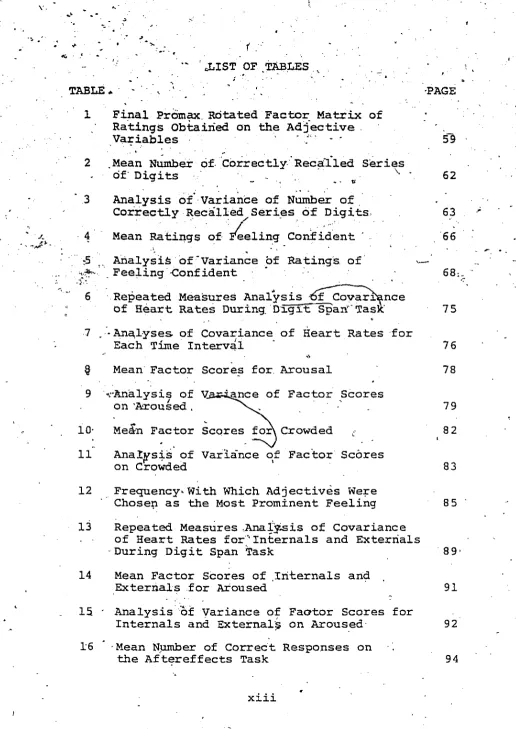
*' sLIST OF TABLES v
* „ 4 * ' .
TABLE * • - '' \ V
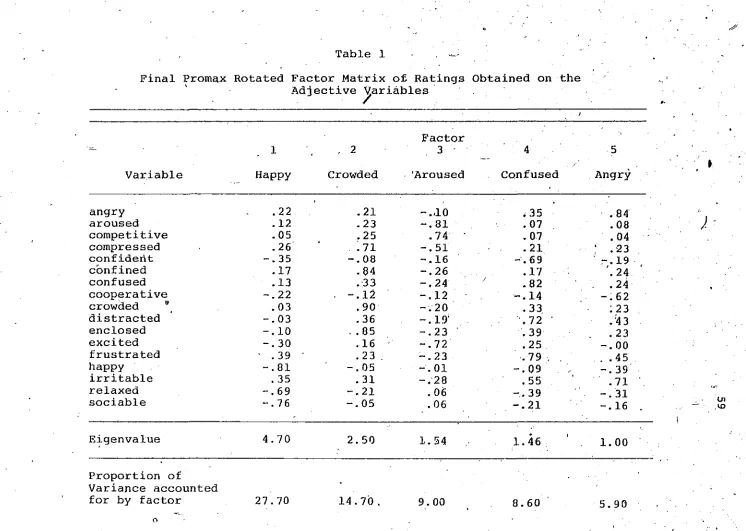
1 Final Promax. Rotated Factor Matrix of
Ratings Obta.iried on the Adjective .
Variables - '
2 .Mean Number of- Correctly Recalled Series
of'Digits _ v - v
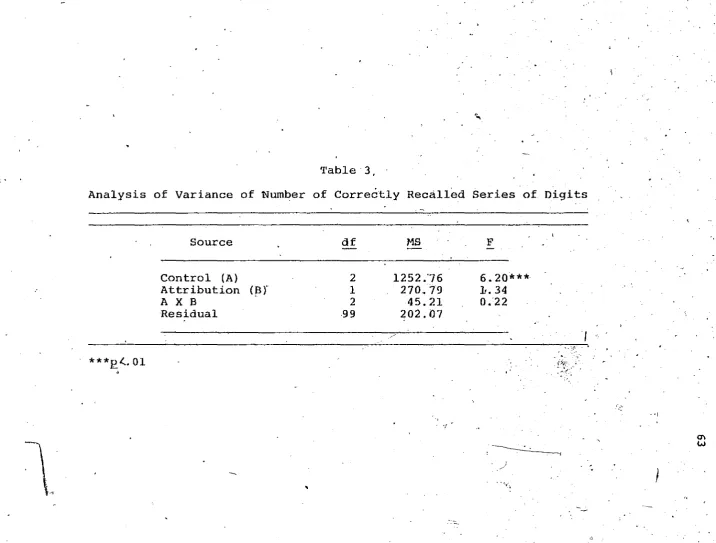
’ 3 Analysis of Variance of Number of
Correctly Recalled Series of
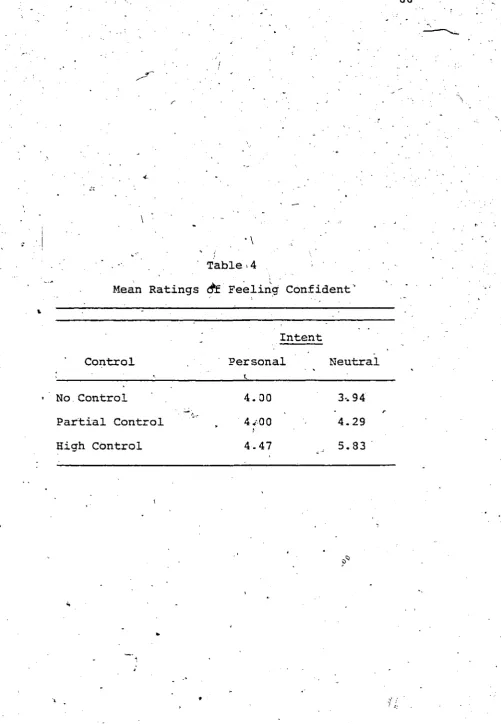
Digits-■/. 4 Mean Ratings of- i d l i n g Confident '
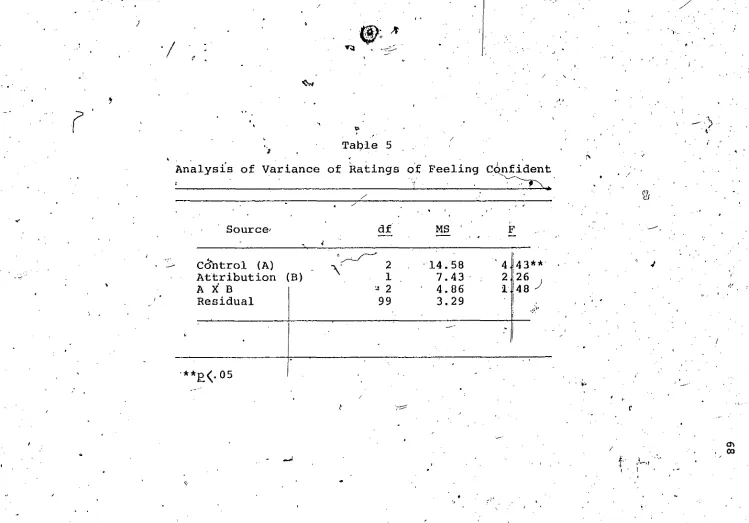
r5 Analysis of'Variance of Ratings, of
. Feeling -Confident •
6 Repeated Measures Analysis f5f Covariance
of Heart Rates During. Drgit Span'Task
* *
7 . - Analyses of Covariance of Heart Rates for Each Time Interval
§ Mean Factor Scores for. Arousal
9 -.‘-Analysis of V a x ^ n c e of Factor Scores
on 'Aroused ,
10- Me£n Factor Scores f
oA
Crowded11 Analysis of Varla'nce of Factor Scores
on Crowded
12 Frequency*With Which Adjectives Were
Chosen as the Most Prominent Feeling
13 Repeated Measures -Analysis of Covariance
of Heart Rates for'’ Internals and Externals
-During Digit Span Task
14 Mean Factor Scores of .Internals and
Externals for Aroused
15 ' Analysis of Variance of Factor Scores for
Internals and External'^ on Aroused
16 - Mean Number of Correct Responses on
the Aftereffects Task
x m
•PAGE
59
62
63
66
68:
75
76
78
79
82
t
83
85
8 9 ■
91
92
xiv
TABLE >
17 Analysis, of Variance of'Number of
Correct Responses on the Aftereffects Task
■ 1 8 The Number of Subjects Who Scored in
tdie Top and Bottom Fifty Percent on the 'Aftereffects Task
19 Mean Number of Correct Responses by
Internals and Externals on Aftereffects'
Task *
20 Analysis of Variance of Correct Responses
by Internals and Externals on After effects Task
21 The Number-of Internals and Externals
Who Scored in the Top Fifty Percent' on the Aftereffects Task *
Si
PAGE
95
96
98
■99
101
, » LIST OF FIGURES 1
V *
F & U R E ' ' y . RAGE
1 A Control-Attribution Theory of Crowding 37
2 Mean Unadjusted Heart Rates During Pre
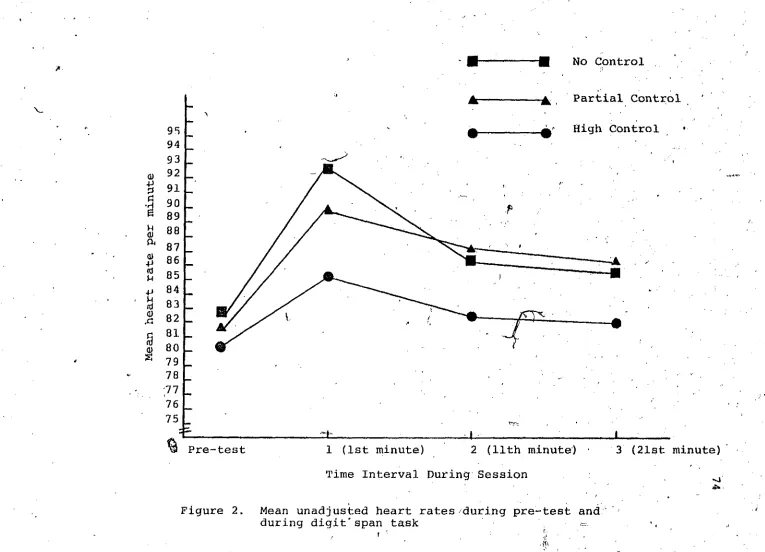
-Test and During Digit Span Task : . 74
3 Mean Unadjusted Heart Rates During Pre- . ■
Test and During' Digit Span Task for •
Internals and Externals ' 88
\
\ .
\ .
V . • .
•\ • CHAPTER I
• . \
\ Introduction
1 The purpose of the .present dissertation is-.*to propose
a: two-component theory o f . crowding that attempts to specify
the set of conditions that-are-both necessary and
suffi-1 »
cient for crowding to occur. In addition, an experimental
■test of the- theory was conducted. The two components that
are assumed to be involved can be described in terms-of
(1) personal control and (2) attributional processes.
Although some recent theoretical approaches have attempted
to explain crowding in terms of o n e ’s reaction to a per
ceived loss of control over the .environment or as a
cogni-✓
tive label that results from an arousal-attribution pro
cess, most of these approaches {see Schmidt & Keating,
1979ab, for an exception) have emphasized either the con
trol or attribution component and neglected the other.
The present analysis represents an integrated
control-attribution.explanation which proposes that crowding occurs
only as a joint function of both components.' In addition
to specifying the antecedent conditions that elicit the
initial perception of crowding, the present theory accounts
for both the immediate behavioural reactions to crowding
and the subsequent responses that are manifested later in
time. It 'should-be emphasized that the present model
'defines crowding'in terms of a psychological experience-as
opposed to a physical state of.population density.
In describing the proposed theory/ four major sections’
are .included in the discussion below. In the first section
• •
the author considers work that has. been done on the
rela-• ^ tionship between crowding and one's perceived control’ over
.the environment, and in the second section he reviews the'
work which has been done on the relationship between
'
" I
crowding and attrib.utional processes. In the ^hird section,
the advantages of the present approach are discussed in
•relation to current^alternatives. Finally/ a summary of
the present theory is provided.
Control Over the Environment
During the past ten years, an increasing amount of .
empirical and theoretical evidence has supported ‘the
position that crowding somehow involves a perceived loss
of control over the environment. This evidence has been
organized by the present author under four sub-headings
which deal with {1) models of crowding that existed prior
to the emergence of the control concept; (2) empirical
research on control as a mediating variable in crowding;
(3) the theoretical link between crowding and the control
concept; and (4) physiological arousal that results from
a perceived loss of control.
' ... -literature, .Stokols (1976) identified three major
J .. • '
% ’ • . r *
1 theoretical perspectives that have evolved in the
crowding research. Although the relationship between
. ^ crowding and the concept of control' was not identified by^
the authors o f .these pre-control models, Stokols pointed
- t
-out that all- three perspectives depict crowding as the
' ' ^
.perceived loss of control over the environment. According
\
• to Stokols,. one such perspective incorporates the overload
models which describe crowding as exposure to excessive
-stimulation^/^Milgram {1970)., for example, has argued
that a state, of overload characterizes city dwellers who
are frequently the recipients of too much simultaneous
. stimulation, receiving environmental inputs more rapidly
than they can process these inputs. As a result, the city
dweller learns certain forms^ of adaption such as ignoring
I
unimportant others and .allocating less time to environment
al inputs. Other investigators who have adopted an over
load approach -to crowding include Desor (1972) , Baum and
Valins (1973; 1977) , Saegert (1973;- 1978) , and Altman
(1975).
The second theoretical perspective identified by
Stokols is the behavioural constraint model which emphasizes
y *
loss of contrbl in terms of the behavioural restrictions
that accompany densely populated conditions. This second
perspective is based on Brehm's (I9f?..6) reactance theory
which slates that a person who perceives a threat to one
' S ' .
k
4
of his or her freedoms will ‘be motivated to take steps to
I ‘ '
eliminate the threat and restore the -particular freedom
i involved. "Applied to crowding, if the presence, of other
^ persons ^inhibits people from carrying out particular
activities that they would otherwise wish to engage in,
i
-they will be motivated to put more space between themselves
and the others. Those researchers who can be grouped under
the behavioural constraint model include Sommer (1969),
Proshansky, Ittelson, and Rivlin (1970), and Stokols
(1972). |
The ecological model was' the third major theoretical
perspective identified by Stokols. The ecological model,
which has been developed by Barker (1968) and Wicker (1973),
emphasizes loss of control in terms of potential scarcities
that are associated with crowded conditions. The basic
■ i
unit of analysis is the "behaviour setting" which can be
defined by characteristic patterns of behaviour which
occur within given spatial boundaries during specific
periods of time. Although a behaviour setting requires
a division of labour or some type of role structure among
its participants to maintain its existence, a situation
often exists whereby the setting is either, ’’undermanned"
i
or "overmanned". In the case of overmanning, there are
more participants than-that which is required to maintain
<
the setting. Consequently, the participants develop
\
5
the greater scarcity ofy^so^jal roles and, hence, potential
f o r .competition’and exclusion" (Stoko.ls, 1976, p^SS).
Research on' control. The relevance of perceived con
trol to the experience of crowding has been tested
empirically in several studies. The initial research on
this topic, focused on behavioural "aftereffects" which
■ $
occur as the result•of performing tasks under conditions
of high population density. More recent research has
focused on the role of /Control in mediating „gne'X •
"perceptions" of crowding and on the more long-range
/ •ftv? #
effects of crowdinVl
With regard to the aftereffects research, Sherrod
(1974) found that subjects who had performed a variety of
tasks under crowded conditions demonstrated adverse after
effects on subsequent task performance. The decrements
*0
in performance, however, were not as great for groups of
subjects who worked under crowded conditions but who had
been .told that they could leave the room whenever they
wanted (perceived control). Sherrod’s laboratory findings
were consistent with those of Glass and Singer (1972) and
Sherrod and Downs (1974) who used noise as the environment
al stressor.instead of crowding. For example, Glass and
Singer (1972) found that groups of subjects who had been
given the perceived option of turning off noise while
performing an initial set of tasks did less poorly on
subsequent tasks than subjects who had not been given the
option. In a. field study,..Langer'-and Saegert (1977)'
.recruited shoppers at'city supermarkets and asked-
them-to perform a shopping List task which involved finding •
the most economical product for each of a number of items.
The shoppers who were recruited during crowded times
performed significantly worse than those recruited during
less'crowded .times. However, the negative effect o f ’
crowding on task performance 'was ameliorated for those
shoppers who were provided with cognitive control in the
form of information that described the possible effects <i
of crowding.
The importance of control in”mediating one's percep
tion of crowding has been investigated in a couple of
experiments conducted by Rodin, Solomon, and Metcalf
(1973). In the first experiment, naive subjects, upon
entering an elevator, were maneuvered into one of two
positions by four confederates. Subjects who had been
maneuvered into position in front of the "control" panel
reported feeling less crowded than those who had been
maneuvered into a position away from the panel. In the
second experiment, subjects who took part in group pro
cess tasks were randomly assigned to a role that gave
them either no control or one of two types of control
over the group's activities. Again, the subjects who had
been given some type of control felt less crowded than
The aforementioned research on aftereffects demon
strates that- crowdirfig without perceived control results in
/ decrements in t a s k ’performance over a relatively short
period of time. More recent research/has suggested that
the adverse effects of. prolonged exposure to crowding
o . . •
without control are even more serious. because of the
possible long-term effeet^. For example, in a .situation
r
that involved cho'osing between a more attractive and less
attractive reward, children from relatively crowded
housing units behaved more passively than children from
less crowded units (Rodin, 1976). In this study, Rodin
trained childreh from a large housing project on an
elaborate apparatus which administered various types of
reinforcements. One type of reinforcement was
experimenter-selected candy versus self-selected candy. \
Although all of the children learned that they could
change the administration schedule of the apparatus to
convert experimenter-selected candy to self-selected
candy and despite the finding that all children viewed
»
the self-selected candy as more attractive, the children
from the crowded units changed the schedule significantly
less often. Rodin interpreted her results as evidence
that the crowded children had acquired "learned
helpless-w
ness" (Seligman, 1975) as a result of a history of being
exposed to non-contingent or uncontrollable reinforcement.
A second experiment by Rodin added further support to this
interpretation.' In one condition, children were presented
with a non-solvable task followed by-a solvable task, and
in a second condition, children were presented with two
•solvable tasks in succession. As expected, experience
^ .W*. ~
with an initial unsolvable task led to relatively poorer
performance on the subsequent one. This effect, however,
was compounded for those children who had been reared in
relatively crowded homes. Although other factors were
also found to compound the effect, residential crowding
. by itself accounted for a significant part of. the variance.
Another interesting study which examined the long
range .effects of crowding under conditions of relatively
little control, was conducted by Baum and Aiello (1978) .
3aum and Aiello (1978) compared students living in
"long-corridor residences" with those living in "short-"long-corridor
residences". Although the density was similar for the
two types of residences, the interior architecture was quite
different. In the long-corridor residences, students were
grouped around a common lounge, bathroom, and hallway in
relatively large numbers.. This type of structure, created
"overloaded" conditions due to the inevitability of
excessive and unpredictable social interaction (Valins &
Baum, 1973). Overloaded conditions were much less evident
in the short-corridor structures where students were
grouped around common facilities in relatively small
. • ■ ■ . ' . J
: . ' 9
'* . . ;
investigators predicted that students who had moved into
•' * • .
long-corridor residence's would initially take active
. steps to reassert - therr** control over the environment but
1 '
would- become relatively passive over time when their
' ■ ’ ' ;
efforts proved to be futile. The prediction was confirmed.
Compared with students from short-corridor.residences, the
long-corridor students”^ "were more competitive, reactive,
A? ■'
and involved with reestablishing control after 1 and 3
weeks of residence. By' the end of 7 weeks, however,- they
had become withdrawn, were less involved, and exhibited
symptoms of helplessness^ (p. 1000}.
The studies that have been described thus far have
examined control as a situational variable and have con
sistently found it to be an important mediator of crowding.
Surprisingly, relatively little research has examined the '
„ possible role played by control as a personal variable.
Locus of control, considered as a personality trait, refers
to the extent that a person believes that reinforcements
are contingent upon-his-or her own behaviour. Individuals
who are characterized as having a generalized belief that
reinforcements are contingent upon their own behaviour are
said to have an internal locus of control. Individuals
i
who are characterized as having a generalized belief that
reinforcements occur independently of their own behaviour
are said to have an external locus of control. the
- research that has been conducted on the personality
variable, Duke and Nowicki (1972).used a pencil-and-paper
procedure wherein subjects were required to indicate the
distance at which they would feel.uncomfortable when
approached by fictitious strangers. The researchers found
that individuals having an external locus^ofL control
(externals) placed greater interpersonal distance between
' themselves and strangers than individuals having an
inter-nal locus of control (interinter-nals) . ' Basing the interpreta
tion o f t h e i r results on social learning theory. (Rotter1, .
.1954), Duke and Nowicki explained that internals would
feel less threatened by the presence of strangers because
of their belief that they, themselves, are responsible
for what happens to them. Since externals, on the other
hand, would believe more strongly that their' fate is con
trolled by other people, they would feel more threatened
by the close presence of others. In a later study,
Schopler and Walton (1974) found that externals were more
likely to experience crowding in high density situations
than internals. In hnother study, however, among students
who had reported feeling cramped in their dormitory rooms,
internals demonstrated a need for more interpersonal
distance than externals on a projective measure of person
al space (Baron, Mandel, Adams & Griffen, 1975).
Theoretical link between control and crowding. In
dealing with the specific concept of control (as opposed
' - .. ' ■ 11
• \ ■ "
- . . " • . ■=!«& ■ . ‘ '• ■
-its theoretical relationship tp crowding, researchers
have used one of two theories..- reactance theory dr
social learning, thpory. Both of these theories have been
used primarily to explain how control;is involved in the
motivational aspects of crowding. Interestingly/ the
motivational accounts that have been provided by the two
theories are quite - ^ c o m p a t i b l e F o r example, in reactance
theory,'when the presence of others reduces or threatens
an— individual's freedom, a state of motivational arousal
, is induced which results in efforts to restore and/or
preserve the freedom. In social learning theory, when the
,T 2 ' ^
•presence"of others is aversive for' any reason, the
internally controlled person' ^-belief that he or she
personally has the capacity to bring about more reinforc
ing conditions .is the motivating factor which results in
attempts to change the situation. . According to- both
•reactance theory and social learning theory, initial
failure to restore one's freedom of to bring about more
. reinforcing conditions is said to result in increased
motivational arousal or frustration, respectively. In
both theories, continued failure is said to result in a
state of passivity or learned helplessness {Rotter, 1966;
Wortman & Brehm, 1975).
Although both social learning theory and reactance
theory have proved useful iir~explaining the motivational ,
role -of the control factor in crowding, both theories
1 2
have been limited by the tendency to emphasize either
situational'or dispositional variables while neglecting
. -, the importance of the other. In reactance theory, the
emphasis is usually on a situation that threatens a
particular freedom of the individual.. Although reactance
..theory acknowledges that an individual must perceive that
he or she has.the freedom in the first place, relatively
little emphasis is placed on personal variables. On the
- other hand, while social learning theory. acknowledges■ '
\ ' ■
« ■ \ *■ s
' . that some situations may produce similar effects acrgss
individuals, the emphasis is on the individual's general-...
ized expectancy of locus of control which^accounts for
why people react differently in many similar situations.
The present author suggests that interactional approach
that considers the joint contribution of situational and
dispositional variables provides a more adequate -analyst ./*
of crowding. More will be said about the value -of con
sidering both s’ituational and dispositional variables in
a later section.
A theoretical perspective that may also prove useful
in explaining the relevance -of control to crowding is
White’s (1959) concept of competence, defined as an
organism's capacity to interact Effectively with its
environment. The concept of competence, which perhaps,
underlies the relation of reactance theory and social
learning theory, would also be compatible with-an
9
13
interactional approach. It should be.pointed out that
- the relevance of competence to each of the two theories .
-has been .discrCTSsed by other writers. For example, per
ceived competence has been found to. be a significant
variable in determining the amount of reactance that is
experienced by an individual (e.g., Wicklund & Brehm,.
1968). Also, Rotter (1966) has acknowledged the' relation
of the locus of control concept to White's notion of
competence. In White's development of concept of
competence, "effective motivation" is given a -prominent
role. According to White, 'effectance motivation is the
underlying motive toward competence and is the impelling
force involved in a large variety of behaviours, including
curiosity, exploration, manipulation, and mastery. These
behaviours are viewed as having an adaptive function and
are commonly engaged in when physiological needs have
been satisfied. Assuming that effectance motivation has
some kind of neurogenic basis, White concludes that the
behaviours that result from this motive are inherently
reinforcing, being accompanied by a "feeling of efficacy".
The development of competence, in turn, depends on the
exercise of such adaptive behaviours. " Although White was
not specifically interested in individual differences, it
is reasonable to assume that dispositional and learning
factors contribute to the extent of on e ’s effectance
motive and corresponding level of perceived competence.
■ 14
1
- : . . y • : % '
Thus, the amount of perceived control t h a t ^ n individual
has over his or her environment can be viewed as an
important aspect of competence. Also,, when crowded
conditions bring about a perceived reduction of control,
one's effectance'motive may determine the intensity of
the individual1s reaction.to crowding.
’ Arousal due to loss of control. The position that
, loss of control produces physiological arousal has been
supported, conceptually,- by a number .of theorists in the
area of crowding (e.g., Stokols, 1976; Baron & Rodin,
1978; Schmidt & Keating, 1979ab). Moreover a considerable
amount of evidence has suggested that perceived loss of
control does, in fact, induce a state of physiological
arousal. For example, studies have shown that perceived
or actual control over aversive stimuli diminishes nega
tive affective responses (e.g., Pervin, 1963; Glass &
Singer, 1972; Klemp & Rodin, 1976) and physiological
indices of arousal (e.g., Corah & Boffa, 1970? Starke,
1973) .
Although several studies have demonstrated that high
density "induces physiological arousal (e.g., McBride, King,
& James, 1965; Evans & Howard, 1972; Epstein & Aiello,
1974; D'Atri, 1975; Evans, 1975; Saegert, 1975), it is
difficult to determine whether the arousal was^ caused by
a reduction in control associated with -.increased density
• ' . 15
presence of-others N(e.g.-, audience effects). At least
\
-one study, however, has suggested that loss of control:
is -the major determinant of arousal. Sundstrom (1975),
for example, found that exposure to high room density
resulted in self-reported discomfort and nonverbal
indicators- of stress which decreased over.time unless
"goal blocking" was also introduced. When goal blocking
was introduced, measures.of arousal increased over time
independent of room density.
The relationship that exists between perceived
loss of control and arousal helps to explain,both the
immediate and long-term- reactions to crowding.. The most
immediate reaction to' crowding is the various physiolog
ical responses that are indicative of arousal (e.g.,
changes in heart rate and blood pressure). Then,1 the
various behavioural responses and/or coping mechanisms
that have been .associated with crowding (see Sundstrom,
1978, for a review) represent attempts on the part of
the individual to reduce his or her control-induced
arousal. For example, aggressiveness, avoiding eye con
tact, and moving away from others are responses which
may be interpreted as attempts to establish control in
certain situations. Depending on such variables as
length of exposure to the control-reducing situation,
the extent to which perceived control is reduced, and
the amount of effort that is required to regain control,
16
the individual m a y ’incur various psychological and
physiological "costs" (Sundstrom, 1975}, for example,
amount of fatigue. As-mentioned previously, constant
and/or repeated failures to establish control over the
environment are said to lead to certain long-term costs,
such as learned helplessness.
Summary of role played by. perceived control.
.. According to the present analysis, the role played by the
control factor in the experience of crowding can be,
summarized by'the following points:
{
(1) Situational and personal factors can interact in
such a way as to decrease the perceived control
that an individual has over his or her environment.
•fc.
(2) - Perceived loss of control is accompanied by a
motivational state of arousal whereby the individual
intensifies his or her effgrts to regain control.
(3) A prolonged state of control-induced arousal and
effortful attempts (including overt behaviours and
covert coping mechanisms) to reduce this arousal
results in psychological and physiological costs
(e.g., fatigue). ■ '
(4) Continued failure to establish control over the
environment leads to passivity indicative of a
state of learned helplessness.
(5) In general, it is proposed that loss of control
a n d t h u s , determines the ‘intensity of the
experience.
Attribution and Crowding
Relative to perceived' control, the possible role
played by attributional processes in crowding has
received little attention. Although several theorists
have, acknowledged the possibility that attribution is
involved in crowding,, the topic has rarely been
approached as the major subject of interest. Exceptions
to this pattern, however, have been*provided by Worchel
(1978} and Gochman (1976), whose work will be reviewed
in the present section. The role of the attribution
component in the present theory will then be discussed.
Worchel's analysis. Worchel (1978) reports two
experiments that were conducted to determine if crowding
•can be explained in terms of Schacter and Singer's (1962)
two-component theory of emotion. According to Schacter
and Singer, a specific emotion is merely the cognitive
labelling of physiological arousal wherein the labelling
process is dependent upon the stimulus cues that are
available in one's surroundings. In treating the expe
rience of crowding like any other emotion, Worchel
hypothesized that it is the violation of personal space
(defined in terms-.of extreme proximity to others) that
induces arousal, and the arousal is interpreted by the
individual as crowding if its source is attributed to the.
18
presence of another person or persons. In’ Worchel1 s
first experiment, groups of subjects were required to ,
perform tasks under various levels of interaction
dis-■ tance and in the presence^or absence o f .distractors
(pictures and wind chimes). Worchel reasoned that if the
attribution process is srelevantrto the analysis of
crowding, then the presence of distractors should reduce
the salience of the other people and, consequently,
diminish the subjecti-ve-experience of crowding. The
results supported his hypothesis. That is, for those
groups who performed under extremely close interaction
conditions, the presence of distractors significantly
reduced feelings of being crowded. In the second
experiment^,' instead -of using distractors, the investigator
provided some groups of closely spaced subjects with
false information regarding the source of their aroiJs-al
(i.e., subliminal noise) and, again, found results that
4
were consistent with an attributional analysis. Among
the subjects who were required to interact at extremely,
close distances, those who were led to believe that the
source of their arousal was subliminal noise reported
feeling less crowded than those who had not been given
an explanation for their arousal.
Gochman’s analysis. Another attributional analysis
of crowding has been offered by Gochman (1976). According
and/or disconfirmed expectations. .When this type of
arousal occurs in a situation where other people are
present/ the.- aroused individual notices the negative
aspects of high density which results in an attribution
of Crowding. A series of studies bv Gochman produced..
\
results that supported her model. . 'For example,-in an
experiment which investigated the effect of room density
on task- performance,' density had no effect on the percep
tion of crowding when subjects attained their goals,
whereas poor performers in high density conditions
reported .feeling more crowded- than their counterparts
in low density conditions. In another experiment in
which subjects performed anagram tasks.under conditions
of high room density, performance was manipulated to
confirm or disconfirm prior expectations. Both positive
i
and negative disconfirmed expectations resulted in
stronger attributions of crowding than confirmed expec
tations.
Attribution and the present theory. Like Gochman
(1976) ^ajid Worchel (1973), the present author proposes
that the attribution of arousal to other people in the
environment is necessary to produce the experience of
crowding. There are important differences, however,
between thepj^esent analysis and the attributional
models thafb have been proposed by Gochman (1976) and
Worchel (1978). The role played by the attribution
process in the present theory and how it relates to the
control component will be described in the current section.
The specific differences between the present analysis .
and the alternative approaches will be explained in the
next section., J
According to ,the present .theory,; given that an . •
\ '
individual is aroused by a perceived loss of contro'l over
-■ 1 . .
the environment, the' label of crowding is applied when the
individual attributes the arousal to theXpresence of
other people in the environment'. Whereas V h e control
component is viewed as the motivational component that
accounts for the intensity of the experience! the attrir
bution factor is viewed as the cognitive component that
accounts for the label of crowding that is attached to
the experience. To the extent that the presence of other
people is the most salient stimulus in the surrounding
environment, the individual will be confident that crowd
ing is the reaction that he or.she is experiencing.
Obviously, as the number of other people in the environ
ment increases, or as the proximity to others increases,
the likelihood' that other people will be the most salient
stimuli in the environment increases.
i
In addition to the conditions described above, one
additional factor is required to invoke the labfc'l of
crowding. This stipulation concerns the. perceived inten
tions of the other people in the environment. It is
.proposed that the label of crowding applies only when
: v.-- the arousal associated with perceived loss of control is
attributed to the presence of others in a "neutral"
context. That is, the individual will identify his o-r her
' 1 - ■ ' • " . .. ■ . - ■ ■
experience as crowding only when the individual perceives
that the experienced loss of control has not been
inten-tiona'lly inflicted by others. When an individual senses
a loss of control and attributes the source of the
accompanying arousal to the presence n f others, but
recognizes that either physical' limitations of the
environment (e.g., inadequate subway system) or various
situational demands (e. g. vying, for scarce resources)
e are to blame, the label of crowding will be applied.
However, if for example, the individual perceives that
his or her loss of control is the specific intent of
other people in the environment or is the result of
unthoughtfulness or norm violations, then the accompanying
arousal will be labelled differently (e.g., anger, fear,
or disgust).
Although no previous research has attempted to dis
tinguish between those conditions which elicit the cogni
tive label of crowding and. those conditions which elicit
such negative labels as anger and frustration, Jones and
Davis (1965) have identified several variables that may
\
influence the type of attribution that one person makes
regarding the intent of another person. A few. of these
variables are particularly relevant to the present ,
discussion. Personalism refers to the-situation in which
the'behaviours of-a stimulus, person are directly influenced
by the presence of a perceiver. According to' Jones and.
Davis, a perceiver is more likely to view the undesirable
behaviour of a. stimulus person as reflecting malevolent
intent when it is directed towards himself or herself
than when it is directed towards another person. Hedonic
relevance refers to the situation in which someone else's
behaviour is rewarding or costly to the perceiver and
where the behaviour is not viewed as being elicited by
the perceiver's presence. "Presumably, the more hedoni-1
cally relevant an act i s 'for the perceivers, the more
inclined they will be to infer that the act reflects
a particular intent, disposition, or both" (Harvey &
t
Smith, 1977, p. 145). Whether or not the stimulus person
is believed to have exercised free choice in performing
an act is another variable that probably influences the
attribution of intent. That is, there will probably be a
stronger tendency to perceive the behaviour of a stimulus
person as reflecting personal intent when the perceiver
believes that the behaviour was an act of free will than
when,the behaviour is believed to have been elicited by
external circumstances. If a given act appears to be
induced by strong external pressures, the behaviour is
23
actor. If', however, a given act .occurs despite strong
external pressures which would normally be expected to
inhibit such , an act, the tendency to perceive that behaviour .
as reflecting personal intent would be relatively-strong
(Kelley, 1972). According to the present model-, then.,
the cognitive label of crowding would be associated with'
a lack of personalism and a belief that the stimulus ..
persons have little or no coice over how they.can behave.
. The label of crowding would also be associated with a
high degree of hedonic ^levance, but in situations where
it would be very difficult to infer personal intent.
Finally, as was the case with the control factor, it *
should ^e emphasized that whether or not one's feeling of
arousal is labelled -as crowding depends on both situation
al and personal variables. Obviously, the salience of
other people in the environment is the prime situational
variable that will help the individual identify the
source of his or her arousal. On the other hand, an
individual's tendency tp view others in a positive dr
negative way will contribute to whether one perceives
others to be threatening his or her control in an inten
tional manner. Thus, for example, trust versus distrust
could.be an important personal variable relevant to the
attribution component which influences the experience of
crowding.
;24
' t
Summary of the role of attribution in the experience
. o’f~ crowding^ According to the present analysis, the role '
played'by the attribution component in the experience of
crowding can be summarized by the following points: ..
(1) A state of arousal’is identified as crowding when
it is attributed to the presence" of other people
who are^perceived to be r e d u c i n g ’one * s control over
* _ _ • ' - ’ '
' the environment, in an unintentional \ and non-personal
level.
(2) The- confidence with which the label, of crowding is
applied to one's arousal depends on the salience
of people relative to other stimuldS^in the environ
ment.
(3) The attribution of crowding is modified by situation
al and personal variables.
(4) In general, it is proposed that the attribution pro
cess accounts for the cognitive aspect of crowding.
Advantages of the Present Two-Component Theory
In this section, three main advantages of the present
theory are described. These advantages include (1) the
theory's ability to specify the necessary and sufficient
conditions that are required for crowding, (2) the theory's
ability to predict relatively fine variations in the
experience of crowding, and (3) the theory's general
consistency with the research that has been done on .