Number 12113
LINK
EastTIDlor
./?ATAURO(.jMaumeta WETA.A STRAIT
0 10 20 30 40km
EDITORIAL
April 1988
ISSN 1010 1888
CONTENTS
Asia-Pacific Consultation
Full text of the StatementNews from Inside
Document
Fixing Foreign Visits - Secrets from 1976
Church News
Papal Concern, but doubts remain
International
New Talks on a Portuguese Visit to Timor
Review
Eukumindo on East Timor
STARTING SOMETHING IN ASIA?
In this issue of Timar Link we include the full text of the Statement published in Manila on November 18 by those who participated in the "Asia-Pacific Consultation on East Tim or". The event should be celebrated. Representatives from 13 countries and many different kinds of organisation attended the three days of intense work. Most of all, the meeting broke new ground.
It was the first international meeting to be convened by and for Asian and Pacific groups to discuss East Timor.
It was also the first such meeting to be held in ASEAN. Until this time, it has been virtuaUy out of the question to think of holding a conference on East Timar within any member country of ASEAN.
The Conference should not therefore be valued for its direct political impact, which was small, but because it contains the seeds of future developments which might, over the long term, be enormously important for East Tim or.
First of all, its success suggests that it may now be possible to raise East Timar as a serious public issue within the Asian-Pacific region - if not immediately, at least over a period of several years. It has also surely given new impetus to the work of several East Timar groups that are already in existence, in Japan, Australia, New Zealand and Hong Kong. Now others may take root - to start with, most probably in the Philippines and Papua New Guinea. The conference has vindicated the vision of a number of East Timor activists, particularly in Australia, who have been working patiently for several years with such a meeting in mind.
What is at issue is of still wider importance than this, however.
It is not merely a matter of bringing into play a new area of the world which has not been active on East Tim or. If the question of East Timor does not become an Asian issue, a Pacific issue, if it continues to be raised only or mainly by groups in the developed
industrial countries of the West, then it will become increasingly marginal. Europeans, North Americans and Australians may continue to protest, probably in dwindling numbers, but unless Asian and Pacific peoples are involved the issue will never return to the main political agenda. The Western governments still hold the power to secure a political settlement, by bringing Indonesia to the negotiating table; but they will never feel under pressure to do so, unless the demand for a settlement in Timar is given legitimacy from within the Asian and Pacific region.
ASIA·PACIFIC CONSULTATION ON EAST
TIMOR - STATEMENT
Delegates from 13 countries attended the first Asia - Pacific Consultation on East Timor, held in Manila, Philippines, 16-18 November 1987. Participants included representatives of the two Timorese political parties, UDT and Fretilin, officials of several International Church networks, human rights and development agencies and delegates from Asia, Pacific and European solidarity groups.
The Consultation was convened to consolidate and expand emerging concerns on the issue within Asian and Pacific Churches and community organizations.
ANALYSIS
In its analysis of the issue the Consultation highlighted the following points:
1. East Timor remains a major military problem for Indonesia. This is clear from the number of combat troops in the territory, the special command structures directly controlled from Jakarta, the tight internal security situation and continued denial of external access. 2. The Indonesian presence in East Timor is not just a military occupation but is increasingly colonial in character. The economy is controlled by monopolies dominated by the Indonesian elite and social, cultural and political life has been structured to serve Indonesian interests at the expense of the East Timorese people who are systematically excluded, marginalised and powerless.
3. Gross human rights violations continue with varying intensity. However it also needs to be recognized that the ever-present climate of fear, restrictions on free communication, legal rights, assembly and travel are now institutionalised in East Timor. The suppression of East Timorese culture and the systematic Indonesianisation of Timorese society also constitute an abuse of rights fundamental to the preservation of Timorese identity. 4. Timorese armed resistance to
integration remains seemingly indestructible and is a powerful symbol of East Timorese opposition to the annexation. However it also should be recognized that the less well known attitudes of East Timorese at all levels of society,
including clergy, civil servants, students, and village people, are testimony that opposition to integration remains entrenched throughout East Timor. This is also reflected in the decision of the two major Timorese political parties, UDT and Fretilin, to work together in the political struggle for independence.
5. The local Catholic Church has grown rapidly to become a mass organization to which most Timorese adhere. It is administered directly from the Vatican through an Apostolic Administrator and is not formally part of the Indonesian Church. The Timorese Church continues to call for an end to conflict and human rights abuses and for a just settlement, and for greater freedom to fulfil its heavy pastoral responsibilities. The Church is subjected to considerable political pressure, both externally and internally, and keenly feels its isolation. It needs increased support and contact particularly from the international church community. 6. Western and regional economic,
political, military and security ties with Indonesia constitute a major barrier to the advancement of the Timorese cause. Regionally this is exemplified in the interdependence of the Japanese and Indonesian economies, ASEAN political commitments to Indonesia, the active cooperation with Indonesia of other governments in the region particularly Australia and Papua New Guinea, and Indonesia's increasing drive to extend its political influence in the South Pacific.
7. East Timor has not been voted on at the United Nations General Assembly since 1982 and Indonesia continues a major diplomatic and disinformation campaign to quash any discussion on the issue. Nevertheless East Timor remains an issue of active concern to a range of United Nations bodies and to many international and national forums, involving governments, political parties, parliaments, churches and non-governmental organizations.
KEY AREAS FOR ACTION 1. United Nations
a. At its session in Geneva in February 1988 the United Nations
2
Commission on Human Rights will consider the human rights situation in East Tim or. It is recommended that member states of the Commission, particularly those from Asia, be urged:
*
to support a continuing review by the Commission of the human rights situation in East Timor and*
to endorse calls for the full participation of the East Timorese people in future United Nations sponsored talks on the issue.b. Talks on East Timor held between Indonesia and Portugal under the auspices of the United Nations Secretary General have not allowed for formal East Timorese participation.
It is recommended that rep-resentations to the Secretary-General urging full Timorese participation be intensified. There will be no lasting settlement without Timorese cooperation.
Such representations should also express dismay at the inadequacy of official United Nations reports on the issue.
c. The United Nations Committee on Decolonization will hear petitions on East Timor in August 1988 in New York.
It is recommended that strong NGO and government submissions be made, particularly from within the Asia-Pacific region.
2. Portugal
Ambiguity in recent statements on East Timor by the Portuguese Government, which has a major responsibility for ensuring a just settlement of the issue, is cause for alarm, as is Portugal's failure to ensure Timorese participation in the talks process.
It is recommended that representations be made to the Portuguese Government on these failures.
It is further recommended that expressions of concern on Portugal's role be made to Portuguese Church bodies, political parties and the Parliamentary Commission on East Timor.
It is also recommended that Portugal be urged to recognize UDT and Fretilin and to materially support their work.
territory, the Holy See has assumed direct responsibility for the Catholic Church of East Tim or.
It is recommended that the Holy See be urged at every opportunity, particularly by Catholic bodies, to maintain its direct jurisdiction over the diocese of Dili until a just solution has been achieved based on the right of the people of East Timor to self-determination.
It is further recommended that the World Council of Churches and the international Protestant community be urged to dialogue directly with the Christian community in East Timor in a spirit of solidarity and common commitment to justice and peace.
It is also recommended that churches be urged to sign the document 'East
NEWS FROM INSIDE
~~~~~~~~~-Human
Rights
In time for the UN Human Rights Commission meeting, A Paz e Possivel em Timor-Leste has - compiled a complete list of reported arrests and human rights violations in East Timor from January 1985 to December 1987. In publishing the report, the authors recognise that, because of the almost unique conditions obtaining in East Timor, "it is impossible to check the level of accuracy of all information reaching us". They have relied upon three principal sources: private communications received through contacts in the Catholic church; documents produced by the Timorese resistance; and, finally, private communication with individuals, chiefly with refugees.
Where information can be cross-checked, it has proved broadly reliable. A recent issue of A Paz e Possivel newsletter, published in January-February, provides an illustration.
According to Amnesty International reports and official Indonesian statistics, 72 Timorese have been tried and sentenced in the last two years. It turns out that the arrest of at least 30 among these cases had already been reported independently by Fretilin and other sources. "Involuntarily," A Paz e Possivel concludes, "by bringing these prisoners up for trial, the Indonesian authorities have confirmed the reliability of information coming out of Timor along clandestine routes."
The new report, which is 35 pages Jong, contains details of 991 cases - 249
Timor: A Christian Reflection' as part of their overall effort of Christian education and advocacy on East Timor.
IMPLEMENTATION
The following broad action proposals were agreed to by the Consultation participants:
1. The provision of basic information on the issue for the wider community;
2. The regular information servicing of key non-governmental networks in Asia and the Pacific;
3. The establishment of support networks in Papua New Guinea and the Philippines;
4. Monitoring and lobbying of the principal non-UN political forums;
in 1985, 694 in 1986 and 48 in 1987 (for which year the list will be far from complete because of the long delays in transmission of information).
The mass of evidence that this represents acquires still more significance when it is remembered that many cases are never reported. "The climate of terror which exists in the territory," they write, ". . . leads the immense majority of Timorese to keep silent, even among themselves, about the situation that faces them.
"Refugees tell us that they have refrained from asking questions about members of their family who have been taken away by the military, or from visiting others who have been judged and sentenced for political reasons: to show interest in their fate could be enough to cause them too to fall under suspicion of rebellion.
"When people from other towns come to Dili, as far as possible they avoid contacts even with members of their own family living in the capital, to make sure that neither are considered responsible for news that may appear about their home region."
Grim reading
The short text makes grim reading. It is an accumulation of individual tragedies, each recorded with a brief commentary that only hints at the terrible experiences described and the collective memory of suffering and endurance which the people of East Timor have been accumulating for more than a decade. For example: 1985: "Francisco Belo, member of the resistance wounded and captured near Venilale, taken to the Hotel Flamboyant in Baucau from which he disappeared in January."
1986: "Manu Rusu, young adolescent from Uabubo. Arrested on February 22 by 'Group 4', tortured
5. The documentation of the effects of the Indonesian occupation and colonization of East Timor on women and on children.
6. The encouragement of human rights, humanitarian and other organizations to seek independent access to East Tim or.
The Consultation participants sent messages of concern regarding East Timor to the Japanese, Philippines and Portuguese Governments and the United Nations Secretary-General. Messages of solidarity were sent to the Timorese people and the European and North American support network. It was resolved to reconvene at an appropriate time in the future.
St. Theresa's College, Manila. 18 November 1987 •
with electric shocks, cigarette burns, stood two days in a tank of water up to the waist without food."
1986: "Brigita Guterres, 25 years old, raped on November 3rd at Venilale by two soldiers from Company C, Batallion 516, when making her way to her vegetable plot." 1987: "End of February/beginning of March, the whole population of Iliomar was threatened with death if any tears were shed during the execution of 17 civilians, killed with bayonets by 17 soldiers of the 9th Zipur Battalion on the orders of the Battalion commander. Among the 17 who died: Jaime da Costa, 27, civil servant of Iliomar, Martinho Hornai, 36, traditional chief of the same town." (Timor Oriental - Droits de I' Homme, Les Violations Continuent, published in French, may be obtained from A A Paz ePossfvel em Timor-Leste, clo CRC, rua Castilho, 61-2, Lisbon 1200, Portugal; or from East Timor News, rua Pinheiro Chagas, 77-2, Lisbon 1000, Portugal.)
Moises do Amaral
A recent interview with Dr Moises do Amaral, published in Tapol's February issue, illustrates the density of suffering. Dr Do Amaral, leader of the Timorese Democratic Union (UDT), was not in East Timor when the invasion occurred. He has never been able to return. He described to Tapol what the war and Indonesian occupation has meant to his family and his community.
Also, only six nephews have survived. I also lost two half-brothers and many nephews and nieces.
"I know my father died of starvation. I also know that my youngest brother was killed together with his wife. My mother also died because of the famine [of 1978-79 Eds.). A younger sister died because she refused to surrender to the Indonesian soldiers. She was only 22. Her name was Teresa. Two other brothers wanted to surrender but when she refused to surrender, they refused as well.
"As for my father, he became weak and hungry. So he decided to try and reach a village to ask for help. He had one of his grand-daughters with him. But he did not have the strength to finish the journey so he sat down on a stone and they both died, there by the road. That was in 1978. After that, my brother surrendered in 1979, and then he was killed.
"( . . . )At the last census before the invasion, my clan consisted of almost 600 persons, and there were about 2,500 people in our tribe, the Fatuberliu tribe. My father was a liurai (clan chief).
"Almost the entire clan has been wiped out. Only a few dozen people have survived. Some are living in Same and some in Dili. But many other clans from Fatuberliu have also completely disappeared. I think the reason for the heavy death toll is that in the early years of the occupation, from 1976 to 1979, many people from other parts of the country fled to this region and took refuge there. Because of this, the Indonesians regarded our clan as highly suspect, people who should all be wiped out.
"The region was also heavily bombed in the years up to 1979, so by 1980, there was almost no-one left. At that time, I asked the Red Cross if they could trace any of my relatives. They were not able to, and it was only later, when people from the region arrived in Portugal, that I heard what had happened." (From Tapol Bulletin, No 85, February 1988.)
Students in Fear
In previous issues of Timor Link we have reported on the plight of the four Timorese students in Jakarta whose request for asylum, granted by Lisbon, has been frustrated since the end of 1986 by the Indonesian authorities' refusal to grant them an exit visa. The four are still unable to leave and continue to wait, in difficult circumstances, for their case to make progress.
Concern is now being expressed about the safety of other Timorese students, dispersed in universities and
colleges in many parts of Indonesia. Many of them have been under surveillance; now, it seems, some of those who are believed by the authorities to sympathise with Timorese nationalism are being physically threatened.
East Timor News (Urgent Communique No.1, February 15 1988) reports on the fears of many of these students following the deaths of two students in circumstances they believe to be suspicious.
In May 1987, first of all, a politically active student from Los Palos, studying at the Agricultural Institute of Semarang in central Java, was found dead inside a well.
The second death took place in December 1987. Jose Antonio Moniz da Silva, a mature student attached to the Faculty of Co-operative Economy at the Karamala Institute in Jogjakarta was reported to have been killed on the morning of December 15 when he ran over a child on his motorcycle. Suspicion about the incident has grown among Timorese students, because no witnesses have come forward, and the child in question has not been identified. Reports suggest that Mr da Silva sustained only one injury, to the back of his head.
It is known that after Jose da Silva wrote a critical report about East Timor to Governor Carrascalao in July 1987 (following his request for input from students), he was visited by Dr Amarudin, head of public services in Dili. Jose da Silva was told a Commission from Jakarta would be coming in December to question him. Some students have concluded that Mr da Silva's report was intercepted by the secret services and that they were responsible for his death.
Other students have been arrested and detained. One, Germano da Silva, a student of Public Administration who was arrested while on holiday in Dili in October 1986, is still detained by the military in Dili.
Timor Polled
East Timor News (Monthly Memo No.7, December 1987) also reports that during the first half of 1987 the Indonesian authorities secretly monitored public attitudes in East Tim or, by use of informers and secret agents. Students and civil servants were particularly targeted, according to the reports.
The purpose of the exercise was to gauge the degree of Timorese support for, or opposition to, integration within Indonesia. The results were apparently very clear.
A very high proportion of Timorese, the survey concluded, opposed
Indonesia's presence in East Timor. The students, in particular, are openly critical. Attitudes in the civil service are more divided, between those who avoid political involvement or conversation about political matters, those who are outwardly pro-Indonesian but 'seem afraid' and those who speak in favour of progress but remain silent about their attitude towards integration with Indonesia.
(The Monthly Memos may be obtained upon request from East Timor News do Rua Pinheiro Chagas, 77-2, 1000 Lisbon, Portugal.)•
New Cabinet
On March 10, President Suharto was returned unopposed for a fifth five-year term as President of Indonesia.On March 22, he announced the Cabinet that will take Indonesia into the 1990s. Half its members are new, reflecting the view that a new generation must be given experience of high office.
Two appointments are of particular interest for those who watch Indonesian policy towards East Timor. Firstly, in the Foreign Ministry, Moch tar Kusumaatmadja has departed, as expected. His replacement is the able Ali Alatas, very well known to Portuguese diplomats and all who follow East Timor, because as Ambassador to the United Nations he orchestrated Indonesia's effective diplomatic campaign in New York. Aged 55, Mr Ali Alatas can be expected to sharpen up Indonesia's international diplomacy.
General
Murdani
•
•
•
The second significant move concerns General Benny Murdani, who has been appointed Minister of Defence.
Often described as the second most powerful man in Indonesia, General Murdani announced that he would be stepping down as armed forces' commander at the beginning of February.
This position is being filled by the present Army chief, General Try Sutrisno.
... and
Timor
General Murdani's interest m East Timor is not apparently waning, however. Organiser of the original invasion, for some years directly
responsible for the territory's
'pacification', he is still Chairman of
East Timor's Development
Committee, and his public image as
the regime's strongman is inseparably
associated with the war there.
On Christmas Day 1987, as has
DOCUMENT
become his custom, General Murdani
(who is a practising Roman Catholic) ,
visited the troops in East Tim or. In a subsequent statement, he once again
informed journalists that Indonesia will accept the surrender of guerrillas.
He denied that Indonesia has "any
intention of converting the local
(Catholic) community to Islam" and
said that the East Timorese "are free
to conduct religious services according
to their free will, according to their
religious teaching."
Speaking of the resistance, General
Murdani assessed guerrilla strength at
some 500. This figure is the same as
Fixing Foreign Visits:
Secrets from 1976
A remarkable document recently came
into the hands of A Paz
e
Passive! emTimor-Leste in Lisbon. We publish
extracts from it below.
It was held in secret for twelve years, inside East Timor, by an official in the Timorese civil service, and was finally smuggled across the border into West Timor, hidden under the floor carpet of a car.
Many allegations have been made over the years about the different techniques used by the Indonesian
authorities to ensure that foreign visitors leave East Timor with a
favourable impression. Here is
documentary proof of that
manipulation.
Written in Portuguese on three sheets, the document contains the instructions that officials received in advance of the expected arrival of Mr Guicciardi, special representative of the United Nations Secretary General, who attempted to visit the territory at the beginning of 1976. (Mr Guicciardi
5
that he put forward three years ago.
This year, however, he also acknowledged that the conflict is
unlikely to end soon. "It may take several more years to clean them all out," he told Reuters.
On the arms possessed by the
resistance movement, General
Murdani said: "Some of them are
armed with weapons, some are not.
Their weapons are already outdated.
Only between 10 and 11 per cent of
their weapons were obtained from our
soldiers." (Jakarta Post, December 31
1987).
eventually gave up, after repeated Indonesian obstruction.)
The document has not been
professionally validated, but there is no reason to suppose that it is not genuine.
Komando Tugas Gabungan Comando Resort Militer
Guidelines regarding contacts with the UN Delegation
1. General
1. Results of the meeting with
Colonel SOEBIJAKTO, ASS.V
DEFENCE DEPARTMENT on preparations for the visit to East Tim or by the UN delegation. 2. It is necessary to give proper
instructions to the Territorial Units, particularly those in KASI-5 which have the job of orienting the Provisional Government in the Districts, and also the Political Parties and the District Legislative Assemblies.
3. It is most important that uniform replies be given to the various questions the delegation may put.
4. Members of the Provisional
Government should be properly briefed, since, because of their position, they will be approached by members of the aforesaid delegation.
2. Questionnaire (Questions and Replies) and Tasks to Carry Out
5. It must be made clear that the
Provisional Government now
exercises full governing powers, and is therefore the body whose duty and right it is to deal with the delegation on all matters relating to East Timor. All other military or civilian authorities should remain out of view during the delegation's stay.
Delegation that they are unarmed
civilians.
7. All members of the military disguised as unarmed civilians must
avoid any contact or conversation
with the delegation.
8. All sites occupied by the Armed
Forces or already abandoned by them must show no indication
(weapons, munitions, notices)
which might betray their presence or movement through such
localities. Roads must be cleaned
and free of military equipment.
9. It is expressly forbidden for any personnel to move through the streets bearing any sign or marking that indicates that they are members of the armed forces. That is, it is recommended once again that the only military personnel who should appear in the streets are those who are to all appearances civilians. The population should be told that they have nothing to fear and should continue their daily lives normally.
10.The places which will probably be visited are Oe-Cussi, Dili, Atauro, Baucau and Manatuto. Aileu,
Balibo, Maliana, Lospalos and Laga might be visited later. It is extremely important to make sure that the Delegation does not spend the night at any of these places, and, if members of the Delegation should desire to do so, the Provisional Government must firmly oppose the idea, finding any pretext. If the Delegation should want to visit any area that is still subject to military activity the Provisional Goverment must refuse, advancing as justification the very bad state of the roads, bad weather conditions for flying, or the reluctance of the communities living in these areas to meet the Delegation because of the bad treatment they have received at the hands of FRETILIN.
11.The leaders of the local parties, i.e. APODETI, UDT, KOTA and TRABALIST A, should be well-briefed to enable them to inform the UN Delegation about the following points:
a) FRETILIN's activity is communist in character because it has generated terror, threats, torture and destruction;
b) FRETILIN in reality was dominated by activists who came deliberately from Portugal, sent by Potuguese government, and under communist influence, and Rogerio Lobato's visit to Lisbon and the communist countries was assisted by the Portuguese government; c) Avoid stating that all Fretilin
supporters are communists since the majority consist of people who know nothing of communism, but
who were unwittingly deceived by the leaders of FRETILIN;
d) Find out the weak points of the Provisional Government and do as much as possible to deal with this problem;
e) Guide the choice of the people's representatives in the Legislative Council so that these are genuinely acceptable to the people.
[Paragraphs 11-28 provide answers to be given to questions about East Timor's political parties, the number of combatants, social and cultural
conditions, the reasons why the Provisional Government refused Australian aid, and its plans for the future. Eds.]
29 .What treatment is given to prisoners of war and how many are there?
(Reply)
a. Indicate some building that might serve as a prison, which must be guarded by sentries whose weapons are not primed to fire.
b. Select some sensible people, particularly from among the armed forces, to play the role of prisoners of war who have already surrendered to our troops and who are being well treated.
c. To ensure realism, rations should be improved and those playing the part of prisoners must fulfil their role scrupulously.
d. Prisoners' answers must be in line with the Government's instructions, notably in regard to the total number of prisoners held, their good treatment and the improvement they experience in their conditions as the situation returns to normal.
30.What are the Provisional Government's plans regarding the Chinese?
(Reply)
a. The Provisional Government recognises only one China, and b. Continues to respect the rights of
the Chinese, and will offer them greater opportunities to work in the commercial sector.
31.To make sure that political leaders do not contradict one another in front of the UN Delegation, those who are to meet the Delegation must be selected, thereby avoiding the possibility that they might betray the principle of Integration within Indonesia.
32.What is the Provisional Government's programme for integration within Indonesia? (Reply)
a. We are going to introduce a new 6
educational system for the new generation, as has been done for the Indonesian people, that is, a united people with a national language, and maintain the policy of good neighbourliness with other peoples
( . ..
)
b. If necessary we have sufficient funds to finance the process of self determination.
331n what state are East Timor's economic infrastructures?
(Reply) The Portuguese government did nothing for the development of East Timor, for example as regards roads, bridges etc. All-weather roads exist only in Dili and there are none anywhere else; there are few bridges and, since most rivers lack them, crossing is difficult particularly in the rainy season.
34Are there or are there not some Australian journalists in Timor, and if so where are they?
(Reply) We have never seen a foreign journalist in Timor, so we know nothing about this matter.
35 Js the presence of the Communist Front in Timor still necessary? (Reply) The presence of the Communist Front in east Timor is not necessary because the people are Catholic and, since their religious conviction is very deep, they respect and recognise the existence of God. 36.When the UN Delegation arrives it
is not necessary to prepare a welcome by the people because the provisional Government has vehemently rejected the UN's interference in East Timor's internal affairs.
Banners of protest against UN interference should be prepared, such as the following:
a. UNITED NATIONS HANDS OFF TIM OR TIMUR IS TIM OR*. b.WE ARE ALREADY
INTEGRATED WITH INDON-ESIA.*
c. EAST TIMOR PEOPLE ARE INDONESIAN NOW.*
d. UNITED NATIONS WE DO NOT WANT YOUR INTERVENTION HERE*
e. And others.
37 .When the UN Delegation arrives, every element of the Indonesian Armed Forces should be duly advised to carry out precisely the instructions set out above.
Office of the Provisional Government in Dili, January 16 1976.
Secretary to the Provisional Government
Zeca Araujo
THE CHURCH INSIDE
Father Felgueiras
According to reports, Father JoaoFelgueiras, SJ, was still held up in Jakarta during February, waiting for permission to return to East Timor.
Readers will remember (TL 10, July 1987) that last year Fr. Felgueiras was the subject of some controversy when, for family reasons, he came out of East Timor for the first time since 1975. It was reported that he would not be authorised to return. A similar threat hung over the future of a second Portuguese priest, Fr. Jose Martins, who has also been teaching at the junior seminary in Dili.
At the end of October 1987, however, after extensive discussions. Fr. Felgueiras learned that he would not be prevented from continuing his service in the territory.
The exact chain of events, and its significance, is unclear; nor can we say whether the new delay implies that Fr. Felgueiras' return is again in question.
It does appear, however, that the decision originally taken last year were reversed.
In a series of separate statements, Mgr Belo, the Apostolic Administrator, the Indonesian authorities, and the Indonesian Jesuit provincial, Fr. Darminto, each affirmed that they had no wish to stand in the way of Fr. Felgueiras' return.
According to East Timar News
Memo No.5), however, Jesuit sources are said to have confirmed that Fr. Felgueiras is to work under the authority of the Portuguese Jesuit Provincial.
This might be the key development. In 1986, Jesuits living in East Timor were asked to place themselves under the Indonesian Provincial, having been governed directly from Rome since 1975, under a provisional arrangement that took account of East Timor's exceptional situation.
An important principle is at stake here. It affects all the Jesuits in East Timor, not merely those who are of Portuguese nationality. It is reported that the Jesuit General, Fr. Kolvenbach, has taken the case in hand personally, and reports claim that Fr. Felgueiras himself is due to return to Rome in April to present the arguments of the Jesuits in East Timor before their superiors in Rome.•
Clergy Needed - Must be with the people
Mgr Belo, Apostolic Administrator inEast Timor, has asked Religious Orders in Indonesia to help fill shortages of personnel in his diocese.
A Paz
e
Poss{vel (December 1987)reports the request, which was circulated during the August meeting of Indonesian Major Religious Superiors by its Secretary, Fr. Djikstra.
The shortage of personnel is not a new problem; but Mgr Belo's anxiety about it is compounded by rapid population growth and also by the long-term presence of Islam. Some 34 teachers from Saudi Arabia have been given permission to settle in East Timor, and the document expresses fears that, unless new clergy arrive in the next four or five years, irreversible damage will be done to the church's
CHURCH NEWS
standing.
The request also records that, whereas most of the Canossian and Carmelite Sisters in the territory are Timorese, the Indonesian orders which have begun working in East Timor since 1975 (St. Charles Borromeo, Queen of the Rosary, St. Ursula Sisters and the Servants of the Holy Spirit) have not attracted any Timorese aspirants.
It is known that some of the Indonesian religious are not popular among the Timorese.
The document alludes to why this is, in affirming that religious from Indonesia should come "in a spirit of inculturation: to see with the eyes of the people, to love with the heart of the people, and to co-operate with the people."
"New pastoral methods must accord with the situation and condition of local believers," it goes on. "Pastoral methods must be used which correspond to the aspirations of the people, the Church and local believers."
The authors of the request describe East Timor's political situation with bleak economy. "One can say," they write, "that in East Timor two forces are in conflict: our brothers in the mountains, of the maquis, who remain firmly committed to their objectives, and our brothers who have come to establish order. Result: the government's position is more military than civilian."
(Quotations are translated from the French text of A Paz
e
Poss{vel. Eds.)•Pope Reaffirms Concern, Doubts Remain
"The church's universal mission of service leads her to hope that particular consideration will be given to the protection of the ethnic, religious and cultural character of the people of East Timar."
With these words, addressed publicly to the new Indonesian Ambassador at the Vatican on December 14 1987, Pope John Paul II reaffirmed the Vatican's continued
concern about the situation in East Tim or. In this issue, we look at why some observers hesitate to say where the Vatican really stands.
On December 14 the Pope was echoing almost exactly remarks he made in July 1984, when he received the credentials of Ambassador Roni Hendrawan Kuniardi's predecessor, General Sastrapoespita.
On that occasion, he stated that "the
7
Holy See continues to follow the situation in East Timor with preoccupation and with the hope that particular consideration will be given in every circumstance to the ethnic, political and cultural identity of the people."
Mgr da Costa Lopes with Pope John Paul II
1984, into making his remarks. Diplomats were reported to have been surprised by his intervention.
The Indonesian government reacted with predictable sharpness. Foreign Minister Mochtar Kusumaatmaja said that the Pope was not well briefed. "The Pope is one-sidedly informed ..
. Local culture is not endangered at all," he told journalists (Jakarta Post,
17.12.87).
Governor Mario Carrascaliio, though not referring directly to the Pope's remarks, also stated in a speech on December 20 that the Indonesian government had never threatened Timorese culture.
Franz Seda, a member of the Pontifical Commission for Justice & Peace who has strongly defended Indonesia's record in the territory, also commented at length. Formerly a government minister, Mr Seda claimed that "the remarks reflect a positive attitude on the part of the pope towards Indonesia, because John Paul II is speaking to us and discussing (East Timor) with us and not with Portugal or the United Nations."
(UCA News, No. 433, December 23
1987.)
Vatican Attitudes
The incident illustrates the importance which diplomatic opinion attaches to the Catholic church's attitude towards the Timor question and also the uncertainties which veil that attitude. Official statements, predictably diplomatic in phrasing, have been variously used to assert that the Vatican supports the East Timorese cause, and, conversely, that it is ready to recognise the Indonesian occupation as soon as the diplomatic balance shifts decisively in favour of Jakarta.
The truth, no doubt, is considerably
more complicated than either of these interpretations.
It is generally recognised that opinion is divided among those who advise on policy. In particular, there are those who understand, and have sympathy for, the perspective of the Timorese church, and those - generally more conservative, perhaps more powerful - who are more preoccupied by the need to preserve the Catholic church's long-term interests in Indonesia. It is not necessary to assume that both these views cannot to some extent be held at the same time.
Proponents within the church of both sides - the Indonesian nationalist and the Timorese nationalist positions - are able to obtain access to the highest level within the Vatican. Indonesian views are represented through members of the Indonesian Catholic Bishops' Conference, and such figures as Mr Seda. The Vatican's diplomatic representative in Jakarta (the Pro-N uncio) is also assumed to be a channel of influence: although the Pro-Nuncio represents both Indonesia and East Timor (which the Vatican administers separately), it is the experience of observers that the last two Pro-Nuncios have shown s~mpathy for the Indonesian point of view.
On the Timorese side, Mgr da Costa Lopes and, to a greater extent, Mgr Belo have been able to speak directly to high Vatican officials and meet Pope John Paul II himself. Since the diocese of Dili is administered directly from Rome, there is regular written correspondence. In addition, senior representatives of the religious orders serving in East Timor - notably the Salesians and Jesuits - are kept well-informed of the situation in the territory.
8
Such evidence as there is suggests that the Vatican is not only well informed but has an agreed private assessment of the facts regarding East Timor's recent history. A couple of years ago it was certainly taken for granted at very high level that extreme violence has occurred, that economic deprivation was serious, that Indonesia's presence has been associated with abuses of human rights and corruption, and that the people of the territory have been widely alienated as a result.
A Political Pivot
The Vatican is, of course, a state as well as the centre of Catholic authority. The Vatican is subject to representations and pressures from governments. It has been consulted in relation to the talks between Portuga~ and Lisbon sponsored in New York by Mr Perez de Cuellar. The Indonesian government would love to welcome John Paul II to Indonesia - a visit he has already deferred, at least in part because of the Timor conflict. For its part, Portugal has attached particular importance to support from Rome. For several years in the early 1980s, the Catholic church seemed to be one of Lisbon's few independent, credible allies on the issue. The Portuguese Prime Minister, Cavaco Silva, visited Rome in October, soon after his re-election, and certainly raised the matter of East Timor when he did so.
It is far from certain that he obtained the assurances he was seeking, however. While it is not surprising that no public statement or commentary was issued after the talks, Portuguese officials have been noticeably downbeat recently in speaking of their diplomacy in regard to the Catholic church.
Statecraft or Divided Counsel?
the Apostolic Administrator, Mgr Belo. Extreme pressure has been brought to bear on him by the Indonesian authorities, and he is also faced by opposition to him within the diocese. Given that he is the only figure in the Timorese church with direct access to the highest levels of the Vatican, his loss of authority will certainly have reduced the influence of pro-Timorese voices in Rome.
The Pro-Nuncio Bends Light A good example of Rome 'bending light' in relation to Timor was given recently by the current Pro-Nuncio, Mgr Francesco Canalini, interviewed at length by Pembaruan in September 1987. As quoted in the article, Mgr Canalini set out very carefully the logic of the Vatican's diplomatic position with regard to East Timor, but dwelt lightly upon or omitted to mention the church's publicly-stated concern about human rights abuses, humanitarian needs and Timor's political identity. Some of these issues are matters which the Indonesian Catholic church has itself raised.
Mgr Canalini stated, quite correctly, that while the conflict in Timor remains unresolved, the Vatican would not take sides but "awaited a settlement in accord with international law". He explained the Vatican would not transfer East Timor from its "Europe" to its "Asia" department, because to do so "would implicitly constitute recognition of the Indonesian dimension" and pre-empt an eventual settlement.
The same reasoning lies behind the Vatican's refusal to integrate the diocese of Dili within the Indonesian Bishops' Conference.
Mgr Canalini then went on, however, to say that in practical terms the problem was only a legal one -because, for example, Mgr Belo attends meetings of the Indonesian Bishops' Conference and the diocese of Dili runs development programmes in co-operation with the Indonesian Bishops' Conference.
As it stands, this argument is deeply disturbing. It implies that, for the Vatican, no issues of substance lie at the heart of its refusal to adopt Indonesia's point of view over the issue. Such a conclusion is at odds with the public and private view of the Vatican, as expressed by the Pope -and a number of Bishops' Conferences.
Moreover, such a view funda-mentally trivialises the significance of the Vatican's commitments to international law. It suggests that it is merely for reasons of procedural formality - or worse, administrative habit - that Rome will wait for the
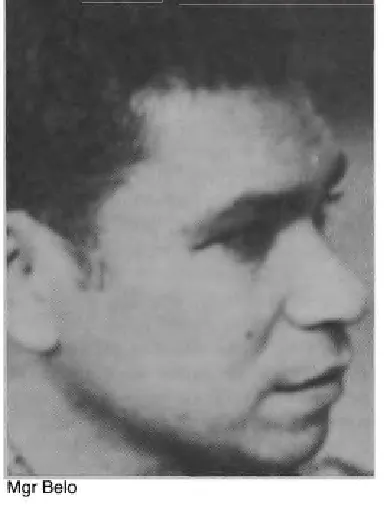
Mgr Belo
international community to resolve this dispute before defining its policy. No weight is given to the moral and political principles which underpin the Timor conflict, and upon which international law and Timor's demand for justice depend.
"Asked if there were a problem in Indonesia-Vatican relations after East Timor was integrated into Indonesia, Mgr Canalini hesitated, seemed to be trying to remember, and finally said 'Nooo'. But the Vatican had once conveyed a statement of concern connected with human rights. He quickly added that the situation had very much improved. The Vatican always had to be careful there not be anything contrary to human rights.
'Compared with the past, of course, the
human rights situation is better."' (Quote from a summary of the Pembuaran article, in Indonesia News Service, No.37, 7.10.87.)
It is easy to detect the shallowness of a diplomatic position that - as set out in this article - is markedly less principled than that of governments in the European Community. In more formal circumstances, one assumes the Vatican's presentation would be intellectually more impressive.
Even if that is so, we cannot take it for granted that nothing has altered. Pope John Paul II did not reaffirm last December exactly what he told the Indonesian Ambassador in July 1984. His remarks were significantly less
demanding upon the Indonesian
authorities. Nowhere was the Vatican's attitude described by any word as strong as "pre-occupied". Above all, gone in 1987 was the reference to concern for the territory's political identity.
Were these words and these absences chosen? The people of Timor can only wait and see. •
9
Fourth
Christian
Consultation
The Fourth Christian Consultation was
held in Lisbon in January, sponsored
by Portuguese Pax Christi, the Presbyterian Evangelical Church of Portugal, A Paz
e
Poss{vel em Timor-Leste and CIIR. It was attended by representatives of Christian organisations from six European countries and the United States, as well as a sizeable number of representatives from Portugal, and followed up three previous meetings held in Holland and Geneva. As in the past, the meeting, which lasted from Friday January 22 to Sunday January 24, was private. No report will be distributed.The Lisbon meeting offered the foreign participants a rare opportunity to meet directly with members of the Timorese community in Lisbon. On the Saturday morning four refugees spoke formally to the meeting, describing their experiences in East Timor after 1975. The meeting then broke up into small groups for informal discussion between participants and larger groups of Timorese.
This direct contact enriched the atmosphere of the meeting very significantly, and for many who took part it was a moving experience.
On Sunday afternoon, the delegates visited the refugee camp at Balteiro, on the outskirts of Lisbon, where Timorese from all over the capital had gathered to welcome them, with a meal and performances of Timorese music and dances.
The Conference also met representatives of Fretilin and the UDT, who made a joint presentation on Saturday evening.
The Consultation was widely covered by the Portuguese media, and on the Monday following the Consultation some of those who took part met with advisers to President Mario Soares, members of the recently appointed Parliamentary Commission on East Timor and officials at the Ministry of Foreign Affairs. A group was also
received
by
the Secretary to theArchbishop of Lisbon.
Justice & Peace Commission
(Statenlaan 35, The Hague,
Netherlands). •
New Church
Statement
on East
Tim or
Eukumindo - the European Working
group for Ecumenical Relations with
Indonesia - is an association of
protestant churches and mission
organisations. Its members include organisations from West Germany, the Netherlands, Switzerland, the United
Kingdom, and the Community of
Churches in Indonesia (PGI). In December, Eukumindo published, in German, the draft of an important position paper on East Tim or, which is reviewed here by Robert Archer.
A New Direction
In previous issues we have signalled the appearance of ground-breaking
statements on East Timor by the
United States National Council of
Churches in Christ (ETL 10, July 1987)
and the Uniting Church in Australia
(ETL 11, November 1987).
The publication of a third document,
this time by an international
association rather than a national body, confirms that the Protestant churches are indeed adopting a new approach in their handling of this acutely sensitive issue.
Put most simply, whereas Protestant church organisations have preferred
since 1975 to be silent in public about East Timor in order to dialogue in private with their Indonesian partners, some of these organisations are now continuing that dialogue on the basis of carefully presented position papers that set out their point of view.
In part this is a response to concern
within their own churches and in their countries. To a greater degree, it seems to be due to recognition that private dialogue with Indonesian church partners has not brought about change. Moreover, the dialogue itself has been painful and frustrating, continued in the teeth of Indonesian resistance to open-ended discussion.
The statements that have been published face up to this difficulty in different ways. The NCCC-USA chose
10
to present a painstaking historical summary of the facts, which demolishes the official Indonesian analysis without ever making direct reference to it. The Uniting Church,
in contrast, opted to challenge the assumptions about the obligations of partnership which have underpinned the Protestant churches' reticence
since 1975.
All the statements nevertheless make considerable effort to comprehend the
views of their Indonesian church partners. In general, these have been expressed forcefully. In many instances, discussion has been vetoed altogether, on the grounds that East Tim or is an internal domestic matter.
In fact the official Indonesian Protestant presentation of events since 1975 has followed closely the official analysis of the Indonesian government - though some Indonesians who visit the territory regularly may acknowledge privately that all is by no means well.
Eukumindo
Indonesian perceptions of their own history, and give considerable weight to the cultural factors conditioning that perception. As a result, many Eukumindo members would tend to disown criticisms of Indonesia which impose "Western" assumptions on Indonesian social and political processes. This position is held the
more strongly, again very
understandably, because the European m1ss1on organisations themselves have a long "colonial" past.
At the same time, Eukumindo shares the universal moral and spiritual values of Christianity - upon which those same "Western" values claim to be founded. There is inevitably some tension in this position.
The Document
There are propositions in Eukumindo's draft position paper with which those sympathetic to East Timor's claims would certainly take issue. On occasion, forgiveably perhaps in a draft, the writing is insensitively worded.
More than the NCCC-USA
statement, and far more than the Uniting Church, the draft seeks to accommodate the Indonesian point of view.
If the Paper is seeking to make an impartial presentation of the views of those engaged in this crisis, it is here that its principal flaw is to be found. For, while the authors take care to explain the feelings of most Indonesians about an issue which engages their country's history and honour, they do not take comparable account of East Timorese feelings about their culture and their history. Since the majority of Timorese do not
consider themselves to be
"Indonesian", it is an omission which may, unfortunately, undermine the report's usefulness; one hopes it can be remedied in a later draft.
In recompense, the authors offer insights into the thinking behind Indonesian perceptions of the issue that should be considered, even if they are not always completely convincing. We are reminded, for example, that: "When Indonesia decided to make East Timor the 27th province of Indonesia, both government and people acted on the erroneous assumption that the East Timorese would accept with enthusiasm what was dear and precious to them: Pancasila, the national language and their army of freedom fighters. (. . . ) That this enthusiasm had grown out of a common historical experience and without it was not possible, was realized by almost no-one, and this led
to disappointments and enormous communications barriers."
Again, "The charge of 'cultural genocide' . . . which Indonesia is said to be perpetuating against East Timorese by introducing the Indonesian language, is incompre-hensible to Indonesians. In this connection Indonesians point to the cultural alienation of East Timor by the Portuguese, as shown by the 'Latinisation' of almost all names and the fact that none of the local languages of East Timor . . . but Portuguese remained the official language."
Important conclusions
There is much to debate about the body of the text - and about the 'way of seeing' which lies behind the authors' approach. The document is more understanding of Indonesian perceptions than any previously published non-Indonesian church statement; though, for its criticisms of the Indonesian army, and its implied admission that East Timor is an international issue, the authors may still find they are criticised by Eukumindo's Indonesian partners. Some sections will certainly be challenged from the Timorese side.
In this context, the document's conclusions should be noted with special care. In effect, they represent the point at which the European churches are likely to approach closest to Indonesian views on East Timor. No Western church body has a more intimate relationship with the Indonesian churches, none has more experience of Indonesia, or identifies its own interests with those of the Indonesian churches more completely. To the extent that there is a gap between Eukumindo's conclusions and those of the Indonesian church, that gap measures the degree to which the Indonesian church stands isolated in its perception of East Tim or.
We quote the conclusions in full below: it will be seen that the gap is, in fact, wide.
"In the difficult situation of East Timor - in many ways tragic and politically very complex - it cannot be for Eukumindo or similar organis-ations to produce suggestions, let alone demands, for the necessary measures. The indigenous churches can do this, but even for them it is difficult.
"Nevertheless, Eukumindo can
express pleas which have a chance of
being considered in the future
reflections of those whose role is to take the decisions. Eukumindo welcomes any political step which contributes to an improvement of the situation of people in East Timor. This is the sense
11
in which the following points are to be
understood:
"I. We are concerned at the fact that so
little reliable information exists
about East Timor. We therefore
request better facilities for visits to
East Timor by international
journalists, church representatives
and representatives of international relief organisations.
"2. We are disturbed by reports that sections of East Timor's population
continue to suffer lack off ood and
medical care, particularly in remote
areas and conflict zones. We
therefore ask that organisations such as the International Committee of the Red Cross (ICRC), Catholic Relief Services (CRS), Parpem PG/ and similar bodies are enabled to provide relief in these areas also, and that no political conditions should be attached to this relief.
"3. We are disturbed by reports of
human rights violations against East
Timorese, of torture, broken
promises of amnesty, etc. Such stances are against the declared will of the Indonesian government. We
therefore ask that ICRC
representatives should be given free access to all prisons in which political prisoners are held.
"4. We are anxious that all possibilities should be exhausted in order to attain a solution for East Timar which is acceptable to all sides, so that the armed conflicts and the fear of lawlessness may cease.
"5. Eukumindo is prepared, within the limit of its capacities, to cooperate with all concerned, particularly with
all church organisations, to
collaborate in the resolution of disputed issues and to press for the provision of the necessary material assistance."
INTERNATIONAL ROUND-UP
PORTUGAL
PARLIAMENTARY VISIT TO TIMOR?
New interest is being shown in the idea of sending a Portuguese parliamentary delegation to East Timor. We report below on the background to this controversial proposal, and on the newly appointed Parliamentary
Commission on East Tim or, which
might play a critical role in Portugal.
New Parliamentary
Commission
After considerable delay, the
Portuguese Parliamentary
Commission on East Timor has been re-convened and its membership agreed.
Parliament being the third instance of power under the Portuguese constitution, with the Government and the Presidency, the Commission has the potential to be an important influence upon - and possibly an
instrument of Portuguese
diplomacy.
The last Commission carried weight because it had support across the political spectrum. Its first report on East Timor, published in November 1986, was adopted unanimously by Parliament, adding political substance to Dr Cavaco Silva's assertive diplomacy on the issue (TL9 March 1987).
The new Commission will also represent all sides of the National Assembly. It contains 29 members, of whom 16 belong to the government Social Democratic Party (PSD), 7 to the principal opposition Socialist Party, and 6 to other groupings (PEP-2, PRD-1, CDS-1, Verdes-1, JD-1).
Its Chairman will be a senior PSD politician, Manuel Dias Loureiro, the party's General Secretary. Although Dr Loureiro has not had a direct involvement in the East Timor issue, his chairmanship will carry authority by virtue of his position in the Party and relationship with the Prime Minister. It is widely assumed that Dr Cavaco Silva takes a direct interest in the direction of policy on East Timor, in consultation with the President, Mario Soares.
The UN and Matters of Protocol
At the end of February, the Commission had still to determine itsprogramme of work - although
preliminary discussions had begun. It
is already certain, however, that the
principal item for discussion will be the question of whether or not, and under
what conditions, a Portuguese
Parliamentary delegation should visit East Timor.
Such a visit became a possibility when it was discussed in New York, during UN-sponsored talks.
The Secretary General's Report (1987) subsequently stated that "The two sides are considering the possibility · of a Portuguese parliamentary delegation visiting East Timor with a view to obtaining first hand information on the situation."
This statement immediately aroused controversy within Portugal on two grounds. (See TL 11, November 1987.) The less important essentially concerns domestic politics and the relations of power, under the terms of Portugal's constitution, between the Government, the Presidency and the National Assembly - each of which are held to be sovereign. Without prior consultation, the government (responsible for conducting the talks with Indonesia) had no right to involve Parliament in proposals about a visit to East Tim or.
It appears now that the apparent slight to Parliamentary sovereignty was due to mistakes by the Portuguese diplomatic mission in New York, which failed to pick up the implications of the Secretary General's wording.
It is understood that Portuguese diplomats have since explained to Indonesia that it is not possible for the Government to make commitments in the name of the Parliament; and that Indonesia will now issue an invitation from its own Parliament to the Portuguese Parliament, thereby restoring proprieties.
Matters of Substance
The second ground of dispute within Portugal's political establishment is one of considerable importance to East Timor, and turns on the question of whether it is possible to make an independent and responsible visit to East Timor, when that visit will be hosted by the Indonesian authorities.
Paradoxically, the Portuguese political establishment is divided between those who assert that any visit under such conditions would be irresponsibly risky and would certainly be exploited by Indonesia to damage
12
Portugal's diplomatic credibility; and those who claim, using exactly the same arguments, that Portugal cannot afford to refuse such an invitation outright.
At stake is the fragile edifice of Portuguese diplomacy, erected with such effort in recent years. If a parliamentary delegation visits East Timor and concludes that "things are altogether better than we thought" or (more likely) is seen by the international press to find no evidence upon which to base criticism, immense damage would be done to the credibility of the Portuguese government's posture - even more in the private talks with Indonesia, perhaps, than in public. The Indonesian authorities, as is well known, are perfectly able to control international visits, preparing crowds, seeding appropriate witnesses in the path of delegations, sanitising and smartening up the environment.
A feeble report from an ill-considered parliamentary delegation would probably lay in ruins the political consensus upon which the recent recovery of Portuguese confidence on this issue relies.
On the other hand, Portuguese diplomats close to the UN process recognise that it might also be fatal to Portugal's international credibility if she was seen to refuse the risks involved in making a visit. Having repeatedly called upon Indonesia to open the territory to international observers, could Indonesia make a more generous gesture than to invite its principal diplomatic opponent? Morever, many Timorese could talk directly to a Portuguese-speaking delegation. In these circumstances, the Indonesian authorities are also seen to be taking considerable risks. If Portugal shied away from this invitation, the diplomats conclude, it could no longer claim to represent neutrally the interests of the Timorese people, and would have forfeited the moral authority upon which its diplomatic influence principally rests.