c
Owned by the authors, published by EDP Sciences, 2018
The SHiP physics program
Giovanni De Lellis1,a
1Dipartimento di Fisica "E. Pancini", Università "Federico II" and INFN, Naples, Italy
Abstract. The discovery of the Higgs boson has fully confirmed the Standard Model of particles and fields. Nevertheless, there are still fundamental phenomena, like the existence of dark matter and the baryon asymme-try of the Universe, which deserve an explanation that could come from the discovery of new particles. The SHiP experiment at CERN meant to search for very weakly coupled particles in the few GeV mass domain has been recently proposed. The existence of such particles, foreseen in different theoretical models beyond
the Standard Model, is largely unexplored. A beam dump facility using high intensity 400 GeV protons is a copious source of such unknown particles in the GeV mass range. The beam dump is also a copious source of neutrinos and in particular it is an ideal source of tau neutrinos, the less known particle in the Standard Model. Indeed, tau anti-neutrinos have not been directly observed so far. We report the physics potential of such an experiment including the tau neutrino magnetic moment.
1 The SHiP experiment
The discovery of the Higgs boson is certainly a big tri-umph of the Standard Model. In particular, given its mass, it could well be that the Standard Model is an effective
theory working all the way up to the Planck scale. Never-theless, there are several phenomena deserving an expla-nation that the Standard Model is unable to provide: the existence of dark matter and its nature, the baryonic asym-metry of the Universe and neutrino masses. It is therefore clear the new physics is there and presumably several new particles have still to be discovered.
Searches for new physics with accelerators are being carried out at the LHC, especially suited to look for high mass particles with ordinary couplings to matter. Comple-mentary searches for very weakly coupled and therefore long-lived particles require a beam dump facility. Such a facility is made of a high density proton target, followed by a hadron stopper and a muon shield. Apart from resid-ual muons, the only remaining particles are electron, muon and tau neutrinos on top of hidden, long-lived particles produced either in proton interactions or in secondary par-ticle decays.
A new experiment, Search for Hidden Particles (SHiP), has been proposed [1], designed to operate at a beam dump facility to be built at CERN and to search for weakly coupled particles in the few GeV mass range. Since a high intensity tau neutrino flux is produced by such a facility from Ds decays, the experimental appara-tus foresees a neutrino detector to study the tau neutrino cross-section and discover the tau anti-neutrino. This de-tector would also be suited to detect dark matter through
ae-mail: [email protected], on behalf of the SHiP
Collabo-ration
the scattering offthe atoms of its target. The physics case
for such an experiment is widely discussed in Ref. [2]. We will review here the physics potential of this experiment for a selection of physics channels, including the tau neu-trino magnetic moment.
In five years, the facility will integrate 2×10²⁰ 400
GeV protons, produced by the SPS accelerator complex, impinging on a 12 interaction length (λint) target made of Molybdenum and Tungsten, followed by a 30 λint
iron hadron absorber. Hidden particles in the GeV mass range would be produced mostly by the decay of charmed hadrons produced in proton interactions. Dsmesons,
co-piously produced among charmed hadrons, are a source of tau neutrinos through their fully leptonic decay. There-fore, the SHiP facility is ideal also to study the physics of tau neutrinos, the less known particle in the Standard Model.
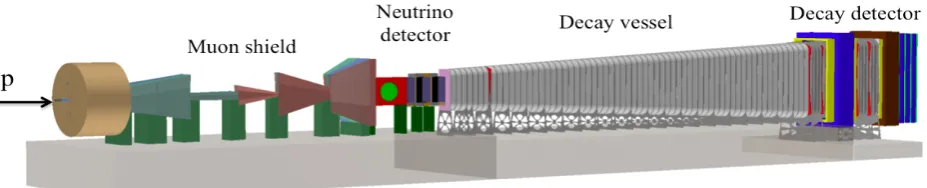
Figure 1 shows the SHiP facility to be placed in the North Area: downstream of the target, the hadron absorber filters out all hadrons, therefore only muons and neutrinos are left. An active muon shield is designed with two sec-tions with opposite polarity to maximize the muon flux reduction: it reduces the muon flux from 1010 down to
105muons per spill. 4×10¹³protons are extracted in each
spill, designed to be 1s long to reduce the detector occu-pancy [3]. A first successful test of the SPS cycle with a 1s long spill was performed in April 2015.
Figure 1.The beam dump facility and the SHiP detector.
for the High Energy panel of the European Strategy to be held in 2020, that will recommend about the approval of the experiment. The construction and installation will last until the third long shutdown of the LHC and the data tak-ing is assumed to start in 2026.
The neutrino detector is made of a magnetised target region, followed by a muon spectrometer, as shown in Fig-ure 2. The neutrino target is based on the emulsion cloud chamber technology employed by the OPERA experiment [4], with a compact emulsion spectrometer, made of a se-quence of very low density material and emulsion films to measure the charge and momentum of hadrons in mag-netic field. Indeed, this feature would allow to discrimi-nate between tau neutrinos and anti-neutrinos also in the hadronic decay channels of the tau lepton. The emulsion target is complemented by high resolution tracking cham-bers to provide the time stamp to the event and connect muon tracks from the target to the muon spectrometer. The muon spectrometer is based on the concept developed for the OPERA apparatus: a dipolar iron magnet where drift tubes provide the momentum and resistive plate chambers provide the tracking within the iron slabs.
The emulsion target will also act as the target of dark matter as well as of any very weakly in- teracting particle produced at the accelerator, when its mass is in the GeV range. The detector is being optimised to search for in-teractions with the atoms (both electrons and nuclei) of very weakly interacting particles. The optimisation con-cerns e.g. the target material, the sampling frequency of the emulsion cloud chamber and the timing performances of the target tracker that would enable the separation be-tween neutrinos and heavy particles based on the time of fligth measurement.
The detector for hidden particles is located in the downstream part of a 60 m long evacuated decay vessel, with an elliptical transverse section of 5×10 m2, with the
longer axis vertically. The hidden particles are supposed to decay within the vessel. The requirement to have less than 1 neutrino interaction in the vessel over five years sets the pressure to about 10−3 mbar. A magnetic
spec-trometer is located downstream of the vessel: it is made of straw tubes with a material budget of 0.5%X0 per
sta-tion, achieving a position resolution of 120µm per straw, with 8 hits per station on average. This gives a momentum resolution of about 1%. The challenge is to build 5m long
straw tubes and the large vacuum vessel. The vessel would be sorrounded by a liquid scintillator layer to tag particles coming from outside. Downstream of the spectrometer, an hadronic and electromagnetic calorimeter and a muon filter are used to identify particles.
2 Search for hidden particles
Extensions of the Standard Model in the low mass region foresee the existence of particles as singlets with respect to the Standard Model gauge group. These particles couple to different singlet compos- ite operators (so-called Por-tals) of the Standard Model. The neutrino can be consid-ered as the first example of a hidden particle: it was pos-tulated in 1930 to explain the puzzle of the beta decay, it is very light and extremely weakly interacting. The SHiP detector located immediately downstream of a beam dump has the potentiality to discover all of them, since it is sen-sitive to very weakly interacting and long lived particles in a wide unexplored range of their masses and couplings. We describe in the following its sensitivity to heavy neu-tral leptons, as an example. For the sensitivity to the other portals, we refer to Ref. [1].
2.1 Search for heavy neutral leptons
Neutrino masses are usually explained by the see-saw mechanism with a lagrangian term given by
L=ıN¯I∂µγµNI −YIαN¯ICHL˜ α−MIN¯CI NI+h.c. (1)
where 3 right-handed heavy neutrinosNI are introduced. The mass of active neutrinos is given by mν m2D/MI where mD YIαv andv 246 GeV is the Higgs
vac-uum expectation value. A massive neutrino with MI of the order of 1 GeV and Yukawa couplingsYIα of the
or-der of 10−7 would account for an active neutrino mass
mν0.05 eV, as measured by neutrino oscillation
experi-ments.
Figure 1.The beam dump facility and the SHiP detector.
for the High Energy panel of the European Strategy to be held in 2020, that will recommend about the approval of the experiment. The construction and installation will last until the third long shutdown of the LHC and the data tak-ing is assumed to start in 2026.
The neutrino detector is made of a magnetised target region, followed by a muon spectrometer, as shown in Fig-ure 2. The neutrino target is based on the emulsion cloud chamber technology employed by the OPERA experiment [4], with a compact emulsion spectrometer, made of a se-quence of very low density material and emulsion films to measure the charge and momentum of hadrons in mag-netic field. Indeed, this feature would allow to discrimi-nate between tau neutrinos and anti-neutrinos also in the hadronic decay channels of the tau lepton. The emulsion target is complemented by high resolution tracking cham-bers to provide the time stamp to the event and connect muon tracks from the target to the muon spectrometer. The muon spectrometer is based on the concept developed for the OPERA apparatus: a dipolar iron magnet where drift tubes provide the momentum and resistive plate chambers provide the tracking within the iron slabs.
The emulsion target will also act as the target of dark matter as well as of any very weakly in- teracting particle produced at the accelerator, when its mass is in the GeV range. The detector is being optimised to search for in-teractions with the atoms (both electrons and nuclei) of very weakly interacting particles. The optimisation con-cerns e.g. the target material, the sampling frequency of the emulsion cloud chamber and the timing performances of the target tracker that would enable the separation be-tween neutrinos and heavy particles based on the time of fligth measurement.
The detector for hidden particles is located in the downstream part of a 60 m long evacuated decay vessel, with an elliptical transverse section of 5×10 m2, with the
longer axis vertically. The hidden particles are supposed to decay within the vessel. The requirement to have less than 1 neutrino interaction in the vessel over five years sets the pressure to about 10−3 mbar. A magnetic
spec-trometer is located downstream of the vessel: it is made of straw tubes with a material budget of 0.5%X0 per
sta-tion, achieving a position resolution of 120µm per straw, with 8 hits per station on average. This gives a momentum resolution of about 1%. The challenge is to build 5m long
straw tubes and the large vacuum vessel. The vessel would be sorrounded by a liquid scintillator layer to tag particles coming from outside. Downstream of the spectrometer, an hadronic and electromagnetic calorimeter and a muon filter are used to identify particles.
2 Search for hidden particles
Extensions of the Standard Model in the low mass region foresee the existence of particles as singlets with respect to the Standard Model gauge group. These particles couple to different singlet compos- ite operators (so-called Por-tals) of the Standard Model. The neutrino can be consid-ered as the first example of a hidden particle: it was pos-tulated in 1930 to explain the puzzle of the beta decay, it is very light and extremely weakly interacting. The SHiP detector located immediately downstream of a beam dump has the potentiality to discover all of them, since it is sen-sitive to very weakly interacting and long lived particles in a wide unexplored range of their masses and couplings. We describe in the following its sensitivity to heavy neu-tral leptons, as an example. For the sensitivity to the other portals, we refer to Ref. [1].
2.1 Search for heavy neutral leptons
Neutrino masses are usually explained by the see-saw mechanism with a lagrangian term given by
L=ıN¯I∂µγµNI−YIαN¯ICHL˜ α−MIN¯CI NI+h.c. (1)
where 3 right-handed heavy neutrinosNI are introduced. The mass of active neutrinos is given by mν m2D/MI where mD YIαv andv 246 GeV is the Higgs
vac-uum expectation value. A massive neutrino with MI of the order of 1 GeV and Yukawa couplingsYIαof the
or-der of 10−7 would account for an active neutrino mass
mν0.05 eV, as measured by neutrino oscillation
experi-ments.
If several conditions are satisfied, among which CP is not conserved, these right-handed neutrinos could also ex-plain the leptogenesis and therein the baryogenesis [5, 6]. Such models do not pretend to explain also dark matter: a dark matter candidate could be provided by a fourth right-handed neutrino or an axion. Moreover they do not require
Figure 2.The neutrino detector upstream of the decay vessel in different views.
HNL mass (GeV) -1
10 1
2
HNL coupling to SM U
-11 10
-10 10
-9 10
-8 10
-7 10
-6 10
dominating
e 2
Inverted hierarchy, U
BBN
BAU / Seesaw
BAU
PS191
CHARM
NuTeV
Figure 3.Exclusion limits at 90% C.L. set for inverted hierarchy withU2
e dominating, according to Ref. [10].
two of the three heavy neutrinos to be quasi-degenerate be-cause CP violation does not need to be enhanced by mass degeneracy.
In the attempt of explaining also dark matter with three heavy neutrinos, it was first introduced in 2005 the so-calledνMSM [7, 8], later followed by refined versions [9].
The role of the three right-handed neutrinos is different as well as their mass: M1 could be a dark matter candidate
with the mass of several keV whileM2andM3should be
states with a mass of about 1 GeV and quasi-degenerate to provide the baryon asymmetry of the Universe.
The statesN2andN3could be produced in the decay of
sufficiently massive particles like charmed hadrons. These
states would be long lived particles that in turn could de-cay, for example, intoπ µ.
Figure 3 shows the experimental and cosmological bounds on the search for heavy neutral leptons. It also re-ports superimposed the exclusion limits at 90% C.L. SHiP could set in case no signal is found, assuming the model re-ported in Ref. [10] with inverted hierarchy and a dominant electron coupling,U2
e :Uµ2:Uτ2=48 : 1 : 1. The
parame-ter space explored by SHiP extends in the cosmologically relevant region that is experimentally unexplored.
3 Physics with the neutrino detector
The tau neutrino is the less known particle in the Stan-dard Model. Four candidates were firstly reported in 2001 by the DONUT experiment [11] and the observa-tion of this particle was finally confirmed in 2008 when 9 candidates events were reported with an estimated back-ground of 1.5 [12]. In the same paper they reported, for the first time, the tau neutrino cross-section where the constant term was measured to be σconstντ = (0.39±
0.13±0.13) ×10−38cm2GeV−1. The large uncertainty
is due to the poor statistical sample and to the rather scarce knowledge of the incoming flux. On top of the large uncertainty, DONUT could not separate tau neutri-nos from anti-neutrineutri-nos. The OPERA experiment [4] has detected five tau neutrinos [13–17], leading to the dis-covery of tau neutrino appearance from muon neutrino oscillations [17]. The only leptonic decay observed by OPERA [15] shows negative charge as expected from a
ντinteraction. Therefore, so far there is no direct evidence
The number ofντand ¯ντemerging from the molybde-num target can be estimated as:
Nντ+¯ντ=4Np
σc¯c
σpN fDsBr(Ds→τ)=6.6×10¹⁵ (2)
whereNpis the number of interacting protons (all
incom-ing ones); σc¯c = 18.1 ±1.7 µbarn [18] the associated
charm production per nucleon; σpN = 10.7 mbarn the hadronic cross-section per nucleon in a Mo target. The in-elastic cross-section pAshows theA0.71dependence [19];
fDs = (8.8±0.6
+0.5
−0.9)% [20] is the fraction ofDs mesons
produced; Br(Ds → τ) = (5.54±0.24)% [21] is theDs
branching ratio intoτ; the factor 4 accounts for the charm pair production and for the twoντproduced perDsdecay.
The SHiP facility is therefore aντfactory, with 6.6×10¹⁵ tau neutrinos produced, equally divided in neutrinos and anti-neutrinos. Given the neutrino target mass of about 10 tons, one expects more than 10000 interactions of tau neu-trinos and anti-neuneu-trinos.
The prediction of the tau neutrino yield is affected by
a large uncertainty: indeed, simulation studies of proton interactions in heavy and thick targets show that a sizeable contribution (about a factor of 2) to the charmed hadron yield comes from the cascade production [22]. Charmed hadrons are produced either directly from interactions of the primary protons or from subsequent interactions of the particles produced in the hadronic cascade showers. The SHiP Collaboration has proposed the SHiP-charm project [23], aiming at measuring the associated charm production by employing the SPS 400 GeV/c proton beam.
This proposal includes a study of the cascade effect to
be carried out using ECC techniques, i.e. slabs consisting of a replica of the SHiP experiment target [1] interleaved with emulsion films. The detector is hybrid, combining the emulsion technique with electronic detectors to pro-vide the charge and momentum measurement of charmed hadron decay daughters and the muon identification. This allows a full kinematical reconstruction required by the double-differential cross- section measurement.
Accord-ing to the simulation performed, the delivery of 2×10⁷
protons on target would allow the detection of about 1000 fully reconstructed charmed hadron pairs. An optimisa-tion run is scheduled for 2018 and the full measurement is planned after the long shutdown LS2 of the CERN accel-erator complex, with 5×10⁷protons on target and a charm
yield of about 2500 fully reconstructed interactions. The charged-currentντ(ντ) differential cross-section is given by five structure functions. The contribution to the cross-section ofF4andF5structure functions, introduced
by Albright and Jarlskog [24], is negligible in muon and electron neutrino interactions due to the light charged lep-ton mass. On the contrary, given the non-negligible mass of theτlepton, tau neutrino scattering is sensitive to their
contribution. Indeed, the hypothesis ofF4=F5=0 would
significantly increase theντ andντ charged-current deep-inelastic cross sections and the corresponding number of expectedντandντinteractions. The region of the energy spectrum below 40 GeV is highly sensitive to the non-zero values of these structure functions.
In the Standard Model, neutrinos may interact with a photon through second order diagrams giving a mag-netic moment proportional to the neutrino mass and there-fore totally negligible and undetectable. Beyond standard model theories predict a neutrino magnetic moment many orders of magnitude higher. Testing the neutrino magnetic moment is therefore a test of possible physics beyond the standard model. Limits on the magnetic moment of muon and electron neutrinos are rather stringent while the one of tau neutrinos is practically unconstrained. An anoma-lous magnetic moment of the tau neutrino would result in tau neutrino interactions with electrons. Quasi-elastic electron neutrino interactions where the final state proton is undetected constitute the main background. An upper limit µν < 1.3×10⁻⁷µB can be achieved with the SHiP experiment in case no excess is observed.
3.1 Strange parton distribution
Charmed hadrons are produced in neutrino and anti-neutrino charged-current interactions at the level of about 5%. Experiments based on calorimetric technology iden-tify charmed hadrons only in their muonic decay chan-nel, when two opposite sign muons are produced in the final state. A cut of 5 GeV is applied to muons in or-der to suppress the background due to punch-through pi-ons. The nuclear emulsion technology, instead, identi-fies topologically the charmed hadron by detecting its de-cay vertex. Energy cuts are therefore much looser, thus providing a better sensitivity to the charm quark mass. Moroever, a large statistical gain is provided by the use of hadronic decay modes [25]. Indeed, despite the fact that 1.280.000 νµ and 270.000 ¯νµ charged-current inter-actions were collected by the NuTeV/CCFR
Collabora-tion, only 5102νµand 1458 ¯νµ events were identified as charm production induced by neutrino charged-current in-teractions. The largest number of events in an emulsion experiment was collected by CHORUS with 2013 charm candidates fromνµand only 32 from ¯νµ[26]. SHiP will integrate about 105 charm candidates, more than one
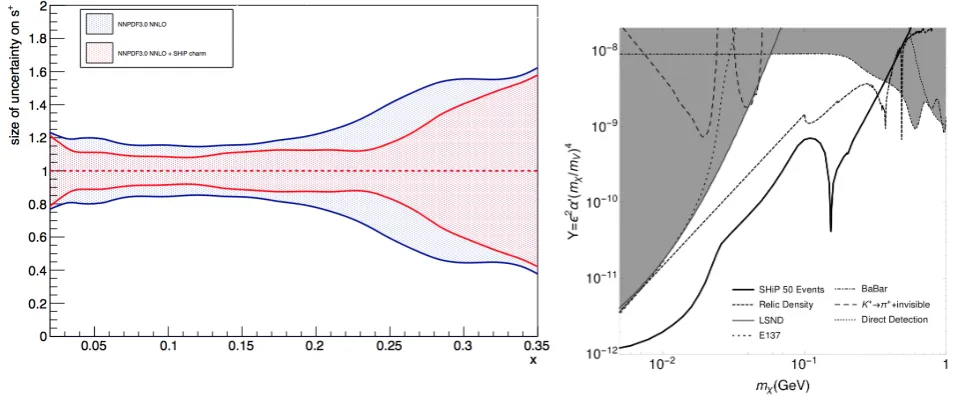
or-der of magnitude larger than the present statistics, with a large (∼ 30%) contribution from anti-neutrinos. Charm production in neutrino scattering is extremely sensitive to the strange quark content of the nucleon, especially with anti-neutrinos where the s-quark is dominant. SHiP will improve significantly the uncertainty on the strange quark distribution in the nucleon as shown in the left plot of Fig-ure 4 in terms ofs+ =s(x)+s¯(x) in the 0.02<x<0.35
range.
3.2 Dark Matter search
The number ofντand ¯ντemerging from the
molybde-num target can be estimated as:
Nντ+ν¯τ=4Np
σcc¯
σpN fDsBr(Ds→τ)
=6.6×10¹⁵ (2)
whereNpis the number of interacting protons (all incom-ing ones); σc¯c = 18.1 ±1.7 µbarn [18] the associated charm production per nucleon; σpN = 10.7 mbarn the hadronic cross-section per nucleon in a Mo target. The in-elastic cross-section pAshows theA0.71dependence [19];
fDs = (8.8±0.6
+0.5
−0.9)% [20] is the fraction ofDs mesons
produced; Br(Ds → τ) = (5.54±0.24)% [21] is the Ds branching ratio intoτ; the factor 4 accounts for the charm pair production and for the twoντproduced perDsdecay. The SHiP facility is therefore aντfactory, with 6.6×10¹⁵
tau neutrinos produced, equally divided in neutrinos and anti-neutrinos. Given the neutrino target mass of about 10 tons, one expects more than 10000 interactions of tau neu-trinos and anti-neuneu-trinos.
The prediction of the tau neutrino yield is affected by a large uncertainty: indeed, simulation studies of proton interactions in heavy and thick targets show that a sizeable contribution (about a factor of 2) to the charmed hadron yield comes from the cascade production [22]. Charmed hadrons are produced either directly from interactions of the primary protons or from subsequent interactions of the particles produced in the hadronic cascade showers. The SHiP Collaboration has proposed the SHiP-charm project [23], aiming at measuring the associated charm production by employing the SPS 400 GeV/c proton beam. This proposal includes a study of the cascade effect to be carried out using ECC techniques, i.e. slabs consisting of a replica of the SHiP experiment target [1] interleaved with emulsion films. The detector is hybrid, combining the emulsion technique with electronic detectors to pro-vide the charge and momentum measurement of charmed hadron decay daughters and the muon identification. This allows a full kinematical reconstruction required by the double-differential cross- section measurement. Accord-ing to the simulation performed, the delivery of 2×10⁷
protons on target would allow the detection of about 1000 fully reconstructed charmed hadron pairs. An optimisa-tion run is scheduled for 2018 and the full measurement is planned after the long shutdown LS2 of the CERN accel-erator complex, with 5×10⁷protons on target and a charm
yield of about 2500 fully reconstructed interactions. The charged-currentντ(ντ) differential cross-section is
given by five structure functions. The contribution to the cross-section ofF4andF5structure functions, introduced
by Albright and Jarlskog [24], is negligible in muon and electron neutrino interactions due to the light charged lep-ton mass. On the contrary, given the non-negligible mass of theτlepton, tau neutrino scattering is sensitive to their
contribution. Indeed, the hypothesis ofF4=F5=0 would significantly increase theντ andντcharged-current
deep-inelastic cross sections and the corresponding number of expectedντandντinteractions. The region of the energy
spectrum below 40 GeV is highly sensitive to the non-zero values of these structure functions.
In the Standard Model, neutrinos may interact with a photon through second order diagrams giving a mag-netic moment proportional to the neutrino mass and there-fore totally negligible and undetectable. Beyond standard model theories predict a neutrino magnetic moment many orders of magnitude higher. Testing the neutrino magnetic moment is therefore a test of possible physics beyond the standard model. Limits on the magnetic moment of muon and electron neutrinos are rather stringent while the one of tau neutrinos is practically unconstrained. An anoma-lous magnetic moment of the tau neutrino would result in tau neutrino interactions with electrons. Quasi-elastic electron neutrino interactions where the final state proton is undetected constitute the main background. An upper limit µν < 1.3×10⁻⁷µB can be achieved with the SHiP experiment in case no excess is observed.
3.1 Strange parton distribution
Charmed hadrons are produced in neutrino and anti-neutrino charged-current interactions at the level of about 5%. Experiments based on calorimetric technology iden-tify charmed hadrons only in their muonic decay chan-nel, when two opposite sign muons are produced in the final state. A cut of 5 GeV is applied to muons in or-der to suppress the background due to punch-through pi-ons. The nuclear emulsion technology, instead, identi-fies topologically the charmed hadron by detecting its de-cay vertex. Energy cuts are therefore much looser, thus providing a better sensitivity to the charm quark mass. Moroever, a large statistical gain is provided by the use of hadronic decay modes [25]. Indeed, despite the fact that 1.280.000 νµ and 270.000 ¯νµ charged-current
inter-actions were collected by the NuTeV/CCFR Collabora-tion, only 5102νµand 1458 ¯νµ events were identified as
charm production induced by neutrino charged-current in-teractions. The largest number of events in an emulsion experiment was collected by CHORUS with 2013 charm candidates fromνµ and only 32 from ¯νµ[26]. SHiP will
integrate about 105 charm candidates, more than one
or-der of magnitude larger than the present statistics, with a large (∼ 30%) contribution from anti-neutrinos. Charm production in neutrino scattering is extremely sensitive to the strange quark content of the nucleon, especially with anti-neutrinos where the s-quark is dominant. SHiP will improve significantly the uncertainty on the strange quark distribution in the nucleon as shown in the left plot of Fig-ure 4 in terms of s+ =s(x)+s(x) in the 0¯ .02<x<0.35
range.
3.2 Dark Matter search
The dark matter at an accelerator can be produced through the decay of a dark photon and it can thus be copiously produced at a beam dump facility. Given the proton en-ergy, a dark matter in the GeV and sub-GeV mass range can be produced at SHiP. Direct searches performed in the underground laboratories rely on the observation of nuclear recoils induced by the scattering of galactic dark
Figure 4.Left: Improvement of the accuracy ons+with SHiP (red) compared to the present status (blue) in the 0.02<x<0.35 range. Right: SHiP sensitivity to light dark matter in the (mχ,Y) plane.
matter. Given the non-relativistic nature of galactic dark matter, induced recoils show a kinetic energy of the keV order if the dark matter mass is around 1 GeV. This makes the search for dark matter at around 1 GeV or below ex-tremely difficult. The sensitivity of current experiments in that range is therefore limited by the capability of observ-ing such low energy recoils. At the accelerator, on the contrary, the dark matter would be ultra-relativistic and it could be observed through its scattering off the elec-trons of the lead-emulsion target of the neutrino detector. The elastic interaction of dark matter particles with elec-trons produces one electron in the final state, thus mimik-ing elastic interaction of neutrinos that constitute the main background for this search. In Ref. [1] we have estimated the total background. Following the approach described in Ref. [27], the right plot of Fig. 4 shows the SHiP sensitiv-ity to light dark matter in the plane (mχ,Y) wheremχis the
dark matter mass,Y =ε2αm 4
χ
m4
V
,mV the mass of the dark photon as dark matter parent,εthe coupling. This plot is drawn for the fixed ratio mV
mχ
=5 andα=0.5. The deep
peak at around 150 MeV is due to theρ/ωresonances in the dark photon production. The slope change around 27 MeV is due toπ0production. The sensitivity to light dark
matter turns out to be very competitive with all the planned experiments in the next decade.
The neutrino detector is in general sensitive to the search for very weakly interacting particles when they in-teract with the atoms of the emulsion target.
References
[1] M. Anelli et al.,A facility to Search for Hidden Parti-cles (SHiP) at the CERN SPS, arXiv:1504.04956.
[2] S. Alekhin et al., A facility to search for hidden particles at the CERN SPS: the SHiP physics case, arXiv:1504.04855.
[3] A. Akmete et al.,The active muon shield in the SHiP experiment, JINST 12 (2017) no.05, P05011.
[4] N. Agafonova et al., The OPERA experiment in the CERN to Gran Sasso neutrino beam, JINST4 (2009) P04018.
[5] M. Drewes, et al., Leptogenesis from a GeV Seesaw without mass degeneracy, JHEP1303(2013) 096. [6] M. Drewes,The phenomenology of right handed
neu-trinos, Int. J. Mod. Phys.E22(2013) 1330019. [7] T. Asaka and M. Shaposhnikov, The nuMSM, dark
matter and baryon asymmetry of the universe, Phys. Lett.B620(2005) 17.
[8] M. Shaposhnikov,A possible symmetry of the nuMSM, Nucl. Phys.B763(2007) 49.
[9] L. Canetti et al., Sterile neutrinos as the origin of dark and baryonic matter, Phys. Rev. Lett.110(2013) 061801.
[10] L. Canetti and M. Shaposhnikov,Baryon Asymmetry of the Universe in the NuMSM, JCAP1009(2010) 001. [11] K. Kodama et al.,Observation of tau neutrino
inter-actions, Phys. Lett.B504(2001) 218.
[12] K. Kodama et al.,Final tau-neutrino results from the DONuT experiment, Phys. Rev.D78(2008) 052002. [13] N. Agafonova et al., Observation of a first ντ
can-didate in the OPERA experiment in the CNGS beam, Phys. Lett.B691(2010) 138.
[14] N. Agafonova et al.,New results onνµ→ντ
appear-ance with the OPERA experiment in the CNGS beam, JHEP1311(2013) 036.
[15] N. Agafonova et al.,Evidence forνµ → ντ
[16] N. Agafonova et al.,Observation of tau neutrino ap-pearance in the CNGS beam with the OPERA experi-ment, PTEP2014(2014) 101C01.
[17] N. Agafonova et al.,Discovery ofτneutrino appear-ance in the CNGS Neutrino Beam with the OPERA ex-periment, Phys. Rev. Lett.115(2015) 121802.
[18] C. Lourenco, H.K. Wohri, Heavy flavour hadro-production from fixed-target to collider energies, Phys. Rept.433(2006) 127.
[19] J. Carvalho,Compilation of cross sections for pro-ton nucleus interactions at the HERA energy, Nuclear PhysicsA725(2003) 269.
[20] H. Abramowicz et al.,Measurement of charm frag-mentation fractions in photoproduction at HERA, JHEP 1309(2013) 058.
[21] K.A. Olive et al.,Review of Particle Physics, Chin. Phys.C38(2014) 090001.
[22] H. Dijkstra and T. Ruf,
http://cds.cern.ch/record/2115534/files/
SHiP-NOTE-2015-009.pdf.
[23] A. Akmete et al. [SHiP Collaboration], CERN-SPSC-2017-033, SPSC-EOI-017 (2017).
[24] C. H. Albright and C. Jarlskog,Neutrino Production of m+and e+Heavy Leptons.1, Nucl. Phys. B84(1975)
467.
[25] G. De Lellis et al., Charm physics with neutrinos, Physics Reports399(2004) 227.
[26] A. Kayis-Topaksu et al.,Measurement of charm pro-duction in neutrino charged-current interactions, New J. Phys.13(2011) 093002.