_____________________________________________________________________________________________________ *Corresponding author: E-mail: [email protected];
(Past name: British Journal of Medicine and Medical Research, Past ISSN: 2231-0614, NLM ID: 101570965)
Efficacy of Dental Floss Impregnated with
Commercially Available Mouthwashes on
Reduction of Supragingival Biofilm:
A Randomized Single Blind Study
Nitika Shinde
1*, Prashanth Shetty
1, Varsha Jadhav
1, C. Naresh Kumar
2,
Abhishek Talathi
1and Sabiha Patel
11
Yogita Dental College and Hospital, Khed, India.
2
Vishnu Dental College, Bhimavaram, India.
Authors’ contributions
This work was carried out in collaboration between all authors. All authors read and approved the final manuscript.
Article Information
DOI: 10.9734/JAMMR/2017/36695 Editor(s): (1)Dimitrios Dionysopoulos, Department of Operative Dentistry, School of Dentistry, Aristotle University of Thessaloniki, Greece. (2)Mamta Kaushik, Professor, Department of Conservative Dentistry and Endodontics, Army College of Dental Sciences, India.
(3)Thomas I. Nathaniel, University of South Carolina, School of Medicine-Greenville, Greenville, USA. Reviewers: (1)Marco Montevecchi, University of Bologna, Italy. (2)Setu Mathur, RUHS- College of Dental Sciences, India. (3)B. C. Ephraim-Emmanuel, Bayelsa State College of Health Technology, Nigeria. (4)Eleni Kotsiomiti, Aristotle University of Thessaloniki, Greece. (5)Khushbu Yadav, Purbanchal University, Nepal. Complete Peer review History:http://www.sciencedomain.org/review-history/22519
Received 9th September 2017 Accepted 24th November 2017 Published 29th December 2017
ABSTRACT
Aim: To evaluate the efficacy of dental floss impregnated with commercially available Chlorhexidine gluconate, Cetylpyredinium Chloride and Chlorine dioxide mouthwash on reduction of Supragingival Biofilm.
Materials and Methods: Sixty dental students were randomly divided into four groups (n=15 Control group (group 1-distilled water) included floss impregnated in distilled water. Test groups were (group 2- Rexidine® mouthwash) (group 3- Colgate Plax® mouthwash) (group 4- Freshclor® mouthwash) All the patients used same toothbrush and a unwaxed dental floss impregnated with
mouthwash twice a day. The presence of the dental biofilm and bleeding on probing was evaluated only on four surfaces, resulting in four scores for each tooth (mesiobuccal, distobuccal, mesiolingual and distolingual). The four surfaces were assessed according to the Quigley–Hein Index , modified by Turesky et al. and papillary bleeding index.
Results: After 15 days, the mean plaque score using Turesky Gilmore Plaque Index of all teeth examined was 0.8473333±0.2868076, for control group, 0.969444 ±0.4494448 for group 2, 0.608333 ± 0.2082143 for group 3, 0.608333 ± 0.2082143 for group 4.
Mean papillary bleeding index scores were 1.60 ± 0.632 for control group, 0.33 ± 0.488 for group 2, 1.07 ± 0.704 for group 3, 1.13± 0.640 for group 4.
Group 3 showed statistically significant levels in reduction of plaque scores with Turesky Gilmore Plaque Index.
Conclusion: The present study concluded that the CHX impregnated floss was more effective in reducing the interproximal plaque levels. And cetylpyridinium impregnated floss was better in reducing the biofilm level when assesed using Turesky Gilmore modification of Quigley Hein plaque index.
Keywords: Biofilm; interproximal areas; dental floss; indices.
1. INTRODUCTION
Main aetiological factor for periodontal disease (PD) are the Dental biofilms [1]. The use of a toothbrush is the best mechanical way for control of the biofilm to prevent PD [2]. However, there is need of additional cleaning devices to supplement the use of toothbrushes due to their reduced efficiency and efficacy in removing the dental biofilm in the inter-proximal [3]. In addition, PD does not necessarily affect all tooth areas with equal severity [4]. Inter-proximal surfaces have larger concentrations of dental biofilm accumulation than on smooth surfaces, suggesting the importance of use of interdental cleaning in these areas [5].
Several inter-proximal cleaning devices are regularly available, including single tufted brushes, toothpicks and dental floss [6]. Size and morphology of the inter-dental spaces should be considered before choosing the appropriate inter dental aid. Evaluation of the skill and ability of the patient to use these devices is also important [7]. Only a small portion of the population uses dental floss on a daily basis, and its consumption is greater in individuals with higher socioeconomic levels, according to Zimmer et al. [8]. The efficiency of flossing increases when its usage is increasingly encouraged. [9], but a large group of dental professionals do not routinely recommend this to the population concerned. All of these difficulties make the habit of flossing less acceptable.
There is a lot of literature establishing, that flossing is effective, but it depends on the patient’s situation whether it should be carefully
recommended by a dental professional [6,10]. Despite these evidences, one systematic review established that tooth brushing and dental flossing provide no benefit, when compared to tooth brushing alone, on removing plaque and reducing gingivitis [5]. Also, another systematic review states that there is weak and very unreliable evidence suggesting that flossing plus tooth brushing may be associated with a small reduction in plaque [11].
Use of various antimicrobial agents have been suggested as an adjunct to enhance the efficacy of mechanical plaque control. Chlorhexidine is the gold standard for this purpose. It is a dicationic compound that is able to join anionic compounds, such as phosphate and carboxyl radicals from the tooth surface and salivary glycoproteins. It damages the cytoplasmic membrane, leading to bacterial cell lysis [12]. Additionally, retention capacity of chlorhexidine helps it to remains in oral tissues for a prolonged time, exhibiting a high substantivity [13].
On the other hand, Colgate Plax® is an cetylpyredinium chloride containing mouth rinse that has similar antiplaque and antigingivitis effects as chlorhexidine but does not have the unwanted side effects of chlorhexidine [14]. Stabilised chlorine dioxide has marked bactericidal effects against oral bacteria associated with gingivitis and periodontitis [15].
2. MATERIALS AND METHODS
Ethical aspects: The study was approved by the Ethical Committee of our institution and informed consent was obtained from every participants.
2.1 Study Type
This study followed the CONSORT statement, and it was designed as a single-centre, parallel, single-blind, controlled and randomized clinical trial.
A total of 60 female dental students (aged 18 to 24 years) from our institution were, examined for this clinical trial. Those volunteers who fulfilled the following inclusion criteria were included. As per inclusion criteria, all volunteers had to be in a good general health (free from any major systemic disease) Secondly, they had to display interproximal spaces without any diastema or gingival recession.
Patients with any kind of dental prosthesis, caries or any other plaque retentive factor, with exception of dental calculus, were excluded from this study. Those who used systemic antibiotics within 3 months prior to the start of the study and those who possessed systemic conditions that exerted an effect on periodontal health, such as diabetes, were also excluded.
2.2 Experimental Design
Sixty dental students were equally divided into four groups (n=15). Control group (group 1-distilled water) included floss impregnated in distilled water. Test groups were (group 2- Rexidine® mouthwash) (group 3- Colgate Plax® mouthwash) (group 4- Freshclor® mouthwash) All the patients used same toothbrush and unwaxed dental floss impregnated with mouthwash twice a day.
All the patients were examined at visit one and supragingival scaling and root planning was done with the purpose of making the dentition 100% free of plaque, calculus and extrinsic stains. For present study, only the anterior teeth were selected for evaluation, which includes total twelve inter-proximal spaces on the upper arch and twelve on the lower arch [16].
Except first visit, daily oral hygiene procedures were not supervised. The patients were motivated to perform this procedure twice a day in 12-hours intervals.
To achieve standard conditions, each volunteer received a kit that contained a new toothbrush with soft bristles and fluoride containing dentifrice. They were instructed to follow modified bass method of tooth brushing and demonstration was given for the same at the first visit only. Furthermore, the volunteers were requested not to use any kind of antiseptic mouthwash or chewing gum during the period of study. After 1week they were recalled as Second Visit. The recordings of indices were done which were considered as Baseline readings. Same time they were introduced floss and method of using the same. The intervention started at same visit. On day 15 of the experimental period, subjects attended another appointment as Visit 3 to evaluate clinical parameters again.
The laboratory phase used is an adaptation of the protocol developed by Oppermann et al. [17] and Muniz et al. [16]. Initially, 30-cm lengths of waxed dental floss (Colgate Sensitive Dental Floss) were cut with the help of a ruler. In an autoclave, these floss segments were sterilized and then placed in previously sterilized test tubes with the mouthwashes and distilled water.
During 24 hr., these falcon tubes remained in a incubator at a constant temperature of 37°C as a tentative to impregnate the solution on the floss. After that time, the floss passed through a drying stage in the same incubator for the same period of time and was then subsequently placed in appropriate packages.
On third Visit, the presence of the dental biofilm and bleeding on probing was evaluated only on four surfaces, resulting in four scores for each tooth (mesiobuccal, distobuccal, mesiolingual and distolingual) [16]. The four surfaces were assessed according to the Quigley–Hein Index [18], modified by Turesky et al. [19] and papillary bleeding index (Muhlemann [20]).
Sample size was estimated using Cohen’s d formula for minimum difference expected. Through, it was estimated a sample size of eight volunteers per group taking into consideration a power of study (1-β) 80% and an alpha value of 5%. However, a dropout rate of approximately 20% was added to the sample size which gives 60 volunteers.
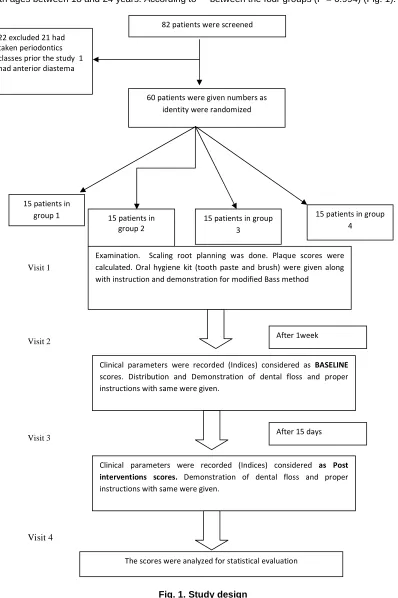
shown in Fig. 1. All the volunteers were adults with ages between 18 and 24 years. According to
ANOVA test, there are no age differences between the four groups (P = 0.994) (Fig. 1).
Fig. 1. Study design
82 patients were screened
60 patients were given numbers as identity were randomized 22 excluded 21 had
taken periodontics classes prior the study 1 had anterior diastema
15 patients in
group 1 15 patients in
group 2
15 patients in group 3
15 patients in group 4
Examination. Scaling root planning was done. Plaque scores were calculated. Oral hygiene kit (tooth paste and brush) were given along with instruction and demonstration for modified Bass method
Clinical parameters were recorded (Indices) considered as BASELINE scores. Distribution and Demonstration of dental floss and proper instructions with same were given.
After 1week
Clinical parameters were recorded (Indices) considered as Post interventions scores. Demonstration of dental floss and proper
instructions with same were given.
After 15 days
The scores were analyzed for statistical evaluation Visit 1
3. RESULTS
All the scores were tabulated and entered in to Microsoft Excel 2007. Statistical analysis was done using SPSS (Statistical Package for Social Sciences) Version 17. The four groups were compared by ANOVA (Analysis of Variance) followed by intergroup comparison was done by Tukey’s post hoc test. Before and after scores (2nd visit /Baseline Scores) and (after 15 days / Post Interventional scores) were compared by paired‘t’ test. p value was set at 0.05 and scores were considered statistically significant only when they are less than 0.05.
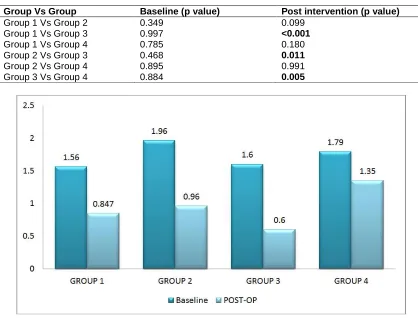
The mean plaque score using Turesky Gilmore Modification of Quigley Hein Plaque Index in Group 1(n=15) was 1.566667± 0.1687371 at baseline with minimum score 1.1667 and maximum score 1.7917 while in post intervention mean score was 0.8473333±.2868076 with minimum score 0 and maximum score 1.00.
The mean plaque score using Turesky Gilmore Modification of Quigley Hein Plaque Index in Group 2(n=15) was 1.958333± 0. .3886408 at baseline with minimum score 1.2083 and maximum score 2.5417 while in post intervention mean score was 0 .969444 ±0. 4494448 with minimum score 0 and maximum score 2.0833.
The mean plaque score using Turesky Gilmore Modification of Quigley Hein Plaque Index in Group 3 (n=15) was 1.608333 ± 0. .2518779 at baseline with minimum score 1.2917 and maximum score 2.2500 while in post intervention mean score was 0.608333 ± 0.2082143 with minimum score o.3333 and maximum score 1.0417.
The mean plaque score using Turesky Gilmore Modification of Quigley Hein Plaque Index in Group 4 (n=15) was 1.797222 ± 0. .4151361 at baseline with minimum score 1.0417 and maximum score 2.5833 while in post intervention mean score was 0.608333 ± 0.2082143 with minimum score 0.7083 and maximum score 2.2083.
The GBI score using Papillary Bleeding Index in Group 1(n=15) was 2.27 ± 0.961 at baseline with minimum score 1.00 and maximum score 4.00while in post intervention mean score was 1.60 ± 0.632 with minimum score 1 and maximum score 3.00.
The GBI score using Papillary Bleeding Index in Group 2(n=15) was 2.33± 0.724 at baseline with
minimum score 0.00 and maximum score 4.00while in post intervention mean score was 0.33 ± 0.488with minimum score 0 and maximum score 1.00.
The GBI score using Papillary Bleeding Index in Group 3(n=15) was 2.80± 0.862 at baseline with minimum score 0.00 and maximum score 2.00 while in post intervention mean score was 1.07 ± 0.704 with minimum score 0 and maximum score 2.00.
The GBI score using Papillary Bleeding Index in Group 4 (n=15) was 2.57 ± 0.938 at baseline with minimum score 1.00 and maximum score 4.00 while in post intervention mean score was 1.13± 0.640 with minimum score 0 and maximum score 2.00.
More effective supragingival biofilm control was seen with patients using dental floss impregnated with cetylpyredinium chloride mouthwash when assessed with help of Turesky Gilmore Modification of Quigley Hein Plaque Index.
Dental floss impregnated with Chlorhexidine gluconate Mouthwash was more efficient in cleaning interdental areas when assessed using Papillary Bleeding Index.
4. DISCUSSION
Disclosed biofilm was used in this study, to assess plaque scores. Although the use of disclosing solutions in the management of biofilm control can be somehow discouraging for some patients, the use of disclosing solutions
combined with index scales enables
comparisons between new and existing oral hygiene products [17]. When the mechanical action of flossing was combined with the chemical action of chlorhexidine, it was possible to achieve more satisfactory results in reducing the interproximal biofilms on these surfaces.
association with the use of a toothbrush, similarly reduced the level of dental biofilms to a significantly greater extent than the use of a toothbrush alone.
In contrast with these results, a systematic review by Berchier in 2008, concluded that routine instruction to use dental floss is not supported by the literature, and the use of the floss should be analysed carefully by dental professionals so that patient should benefit the most from this type of interproximal cleaning device [6]. Additionally, another clinical trial did not report any additional benefits of the use of dental floss when it was compared to the use of a toothbrush alone [23]. The study found that after 8 weeks, the group that used only a toothbrush and toothpaste showed a reduction of interproximal biofilms which was quite similar to the group that used dental floss as well. Authors also indicated the need for an accurate manual dexterity to obtain the proper efficacy of dental floss. In the present study, at baseline, all patients were instructed on the proper way to use the floss.
This study results showed that dental floss impregnated with cetylpyredinium chloride mouthwash provided statistically significant lower supragingival biofilm assessed using Turesky Gilmore modification of Quigley Hein Plaque Index than those of the other three groups. Colgate plax ® has been studied in many controlled clinical trials which showed plaque reductions ranging from 22-36% and gingivitis
reductions ranging from 23-36% with the longest study being 9 months [13]. And patients who used floss impregnated with chlorhexidine mouthwash showed reduced scores of deposits in the interdental areas assessed by Papillary Bleeding Index. Stabilized chlorine dioxide mouthwash exerts its bactetricidal effect by fixing cellular membrane proteins. It is used primarily in reduction of volatile sulphur compounds and hence potent agent for treatment of halitosis. Stabilized chlorine dioxide has marked bactericidal effects against oral bacteria associated with gingivitis and periodontitis [14].
Results of this study corroborate with the results of other studies that combined mechanical and chemical methods to control dental biofilms. In addition, a study by Gisselsson et al. [24] showed that after 3 years, the number of caries lesions was lower in children that used dental floss combined with chlorhexidine 1% gel than in children that used dental floss and a placebo gel.
Addition advantage of the impreganation of dental floss with mouthwash could be that it serves the purpose of both the chemical as well as mechanical plaque control.
However more investigations of the laboratory phase should be done, mainly, to assess how the impregnation with mouthwash happens. Further clinical trials with longer experimental periods should be performed to confirm or reject the absence of side effects, especially in nonprofessional individuals with a larger sample.
7
Table 1. Descriptive statistics for TGG plaque score among all four groups at baseline and after intervention
Descriptive statistics
Group Pre/post N Minimum Maximum Mean Std. deviation
Group 1 Baseline Average 15 1.1667 1.7917 1.566667 .1687371
Post Intervention Average 15 .0000 1.0000 0.8473333 .2868076
Group 2 Baseline Average 15 1.2083 2.5417 1.958333 .3886408
Post Intervention Average 15 .0000 2.0833 .969444 .4494448
Group 3 Baseline Average 15 1.2917 2.2500 1.608333 .2518779
Post Intervention Average 15 .3333 1.0417 .608333 .2082143
Group 4 Baseline Average 15 1.0417 2.5833 1.797222 .4151361
Post Intervention Average 15 .7083 2.2083 1.350000 .4100063
Table 2. Comparison of group for Turesky Gilmore Modification of Quigley Hein Plaque Index scores within the group (by pair t Test) as well as intergroup comparison by ANOVA
Group 1 Group 2 Group 3 Group 4 ANOVA p value
Baseline 1.566667 ± 0.1687371 1.958333 ± 0.3886408 1.608333 ± 0.2518779 1.797222 ± 0.4151361 0.056
Post intervention 0. 8473333 ± 0.2868076 0.969444 ± 0.4494448 0.608333 ± 0.2082143 1.350000 ± 0.4100063 <0.0001
Mean difference 0.152778 0.6186667 0.8306667 0.4580000 ---
Paired t test p value 0.214 <0.0001 <0.0001 <0.0001 ---
Intergroup comparison
Group Vs Group Baseline Post intervention
Group 1 Vs Group 2 0.497 0.0587
Group 1 Vs Group 3 0.078 0.0046
Group 1 Vs Group 4 0.468 <0.0001
Group 2 Vs Group 3 0.475 0.0034
Group 2 Vs Group 4 0.884 0.0524
Table 3. Descriptive statistics for Papillary Bleeding Index score among all four groups at baseline and after intervention
Descriptive statistics
Group N Minimum Maximum Mean Std. deviation
Group 1 Baseline 15 1 4 2.27 .961
Post Intervention 15 1 3 1.60 .632
Group 2 Baseline 15 1 3 2.33 .724
Post Intervention 15 0 1 .33 .488
Group 3 Baseline 15 2 4 2.80 .862
Post Intervention 15 0 2 1.07 .704
Group 4 Baseline 14 1 4 2.57 .938
Post Intervention 15 0 2 1.13 .640
Table 4. Comparison of group for Papillary Bleeding Index score within the group (by pair t Test) as well as intergroup comparison by ANOVA
Group 1 Group 2 Group 3 Group 4 ANOVA p value
Baseline 2.27 ± 0.961 2.33 ± 0 .724 2.80 ± 0.862 2.57 ± 0 .938 <0.0001 Post intervention 1.60 ± 0.632 0.33 ± 0. 488 1.07 ± 0 .704 1.13 ± 0.640 0.336
Mean difference 0.667 2.000 1.733 1.500 ---
Paired t test p value
0.045 <0.0001 <0.0001 <0.0001 _______
Intergroup comparison by Tukey’s post hoc test
Group Vs Group Baseline (p value) Post intervention (p value)
Group 1 Vs Group 2 0.349 0.099
Group 1 Vs Group 3 0.997 <0.001
Group 1 Vs Group 4 0.785 0.180
Group 2 Vs Group 3 0.468 0.011
Group 2 Vs Group 4 0.895 0.991
Group 3 Vs Group 4 0.884 0.005
5. CONCLUSION
The present study concluded that the CHX impregnated floss was more effective in reducing the interproximal plaque levels. Cetylpyridinium impregnated floss was better in reducing the biofilm level when assesed using Turesky Gilmore modification of Quigley Hein plaque index.
CONSENT
As per international standard or university standard, patient’s written consent has been collected and preserved by the authors.
ETHICAL APPROVAL
As per international standard or university standard, written approval of Ethics committee has been collected and preserved by the authors.
COMPETING INTERESTS
Authors have declared that no competing interests exist.
REFERENCES
1. Han X, Kawai T, Taubman MA.
Interference with immune-cellmediated bone resorption in periodontal disease. Periodontol 2000. 2007;45:76–94.
2. Santos A. Evidence-based control of plaque and gingivitis. J Clin Periodontol. 2003;30(Suppl. 5):13–6.
3. Laing E, Ashley P, Gill D, Naini F. An update on oral hygiene products and techniques. Dent Update. 2008;35:270-9. 4. Salvi GE, Della Chiesa A, Kianpur P,
Attstrom R, Schmidlin K, Zwahlen M, Lang NP. Clinical effects of interdental cleansing on supragingival biofilm formation and development of experimental gingivitis. Oral Health Prev Dent. 2009;7:383–91.
5. Lang NP, Cumming BR, Loe H.
Toothbrushing frequency as it relates to plaque development and gingival health. J Periodontol. 1973;44:396–405.
6. Berchier CE, Slot DE, Haps S, Van der Weijden GA. The efficacy of dental floss in addition to a toothbrush on plaque and parameters of gingival inflammation: A systematic review. Int J Dent Hyg. 2008;6: 265–79.
7. Zanatta FB, Moreira CH, Rosing CK. Association between dental floss use and gingival conditions in orthodontic patients. Am J Orthod Dentofacial Orthop. 2011; 140:812–21.
8. Zimmer S, Kolbe C, Kaiser G, Krage T, Ommerborn M, Barthel C. Clinical efficacy of flossing versus use of antimicrobial rinses. J Periodontol. 2006;77:1380–5. 9. Warren PR, Chater BV. An overview of
established interdental cleaning methods. J Clin Dent. 1996;7:65–9.
10. Unsal E, Akkaya M, and Walsh TF: Influence of a single application of
subgingival chlorhexidine gel or
tetracycline paste on the clinical parameters of adult periodontitis patients. J Clin Periodontol. 1994;21:351-5.
11. Sambunjak D, Nickerson JW, Poklepovic T, et al. Flossing for the management of periodontal diseases and dental caries in adults. Cochrane Database Syst Rev. 2011;7:CD008829.
12. Herrera D, Roldan S, Santacruz I, Santos S, Masdevall M, Sanz M. Differences in antimicrobial activity of four commercial
0.12% chlorhexidine mouthrinse
formulations: An in vitro contact test and salivary bacterial counts study. J Clin Periodontol. 2003;30:307–14.
13. Shahani MN, Subba Reddy VV.
Comparison of antimicrobial substantivity of root canal irrigants in instrumented root canals up to 72 h: An in vitro study. J Indian Soc Pedod Prev Dent. 2011;29:28– 33.
14. Mankodi S, Bauroth K, Witt JJ, Bsoul S, He T, Gibb R, Dunavent J, Hamilton A. A 6-month clinical trial to study the effects of a cetylpyridinium chloride mouth rinse on gingivitis and plaque. Am J Dent. 2005;18: 9-14.
15. Takayama M, Suglimoto H, mizutami S, Tanno K, bactericidal activity of chlorine dioxide. J Antibact Antifung Agent. 1995; 23:401-6.
16. Muniz FWMG, Sena KS, de Oliveira CC, Ver_ıssimo DM, Carvalho RS, Martins RS. Efficacy of dental floss impregnated with chlorhexidine on reduction of supragingival biofilm: a randomized controlled trial. Int J Dent Hygiene. 2015;13:117—24.
18. Quigley GA, Hein JW. Comparative cleansing efficiency of manual and power brushing. J Am Dent Assoc. 1962;65:26– 29.
19. Turesky S, Gilmore ND, Glickman I.
Reduced plaque formation by the
chloromethyl analogue of victamine C. J Periodontol. 1970;41:41–43.
20. Muhlemann HR, Son S. Gingival sulcus bleeding - a leading symptom in initial gingivitis. Helvetica Odontologica Acta. 1971;15:107-13.
21. Gjermo P, Flotra L.The effect of different methods of interdental cleaning. J Periodontal Res. 1970;5:230–6.
22. Terezhalmy GT, Bartizek RD, Biesbrock AR. Plaque-removal efficacy of four types of dental floss. J Periodontol. 2008;79: 245–251.
23. Schuz B, Wiedemann AU, Mallach N, Scholz U. Effects of a short behavioural intervention for dental flossing: Randomized-controlled trial on planning when, where and how. J Clin Periodontol. 2009;36:498–505.
24. Gisselsson H, Birkhed D, Bjorn AL. Effect of a 3-year professional flossing program with chlorhexidine gel on approximal caries and cost of treatment in preschool children. Caries Res. 1994;28:394–9.
_________________________________________________________________________________ © 2017 Shinde et al.; This is an Open Access article distributed under the terms of the Creative Commons Attribution License (http://creativecommons.org/licenses/by/4.0), which permits unrestricted use, distribution, and reproduction in any medium, provided the original work is properly cited.
Peer-review history: