The SHiP experiment at CERN
Walter M. Bonivento, on behalf of the SHiP Collaboration1,a
1Istituto Nazionale di Fisica Nucleare, Sezione di Cagliari, Cittadella Universitaria di Monserrato, Monserrato (CA),Italy
Abstract.The discovery of the Higgs boson has fully confirmed the Standard Model of particles and fields. Nevertheless, there are still fundamental phenomena, like the exis-tence of dark matter and the baryon asymmetry of the Universe, deserving an explanation that could come from the discovery of new particles. Searches for new physics with ac-celerators are performed at the LHC, looking for high massive particles coupled to matter with ordinary strength. A new experiment at CERN meant to search for very weakly cou-pled particles in the few GeV mass domain has been recently proposed. The existence of such particles, foreseen in different theoretical models beyond the Standard Model,
is largely unexplored. A beam dump facility using high intensity 400 GeV protons is a copious source of such unknown particles in the GeV mass range. The beam dump is also a copious source of neutrinos and in particular it is an ideal source of tau neutrinos, the less known particle in the Standard Model. The neutrino detector can also search for dark matter through its scattering offthe electrons. We report the physics potential of the
SHiP experiment.
1 Introduction
The discovery of the Higgs boson is certainly a big triumph of the Standard Model. Nevertheless, there are several phenomena deserving an explanation that the Standard Model is unable to provide: the existence of dark matter and its nature, the baryonic asymmetry of the Universe and neutrino masses. It is therefore clear that new physics is there and presumably several new particles have still to be discovered. Searches for new physics with accelerators are being carried out at the LHC, especially suited to look for high mass particles with ordinary couplings to matter. Complementary searches for very weakly coupled and therefore long lived particles require a beam dump facility. Such a facility is made of a high density proton target, followed by a hadron stopper and a muon shield. Apart from residual muons, the only remaining particles are electron, muon and tau neutrinos on top of hidden, long lived particles produced either in proton interactions or in secondary particle decays.
A new experiment, Search for Hidden Particles (SHiP), has been proposed [1], designed to operate at a beam dump facility to be built at CERN and to search for weakly coupled particles in the few GeV mass range. Since a high intensity tau neutrino flux is produced by such a facility fromDs decays, the experimental apparatus foresees a neutrino detector to study the tau neutrino cross-section and discover the tau anti-neutrino. This detector would also be suited to detect dark matter through the
Target/Magnetised hadron absorber
Active muon shield
Emulsion spectrometer Decay volume
Hidden sector spectrometer
p@400GeV
π
µ
hnl
115m
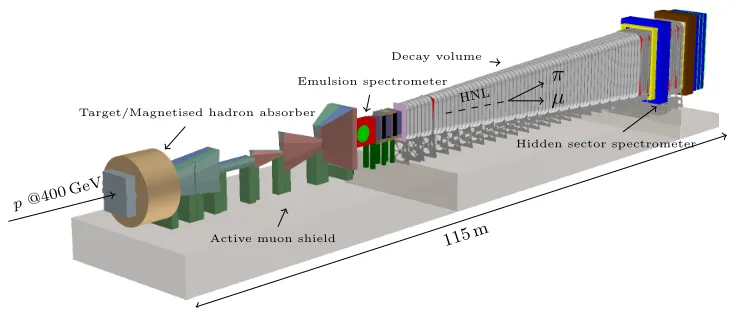
Figure 1.The beam dump facility and the SHiP detector.
scattering offthe atomic electrons of its target. The physics case for such an experiment is widely discussed in Ref. [2]. We will review here the physics potential of this experiment for a selection of physics channels.
2 The SHiP facility and apparatus
In five years, the facility will integrate 2×10²⁰ 400 GeV protons, produced by the SPS accelera-tor complex, impinging on a 12 interaction length (λint) target made of Molybdenum and Tungsten, followed by a 30λintiron hadron absorber. Hidden particles in the GeV mass range would be pro-duced mostly by the decay of charmed hadrons propro-duced in proton interactions.Dsmesons, copiously produced among charmed hadrons, are a source of tau neutrinos through their fully leptonic decay. Therefore, the SHiP facility is ideal also to study the physics of tau neutrinos, the less known particle in the Standard Model.
Figure 1 shows the SHiP facility to be placed in the North Area: downstream of the target, the hadron absorber filters out all hadrons, therefore only muons and neutrinos are left. An active muon shield is designed with two sections with opposite polarity to maximize the muon flux reduction: it reduces the muon flux from∼1010down to∼105muons per spill. 4×10¹³protons are extracted in each spill, designed to be 1s long to reduce the detector occupancy. A first successful test of the SPS cycle with a 1s long spill was performed in April 2015.
An emulsion spectrometer to detect tau neutrinos and search for dark matter is located downstream of the muon shield, followed by the decay vessel and the detector for hidden particles. The Collabora-tion has been requested by the SPSC Committee to prepare a Comprehensive Design Report by 2018, in the framework of the Physics Beyond Colliders working group, launched in March 2016 at CERN. This working group is meant to prepare proposals as input for the High Energy panel of the European Strategy to be held in 2019-2020; approval of the experiment will follow the recommendation of this panel. The construction and installation will last until the third long shutdown of the LHC and the data taking is assumed to start in 2026.
Target/Magnetised hadron absorber
Active muon shield
Emulsion spectrometer Decay volume
Hidden sector spectrometer
p@400GeV
π
µ
hnl
115m
Figure 1.The beam dump facility and the SHiP detector.
scattering offthe atomic electrons of its target. The physics case for such an experiment is widely discussed in Ref. [2]. We will review here the physics potential of this experiment for a selection of physics channels.
2 The SHiP facility and apparatus
In five years, the facility will integrate 2×10²⁰ 400 GeV protons, produced by the SPS accelera-tor complex, impinging on a 12 interaction length (λint) target made of Molybdenum and Tungsten, followed by a 30λint iron hadron absorber. Hidden particles in the GeV mass range would be pro-duced mostly by the decay of charmed hadrons propro-duced in proton interactions.Dsmesons, copiously produced among charmed hadrons, are a source of tau neutrinos through their fully leptonic decay. Therefore, the SHiP facility is ideal also to study the physics of tau neutrinos, the less known particle in the Standard Model.
Figure 1 shows the SHiP facility to be placed in the North Area: downstream of the target, the hadron absorber filters out all hadrons, therefore only muons and neutrinos are left. An active muon shield is designed with two sections with opposite polarity to maximize the muon flux reduction: it reduces the muon flux from∼1010down to∼105muons per spill. 4×10¹³protons are extracted in each spill, designed to be 1s long to reduce the detector occupancy. A first successful test of the SPS cycle with a 1s long spill was performed in April 2015.
An emulsion spectrometer to detect tau neutrinos and search for dark matter is located downstream of the muon shield, followed by the decay vessel and the detector for hidden particles. The Collabora-tion has been requested by the SPSC Committee to prepare a Comprehensive Design Report by 2018, in the framework of the Physics Beyond Colliders working group, launched in March 2016 at CERN. This working group is meant to prepare proposals as input for the High Energy panel of the European Strategy to be held in 2019-2020; approval of the experiment will follow the recommendation of this panel. The construction and installation will last until the third long shutdown of the LHC and the data taking is assumed to start in 2026.
The emulsion spectrometer detector is made of a magnetised target region, followed by a muon spectrometer. The neutrino target is based on the emulsion cloud chamber technology employed by the OPERA experiment [3], with a compact emulsion spectrometer, made of a sequence of very low density material and emulsion films to measure the charge and momentum of hadrons in magnetic
field. Indeed, this feature would allow to discriminate between tau neutrinos and anti-neutrinos also in the hadronic decay channels of the tau lepton. The emulsion target is complemented by high resolution tracking chambers to provide the time stamp to the event and connect muon tracks from the target to the muon spectrometer. The muon spectrometer is based on the concept developed for the OPERA apparatus: a dipolar iron magnet where drift tubes provide the momentum and resistive plate chambers provide the tracking within the iron slabs. The atoms of the emulsion target would also act as the target of dark matter coming from the decays of the dark photons produced from the proton interaction in the target.
The detector for hidden particles is located in the downstream part of a 60 m long evacuated decay vessel, with a rectangular transverse section of 5×10 m2, with the longer axis vertically. The hidden particles are supposed to decay within the vessel. The requirement to have less than 1 neutrino interaction in the vessel over five years sets the pressure to about 1 mbar. A magnetic spectrometer is located downstream of the vessel: it is made of straw tubes with a material budget of 0.5%X0 per station, achieving a position resolution of 120µm per straw, with 8 hits per station on average. This gives a momentum resolution of about 1%. The vessel would be surrounded by a liquid scintillator layer to tag particles coming from outside. Downstream of the spectrometer, an hadronic and electromagnetic calorimeter and a muon filter are meant for particle identification. A timing detector with a resolution better than 100 ps makes the combinatorial background negligible.
3 Search for hidden particles
Extensions of the Standard Model in the low mass region foresee the existence of particles as singlets with respect to the Standard Model gauge group. These particles couple to different singlet compos-ite operators (so-called Portals) of the Standard Model. The neutrino can be considered as the first example of a hidden particle: it was postulated in 1930 to explain the puzzle of the beta decay, it is very light and extremely weakly interacting. The SHiP detector located immediately downstream of a beam dump has the potentiality to discover all of them, since it is sensitive to very weakly interacting and long lived particles in a wide unexplored range of their masses and couplings. We describe in the following its sensitivity to dark photons, heavy neutral leptons and dark matter. For the sensitivity to the other portals, we refer to Ref. [1].
3.1 Search for hidden photons
Dark photons are vectorial particles coupled to the photon with a lagrangian termL =−kBµνVµν/2. In a beam dump facility, they can be produced directly from the proton interaction with the target and in the decay of particles likeπ0,η,ωandη. The dark photon may decay into dark matter particles
or, if no lighter hidden particles exist, into final states likee+e−,µ+µ−orqq. Recently, data from old¯
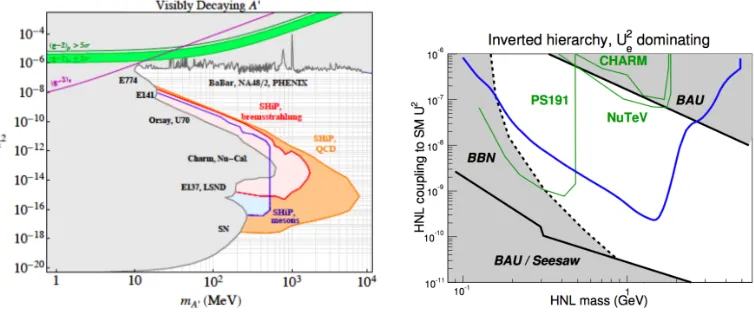
experiments have been reanalysed and exclusion plots have been derived together with cosmological limits [4, 5]. The left plot of figure 2 shows the exclusion limits at 90% C.L. set by SHiP in case no signal is found. The parameters displayed are the mass andε2squared coupling of the dark photon. It is worth noting that the region investigated by SHiP covers a new region, unexplored by previous searches.
3.2 Search for heavy neutral leptons
Neutrino masses are explained by the see-saw mechanism with a lagrangian term given by
Figure 2. Left: exclusion limit at 90% C.L. in the dark photon search, in the plane defined by its mass and2 squared coupling. Right: exclusion limits at 90% C.L. in the heavy neutral lepton search, for inverted hierarchy withU2
edominating, according to Ref. [11].
where 3 right-handed heavy neutrinosNI are introduced. The mass of active neutrinos is given by
mνm2D/MI wheremDYIαvandv246 GeV is the Higgs vacuum expectation value.
If several conditions are satisfied, among which that CP is not conserved in the leptonic sector, these right-handed neutrinos could also explain the leptogenesis and threfore the baryogenesis [6, 7]. Such models do not claim to explain also dark matter: a dark matter candidate could be provided by a fourth right-handed neutrino or an axion. Moreover they do not require two of the three heavy neutri-nos to be quasi-degenerate because CP violation does not need to be enhanced by mass degeneracy.
In the attempt of explaining also dark matter with three heavy neutrinos, the so-calledνMSM [8, 9]
was first introduced in 2005, followed by more refined versions [10] later on. The role of the three right-handed neutrinos is different as well as their mass: M1could be a dark matter candidate with
the mass of several keV whileM2 andM3 should be states with a mass of about 1 GeV and
quasi-degenerate to provide the baryon asymmetry of the Universe. The statesN2andN3could be produced
in the decay of sufficiently massive particles like charmed hadrons. These states would be long lived
particles that in turn could decay, for example, into a pion-muon pair.
The right plot of Figure 2 shows the experimental and cosmological bounds on the search for heavy neutral leptons. It also reports superimposed the exclusion limits at 90% C.L. SHiP could set in case no signal is found, assuming the model reported in Ref. [11] with inverted hierarchy and a dominant electron coupling,U2
e : Uµ2 : Uτ2 = 48 : 1 : 1. The parameter space explored by SHiP extends in the cosmologically relevant region that is experimentally unexplored.
4 Physics with the neutrino detector
Figure 2. Left: exclusion limit at 90% C.L. in the dark photon search, in the plane defined by its mass and2 squared coupling. Right: exclusion limits at 90% C.L. in the heavy neutral lepton search, for inverted hierarchy withU2
edominating, according to Ref. [11].
where 3 right-handed heavy neutrinosNI are introduced. The mass of active neutrinos is given by
mνm2D/MI wheremDYIαvandv246 GeV is the Higgs vacuum expectation value.
If several conditions are satisfied, among which that CP is not conserved in the leptonic sector, these right-handed neutrinos could also explain the leptogenesis and threfore the baryogenesis [6, 7]. Such models do not claim to explain also dark matter: a dark matter candidate could be provided by a fourth right-handed neutrino or an axion. Moreover they do not require two of the three heavy neutri-nos to be quasi-degenerate because CP violation does not need to be enhanced by mass degeneracy.
In the attempt of explaining also dark matter with three heavy neutrinos, the so-calledνMSM [8, 9]
was first introduced in 2005, followed by more refined versions [10] later on. The role of the three right-handed neutrinos is different as well as their mass: M1 could be a dark matter candidate with
the mass of several keV whileM2 andM3 should be states with a mass of about 1 GeV and
quasi-degenerate to provide the baryon asymmetry of the Universe. The statesN2andN3could be produced
in the decay of sufficiently massive particles like charmed hadrons. These states would be long lived
particles that in turn could decay, for example, into a pion-muon pair.
The right plot of Figure 2 shows the experimental and cosmological bounds on the search for heavy neutral leptons. It also reports superimposed the exclusion limits at 90% C.L. SHiP could set in case no signal is found, assuming the model reported in Ref. [11] with inverted hierarchy and a dominant electron coupling,U2
e : Uµ2 : Uτ2 = 48 : 1 : 1. The parameter space explored by SHiP extends in the cosmologically relevant region that is experimentally unexplored.
4 Physics with the neutrino detector
The tau neutrino is the less known particle in the Standard Model. The observation of this particle was finally confirmed in 2008 when 9 candidates events were reported with an estimated background of 1.5 [12]. In the same paper, the tau neutrino cross-section, with a 50% uncertainty due to the small statistical sample and to the rather poor knowledge of the incoming flux, was also reported. The DONUT experiment was unable to separate neutrinos from anti-neutrinos. The OPERA experiment has detected five tau neutrinos [13–17], discovering the tau neutrino appearance from muon neutrino
oscillations. The only leptonic decay observed by OPERA [15] shows negative charge as expected from aντinteraction. Therefore, so far there is no direct evidence for tau anti-neutrinos.
The number ofντand ¯ντemerging from the molybdenum target can be estimated as:
Nντ+ν¯τ=4Np σcc¯
σpN fDsBr(Ds→τ)=6.6×10
15 (2)
whereNpis the number of interacting protons,σcc¯ =18.1±1.7µbarn [18] is the associated charm
production per nucleon,σpN =10.7 mbarn is the hadronic cross-section per nucleon in a Mo target,
fDs =(8.8±0.6+−00..59)% [19] is the fraction ofDsmesons produced,Br(Ds→τ)=(5.54±0.24)% [20]
is theDsbranching ratio intoτand the factor 4 accounts for the charm pair production and for the twoντproduced perDsdecay. The SHiP facility is therefore aντfactory.
Given the neutrino target mass of 9.6 tons, the neutrino flux, the geometrical acceptance of the detector and the standard model cross-section [21], one expects about 7000 interactions of tau neutri-nos and 3500 of tau anti-neutrineutri-nos. The charged-currentντ(ντ) differential cross-section is given by five structure functions. The contribution to the cross-section ofF4andF5structure functions [22]
is negligible in muon and electron neutrino interactions due to the light charged lepton mass. On the contrary, given the non-negligible mass of theτ lepton, tau neutrino scattering is sensitive to
their contribution. Indeed, the hypothesis ofF4 = F5 = 0 would significantly increase theντ and
ντcharged-current deep-inelastic cross sections and the corresponding number of expectedντandντ interactions. SHiP is sensitive to a non-null value ofF4andF5[1].
4.1 Strange parton distribution
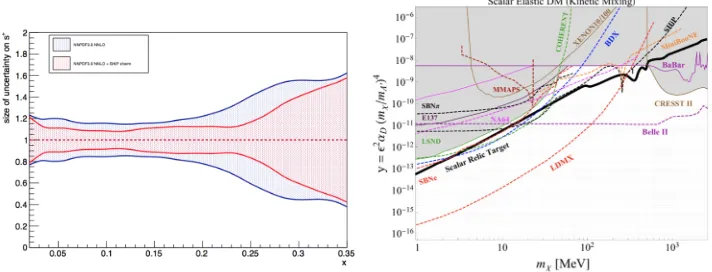
Charmed hadrons are produced in neutrino and anti-neutrino charged-current interactions at the level of about 5%. Advantages of the nuclear emulsion technology in the detection of neutrino-induced charm production are discussed in Ref. [23]. Despite the fact that 1.280.000 νµ and 270.000 ¯νµ charged-current interactions were collected by the NuTeV/CCFR Collaboration, only 5102 νµ and 1458 ¯νµevents were identified as charm production induced by neutrino charged-current interactions. The largest number of events in an emulsion experiment was collected by CHORUS with 2013 charm candidates fromνµand only 32 from ¯νµ[24]. SHiP will integrate about 105charm candidates, more than one order of magnitude larger than the present statistics, with a large (∼30%) contribution from anti-neutrinos. Charm production in neutrino scattering is extremely sensitive to the strange quark content of the nucleon, especially with anti-neutrinos where thes-quark is dominant. SHiP will im-prove significantly the uncertainty on the strange quark distribution in the nucleon as shown in the left plot of Figure 3 in terms ofs+=s(x)+s¯(x) in the 0.02<x<0.35 range.
4.2 Dark Matter search
The dark matter at an accelerator can be produced through the decay of a dark photon and it can thus be copiously produced at a beam dump facility. Given the proton energy, a dark matter in the GeV and sub-GeV mass range can be produced at SHiP. Direct searches performed in the underground laboratories rely on the observation of nuclear recoils induced by the scattering of dark matter. Given the non-relativistic nature of dark matter, the recoils induced show a kinetic energy of the keV order if the dark matter mass is around 1 GeV. This makes the search for dark matter at around 1 GeV or below extremely difficult. The sensitivity of current experiments in that range is therefore limited
Figure 3.Left: improvement of the accuracy ons+with SHiP (red) compared to the present status (blue) in the
0.02<x<0.35 range. Right: sensitivity to the light dark matter (figure from [25])
the lead-emulsion target of the neutrino detector. The elastic interaction of dark matter particles with electrons produces one electron in the final state, thus mimicking elastic interaction of neutrinos that constitute the main background for this search. The total background to this search is estimated in Ref. [1] and the right plot of Figure 3 shows the sensitivity in the plane of the couplingyand the dark
matter massmχ. In the same plot, the sensitivity of other experimental programs is shown together with the relic dark matter density. SHiP sensitivity is such to test in some mass regions the predictions made from the relic dark matter density.
References
[1] M. Anelli et al., arXiv:1504.04956.
[2] S. Alekhin et al., Rept. Prog. Phys.79(2016) no.12, 124201. [3] N. Agafonova et al., OPERA Coll., JINST4(2009) P04018. [4] J. Brunner, Phys. Lett.B731(2014) 320.
[5] A. Fradette et al., Phys. Rev.D90(2014) 035022. [6] M. Drewes, et al., JHEP1303(2013) 096.
[7] M. Drewes, Int. J. Mod. Phys.E22(2013) 1330019. [8] T. Asaka and M. Shaposhnikov, Phys. Lett.B620(2005) 17. [9] M. Shaposhnikov, Nucl. Phys.B763(2007) 49.
Figure 3.Left: improvement of the accuracy ons+with SHiP (red) compared to the present status (blue) in the
0.02<x<0.35 range. Right: sensitivity to the light dark matter (figure from [25])
the lead-emulsion target of the neutrino detector. The elastic interaction of dark matter particles with electrons produces one electron in the final state, thus mimicking elastic interaction of neutrinos that constitute the main background for this search. The total background to this search is estimated in Ref. [1] and the right plot of Figure 3 shows the sensitivity in the plane of the couplingyand the dark
matter massmχ. In the same plot, the sensitivity of other experimental programs is shown together with the relic dark matter density. SHiP sensitivity is such to test in some mass regions the predictions made from the relic dark matter density.
References
[1] M. Anelli et al., arXiv:1504.04956.
[2] S. Alekhin et al., Rept. Prog. Phys.79(2016) no.12, 124201. [3] N. Agafonova et al., OPERA Coll., JINST4(2009) P04018. [4] J. Brunner, Phys. Lett.B731(2014) 320.
[5] A. Fradette et al., Phys. Rev.D90(2014) 035022. [6] M. Drewes, et al., JHEP1303(2013) 096.
[7] M. Drewes, Int. J. Mod. Phys.E22(2013) 1330019. [8] T. Asaka and M. Shaposhnikov, Phys. Lett.B620(2005) 17. [9] M. Shaposhnikov, Nucl. Phys.B763(2007) 49.
[10] L. Canetti et al., Phys. Rev. Lett.110(2013) 061801. [11] L. Canetti and M. Shaposhnikov, JCAP1009(2010) 001. [12] K. Kodama et al., Phys. Rev.D78(2008) 052002. [13] N. Agafonova et al., Phys. Lett.B691(2010) 138. [14] N. Agafonova et al., JHEP1311(2013) 036. [15] N. Agafonova et al., Phys. Rev.D89(2014) 051102. [16] N. Agafonova et al., PTEP2014(2014) 101C01. [17] N. Agafonova et al., Phys. Rev. Lett.115(2015) 121802. [18] C. Lourenco, H.K. Wohri, Phys. Rept.433(2006) 127. [19] H. Abramowicz et al., JHEP1309(2013) 058.
[20] K.A. Olive et al., Chin. Phys.C38(2014) 090001. [21] M. H. Reno, Phys. Rev. D74(2006) 033001.
[22] C. H. Albright and C. Jarlskog, Nucl. Phys. B84(1975) 467. [23] G. De Lellis et al., Physics Reports399(2004) 227.