_____________________________________________________________________________________________________
*Corresponding author: E-mail: [email protected];
www.sciencedomain.org
Sequential Treatment with Lamivudine and
Peg-interferon Therapy in Patients with E-positive
Chronic Hepatitis B and High Viral Load
Shou-Wu Lee
1,2*,
Sheng-Shun Yang
1,3, Teng-Yu Lee
1,2, Hong-Zen Yeh
1,3and Chi-Sen Chang
1,21
Department of Internal Medicine, Division of Gastroenterology, Taichung Veterans General Hospital, Taichung, Taiwan.
2
Department of Internal Medicine, Chung Shan Medical University, Taichung, Taiwan.
3
Department of Internal Medicine, National Yang-Ming University, School of Medicine, Taipei, Taiwan.
Authors’ contributions
This work was carried out in collaboration between all authors. Authors SWL and TYL designed the study, wrote the protocol and wrote the first draft of the manuscript. Authors SSY, HZY and CSC managed the literature searches and analyses of the study performed the spectroscopy analysis.
All authors read and approved the final manuscript.
Article Information
DOI: 10.9734/BJMMR/2016/21870 Editor(s): (1) Alex Xiucheng Fan, Department of Biochemistry and Molecular Biology, University of Florida, USA. (2)Pasquapina Ciarmela, Department of Experimental and Clinical Medicine, Polytechnic University of Marche, Italy. (3)Philippe E. Spiess, Department of Genitourinary Oncology, Moffitt Cancer Center, USA and Department of Urology and Department of Oncologic Sciences (Joint Appointment), College of Medicine, University of South Florida, Tampa, FL, USA. Reviewers: (1) Rodrigo Crespo Mosca, São Paulo University, Brazil. (2)Syed Ali Raza Kazmi, Institute of Biomedical and Genetic Engineering, Islamabad, Pakistan. Complete Peer review History:http://sciencedomain.org/review-history/12164
Received 7th September 2015 Accepted 20th October 2015 Published 9th November 2015
ABSTRACT
Background: Patients with chronic hepatitis B virus (HBV) who are positive for e antigen (HBeAg)
and have a high viral load are considered to be poor therapeutic responders to pegylated interferon (PEG-IFN). The aim of this study was to assess the therapeutic response of sequential therapy, lamivudine (LAM) followed by PEG-IFN, in these cases.
Methods: Chronic HBV patients who were HBeAg positive, with HBV DNA over 107 IU/ml and ALT 2-10 times the upper normal limit, and who were treatment naive were included in our study. Those with concurrent hepatitis C or HIV infection, liver cirrhosis or decompensated cirrhosis, or
pregnancy were excluded. The enrolled cases received therapy with PEG-IFN monotherapy for 48 weeks (IFN group) or sequential therapy with lamivudine (LAM) for 4 weeks followed by PEG-IFN therapy for 48 weeks (LAM/ PEG-PEG-IFN group).
Results: There were 10 patients in each group, and there were no differences in age, gender,
HBV genotype, pre-treatment ALT, and HBV DNA levels between the two groups. The biochemical, virological and serologic responses within 24 weeks after treatment were 40%-60%, 30-50%, and 40-50%, respectively, in the PEG-IFN group, compared with 70%, 40%, and 20-40%, respectively, in the LAM/PEG-IFN group. The rates of positive EOT were 30% and 10% in the PEG-IFN group and the LAM/PEG-IFN group, respectively, with rates of 40% and 10% in the SVR-12-week subgroup, and 30% and 20%, respectively, in the SVR-24-week subgroup. The therapeutic responses between the two groups showed no differences.
Conclusion: In chronic HBV patients who were positive for HBeAg positive and with a high viral
load at baseline, similar therapeutic responses were noted between the sequential LAM/PEG-IFN therapy group and the PEG-IFN monotherapy group. Further research with a higher number of patients and a prolonged LAM course are needed to confirm the efficacy of this approach.
Keywords: Hepatitis B; interferon; lamivudine; sequential treatment.
1. BACKGROUND
Chronic infection of hepatitis B virus (HBV) is a major global health problem and leads to the development of cirrhosis, liver failure, and hepatocellular carcinoma [1]. Most HBV infection in Asia and Western Pacific nations is usually acquired perinatally or in early childhood. These cases have hepatitis B e antigen (HBeAg)-positive chronic hepatitis B with high HBV-DNA levels, and they develop moderate to severe hepatic inflammation with increased alanine aminotransferase (ALT) levels after 10–30 years of infection [2]. Antiviral treatment is indicated in patients who remain HBeAg positive with high HBV-DNA levels after a 3-month period of increased ALT levels. Currently available antiviral treatment for chronic HBV can be divided into two classes of therapeutic agents: nucleos(t)ide analogues (NAs), including lamivudine (LAM), telbivudine, entecavir, adefovir tenofovir, and interferon (IFN)/pegylated interferon (PEG-IFN).
IFN has both antiviral and immunomodulatory actions, and its advantages include a finite course of treatment, absence of drug resistance, and an opportunity to obtain a post-treatment durable response to therapy [3]. Moreover, IFN can reduce the level of intrahepatic cccDNA by inducing cytotoxic T cell activity for immune clearance of infected cells. However, a high HBV DNA load is associated with an inefficient T cell response to HBV-related antigens [4,5,6]. In addition, previous evidence has shown that a decreased viral load induced by NAs treatment can result in the subsequent restoration of CD4 followed by the CD8 cellular immune response against HBV [7]. Sequential therapy for chronic
HBV individuals with high HBV DNA load, starts with NAs to lower the viral load before IFN therapy is initiated, thereby restoring treatment sensitivity, as low HBV DNA levels are considered to be potentially associated with a favorable response to IFN. However, there were no studies comparing the efficacy between sequential therapy and IFN monotherapy until now.
The aim of this study was to compare the efficacy of PEG-IFN monotherapy and sequential therapy, lamivudine followed by PEG-IFN, by assessing the therapeutic responses of chronic HBV patients with positive HBeAg and baseline high viral load.
2. METHODS
hemorrhage, and hepatic encephalopathy, (c) serious concurrent medical illnesses that contraindicate to use of IFN, and (d) pregnancy. The results of the general characteristics and serum data of the participants were collected and compared. This study was conducted with the approval of the Clinical Research Ethics Committee of Taichung Veterans General Hospital.
The enrolled patients were stratified into two groups: the IFN monotherapy group: PEG-IFN alpha-2a given once a week subcutaneously for 48 wk, and the LAM/PEG-IFN sequential therapy group: LAM 100 mg daily for 4 weeks, followed by PEG-IFN alpha-2a given once a week subcutaneously for 48 weeks. Serum was assayed for ALT, HBV DNA, and HBeAg at the beginning of treatment and every 3 months until 6 months after that. At each monthly clinic visit, laboratory tests were performed to determine the safety of the treatment and adverse events.
Responses to therapy were assessed as follows: biochemical response was defined as a decrease in serum ALT levels to within the normal range; virological response was defined as a decrease in serum HBV DNA to 2000 IU/mL; and a serological response was defined as loss of serum HBeAg. Positive end-of-treatment (EOT), sustained off-treatment virological responses (SVR)-12 and SVR-24 were defined by the achievement of all the above at 0, 12, and 24 weeks after the end of treatment.
Data are expressed as standard deviation of the mean for each of the measured parameters. Gender, HBV genotype, and responses to therapy are expressed as a percentage of the total patient number. A p value below 0.05 was considered statistically significant. Statistical comparisons were made using Pearson’s chi-square test of exact Fisher’s test to compare the effects of gender, HBV genotype, and responses to therapy. Independent t test was used to analyze age, HBV DNA, and ALT level. All statistical analyses were performed using SPSS V.18.0 for Windows (SPSS, Inc, Chicago, Illinois, USA).
3. RESULTS
Twenty consecutive chronic HBV patients who were HBeAg positive and fulfilled the inclusion criteria were enrolled. The demographic, clinical, biochemical, and virological features of the PEG-IFN group and the LAM/PEG-PEG-IFN group of
patients at baseline are summarized in Table 1. There were 10 patients in each group, and there were no significant differences in gender (male ratio 60% vs. 40%, P=0.656), HBV genotype (genotype B/C 6/4 vs. 9/1, P=0.303), age (mean 36.1 years old vs. 31.9 years old, P=0.246), pre-treatment ALT (mean 246.7 IU/L vs. 287.3 IU/L, P=0.617), and pre-treatment HBV DNA levels (mean 13.62x10⁷ IU/ml vs. 13.99x10⁷ IU/ml, P=0.945) between the two groups.
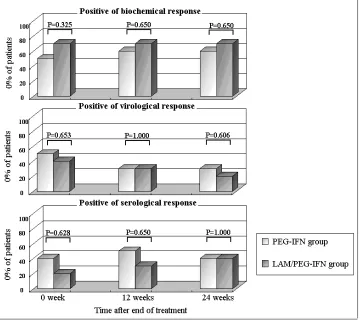
The responses to therapy at the end of treatment, 12 weeks and 24 weeks after treatment, among these patients are displayed in Figs. 1 and 2. The therapeutic responses between the two groups showed no significant differences. Favorable biochemical responses were achieved in 40%-60% of patients in the PEG-IFN group and in 70% in the LAM/PEG-IFN group. The percentage of positive virological responses was 30-50% in the PEG-IFN group and 20-40% in the LAM/PEG-IFN group. Beneficial serologic responses were attained in 40-50% in the PEG-IFN group, and 20-40% in the LAM/PEG-PEG-IFN group. The differences between these two groups were non-significant. The positive ratio of EOT was 30% and 10%, SVR-12 was 40% and 10%, and SVR-24 was 30% and 20%, in the PEG-IFN group and the LAM/PEG-IFN group, respectively.
The decline of HBV DNA level during treatment is shown in Fig. 3. The HBV DNA levels were insignificantly lower in the LAM/PEG-IFN group (13.9x10⁷, 1.4x10⁷, 0.4x10⁷ and 0.5x10⁷ IU/ml in 0, 12, 24, and 48 weeks after treatment) than those in the PEG-IFN group (13.6x10⁷, 2.2x10⁷, 1.9x10⁷ and 1.2 x10⁷ IU/ml in 0, 12, 24, and 48 weeks after treatment). A comparison of the HBV DNA changes between patients with and without positive SVR-24 are displayed in Fig. 4. The individuals with positive SVR-24 had a lower pre-treatment HBV DNA level compared with those without (13.9x10⁷ vs. 13x107 IU/ml in the PEG-IFN group; 15.9x10⁷ vs. 6.1x10⁷ IU/ml in the LAM/PEG-IFN group).
4. DISCUSSION
achievable with the currently available anti-HBV agents. A more realistic end point is the induction of sustained or maintained virological remission. The SVR on IFN/PEG-IFN therapy in HBeAg
positive individuals is defined as anti-HBe seroconversion, ALT normalization, and HBV DNA level below 2000 IU/ml after the end of therapy [8].
Table 1. Basic characteristic of patients under monotherapy and sequential therapy
Variable PEG-IFN group (n=10 ) LAM/PEG-IFN group (n=10) P-value
n% M±SD n% M±SD
Mean age (year) 36.10±5.31 31.90±3.31 0.246b
Gender 0.656a
Male 4 (40.0%) 6 (60.0%) Female 6 (60.0%) 4 (40.0%)
HBV genotype 0.303C
B 4 (60.0%) 9 (90.0%)
C 4 (40.0%) 1 (10.0%)
HBV DNA (107 IU/ml) 13.62±3.67 13.99±16.83 0.945b ALT (IU/L) 246.70±184.97 287.30±171.86 0.617b
a
Pearson’s Chi-square test; b T test; c Fisher’s exact test; Abbreviations: ALT: Alanine aminotransferase; HBV: Hepatitis B virus; LAM: Lamivudine; M ± SD: Mean ± standard derivation; n: Numbers;
PEG-IFN: Pegylated interferon
Fig. 2. End-of-treatment (EOT), sustained off-treatment virological response (SVR)-12-week and SVR-24-week between patients under PEG-IFN monotherapy and LAM/PEG-IFN sequential
therapy
Fig. 3. Changes of HBV DNA during treatment between patients under PEG-IFN monotherapy and LAM/PEG-IFN sequential therapy
In HBeAg-positive patients, sustained clearance of HBeAg from serum is associated with a higher likelihood of losing HBsAg, reduced incidence of cirrhosis and HCC, and improved survival [9,10]. According to the past reports, anti-HBe seroconversion rates were of the order of 30% with a 12-month course of PEG-IFN [11]. The rates of HBsAg loss in the following 12 months of treatment were 3–7% with PEG-IFN [12]. Certain general baseline and on-treatment predictors of subsequent response have been identified. For example, in HBeAg-positive chronic HBV, the pre-treatment predictors of anti-HBe seroconversion are low viral load (HBV DNA below 2x10⁸ IU/ml), high serum ALT levels (above 2–5 times upper normal limit), HBV genotype (A/B better than C/D), and high activity scores on liver biopsy [5,11,13,14].
The immunomodulators of IFN act by promoting cytotoxic T-cell activity for lysis of infected hepatocytes and by stimulating cytokine production for control of viral replication. A high HBV viral load is associated with a poor response to IFN due to T-cell hyporesponsiveness in these patients [15]. In contrast, LAM induces early suppression of serum HBV DNA and has been shown to restore a cellular immune response in chronic HBV [7]. Thus, the rationale for combination or sequential therapy is based on the concept that suppression of viral replication by LAM can decrease viral protein synthesis on the surface of hepatocytes, which may restore the immune response and optimize the immunomodulatory effects of IFN for clearing infected cells.
However, according to previous studies, 1-year combination therapy with LAM and PEG-IFN does not appear to have an advantage over PEG-IFN alone [11,12,13]. Alternatively, sequential administration may be more effective because of the moderate resumption of viral replication that is observed after the withdrawal of LAM, a situation in which IFN is more effective. Sarin et al. reported that the addition of a 4-week LAM regimen before starting a 24-week course of PEG-IFN resulted in a significantly higher rate of sustained HBeAg clearance than that with PEG-IFN alone (39% vs. 14%; P = 0.05) [16]. Serfaty et al. designed a sequential therapy for patients resistant to IFN alone: LAM 100 mg/d alone for 20 weeks, IFN and LAM for 4 weeks, and lastly IFN alone for 24 weeks. Anti-HBeAg seroconversion occurred in 5 of 11 patients, and anti-HBsAg seroconversions occurred in 3 of 14 patients. All patients had undetectable serum HBV DNA after 24 weeks of LAM treatment [17].
In this study we investigated the efficacy of a sequential therapy, LAM for 4 weeks followed by PEG-IFN alpha-2a for 48 weeks, to treat chronic HBV patients with high HBV DNA levels, who are considered poor responders to IFN alone. However, the results of our study found serum HBeAg loss and SVR were about 20-40% and 10-20%, respectively, within 6 months after the end of treatment, which was not superior to traditional IFN monotherapy. A possible reason is that a 4-week course of LAM might not be the optimal therapy for inducing sufficient HBV DNA load decrease and restoring T-lymphocyte hyporesponsiveness in chronic HBV patients. A better option might be to prolong NAs therapy until the goal of lowering HBV DNA load has been achieved rather than applying a definite course of NAs therapy, especially for the individuals with high baseline HBV viral load, as was the case in the present study.
In our patients, a greater decline in HBV DNA was found in the LAM/PEG-IFN group than in the PEG-IFN group. This finding was not surprising because LAM was used before PEG-IFN was started in these patients. Individuals with positive SVR-24 had a lower pre-treatment HBV DNA level, especially in the cases receiving sequential LAM and PEG-IFN therapy. These results not only demonstrate the importance of a low baseline HBV viral load for achieving ideal therapeutic responses in chronic HBV patients under PEG-IFN therapy, but also suggest the potential benefits of a prolonged sequential LAM period before starting PEG-IFN.
There were some limitations in our study. Firstly, it was not a randomized controlled trial, although baseline characteristics of the subjects between these two groups did not differ. Secondly, we did not analyze the different dosages of PEG-IFN. Some patients received a low dosage of PEG-IFN as adverse events might have affected the final therapeutic responses. Thirdly, the number of cases analyzed was limited. Further research should include a larger patient population to confirm these results.
5. CONCLUSION
prolonged NAs course are need to confirm the efficacy of this treatment modality.
CONSENT
All authors declare that written informed consent was obtained from the patient (or other approved parties) for publication of this original article.
COMPETING INTERESTS
Authors have declared that no competing interests exist.
REFERENCES
1. Lok AS. Chronic hepatitis B. N Engl J Med. 2002;346:1682–3.
2. Lok AS, Lai CL, Wu PC, Leung EK, Lam TS. Spontaneous hepatitis B e antigen to antibody seroconversion and reversion in Chinese patients with chronic hepatitis B virus infection. Gastroenterology. 1987;92: 1839–1843.
3. Yang YF, Zhao W, Xia HM, Zhong YD, Huang P, Wen J. Longterm efficacy of interferon alpha therapy on hepatitis B viral replication in patients with chronic hepatitis B: A meta-analysis. Antiviral Res. 2010;85: 361–5.
4. Chisari FV, Ferrari C. Hepatitis B virus immunopathogenesis. Annu Rev Immunol. 1995;13:29–60.
5. Perrillo RP, Schiff ER, Davis GL, Bodenheimer HC Jr, Lindsay K, Payne J, Dienstag JL, O'Brien C, Tamburro C, Jacobson IM. A randomized, controlled trial of interferon alfa-2b alone and after prednisone withdrawal for the treatment of chronic hepatitis B. Hepatitis Interventional Therapy Group. N Engl J Med. 1990;323: 295–30.
6. van Nunen AB, Hansen BE, Suh DJ, Löhr HF, Chemello L, Fontaine H, Heathcote J, Song BC, Janssen HL, de Man RA, Schalm SW. Durability of HBeAg seroconversion following antiviral therapy for chronic hepatitis B: Relation to type of therapy and pretreatment serum hepatitis B virus DNA and alanine aminotransferase. Gut. 2003;52:420–4.
7. Boni C, Penna A, Ogg GS, Bertoletti A, Pilli M, Cavallo C, Cavalli A, Urbani S, Boehme R, Panebianco R, Fiaccadori F, Ferrari C. Lamivudine treatment can overcome cytotoxic T-cell hyporesponsiveness in
chronic hepatitis B: new perspectives for immunetherapy. Hepatology. 2001;33:
963–71.
8. European Association for the Study of the Liver. EASL clinical practice guidelines: Management of chronic hepatitis B virus infection. J Hepatol. 2012;57:167–85. 9. Van Zonneveld M, Honkoop P, Hansen BE,
Niesters HG, Darwish Murad S, de Man RA, Schalm SW, Janssen HL. Long-term follow-up of alpha-interferon treatment of patients with chronic hepatitis B. Hepatology. 2004;39:804–10.
10. Buster EH, Flink HJ, Cakaloglu Y, Simon K, Trojan J, Tabak F, So TM, Feinman SV, Mach T, Akarca US, Schutten M, Tielemans W, van Vuuren AJ, Hansen BE, Janssen HL. Sustained HBeAg and HBsAg loss after long-term follow-up of HBeAg positive patients treated with peginterferon alpha-2b. Gastroenterology. 2008;135: 459–67.
11. Lau GK, Piratvisuth T, Luo KX, Marcellin P, Thongsawat S, Cooksley G, Gane E, Fried MW, Chow WC, Paik SW, Chang WY, Berg T, Flisiak R, McCloud P, Pluck N. Peginterferon Alfa-2a, lamivudine, and the combination for HBeAg-positive chronic hepatitis B. N Engl J Med. 2005;352: 2682–95.
12. Marcellin P, Lau GK, Bonino F, Farci P, Hadziyannis S, Jin R, Lu ZM, Piratvisuth T, Germanidis G, Yurdaydin C, Diago M, Gurel S, Lai MY, Button P, Pluck N. Peginterferon alfa-2a alone, lamivudine alone, and the two in combination in patients with HBeAg-negative chronic hepatitis B. N Engl J Med 2004;351: 1206–17.
13. Janssen HL, van ZM, Senturk H, Zeuzem S, Akarca US, Cakaloglu Y, Simon C, So TM, Gerken G, de Man RA, Niesters HG, Zondervan P, Hansen B, Schalm SW. Pegylated interferon alfa-2b alone or in combination with lamivudine for HBeAg-positive chronic hepatitis B: A randomized trial. Lancet. 2005;365:123–9.
14. Wong DKH, Cheung AM, O’Rourke K, Naylor CD, Detsky AS, Heathcote J. Effect of alpha-interferon in patients with hepatitis B e antigen-positive chronic hepatitis B. A meta-analysis. Ann Intern Med. 1993;119: 312–23.
16. Sarin SK, Sood A, Kumar M, Arora A, Amrapurkar D, Sharma BC, Konar A, Chawla YK, Jain RK, Nanda V, Kumar A, Hissar S, Lavate P, Lahoti D. Effect of lowering HBV DNA levels by initial antiviral therapy before adding immunomodulator on treatment of chronic hepatitis B. Am J Gastroenterol. 2007;102:96–104.
17. Serfaty L, Thabut D, Zoulim F, Andreani T, Chazouillères O, Carbonell N, Loria A, Poupon R. Sequential treatment with lamivudine and interferon monotherapies in patients with chronic hepatitis B not responding to interferon alone: Results of a pilot study. Hepatology. 2001;34:573–7.
_________________________________________________________________________________ © 2016 Lee et al.; This is an Open Access article distributed under the terms of the Creative Commons Attribution License (http://creativecommons.org/licenses/by/4.0), which permits unrestricted use, distribution, and reproduction in any medium, provided the original work is properly cited.
Peer-review history: