www.ijiset.com
202
Groundnut Production Constraints and Farmers’
Preferred Varieties in Niger
Mamadou A. COULIBALYP
1
P
, BonnyPPR. NTAREP
2
P
, Vernon E. GRACENP
3
P
, Eric DANQUAHP
4
P
, Kwadwo OFORIP
4
P
1
P
Institut National de la Recherche Agronomique du Niger (INRAN),
P
2
P
Former Groundnut Breeder at International Crop Research Institute for the Semi-Arid Tropics, Bamako, Mali;
P
3
P
Cornell University, USA;
P
4
P
School of Agriculture, College of Basic and Applied Sciences, University of Ghana, Accra, Ghana
Abstract
A participatory rural appraisal through Focus Group Discussions was conducted to assess farmers' perceptions on groundnut production constraints and to collect information on preferences for elite groundnut varieties in two of the three highest groundnut production zones of Niger. Three villages per zone were involved in the study. Drought is the major constraint affecting groundnut production, followed by low soil fertility, rosette disease, weeds and lack of equipment. The most popular farmers preferred varieties were 55-347, RRB, and JL24. Sowing before the onset of the rainy season, utilization of early maturing varieties, early sowing just after the first rainfall and ploughing were the local strategies developed to alleviate drought impact. One of the key challenges of the smallholder farmers in Niger is how to harness limited available resources to mitigate harsh environmental conditions for the improvement of groundnut production to enhance incomes and reduce malnutrition and poverty.
Key words: Groundnut, Production
constraints, Farmers’ preferred varieties
1. Introduction
One of the crucial aspects to consider in plant breeding is the involvement of farmers in the improvement of existing cultivars and the selection of new varieties. There is limited information in Niger on groundnut production constraints and farmers' preferred groundnut varieties traits. When farmers are not involved in breeding activities, breeder’s products may not be easily adopted; because they may not meet farmers and consumer expectations. Chambers (1994) described a participatory
rural appraisal (PRA) as a growing family of approaches and methods to enable local (rural or urban) people to express, enhance, share and analyze their knowledge of life and conditions, to plan and to act. When PRA is well done, local people, and especially the poorer, enjoy the creative learning that comes from presenting their knowledge and their reality. Nkongolo et al. (2008) conducted a PRA to identify the major characteristics of sorghum landraces in Malawi by using focus group discussion (FGDs), matrix ranking, and individual interviews. Joshi and Witcombe, (1996) used Farmer participatory varietal selection to identify farmer-acceptable cultivars of rice and chickpea in India. Scientists’ selection criteria are not always be linked with those of farmers; therefore, integration of farmers’ opinion in breeding various crops to enhance variety adoption is becoming increasingly popular and effective in terms of the cost of transferring the right varieties and technology to farmers (Efisue et al., 2008).
The objectives of this study were to:
(i) Determine production constraints in two groundnut production zones in Niger;
(ii) Identify the farmers preferred groundnut varieties.
2. Methodology
2.1. Study areas
203
Roumdji, N’Yelwa and Yardaji in Madarounfa (13P
o
P
18'27''N and 7P
o
P
9'21'' E). The two districts are located in Sudano-Sahelian agro ecological zone with two main seasons: (i) a short rainy season from June to September, with an average annual rainfall estimated at 500-600 mm, (ii) a dry season spanning from October to May. This includesa cold period (December to March) and a hot period (April-May). The soil type is tropical ferruginous soils of clay loam in Madarounfa and mainly sandy and infertile in Magaria.
2.2. Selection of study sites
Selection of sites was done jointly by National Institute for Agricultural Research of Niger (INRAN) researcher and the agricultural extension agents. The six villages were selected by using the following criteria:
- Having a Farmer’s organizations that would enable the study to build on existing trust of local farmers;
- Groundnut was important in the local farming systems and farm household incomes;
- They were representative of the regions in terms of agro-environmental and socio-economic conditions.
Once a village was selected, the investigator and the agricultural extension agent jointly identified one or two villagers (male and female) as potential local representatives for preparing the FGD session.
2.3. Sampling method
Because of common heterogeneity among agricultural households, stratified sampling was used. In each village, the village chief assisted in selecting the participants from the famer’s organizations. Thirty farmers were selected per village based on their experience in groundnut production. At least 15 men and 15 women participated in FGDs sessions, thus totaling 187 farmers (98 males and 89 females) for the six villages (Table 1).
Table 1: The number of farmers by gender that participated in Focus group discussion sessions
Department/Villages Male Female Total
Magaria
Angoual Gamji
17 14 31
N’cha Roua 15 21 36
Wadata 15 14 29
Madarounfa
Angoual Roumdji
12 18 30
N’Yelwa 19 13 32
Yardaji 14 15 29
Total 98 89 187
2.4. Data collection and analysis
www.ijiset.com
204 3. Results
3.1. Farmers’ preferred varieties in Magaria
The variety RRB was the most preferred across the three villages followed by 55- 437. RRB and 55-437 were used by the farmers in all the three locations in Magaria. RRB was preferred by 52.07% of the respondents followed by 55-437 (42.93%) (Table 2). Only 5% of the respondents used local varieties. The respondents preferred RRB to 55-437 because of its oil content, tolerance to rosette disease and haulm high yield. All (100%) of the FGDs respondents wanted new groundnut varieties that are early maturing, drought tolerant and highly productive in terms of yield, oil content and haulms. Most of the respondents used 55-437 because it was the first improved variety to be introduced since 1974 and well known to be drought tolerant initially.
Table 1: Farmers’ preferred varieties ranked in Magaria
Varieties Angoual
Gamji
N’Cha Roua
Wadata (%) Ranking
RRB 12.6 24.14 15.33 52.07 1
55-437 17.20 16.40 9.33 42.93 2
Local 2 2 1 5 3
JL24 0 0 0 0
3.2. Farmers preferred varieties in Madarounfa
The varieties 55-437 and JL24 were the most preferred and most cultivated by farmers, in all the three villages in Madarounfa. These varieties were used by the farmers in all the three locations; RRB was less used in Yardaji. 55-437 was preferred by 44.80% of respondents, followed by JL24, 30% and RRB, 23.20% (Table 3). The respondents preferred 55- 437 to JL24 and RRB because of its yield potential, drought tolerance and earliness (90 days). Only 2% of the respondents in all the three localities used local groundnut varieties. Most of the respondents mentioned the need of new groundnut varieties that are high yielding, early maturing and drought tolerant.
Table 3: Farmers’ preferred varieties ranked at Madarounfa
Varieties Angoual Roumdji
N’Yelwa Yardaji (%) Ranking
55-437 17.5 15.05 12.25 44.80 1
JL 24 14.20 10.3 5.5 30 2
RRB 11.2 12 0 23.20 3
Local 1 0 1 2 4
3.3. Sources of seeds
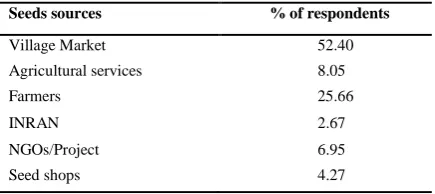
Farmers in all the six villages bought groundnut seeds from different sources (Table 3). The majority of the respondents (52.4 %) purchased their groundnut seeds from the village markets, and 25.66% buying from their neighbors. Only 21.94% of the farmers across the six villages used improved groundnut seeds from the National Institute for Agricultural Research. Other sources were, NGOs/Projects and seed shops.
Table 4: Groundnut seeds sources
Seeds sources % of respondents
Village Market 52.40
Agricultural services 8.05
Farmers 25.66
INRAN 2.67
NGOs/Project 6.95
Seed shops 4.27
3.4. Production constraints in Magaria
205
equipment were ranked 3, 4 and 5P
th
P with 9.30, 5.20 and 1%, respectively.
Table 5: Main production constraints ranked by gender in the 3 villages of Magaria
Constraints Angoual Gamji
N’Cha Roua
Wadata (%) Ranking Drought 23 22.40 17.30 62.70 1
Low soil fertility
8.50 7.20 6.10 21.80 2
Rosette disease
4.10 3.20 2 9.30 3
Weed 1 3 1.20 5.20 4
Lack of field equipment
0 1 0 1 5
3.5. Production constraints in Madarounfa
Five production constraints were listed by the farmers in all the three villages in Madarounfa. Drought was the major constraint followed by low soil fertility. Drought was ranked first by 67.52% of the respondents followed by low soil fertility (21.97%) (Table 6). The reasons for ranking these constraints are the same as described in Section 3.4. Rosette disease, weeds and lack of equipment were mentioned by 6.22%,3.29% and 1% respectively.
Table 6: Main production constraints ranked by gender in the 3 villages of Madarounfa
Constraints Angoual Roumdji
N’Yelwa Yardaji (%) Ranking Drought 20 24.50 23.02 67.52 1
Low soil fertility
8.50 6.40 7.07 21.97 2
Rosette disease
3.22 2 1 6.22 3
Weed 2 1.29 0 3.29 4
Lack of field equipment
1 0 0 1 5
4. Discussion
The varieties 55-437 and RRB were preferred in Magaria while in Madarounfa, JL24 and 55-437 were preferred by the farmers. There is a difference in groundnut varietal preferences across the six villages. None of the respondents in the three villages in Magaria mentioned the JL24, whereas 30% of the respondents in all the villages of Madarounfa mentioned JL24. Among the varieties identified in this study, 55-437 was introduced in 1974 while JL24 and
RRB were introduced in the last two decades by the International Crops Research Institute for the Semi-Arid-Tropics (ICRISAT) and INRAN. Overall, the three varieties 55-437, RRB and JL24 are the most preferred varieties across the six villages according to respondents. These varieties were preferred to local varieties because of their oil content (around 50%), yield potential and haulm production. Although, these varieties are the farmers' preferred varieties; they are still low yielding (≤500kg/ha) and susceptible to drought and rosette disease. From these results; it is also clear that groundnut producers in the main zones faced a challenge in terms of choice of groundnut varieties. There is a crucial need to develop new groundnut varieties or to improve farmers preferred varieties to meet farmer’s expectations.
The main production constraints are similar in all six villages. From the rankings, drought is the major challenging constraint to groundnut production, followed by low soil fertility, rosette disease, then weeds and lack of equipment.
www.ijiset.com
206
fertilizer or manure in order to improve soil fertility, consequently even though improved groundnut seeds will be available, they need also capacity building on how to enhance soil fertility. Soil fertility constraints to crop production are recognized widely as a major obstacle to food security and agro-ecosystem sustainability in sub-Saharan West Africa (Buerkert, 2002). Soil fertility depletion on smallholder farms has been cited as the fundamental biophysical root cause responsible for the declining per capita food production in Africa (Enyong, et al., 1999). Ajayi (2007) reported that low soil fertility is one of the greatest biophysical constraints to agricultural
production in sub-Saharan Africa.
The respondents in this study also mentioned thelack of government support to poor farmers to control pest damage as a major constraint. Most of the respondents cited rosette disease as one of the most damaging diseases. It is transmitted by the vector Aphis crassivora. The farmers faced serious yield losses (25-100%) due to this disease during the last seven years. Initially the farmers ignored the vector of the disease, but currently they understand how the disease is spread from farm to farm and know the best methods to control the disease. ICRISAT estimates that groundnut rosette disease causes greater yield loss than any other virus disease affecting groundnut in the semiarid tropics. Duivenbooden et al., (2002) cited rosette as the most destructive disease in Niger in 1975. During the same period, an epidemic in northern Nigeria destroyed approximately 0.7 million ha of groundnuts, with an estimated loss of $250 million (Naidu et al., 1999). Similarly, the epidemic that occurred in 1995 in eastern Zambia affected approximately 43,000 ha, causing an estimated loss of $4.89 million. In the following year, in the central region of neighboring Malawi, groundnut production was reduced 23% by groundnut rosette disease. Yield losses due to groundnut rosette disease depend on the growth stage of the plant when infection occurs. A 100% loss in pod yield may result if infection occurs before flowering. Yield loss is variable if infection occurs between flowering and the pod maturing stage, whereas subsequent infections cause negligible effects.
Respondents in all the villages cited weeds among the main groundnut production
constraints. Competition from weeds reduces yield and farmers complained about the lack of government support to control weeds. The large distribution of poor sandy soil in all the villages contributes to quick development of weeds that compete with the crop. The lack of equipment has been also cited by Angoual Roumdji farmers as one of the production constraints that reduces production.
Most of respondents mentioned the following local methods to alleviate drought in the six villagers: sowing before the onset of the rainy season, utilization of early maturing genotypes, early sowing just after the first rainfall and ploughing before sowing. Although, utilization of early maturing varieties could be an escape mechanism of drought, particularly the end-of-season drought, these early maturing genotypes are not available to the farmers.
5. Conclusion
Drought was the major constraint contributing to low groundnut production followed by low soil fertility and rosette disease.
The most popular varieties preferred by farmers were 55-347, RRB, and JL24. The information gathered is useful to groundnut breeders to develop good quality groundnut varieties that take into account farmers’ preferences. Improvement of these characters in new varieties with drought tolerance would boost productivity with likely positive impact on small scale farmers’ food security, incomes and livelihoods.
Acknowledgements
Authors acknowledge Alliance for Green Revolution of Africa (AGRA) for funding and West Africa Center for Crop Improvement (WACCI) University of Ghana and National Institute for Agricultural Research of Niger (INRAN) for providing facilities.
References
Ajayi, O. C. User Acceptability of Sustainable Soil Fertility Technologies: Lessons from Farmers 'Knowledge, Attitude & Practice in
Southern Africa, Journal of Sustainable
207
Buerkert, A., Multi-site time-trend analysis of soil fertility management effects on crop production in sub-Saharan West Africa, Experimental1T1TAgriculture,1T1TVol. 38, 2002,163-183.
Chambers, R. Participatory Rural Appraisal (PRA): Analysis of Experience. World Development,Vol. 22, 1994, 1253-1268. Chiteka, Z.A. The present and future status of groundnut breeding and research in Zimbabwe, 1985, pp. 125-133 in Proceedings of the Regional Groundnut Workshop for Southern Africa, 26-29 Mar 1984, Lilongwe, Malawi.
Dulvenbooden, N.V., Abdoussalam, S. & Moamed, A.B. Impact of climate change on agricultural production in the Sahel-Part 2.case study for groundnut and Cowpea in Niger, Climatic Change,Vol. 24, 2002, 349-368. Efisue, A., Tongoona, P., Derera, J., Langyintuo, A., Laing, M. & Ubi, B. Farmers' Perceptions on Rice Varieties in Sikasso Region of Mali and their Implications for Rice Breeding. Journal of Agronomy and Crop Science, Vol. 194, 2008, 393-400.
Enyong, L.A., Debrah, S.K. & Bationo A. Farmers’ perceptions and attitudes towards introduced soil-fertility enhancing technologies in western Africa, Nutrient Cycling in Agroecosystems, Vol. 53, 1999, 177-187.
Joshi, A. & Witcombe, J.R. Farmer Participatory Crop Improvement II. Participatory Varietal Selection, a Case Study in India, Experimental Agriculture, Vol. 32, 1996, 461-477.
Nageswara, R.R.C., Sadar Singh, R.C., Sivakumar, M.V.K., Srivastava, K.L. & Williams, J. H. ‘Effect of Water Deficit at Different Growth Phases of Peanut: I. Yield Responses’. Journal of Agronomy, Vol. 77, 1985, 782-786.
Naidu, R.A., Kimmins F.M., Deom, C.M., Subrahmanyam, P., Chiyembekeza, A.J. & Van der Merwe, P.J.A. Groundnut rosette A virus disease affecting groundnut production in Sub-Saharan Africa. Plant Disease, Vol. 83, 1999, 700-709.
Ndunguru, B.J., Ntare B.R., Williams J.H. & Greenberg D.C. Assessment of groundnut cultivars for end-of-season drought tolerance in a Sahelian environment. Journal of Agricultural Science,Vol. 125, 1995, 79-85. Nkongolo, K.K., Chinthu, K.K., L., Malusi, M. & Vokhiwa, Z. Participatory variety selection
and characterization of Sorghum (Sorghum bicolor (L.) Moench) elite accessions from Malawian gene pool using farmer and breeder knowledge, African Journal of Agricultural Research,Vol. 3, 2008, 273-283.