VOLUME 4
March 1951
Number 2
In this Issue
Editorial-the Journal Moves Ahead ... H.H. Biswell
81
Grazing Preferences of Cattle for Certain Reseeding
Grasses... H.W. Springfield and H.H. Reynolds
83
Treatments to Improve the Emergence and Stand of
Smilo Grass. ... ... Horton M. Laude
88
Grass Yields of Three Differently Treated Range Areas
A.C. Everson
93
Selective Herbicides for Improving California Forest
Ranges
Donald R. Cornelius and Charles A. Graham
95
Recovery and Viability of Macartney Rose Seeds Fed
to Cattle ... ... ... Wayne G. McGully
101
Patrick Beveridge Kennedy-Early Range Manager
Alan A. Beetle
107
A One-Man Portable Livestock Exclosure
John M. Fenley
112
Book Reviews:
Cowboys and Cattle Kings (Sonnichsen)
Alan Rogers
114
Western Stock Ranching (Saunderson)
L.A. Stoddart
114
Current Literature... ... ... Grant A. Harris
116
News and Notes . ... ... ... ... 121
With the Sections... ... ... ... 125
Bylaws (revised) ... ... ... ... 131
Published Quarterly by
JOURNAL OF RANGE MANAGEMENT
TO FOSTER ADVANCEMENT
IN
GRAZING LAND MANAGEMENT
The Journal of Range Management is published bimonthly by the American Society of Range Management at Mount Royal and Guilford Avenues, Balti- more 2, Maryland. Subscription, $5.00 per year; students $3.00. Single copies $1.50. Changes of address and communications on business matters should be addressed to the publishers at Baltimore, Maryland, or preferably to the Treasurer, C. Kenneth Pearse, P. 0. Box 951, Tucson, Arizona.
Address communications on editorial matters to the Editor.
Entered as second-class matter at the Post Office at Baltimore, Maryland. Copyright, 1951, by the American Society of Range Management.
EDITOR: R. S. Campbell, Southern Forest Experiment Station, 1008 Federal Office Building, New Orleans 12, Louisiana
THE EDITORIAL BOARD
1949-1951
B. W. Allred, U. S. Soil Conservation Service, Fort Worth 1, Texas David F. Costello, Rocky Mt. For. & Range Exp. Sta., Fort Collins, Colorado
1950-1952
Kenneth B. Platt, Bureau of Land Management, Portland 18, Oregon
. E. W. Tisdale, University of Idaho, Moscow, Idaho
1951-1953
ADVERTISE
in the
Jozlmal of
RANGE
MANAGEMENT
Rates:
ON REQUEST
FROM EDITOR
The
Ross
seed
Company
Wichita, Kansas
*
Buyers and Sellers
of
Western
RANGE
Grasses
Since 1884
AMERICAN
SOCIETY
OF RANGE
MANAGEMENT
hTame
Application for Membership
Title
Business Address
Home Address ’
indicate to which address Journal should be .mailed
Employer or Business Remarks
Calendar year dues are to apply
Date of Application Annual Dues $5.00, of which $3.50 is for a subscription to the Journal of Range’Management. Students $3.00.
Enclosed ($ ). Make checks payable to American Society of Range
Journal of
RANGE
MANAGEMENT
Editorial
The Journal Moves Ahead
T
HE BOARD of Directors voted last August to get out six issues of the Journal of Range Management each year and to increase the total number of pages per volume, beginning in 1951. This action is worthy of special com- ment.Stepping the number of issues from four up to six per year indicates real progress with the Journal. This action means that the Editor and Board of Directors expect to have enough manu- scripts and other material for this number of issues. This is far different than some members expected when the Society was organized. At first a fern people thought it unwise for the Society to try to publish a journal at all for lack of ma- terial or adequate finances. They sug- gested that the Society get out a mimeo- graphed news statement occasionally and that members continue publishing scien- tific papers in established journals such as those in forestry, animal husbandry, agronomy, plant physiology, and ecology.
But it has turned out that plenty of material has been available-good ma- terial; and even those who were most pessimistic about beginning the Journel are now ent,husiastic about it. The nr- titles have been outstanding and very satisfying. They cover a wide range of subjects and are written in such a may as to be easily understandable. Further- more, a majority of them present useful and worthwhile information. The Journal
continues to improve with each issue and, in the opinion of this writer, it has reached a new height of perfection in the past few numbers. The Journal now compares favorably with the best of those long established in other fields. Congratula- tions to the Editor and to the contribu- tors!
82 EDITORIAL
journals and are located in the field where a library is not readily available should especially welcome the news of more frequent issues. Most members will agree that it is good psychologically to have the Journal and range matters brought to the attention of members more frequently than was possible in four is- sues. It helps to create interest. More frequent publications will result also in the printing of more material, and, in general, more for the member’s money.
Disadvantages of increasing the num- ber of issues appear to be few and minor; they seem to be far outweighed by the advantages. More issues will add to the work of t,he Editor, of course. Also, some members probably will wonder if the Society can afford six issues and if the action will result in an increase in dues at a time when every other living cost is rising. Would an increase in dues pre- vent some potential members from join- ing the Society, and prompt others to drop membership? That is questionable; the dues have not yet increased. It is espected that the extra cost of the two additional issues will be taken care of by more subscriptions and dues from a larger membership.
As the Journal grows in size it becomes increasingly valuable in bringing together under one cover a greater number of articles on the subject of range manage- ment. Including the excellent Current Literature section, the whole field of range publications is contained here under one cover. Formerly the articles were so scattered among other journals and kinds of publications that it was
nearly impossible for many range manag- ers to see even a few of them. Many articles on range subjects will continue to be published in other journals, of course, and should be. Certain ones published in other journals probably will be used more widely, and perhaps to better advantage than they would be if published in the Journal of Range Man- agement. Some articles on the subject of forest grazing, for example, might find their greatest use in the Journal of For- restry; perhaps the same would hold true for a few of the articles that touch on other closely allied fields.
A large Journal is needed to cover adequately all the material that should be printed and made available to Society members. After all the field of range management is large. A look at the mem- bership list indicates as much-in addi- tion to livestock producers and range specialists are agronomists, animal hus- bandmen, conservationists, economists, foresters, wild lifers, and sportsmen. All of our members representing these various interests are concerned, in one way or another, with the wise handling of the native or uncultivated forage crop itself, which is largely the job of range manage- ment.
Grazing Preferences
of Cattle for Certain
Reseeding Grasses
H. W. SPRINGFIELD AND H. G. REYNOLDS
Range Conservationists, Southwestern Forest and Range Experiment Station, Tucson, Arizona’
S
TUDIES in New Mexico in the early fall of 1949 showed that grazing preferences of cattle should be considered when selecting reseeding species for this season of grazing. Cattle preferences for reseeded grasses were found tofluenced by several factors most t,ant of which were succulence of and time of day.
be in- impor-
forage
EXPERIMENTAL AREA
The study site is in the ponderosa pine type at an elevation of 8,300 feet near Vallecitos, New Mexico. Before reseeding it was typical of pine openings which, when deteriorated, support only a sparse stand of native vegetation but have a high forage-producing potential. Principal native plants, occupying most of these deteriorated openings, are Ken- tucky bluegrass (Pea pratensis), winter redtop (Agrostis hiemalis), blue grama
(Bouteloua gradis), rabbitbrush (Chryso-
thamnus spp .), and pingue (Actinea
richardsoni). Soil is a deep loam, well drained, with high water-holding ca- pacity. Average annual rainfall is about 22 inches.
In August 1946 the following species were planted in quarter-acre plots, ran- domized in three blocks: Crested wheat- grass (Agropyron cristatum), bluestem wheatgrass (A. smithi), slender wheat- grass (A. trachycaulum), tall oatgrass
(Arrhenatherum elatius), smooth brome
l Maintained by the Forest Service, U. S.
Department of Agriculture, for Arizona, New Mexico, and West Texas, with headquarters at Tucson.
(Bromus inermis), orchardgrass (Dactylis
glomerata) , big bluegrass (Poa ampla) ,
and Kentucky bluegrass (P. pratensis). No grazing was permitted-until August 1949, by which time good stands had been established in all plots.
EXPERIMENTAL PROCEDURE
Thirty-one grade Herefords including 24 cows, 6 calves, and 1 yearling bull were allowed to graze freely over the reseeded plots from August 21 to Sep- tember 12, 1949. Cattle grazed only the seeded plots since the plantings were in- cluded within a 12-acre fenced enclosure.
All species of plants were mature and seeds had been cast by the time grazing began. Total herbage production of each species before grazing was measured by the double sampling method (Wilm, 1944) on belt transects located randomly over the plots. Herbage was clipped at ground level. Utilization was determined by resampling the same plots on August 28, September 2, and September 12.
Cattle movements were observed hourly between 6 a.m. and 7 p.m. throughout the grazing period. Records were
tion each
kept which made possible calcula- of daily cow-hours of grazing for species.
FLuLTS
Relative preferences
Cattle chose a wide selection of plant species before forage scarcity influenced grazing habits. Of the eight species, all but one were grazed during the first week
and no one spwies mndc up more than 26 pucmt, of t,hr diet. Yet cattle clear:y prefer& certain species as indicated hy differences in percentage of diet, rontrib- uted hy each. Orrhardgrass and smoot,h hrome togrther made up half of the Ma1 diet, rontrihuting 26 and 2-L percent,, rcsp&ivrly (Fig. I), Slender wheatgrass also was grazed hazily the first, week, comprising 21 percent of t,he diet,. Crestrd Irhezatgrass, Kent,wky bluegrass, and tall oatgrass, each made up about 9 percrnt of thr diet, and thus formed an intermediat.e preference group. Blurstrm wheat,grass and hig blue grass WCI‘P least preferred of t,he eight grasses. They were not, grazed until almost all other forage was gone, and during the first wek made up togrthcr on’y 3 pnwnt of the dipt.
only 1 percent and hig bhwgrass 43 per- cent of thP diet during the last week of grazing. This shift in diet took place only after t,he most prdrrred species had been grazed so closely t,hat it was difficult for the cattlc to obtain suffieicnt forage from them for sustenance.
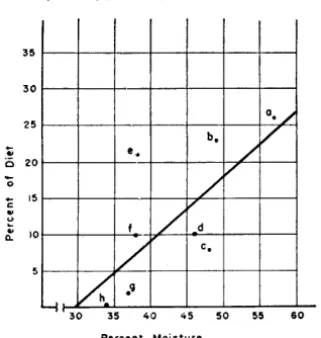
moisture rontent, appeared to strongly influence preference during this late sum- mer and early fall grazing period. Those species with highest moisture content were most, highly preferred (Fig. 2). Other workers, under different seasons of use, and other range conditions, have ob- served a similar preference for succulent forage. On semidesert grassland ranges
-1s the highly prdcrred species became scarce vattle consumed a greater propor- tion of t,he others. During the later peri- ods of grazing less preferred spe:ries made up a progressively larger part of the diet. For example, in contrast to the first grazing period, orrhardgrass made up
GRAZING PREFERENCES OF CATTLE 85
new growth and will remain in local areas, such as washes, where growth remains green longer at the end of the growing season (Culley, 1937).
25
Percent Moisture
FIG. 2. Relation between percent in diet and moisture content of eight reseeded species. a, orchardgrass; b, smooth brome; c, tall oatgrass; d, Kentucky bluegrass; e, slender wheatgrass; f, crested wheatgrass; g, bluestem wheatgrass; h, big bluegrass. Line fitted by least squares (r = 0.69).
In this particular study those species which were preferred apparently had the ability to maintain succulence for a longer period or to respond to soil mois- ture late in the growing season.
Cattle altered their grazing habits with changes in the weather. They grazed less discriminately when mature grasses were wet from rain or heavy dews. Ani- mals also grazed for longer periods during cloudy weather.
Forage preferences varied with time of day (Fig. 3). Cattle consumed the greatest variety and abundance of species during the morning and evening and when mov- ing to water at noon. At other times, the few animals which grazed were highly selective in their habits.
Cattle followed a fairly definite daily grazing routine. They usually began graz- ing about daylight (5:30 a.m.), then moved to water about 8:00 a.m., and
afterwards rested in the shade. Shortly before noon cattle moved to water, drank, grazed a short time, and returned to rest in the shade. Most animals passed the afternoon by resting, although a few ani- mals grazed for short periods. At about 5 :00 p.m. animals grazed to water as a group and after drinking continued to graze until late evening.
.
6 7 6 9 10 II 12 I 2 3 4 5 6 7
AM PM
lime of Day
FIG. 3. Effect of time of day on cattle pre- ference for eight reseeded grasses based upon hourly observations and expressed as percent of t,otal cow-hours available for grazing.
86 H. W. SPRINGFIELD AND H. G. REYNOLDS Cattle grazed slender wheatgrass about
the same throughout the day. Kentucky bluegrass and crested wheatgrass were taken in greatest amounts during the early morning. Other species were grazed rather indiscriminately.
Cattle preferred individual plants of a species. Although no regrowth of grazed plants occurred, animals tended to return to the same plants leaving other plants of the same species untouched until al- most all other forage was gone. For ex- ample, when crested wheat,grass was 50
percent utilized, 40 percent of the in- dividual plants remained ungrazed, and about 30 percent of the plants were grazed to 2 inches stubble height or less. Even when total utilization of crested wheatgrass reached 70 percent, one-fifth of the individual plants were still un- grazed.
This observation conforms to the more general conclusion that cattle grazing native mixed grama ranges show pref- erence for individual plaqts of a given species. Grazing seldom is to a constant stubble height; some plants of a species may be grazed to near ground level, while others remain untouched (Can- field, 1942).
APPLICATION OF RESULTS Moisture content of forage appears to be an index as to how readily cattle graze reseeding species during the early fall in northern IVew Mexico. Perhaps a similar relation exists for other range types and regions. If so, determinations of moisture content of herbage samples taken during different seasons might be employed as an indicator as to what time of year a particular reseeded species is most valuable for grazing. This study suggests that species which maintain succulence over long periods of time, or show the ability to respond to intermit-
tent rainfall, may provide preferred for- age.
When given free choice, cattle select a wide variety of forage. Selection of forage varies with time of day, changing weather conditions, associated species, and other factors. These observations suggest a justification for mixture plantings in range reseeding. Mixtures, however, re- quire both careful design and manage- ment. Highly preferred species cannot be planted with relatively unpalatable spe- cies. Unless plants of a similar preference class are used together, destructive graz- ing and eventual elimination of the most highly preferred species may result under full use of all species. Cattle shift their diet to less preferred species only when the highly preferred species have been closely grazed; even then they will con- tinue to graze any accessible forage of the preferred species.
It is commonly recognized that utiliza- tion of a range varies with distance from water, steepness of slope and other fac- tors (Glendening, 1944). Some workers have suggested that highly preferred species can be reseeded on parts of the range area where natural barriers tend normally to reduce utilization; whereas least preferred species can be planted on the more accessible sites (Hurd and Pearse, 1944). On cattle ranges in the pine type in northern New Mexico, such species as orchardgrass and smooth brome might better be planted in the less acces- sible sites, while, of the species tested, big bluegrass would be best for planting around concentration areas.
IJTERATURE CITED
CANFIELD, R. H. 1942. The relative grazing preference of cattle for the common semi- desert grasses in southern Arizona. South- western For. and Rge. Espt. Sta. kes. Note 102, 3 pp. (proc.)
GRAZING PREFERENCES OF CATTLE 87
cattle. Southwestern For. and Rge. Expt . Sta. Res. Note 21, 4 pp. (proc.)
GLENDENING, G. E. 1944. Some factors af- fecting cattle use of northern Arizona pine- bunchgrass ranges. Southwestern For. and Rge. Expt. Sta. Res. Rept. No. 6, 9 pp.
(proc .)
HURD, R. M. AND C. K. PEARSE. 1944. Rela-
tive palatability of eight grasses used in
range reseeding. Jour. Amer. Sot. Agron. 36 : 162-165.
STANLEY, E. B. AND C. W. HODGSON. 1938. Seasonal changes in the chemical composi-
tion of some Arizona range grasses. Ariz. Agr. Expt. Sta. Bul. 73: 451-466.
WILM, H. G. ET AL. 1944. Estimating forage yield by the double-sampling method. Jour. Amer. Sot. Agron. 36 : 194-203.
THE RANGE IN 1886
In estimating the carrying capacity of the range, it is generally calculated that 40 acres should be allowed to a steer. . . . But whether 40 acres are required or less than 40 acres, one thing is quite certain, that it takes a great deal more than any one who has never been upon the range would suppose. The native grasses are not strong and luxuriant growers, and even if moisture and all the conditions of soil and surface were favorable would not produce heavily. And as their period of growth is confined mainly to the spring and early summer, when they are stimulated by an occasional rain they produce very little in point of weight and bulk, and their admirable quality is not sufficient to com- pensate for their lack of quantity.
George W. Rust
Treatments
to Improve the Emergence
and
Stand of Smilo Grass
4
HORTON M. LAUDE
Assistant Projessor of Agronomy, Division of Agronomy, University of California, Davis, California
0
R YZOPSIS miliacea (L.) Benth. and Hook., commonly called smile, was introduced into California over sev- enty years ago. This long-lived perennialbunch grass has gained the reputation of being drought resistant, palatable, and of growing particularly well on fresh ash following the removal of brush by burn- ing. However, difficulty in establishing stands on unburned sites and on culti- vated land has been encountered repeat- edly (Kennedy, 1918; Love, 1947). The seedling growth of smilo is exceedingly slow and in its early stages of development the plant is a poor competitor.
Kennedy (1918) and Love (1947) have discussed the origin, value, and place of smilo in range seedings. Little study, however, has been directed toward over- coming the difficulties in obtaining satis- factory stands. Treatment of the seed with sulfuric acid has been employed to improve germination (Trumble, 1937). Several workers (Huntamer, 1934; Stod- dart and Wilkinson, 1938; and Toole, 1940) have st,udied germination in the related species, Indian ricegrass (Ory-
zopsis hymenodes), and have reported
that seed treatment with sulfuric acid is beneficial. Recently it has been found that germination and emergence of celery seed has been hastened following treatment with sodium hypochlorite solutions (Tay- lor, 1949) and this chemical has been used to break dormancy and to improve the germination of guayule (Benedict and Robinson, 1946). It appeared desirable to determine whether certain range plants would benefit through seed treatment
with this chemical. The present investiga- tion was undertaken to determine the effect of sulfuric acid and of sodium hypochlorite treatments of smilo seed on the emergence and stand of this species.
MATERIALS AND METHODS
Two sources of seed were used, Cali- fornia certified smilo and a strain obtained from the Soil Conservation Service bear- ing the accession number P-726-CF-N-2. Both responded in like manner to treat- ment. Greenhouse seedings of replicated loo-seed samples were made in unsteri- lized soil at + inch depth and were watered as necessary to maintain available soil moisture. Field plantings were at i inch depth in replicated rod rows.
The two sulfuric acid (H2S04) treat- ments used were concentrated acid and approximately 71 percent sulfuric acid prepared by diluting 3 parts of concen- t’rated acid with 1 part of distilled water by volume. Two sodium hypochlorite (NaClO) solutions were employed. A standard reagent solution of approxi- mately 2.5 percent available chlorine was used, as was full strength household Cloroxl in which the active ingredient is stated to be sodium hypochlorite. No effort was made’ to determine the avail- able chlorine strength of the Clorox, but freshly opened bottles were used in each test. This was done so that the solution of this material employed would be as \
1 Although Clorox was chosen for use in these eweriments, no endorsement of this prod- uct is intended nor is criticism implied of simi- lar products which are not mentioned.
.
TREATMENTS OF SMILO GRASS 89
similar as possible to that available to the rancher who might treat seed. In the field test 30 percent hydrogen peroxide (H202) was selected for one treatment. Each solution was used only once on seed and then was discarded.
Regardless of the treating chemical employed, the method was the same. Dry seed was immersed in the treating solu- tion and stirred to insure complete wet- ting. About 4 cc. of solution was used for each 100 seeds. In larger seed lots, suf- ficient solution to cover the seed as it was stirred was employed. After the specified treatment time (duration of immersion) the seed was thoroughly washed in tap water for no less than 20 minutes, and dried before planting. In certain of the hypochlorite treatments, this rinsing was omitted.
Counts of emerged seedlings were made at periodic intervals. Since only living seedlings were counted, the figures denote emergence and survival.
RESULTS AND DISCUSSION The growth of greenhouse plantings of untreated smilo was observed to deter- mine t]he nature of emergence and seedling development of this species under favor- able conditions of moisture and tempera- ture. Emergence commenced six to ten days after planting, and continued ac- tively during the following 30 days. Three weeks after planting the most advanced seedlings had only one leaf and were from 0.5 to 1.5 inches tall. After ten weeks the majority of seedlings had reached the three- to four-leaf stage and a height of 4 to G inches. This slow emergence and seedling development tends to favor sev- eral conditions contributing to stand failure in range seedings. Among these are crusting of the soil surface before emergence, failure to emerge quickly after short periods of precipitation, and weed competition.
Concentrated sulfuric acid treatments of 1, 3, 5, 7 and 12 minutes were studied in the greenhouse. Emergence was has- tened and stand increased by the l- and 3-minute treatments. Twelve days after planting 80 percent of the seed treated 3 minutes had emerged compared to 18 per cent for the control. The longer treat- ments injured the seed and resulted in reduced emergence. r\;o seed survived the 12-minute soaking. It was difficult to handle the small seed properly during these short intervals in concentrat’ed acid. The use of diluted acid for longer periods of time appeared more promising.
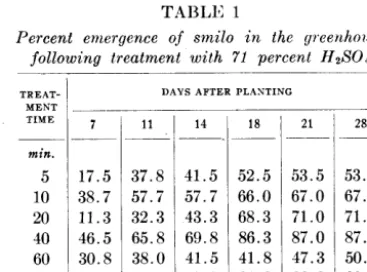
Greenhouse plantings were made fol- lowing seed treatments with 71 percent H2S04 for 5, 10, 20, 40, and 60 minutes. All treated samples commenced emer- gence on the fifth day while control seedlings started to appear two days later. Table 1 presents the emergence and survival percentages during the first 28 days. Greater numbers and faster emer- gence were obtained in the treated lots compared to the control. It was concluded from this and repeated experiments that 20- to 40-minute treatments with 71 per- cent H&O4 were most beneficial.
T,413Ll< 1
Percent emergence of smile in the greenhouse following treatment with 71 percent HG304
TREAT- DAYS AFTER PLANTING MENT __
TIME 7 11 14 18 21 28
~.
min.
5 17.5 37.8 41.5 52.5 53.5 53.3 10 38.7 57.7 57.7 66.0 67.0 67.3 20 11.3 32.3 43.3 68.3 71.0 71.5 40 46.5 65.8 69.8 86.3 87.0 87.8 60 30.8 38.0 41.5 41.8 47.3 50.0
h-one 1.0 11.5 / 15.5 26.8 28.3 j 29.5 \
_
.
90 HORTON M. LAUDE
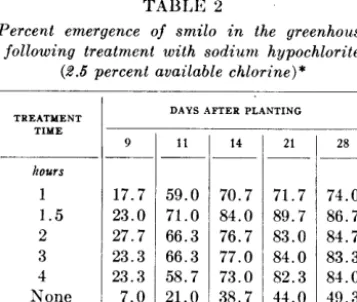
of one hour. An experiment comprised of treatments up to four hours in duration was carried out in the greenhouse. In- creased and more rapid emergence was recorded for all of the hypochlorite treat- ments as shown by Table 2. The high emergence obtained following four hours of treatment indicated that the point of over treatment had not been reached. When longer periods were used in other tests it beca.me apparent that treatment for more than 12 hours was necessary to reduce emergence noticeably. Best results were obtained following treatments of
1.5 to 6 hours. The wide range in bene- ficial treatment times was considered an advantage of this sodium hypochlorite over the acid solutions, particularly should seed treatment be carried out on the ranch.
TABLE 2
Percent emergence of smile in the greenhouse following treatment with sodium hypochlorite
(2.5 percent available chlorine)*
TREATMENT TIME
hours
1 1.5 2 3 4 lYone
DAYS AFTER PLANTING
9 11
~ 1 14
17.7 59.0 70.7 71.7 74.0
23.0 71.0 84.0 89.7 86.7 27.7 66.3 76.7 83.0 84.7 23.3 66.3 77.0 84.0 83.3 23.3 58.7 73.0 82.3 84.0 7.0 21.0 38.7 44.0 49.3
-
21 28
* The high level of emergence throughout this trial suggested favorable response to the lower greenhouse temperatures that prevailed.
The use of household Clorox as a so- dium hypochlorite solution for seed treat- ment was investigated. Seed treated with Clorox for periods ranging from 5 mintites to 10 hours was planted in the greenhouse. Greatest increase in speed of emergence and in numbers of seedlings emerged was obtained with treatments of 0.5, 1, 2, and 3 hours. Emergence 7 days after planting
for these treatments averaged 30 percent as compared to 1.8 percent for the un- treated. The average emergence for these treatments after 28 days was over 60 percent as compared to 30.5 percent for the control. Shorter or longer treat- ments gave decidedly reduced emergence, and those over 6 hours in duration re- sulted in injury.
Figure 1 illustrates graphically seedling emergence in the greenhouse from plant- ings of untreated seed compared with plantings treated with sulfuric acid or Clorox. As indicated, the more successful acid treatments generally yielded a some- what greater emergence than did the Clorox. However, both consistently re- sulted in earlier emergence and greater numbers of seedlings than did untreated controls. These features were desired in the treatments to improve stand estab- lishment.
The effect of omitting the rinsing in tap water following the hypochlorite and Clorox treatments was noted. Emergence was compared for washed and unwashed samples planted in the greenhouse. A reduction in emergence varying from 1 percent to 10 percent was obtained when the washing was omitted. This appeared to be of sufficient magnitude to justify the retention of rinsing as a part of the treatment.
A series of the more successful treat- ments of shorter duration as determined by greenhouse testing was selected for field trial. Previous experience had in- dicated that these shorter treatments we’re superior to the longer in field plant- ings.
Rod rows in replicated blocks were .
TREATMENTS OF SMILO GRASS 91
01 I I
I
I
II
0 2 6 /O /4 /8 22 26 JO
FIG. 1. Emergence of smilo in the greenhouse when untreated, treated with clorox for 30 minutes and treated with 71 percent H&S04 for 30 minutes.
TABLE 3
Percent emergence and survival of smile in the Jield
TREATMENT
7170 HzS04, 20 min.
Cont. H&O.,, 1 min. . . . Clorox, 60 min. . Clorox, 60 min.*. . NaCIO, 90 min.. NaClO, 180 min.. Hz02, 90 min.. . . None. . .
DAYS AFTER PLASTISG
14
13.8
4.8 9.3 7.3 5.8 3.2 0.2 0.0
I
-
17
34.9 42.0
17.4 22.6 24.8 30.7 20.9 26.7 14.4 18.9 20.8 27.8 1.3 3.5 1.9 3.5 / 21
L.s.d. (5% level). 8.8
* Not washed following treatment.
28
40.8
24.3 31.8 28.9 21.5 29.4 4.1 3.8
casions between the third and twenty- fourth day following planting. Emergence and survival percentages are presented in Table 3.
All treatments except the hydrogen peroxide resulted in much faster emer- gence and in greater numbers of seedlings than did the control. An analysis of the counts taken 28 days after planting showed these increases to be statistically significant. The 71 percent H&SO, was significantly higher than the concentrated acid and barely significant compared to the 60-minute washed Clorox which was next highest. The best Clorox and NaClO treatments did not differ significantly. From this and other trials the two most satisfactory field treatments appeared to be 71 percent HzS04 for 20 minutes or Clorox for 60 minutes followed by thor- ough rinsing of the seed in tap water. The greater ease of j handling Clorox
92 HORTON
It should be pointed out that the seed
treatments discussed in this paper are not means of eliminat,ing stand failure.
Obviously they deal with only a few of the many factors contributing to stand failure following seeding. However, the results do appear to justify the use of these chemical seed treatments in range seedings when more rapid and uniform emergence of smile is desired on unburned and on cultivated sites. Such treat,ments would seem of particular value also in plantings for seed production. There is in addition the possibility that treatments with sodium hypochlorite solutions may be beneficial in the case of certain other range species exhibiting slow seedling emergence, although careful investiga- tion will be needed to determine this.
SUMMARY
Methods of improving stand establish- ment of smilo, Or~xopsis mdiacea (L.)
Renth. and Hook., were investigated in the greenhouse and field. Treatment of the seed prior to planting with concen- t,rated HzSO+ 71 percent H2S04, sodium hypochlorite, or Clorox was studied. l’hese treatments are described and their effect in hastening emergence and in increasing the number of seedlings emerged is reported. Greater ease of han- dling is suggested as an advantage of the sodium hypochlorite solutions as com- pared to the acid.
Best results were obtained in the field using treatments of 71 percent HZSOJ for 20 minutes or Clorox for 60 minutes.
M. LAUDE
In a field tr:al four weeks after plantieg, 3.8 percent of the untreated seed had emerged while emergence had reached 40.8 percent following this acid treatment and 3 1.8 percent following the Clorox.
It is evident that these treatments will not eliminate stand failures with smilo since they deal ,with only a few of the many factors contributing to stand fail- ure. They do provide, however, a means of obtaining more rapid and greater emergence.
LITEItATUItE CITED
BENEDICT, H. M. ANI) JEANETTE RORINSON. 1946. Studies on the germination of Guayule seed. U. S. Dept. Agr. Tech. Bull. 921) 48 pp.
HFNTAMER, MAY Z. 1934. Dormancy and de- layed germination of Oryxopsis hynxmoides.
(Unpublished thesis.) Washington State College, Pullman, Washington.
KENNEDY, P. B. 1918. Smilo grass for ranges and non-irrigated land. Itural World Service Bull. No. 4, 4 pp.
LOVE, R. M. 1947. Smilo grass. California Certified Seed News. Calif. Crop Tmprove- ment Ass’n., Davis, Calif., No. 4, 2 pp. STOI~DART, 1,. A., AND K. J. WILKINSON. 1938
Inducing germination in Oryzopsis hymen- oides for range reseeding. Jour. Amer. Sot. Agron. 30: 763-768.
TAYLOR, C. A. 1949. Some factors affecting germination of celery seed:Plant Physiol. 24: 93-102.
TOOLE, V. K. 1940. The germination of seed of Oryxopsis hymenoides. Jour. Amer. Sot. Agron. 32: 33-41.
Grass Yields of Three Differently Treated
Range Areas
A. C. EVERSON
Research Assistant, Department of Botany and Range Ecology, University of Arizona, Tucson, Arizona
T
HE cumulative effects of drought, shrub invasion, and overgrazing have resulted in deterioration of the range resources. It has been estimated that depletion of the forage cover has neces- sitated a reduction in livestock numbers in the Southwest to half that of former years (Luker, 1947).Questions are frequently raised as to the feasibility of clearing, reseeding, or pro- tecting rangelands from grazing until the seeded species are established or the native grasses are reestablished. One phase of a cooperative range rehabilita- tion study by the Southwestern Forest and Range Experiment Station, the Kurs- ery Division of the Soil Conservation Service, and the Department of Botany and Bange Ecology at the University of Arizona was to determine the yield of grass on a southwestern range that was (1) cleared, reseeded and protected, (2) cleared and protected but not reseeded, and (3) untreated and open to graz- ing.
STUDY AREA
The study area was on the Santa Rita Experimental Range 35 miles south of Tucson at an elevation of about 3700 feet. The site was representative of ex- tensive areas of deteriorated semi-desert grassland range of the Southwest. There was a mcderate amount of mesquite
(Prosopis velutina), cholla (Opuntia ful- gida), prickly pear (Opuntia engelmannii),
burroweed (Haplopappus tenuisectus),
scattered remnant perennial grasses,
and annual six-weeks grasses (Bouteloua aristidoides and Aristida adscensionis).
The soil is a Comoro coarse sandy loam derived from granite and associated igne- ous rocks. The upper horizon is l$ to 2+
feet deep, fertility is relatively high, and the topsoil is readily susceptible to ac- celerated erosion when the vegetative cover is removed (Canfield, 1948). The soil reaction is neutral in the surface six inches and becomes slightly alkaline at lower depths.
Mean annual precipitation since the study was initiated in 1946 has been 13.7 inches. Summer precipitation--July, Au- gust and September-was 11.33, 4.78,
6.18, and 8.30 inches for the years 1946 through 1949. Summer temperatures var- ied from an average minimum of G5”F. to an average maximum of 97°F. The average minimum and maximum winter temperatures ranged from 42°F. to Sl”F., respectively .
METHOD
The study was made on three plots each 100 feet wide and 420 feet long. In the spring of 1946 two of the plots were fenced and the brush species eradicated. The mesquite trees were cut and removed and the stumps treated with diesel oil. Cholla cactus and prickly pear were grubbed and removed. Burroweed was mowed with a tractor mower.
On July 3, 1946, three grass species were seeded in one of the cleared plots. Lehmann lovegrass (Eragrostis lehmanni- ana) was seeded with a double-bank
94 A. C. EVERSON
cult)ipacker seeder. Following the culti- packer treatment one-half the plot was broadcast seeded with slender grama
(Routeloua jiliformis); the other half was broadcast seeded with Arizona cotton- grass (Trichachne
caZifornica) .
The secondplot was not seeded and did not receive any treatment other than protection after the brush was removed. The third plot which was twenty feet distant from the seeded plot was untreated and open to grazing.
In September, 1949, the plots were sampled to determine the yield of grass under each of the three treatments. Cir- cular sample plots 9.6 square feet in size were used in order that the gram weight per plot could readily be converted to pounds per acre (Frischknecht and Plum- mer, 1949). The sample plots were ran- domly located. All of the grass species were clipped at a uniform stubble height of one and one-half inches. In the three instances where the sample plot in the non-protected area had been grazed an- other random plot was located and clipped. The total air-dry weight of grass produced on each area was determined.
RESULTS
This study indicates that brush control, reseeding and protection, or brush con- trol and protection will increase the grass yield of deteriorated rangelands (Table 1). The area that was cleared, seeded and protected four years produced eight times more grass by weight than untreated range. Eradicating the invading brush species and protecting the range from grazing greatly facilitate range recov-
ery-more than three times as much grass was produced on the area so treated than was produced on the open range.
TAHLIS 1
Air-drg gicld of grass in pounds per acre
Perennial grass Annual grass
Total. . 878.5
AREA
Cleared, seeded, and pro-
tected __-
Cleared and pro- Open
tected range
-I-
876.7 269.2 48.6 1.8 102.0 63.0
--- I----
371.2 / 111.6
The results obtained from the treat- ments discussed in this paper depend upon the degree of brush infestation, the quality and quantity of perennial grass remnants, the extent of soil depletion, location of the range site, and prevailing weather conditions. The conditions under which this study was conducted are believed to be representative of the southwestern desert grassland. Brush control, reseeding and protection appear to have practical application in improving the condition of the brush-infested and deteriorated rangelands of the Southwest.
LITERATURE CITED
CANFIELD, R.H. 1948. Perennial grass com-
petition as an indicator of condition of southwest,ern mixed grass ranges. Ecol. 29 :
190-204.
FRISCHKNECHT,NEILC.,AND PERRYPLUMMER.
1949. A simplified technique for deter- mining herbage production on range and pasture land. Jour. Agron. 41: 63-65.
LUKER, CYRIL. 1947. Soil conservation and
Selective Herbicides for Improving California
Forest Ranges
DONALD R. CORNELIUS AND CHARLES A. GRAHAM
Range Conservationists, California Forest and Range Experiment Station, Berkeley, California’
T
HIS paper reports some preliminary tests with selective herbicides for con- trol of weeds and brush on forest ranges in northeastern California. The results are encouraging. Herbicides were sprayed on depleted range areas dominated by big sagebrush (Artemisia tridentata), black sagebrush (A. arbuscula), silver sage- brush (A. cana), green manzanita (Arc- tostaphylos patula), and buttercup (Ra- nunculus alismaefolius and R. occiden- talks). Control of undesirable plants was most successful on areas with big sage- brush and buttercup, where the spraying accelerated growth of bunchgrasses by two to four times. Spraying also showed promise as a relatively inexpensive method of site preparation in advance of seeding.KIND OF RANGE LAND TREATED The areas selected for experimental spraying were representative of the meadow and sagebrush grazing types, and of maneanita brushfields that have replaced or occur in the open timber type in some localities; all were in the pine forest zone at an elevation of about 5600 feet, on the Lassen National Forest.
Meadow.-Semi-wet meadows on the floors of mountain valleys are key grazing areas because they have relatively level topography, desirable plants for grazing, and watering places for livestock. *Most
l Maintained by the Forest Service, U. S. Dept. of Agriculture, at Berkeley, in coopera- tion with the University of California. The Sherwin-Williams Company furnished the chemicals used.
meadows have drainage channels, but as the gradient is usually slight, the soil remains moist until mid-summer or longer. Many meadows, however, have deteriorated. Native grasses of high for- age value have decreased and unpalatable species increased ; buttercup and other
weeds now dominate the cover. If a suitable plant cover could be established, forage production from these meadows could be materially increased.
Sagebrush.-Silver sagebrush dominates some of the land next to the meadows. These areas may be under water from 3 to 10 weeks after snow melts because sur- face drainage is slight and the soil has such heavy texture that seepage is very slow. By mid-summer the areas become dry and the soil cracks. Little soil mois- ture is available for plant growth in late summer, and a droughty condition pre- vails in autumn.
Big sagebrush thrives on the well- drained slopes where the soil is deep and porous, and black sagebrush grows on the slopes or flats below the big sagebrush where the soil is heavier and has less depth.
The three species vary in growth habit and resistance to control. Big sagebrush on the study areas was from 2 feet to 3.5 feet high, being at least twice the height of silver sagebrush. Big sagebrush plants usually have single stems that are brittle and non-sprouting. Silver sagebrush plants have several small, willowy stems which sprout freely following damage to the top. Black sagebrush is smaller than big sagebrush but similar in growth form
96 DONALD R. CORNELIUS AND CHARLES ,4. GRAHAM
and in control by herbicides, therefore results are discussed only for big sage- brush and silver sagebrush.
Manxanita brush.-Green manzanita is found in the ponderosa and Jeffrey pine forest on slopes above the meadows. This shrub often dominates local areas of these sites to the exclusion of both timber reproduction and livestock forage. On the experimental areas manzanita had a crown density of 48 percent. IMPROVEMENT OF MOUNTAIN ME‘SDOWS
BY SPRAYING
Procedure.-The semi-wet meadow se- lected for the test was fenced 13 years ago, and has been grazed only lightly and int,ermittently since then. Some recovery could be noticed inside the protected area, which had a thicker sod and more vigorous plants than the surrounding area, but weedy species such as buttercup were still dominant. On June 26, 1948, when buttercup was in full flower, two plots were sprayed at the rate of 3.3 pounds of t!he butyl ester of 2,4-D in 1O’gallons of diesel oil per acre. The area was sprayed by use of a lo-foot boom and sprayer mounted on a pickup truck bed. This combination could easily be used on large- scale operations. Actual kill of the plants was determined in the summer of 1949.
Change in vegetative composition.-
Spraying greatly diminished the amount of buttercup and aster (Aster foliaceous).
Other weedy herbaceous species occurring in the meadow included knotweed (Poly-
gonum bistortoides), camassia (Camassia quamash), and cinquefoil (Potentilla graci- Zis). Results for these three species were inconclusive. The undesirable grasslike plants, coarse rush (Juncus balticus)
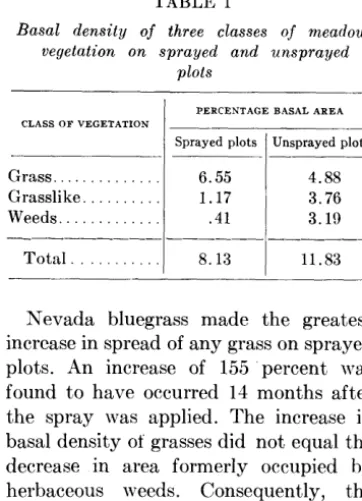
and sedge (Carex douglasii), decreased in amount on the sprayed plots (Table 1). Grasses increased in density as the competing weedy herbaceous plants died out. Nevada bluegrass (Poa nevadensis) ,
spike redtop (Agrostis exserata), mat muhly (Muhlenbergia squarrosa) .r and
California oatgrass (Danthonia califor- nica), were the most numerous grasses of the meadow. Tufted hairgrass (Deschamp- sia caespitosa), and nodding barley (Hor- deum nodosum) were present in lesser amount but were conspicuous because of their size.
TABLE 1
Basal density of three classes of meadow vegetation on sprayed and unsprayed
plots
CLASS OF VEGETATION
PERCENTAGE BASAL AREA
Sprayed plots Unsprayed plots
Grass. . . . . 6.55 4.88
Grasslike. . . . . 1.17 3.76 Weeds. . . . . . . .41 3.19 ---_--_- _--- --__---
Total 8.13 11.83
Nevada bluegrass made the greatest increase in spread of any grass on sprayed plots. An increase of 155 percent was found to have occurred 14 months after the spray was applied. The increase in basal density of grasses did not equal the decrease in area formerly occupied by herbaceous weeds. Consequently, the basal area for all vegetation was less on sprayed than on unsprayed plots.
InJEuence on seed and forage production.
-The desirable native grasses produced seed much more abundantly on the sprayed than on unsprayed plots. Seven- teen seed stalks of the principal grasses developed per square foot of sprayed meadow. Unsprayed plots averaged only 0.5 seed stalk per square foot. The height of seed stalks averaged 13 inches on sprayed and 9 inches on unsprayed plots. Upon control of the competition from undesirable weeds, the Nevada bluegrass ,
SELECTIVE HERBICIDES FOR CALIFORNIA RANGES 97
the same grasses gave on the unsprayed plot (Table 2). Total production was not significantly different for sprayed versus unsprayed plots when weedy species were included.
TABLE 2
J’ield in 1949 on spralyed and unspra~~cd meadow plots
SPECIES GROUP SPRAYED
-I-
lbs. per
acre
Crass... 1028 Herhaceous weeds. 8
Grasslike (rushes-sedges) 8 Total . . 1045
I -i
____ UN- SPRAYED
Ibs. per
acre 242 488 350 ---- 1080
IMPROVEMENT OF SAGEBRUSH RANGE BY SPRAYING
Procedure.-Sagebrush had been shown to be susceptible to the sodium salt of
2,4-D in 1946 and 1947. From 5 to 16
pounds of acid equivalent of 2,4-D in 1600 gallons of water per acre were used in these early tests. In 1948 an attempt was made to develop a procedure that would be practical for range improvement uses. Different amounts of the butyl ester of 2,4-D were applied with 20 gal- lons of water per acre as a carrier. Spray- ing was done with the truck-mounted boom and sprayer.
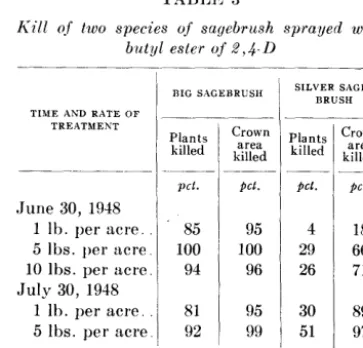
Szcsceptibil&!y of sagebrush.--Big sage- brush proved highly susceptible or hyper- sensitive to 2,4-D (Table 3). A satisfac- tory kill of big sagebrush was attained by applying 1 pound of the butyl ester per acre in late June. Higher rates per acre gave a slightly higher percentage kill but not enough higher to warrant $he greater expense. Increasing the rate of application above 5 pounds per acre did not significantly increase or decrease the percentage kill of either species of sage- brush.
Vntreated big sagebrush grew actively from May 1 to August 1 in 1948. When the spray was applied (June 30), 7 inches
TABLE 3
h-ill of two species oj sayebrush sprayed with, butgl ester of 2,4-D
TIME APr’D RATE OF TREATMENT
*June 30, 1948 1 lh. per acre..
5 lbs. per acre 10 lbs. per acre. July 30, 1948
1 lb. per acre. 5 lhs. per acre
BIG S.kCEBRUSH SILVER SAGE- BRUSH Plants killed .___ pet. Crown area killed Plants killed Crown area killed
pet. pet. pet.
85 95 4 18 100 100 29 66 94 96 26 71 81 95 30 89 92 99 51 97
of new twig growth had been produced, approximately half of the vegetative growth for the year. All twig growth on unsprayed big sagebrush ceased after August 15, having attained a maximum length of 12 inches. The peak of flowering for big sagebrush occurred about Sep- tember 15. Black sagebrush had approxi- mately the same period of active growth but the peak of flowering came one month earlier. From the results shown in Table 3 and from observation of adjacent plots sprayed at monthly intervals during the summer of 1949, we conclude that the best time to spray is during the period of most active growth. This period was be- tween May 15 and June 30 in 1948. If allowance is made for the lateness of plant development in 1948, the average period of most active growth may be expected between May 1 and June 10.
vegetat,ive groMh from June 1 t,o Sep- tember 1 in 1948, and the peak of flower- ing came September 10. The period of most act,ive growth for silver sngehruslr comes approximately one month later then for big sagebrush. The influence of this lntcr period of artive growth upon susceptibility of the plant to 2,4-D is shown in Table 3; July 30 appliration gave higher percentage kill than the dune 30 applicilt,ion.
Growth oj hmchyrass.-In the depleted condition of the sagebrush range, grass plants produced very litt,ln forage. l:pon control of the undesirable competit,ion from big sagrhrush, the hunchgrnss
responded remarkably wll (Fig. 1).
sprayed plots averaged 2.5 times the yield that the mm grasses produced from unsprayed plots (Table 4).
TAALX 4
UNTREATED
On t,he big sagebrush area the three principal native grasses were Idaho fescue (F&m idahoensis), nwtern stipa (Stipa
occident&s), and sitanion (Sitanion h,ys- triz). These grasses averaged 9.6 seed stalks per plant on sprayed and 2.7 on unsprayed plots. Height of seed stalks averaged 16.3 and 12.6 inches, respee- tively. The production of forage from
Cheatgrass (Hromus tcctorum) xvas not nhrmdant on the ranges used in this study. Consequently, the results do not show how native grasses will recover in compe- tition Ah a thick stand of cheatgrass.
SELECTIVE HERBICIDES FOR CALIFORNIA RANGES 99
reseeding by drilling forage species after the spray treatment will be advantageous to speed the recovery. Also, the range manager will need to provide proper grazing management to enable the re- leased grasses and reseeded species to quickly dominate the area opened by killing the sagebrush.
RE.4CTION OF MANZANITA TO SPRAYING Procedure-Manzanita brush was sprayed with 2,4-D and 2,4,5-T in late July 1948. The manzanita was beginning to flower and twigs and leaves were growing actively. Because of the rough topography and heavy brush, the truck was parked and the spray applied through a 200-foot hose with a single orifice nozzle. For complete coverage of the manzanita foliage, 10 gallons of diesel oil per acre served as the carrier for the 2,4-D and 20 gallons of water per acre for the 2,4,5- T.
Results.-Top growth of maneanita was killed by 2,4-D and by 2,4,5-T. However, sprouts appeared from the burls at the base of the plants: 100 per- cent of the plants sprayed with 3.4 pounds of the butyl ester of 2,4,5-T per acre, and 89 percent on those receiving 6.7 pounds of the butyl ester of 2,4-D per acre. Spraying did not control the brush well enough to warrant large- scale use to increase forage production. The fact that top growth was killed by both chemicals and some plants were killed by 2,4-D shows maneanita is susceptible to selective herbicides.
NATURAL SEEDING ON SPRAYED AREAS Seedlings of native forage plants were not found in 1949 on any of the sprayed areas, even though the season of 1948 presented exceptionally favorable condi- tions for native grasses to produce seed on the ranges in northeastern California.
The experimental areas were not grazed in either year, another condition favoring production of seed.
Observations on other experimental areas of depleted range in the vicinity of the sprayed areas show that natural thickening of the native bunchgrasses is extremely slow. Thickening occurs pri- marily by tillering of the plants. New seedlings contribute very little toward increasing the density of the forage cover even under total protection from grazing for several years. Therefore, artificial revegetation may be required to obtain recovery of much of the de- pleted meadow and sagebrush range in a reasonable length of time.
RESEEDING ON SPRAYED AREAS ,
That herbicides my be useful in re- vegetation projects was shown by early results from reseeding trials on sprayed areas. Plots were prepared adjacent to the sprayed plots by plowing and discing. A mixture of forage species including smooth bromegrass (Bromus inermis) ,
crested wheatgrass (Agropyron cristatum),
timothy (Phleum pratense), western wheatgrass (Agropyron smithii), alfalfa (Medicago sat&), and birdsfoot trefoil
(Lotus corniculatus) was drilled across the sprayed and the plowed plots in sagebrush and in meadow. As of Septem- ber 1949, the number of seedlings es- tablished per square foot was:
Autumn 1948 Spring 1949 sowing sowing
Big sagebrush Sprayed with 2,4-D
and drilled. . . . . . 8.8 6.2 Plowed and drilled. . . 10.2 5.0
Meadow
Sprayed with 2,4-D
and drilled. . . . . . 10.4 0.0
Plowed and drilled. . . . 11.6 2.8
100 DONALD R. CORNELIUS AND CHARLES A. GRAHAM
cant. Plowing destroyed all of the native grasses. Spraying did not destroy any of the grasses, but discing and drilling re- duced the density by approximately one- half. Nevertheless, there remained on the sprayed plots an average of 0.5 to 1.0 native grass plants per square foot on the sagebrush type. On the sprayed meadow remaining native grass plants averaged 1.8 per square foot with autumn discing and drilling and 5.2 plants per square foot with spring discing and drilling.
Autumn sowing, which produced a satisfactory stand on all plots, proved significantly better than spring sowing. Spring seedbed preparation and planting were especially unsatisfactory on the meadow. The meadow remained wet and equipment could not be efficiently oper- at)ed at the time spring seeding should be done.
Spraying has some distinct advantages over plowing. Some areas that are too rocky t,o be plowed can be sprayed. Where soil erosion presents a hazard, spraying is better conservation practice, since it leaves much of the protective cover in- tact and does not destroy soil structure. Also, the method promises some econo- mies in reseeding.
NEED FOR ADDITIONAL INFORMATION AND PRECAUTION
(lreater efficiency and more consistent results may be expected from further st)udy of selective herbicides. The various chemicals and methods for their use seem almost innumerable and will require many years for full study and evaluat’ion. R/leanwhile a few precautions in their use should be remembered.
Some desirable native legumes ‘and browse plants are susceptible to the herbicides now in use. Where these de- sirable plants occur the range manager will need to decide whether control of the undesirable brush and weeds will be worth more than the loss of desirable
plants. Also, some agricultural crops are susceptible to 2,4-D and care must be taken to avoid drift of spray materials if such crops are growing near the range to be treated.
There has been some indication, on other kinds of sagebrush, that below- normal precipitation may decrease the effectiveness of 2,4-D. The spraying for the experiment reported on in this paper was done in a year of above-normal pre- cipitation. Some large-scale projects aimed at control of big sagebrush by use of 2,4-D applied by airplane have been reported as a failure. The details of the projects have not been published, but the failure is mentioned here as a warning that not all spraying with the chemicals has been successful.
SUMMARY
The butyl ester of 2,4-D was sprayed on mountain meadow, big sagebrush, silver sagebrush, and manzanita brush ranges in northeastern California. Butter- cup and some other meadow weeds were satisfactorily killed. Big sagebrush proved highly susceptible, the kill being 85 per- cent. On silver sagebrush and green manzanita, sprouting occurred so control of these two species cannot be considered satisfactory although much of the crown was killed. Grasses in the meadow and big sagebrush range exhibited greatly ac- celerated growth as a result of spraying to control the competing weeds and brush. Spraying with selective herbicides offers a method of eradicating undesirable vegetation less expensive than plowing. Spraying may be used on areas too rocky or rough for plowing. $praying keeps the erosion hazard at a minimum because much of the vegetative cover and soil structure remains intact.
Recovery and Viability of Macartnev Rose
Seeds Fed to Cattle
WAYNE G. McCULLY
Assistant Professor, Department of Range and Forestry, Texas Agricultural Experiment Station, College Station, Texas
T
HE INVASION and spread of noxi- ous woody plants over the 93.5 mil- lion acres of range lands in Texas have resulted in lowered grazing capacity, in- creased livestock handling costs and lowered returns to the operator. This infestation includes an estimated 40,000 acres (Allred, 1948) of Macartney rose,Rosa bracteata Wendl. in the upper coastal region. This species also is known locally as Chickasaw rose, hedge rose, and wild rose.
The noxious character of the Macartney rose in grazing land was recognized by Hume (1943) and again by Taylor (1949). Both attributed the increase and spread of Macartney rose on range lands to seed disseminated by livestock and by birds. This rose species also reproduces vege- tatively, sprouting profusely from the base of the main stem and from shallow lateral roots if the top is killed or removed. Taylor believes that birds are the most important agents of seed dispersal.
A native of China, the Macartney rose was introduced into England prior to 1800 by a diplomat,ic mission headed by Lord Macartney (Keays, 1942: Hume, 1943). It was subsequently introduced into the United States, and is believed to have spread westward into Texas from the port city of New Orleans (letter from S. W. Geiser, Oct. 12, 1948). At one time it was recommended as a hedge plant ‘be- cause of the high cost of initial fencing (Webb, 1931). Relics of many of these old hedges may still be seen in south Texas, many apparently furnishing the nucleus for local infestation.
Individual plants of Macartney rose form dense clumps ten or more feet in height and several yards wide (Fig. 1A). These clumps may coalesce to form dense impenetrable thickets along fence lines and drainage ditches and in river bottoms. Loudon (1880) states that the plant grows best on loam soil in England, but it is often found in Texas on clay or sandy soils.
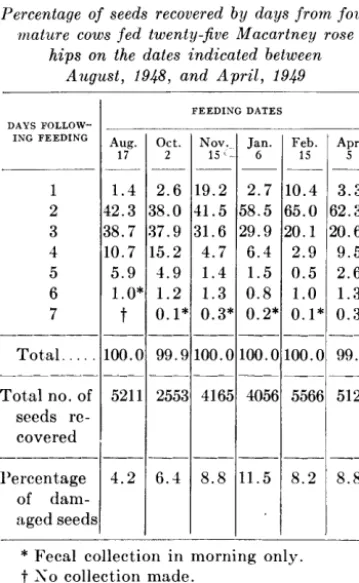
A study has been made by the Depart- ment of Range and Forestry of the Texas Agricultural Experiment Station to de- termine some of the factors relating to the spread and establishment of Macartney rose on land used for grazing. This study consisted of four phases: (1) to determine the proportion of recovered seeds of the Macartney rose which is physically damaged in the bovine digestive tract; (2) to determine the viability of apparently sound seeds after passage through the digestive tract of cattle; (3) to determine the influence of retention within the fecal material on the viability of the seeds; and (4) to determine the necessity for cold stratification, a standard nursery practice with ornamental roses, in germinating seeds of the Macartney rose.
Rose seeds are known to pass through certain mammals and birds unharmed. Harmon and Keim (19343 recovered 13.3 percent of Rosa arkansana seeds fed to yearling calves during the four days fol- lowing ingestion. No germination was ob- tained by these authors, possibly because the seeds were not subjected to cold stratification for after-ripening. Seeds of a rose species in Minnesota passed through
a sharp-tailed grouse gave eight and one- half times the germination of those col- lected directly from the plants (Aldous, 1941). Schultz (1949) mas unable to germinate apparent,ly sound Macartney rose seed fed to chickens.
Rose seeds of the temperate zone species are dormant and require stratification at a low temperature to prepare them for germination (Cracker and Barton, 1931). The most effective stratification tempera- ture is 41°F., but individual species have reacted favorably to temperatures ritng-
been found to germinate readily at the recommended stratification temperature (Cracker and Barton, 1931).
Green seeds of Macartney rose germi- nated better without, stratification than seeds which were air-dried and subjected various scarification and stratification rneaares (Schult,z, 1949). Crocker and Barton (1931), in their work with
Rosa
rugosa, found that fresh green seed germi-
nated hetter than seed allowed to dry on the plant. After three years of dry storage se& dried on the bush gave the sameing from 32 to 50°F. (Afsnasicv, 1942). The time required for this after-ripening has been found to vary considerably de- pending upon the species. Rosa multdj‘ha
germinated 72.5 percent and completed germination in four months whereas