A Cryptanalysis of HummingBird-2: The Differential
Sequence Analysis
Qi Chai and Guang Gong
Department of Electrical and Computer Engineering University of Waterloo
Waterloo, Ontario, N2L 3G1, Canada
{q3chai, ggong}@uwaterloo.ca
Abstract. Hummingbird-2is one recent design of lightweight block ciphers targeting constraint devices, which not only enables a compact hardware implementation and ultra-low power con-sumption but also meets the stringent response time as specified in ISO18000-6C.
In this paper, we present the first cryptanalytic result on the full version of this cipher using two pairs of related keys, i.e., four keys. We discover that the differential sequences for the last invocation of the round function can be computed by running the full cipher, due to which the search space for the key can be reduced. Base upon this observation, we propose a probabilistic attack encompassing two phases, preparation phase and key recovery phase. The preparation phase, requiring 280 effort in time, aims to reach an internal state, with 0.5 success probability, that satisfies particular conditions. In the key recovery phase, by attacking the last invocation of the round function of the encryption (decryption resp.) using the proposed differential sequence analysis (DSA), we are able to recover 36 bits (another 44 bits resp.) of the 128-bit key. In addition, the remaining 48 bits of the key can be exhaustively searched and the overall time complexity of the key recovery phase is 248.14.
Note that the proposed attack, though exhibiting an interesting tradeoff between the success probability and time complexity, is only of a theoretical interest at the moment and does not affect the security of theHummingbird-2in practice.
Keywords: lightweight cryptography, differential cryptanalysis, Hummingbird encryption
1
Introduction
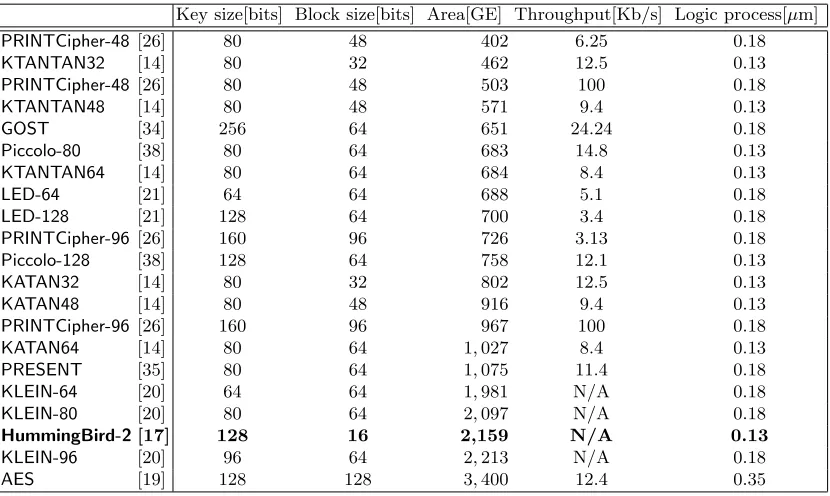
Passive RFID tags and other constraint computing devices are usually characterized by extremely tight cost and power consumption requirements. The needs of cryptographic primitives on such devices have been increasing with the growing pervasiveness and mass deployment of these devices. To this end, considerable lightweight stream/block ciphers are proposed in recent years, targeting very small hard-ware footprint and reduced power consumption. Typical examples are listed in Table 1. Meanwhile, cryptanalysis of these lightweight primitives has received considerable attention due to a widely-accept concern – the pursue of efficiency at the cost of reducing the security margin or applying innovative but less well understood technologies lead lightweight candidates to be less durable relative to regu-lar symmetric ciphers. This concern has been further confirmed by the successful cases of attacking
II
Table 1.Recent Design/Implementation of Lightweight Ciphers (ordered by gate equivalent (GE)) Key size[bits] Block size[bits] Area[GE] Throughput[Kb/s] Logic process[µm]
PRINTCipher-48[26] 80 48 402 6.25 0.18
KTANTAN32 [14] 80 32 462 12.5 0.13
PRINTCipher-48[26] 80 48 503 100 0.18
KTANTAN48 [14] 80 48 571 9.4 0.13
GOST [34] 256 64 651 24.24 0.18
Piccolo-80 [38] 80 64 683 14.8 0.13
KTANTAN64 [14] 80 64 684 8.4 0.13
LED-64 [21] 64 64 688 5.1 0.18
LED-128 [21] 128 64 700 3.4 0.18
PRINTCipher-96[26] 160 96 726 3.13 0.18
Piccolo-128 [38] 128 64 758 12.1 0.13
KATAN32 [14] 80 32 802 12.5 0.13
KATAN48 [14] 80 48 916 9.4 0.13
PRINTCipher-96[26] 160 96 967 100 0.18
KATAN64 [14] 80 64 1,027 8.4 0.13
PRESENT [35] 80 64 1,075 11.4 0.18
KLEIN-64 [20] 64 64 1,981 N/A 0.18
KLEIN-80 [20] 80 64 2,097 N/A 0.18
HummingBird-2[17] 128 16 2,159 N/A 0.13
KLEIN-96 [20] 96 64 2,213 N/A 0.18
AES [19] 128 128 3,400 12.4 0.35
A Brief History of Hummingbird Cipher: Motivated by the design of the well-known Enigma machine, the first generation of Hummingbird(call itHB-1) was proposed by the engineers in Revere Security and was further analyzed and published in [16] as an ultra-lightweight cryptographic algorithm targeting low-cost RFID tags, smart cards, and wireless sensor nodes to meet the stringent response time and power consumption requirements. Although HB-1, with an innovative hybrid structure of block cipher and stream cipher, was designed to provide 256-bit security, Saarinen, in FSE’11, showed a chosen-IV and chosen-message attack [36] that can recover the full secret key with at most 264off-line computational effort under two related IVs. Recently, Revere Security published the second generation of Hummingbird (call it Hummingbird-2 or HB-2) in [17], which inherits the design philosophy from
HB-1, e.g., it has a small block size of 16-bit to adapt the needs of encrypting short messages in RFID applications and it retains the hybrid structure as a security compensation for the small block size. High level differences betweenHB-1andHB-2are: (1) key size has been reduced to 128 bits to satisfy the actual need for constrained devices; (2) size of the internal state has been increased from 80 bits to 128 bits; (3) the nonlinear keyed transformation inHB-2has four invocations of the S-boxes, compared to five inHB-1, to further increase the throughput.
In addition, it is claimed in the same paper thatHB-2can withstand differential, linear and algebraic attacks and the four 4-bit S-Boxes in HB-2 belong to the optimal classes as discussed in [31]. Its resistance to the side-channel cube attack is recently investigated in [18], where the author applied cube attack to recover 48 bits of the secret key providing the attacker could access the internal states ofHB-2during an early stage in the initialization. However, this attack is marginal since it only threats
III
Our Contribution: By refining/improving our preliminary results in [10], we present, in this paper, the first cryptanalytic result on the full version of this cipher using two pairs of related keys, i.e., four keys. Our attack makes use of the internal state of such a cipher and our philosophy is general: (1) the outputs of the encryption/decryption may leak information of the subkeys (under the differential cryptanalysis) as long as the internal states of the cipher satisfy particular conditions; (2) due to the birthday paradox, such a condition always happens with 1/2 probability providing 2L/2 attempts are made, whereL(in bit) is the size of the internal state. To be specific, we propose the following attack encompassing two phases, a probabilistic preparation phase and a key recovery phase.
– To realize the two particular conditions regarding the internal states, the preparation phase spends 280effort in time to achieve the success probability 0.5 (due to the birthday paradox). If succeeds, one could proceed to the key recovery phase.
– The key recovery phase is basically an instance of a novel cryptanalytic technique – we call it differential sequence analysis (DSA) – which can be seen as a hybrid of the conventional differential cryptanalysis and saturation attack. After exhibiting DSA’s definitions and properties, we present its applications in the attacking scenarios, i.e.,
– by using the encryption of HB-2, DSA recovers 36-bit (out of 128-bit) of the key, if condition (A) (regardingHB-2’s secret key, input and internal state) holds.
– by using the decryption of HB-2, DSA recovers another 44-bit of the key, if condition (B) (regardingHB-2’s secret key, input and internal state) holds.
– the rest 48-bit of the key can be exhaustively searched and the overall time complexity is 248.14.
Success Probability
Time Complexity [Calls of encryption] 0.5
280
1
2128
0.5
2127
An (unknown/nonexistent) ideal attack to succeed with constant effort Our attack presented in this paper
(Trivial) exhaustive search inF1272 for the key
(Trivial) exhaustive search inF128
2 for the key
The set of non-trivial attacks
Fig. 1.Tradeoff between Success Probability and Time Complexity when attacking HB-2(In fact, since one encryption only provides 16-bit entropy of the key, the exhaustive search needs a bit more than 2128calls of the encryption function following the “key testing” procedure as described in [4], i.e., 2128+ 2112+ 296+ 280+ 264+
248+ 232+ 216≈2128.000022and 8 plaintext-ciphertext pairs to uniquely determine the key with probability 1.)
IV
to succeed with probability 1, our preparation phase requiring more effort in time than the exhaustive search, which makes the proposed method only of theoretical interests at the moment, i.e., the attack presented in this paper does not affect the security of theHummingbird-2 in practice.
Organization: In Section 2, the specification of HB-2is presented. Section 3 describes the principle of our attack at a high level. In Section 4, we devise the DSA technique, discuss its properties and how to use it to attack parts of HB-2. In Section 5, we show how to achieve the desired conditions. We conclude the paper in Section 6.
Notations: Throughout the rest of this paper, we make use of the following notations.
– An hexadecimal number is indicated by a prefix “0x”, e.g., 0x10 = 16.
– Unless otherwise stated, “+” denotes the addition in F2, which can also be vector-wise, e.g., (a, b) + (c, d) = (a+c, b+d), wherea, b, c, d∈Fm
2 .
– “” or “” operator denote addition or subtraction modulo 216.
– The high-bit XOR differential is defined asH =0x8000, a nice property of which is, givenx, x0, y∈
F162 andx+x0=H, the following holds with probability 1,
(xy) + (x0y) =H, (xy) + (x0y) =H, (yx) + (yx0) =H.
That is to say, as pointed out in [36], the differentialH behaves the same under “+” and “/”.
2
Specification of
Hummingbird-2
Hummingbird-2is a 16-bit block cipher with a 128-bit secret keyK= (K1, ..., K8)∈(F162 , ...,F162 ) =F1282 and a 64-bit public initialization vector IV = (IV1, ..., IV4) ∈ (F162 , ..., F
16 2 ) = F
64
2 . As opposed to conventional block ciphers, it has an 128-bit internal state R = (R1, ..., R8) ∈ (F162 , ...,F
16 2 ) =F
128 2 , which participates in each encryption/decryption and is updated after that.
Building Block: W D16 : {0,1}16 7→ {0,1}16 is the fundamental block or round function of HB-2 encryption, which is defined as
W D16(x, Ka, Kb, Kc, Kd) =f(f(f(f(x+Ka) +Kb) +Kc) +Kd),
where xis the varying input, e.g., plaintext, intermediate state,Ka, Kb, Kc, Kd are four 16-bit secret
keys and the nonlinear functionf is specified as
S(x) =S1(x1)||S2(x2)||S3(x3)||S4(x4), x= (x1, x2, x3, x4)
L(x) =x+ (x <<<6) + (x <<<10)
f(x) =L(S(x)).
Note that the four S-boxes, i.e.,S1(xi) toS4(xi), are given in Table 2.
Besides, the inverse ofW D16 is employed in the decryption, which is defined as
V
Table 2.S-boxes in HummingBird-2
x 0 1 2 3 4 5 6 7 8 9 10 11 12 13 14 15 x 0 1 2 3 4 5 6 7 8 9 10 11 12 13 14 15 S1(x) 7 12 14 9 2 1 5 15 11 6 13 0 4 8 10 3 S−11(x) 11 5 4 15 12 6 9 0 13 3 14 8 1 10 2 7
S2(x) 4 10 1 6 8 15 7 12 3 0 14 13 5 9 11 2 S−21(x) 9 2 15 8 0 12 3 6 4 13 1 14 7 11 10 5
S3(x) 2 15 12 1 5 6 10 13 14 8 3 4 0 11 9 7 S−31(x) 12 3 0 10 11 4 5 15 9 14 6 13 2 7 8 1
S4(x) 15 4 5 8 9 7 2 1 10 3 0 14 6 12 13 1 S−41(x) 10 7 6 9 1 2 12 5 3 4 8 15 13 14 11 0
where y =W D16(x, Ka, Kb, Kc, Kd) and f−1 is the inverse of f. The four S-boxes used in f−1 are
also listed in Table 2.
Initialization: Hummingbird-2 is initialized before use. Let (R1(r), ...R8(r)) ∈ {0,1}128 denote the in-ternal state at therth iteration in the initialization. The initialization can thus be formulated as, for
r= 0,1,2,3,
t1=W D16(R (r)
1 < r >, K1, K2, K3, K4) (1)
t2=W D16(R (r)
2 t1, K5, K6, K7, K8) (2)
t3=W D16(R (r)
3 t2, K1, K2, K3, K4) (3)
t4=W D16(R (r)
4 t3, K5, K6, K7, K8) (4)
R1(r+1)= (R1(r)t4)≪3 (5)
R2(r+1)= (R2(r)t1)≪1 (6)
R3(r+1)= (R3(r)t2)≪8 (7)
R4(r+1)= (R4(r)t3)≪1 (8)
R5(r+1)=R5(r)+R(1r+1) (9)
R6(r+1)=R6(r)+R(2r+1) (10)
R7(r+1)=R7(r)+R(3r+1) (11)
R8(r+1)=R8(r)+R(4r+1), (12)
where< r >represents a counter and (R(0)1 , ..., R(0)8 ) = (IV1, IV2, IV3, IV4, IV1, IV2, IV3, IV4).
VI
Encryption: After the initialization, each encryption, by invoking the round function for four times, transforms a single plaintext wordPi∈F162 , i= 1,2, ...,to a corresponding ciphertext wordCi, i.e.,
t1=W D16(R (i)
1 Pi, K1, K2, K3, K4) (13)
t2=W D16(R (i)
2 t1, K5+R (i)
5 , K6+R (i)
6 , K7+R (i)
7 , K8+R (i)
8 ) (14)
t3=W D16(R (i)
3 t2, K1+R (i)
5 , K2+R (i)
6 , K3+R (i)
7 , K4+R (i)
8 ) (15)
Ci=W D16(R
(i)
4 t3, K5, K6, K7, K8)R (i)
1 , (16)
where (R(1i), ..., R8(i)) ∈F1282 is the internal state during the ith encryption and it is updated, at the end of the encryption, as follows:
R(1i+1)=R(1i)t3 (17)
R(2i+1)=R(2i)t1 (18)
R(3i+1)=R(3i)t2 (19)
R(4i+1)=R(4i)t1R (i+1)
1 (20)
R5(i+1)=R5(i)+R(1i+1) (21)
R6(i+1)=R6(i)+R(2i+1) (22)
R7(i+1)=R7(i)+R(3i+1) (23)
R8(i+1)=R8(i)+R(4i+1) (24)
A shorthand of Eq. (13)-(24) is Ci=E(Pi, K) =E(Pi,(K1, ..., K8)).
Decryption: Decryption of a single wordCi∈F162 , i= 1,2, ..., followed by the same initialization, is
u3=W D16−1(CiR
(i)
1 , K8, K7, K6, K5) (25)
u2=W D16−1(u3R (i)
4 , K4+R (i)
8 , K3+R (i)
7 , K2+R (i)
6 , K1+R (i)
5 ) (26)
u1=W D16−1(u2R (i)
3 , K8+R (i)
8 , K7+R (i)
7 , K6+R (i)
6 , K5+R (i)
5 ) (27)
Pi=W D16−1(u1R (i)
2 , K4, K3, K2, K1)R (i)
1 . (28)
After this, the internal states are updated as in the encryption, i.e., using Eq. (17)-(24), wheret3 =
u3R
(i)
4 ,t2=u2R (i)
3 andt1=u1R (i) 2 .
3
Overview of Our Cryptanalytic Method on the Full
HB-2
Adversary Model: We consider a scenario that two paralleled executions of encryptions are Ci =
E(Pi, K) andCi00 =E(Pi00, K0), where the internal states are (R (i) 1 , ..., R
(i)
8 ) and (R0 (i0) 1 , ..., R0
VII
attacker is free to choose plaintext Pi ∈ F162 and Pi00 ∈ F162 , launch encryption without knowing the related keys, and observe the correspondingCi∈F162 andCi00 ∈F162 ; or choosesCi∈F162 andCi00 ∈F162 , launches decryption without knowing the related keys, and observes the correspondingPi ∈F162 and Pi00 ∈ F216.
Attack In A Nutshell: Block ciphers are usually based on iterating a cryptographically weak func-tion sufficient number of times without disturbing, e.g., modifying, the outputs of intermediate rounds except whitening them with round-keys. Our attack on the fullHB-2 exploits the fact that the inter-nal states, instead of enhancing the overall cryptainter-nalytic strength, give the attacker an opportunity to create an input differential for the last invocation of W D16 (W D16−1 resp.) in the encryption (decryption resp.) and to retrieve the corresponding distribution of the output differences (call the collection of them a differential sequence), which is information-rich in a subset of key. Henceforth, after obtaining such atemplate sequence, the attacker, in an off-line environment, could search for the key bits associated, which usually constitute a subset of entire key bits. In all, our full attack can be divided into two phases:preparation phaseas described in Section 5 andkey recovery phase as described in Section 4.
Key Recovery Phase: In the key recovery phase, to remove the undesired interference introduced by the varying internal states when consecutive words are encrypted/decrypted, our attack here targets a specific encryption/decryption after the preparation, i.e., ith encryption/decryption for one HB-2
instance and i0th encryption/decryption for the other one. This is because given the key, IV, and the plaintext chain fed are fixed, theith internal state and thei0th internal state are fixed as well. Hence-forth, we omit the superscript/subscript i and i0 of HB-2 variables for convenience when describing operations in the key recovery phase.
Providing the preparation phase succeeds, the attacker accomplishes the following utilizing the properties of the differential sequence analysis:
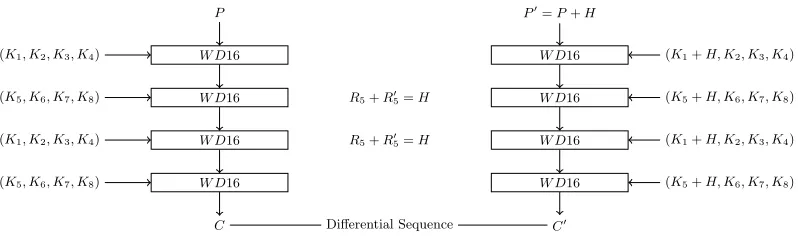
– Step 1. 36 bits of (K5, ..., K8)∈F642 are recovered using the differential sequence obtained from the last invocation ofW D16 in the encryption if a particular condition meets, as shown in Fig. 2.
– Step 2. 28 bits of (K4, ..., K1)∈F642 are recovered using the differential sequence obtained from the last invocation ofW D16 in the decryption if another particular condition meets.
– Step 3. the rest 64-bit key are exhaustively searched using either encryption or decryption.
To be specific, the condition needed to launch Step 1 inkey recovery phaseis:
Condition (A) : ∆K = (K1, ..., K8) + (K10, ..., K
0
8) = (H,0,0,0, H,0,0,0)
∆P =P+P0=H
∆R= (R1, ..., R8) + (R01, ..., R08) = (0,0,0,0, H,0,0,0).
The condition needed to launch Step 2 inkey recovery phase is:
Condition (B) : ∆K= (K1, ..., K8) + (K10, ..., K
0
8) = (0,0,0, H,0,0,0, H)
∆C=C+C0 =H
VIII
W D16
W D16
W D16
W D16
W D16
W D16
W D16
W D16
R5+R05=H
R5+R05=H
Differential Sequence (K1, K2, K3, K4)
(K5, K6, K7, K8)
(K1, K2, K3, K4)
(K5, K6, K7, K8)
(K1+H, K2, K3, K4)
(K5+H, K6, K7, K8)
(K1+H, K2, K3, K4)
(K5+H, K6, K7, K8)
P P0=P+H
C C0
Fig. 2.Constructing Differential Sequence from Encryption with Condition (A)
To reach∆P or∆C in the two conditions above, the adversary model already allows the plaintex-t/ciphertext to be freely chosen; to reach∆K, two pair of related-keys have to be used in our attack; and to reach∆R, an extra phase, called preparation phase, has to be introduced.
Preparation Phase: As one may expect, preparation phase of our attack copes with the realization of∆Rs one at a time. To this end, one obvious way is to mount side-channel injection attack as shown in Appendix D, which gives the attacker no time/memory penalty, i.e., the overall time/memory complexity of the attack is dominated by that of the key recovery phase.
However, side-channel injection attack is not considered much in this work. Instead, we realize both conditions in a probabilistic manner, i.e.,
– (R(1i), ..., R(8i)) and (R10(i0), ..., R08(i0)) can be “randomized” by feeding both HB-2 instances with either different IVs and/or chains of random plaintext words. According to the birthday para-dox, there is at least 0.5 chance that the randomized (R(1i), ..., R8(i)) ∈ F128
2 and the randomized (R01(i0), ..., R80(i0))∈F1282 satisfies∆Rin condition (A) (condition (B) resp.) providing 264 attempts are made.
– Note that, in the previous step, even if∆Rhappens, the attacker is usually unaware. To determine, we improve the mechanism above in light of another characteristic of HB-2, i.e., if condition (A) (condition (B) resp.) holds at the current round, it also holds for the next round. Hence, the differential sequences produced at the current round by ((R(1i), ..., R8(i)),(R10(i0), ..., R80(i0))) is exactly the same as that produced at the next round by ((R(1i+1), ..., R(8i+1)),(R01(i0+1), ..., R08(i0+1))).
– If the above step succeeds, the attacker proceeds to the key recovery phase to attack.
In what follows, we detail each of the above phases and steps.
4
Differentials Sequence Analysis (DSA)
In this section, we present a novel technique called differential sequence analysis (DSA) rooted in the differential cryptanalysis and the saturation attack. To be specific, we exhibiting its definitions, properties, and applications to attack one round of theHB-2, that constitutes thekey recovery phase
IX
4.1 Differential Cryptanalysis and Saturation Attack
Differential cryptanalysis is a method analyzing the effect of particular differences in plaintext pairs on the differences of the resultant ciphertext pairs, which is based on a crucial observation that for any particular input differential, not all the output differential are possible, and the possible ones may not appear uniformly. In the original version of differential cryptanalysis [37], a unique differential is exploited to recover the subkey used in the last round of a block cipher. This idea has been extended in several ways: Biham and Shamir themselves further considered in [37] to use a trail of differentials to attack; Lai in [27] connected differential cryptanalysis with derivative of polynomials and presented a rigorous definition of higher order differentials; Knudsen [25] considered to use part of the input and output that have differential characteristics for the analysis; Biham, Biryukov and Shamir proposed in [5] to use differentials that happen with probability 0 as distinguishers; and recently, Blondeau and G´erard demonstrated the multiple differential cryptanalysis in [6], where a set of input/output differentials are considered together.
Saturation attack [28, 23, 8] exploits the fact that the output set is saturated, i.e., the outputs form the whole space of Fm
2, if the input set for the m-bit core injective function is saturated. Since the saturation of the outputs is observable, this technique usually serves as a distinguisher for the attacker. At a high level, our differential sequence analysis in this paper can be understood as a hybrid of the conventional differential cryptanalysis and saturation attack, i.e., the set of the output differentials (instead of the outputs themselves) with respect to a particular/fixed input differential and a saturated set of inputs is considered. From another angle, due to the use of output differentials caused by a saturated set of inputs, our attack is also a special case of multiple differential cryptanalysis [6].
4.2 (First-order) Differential Sequence
Assume we have a keyed permutationh(w, K) mappingw∈Fm2 to h(w, K)∈Fm2 with respect to the secret keyK, wheremis a positive integer. Given a fixedθ∈Fm
2, the first-order differential is known as
∆θ,K(w) =h(w, K) +h(w+θ, K).
The (first-order) differentials sequence of h at θ is basically one row in the differential distribution table of h with respect to the input differential θ. To discuss its properties, we define it in a more formal way.
Definition 1. The first-order differential sequence (DS) of h at θ is a non-binary sequence of 2m entries, i.e.,
∆θ,K= (z0, z1, ..., z2m−1),
where zi denotes the multiplicity (that is, number of occurrences) of i in the set {w∈Fm2 |∆θ,K(w)}, i.e.,
zi=|{w∈Fm2| ∆θ,K(w) =i}|.
Note that this definition can be extended to higher orders. In this paper, we restrict ourselves to the first-order case.
For example, the differential sequence is {0,0,0,2,0,0,2,0,0,4,2,0,4,0,0,2} providing {w =F42| ∆θ,K(w)}={12,10,3,9,6,9,15,12,12,10,3,9,6,9,15,12}andθ= 0x08. The length of the differential
X
4.3 Properties of the Differential Sequence
The saturated set of inputs brings quite a lot of interesting properties to the conventional differential cryptanalysis. We list the core properties to attackHB-2here.
Property 1. For a fixedθ∈Fm2 ,∆θ,Kis constructed by evaluating and counting (h(w, K)+h(w+θ, K))
for everywin Fm
2 regardless of the order ofw∈Fm2 been accessed.
This property follows immediately from Definition 1 and is useful in the sense that even though
h(w, K) is an intermediate round in a cipher (thus,wis an intermediate value), we are able to capture
∆θ,K given thatθ can be fixed in a particular way andwtraverses the whole space ofFm2 . Stated in another way, we have the property below.
Property 2. Letperm(w) be a permutation ofwin Fm2, i.e., perm(w) :Fm2 7→Fm2 . For a fixedθ∈Fm2 and everyw∈Fm2 ,∆θ,K can be obtained either by evaluating and counting (h(w, K) +h(w+θ, K)),
or by evaluating and counting (h(perm(w), K) +h(perm(w) +θ, K)).
In what follows, we use
[h(w, K) +h(w+θ, K)|w∈Fm2 ] = [h(perm(w), K) +h(perm(w) +θ, K)|w∈Fm2]
as a symbolic expression for Property 2, where [...] actually defines a multiset andθ is always a fixed value in Fm2 for the rest of the paper. Henceforth, a straightforward extension of Property 2 can be derived below.
Property 3. Letpermi,i= 1, ..., n, be permutations inFm2. We have
[h(w, K) +h(w+θ, K)|w∈Fm
2]
= [h(permn(...(perm1(w))), K) +h(permn(...(perm1(w))) +θ, K)|w∈Fm2].
Proof.permn(...(perm1(w))) can be written asperm(w) inFm2. As aforementioned, the obtained differential sequence is primarily used to search for the key bits associated. Henceforth, we are especially interested in the correspondences between the differential sequence and theKin the underlying functionh(w, K), e.g., is the mapping fromK to the differential sequence injective or not? To this end, we start with a special case of Property 2.
Property 4. ProvidingK=KaSKb,KaTKb=∅andh(w, K) =h(w+Ka, Kb), we have
[h(w, K) +h(w+θ, K)|w∈Fm2] = [h((w+Ka), Kb) +h((w+Ka) +θ, Kb)|w∈Fm2].
Proof.By applying Property 2 and set perm(w) =w+Ka, this property follows immediately.
From the property above, it is clear that all Ka ∈F|2Ka|produces the same sequence while differ-ent Kbs may produce different sequences. Therefore, this property in fact implies that the obtained
XI
Property 5. LetΓ be a subset ofFm2 andpermis a permutation inΓ, i.e.,perm(w) :Γ 7→Γ, we have
[h(w, K) +h(w+θ, K)|w∈Γ] = [h(perm(w), K) +h(perm(w) +θ, K)|w∈Γ].
Proof.This property follows from Definition 1, if and only ifpermis a permutation in Γ. Furthermore, we call [h(w, K) +h(w+θ, K)|w∈Γ] or [h(perm(w), K) +h(perm(w) +θ, K)|w∈Γ] asub-differential sequenceof∆θ,K. Therefore, we can actually view a differential sequence obtained in
Fm2 as a summation of several sub-differential sequences obtained in the disjoint subspaces ofFm2. This intuition can be written as below.
Property 6. LetΓi,i= 1, ..., q, be qdisjoint partitions ofFm2 , i.e.,
Γi∩Γj=∅, 1≤i6=j≤q (29)
∪qi=1Γi=Fm2 (30)
and let the differential sequence obtained by [h(w, K) +h(w+θ, K)|w∈Γi] be∆
{Γi}
θ,K, we thus have,
∆θ,K=
q
X
i=1 ∆{θ,KΓi}.
Following this reasoning, Property 4 can also be extended as below, which tells us that a differential sequence inΓ only corresponds to the key nonlinearly (inΓ) associated.
Property 7. ProvidingK =KaSKb,KaTKb =∅ andh(w, K) = h(w+Ka, Kb), we have, ifΓ is a
subset ofFm2 and (w+Ka) is a permutation in Γ with respect toKa,
[h(w, K) +h(w+θ, K)|w∈Γ] = [h((w+Ka), Kb) +h((w+Ka) +θ, Kb)|w∈Γ].
Therefore, if each of the sub-differential sequence stays the same with respect to the keys belonging to a particular set, denoted as Φ0, the overall differential sequence remain the same under Φ0. We formalize this correspondence as below.
Property 8. LetΦ0=∩
q
i=1{k|w+k:Γi 7→Γi, k, w∈Fm2},K=KaSKb,KaTKb=∅andh(w, K) =
h(w+Ka, Kb), we have
∆θ,K=∆θ,κ, (31)
whereκ=κaSκb,κaTκb=∅,Ka, κa ∈Φ0and κb=Kb.
Proof.Let∆{θ,KΓi}be the sub-differential sequence obtained by Property 7. Thanks to Property 6, we have ∆θ,K =Pqi=1∆{
Γi}
θ,K and ∆θ,κ=
Pq i=1∆
{Γi}
θ,κ . Thanks to Property 7, for eachi, ∆
{Γi} θ,K =∆
{Γi} θ,κ
providingKa, κa∈Φ0 andκb =Kb.
As opposed, providing κb 6= Kb while Ka, κa ∈ Φ0, it is quite likely that ∆θ,K 6= ∆θ,κ since
∆{θ,KΓi}6=∆{θ,κΓi} for eachi.
XII
4.4 Differential Sequence Analysis against HB-2
In this subsection, we attack the last invocation ofW D16 (W D16−1 resp.) in the encryption (decryp-tion resp.) of HB-2by exploiting the DSA as presented. To be specific, our Theorem 1 and Theorem 3 give answers to the question “how to obtain the differential sequences” while our Theorem 2 and Theorem 4 exhibit “how to use the differentials sequences”. Since theHB-2has a 16-bit block size, we havem= 16 for the rest.
Attacking W D16 in Encryption: To show our idea in a concise way, we assume thatR1 and R10 are known (in fact, they are identified by our algorithms in the preparation phase). In addition, let
hin Definition 1 be the last invocation ofW D16, i.e., Eq. (16), in the encryption. We thus have the following theorems.
Theorem 1. When condition (A) meets, the differential sequence of the lastW D16in the encryption atθ=H can be extracted from executing the entire encryption.
Proof: First of all, when condition (A) holds, we have,
t01=W D16(R01P0, K10, K20, K30, K40)
=W D16(R1(P+H),(K1+H), K2, K3, K4) =t1
t02=W D16(R02t10, K50 +R50, K60 +R06, K70 +R07, K80 +R08) =W D16(R2t1,(K5+H) + (R5+H), K6+R6, K7+R7,
K8+R8) =t2
t03=W D16(R03t20, K10 +R50, K20 +R06, K30 +R07, K40 +R08) =W D16(R3t2,(K1+H) + (R5+H), K2+R6, K3+R7,
K4+R8) =t3
Next,∆H,(K5,K6,K7,K8)= [z0, z1, ..., z216−1] can be extracted, where
zi =|{t3∈F162 |(W D16(R4t3, K5, K6, K7, K8) +W D16(R04t
0
3, K
0
5, K
0
6, K
0
7, K
0
8)) =i}| =|{t3∈F162 |(W D16(R4t3, K5, K6, K7, K8) +W D16(R4t3,(K5+H), K6, K7, K8)) =i}|
=|{t3∈F162 |(W D16(R4t3, K5, K6, K7, K8) +W D16((R4+H)t3, K5, K6, K7, K8)) =i}|
=|{P ∈F16 2 , P
0=P+H|(C
R1) + (C0R1) =i}|.
The second last equality comes from the fact
(R4t3) + (K5+H) = ((R4+H)t3) +K5,
which can be easily verified by the computer simulation.
Note that condition (A) is a necessary condition for the following condition:
∆K= (K1, ..., K8) + (K10, ..., K
0
8) = (0,0,0,0,0,0,0,0) ∆P =P1+Pi00 = 0
XIII
such that both of them produce the same differential sequence ofW D16. However, we use condition (A) through the rest of the paper because it has an additional property that keeps the attacker informed
once∆Rhappens (see Section 5.2).
This theorem suggests that, after querying the encryption with every P ∈F16
2 and obtaining the resultant output differentials, the attacker could have atemplate sequence∆H,(K5,K6,K7,K8)to search
for parts of (K5, K6, K7, K8). The next theorem discloses the correspondence between∆H,(K5,K6,K7,K8)
and (K5, K6, K7, K8).
Theorem 2. Let ∆H,(K5,K6,K7,K8) be obtained from Theorem 1. For κ5∈F
16
2 andκ6∈F162 , we have
∆H,(K5,K6,K7,K8)=∆H,(κ5,κ6,K7,K8),
whereK6 andκ6belong to the same setΦi=Φ0+i,0< i≤15, andΦ0, of cardinality212, is tabulated
in Appendix C.
Proof:To prove, we discuss the correspondence betweenK5, K6, K7, K8 and the template sequence in a respective way.
Correspondence BetweenK5and DS: For the time being, let us considerh(w, K) =f(f(w+K5)+ K6) (a simplified W D16), wheref :F162 7→F162 (as described in Section 2) is an injective function, we thus have, by lettingw=R4t3 andθ=H,
[h(w, K) +h(w+θ, K)|w∈F16 2 ]
= [f(f(w+K5) +K6) +f(f(w+K5+θ) +K6)|w∈F162 ]
= [f(f(perm1(w)) +K6) +f(f(perm1(w) +θ) +K6)|w∈F162 ]
It is clear from the context thatperm1(w) =w+K5is a permutation inFm2 , and, due to Property 4,∆H,(K5,K6,K7,K8) does not dependent onK5.
Correspondence Between K6 and DS: First of all, we define the following auxiliary variables for convenience:
– λi,i= 1, ..., q, areqpossible output differences off, given the input difference isθ.
– Γi={f(w)|f(w) +f(w+θ) =λi, w∈F162 },i= 1, ..., q, are qdisjoint partitions ofF162 such that: (1) Eq. (29) holds, otherwise there is a w∈(Γi∩Γj), 1≤i6=j ≤q, such that f(w) +f(w+θ)
produces output differencesλi andλj, λi 6=λj, which is impossible; (2) Eq. (30) holds, otherwise
there is a w∈(F162 − ∪
q
i=1Γi), that produces an output difference∈ {/ λ1, ..., λq}, which contradicts
our definition.
– Φ0 = ∩qi=1{k|f(w) +k : Γi 7→ Γi, k ∈ F162 }. Intuitively, Φ0 encompasses all possible keys, which makef(w) +k a permutation inΓi,i= 1, ..., q.
Furthermore, let us consider two cases: (1)K6∈Φ0; and (2)K6∈a coset ofΦ0.
For case (1), i.e.,K6∈Φ0, the above equations can be further written as, by settingperm2(w) = f(perm1(w)) +K6,
[f(f(perm1(w)) +K6) +f(f(perm1(w) +θ) +K6)|w∈F162 ]
= [f(f(perm1(w)) +K6) +f(f(perm1(w)) +λi+K6)|w∈Γi] fori= 1, ..., q
= [f(f(perm1(w)) +K6) +f(f(perm1(w)) +K6+λi)|w∈Γi] fori= 1, ..., q
= [f(perm2(w)) +f(perm2(w) +λi)|w∈Γi] fori= 1, ..., q
XIV
The above equation holds because of Property 8, e.g., forK6∈Φ0, every [f(w) +f(w+λi)|w∈Γi]
produces the same sub-differential sequence. Therefore, the overall differential sequence stays the same for everyK6∈Φ0. Stating in another way, providingK6andκ6are both inΦ0,∆H,(K5,K6)=∆H,(κ5,κ6).
The above derivation is further confirmed through extensive experiments, where we found
(λ1, ..., λ6) = (0x30cc,0x6198,0x9264,0xa2a8,0xc330,0xf3fc),
(Γ1, ...Γ6), andΦ0as tabulated in Appendix C, which is of cardinality 212.
In what follows, we prove case (2), i.e., the above equations are true for K6∈Φi =Φ0+i. This is because, by lettingK6=.K6+/K6 such that.K6∈Φ0,
[f(f(perm1(w)) +K6) +f(f(perm1(w)) +K6+λi)|w∈Γi] fori= 1, ..., q
= [f(f(perm1(w)) +.K6+/K6) +f(f(perm1(w)) +.K6+/K6+λi)|w∈Γi] fori= 1, ..., q
= [f(perm3(w) +/K6) +f(perm3(w) +/K6+λi)|w∈Γi] fori= 1, ..., q
= [f(w+/K6) +f(w+/K6+λi)|w∈Γi] fori= 1, ..., q
The second last equation holds because of our proof of case (1) (by lettingperm3(w) =f(perm1(w)) + .K6).
In addition, it is clear that:
– the sub-differential sequence [f(w+/K6) +f(w+/K6+λi)|w ∈ Γi], is different from [f(w+
f(w+λi)|w ∈Γi] as long as/K6 6= 0. So is the overall differential sequence with overwhelming probability.
– forK6=.K6+/K6,κ6=.κ6+/κ6,K66=κ6, the sub-differential sequence [f(w+/K6) +f(w+ /K6+λi)|w∈ Γi], is the same as [f(w+/κ6) +f(w+/κ6+λi)|w∈Γi] as long as /K6 =/κ6. This is due to the possibility that.K6, .κ6∈Φ0,.K66=.κ6could yield/K6=/κ6.
From the accusation above and our extensive experiments, it can be concluded that the key space ofK6∈F162 has been divided into 16 cosets, i.e.,Φ0, ..., Φ15, and each is of cardinality 212.
Correspondence Between (K7, K8) and DS: We carry on all the notations above for K7 except settingh(w, K) =f(f(f(f(w+K5) +K6) +K7) +K8). We found that, forK7,Φ0 is always a empty set because too manyλi divides F162 into numerous tiny subspacesΓi, for which there is noK7 could makef(w) +K7a permutation in everyΓi,i= 1, ..., q. Same phenomenon happens toK8. In all, each choice of (K7, K8) produces a different differential sequence, which is further confirmed empirically.
Attacking W D16−1 in Decryption: Similar attack can be performed against the decryption. By assumingR1 andR10 are known and letting hin Definition 1 be the last invocation ofW D16−1, i.e., Eq. (28), we have the following results for our attack.
XV
Proof: First of all, when condition (B) holds, we have,
u3=W D16−1(CR1, K8, K7, K6, K5)
=W D16−1((C+H)R01,(K8+H), K70, K60, K50) =u03 u2=W D16−1(u3R4, K4+R8, K3+R7, K2+R6, K1+R5)
=W D16−1(u03R40,(K4+H) + (R8+H), K30 +R07, K20 +R60, K10 +R50) =u02 u1=W D16−1(u2R3, K8+R8, K7+R7, K6+R6, K5+R5)
=W D16−1(u02R03,(K8+H) + (R8+H), K70 +R
0
7, K
0
6+R
0
6, K
0
5+R
0
5) =u
0
1
Next,∆H,(K4,K3,K2,K1)= [z0, z1, ..., z216−1] can be extracted, where,
zi=|{u1∈F162 |(W D16− 1(u
1R2, K4, K3, K2, K1) +W D16−1(u10 R02, K40, K30, K20, K10)) =i}| =|{u1∈F162 |(W D16−1(u1R2, K4, K3, K2, K1) +W D16−1(u01R20, K4+H, K3, K2, K1)) =i}| =|{C∈F162 , C
0=C+H| (P
R1) + (P0R1) =i}|.
A similar theorem describes the correspondence between∆H,(K4,K3,K2,K1) and (K4, K3, K2, K1).
Theorem 4. Let ∆H,(K4,K3,K2,K1) be obtained from Theorem 3. For κ1∈F
16
2 andκ4∈F162 ,
∆H,(K4,K3,K2,K1)=∆H,(κ4,K3,K2,κ1),
whereK4andκ4belong to the same setΦi=Φ0+i,0≤i≤212−1, andΦ0={0x0000,0x0010, ...,0x00f0}.
Proof: Similar as Theorem 2, except that we could easily observe from the experimental data that
Φ0={0x0000,0x0010,0x0020, ...,0x00f0}.
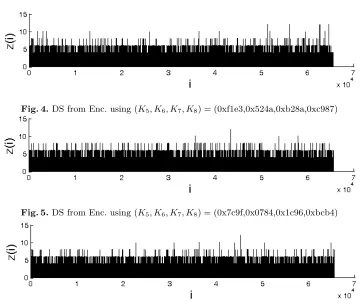
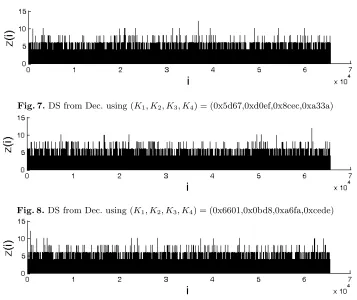
Visualization of Differential Sequences From HB-2: We provide several examples of the dif-ferential sequences used in our experiments in Appendix B. Fig. 4 to Fig. 6 are the ones obtained from the last invocation ofW D16 in the encryption withIV = (0,0,0,0) and different keys randomly selected. Fig. 7 to Fig. 9 in Appendix B are the ones obtained from the last invocation of W D16−1 in the decryption withIV = (0,0,0,0) and different keys randomly selected. All of the sequences are substantially different from each other, which exhibits their correlations to the underlying keys in an intuitive way.
4.5 Local Search in DSA
After the template sequence has been captured, the attacker could, in an off-line environment, launches
h(w, K) =W D16 (h(w, K) =W D16−1resp.) to search for parts of (K5, K6, K7, K8) ((K1, K2, K3, K4 resp.), which is called thelocal search in DSA. Through the local search, the attacker recovers 36-bit (44-bit resp.) information regarding the key.
A naive way to search locally is to produce a complete local differential sequence from [h(w, K) +
XVI
The efficiency of this method can be substantially improved if the early-abort strategy [30] is adapted, i.e., given theith entry in the local differential sequence is greater than theith entry in the template sequence, one could assert that the trial key is incorrect and terminate the search in advance. We present this improved local search algorithm below.
1: letT DS be the template sequence obtained
2: initiate the local differential sequenceLDSas a list of 216 “0”s 3: forwfrom 0 to 216−1do
4: randomly chooseK
5: dif f ←h(w+K) +h(w+H+K) 6: LDS[dif f]←LDS[dif f] + 1 7: if LDS[dif f]> T DS[dif f]then 8: return NULL
9: end if 10: end for
11: if LDS[w] =T DS[w] forw= 0,1, ...,216−1then 12: returnK
13: end if
The theoretical derivation of the time complexity of the above algorithm could be quite cumbersome. Instead, we recorded the number of the for-loops that are actually executed, denoted asl, during the search. Through repeated testings, we found that, in average, 1.640< l <1.660 for-loops are spent per key trial for both local searches usingW D16(.) and W D16−1(.). Thus, we conclude the cost per key trial of our local search algorithm is 1.65 executions of (a pair of)h(w, K)s .
4.6 Differential Sequence Analysis (DSA) Against HB-2and Its Time Complexity
We are ready to list out the steps performed by the attacker during the key recovery phase, as below.
1. When condition (A) holds, the attacker extracts the template sequence ∆H,(K5,K6,K7,K8) using
((CR1) + (C0R1)), whereC andC0 can be obtained by querying the encryption withP and P0 = P +H, and R
1 and R01 are obtained in the preparation phase. Then, the attacker locally searches 36-bit of (K5, K6, K7, K8) using the proposed local search algorithm.
2. Similarly, utilizing the decryption, when condition (B) holds, the attacker extracts another tem-plate sequence ∆H,(K4,K3,K2,K1) using (PR1) + (P
0R
1), and guesses to determine 44-bit of (K4, K3, K2, K1) using the proposed local search algorithm.
3. After that, the attacker searches the remaining 48-bit of the key using 248 trial encryptions1.
The overall complexity of the above steps is
236×1.65
| {z }
determine 36-bit of (K5, ..., K8)
+ 244×1.65
| {z }
determine 44-bit of (K1, ..., K4)
+ 248
|{z}
determine the rest
≈248.14,
where negligible memory is required by each steps.
1
XVII
5
A Probabilistic Realization of Conditions (A) and (B)
The attacks in the last section solely depends on the occurrences of conditions (A) and (B), to reach
∆Rs of which seems unpractical at the first glance as the initialization of HB-2 makes the internal states unpredictable. In this section, we show a probabilistic approach to realize these conditions – when the internal states of two HB-2 instances are respectively random, there is a certain chance that the attacker could get the desired differentials in the internal states. To this end, we study how to randomize the internal states of HB-2at first, and, how to determine whether the desired∆Rs happen.
5.1 Randomize the Internal States
There are two ways for the adversary to affect the internal states of HB-2:
– Providing the key is fixed, it is clear, from Eq. (1)-(12), that (IV1, ..., IV4)7→(R1, ..., R4) is an in-jective mapping and so is (IV1, ..., IV4)7→(R5, ..., R8). Therefore, the attacker could easily generate 264(out of 2128) different internal states by choosing different IVs and launching the initialization.
– For a fixed key and a particular IV, the attacker could choose plaintext P1 to feed HB-2at first. If a state transition graph is drawn, we can see that the starting state, i.e., R(1), transits to 216 neighboring states while eachP1∈F162 is encrypted. Next, if another encryption is performed, e.g., encrypting P2, each of these “neighboring states” again transits to another 216 states providing P2 takes every value in F162 . By continuing this process, we would have all 2128 states covered in this graph. Therefore, to produce a set of random internal states, i.e., {R(1), R(2), ...}, we could, as shown in Fig. 3, feed the encryptions with a plaintext chain where Pi is selected uniformly at
random inF162 fori= 1,2, .... Similarly, a ciphertext chain could be fed to the decryption oracle to generate a set of random internal states as well. Note that feeding HB-2encryption with a chain of N random inputs is equivalent to perform anN-step 216-dimensional random walk in its state transition graph. Therefore,|{R(1), R(2), ...}| ≈N ifN 2128[15].
IV EK EK EK EK ...
Internal States R(1) R(2) R(3) R(4) ...
Plaintext Chain P1 P2 P3 P4 ...
Fig. 3.FeedingHB-2Encryption with a Plaintext Chain
Therefore, the algorithm below provides, to the later steps, the randomized internal states of t-wo running HB-2 instances through an effort-saving way – one instance initializes a random IV and encrypts one random plaintext, while the other one, besides initializes a random IV, encryptsN ran-dom plaintexts consecutively. Since {R(1), R(2), ..., R(N)} is a set of random variables as analyzed,
XVIII
1: LetR(i)⇐E(Pi, K) be the internal stateR(i) after encryptingP1, ..., Pi
2: Randomly chooseIV0 andP10,R
0(1)⇐E(P0
1, K)
3: Randomly chooseIV 4: forifrom 1 toN do
5: Randomly choosePi,R(i)⇐E(Pi, K)
6: if R0(1)+R(i)=∆Rthen 7: return “∆Rhappens” 8: end if
9: end for
Note that, currently, the given algorithm is only a skeleton for our attack, which is discussed in more detail in the next subsections and the full-fledged version is given at last. Nevertheless, we can already sense an interesting property from this skeleton algorithm.
Property 9. In the algorithm above, a certain∆Rhappens with 0.5 probability whenN = 264.
Proof.This property holds due to the birthday paradox.
5.2 Determine while Guessing
To inform the attacker during the attempting, as long as condition (A) (condition (B) resp.) happens, we use one unusual differential characteristic in the encryption (decryption resp.), as first pointed out by HB-2’s designers, such that the differentials in the internal states, secret keys and the inputs can be maintained and entered into the next round, i.e., for a positive integeri,
(∆Pi, ∆K, ∆R(i)) = (∆Pi+1, ∆K, ∆R(i+1)).
Therefore, the following theorem holds.
Theorem 5. Let∆(i 0)
H,(K5,K6,K7,K8)(∆
(i0)
H,(K4,K3,K2,K1)resp.) be the differential sequence produced by the two encryption instances (two decryption instances resp.) with internal states R(1) and R0(i0) and let ∆(i
0+1)
H,(K5,K6,K7,K8) (∆
(i0+1)
H,(K4,K3,K2,K1) resp.) be the differential sequence produced by the two encryption
instances (two decryption instances resp.) with internal statesR(2)andR0(i0+1)(call∆(i0)
H,Kand∆
(i0+1)
H,K neighboring template sequences). Therefore,
- If condition (A) happens during encryption, the adversary observes two identical neighboring tem-plate sequences, i.e.,
∆(i 0)
H,(K5,K6,K7,K8)=∆
(i0+1)
H,(K5,K6,K7,K8);
otherwise, the above equation holds with negligible probability.
- If condition (B) happens during decryption, the adversary observes two identical neighboring tem-plate sequences, i.e.,
∆(i 0)
H,(K4,K3,K2,K1)=∆
(i0+1)
H,(K4,K3,K2,K1);
XIX
Proof: It follows from Definition 1 and Property 1.
Therefore, the above theorem can serve as an algorithm to determine the occurrences of condition (A) or condition (B), i.e., it returns either (Success, ∆(H,Ki0) , R(1)1 , R1(2)) or (F alse, N U LL, N U LL, N U LL) to the key recovery phase. Unfortunately, in this algorithm, the correct template sequences can only be extracted with the correctR(1)1 andR(2)1 due to Theorem 1 and Theorem 3. For instance, using the encryption, the two neighboring sequences are
∆(i0)= (z0(i0), z1(i0), ..., z65535(i0) ) (32)
∆(i0+1)= (z(i 0+1)
0 , z
(i0+1) 1 , ..., z
(i0+1)
65535) (33)
where
z(i 0)
j =|{P1∈F216, P0i0 =P1+H|(C1R1(1)) + (Ci00 R0 (i0)
1 ) =j}| and
z(i 0+1)
j =|{P2∈F162 , P0i0+1=P2+H|(C2R(2)1 ) + (Ci00+1R0 (i0+1) 1 ) =j}|
Henceforth, it is true that by guessing R(1)1 andR1(2), the algorithm above would cost 232 encryp-tions/decryptions per execution.
To improve its efficiency, we make use of theraw neighboring sequencesand their correlations, where the raw neighboring sequences are defined as below:
∆(i0)= (z0(i0), z(1i0), ..., z65535(i0) )
∆(i0+1)= (z(i 0+1)
0 , z
(i0+1) 1 , ..., z
(i0+1) 65535)
where
z(i 0)
j =|{P1∈F162 , P0i0 =P1+H|C1+Ci00 =j}| and zj(i0+1)=|{P2∈F162 , P0i0+1=P2+H|C2+Ci00+1=j}|.
In addition, we have the following hypothesis regarding the correlations of the raw neighboring sequences, due to the fact that the modulo addition is only first-order correlation-immune:
Hypothesis 1 The correlation of the two raw neighboring sequences derived from the two identical neighboring sequences is stronger than that of the two raw neighboring sequences derived from the two distinct neighboring sequences.
This hypothesis has been empirically verified, i.e., we found that, for the two identical neighboring sequences, the corresponding two raw neighboring sequences always have more than 30000 (out of 65536) identical entries, i.e.,
Corr(∆(i0), ∆(i0+1)) =|{z(i 0)
j =z
(i0+1)
j , j= 0,1, ...,65535}|>30000, iff∆
(i0)=∆(i0+1),
whereCorr(., .) is the non-normalized correlation.
On the contrary, for the two distinct neighboring sequences, the corresponding two raw neighboring sequences always have less than 19000 (out of 65536) identical entries, i.e.,
Corr(∆(i0), ∆(i0+1)) =|{z(i 0)
j =z
(i0+1)
j , j= 0,1, ...,65535}|<19000, iff∆
XX
By treating the correlation of the raw neighboring sequences as a criterion, Theorem 5 is now able to return whether∆(i0)equals∆(i0+1)within 216time complexity. Once the identical neighboring sequences are identified, the adversary is able to guess to recoverR1(1)andR(2)1 with 232effort in time.
5.3 Preparation Phase and Its Time Complexity
We recap the whole process in the preparation phase for the encryption as shown below, which is an extension of the skeleton algorithm we shown before. Note that the preparation using the decryption is similar and omitted here.
1: randomly chooseIV0 andP10,R
0(1)⇐E(P0
1, K)
2: randomly chooseIV
3: randomly choose a constantP20
4: forifrom 1 toN= 264do
5: randomly choosePi,R(i)⇐E(Pi, K)
6: generate∆(i)usingR0(1) andR(i)
7: R0(2)⇐E(P20, K)
8: R(i+1)⇐E(P
i+1, K) wherePi+1=P20+H
9: generate∆(i+1)usingR0(2) andR(i+1) 10: if Corr(∆(i), ∆(i+1))>30000then 11: guess to determineR(1)1 andR
(2) 1
12: recover∆(iH,K0) from the raw neighboring sequences
13: return (Success, ∆(iH,K0) , R(1)1 , R1(2)), keep current states and enter the key recovery phase 14: end if
15: decrypt usingC20 andCi+1 to roll backHB-2’s states toR0(1)andR(i)
16: end for
17: return (F alse, N U LL, N U LL, N U LL)
Using the encryption (decryption resp.) only, the attacker has 0.5 probability to reach condition (A) (condition (B) resp.) with 264×216= 280time complexity. After that, he is able to guess to determine
R(1)1 andR(2)1 with additional 232effort in time. In all, the time complexity of the preparation phase is
264×216
| {z }
test whether the condition happens
+ 232
|{z}
guess to determineR1s
+ 216
|{z}
recover the template seuqnece
≈280.
It is worth mentioning that to succeed with probability 1, the preparation phase requires 2128+16= 2144 effort in time, which is slower than the exhaustive search.
6
Concluding Remarks
XXI
parts of the key can be obtained. In addition, we demonstrate the application of this technique, that constitutes the key recovery of the lightweight block cipherHummingbird-2with 248.14time complexity, given particular conditions hold in its internal states, secret keys and the inputs. Furthermore, we investigate how to reach these conditions in our preparation phase with 0.5 chance and 280 effort in time. To the best of our knowledge, this is the first cryptanalytic result of the fullHummingbird-2.
The attack presented against Hummingbird-2 is a special case of the general DSA, to build the theoretic framework of which is part of our future work. In addition, it will be evaluated in the recent future: (1) whether the generalized DSA provides even better results against Hummingbird-2
and other potentially vulnerable ciphers, especially the ones with small block size and with internal states, e.g., stateful block ciphers [24]; (2) the possibility that the generalized DSA can work with other cryptanalysis technologies, e.g., meet-in-the-middle.
Acknowledgement
We thank Dr. Martin ˚Agren for the valuable comments on improving the editorial quality of this paper.
References
1. J.P. Aumasson, M. Naya-Plasencia and M.J.O. Saarinen, Practical attack on 8 rounds of the lightweight block cipher KLEIN, to appear in Proceedings ofINDOCRYPT’11, pp.1–13, 2011.
2. M. Abdelraheem, G. Leander and E. Zenner, Differential cryptanalysis of round-reduced PRINTcipher: computing roots of permutations,Fast Software Encryption, FSE’11, LNCS 6733, pp. 1–17, 2011.
3. M. ˚Agren, Some instant-and practical-time related-key attacks on KTANTAN32/48/64, Selected Areas in
Cryptography, SAC’11, LNCS 7118, pp. 213–229, 2012.
4. A. Bogdanov and C. Rechberger, A 3-subset meet-in-the-middle attack: cryptanalysis of the lightweight block cipher KTANTAN,Selected Areas in Cryptography, LNCS 6544, pp. 229–240, 2011.
5. E. Biham, A. Biryukov and A. Shamir, Cryptanalysis of Skipjack reduced to 31 rounds using impossible differentials,Journal Of Cryptology, vol. 18, no. 4, pp. 291–311, 1999.
6. C. Blondeau and B. G´erard, Multiple differential cryptanalysis: theory and practice,Fast Software
Encryp-tion, FSE’11, LNCS 6733, pp. 35-54, 2011.
7. A. Bogdanov and C. Rechberger, A 3-subset meet-in-the-middle attack: cryptanalysis of the lightweight block cipher KTANTAN,Selected Areas in Cryptography, SAC’10, LNCS 6544, pp. 229–240, 2010. 8. A. Biryukov and A. Shamir, Structural cryptanalysis of SASAS, Journal of cryptology, vol. 23, no. 4, pp.
505–518, 2010.
9. A. Biryukov, I. Kizhvatov and B. Zhang, Cryptanalysis of the Atmel cipher in SecureMemory, CryptoMemory and CryptoRF,Applied Cryptography and Network Security, ACNS’11, LNCS 6715, pp. 91–109, 2011. 10. Q. Chai, Design and analysis of security schemes for low-cost RFID systems,PhD Thesis, University of
Waterloo, 2012.
11. J. Cho, Linear cryptanalysis of reduced-round PRESENT,The Cryptographers’ Track at the RSA
Confer-ence, CT-RSA’10, LNCS 5985, pp. 302–317, 2010.
12. Q. Chai, X. Fan and G.Gong, An ultra-efficient key recovery attack on the lightweight stream cipher A2U2,
Cryptology ePrint Archive: Report 2011/247, pp. 1–4, 2011.
13. B. Collard and F.X. Standaert, A statistical saturation attack against the block cipher PRESENT, The
Cryptographers’ Track at the RSA Conference, CT-RSA’09, LNCS 5473, pp. 195–210, 2009.
XXII
15. A. Dvoretzky and P. Erdos, Some problems on random walk in space,In Proceedings of Second Berkeley
Symposium on Mathematical Statistics and Probability, vol. 353, pp. 353–367, 1951.
16. D. Engels, X. Fan, G. Gong, H. Hu and E. Smith, Hummingbird: ultra-lightweight cryptography for resource-constrained devices,Financial Cryptography and Data Security, FC’10, pp. 3–18, 2010.
17. D. Engels, M.J.O. Saarinen and E. Smith, The Hummingbird-2 lightweight authenticated encryption algo-rithm,Workshop on RFID Security, RFIDSec’11, LNCS 7055, pp. 19–31, 2011.
18. X. Fan and G. Gong, On the security of Hummingbird-2 against side-channel Cube attacks, Western
European Workshop on Research in Cryptology, WEWoRC’11, pp. 100–104, 2011.
19. M. Feldhofer, J. Wolkerstorfer and V. Rijmen, AES implementation on a grain of sand,Information
Secu-rity, IEE Proceedings, vol. 152, no. 1, pp. 13-20, 2005.
20. Z. Gong, S. Nikova and Y.W. Law, Klein: a new family of lightweight block ciphers,Workshop on RFID
Security, RFIDSec’11, LNCS 7055, pp.1–18, 2011.
21. J. Guo, T. Peyrin, A. Poschmann and M.Robshaw, The LED block cipher,Cryptographic Hardware and
Embedded Systems, CHES’11, LNCS 6917, pp. 326–341, 2011.
22. F.D. Garcia, P. van Rossum, R. Verdult and R.W. Schreur, Dismantling SecureMemory, CryptoMemory and CryptoRF. In Proceedings of the 17th ACM Conference on Computer and Communications Security,
CCS’10, pp. 250-259, 2010.
23. K. Hwang, W. Lee, S. Lee, S. Lee and J. Lim, Saturation attacks on reduced round Skipjack,Fast Software
Encryption, FSE’02, pp. 15–23, 2002.
24. A. Kiayias and M. Yung, cryptographic hardness based on the decoding of Reed-Solomon codes,Automata,
Languages and Programming, pp. 783–783, 2002.
25. L. Knudsen, Truncated and higher order differentials,Fast Software Encryption. FSE’95, LNCS 1008, pp. 196–211, 1995.
26. L. Knudsen, G. Leander, A. Poschmann and M. Robshaw, PRINTcipher: a block cipher for IC-printing,
Cryptographic Hardware and Embedded Systems, CHES’10, LNCS 6225, pp.16–32, 2011.
27. X. Lai, Higher order derivatives and differential cryptanalysis,Kluwer International Series in Engineering
and Computer Science, pp. 227–227, 1994.
28. S. Lucks, The saturation attack: a bait for Twofish,Fast Software Encryption, FSE’02, pp. 187–205, 2002. 29. G. Leander, M.A. Abdelraheem, H. AlKhzaimi and E. Zenner, A cryptanalysis of PRINTcipher: the
in-variant subspace attack.Advances in Cryptology, CRYPTO’11, LNCS 6841, pp. 206-221, 2011.
30. J. Lu, J. Kim, N. Keller and O. Dunkelman, Improving the efficiency of impossible differential cryptanalysis of reduced Camellia and MISTY1,The Cryptographers’ Track at the RSA Conference, CT-RSA’08, LNCS 4964, pp. 370–386, 2008.
31. G. Leander and A. Poschmann On the classification of 4 bit s-boxes, Arithmetic of Finite Fields, LNCS 4547, pp. 159-176, 2007.
32. K. Nohl, D. Evans, S. Starbug and H. Pl¨otz, Reverse-engineering a cryptographic RFID tag,In Proceedings
of the 17th conference on Security symposium, USENIX’08, pp. 185–193, 2008.
33. N. Courtois, G. Bard and D. Wagner, Algebraic and slide attacks on KeeLoq,Fast Software Encryption,
FSE’08, LNCS 5086, pp. 97-115, 2008.
34. A. Poschmann, S. Ling and H. Wang, 256 bit standardized crypto for 650 GE–GOST revisited,
Crypto-graphic Hardware and Embedded Systems, CHES’10, LNCS 6225, pp. 219–233, 2011.
35. C. Rolfes, A. Poschmann, G. Leander and C. Paar, Ultra-lightweight implementations for smart devices– security for 1000 gate equivalents.In Proceedings of the 8th IFIP WG 8.8/11.2 International Conference on
Smart Card Research and Advanced Applications, CARDIS’08, LNCS 5189, pp. 89–103, 2008.
36. M.J.O. Saarinen, Cryptanalysis of Hummingbird-1, Fast Software Encryption, FSE’11, LNCS 6733, pp. 328–341, 2011.
37. A. Shamir and E. Biham, Differential cryptanalysis of DES-like cryptosystems, Advances in Cryptology,
CRYPTO’90, LNCS 537, pp. 2-21, 1990.
XXIII
A
Side-channel Injection Attack to Recover (
R
5, R
6, R
7, R
8)
As can be seen from Eq. (6)-(9),R5, R6,R7,R8 do not participate in the randomization process but simply record (by Xoring) the historical statuses of R1,R2, R3, R4 respectively. Therefore, following steps allow a side-channel attacker, who is able to inject “1” to a certain bit of the register storingRj,
5≤j ≤8, to recover (R5, R6, R7, R8):
1. The attacker encrypts with a known IV and the target key to get a plaintext/cipher pair (P, C), where P∈F162 , C ∈F162 ;
2. He resetsHB-2and initializesHB-2with the same IV and key. At any time during this initialization, he injects “1” to theqth bit, 0≤q≤15, of the register which storesR5. He then encryptsP and gets C0. IfC=C0 (which implies the injection does not change the internal states of HB-2), the attacker in fact learns that the qth bit ofR5 is 1; otherwise it is 0. He repeats this step for every q in{0,1, ...,15}to recover R5;
3. Step (2) can be repeated to recover R6,R7 andR8;
The cost of this injection attack to recover (R5, R6, R7, R8) is 64 injections and 64 invocations of
HB-2encryption. In addition, since the attacker has a large time window to perform the injection to theqth bit ofRj(any time during therth iteration of the initialization), this side-channel attack seems
XXIV
B
Visualization of Differential Sequences
Fig. 4 to Fig. 6 are the ones obtained from the last invocation of W D16 in the encryption with
IV = (0,0,0,0) and different keys randomly selected. Fig. 7 to Fig. 9 are the ones obtained from the last invocation ofW D16−1in the decryption withIV = (0,0,0,0) and different keys randomly selected. All of the sequences looks substantially different from each other, which exhibits their correlations to the underlying keys in an intuitive way.
Fig. 4.DS from Enc. using (K5, K6, K7, K8) = (0xf1e3,0x524a,0xb28a,0xc987)
Fig. 5.DS from Enc. using (K5, K6, K7, K8) = (0x7c9f,0x0784,0x1c96,0xbcb4)
XXV
Fig. 7.DS from Dec. using (K1, K2, K3, K4) = (0x5d67,0xd0ef,0x8cec,0xa33a)
Fig. 8.DS from Dec. using (K1, K2, K3, K4) = (0x6601,0x0bd8,0xa6fa,0xcede)
XXVI
C
The Set
Φ
0XXVII
XXVIII
D
Side-channel Injection Attack to Realize
∆R
As mentioned in the Proof of Theorem 1, condition (A) gives us the same differential sequence as the following condition does,
∆K= (K1, ..., K8) + (K10, ..., K80) = (0,0,0,0,0,0,0,0) ∆P =P1+Pi00 = 0
∆R= (R1, ..., R8) + (R01, ..., R
0
8) = (0,0,0, H,0,0,0,0),
![Fig. 1. Tradeoff between Success Probability and Time Complexity when attacking HB-2 (In fact, since oneencryption only provides 16-bit entropy of the key, the exhaustive search needs a bit more than 2128 calls of theencryption function following the “key testing” procedure as described in [4], i.e., 2128 +2112 +296 +280 +264 +248 + 232 + 216 ≈ 2128.000022 and 8 plaintext-ciphertext pairs to uniquely determine the key with probability 1.)](https://thumb-us.123doks.com/thumbv2/123dok_us/7890975.1309519/3.612.76.530.387.518/tradeo-probability-complexity-oneencryption-exhaustive-theencryption-ciphertext-probability.webp)