THi/
ff I ;J ',7VICTORIA UNIVERSITY OF TECHNOLOGY
Algorithms for
Pipeline Transfer
Scheduling
VICTORIA DNIVERSITY OF TECHNOLOGY
FOOTSCRAY CAMPUS
THESIS SDBMISSION
FOR
MASTER OF APPLIED SCIENCE
(BY RESEARCH)
ALGORrmMS FOR
PIPELINE TRANSFER
SCHEDULING
Thesis by: John Andrew YODNG
Department of Computer and Mathematical Sciences Faculty of Science
Victoria University of Technology: Footscray Campus Student number: 8401417
Supervisor: Professor Robert E. JOHNSTON Dean
Faculty of Engineering
Victoria University of Technology: Footscray Campus
STA ARCHIVE
30001001365503
Young, John Andrew
CONTENTS
Chapter Page
Acknowledgment i Abstract ii
Summary ... iii
1. Problem Characterization
1.1 Introduction 1 1.2 Classification 3 1.3 Job Definition 5 1.4 Machine Definition 11 1.5 Resource Definition 12 1.6 Assignment Definition 13 1. 7 Performance Evaluation 16
1.8 Current Approach 19 1.9 Previous Investigation 22
1.10 Study O b j e c t i v e s 23
2 . L i t e r a t u r e R e v i e w
2 .1 I n t r o d u c t i o n 2 8 2 .2 M a n u a l M e t h o d s 3 0
2.3 Generic Numerical Methods 32 2.4 Scheduling Rules Approach 54
2 .5 Other Methods 72 2.6 Performance Evaluation 75
Model Fozmulation
3 .1 Introduction 88 3.2 Intended Scope 88
3 .3 Assumptions 89 3 .4 Nomenclature 92 3.5 Objective Function 94
3 .6 Constraints 94
4 . Algorithm Description
4 .1 Introduction 99 4 .2 Organization lOO 4 .3 Algorithm Description 104
CONTENTS
Chapter Page
5. E^qperimental Investigation
5 .1 Introduction 125 5.2 Instance Evaluation Experiment .... 125
5.3 Instance Evaluation Results 129
5.4 Simulation Experiment 144 5 .5 Simulation Results 151
6. Discussion
6.1 Evaluation Methodology 178 6.2 Performance Evaluation 184 6.4 Algorithm Structure 197
6.5 Further Work 202
7. Conclusions 206
References 208
J^jpendices
A Historical Data 213
B Frequency Distributions 215
C Experimental Input 222
D Instance Evaluation Results 235
E Simulation Results 260
ACKNOWLEDGEMENT
I would like to thank two people, without whose support the preparation
of this thesis would not have been possible: Professor R E Johnston for
his effective guidance and coaching throughout the duration of this
ABSTRACT
A common logistics problem in the petroleum industry is the scheduling
of the pipeline transfer of petroleum fuels from oil refineries to
distribution terminals. With a fixed set of pipelines, each with its
own restrictions and constraints, the scheduler must organize the
products and timing of transfers through each pipeline so as to deliver
the required quantity of each product to the appropriate terminals to
meet the demands of the market.
Of the many possible approaches to the scheduling problem which are
reviewed in this thesis one basic approach was chosen for future
research. Specifically this thesis results from an investigation of the
feasibility of using a tree-search algorithm based upon a similar
approach successfully used in paper machine trim scheduling.
The computer based system presented in this paper includes a data
structure for handling the daily scheduling data, and a tree search
algorithm to generate the schedule. The algorithm uses combinations of
products on pipelines as the major decision variables. At each stage in
the tree-search a limited set of "good" combinations is generated and
ranked. The algorithm proceeds by choosing the highest ranked
combination, adding that to the schedule and moving, chronologically, to
the next stage. Backtracking is used to improve the solution quality by
removing a selected combination and replacing it by the next ranked
combination with a view to improving the objective function. The key to
the algorithm is in the heuristic for the generation of the "good"
SUMMARY
A common logistics problem in the petroleum industry is the scheduling
of the pipeline transfer of petroleum fuels from oil refineries to
distribution terminals. Despite the complexity of this scheduling task
most schedules appear to be prepared manually, often with the aid of a
Gantt chart. This method is time consuming and relies heavily on the
experience of the scheduler to produce acceptable solutions.
This work investigates a number of techniques developed to improve the
Gantt based method used at Mobil Oil Australia's Altona Refinery. The
work was directed at improving the decision making of the scheduler,
principally by reducing the amount of time required for schedule
preparation, thereby allowing more time for schedule evaluation.
The computer based system developed uses a heuristic approach imbedded
in a tree-search structure. The algorithm uses combinations of products
on pipelines as the major decision variables. At each stage in the
tree-search a limited set of "good" combinations is generated and
ranked. The algorithm proceeds by choosing the highest ranked
combination, adding that to the schedule and moving, time-wise, to the
next stage, until a solution is reached.
Backtracking is used to improve the solution quality by removing a
selected combination and replacing it by the next ranked combination
with a view to improve the objective function. The key to the algorithm
The algorithm, coded in FORTRAN 77, operates on the Company's mainframe
computer. Solution times are short, typically of the order of 1 or 2
seconds. The algorithm could easily be adapted to run on a personal
computer if required.
The algorithm's performance was tested using instance evaluation and
simulation experiments. Performance was evaluated with respect to total
weighted tardiness and work completed. Selection rules, used to rank
jobs and job combinations, were analyzed as a function of machine load
to determine relative performance over typical operating conditions.
The Shortest Processing Time (SPT) rule, supplemented with the pattern
utilization heuristic, provided the best performance over the range of
machine loads tested. The performance of this rule without pattern
utilization enhancement was poor.
The Cost Over Time (COVERT) rule provided the best performance over the
range of machine loads tested when the pattern utilization heuristic was
not employed. At very high machines loads the Apparent Tardiness Cost
rule provided the best performance.
The performance of the algorithm, both in terms of solution quality and
ease of use, is acceptable for practical use. Further development will
enhance performance, principally through improved backtracking and
Chapter 1 PROBLEM CHARACTERIZATION
Refinery
<^ty
Terminals
(OoB s.T ^
m-3
F i g u r e 1 . 1
Typical Oil Refinery Product Distribution
1.1
Introduction
Pipeline networks are commonly used to transport petroleum fuels from
oil refineries to distribution terminals. A schematic representation of
this process highlighting the main entities in the distribution chain is
shown above. In a typical world-scale refinery of 100 thousand barrels
per day capacity this process involves moving approximately 16 million
litres per day of product (about 13 thousand tonnes per day) . A typical
product range may include 10 to 20 distinct types, such as gasolines
(petrols), jet fuels, diesel fuels and fuel oils. The pipeline system
may consist of a single pipeline, through which all products are
transferred, or may include multiple pipelines with dedicated services.
importantly from a scheduling viewpoint, may not be available
continuously. Within these constraints the system must deliver the
required quantity of each product to the appropriate terminals to meet
the demands of the market, whilst maintaining segregation at each point
in the distribution chain.
Despite the complexity of the task most schedules appear to be prepared
manually, usually with the aid of a Gantt chart. This is due to a
number of reasons. First, each refinery's pipeline network is unique
and the lack of commonality hinders the application of generalized
scheduling software. Secondly, competitive pressures tend to prevent
developed systems reaching the public domain, if such systems do indeed
exist. Finally, and perhaps most importantly, manually prepared Gantt
based methods adequately handle the scheduling demands from an
operational standpoint, although they may fall well short of simplifying
the scheduler's task.
The principal shortfalls of any manual method are the time taken to
generate the schedule and the reliance upon the scheduler's experience.
The first factor is particularly important when schedules need to be
generated frequently, because the time spent in generation reduces the
time available to assess the implications of the proposal. In the
system studied this generation can take many hours, and changing
circumstances require daily revision of the schedule. The heavy
reliance on the scheduler's experience for both the schedule quality and
adherence to technological constraints imposes severe strains during
This work investigates a number of techniques developed to improve the
Gantt based method used at Mobil Oil Australia's Altona Refinery,
located in Melbourne, Australia. The work was directed at improving the
decision making of the scheduler, principally by reducing the amount of
time required for schedule preparation, thereby allowing more time for
schedule evaluation. This report describes the approach selected and
methods developed to achieve these aims. Whilst the methods developed
are not expected to be applicable to all refinery distribution networks
they should provide sufficient flexibility to handle similarly
structured problems.
1.2 Classification
Scheduling problems are typically characterized by four types of
information (Conway [20], French [30]):
1. The jobs and operations to be performed.
2. The number and type of machines that comprise the shop.
3. The job/machine assignments which can be made.
4. The criteria by which the schedule will be evaluated.
In the above context, a job is the physical entity that is the object of
work, and also refers to the work that is performed. In the pipeline
scheduling problem a job is a specified quantity of a given product to
be transported from the refinery to a distribution terminal.
A job may require one or more operations, in which each operation refers
only requires one type of operation, pumping. However, as explained
later, each job may be split into a number of parcels which are
processed as separate operations, either on different pipelines or at
different times during the schedule.
A machine is a processor which performs one or more of the specified
operations or tasks which constitute the job. In this case the machines
are the pipelines which link the refinery to the distribution terminals.
One or more machines are referred to collectively as a shop.
A resource or tool is entity required by a machine in order to perform
an operation. This resource may or may not be consumed in the
operation, and more than one resource may be required for the particular
operation. The resources in this system are explained in Section 1.5.
An assignment is the allocation of a job to a machine for processing.
This may be governed by a number of restrictions: for example in this
problem certain product types can only be pumped on certain pipelines
due to physical and logistical constraints.
In addition to the above taxonomy the following characteristics
significantly affect the scheduling process:
The Schedule Horizon, which is the time-frame over which the schedule
holds. In this case the horizon is typically one week (of seven days)
from the date the schedule is prepared. Certain features outside this
period may be known in advance, but will only be implicitly factored
shifting more of one product than another, or more product to one
offtaker than another.
The Generation Frecaiencv, which is the time between generation of old
and new schedules. Despite the horizon of about one week the schedule
in this study is revised at least daily, and often three or four times
each day to account for changing circumstances. These externalities
typically include equipment malfunctions, delays in product releases or
other distribution disruptions.
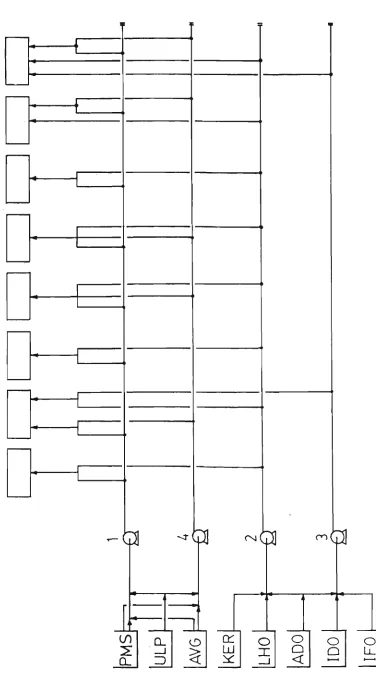
The distribution network studied is shown schematically in Figure 1.2
(page 25) and the main features of this system are described below.
1.3 Job Definition
In refinery jargon jobs are called "transfers", which are defined by the
following major attributes:
1. Offtaker, which is the customer who will receive the transfer.
2. Product. which is the type of material the offtaker will receive,
such as gasoline (petrol), jet fuel, diesel, etc.
3. Readv time, which is the time the product becomes available for
4. Due time, which is the time by which the customer expects to have
received all of the transfer.
5. Quantity, which is the amount of product the offtaker expects to
receive.
6. Priority, which is the relative importance of the transfer amongst
its peers.
These are discussed in the following sections.
1.3.1 Offtaker
The offtakers in this study are the major oil companies competing in the
Australian market place. Whilst it may appear illogical for a
marketer/refiner to supply its competitors, the transportation costs
resulting from Australia's geographical size encourage this form of
supply optimization. This arrangement allows each marketer to compete
in regions in which it does not have a refinery without transporting
products long distances from its manufacturing centre.
For example, if this arrangement did not exist, a company would need to
transport gasoline from its refinery on the west coast to sell in
eastern Australia, while another company would transport an equivalent
volume of the same product from its refinery in the east to sell on the
west coast. These bilateral and multilateral exchanges bring
significant benefits by minimizing needless transportation costs, and
also reduce the risk of accidents when bulk quantities of fuel are
housing the company's refinery that would otherwise arise due to a
transport logistics advantage (BTCE [15], p 3 5 ) .
Following rationalization of the industry there are now approximately 5
offtakers, operating 7 distribution terminals. However, when this study
commenced there were 7 offtakers operating 8 terminals, and prior to
this there were at least 9 offtakers operating 10 terminals.
1.3.2 Product
The products in this study are fuels, such as aviation gasolines
(avgas), motor gasolines (mogas or petrol), kerosene, jet fuel, light
heating oil, distillates, and residuals. Each of these categories
contains a number of different grades. This totals about 15 different
materials, each requiring segregation during storage and transfer.
1.3.3 Ready Time and Arrival Pattern
Transfers are sourced from product batches. Whilst oil refineries
operate continuously, products are blended in batches, with each batch
corresponding to the contents of a single tank. In this way the
required product quality can be guaranteed before the material is
released into the market. Most product grades can be sourced from more
than one tank. This allows certified product meeting sales quality
specifications to be transferred while unfinished product is blended for
the next batch.
Tank sizes are typically several times larger than transfer sizes,
tank batches. In each case this results in a static job arrival
pattern. The release time of each tank batch can be predicted in
advance, and the scheduler determines the transfers which will be
sourced from this batch. Hence the release times of the jobs sourced
from a single tank are clustered around the time the batch is released.
Judging which jobs should be sourced from each batch is a major problem
in itself, but is beyond the scope of this study. (The loading and
unloading of refinery tanks is examined by Christofides et al [17,18].)
1.3.4 Due Time
The due time for each transfer is set by negotiation between the
refinery (the supplier) and the offtaker (the receiver). Obviously the
priorities of the two parties are often different, and the offtaker must
compete with its peers for product and pipeline availability.
Late transfers incur penalties due to demurrage charges, which in the
case of coastal and international shipping are particularly severe.
Quite apart from these financial considerations, delays result in a
deterioration in customer relationships. These ultimately reduce the
customer's willingness to cooperate and affect the flexibility of the
system to meet demands.
Early transfers are not penalized, nor do they earn a credit to offset
1.3.5 Quantity and Processing Time
The quantity of each transfer is set by negotiation between the refinery
and the offtaker. A monthly plan, decided in advance by the respective
supply departments of the organizations involved in the exchange program
(not the refinery itself), allocates the monthly refinery production.
It is the scheduler's task to determine how and when this allocation is
provided. This must ensure an equitable distribution, so that
individual offtakers are not disadvantaged if potential production
problems disrupt supply and monthly targets are not achieved.
The specified transfer quantity is invariably fixed for each transfer
without appreciable tolerance for over or under supply. This is
principally due to the sourcing of transfers from tank batches of given
volume: allowing a tolerance on one transfer would imply a corresponding
tolerance on another transfer to balance the total batch quantity.
The processing time of a job is a function of the quantity transferred
and the processing rate of the pipeline used. Whilst the quantity of
the transfer is known the portion transferred by each operation
comprising the transfer is not known until the schedule is developed.
However, the pumping rate is known and fixed for each pipeline/offtaker
combination and hence the problem is deterministic in nature.
1.3.6 Priority
Transfers acquire priorities due to a niomber of factors. These include
the demand for particular product types (often a function of the
downstream distribution mode: for example, seaborne liftings involve
much higher demurrage penalties than road or rail. These priorities are
predominantly unquantifiable, but qualitative assessments are used to
meet the demands of the distribution system.
1.3.3 Number
The number of transfers processed each week (i.e. within the scheduling
horizon) varies significantly, due to a number of factors including
market demand, product availability and, quite possibly, the style of
the scheduler involved. Data collected over a 32 week period are given
in Appendix A and summarized in Table 1.1. These show that a typical
schedule involves on average approximately 40 jobs, although this may
range from about 25 to 50. This distribution is shown in Appendix A.
Pipelines 1 and 4 are grouped together because of their common service
(gasoline).
Table 1.1 Number of Jobs per Week
Pipeline
4 2 Total
Average Minimum Maximiom Variance
Std Deviat ion
1.4 Machine Definition
1.4.1 "Main" Pipelines
Four main pipelines link the refinery to the offtaker distribution
terminals. Each main pipeline is restricted to the type of products
which may be transferred through it, due to the suction pipeline
arrangement (described later) and by physical design. In addition, not
all pipelines connect the refinery to each of the distribution
terminals.
In the system studied two of the pipelines join prior to reaching a
number of the terminals. This restricts these pipelines to transferring
the same product type when transferring simultaneously to those
terminals located after the confluence. This is equivalent to these
pipelines sharing a common offtaker pipeline at each of these
distribution terminals, and is shown on the diagram as such.
Each pipeline has its own pump, although some pipelines share a spare.
Pipeline capacity (i.e. pumping rate) is a function of the main pipeline
and the offtaker to which the product is being pumped (principally due
friction losses over the distance pumped). Pipeline capacity is
effectively independent of the product type being transferred.
1.4.2 Pipeline Availability
The pipelines are usually available continuously, however, planned
shutdowns for maintenance and unplanned shutdowns due to equipment
schedules must take this into account. Unplanned shutdowns are rare,
due to the sparing of critical equipment such as pumps, but may last for
long enough to require revision of schedules to accommodate the lost
capacity, or lost flexibility.
1.5 Resource Definition
1.5.1 "Suction" Pipelines
The suction pipelines connect the refinery tanks to the main transfer
pipelines of the distribution network. (The pipeline network pumps draw
product through these pipelines and hence the term "suction") . No tank
is connected to all main pipelines, and some main pipelines share the
same suction pipelines. The main pipelines sharing the same suction
pipelines must therefore transfer the same tank contents, and hence same
product type, if they operate simultaneously.
1.5.2 "Offtaker" Pipelines
The offtaker pipelines connect the main pipelines to the offtaker
distribution terminals. Not all offtakers are connected to all main
pipelines and some offtakers use the same pipeline to connect their
terminal to more than one main pipeline. To maintain product integrity
each main pipeline must transfer the same product type if the offtaker
accepts transfers through a single offtaker pipeline simultaneously.
Due to piping and valving arrangements some of these offtaker pipelines
which connect multiple main pipelines cannot accept simultaneous
1.5.3 Offtaker Distribution Terminals
The offtaker distribution terminals receive the product transferred from
the refinery. The products are distributed from these terminals to the
market by road, rail and sea. Each terminal contains limited tankage
for each of the selected product types.
1.5.4 Offtaker Availability
One of the major factors affecting scheduling is that some offtakers are
only willing to receive product during specified periods, or windows.
These windows are typically a function of the day of the week. They can
be extended by the offtaker working overtime if mutually convenient.
Whilst this is obviously in the scheduler's interest, it may not be so
for the offtaker.
1.6 Assignment Definition
Three main types of job/machine assignment or flow pattern discipline
are recognized within the "machine shop" (French [3 0 ] , pl4) :
F the flow shop, in which the machine order for all jobs is the
same,
P the permutation job shop, in which the machine order for all
jobs is the same and the job order for each machine is the
same, and
G the general job shop, in which there are no restrictions on
Our study involves a special case of the general category: although jobs
may be processed on one or more machines (i.e. pipelines), the machines
are not identical and are not independent of each other. This
interdependency is due to common suction and offtaker pipelines and
prevents the problem being decomposed into sub-sets dealing with each
main pipeline in isolation. Hence at each point in the schedule the
technological constraints of the suction and offtaker pipelines must be
satisfied before the task of assigning jobs to machines can proceed.
1.6.1 Assignment Options
The offtaker and product define the job/machine assignments available
within the system, i.e. the particular pipelines on which the transfer
can be pumped. This in turn sets the requirement for resources, such as
the suction and offtaker pipelines needed to link the main pipelines
with the refinery and offtaker terminals.
1.6.2 Setup Times
Product integrity requires transfers of different product types to be
segregated appropriately to avoid contamination. In some systems this
is assisted by the use of "pigs" (solid devices which can pass through
the pipeline, placed between dissimilar products), although this
technique is not used in the network studied. Whether pigs are used or
not the interface between such transfers must be identified and the
pipeline purged until contaminants are reduced below an acceptable
level. This results in sequence dependent setup times which must be
The setup, or "lineclear", times are a function of the main pipeline and
the dissimilar product types involved. In the system studied this
pairwise interaction is most strongly dependent on the product about to
scheduled and for practical purposes the dependence on the initial
product is ignored. The setup times are not a function of the offtaker
receiving the transfer because all lineclears are transferred to one
terminal (that of the company operating the pipeline network).
The setup time between transfers of similar product, arising from
valving and tankage changes, are typically small in comparison to the
product transfer time and can be ignored.
1.6.3 Preeinptability
Transfers, once commenced, may be halted to allow higher priority
transfers to proceed, or satisfy some constraint, such as an offtaker
terminal closing for the night, or to switch to another pipeline to take
advantage of a higher processing rate. There is no limit to the number
of times a transfer may be preempted, although each preemption results
in some loss in processing capacity, due to the setup time involved.
1.6.4 Precedence Constraints
Precedence constraints are restrictions on the possible ordering of
jobs, due to either technological constraints (i.e. some physical
impossibility) or external policy. The are no general precedence
constraints in this system, although restrictions may intermittently
occur in which a defined ordering or transfers is required. This is
1.7 Performance Evaluation
1.7.1 Obj ectives
The objective of the schedule is not easily quantifiable in terms of any
economic function. The "cost" of a particular schedule is difficult to
define, and similarly does not necessarily measure what the scheduler is
trying to achieve. Instead, the scheduler's assessment of what
constitutes a "good" schedule, or whether one schedule is "better" than
another, is largely qualitative. Hence the main characteristics of
"good" schedules and the incentives for improving schedule quality need
to be examined to enable improvements to the existing method to be
measured. Indeed, whether an "optimal" schedule can be defined, and
whether optimality is needed or justified, should be reviewed.
In the system studied "good" schedules exhibit the following qualities.
They:
1. balance refinery production within ullage constraints,
2. satisfy offtaker product demands, and
3. maintain offtaker cooperation.
Each of these characteristics shall be examined briefly:
Balance Production
Refineries operate continuously and process large quantities of material
with limited storage capability. Plant start-ups and shut-downs are
time consuming, expensive and adversely affect product quality. Costs
dollars per day. Therefore, the main priority of the schedule is to
minimize any disruption to the refinery operation resulting from failure
to distribute product as quickly as it is manufactured.
Satisfy Demand
This involves supplying the required amounts of each product to each
offtaker when required to meet the demands of the market. However,
because the offtaker requirements may not necessarily match the
refinery's priorities in terms of quantity, type, timing or disposition
the differing priorities must be resolved in some mutually convenient
manner. This leads to the third goal:
Maintain Cooperation
Cooperation of all parties involved in the distribution system is
essential to smooth operation. Unsatisfactory performance on the part
of the scheduler, due to late deliveries or perceived bias during supply
shortages could potentially result in claims for damages. However, the
main manifestation of customer complaints would be in terms of future
inflexibility in receiving product transfers, significantly increasing
the already difficult task of producing feasible schedules.
1.7.2 Peirformance Measures
Each of the above qualities is difficult to quantify explicitly, or even
model implicitly through proxy measures. However, some parameters are
required to assist assessment of schedule quality.
The nature of the production balancing goal suggests a need to quantify
the facility could perform was maximized, providing of course that the
work was performed efficiently, and would reduce any likelihood of the
machines limiting refinery production.
The second and third goals imply a need to monitor customer satisfaction
and hence a measure of delivery performance is logical (other measures
may also be appropriate). Other considerations, such as product
quality, are seldom affected by delivery decisions in this system and
are beyond the scope of the scheduling problem.
1.7.3 Optimality Requirement
The discussion of the previous sections suggests that optimality is
likely to be elusive, not only due to the complexity of the scheduling
task, but also because the performance measures are not rigidly
definable. However, common sense suggests in any case that finding the
optimal solution is not required. Instead, what is sought is a "good"
solution, or solutions, which satisfy the requirements of the refinery
and offtakers in a reasonable manner. Thus what is required is the
ability to tell if a particular schedule meets the minimum requirements,
and, if having met these requirements, one schedule is better than
another. In addition, one needs to tell when to stop searching for
better solutions: from a practical standpoint there is no need to press
on with further improvement if the costs of doing so outweigh the
1.8 Current Approach
A brief description of the current approach is necessary to understand
the problems which initiated the need for this research.
The current method is a manual method which relies on the experience of
the scheduler to prepare workable solutions. By way of background the
scheduler is typically an engineer with
one
to two years experience with
the company following recruitment, usually immediately after graduation.
The person is generally assigned to the position for six to twelve
months before rotation into another area.
1.8-1 Tasks
The primary tasks of the scheduler are:
1. Plan blending of finished products from intermediate blendstocks.
2. Organize laboratory testing of finished blends for quality
certification.
3. Manage intermediate and finished product inventories.
4. Set job due dates in conjunction with offtakers, recognizing
refinery and offtaker priorities and constraints.
5. Allocate transfers to batches.
6. Schedule pipeline transfers.
7. Discuss schedules with field personnel prior to implementation.
Thus the scheduler is required to interact with a wide range of refinery
personal and customers in order to obtain the required information and
services to complete the scheduling task.
1.8.2 Preparation
The schedule is prepared with the aid of a Gantt chart. As discussed
earlier, the schedule is revised on a daily basis, and often more
frequently, for a seven day rolling horizon. The operational nature of
the job, combined with the 24 hour operation of the refinery, results in
occasional "out-of-hours" requirements for schedule revision. Hence the
appeal of a manual Gantt based method due to its portability. A typical
Gantt chart is shown in Figure 1.3 (page 2 6 ) , in which the product
transfers are shown as blocks with an internal arrow. This chart
demonstrates the high utilization of three of the four major pipelines.
Combined with the limited offtaker reception windows and physical
assignment constraints, this results in a difficult scheduling task.
Schedule preparation typically takes about three hours per day,
including offtaker liaison to set delivery requirements, for an
experienced scheduler. Schedulers are trained during a "handover"
period lasting about one to two weeks by the previous incumbent. This
involves explanation of "rules of thumb" found useful for efficient
operation, although scheduling techniques are developed by each
1.8.3 Implementation
Following preparation the schedule information is manually translated
from the Gantt chart into a format suitable for implementation in the
field by operators. A typical field schedule is shown in Figure 1.4
(page 2 7 ) .
1.8.4 Problems
The major problem with the current method is the length of time required
to generate suitable schedules. This leaves the scheduler little time
to evaluate the implications of each proposal, due to the frequency with
which revisions are required. Time constraints are such that often all
that is sought is a feasible operation. Very little time can be devoted
to improving what can sometimes be a poor solution to the operational
problems at hand.
The most serious ramification of a poor schedule is lost production.
This may not be manifested immediately, but may surface later due to
loss of operational flexibility. In addition, increased operating costs
due to labour overtime penalty payments may be incurred if transfers are
not confined to the offtakers' standard availability windows.
Obviously infeasible solutions cannot be accepted. The refinery's
production must be transferred to the offtaker terminals: only in
extreme circumstances would production be reduced to satisfy the
pipeline constraints. The scheduler simply must persist until a
feasible schedule is obtained. It is the time taken to achieve this
Schedule quality is a strong function of the experience of the
scheduler. Particularly during the initial learning phase, the novice
must devote an extreme amount of time simply to obtain a feasible
solution. This reduces the time available for other required tasks,
such as gasoline blending. The refinery is particularly vulnerable
during these periods to operational disruptions, whether resulting
directly from poor or inflexible schedules, or indirectly through
non-optimal performance to correct product quality deficiencies.
A further inefficiency of the current method is the manual transcribing
of data from the Gantt chart the scheduler uses, to the operating
instructions for the operations personal. Not only is the time
consuming, it increases the chances for errors, which may result
operational problems, such as poor system performance or product
contamination.
1.9 Previous Investigation
A Study of this pipeline scheduling problem was conducted (Young [75]),
in which a mixed integer programming (MIP) approach was used. Although
many of the technological constraints were able to be adequately
modelled, the computational complexity of the MIP method prevented
practical application. Solution times on even the smallest problems
were considered too long for practical use, in a position in which
efficient time management is crucial to meeting operational deadlines.
On larger problems solutions were sometimes unattainable due to rounding
In short, the MIP method was considered impractical for the size of the
problem and the solution frequency required. Even if the MIP method had
been successful from this point, a further difficulty was that the
method (at that time and probably still) required mainframe computing
facilities, and access to these would have been awkward, though probably
not impossible, when "out of hours" revisions were required.
1-10 Study Objectives
The objective of this study is to address the major problems currently
experienced. This can be defined as follows:
1. Reduce the schedule preparation time to allow more time for
evaluation of the solution.
2. Provide solutions at least as good as those generated manually by
experienced schedulers.
3. Reduce the dependence of the schedule quality on the experience of
the scheduler.
4. Achieve the above with a simple to use and simple to understand
system, providing practical and reliable performance, in a cost
effective manner.
The first and third objectives have been well discussed in preceding
sections. The second category, whilst initially obvious, raises a
performance measures have already been briefly discusses, and schedule
cfuality is reviewed within the context of the reported literature in
Chapter 2.
The final objective recognizes the user requirements of any installed
system. Unless the system makes make the scheduler's current job easier
it is unlikely to be used to its full potential. However elegant the
underlying mathematical model and good the final solution, if the user
doesn't feel comfortable with its predictions, or finds it unwieldy to
use, it will not fulfil its purpose. It is important to recognize that
any new system is not intended to replace, or reduce, the scheduler's
involvement in the scheduling process. Instead what is sought is an
improved tool to assist the user in the successful solution of the
Figure 1.2 D i s t r i b u t i o n Network
a
-^(Dl r^Ql ^(3
• * ,
LO Q_
a.
UJo
z:
o
Q <O
Q
O
Figure 1.3
Typical Gantt Chart
- — - 1 ;
^ • < :
S r
o «. > • .1 3 < 3 . LU
5:
LU U J »-•< v j
2 ^
' • - • — j " I ' l
~:
_ _ „ _
_J g
J .
O-r ' r 3 . 4 '
. . . r : .
1
— *"~ -——
..
^r-i
"i' ? ? •-s 1
-- i j ' ' f
-E . - " ^ ^
, .
? = r
-[ ,^
3 • • • *^ # "^ ' L
r . • - • 1 1
-1,
- . . 5^
t . «. "5 <
-.^r
. - .. -El. . 1
•• . / » ^
~
; ; . IN":
1 <
-r- r « - .
-^r • E
.H . . . . 1 ^
:•
r
- - 1
U - - \ - - S 3 ^ r
1..^ ' -
x^_... . . . . ^ — J.
,, 5
rTfv* 1*"
-(
T - •^ - - - J
. . . . . ^
Q
CO
. „ p , — J
-— (
K
. _
- • • •
-^ - 1
c ^ ^
-»m .. —
it •
-S r «
S I " • . -N C .;
^ ^ "...
« _ _____
^ s i
- T — T
~7> • • -- "> •—*
rti
' - ' ^ * N . - w ^'-K
... . .... .. _ -• ' .. .M _. . . - \3
> ! 1T-^U
^4
-—4 5 ^ —4
--i|li>_
- - I —
-.^.-I
._ _..-
1-...,'~L" _ 4I
-^ -^ -^• • - i —
o
: :
-If
• "-i^
---•-» a. ._ -- .B . . .
. UJ i.
-z.
o
1 -u.: i
- , ' I
— ^ .—
' — .
<
-'^~
• . .
• X
-• *
•.-——
_. 1 —
B.
•
*
— ( . - <
- • • • • - -_ ) *
1 ^
•— -•- JCX
* 5 .i
•S.X .... _
— •• •
• • •
J .
— • •<
-... . J M
-.m. ...
1 — ] —
. ^
'^ ti
..^ "
1
— • - . J k .
^ J
1'""•N " 7
.^ 0 o
-r
T
• — - 5 1 ^
-'• \~i_^ •
- \ 2 r^
C •<
• - —^=
-J r ... ^ ! —L . .. • — - —. -t t •• + »L 10 1^ X . ; ... . -V 1
^ n i
T'
* 1-H-—
1
-- • " £_
-• -•
o
-i «
o
• " •
1 1 -1 • + i 1 -^ __
1 '•
— - ^ - ^ - ^ . ^ , 1
•~ I
.:1_.
^, • ' \\ siO N i t
>^!t 1 1
Figure 1.4 Typical Field Schedule
NOV IS '88 09=23 P.R.fi.OLTOHfl 391 0790 P. 4/4
PETROLEUM l^liFINEHIKS (AUST) ALTONA KEFINERY
P I P E L I N E S C H E D U L E - vors.ion t w o (rip u p v e r s i o n 1 ) D A T E : E U I D A Y 1 1 / 1 1 — - > MONDAY 14/11
DAY PROD TANK COMPANY V O L U M E S & C O M M E N T S
N O . 1 L I N E Qtatic on ERIDAY FRIDAY static on SATURDAY I:ATURDAY SATURDAY SATURDAY PMS V6U V69 AVGAS P9 P9 PIO Pl(i 608 508 704 704 811 811 MOBIL MOBIL MOBIL MOBIL MOBIL MOBIL L/C 1000 L/C 2500 L/C 2800 see note KL see note KL KL s t a t i c o n PMS
NO. 4 L I N E F R I D A Y s t a t i c ERIDAY KRIDAY s t a t i c S A T U R D A Y S A T U R D A Y S A T U R D A Y S A T U R D A Y S U N D A Y
on on P7 PMS V6Ct V6'J AVGAl-P9 py Pl'O PIO PIO
808 C A L T E X 1500 K L
500 M O B I L 508 MOBIL 704 7 04 81i 811 811 MOBIL MOBIL M O B I L MOBIL CALTEX
L/C s e e note 1 1150 K L
L/C s e e n o t e 2 3000 KL
L/C 1200 K L 2 5 0 0 K L
NO. 2 LINE FRIDAY A?.l 812 BP A L T 0 4 0 KL I'KIDAY A21 8]?. CALTEX 9 2 0 KL
S A T U R D A Y A Z 2 700 MOBIL 34fi0 K L s e e note S U N D A Y A?.! 812 M O B I L L/C
SUNDAY ^?.\ 812 E S S O 2 0 0 0 K L SUNDAY • A23 812 MOBIL 3300 K L M O N D A Y .;30 G02 MOBIL L/C M O N D A Y J30 H02 MOBIL ' T O C A P A C I T Y
NO. 3 LINE FRIDAY
S A T U R D A Y S U N D A Y SUNDAY AZl A22 A21 A21 B12 AMPOL 7 00 M O B I L 812 MOBIL 812 MOBIL
850 K L 6 1 0 0 K L L/C 6000 K L
s e e n o t e 3
3 O M K R T 0 N L I N E
C O M M E N C E V O L
No t r a n s f e i ' s plrinnecl
PROD TANK PERCENT OWNERSHIP MOBIL : ESSO : BP : CTX
NOT]
Note 1. S t a r t AV'.IAS tr-^nr.f.jr as noon as lab h a s r e l e a s e d .
Note 2. Special, car^ro of P a d ric Inland P r e m i u m . L e t M o b i l know t,liat this In comLiiH down and miist be s e g r e g a t e d ,
Chapter 2 LITERATURE REVIEW
2.1 Introduction
The complexity of the general job shop scheduling problem is well
recognized (Conway et al [20] , p 102) and viable optimizing algorithms
for all but the simplest versions have yet to be found. Graves [35]
noted that actual scheduling environments are so variable that
classification is very difficult, and the inherent uniqueness generally
requires problem-specific solutions. He observed that a distinct lack
of correspondence exists between theory and practice, and concluded that
for complex settings the theory is often not sufficiently developed to
be immediately applicable.
Even prior to conducting a literature search the writer had reason to
doubt previous successful solution of similar pipeline scheduling
operations. First, the organization for which this study was carried
out is a major oil company operating globally. Despite involvement in
the oil industry for many years, a large research and development
organization, and refinery operations located in many countries, no
"better" practical methods beyond the existing manual method were in use
or known at the time. Secondly, the company's research and development
group involved in scheduling applications were not aware of any
competitor's developments in this area. And finally, no vendors had
offered products suitable for this scheduling task.
Therefore, one must ask why are better methods not generally available?
A number of reasons have been mentioned in Chapter 1. Graves' [35]
usually require situation-specific solutions and competitive
confidentiality prevents the disclosure of many methods. In addition,
personal computer facilities with sufficient processing capability have
only recently become available. Schedulers have been unwilling to grasp
computer based methods while access and ease of use have been
unsatisfactory. It will simply take time before suitable applications
are developed, and become available from the user's desk top.
By far the most predominant solutions are purely manually based
scheduling systems (Graves [35]). These systems rely primarily on the
expertise of experienced schedulers, who typically use nothing more than
graphical aids such as a Gantt chart. Schedule evaluation appears to be
qualitative and the dominant schedule evaluation criteria are schedule
feasibility and flexibility. Human understanding of the problem,
adaptability to new constraints and qualitative assessment of
conflicting priorities invariably produces good solutions to practical
problem instances, albeit after extensive human input.
The scheduling literature tends to concentrate on simple systems with
somewhat idealized constraints. This is understandable given the
inherent difficulty of many practical scheduling problems. However, the
assumptions introduced to make the problems tractable often render the
solution algorithm unsuitable for real world problems. Obviously
extensions to model certain practical aspects have been developed.
However, the writer has been unable to locate any reported computer
based method, which adequately handles all of the constraints and
In this chapter some of the methods which have been used to tackle
certain features of the problem at hand are examined. The aim is to
find a solution strategy (or strategies) worthy of further consideration
and which can be developed into a practical scheduling tool. This
review is not intended to be an exhaustive evaluation of alternative
methods to justify the "best" approach from a theoretical standpoint, if
in fact such an approach can be demonstrated. Instead, it provides a
brief investigation of general methodologies to assess their potential
suitability, and then examines reported approaches to specific
characteristics of the pipeline scheduling problem.
2.2 Manual Methods
One striking feature in the current literature is the lack of commentary
about manual scheduling methods. This is not perhaps surprising given
that it is primarily dissatisfaction with manual systems that leads
people to investigate alternative (computer based) methods.
Nevertheless, given the extent of use of manual methods it is important
to determine whether refinements to this method exist which are worth
considering.
As mentioned above, Gantt chart based methods appear to be the primary
manual tool. Their use is noted and briefly described in most basic
scheduling texts (Conway et al [20], French [30]). Clark [19] provides
a thorough explanation of the preparation and use of these charts for
scheduling and evaluation. Whilst his work discusses the range of
applications of Gantt methods to layout, load and progress charts, it
productivity improvement over those currently employed. His work,
however, emphasises that Gantt charts provide one of the best ways of
recording the developed schedule so that intelligent decisions can be
drawn from them.
One principal enhancement of manual Gantt charts has been to use them as
the the basis for computer graphics representations. In this way the
computer can be used to check adherence to technological constraints as
the jobs are moved about on the screen by the scheduler. One major
Australian airline currently uses this approach for flight scheduling.
Jones [48] discusses the extension of Gantt charts to 3 dimensions, a
feature made practicable by the introduction of computer graphics
software. Jones does not present better methods for determining the
schedule sequence, but concentrates on the improvement in problem
representation achievable with current technology. He noted that the
three dimensional chart was probably not useful by itself in helping
decision makers produce better schedules, but the ability to animate
sensitivity analysis would be extremely useful.
Akers and Freidman's graphical procedure is reported in most basic
scheduling texts (Conway [20, French [30]). Whilst the 2 job job-shop
problem is easily visualized (on 2-dimensional rectangular Cartesian
coordinates) , the extension of this method to more jobs, and hence
higher dimensions, is extremely unwieldy, and unsuitable for practical
use.
The prime advantage of manual methods is that the scheduler usually
recognized that the scheduler may have knowledge of scheduling
considerations which are impossible to capture within any given model of
the scheduling system (Baker [8] , p44) . As a result the scheduler is
usually able to produce good schedules. However, when the combinatorial
nature of the problem becomes too complex the human scheduler tends to
rely on simplifying rules of thumb. The real role of computer based
algorithms is to guide the user away from these rules when these rules
become non-optimal (Baker [8], p44),
2.3 Generic Numerical Methods
The lack of success with constructive algorithms (see Section 2.5) has
encouraged the development of enumerative and heuristic methods (French
[30]). Obviously, one approach to obtaining optimal solutions would be
to evaluate (that is, enumerate) all candidates and select the best
solution based upon some performance measure. The difficulty with this
approach is simply the enormous number of solutions possible for
problems of non-trivial size. French ([30], p 19,77) notes that
complete enumeration of the general job shop produces (n!)m candidate
solutions, where n is the number of jobs and m is the number of machines
available to process the jobs. Thus even reasonably small problems are
currently unsolvable using this method within reasonable time limits on
even the largest computers. Computational intractability therefore
forces us to adopt a more sophisticated approach. We shall briefly
review some enumerative methods which implicitly exclude non-optimal
2.3.1 Mathematical Programning Methods
2.3.1.1 Integer Programming
Several attempts have been recorded of recasting scheduling problems as
mathematical programs and in particular mixed integer programs (MIP).
The initial attraction of this approach is that once recast in this form
the problem may be solved by readily available standard algorithms, and
hence optimal solutions can be obtained. However, practical experience
shows that this approach is not promising.
Ccanputational K3q>erience
The standard mathematical programming algorithms currently appear to be
practical for only small problems (Garfinkel and Nemhauser [32] p387),
although this is changing with increases in computer processing power
and improvements in solution algorithms. However, the size of the
resultant MIP problem can often lead to time-consuming and erratic
behaviour of algorithm codes. As noted in Chapter 1, solution failure
due to numerical accuracy errors was observed in earlier pipeline
scheduling work (Young [75]), and solution times, when optimization was
achieved, were unsatisfactory from a practical standpoint. Darby-Dowman
and Mitra [22] note that the use of set covering, set partitioning and
set packing models has not been an unqualified success.
The main problem of the MIP approach is that no generalized method yet
exists to optimize large problems in a reasonable time period. Stepping
from standard linear programming (LP), in which all of the variables are
continuous, to MIP in which some of the variables take integer values,
Zionts ([76], p477) notes that at least with the present level of
technology, IP and MIP problems are many orders of magnitude more
difficult than LP problems. Added to this, he states that "just because
the words "Optimal Solution" appear on the printout does not mean that
the solution is optimal", nor does confirmation of this solution as the
optim\im by any other code. Most importantly, he notes that many
problems are formulated as IP problems because they can be, and not
because they should be.
Algorithms
Williams ( [74], p 155) discusses general methods of solving IP and MIP
problems, and Zionts ( [76], p 480) illustrates several techniques for
accelerating convergence. Garfinkel and Nemhauser ([32] p388) note that
algorithms based exclusively on cutting planes or implicit enumeration
without surrogate constraints have not, in general, been effective for
medium and large problems.
Land and Powell [51] and Tomlin [67] note that all commercially
available MIP codes use a form of "branch and bound" solution strategy
to work systematically through the integer variables. Invariably these
codes require the user to select the parameters which control the order
in which the integer variables are evaluated (IBM [41] ) . Haverly
Systems Inc. [39] (p 10.7) state that "no single strategy is best for
all models. In fact, little is known about the best strategy to use for
various types of models, or even how to classify models". Customization
is required to tune the computational strategy to the problem at hand.
Results can be unpredictable despite this tuning and the optimal
Formulation
Much work has been done on improving the performance of MIP as an
optimization technique, both in the area of problem formulation and
algorithm development. Johnson et al [43] present methods to assist in
the solution of MIP planning models, some of which could be applied to
scheduling applications. Their approach takes advantage of the
hierarchical structure of the integer variables and strengthens the
model formulation, enabling some previously insoluble problems to be
optimized. Bruvold and Evans [14] and Jeroslow and Lowe [42] present
approaches which reduce the number of required binary variables, which
eases the task of the MIP optimizer and increases the size of the
problems which can be successfully solved. Reported solution times for
both of these latter approaches were of the order of minutes for
problems with only a small number of integer variables.
Some of these techniques could be applied to the initial MIP model
constructed to solve this pipeline problem (discussed in Chapter 1 ) , and
possibly could enable the problem to be successfully optimized.
However, the relatively long solution times required would still
preclude using MIP as a practical scheduling tool for this situation.
2.3.1.2 Dynamic Programming
Dynamic programming (DP) has been investigated as a scheduling
technique, originating with the work of Held and Karp, and extended by
others (Conway et al [20]) . Its principle advantage over complete
enumeration is that it eliminates many possible schedules as it
appears limited to problems of up to about 25 jobs (French [30], p97) ,
too small for the pipeline problem.
Dimensionality
The restriction in job numbers is due to the rapid increase in
computational and storage requirements as the problem size grows. The
number of calculations is approximately proportional to n*2 (French
[30], p 9 7 ) . Additionally, at each stage of the optimization all of the
partially constructed schedules are stored until all of the problems at
the next stage have been solved. It is this storage requirement that is
probably the practical limit on problem size, rather than the amount of
calculation (Conway et al [20], p 6 5 ) .
Formulation
The introduction of precedence constraints may reduce the calculations
involved and hence enable problems with more jobs to be solved.
Similarly, the use of dominance conditions (elimination criteria) may
significantly reduce the solution difficulty. On the other hand this
tends to make substantial demands on storage requirements and hence
effectively limits DP to problems with less than 25 jobs (French [30],
pl02) .
2.3.1.3 Branch and Bound
Branch and bound (B+B) is a general purpose strategy that is widely used
for many combinatorial problems, such as in most commercially available
MIP optimization codes and as the basis for many heuristic methods, and
not just scheduling applications. Branching partitions the original
the optimal solution to curtail enumeration of non-optimal sub-problems.
The crux of successful methods is the order in which the sub-problems
are selected for evaluation and the efficiency of prvming sub-optimal
schedules.
The basic concept is shown in Figure 2.1. The problem is partitioned
into a number of sub-problems, termed nodes. The problem may be
visualized as a tree, with the branches representing the connection
between the parent node and successor (or child or offspring) nodes.
The first node is termed the root node and a node which has no
successors is called a terminal node.
Root Node
T T
T=terminal node
Ejcplanations of the basic methodology of the branch and bound method are
widely available (French [30], Conway et al [20] , Baker [5]). The
following section concentrates instead on the practical application of
this technique to the pipeline scheduling problem and discusses reported
limitations.
Graves (1981) [35] notes that all optimization approaches to the job
shop category appear to be B+B procedures. These procedures differ
primarily with respect to the branching rules employed, to the bounding
mechanism and bound generation. Despite the research conducted on the
method the largest problems reported to have been solved have involved
less than 10 tasks scheduled on less than 10 processors.
Branching
Barker and McMahon [11] concur that the most successful algorithms for
scheduling the general job-shop are of the B+B type. They note that two
classes of enumeration scheme may be distinguished. In the first an
operation is chosen to be scheduled adjacent to part of the schedule
already fixed. In the second branching takes place on the basis of some
conflict which seems important, where-ever it appears in the schedule.
In their approach (based upon the second class), each node contains a
complete schedule. The conflict resolution which takes place at each
node is not usually between two operations, but rather between one
operation and a block of several others.
Stinson et al [63] note that schedules rapidly become very large.
Therefore it is necessary whenever possible to prune away portions of
the tree, hopefully in its earlier stages of development. Potts and van
problems all available fast pruning devices should be used. Pruning
operations are done in two ways: by dominance priming and by lower bound
pruning.
DoBoinance Pzruning
Stinson et al [63] note that the most efficient implementation of
dominance pruning is by "left-shifting". Thus if any operation assigned
a start time in some partial schedule can be left shifted to an earlier
start time without violating a precedence or resource constraint the
partial schedule is dominated. This is easily visualized on a Gantt
chart.
Lower Bound Pruning
In lower bound pruning selected constraints are relaxed in order to
obtain a lower bound estimate of the objective value of the complete
schedule. The inclusion of the constraints can only serve to reduce the
quality of the objective value. Thus if the estimate to the relaxed
problem is greater than that of some other known complete schedule the
existing partial schedule can be pruned away.
Obviously the B+B tree is more effectively pruned with a stronger lower
bound. Stinson et al [63] note three types of lower bounds for multiple
resource constrained schedules:
1. precedence based, in which the lower bound is calculated by
ignoring any resource constraints, and hence the resulting schedule
2. resource based, in which precedence constraints are ignored and the
schedule duration is determined by the available resources required
by the remaining tasks, and
3. critical secfuence, in which precedence and resource constraints are
simultaneously taken into account.
In their approach all three lower bounds are calculated and the largest
of the three is taken to be the lower bound of the schedule.
Node Selection
The manner in which the tree develops is a function of the node
selection heuristic. Stinson et al [63] note that to some degree
pruning is enhanced through the rules which govern the manner in which
the tree is allowed to grow. They claim that the use of a single node
selection rule for very large problems may be of limited effectiveness.
This arises because in large trees many nodes may have the same lower
bound. They supported the use of a series of tie breaking rules, called
a decision vector, for selecting the next node from which to branch.
Their decision vector contained a combination of "look-ahead" and
"look-back" parameters, such a lower bounds and machine utilization
respectively.
Ccnputational Performance
Stinson et al [63] presented results for a number of project, flow shop
and job shop scheduling problems. Their results are probably not
directly applicable to the pipeline scheduling problem because it does
not contain the precedence relationships which figured prominently in