_____________________________________________________________________________________________________ *Corresponding author: E-mail: [email protected];
(Past name: British Journal of Medicine and Medical Research, Past ISSN: 2231-0614, NLM ID: 101570965)
The Knowledge and Acceptablity of Cervical Cancer
Screening amoung Female Students in University
for Development Studies (Uds) Tamale
Campus-Dungu
E. M. Der
1*, R. Aduah
2, B. M. Iddisa
2, G. A. Awinboya
2and N. V. Nakong
31
Department of Pathology, School of Medicine and Health Science, University for Development Studies (SMHS; UDS), Tamale, Ghana.
2Department of Nursing, School of Allied Health Science, University for Development Studies
(SAHS; UDS), Tamale, Ghana.
3Department of Midwifery, School of Allied Health Science, University for Development Studies
(SAHS; UDS), Tamale, Ghana.
Authors contributions
This work was carried out in collaboration between all authors. Authors EMD, RA, BMI and GAA conceptualized the study. Authors RA, MBI and GAA compiled and entered the data. Authors EMD, RA, BMI and GAA analysed the data. Authors EMD, RA, BMI, GAA and NVK drafted the manuscript. Authors EMD, RA, BMI, GAA and NVK read, edited and approved the final manuscript for publication.
Article Information
DOI: 10.9734/JAMMR/2018/40783 Editor(s): (1)Dr. Edward J Pavlik, Division of Gynecological Oncology, University of Kentucky Medical Center, USA. (2)Dr. Sevgul Donmez, Faculty of Health Sciences, Gaziantep University, Turkey. (3)Dr. Masahiro Hasegawa, Department of Orthopaedic Surgery, Mie University Graduate School of Medicine, Japan. Reviewers: (1)Diana C. Tapia-Pancardo, National Autonomous University of México, México. (2)Esther. O. Oluwole, University of Lagos, Nigeria. (3)Sandeep Singh, Netherlands. Complete Peer review History:http://www.sciencedomain.org/review-history/25780
Received 16th March 2018 Accepted 1st July 2018 Published 3rd August 2018
ABSTRACT
Adequate knowledge of cervical cancer and the patronage of available screening services in developed countries resulted in a drastic reduction in the morbidity and mortality associated with the disease. In Ghana, cervical cancer is the leading cause of gynaecological cancer-related deaths and this calls for early detection and treatment of the premalignant lesions. The aim of the study was to assess the knowledge and acceptability of cervical cancer screening practices among female
students. This was a cross-sectional descriptive study among female students in the Tamale campus of the UDS. Data was collected randomly using self-administered structured questionnaires. The analysis was done using SPSS Software. Statistical associations between variables were determined by Fisher’s exact test. A total of 300 students were interviewed with a mean age of 23.0 (SD ±2.4). Majority of the students were aware of cervical cancer 262 (87.3%, P<0.001), with the electronic media as the main source (37.7%). Many of the respondents identified the major risk factors of cervical cancer as multiple sexual partners (80.0%, P<0.001), HPV Infection (75.0%, P<0.001) and immunosuppression (71.0%,P<0.001). The great majority of the study population have never been screened for precancerous cervical lesions (91.3%, P<0.001). The reasons for the poor patronage of the screening services were lack of screening centres, the distant location of centres and the high cost of screening. The majority (77.7%, P<0.001) of the participants were willing to undergo screening in the future. The study revealed a high level of cervical cancer awareness among respondents, but low patronage of the available screening services. The majority were, however, willing to undergo the screening if the service is made accessible and affordable.
Keywords: Cervical cancer screening; knowledge; acceptability; premalignant lesions; Tamale-Ghana.
1. INTRODUCTION
Cervical cancer is the second most common cancer in women living in developing countries particularly the Sub-Sahara Africa [1,2,3,4]. In Ghana, it is the most common genital tract malignancy [5,6]. Cervical cancer historically is said to be a sexually transmitted infection [7,8]. Between the years 1974 to 1976, Harold Zur Hausen started to postulate and established the link between Human papillomavirus (HPV), particularly, the high-risk serotypes (16 and 18) and cervical cancer [7]. For his contribution in unraveling this link, he was conferred with 2008 Nobel Prize for Physiology and Medicine.
Studies have shown a drastic reduction in the incidence and mortality rates of cervical cancer in the developed countries where there is effective population-based screening programmes [9,10]. However, the incidences and mortality rates are on the rise in developing countries without effective population-based screening centres [11,12].
The awareness level of the disease, the risk factors, the accessibility and affordability
of screening services varies globally
[13,14,15,16,17]. For instance, risk factors such as early coitus, multiple sexual partners, multiparity, smoking and infection with high-risk HPV serotypes (16, 18, 31, 33) have been identified as inimical to the development of cervical cancer [15,18,19].
Increasing women's knowledge of cervical cancer and preventive health-seeking behaviour can have a great impact on cervical cancer incidence and mortality [15]. The uptake of preventive cervical cancer services is greatly
affected by knowledge of the disease. The aim of the study was to assess the knowledge and acceptability of cervical cancer screening among female students of the University for Development Studies (UDS), Dungu-Tamale in the Northern Region of Ghana.
2. MATERIALS AND METHODS
2.1 Study Site
This study was conducted in the Tamale Campus-Dungu of UDS in Sanerugu District in the Northern Region of Ghana.
Tamale Campus has an estimated population of 4,980 students. The main courses offered in UDS-Tamale Campus, Dungu are human biology, nursing, midwifery, community nutrition, health science education, and doctor of medical laboratory science. The academic calendar consists of three trimesters. This area was
chosen because of the age characteristics of the students, and also due to the wide
diversity of the socio-cultural background of these students.
2.2 Study Design
This was a cross-sectional descriptive study using quantitative methods (self-administered structured questionnaires) to gather data on cervical cancer from sexually active female students.
2.3 Target Population
2.4 Sampling Method
Purposive and simple sampling techniques were used to recruit participants.
2.5 Sample Size Estimation
The sample size for the study depended on the population, the confidence interval, the confidence level and the expected frequency. The sample size was determined using the Cochran formula.
N = Z2 x pq d2
Where:
N = required sample size, Z = Standard value of 1.96+, d = margin of error at 5%, q = 1-p,
p = prevalence of cervical cancer in Ghana is 24.6%.
Using above formula, the estimated sample size was 298.58 female students.
2.6 Data Collection, Analysis and
Presentation
Structured questionnaires (closed and opened-ended) designed based on the objectives of study were self-administered. Data were collected on the following; socio-demographic characteristics, knowledge of cervical cancer, the screening services and the acceptability of cervical cancer screening among respondents. Data were entered into and analysed using the Statistical Package for the Social Sciences (SPSS) version 23.0. Descriptive statistics and
associations (by Fisher’s exact test) between variables were determined. The results
were presented in the form of tables and a pie chart.
2.7 Ethical Consideration
Permission to conduct the study was obtained from the ethical committee of school authority. Written as well as verbal assurances were given to the respondents to withdraw from the study at any time they wished. Also, the respondents were assured of anonymity and confidentiality of information entrusted. Cultural values, norms and beliefs of respondents were duly respected and observed.
3. RESULTS
3.1 Socio-demographic Characteristics
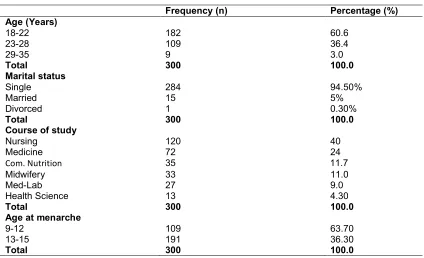
A total of 300 respondents were interviewed, age range of 18 - 35 years with a mean age of 23.0 years (SD±2.4) and modal age group of 18 – 22 years (60.6%). The great majority of the respondents were single and never married before 284 (94.7%). Most had their menarche between 13 - 15 years (63.7%) (Table1).
3.2 Knowledge on Cervical Cancer and Screening Programme
Majority of the female students had heard of cervical cancer {(87.3% vis-à-vis 12.7%) (P<0.001)} (Table 2). Many of the respondents had their information from the Television/Radio (37.7%).
For the risk factors of cervical cancer, respondents were provided with a list and asked to express their opinions (disagree or disagree). The study population agreed with the following: multiple sexual partners (80.0%), Human Papillomavirus (HPV) infection (75.0%), weakened immune system (71.0%) and early onset of sex activity (69.0%) as the most common risk factors for cervical cancer (P<0.001) (Table3). Approximately, 64.7% of the
respondents have never seen someone
diagnosed with cervical cancer (Table 3).
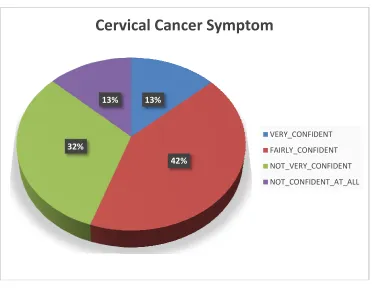
Respondents were asked if they would recognise a symptom of cervical cancer. A total of 126 (42.0%) respondents were fairly confident whiles 39 (13.0%) were not confident (Fig. 1).
The great majority of the respondents have heard of a cervical screening programme in Ghana 246 (82.0%, P<0.0001) (Table 4). A total of 127 (42.3%) knew of a vaccination programme in Ghana compared to 58 (19.3%) who were not aware of such a programme (P < 0.0001). Of those who have heard of the vaccination, only 40 (31.5%) gave the age for vaccination, while 87 (68.5%) did not know the age (P<0.0001) (Table 4).
3.3 Relationship between Knowledge of Cervical Cancer Screening and the Acceptabilityby Respondents
Table 1. The demographic characteristics of study population
Frequency (n) Percentage (%) Age (Years)
18-22 182 60.6
23-28 109 36.4
29-35 9 3.0
Total 300 100.0
Marital status
Single 284 94.50%
Married 15 5%
Divorced 1 0.30%
Total 300 100.0
Course of study
Nursing 120 40
Medicine 72 24
Com. Nutrition 35 11.7
Midwifery 33 11.0
Med-Lab 27 9.0
Health Science 13 4.30
Total 300 100.0
Age at menarche
9-12 109 63.70
13-15 191 36.30
Total 300 100.0
Table 2. Awareness of cervical cancer among respondents in Dungu campus
Frequency (n) Percentage (%) P-value Have you heard of cervical cancer?
Yes 262 87.3 <0.001
<0.001
No 38 12.7
Total 300 100
What was the source of your information
Newspaper 33 8.0
Women’s Magazine 34 8.3
TV/Radio 155 37.7
Internet 68 16.5
Somewhere Else 83 20.2
Have not seen or heard anything 38 9.2
Do you know any person with cervical cancer?
No 279 93.0
Yes 21 7.0
Family member 19 90.5
Close friend 2 9.5
Table 3. The knowledge level of respondents about the risk factors of cervical cancer
Risk factor Disagree (n/%) Agree (n/%) P-value
Infection with Human Papillomavirus (HPV) 75(25.0) 225(75.0) <0.001
Having a weakened immune system 86(28.7) 214(71.3) <0.001
Long term use of contraceptive pills 118(39.3) 182(60.7) <0.001
Infection with chlamydia 94(31.1) 206(68.7) <0.001
Starting to have sex at an early age 92(30.7) 208(69.3) <0.001
Having many sexual partners (current) 60(20.0) 240(80.0) <0.001
Having sexual partners with many previous partners
(91.3%, P<0.001) (Table 5). Participants who had undergone the screening were asked of their experience, majority said the procedure was painful (65.4%) (Table 5).
When respondents were asked if they would in the future go for screen for cervical cancer, the great majority said yes 233 {(77.7%) (P<0.001)}. Approximately 110 (36.7%) will recommend the screening for others, while 190 (63.3%) would not (P<0.001) (Table 5).
3.4 Factors Affecting Cervical Cancer Screening
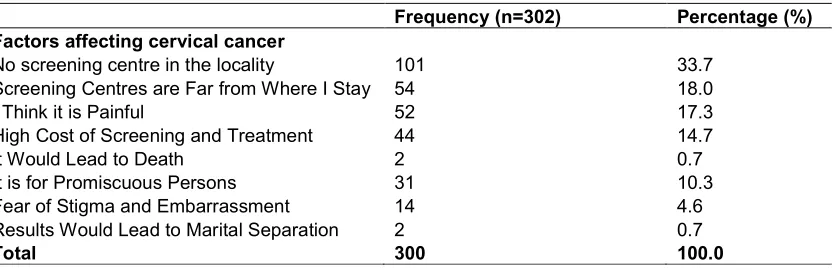
The first five factors militating against successful cervical cancer screening identified by the respondents in descending order were: lack screening centres in their locality (33.7%), the need to travel long distance for screening (18.0%), painful nature of the screening (17.3), high cost of screening (14.6%) and a test meant for promiscuous persons (10.3%) (Table 6).
4. DISCUSSION
In this current study, the respondents were very young (mean age of 23.0 years), with the great majority being single and never married before. This is similar to findings (mean age of 20.0 years) reported by Funmilayo et al. [12] study among medical students in Lagos, Nigeria. The age and marital status of respondents in this current study however differ from Opoku et al. [13] study among women attending the antenatal clinic at the Tamale Teaching Hospital in the northern region of Ghana, who reported a mean age of 28.0 years, with majority of the respondents being married women.
Increasing women knowledge of cervical cancer and preventive health-seeking behaviour can have a great impact on cervical cancer incidence and mortality.[14,15,16] The majority of the female students in this current study were aware of cervical cancer, similar to that reported in the Gabon among female university students.14 The similarity between these two studies is due to the fact that both were conducted among University students where majority of the respondents were offering health related courses. The respondents in this current study had adequate knowledge on the risk factors of cervical cancer. For instance, they identified HPV infection, early onset sexual active and multiple sexual partners as factors that increase a person’s chance of getting cervical cancer. This is in line with the findings of
other previous studies [15,17,18,19,20]. However, the high awareness level of cervical cancer in this current study differs from previous studies in Ghana that reported low awareness or the lack of knowledge about the disease among their study populations [16,21]. The disparity between the previous studies and the current study may be due to the different socio-cultural backgrounds of respondents. For instance, Ebu et al. [16] study was among market women in Accra while the current study was among University students. Also studies in Cameroon [19] and Hong Kong [20], which both looked at the socioeconomic status, sexual habits, prior knowledge of cervical cancer, its prevention, and their attitudes toward cervical cancer screening, among women,similarly revealed inadequate knowledge of cervical cancer and cervical cancer
screening practices among the study
populations.
In this current study, regarding the ability of the respondents to recognise a symptom or sign of cervical cancer, just a little above half (55.3%) were confident they could identify a symptom or sign of the disease. This is similar to the 54.8% reported in by Ghadeer et al. [22] study among Saudi female University students.
Table 4. The knowledge of the study population on cervical screening services
Frequency (n) Percentage (%) P-value Are you aware of any screening programme in Ghana?
Yes 246 82.2 <0.001
No 12 4.0
I don’t know 42 14.0
Are you aware of any vaccination programme in Ghana?
Yes 127 42.3 <0.001
No 58 19.3
Don’t know 115 38.4
Do you know the age at vaccination (years)?
Yes 40 32.5 <0.001
≤13 11 27.5
14 -– 17 11 27.5
≥18 18 45.0
No 87 68.5
Table 5.Respondents’ attitude towards cervical cancer screening
Frequency (n)
Percentage (%)
P-value Have you ever been screened before?
Yes 26 8.7 <0.001
No 274 91.3
What was your experience?
Painful 17 65.4
Time consuming 4 13.4
Embarrassing 3 11.5
Costly 2 7.7
Will you go for the screening in the near future?
Yes 233 77.7 <0.001
No 67 22.3
Will you recommend the screening to another female?
Yes 110 36.7 <0.001
No 190 63.3
Table 6. Factors affecting the participation of respondent in cervical cancer screening
Frequency (n=302) Percentage (%) Factors affecting cervical cancer
No screening centre in the locality 101 33.7
Screening Centres are Far from Where I Stay 54 18.0
I Think it is Painful 52 17.3
High Cost of Screening and Treatment 44 14.7
It Would Lead to Death 2 0.7
It is for Promiscuous Persons 31 10.3
Fear of Stigma and Embarrassment 14 4.6
Results Would Lead to Marital Separation 2 0.7
Total 300 100.0
promotion and intervention strategies would have a positive influence on cervical cancer screening in developing countries such as Ghana.
Fig. 1.Level of Confidence in identifying symptoms of cervical cancer
to undergo screening procedure in the near future, if these services are accessible and affordable. This may be attributed to the increased sensitization on cervical
screening and treatment through health teaching, brochures, televisions and radio programmes and the availability of screening services. This is thus in keeping with Coronado et al
Jamaica regarding future cervical cancer screening intentions among their respondents. This was also similar to Olive et al study in British Columbia, Canada [29]. However, previous studies conducted in Singapore, [25] West Africa, [26] South Africa [30] and Mexico [31] reported low future screening intentions among the study populations. For instance, Aniebue et al study in Nigeria among female undergraduates university students found that majority of the students had no intention in the near future to go for the screening. In Harries et al.
South Africa, it was reported that women have low intention for future screening because they believed the screening; particularly Pap smear will clean or scrap the womb and expose them to possible sexually transmitted infection. Again, Watkins et al. [31] study among Mexican
women identified discomfort, pain and
embarrassment as factor that discourages women from going for future screening. These
32%
13%
Cervical Cancer Symptom
Fig. 1.Level of Confidence in identifying symptoms of cervical cancer
to undergo screening procedure in the near if these services are accessible and . This may be attributed to the increased sensitization on cervical cancer screening and treatment through health teaching, brochures, televisions and radio programmes and the availability of screening services. This is thus in keeping with Coronado et al. [28] study in Jamaica regarding future cervical cancer ntentions among their respondents. This was also similar to Olive et al study in British However, previous [25] West Africa, [26] South Africa [30] and Mexico [31] reported ions among the study populations. For instance, Aniebue et al. [26] study in Nigeria among female undergraduates university students found that majority of the students had no intention in the near future to go . [30] study in South Africa, it was reported that women have low intention for future screening because they believed the screening; particularly Pap smear will clean or scrap the womb and expose them to possible sexually transmitted infection. Again, [31] study among Mexican
women identified discomfort, pain and
embarrassment as factor that discourages women from going for future screening. These
same sentiments were expressed by
respondents in this current study.
From the above studies, it is evident that there are many factors that affect a woman's acceptability of cervical cancer screening and such factors must be addressed in order to enhance uptake of screening services.
5. CONCLUSION
Cervical cancer screening is the major preventive measure that can be employed to significantly reduce the incidence of and mortality of the disease. This study revealed good knowledge level of cervical cancer among female students. Although the utilization of the screening among respondents was low partly due
beyond their capability, the great majority were willing to go for the screening services if these are accessible and affordable. There is a critical need to improve cervical cancer screening participation amongst female undergraduate students in Ghana.
6. RECOMMENDATIONS
1. There is still a need for the vigorous
campaign on cervical cancer and
13%
42%
Cervical Cancer Symptom
VERY_CONFIDENT
FAIRLY_CONFIDENT
NOT_VERY_CONFIDENT
NOT_CONFIDENT_AT_ALL
Fig. 1.Level of Confidence in identifying symptoms of cervical cancer
same sentiments were expressed by
evident that there are many factors that affect a woman's acceptability of cervical cancer screening and such factors must be addressed in order to enhance uptake of screening services.
Cervical cancer screening is the major preventive e that can be employed to significantly reduce the incidence of and mortality of the disease. This study revealed good knowledge level of cervical cancer among female students. Although the utilization of the screening among respondents was low partly due to reasons beyond their capability, the great majority were willing to go for the screening services if these are accessible and affordable. There is a critical need to improve cervical cancer screening participation amongst female undergraduate
There is still a need for the vigorous
campaign on cervical cancer and
FAIRLY_CONFIDENT
NOT_VERY_CONFIDENT
screening services through mass media and organised campus-based seminars to strengthen awareness and increase uptake of screening.
2. Stakeholders of health such as Ministry of Health (MOH) and Ghana health service should incorporate the cost of cervical cancer screening to the National Health Insurance Scheme (NHIS). Also, NGOs focused on women’s health should find funding options for this purpose.
3. The authorities of University for
Development Studies and other
Stakeholders should seek sponsorship to bring screening of cervical cancer to doorsteps of female students
4. Researchers have to do extensive studies in this area by giving emphasis to factors that influence utilization.
CONSENT
As per international standard or university standard written participant consent has been collected and preserved by the authors.
ETHICAL APPROVAL
As per international standard or university standard, written approval of Ethics committee has been collected and preserved by the authors.
COMPETING INTERESTS
Authors have declared that no competing interests exist.
REFERENCES
1. Murthy P, Li E, Azzam H,
Narasimhadevara A, Yezzo M. Cervical cancer mortality: A preventable tragedy. In Murthy P, Smith CL. (Eds.), Women’s global health and human rights,1st ed. Sudbury, MA: Jones & Bartlett Publishers. 2010;267–278.
2. Jemal A, Bray F, Center MM, Ferlay J, Ward E, Forman D. Global cancer statistics. CA: A Cancer Journal for Clinicians. 2011;61:69–90.
3. Benedict NL, Calys T, Joel Y, Ernest K, Nana A, Owusu A, et al. Profile of cancer patients’ seen at Korle Bu teaching hospital in Ghana (A cancer registry review) BMC Research Notes. 2014; 7:577.
DOI: 10.1186/1756-0500-7-577
4. Plummer M, de Martel C, Vignat J, Ferlay J, Bray F, Franceschi S. Global burden of cancers attributable to infections in 2012: A synthetic analysis. Lancet Glob Health. 2016;4:e609-16.
DOI: 10.1016/S2214-109X(16)30143-7 5. Nkyekyer. Pattern of gynaecological
cancers in Ghana. East Afr Med J. 2000; 77:534-538
6. Der EM, Kwame-Aryee RA, Tettey Y, Seffah JD, Wiredu EK, et al. Malignant tumours of the female genital tract: A 10-year histopathological review at the korle-bu teaching hospital (2002-2011). J Clin Exp Oncol. 2015;4:4.
Available:http://dx.doi.org/10.4172/2324-9110.1000146
7. zur Hausen H. Infections causing human cancers. Wiley-VCH, Weinheim – New York, Publ; 2006.
8. Bosch FX, Lorincz A, Muñoz N, Meijer CJLM, Shah KV. The causal relation
between human papillomavirus and
cervical cancer. Journal of Clinical Pathology. 2002;55:244–265.
Available:http://jcp.bmj.com/content/55/4/2 44
9. Siegel R, Naishadham D, Jemal A. Cancer statistics. CA: A Cancer Journal for Clinicians. 2013;63:11–30.
10. Owoeye IOG, Ibrahim IA. Knowledge and attitude towards cervical cancer screening among female students and staff in a tertiary institution in the Niger Delta. International Journal of Medicine and Biomedical Research. 2013;2:48–56.
11. Sankaranarayanan R, Budukh AM,
Rajkumar R. Effective screening
programmes for cervical cancer in low- and middle-income developing countries. Bull WHO, Suppl. 2001;79:954–962.
12. Adejuyigbe FF, Balogun RB, Sekoni OA, Adebukola AA. Cervical cancer and human papilloma virus knowledge and acceptance of vaccination among medical students in Southwest Nigeria. Afr J Reprod Health. 2015;191:140-148.
13. Opoku AC, LaryeaNii EB, Spangenberg K, Cheryl M, Kolbilla D, Gold JK. Perception and risk factors for cervical cancer among women in northern Ghana. Ghana Med J. 2016;50:84–89.
human papillomavirus infection in Gabonese women. BMC Women’s Health. 2015;15:37.
DOI: 10.1186/s12905-015-0193-2
15. American Cancer Society. Cancer Facts and Figures 2005. Atlanta: American Cancer Society; 2005.
16. Ebu NI, Mupepi SC, Siakwa MP,
Sampselle CM. Knowledge, practice and barriers toward cervical cancer screening in Elmina, Southern Ghana. International Journal of Women’s Health. 2015;7:31-39. DOI: 10.2147/IJWH.S71797
17. Castellsagué X, Díaz M, De Sanjosé S, Muñoz N, Herrero R, Franceschi S, Snijders PJF. Worldwide human papil-lomavirus etiology of cervical adenocar-cinoma and its cofactors: Implications for screening and prevention. Journal of the National Cancer Institute. 2006;98;303– 315.
18. Abotchie NP, Shokar KN. Cervical cancer screening among college students in Ghana: Knowledge and health beliefs. Int J Gynecol Cancer. 2009;19: 412–416.
DOI: 10.1111/IGC.0b013e3181a1d6de 19. Tebeu PM, Major AL, Rapiti E, Petignat P,
Bouchardy C, Sando Z, et al. The attitude and knowledge of cervical cancer by Cameroonian women. In J Gynecological Cancer. 2007;18:761–765.
20. Twinn S, Shiu S, Holroyd E. Women's knowledge about cervical cancer and cervical screening practice: A pilot study of Hong Kong Chinese women. Cancer Nursing. 2002;25: 377-384.
21. Adanu RMK, Seffah JD, Duda R, Darko R, Hill A, Anarfi J. Clinic visits and cervical cancer screening in Accra. Ghana Medical Journal. 2010;44.
22. Ghadeer KAS, Eman MA, Amel AF, Farida HK, Sadiqa BS, Tahani Nal. Knowledge of Saudi female university students regarding cervical cancer and acceptance of the human papilloma virus vaccine. Saudi Med J. 2014;35:1223–1230.
23. Ngoma T. World health organization cancer in developing countries. Annals of Oncology. 2006;viii9-viii14.
24. Mukakalisa I, Bindler R, Allen C, Dotson J. Cervical cancer in developing countries: Effective screening and preventive strategies with an application in Rwanda. Health Care for Women International, 2014;35:1065–1080.
DOI: 10.1080/07399332.2014.909433 25. Seow AL, Wong MS, Smith, Lee HP.
Beliefs and attitudes as determinants of cervical cancer screening: A community-based study in singapore. Preventive Medicine. 1995;24:134-41.
DOI: 10.1006/pmed.1995.1026
26. Aniebue PN, Aniebue UU. J Canc Educ. 2010;25:106.
Available:https://doi.org/10.1007/s13187-009-0023-z
27. Jia Y, Li S, Yang R, Zhou H, Xiang Q, Hu T, et al. Knowledge about cervical cancer and barriers of screening program among women in wufeng county, a High-Incidence Region of Cervical Cancer in China. PLoS One. 2013;8(7):e67005.
DOI: 10.1371/journal.pone.0067005 28. CoronaoI E, Anakwenze PC, Aung M, Jolly
EP. Increasing cervical cancer awareness and screening in Jamaica: Effectiveness of a theory-based educational intervention. Int. J. Environ. Res. Public Health. 2016; 13:53.
DOI: 10.3390/ijerph13010053
29. Ogilvie GS, Smith LW, van Niekerk DJ, Khurshed F, Krajden M, Saraiya M, et al. Women’s intentions to receive cervical cancer screening with primary human papillomavirus. Int. J. Cancer. 2013;133; 2934–2943.
30. Harriesa J, Moodleya J, Baroneb AM, Malla S, Sinanovic E. Preparing for HPV vaccination in South Africa: Key challenges and opinions. Vaccine. 2009;27:38–44. 31. Watkins MM, Gabali C, Winkleby M,
Gaona E, Lebaron S. Barriers to cervical cancer screening in rural Mexico. Int J Gynecol Cancer. 2002;12:475-9.
_________________________________________________________________________________
© 2018Der et al.; This is an Open Access article distributed under the terms of the Creative Commons Attribution License (http://creativecommons.org/licenses/by/4.0), which permits unrestricted use, distribution, and reproduction in any medium, provided the original work is properly cited.
Peer-review history: