Generative Models for Fast Calorimeter Simulation: the
LHCb case
Viktoria Chekalina1,2, Elena Orlova3, Fedor Ratnikov1,2,∗, Dmitry Ulyanov3, Andrey
Ustyuzhanin1,2, andEgorZakharov3
1NRU Higher School of Economics, Moscow, Russia 2Yandex School of Data Analysis, Moscow, Russia
3Skolkovo Institute of Science and Technology, Moscow, Russia
Abstract. Simulation is one of the key components in high energy physics. Historically it relies on the Monte Carlo methods which require a tremendous amount of computation resources. These methods may have difficulties with
the expected High Luminosity Large Hadron Collider (HL-LHC) needs, so the experiments are in urgent need of new fast simulation techniques. We introduce a new Deep Learning framework based on Generative Adversarial Networks which can be faster than traditional simulation methods by 5 orders of magni-tude with reasonable simulation accuracy. This approach will allow physicists to produce a sufficient amount of simulated data needed by the next HL-LHC
experiments using limited computing resources.
1 Introduction
Simulation plays an important role in particle and nuclear physics. It is widely used in de-tector design and in comparisons between experimental data and theoretical models. Tra-ditionally, simulation relies onMonte Carlo methodsand requires significant computational resources. In particular, such methods do not scale to meet the growing demands result-ing from large quantities of data expected durresult-ing High Luminosity Large Hadron Collider (HL-LHC) runs. The detailed simulation of particle collisions and interactions as captured by detectors at the LHC using a well-known simulation softwareGeant4annually requires billions of CPU hours constituting more than half of the LHC experiments’ computing re-sources [1, 2]. More specifically, the detailed simulation of particle showers in calorimeters is the most computationally demanding step.
A line of simulation methods that exploit the idea of reusing previously calculated or measured physical quantities have been developed to reduce the computation time [3, 4]. These approaches suffer from being specific to an individual experiment and, despite being
faster than the full simulation, they are not fast enough or lack accuracy. Thus, the particle physics community is in need of new faster simulation methods to model experiments.
One of the possible approaches to simulate the calorimeter response is usingdeep learn-ingtechniques. In particular, a recent work [5], provided evidence thatGenerative Adver-sarial Networkscan be used to efficiently simulate particle showers. While over 100,000× speed-up over Geant4is achieved, the setup was quite simple as the input particles were
CHEP 2018
parametrized by energy only. However, even in this simplified approach, there are significant differences in distributions between generated and original parameters.
In this work we build a model upon Wasserstein Generative Adversarial Networks and show its superior performance over approach [5]. We also evaluate our model in a more complex scenario, when a particle is described by 5 parameters: 3d momentum (px, py, pz) and 2d coordinate (x, y). Our method for high-fidelity fast simulation of particle showers in the specific LHCb calorimeter aims to replace the existing Monte Carlo based methods and achieve a significant speed-up factor.
2 Related work: GANs basics and GANs in HEP
Generative models are of great interest in deep learning. With these models, one can approx-imate a very complex distribution defined as a set of samples. For example, such models can be utilized to generate a face image of a non-existing person or to continue a video sequence given several initial frames. In this section, we give a brief overview of the most popular gen-erative model in computer vision — Gengen-erative Adversarial Networks (GANs), its strong and weak sides and different modifications to alleviate its weaknesses. Then, we review and
anal-yse current approaches for applying GANs to the simulation of calorimeters in High energy physics.
2.1 Background: from GAN to conditional WGAN
Generative Adversarial Networks (GANs) were originally presented by I. Goodfellowet al. in 2014 [6] and quickly became a state-of-the-art technique in areas such as image generation [7], with a huge number of extensions [8–10].
In the GAN framework, the aim is to learn a mappingG, usually calledgenerator, to warp an easy-to-draw distributionp(z) (e.g. p(z)=N(0,I)) into a target distribution pdata(x)
to facilitate sampling from pdata(x). WhenGis learned,G ≡G∗, sampling from the target
distribution pdata(x) is done by first drawing a sample from the distribution p(z) and then
feeding the sample into the generator: G∗(z) ∼ pdata, wherez ∼ p(z). For such sampling procedure, the time needed to draw a sample frompdata(x) is approximately equal to the time
needed to evaluate the functionGin a point.
The generator is learned by using a feedback from an external classifier (usually called discriminator), which tries to find discrepancy between the target distribution pdata(x) and
fake distributionpG(x) defined by samples from the generatorG(z)∼pG(x),z∼p(z). More formally, generatorGand discriminatorDplay the following zero sum game:
min
G maxD Ex∼pdata(x)[logD(x)]+Ex∼pG(x)[log(1−D(x))], (1) whereD(G(z)) is the output of the discriminator specifying the probability of its input to come from the target distributionpdata.
In practice, the mappingsGandDare parametrized by deep neural networks and the ob-jective Eq. (1) is optimized using alternating gradient descent. For a fixed generator, the dis-criminator minimizes binary cross-entropy in a binary classification problem (samples from pdataversus samples frompG). For the fixed discriminator, the generator is updated to make its samples to be misclassified by the discriminator, thus moving the fake distribution closer to the target distribution.
For a fixed generator, it is possible to show that the optimal value for the inner optimiza-tion can be written analytically:
max
parametrized by energy only. However, even in this simplified approach, there are significant differences in distributions between generated and original parameters.
In this work we build a model upon Wasserstein Generative Adversarial Networks and show its superior performance over approach [5]. We also evaluate our model in a more complex scenario, when a particle is described by 5 parameters: 3d momentum (px, py, pz) and 2d coordinate (x, y). Our method for high-fidelity fast simulation of particle showers in the specific LHCb calorimeter aims to replace the existing Monte Carlo based methods and achieve a significant speed-up factor.
2 Related work: GANs basics and GANs in HEP
Generative models are of great interest in deep learning. With these models, one can approx-imate a very complex distribution defined as a set of samples. For example, such models can be utilized to generate a face image of a non-existing person or to continue a video sequence given several initial frames. In this section, we give a brief overview of the most popular gen-erative model in computer vision — Gengen-erative Adversarial Networks (GANs), its strong and weak sides and different modifications to alleviate its weaknesses. Then, we review and
anal-yse current approaches for applying GANs to the simulation of calorimeters in High energy physics.
2.1 Background: from GAN to conditional WGAN
Generative Adversarial Networks (GANs) were originally presented by I. Goodfellowet al. in 2014 [6] and quickly became a state-of-the-art technique in areas such as image generation [7], with a huge number of extensions [8–10].
In the GAN framework, the aim is to learn a mappingG, usually calledgenerator, to warp an easy-to-draw distributionp(z) (e.g. p(z)=N(0,I)) into a target distributionpdata(x)
to facilitate sampling from pdata(x). WhenGis learned,G ≡G∗, sampling from the target
distribution pdata(x) is done by first drawing a sample from the distribution p(z) and then
feeding the sample into the generator: G∗(z) ∼ pdata, wherez ∼ p(z). For such sampling procedure, the time needed to draw a sample frompdata(x) is approximately equal to the time
needed to evaluate the functionGin a point.
The generator is learned by using a feedback from an external classifier (usually called discriminator), which tries to find discrepancy between the target distribution pdata(x) and
fake distributionpG(x) defined by samples from the generatorG(z)∼pG(x),z∼p(z). More formally, generatorGand discriminatorDplay the following zero sum game:
min
G maxD Ex∼pdata(x)[logD(x)]+Ex∼pG(x)[log(1−D(x))], (1) where D(G(z)) is the output of the discriminator specifying the probability of its input to come from the target distributionpdata.
In practice, the mappingsGandDare parametrized by deep neural networks and the ob-jective Eq. (1) is optimized using alternating gradient descent. For a fixed generator, the dis-criminator minimizes binary cross-entropy in a binary classification problem (samples from pdataversus samples frompG). For the fixed discriminator, the generator is updated to make its samples to be misclassified by the discriminator, thus moving the fake distribution closer to the target distribution.
For a fixed generator, it is possible to show that the optimal value for the inner optimiza-tion can be written analytically:
max
D Ex∼pdata(x)[logD(x)]+Ex∼pG(x)[log(1−D(x))]=JS(pdatapG), (2)
where JS is the Jensen-Shannon divergence. In fact, for the fixed generator (hence fixed fake distribution), the discriminator computes the divergence between the target distribution pdataand the fake distribution pG. When the divergence is computed, the generator aims to update the fake distribution to make this divergence lower: minGJS(pdata pG). While the Jensen-Shannon divergence naturally arises from the original game Eq. (1), any divergence or distanceDcan be used instead: minGD(pdata pG). A recent work [11] proposed to use the
Wasserstein distanceinstead of the Jensen-Shannon divergence proving its better behavior:
W(pdata pG)=max
f∈F Ex∼pdata(x)[f(x)]−Ex∼pG[f(x)] (3)
whereF is a set of 1-Lipshitz functions. Using the Wasserstein distance instead of the Jensen-Shannon divergence in the GAN objective leads to the Wasserstein GAN (WGAN) objective:
min
G maxf∈F Ex∼pdata(x)[f(x)]−Ex∼pG(x)[f(x)]. (4)
It is highly non-trivial to search over the set of 1-Lipshitz functions and several ways have been proposed in order to force this constraint [11, 12]. In Ref. [12], it is proved that the set of optimal functions for Eq. (4) contains such function, that the norm of it’s gradient in any point equals one. In practice, this result motivates an additional loss added to the objective Eq. (4) with a weightλ, while the hard constraint on the function fto belong to the setF is removed and f is searched over all possible functions:
min
G maxf Ex∼pdata(x)f(x)−Ex∼pG(x)f(x)+λEx∼pG
∇x˜D(˜x)2−12. (5)
WGAN can be easily adapted to model a conditional distributionpdata(x|y). The generator
is modified to take the condition along with the samplez so the fake distribution is now defined asG(z,y)∼pG(x|y),z∼p(z) and the game is
min
G maxf Ey∼p(y)
Ex∼pdata(x|y)f(x)−Ex∼pG(x|y)f(x)+λEx∼pG(x|y)∇x˜D(˜x)2−12
. (6)
2.2 GANs in high energy physics
A systematic study on the application of deep learning to the simulation of calorimeters for particle physics has been carried out by Paganini et al. in 2017 [5] and has resulted in the CaloGAN package. The authors aim to speed up particle simulation in a 3-layer hetero-geneous calorimeter using GANs framework and achieve∼ ×105 speedup. They used an
existing state-of-the-art but slow simulation engineGeant4to create a training dataset. They simulated positrons, photons and charged pions with various energies sampled from a flat distribution between 1 GeV and 100 GeV. All incident particles in this study have an initial momentum perpendicular to the face of the calorimeter. The shower in the first layer is rep-resented as a 3×96 pixel image, the middle layer as a 12×12 pixel image, and the last layer as a 12×6 pixel image.
CHEP 2018
images, where the sparsity level, energy per layer or total energy, are used as measures of the performance of the model.
The obtained results demonstrate a prospect of application of GANs for the particle show-ers generation and its replacement of the Monte Carlo methods with the proposed approach. The CaloGAN approach yields sizeable simulation-time speedups compared toGeant4.
3 Dataset
In this work, we focused on electrons interactions inside an electromagnetic calorimeter in-spired by the LHCb detector at the CERN LHC [15]. The calorimeter in this study uses "shashlik" technology of alternating scintillating tiles and lead plates. The prototype consists of 5×5 blocks of size 12 cm×12 cm, the cell granularity corresponds to each block being 6 ×6 of size 2 cm×2 cm. There are 66 total layers in ECAL, 2 mm lead absorber and 4 mm scintillator each. In fact, the shower appears in 3d, but all energies deposited in all scintillator layers of one cell are summed up. This procedure reproduced the actual shower energy collection in the calorimeter. Thus, the calorimeter response can be represented as 30 ×30 imagesYwith the corresponding parameters (px, py, pz, x, y) of the original particle. An example of such an image is presented in the top row of Fig. 3.
The training data set is created as follows. The calorimeter prototype structure described above is described inGeant4as a mixture of subsequent sensitive and insensitive volumes. Particles are generated using a particle gun. Particle energies are distributed dropping as 1/E in the energy range between 1 and 100 GeV. Particle positions are generated uniformly in the square 1×1 cm in the centre of the calorimeter face. Finally, particle angles are distributed normally with widths of 20 degrees inXZplane and 10 degrees inYZplane. ThenGeant4is used to simulate particle interaction with the calorimeter using the full set of corresponding physics processes. Information about every event, therefore, includes the original particle parameters accompanied by 30×30 matrix of energies deposited in scintillators for every cell towerY. Electrons are used as test particles. Produced training dataset contains 50 000 events, and another 10 000 events are used as a test data sample.
4 Our GAN model
Our idea is to treat simulations as a black-box and replace the traditional Monte Carlo simu-lation with a method based on Generative Adversarial Networks. As WGANs with gradient penalty are considered to be the state-of-the-art technique for image producing, we imple-ment a tool based on this approach. For it to be useful in realistic physics applications, such a system needs to be able to accept requests for the generation of showers originating from incoming particle parameters such as 3d momentum and 2d coordinate. We introduce an auxiliary task of reconstructing these parameterspx,py,pzandx,yfrom a shower image.
4.1 Model architecture
images, where the sparsity level, energy per layer or total energy, are used as measures of the performance of the model.
The obtained results demonstrate a prospect of application of GANs for the particle show-ers generation and its replacement of the Monte Carlo methods with the proposed approach. The CaloGAN approach yields sizeable simulation-time speedups compared toGeant4.
3 Dataset
In this work, we focused on electrons interactions inside an electromagnetic calorimeter in-spired by the LHCb detector at the CERN LHC [15]. The calorimeter in this study uses "shashlik" technology of alternating scintillating tiles and lead plates. The prototype consists of 5×5 blocks of size 12 cm×12 cm, the cell granularity corresponds to each block being 6 ×6 of size 2 cm×2 cm. There are 66 total layers in ECAL, 2 mm lead absorber and 4 mm scintillator each. In fact, the shower appears in 3d, but all energies deposited in all scintillator layers of one cell are summed up. This procedure reproduced the actual shower energy collection in the calorimeter. Thus, the calorimeter response can be represented as 30 ×30 imagesYwith the corresponding parameters (px, py, pz, x, y) of the original particle.
An example of such an image is presented in the top row of Fig. 3.
The training data set is created as follows. The calorimeter prototype structure described above is described inGeant4as a mixture of subsequent sensitive and insensitive volumes. Particles are generated using a particle gun. Particle energies are distributed dropping as 1/E in the energy range between 1 and 100 GeV. Particle positions are generated uniformly in the square 1×1 cm in the centre of the calorimeter face. Finally, particle angles are distributed normally with widths of 20 degrees inXZplane and 10 degrees inYZplane. ThenGeant4is used to simulate particle interaction with the calorimeter using the full set of corresponding physics processes. Information about every event, therefore, includes the original particle parameters accompanied by 30×30 matrix of energies deposited in scintillators for every cell towerY. Electrons are used as test particles. Produced training dataset contains 50 000 events, and another 10 000 events are used as a test data sample.
4 Our GAN model
Our idea is to treat simulations as a black-box and replace the traditional Monte Carlo simu-lation with a method based on Generative Adversarial Networks. As WGANs with gradient penalty are considered to be the state-of-the-art technique for image producing, we imple-ment a tool based on this approach. For it to be useful in realistic physics applications, such a system needs to be able to accept requests for the generation of showers originating from incoming particle parameters such as 3d momentum and 2d coordinate. We introduce an auxiliary task of reconstructing these parameterspx,py,pzandx,yfrom a shower image.
4.1 Model architecture
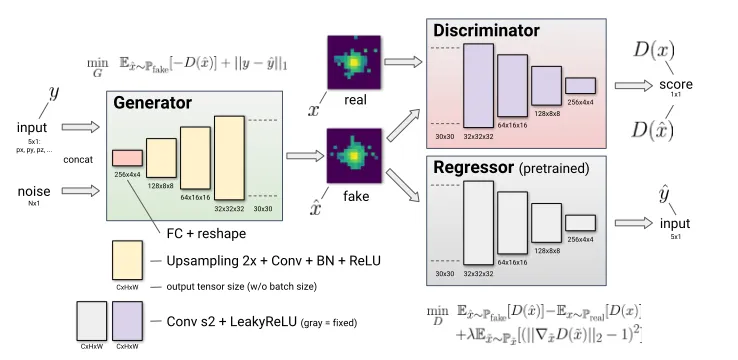
We need to generate a specific calorimeter response for a particle with some parameters. It means that the model is required to be conditional. Firstly, we describe a generator and dis-criminator architecture. The generator maps from an input (a 512×1 vector sampled from a Gaussian distribution and the particle parameters) to a 30×30 image ˆyusing deconvolu-tional layers (in fact, it is an upsampling procedure and convolutions) which are arranged as follows. We concatenate the noise vector and the parameters (px, py, pz, x, y), after which
we add a fully connected layer with reshaping and obtain a 256×4×4 output. After a se-quence of 2d deconvolutions, we get outputs of size 128×8×8, 64×15×16 and 32×32
Generator input
5x1: px, py, pz, ...
256x4x4 128x8x8 64x16x16 32x32x32 30x30 Discriminator 256x4x4 128x8x8 64x16x16 32x32x32 Regressor (pretrained) 256x4x4 128x8x8 64x16x16 32x32x32 real fake 30x30 30x30 score input 1x1 5x1
Upsampling 2x + Conv + BN + ReLU
Conv s2 + LeakyReLU (gray = fixed) CxHxW output tensor size (w/o batch size)
CxHxW CxHxW
noise
Nx1
Training scheme
FC + reshape
concat
Figure 1: Model architecture. Pre-trained regressor for the particle parameters prediction makes our model conditional. Thanks to building up the information from the ptrained re-gressor into the discriminator gradient we learnGto produce a specific calorimeter response.
×32 with ReLu activation functions. After this procedure, we crop the last output to obtain the image of the desired size 30×30.
As for the discriminator, it takes a batch of images as input (all images in the batch are real or generated byG) and returns the score D(y) orD(ˆy) as it is described in [11]. The discriminator architecture is simply the reversed generator architecture (i.e. sizes of layers go in the opposite order). It implies that we have a 30×30 matrix as input, from which we obtain output layers of size 32×32×32, 64×15×16, 128×8×8, followed by reshaping, which leads to 256×4×4, and by applying LeakyRelu activation function we get the final score. The model scheme is presented in Fig. 1.
How to train WGAN with gradient penalty in a conditional manner is described in the following section.
4.2 Training strategy
Due to the nature of WGAN loss, conditioning on the continuous value is a non-trivial task. To overcome this issue we suggest embedding a pre-trained regressor in our model. We train a neural network to predict the particle parameters by the calorimeter response. As for architecture, it has the same one as the discriminator but with a perceptual loss described in [16], because it was seen to work better compared to standard MSE. By building up the information from the pre-trained regressor into the discriminator gradient, we obtain the con-ditional model because we train the generator and the discriminator together. As a result, the discriminator makes the generator produce a specific calorimeter response.
CHEP 2018
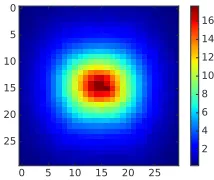
Figure 2: energy deposition in different cells of used 30×30 setup for Geant4 simulated events averaged over all events in the used dataset.
(a)
E0=63.7 GeV
(b)
E0=6.5 GeV
(c)
E0=15.6 GeV
(d)
E0=15.9 GeV
Figure 3: Showers generated withGeant4(first row) and the showers, simulated with our model (second row) for three different sets of input parameters. Color representslog10(MeVE ) for every cell.
5 Experiments
We start with comparing original clusters, produced by fullGeant4simulation and clusters generated by the trained model for the same parameters of the incident particles: the same energy, the same direction, and the same position on the calorimeter face. Corresponding images for four arbitrary parameter sets are presented in Fig. 3. These images demonstrate the very good visual similarity between simulated and generated clusters.
Figure 2: energy deposition in different cells of used 30×30 setup for Geant4 simulated events averaged over all events in the used dataset.
(a)
E0=63.7 GeV
(b)
E0=6.5 GeV
(c)
E0=15.6 GeV
(d)
E0=15.9 GeV
Figure 3: Showers generated withGeant4(first row) and the showers, simulated with our model (second row) for three different sets of input parameters. Color representslog10(MeVE ) for every cell.
5 Experiments
We start with comparing original clusters, produced by fullGeant4simulation and clusters generated by the trained model for the same parameters of the incident particles: the same energy, the same direction, and the same position on the calorimeter face. Corresponding images for four arbitrary parameter sets are presented in Fig. 3. These images demonstrate the very good visual similarity between simulated and generated clusters.
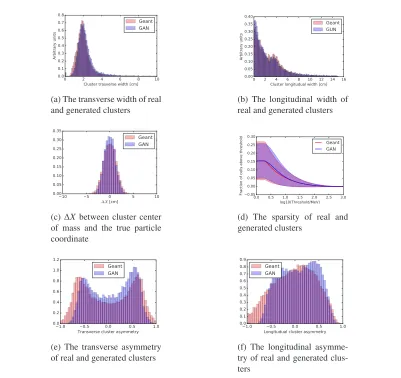
Then we continue with a quantitative evaluation of the proposed simulation method. While generic evaluation methods for generative models exist, here we base our evaluation on physics-driven similarity metrics. These metrics are designed using the domain knowledge and the recommendations from physicists on the evaluation of simulation procedures. For this presentation, we selected a few cluster properties which essentially drive cluster proper-ties used in the reconstruction of calorimeter objects and following physics analysis. If the initial particle direction is not perpendicular to the calorimeter face, the produced cluster is elongated in that direction. Therefore, we consider separately cluster width in the direction of
(a) The transverse width of real
and generated clusters (b) The longitudinal width ofreal and generated clusters
(c)∆X between cluster center of mass and the true particle coordinate
(d) The sparsity of real and generated clusters
(e) The transverse asymmetry of real and generated clusters
(f) The longitudinal asymme-try of real and generated clus-ters
Figure 4: Generated images quality evaluation including described physical characteristics.
the initial particle and in the transverse direction. Spatial resolution, which is the distance be-tween the centre mass of the cluster and the initial track projection to the shower max depth, is another important characteristic affecting the physics properties of the cluster. Cluster spar-sity, which is the fraction of cells with energies above some threshold, reflects the marginal low energy properties of the generated clusters. Finally, longitudinal and transverse asym-metries, which are differences in energies between forward-backwards and left-right sides of the cluster, characterise coherent energy variations. A comparison of these characteristics is presented in Fig. 4.
The primary cluster characteristics demonstrate good agreement with fully simulated data. However, secondary characteristics driven by long-range correlations between different cluster contributions might be significantly improved.
CHEP 2018
6 Conclusion and outlook
The research proves that Generative Adversarial Networks are a good candidate for fast sim-ulation of high granularity detectors typically studied for the next generation accelerators. We have successfully generated images of shower energy deposition with a condition on the particle parameters, such as the momentum and the coordinates, using modern generative deep neural network techniques such as Wasserstein GAN with gradient penalty.
Future work will be focused on improving reproduction of second-order cluster charac-teristics, such as variations and long-range correlations between different cells.
The research leading to these results has received funding from the Russian Science Foun-dation under agreement No 19-71-30020.
References
[1] C. Bozzi, Tech. rep., CERN-LHCb-PUB-2015-004 (2014) [2] J. Flynn, Tech. rep., CERN-RRB-2015-117 (2015)
[3] G. Grindhammer, S. Peters, arXiv preprint hep-ex/0001020 (2000)
[4] C. ATLAS, S. Yamamoto, M. Shapiro, J. Virzi, M. Werner, M. Venturi, M. Beckingham, E. Schmidt, T. Yamanaka, M. Duehrssen et al., Tech. rep., ATL-COM-PHYS-2010-838 (2010)
[5] M. Paganini, L. de Oliveira, B. Nachman, arXiv preprint arXiv:1705.02355 (2017) [6] I. Goodfellow, J. Pouget-Abadie, M. Mirza, B. Xu, D. Warde-Farley, S. Ozair,
A. Courville, Y. Bengio,Generative adversarial nets, inAdvances in neural information processing systems(2014), pp. 2672–2680
[7] A. Radford, L. Metz, S. Chintala, arXiv preprint arXiv:1511.06434 (2015) [8] P. Isola, J. Zhu, T. Zhou, A.A. Efros, arXiv preprint arXiv:1611.07004 (2016)
[9] J.Y. Zhu, T. Park, P. Isola, A.A. Efros, Unpaired Image-to-Image Translation using Cycle-Consistent Adversarial Networks, inComputer Vision (ICCV), 2017 IEEE Inter-national Conference on(2017)
[10] T.C. Wang, M.Y. Liu, J.Y. Zhu, G. Liu, A. Tao, J. Kautz, B. Catanzaro, arXiv preprint arXiv:1808.06601 (2018)
[11] M. Arjovsky, S. Chintala, L. Bottou, arXiv preprint arXiv:1701.07875 (2017)
[12] I. Gulrajani, F. Ahmed, M. Arjovsky, V. Dumoulin, A.C. Courville,Improved training of wasserstein gans, inAdvances in Neural Information Processing Systems(2017), pp. 5769–5779
[13] Y. Taigman, M. Yang, M. Ranzato, L. Wolf,Deepface: Closing the gap to human-level performance in face verification, inProceedings of the IEEE conference on computer vision and pattern recognition(2014), pp. 1701–1708
[14] L. de Oliveira, M. Paganini, B. Nachman, arXiv preprint arXiv:1701.05927 (2017) [15] A.A. Alves Jr. et al. (LHCb collaboration), JINST3, S08005 (2008)