_____________________________________________________________________________________________________
*Corresponding author: E-mail: [email protected];
www.sciencedomain.org
Immune-modulatory Effect of Ionizing Radiation on
Type 1 and Type 2 Immune Responses among
Workers in Cardiac Catheterization Units
Sahar Ali Farahat
1, Neveen Mansour
1, Marwa Sheta
2and Mona Abdallah Ramadan
1*1
Department of Occupational and Environmental Medicine,Faculty of Medicine, Cairo University, Egypt. 2
Department of Clinical Pathology, Faculty of Medicine, Cairo University, Egypt.
Authors’ contributions This work was carried out in collaboration between all authors. Authors SAF, NM and MAR designed and performed the study and wrote the first draft of the manuscript. Author MAR wrote the protocol. Author MS managed the analyses of the study. Authors MAR managed environmental measurements. Authors SAF and NM designed the patient files and managed the literature searches. All authors read and approved the final manuscript.
Article Information
DOI: 10.9734/BJMMR/2017/29663 Editor(s): (1) E. Umit Bagriacik, Department of Immunology, Gazi University, Turkey. Reviewers: (1) Heshu Sulaiman Rahman, University Putra Malaysia, Malaysia. (2)Huda M. Al Naemi, Hamad Medical Corporation, Qatar. (3)Nian Tuncel, Akdeniz University, Turkey. (4)Andras Szasz, St. Istvan University, Hungary. Complete Peer review History:http://www.sciencedomain.org/review-history/17153
Received 22nd September 2016 Accepted 7th November 2016 Published 7th December 2016
ABSTRACT
Introduction: It has long been known that ionizing radiation induced damage of the immune
system. However, substantial evidence suggests more varied effects of radiation on the immune system, prompting the re-characterization of radiation as ‘modulatory’ rather than immune-suppressive.
Objective: This study aimed at investigating the effect of occupational exposure to ionizing
radiation on the immune system, particularly the effect on the balance between type 1(Th1) and type 2(Th2) immune response.
Methods: A group of 47 cardiac catheterization workers (19 physicians,15 nurses and 13
technicians) and another 47 job, age, and sex matched controls were subjected to investigating the level of Th1 cytokines (IL2, INFγ), Th2 cytokines (IL10) and CD4%. Annual personal exposure was monitored by TLD (thermoluminescent dosimeter) readings over the last 3 years
Results: Dosimeter readings were within the acceptable level over the last three years preceding
to the study. There is statistically significantly higher level of Th1 cytokines (IL2, IFNγ) along with statistically significant lower levels of Th2 cytokines ( IL10) associated with lower CD4% among the exposed compared to control groups (P<0.05). Significant positive correlation was detected between the mean TLDs readings and each of IL2 (r=0.617 P<0.001) and IFN γ (r= 0.560 P<0.001). On the other hand, significant negative correlation was detected between mean TLDs readings and CD4% (r= -0.312 p<0.05). ANOVA and Post Hoc tests showed significantly higher level of Th1 cytokines with significantly lower levels of Th2 cytokines and CD4% among the
physicians compared to control group
Conclusion: Occupational exposure to low dose ionizing radiation induce switch of the immune
system to Th1 immune response.
Keywords: Ionizing radiation; immune-modulatory; Th1- Th2; immune response; TLDs.
1. INTRODUCTION
It is well known that occupational doses of radiation among interventional cardiology procedures are the highest doses registered among medical staff using X-rays [1-2].
The effect of ionizing radiation on the immune response has become one of the chief research fields in radiation biology and radiation protection [3]. The interrelationship between ionizing radiation and the immune system is multifactorial and highly depends on the radiation dose/quality and immune cell types [4]; However it results in changes in morphology and functional activity both at the cellular and system levels causing disturbance of immune reactivity whose final result is modulation of the immune system [5]. Several reports indicate that low dose ionizing radiation from natural sources [6] or occupational
exposure [7] may stimulate the immune system and potentiate its effector function, a
phenomenon called “Radiation Hormesis” [8]. Liu [4], has reported that the stimulation of immunity by low dose radiation(LDR) concerns most anti-cancer parameters, including antibody formation, natural killer (NK) and macrophage activity, secretion of cytokines as well as other cellular changes.
Cytokines, as the most important mediators by which cells of the immune system communicate, could be up- or downregulated by LDR [9]. Controversial results have been published concerning the effects of ionizing radiation on the Th1/Th2 balance and its impact on human health.
Th1 and Th2 cells are cross-regulatory in vitro,
and the balance of these cells in vivo determines the character of the cell-mediated immune and
inflammatory response. An imbalance between Th1 and Th2 may be responsible both for the
progression of several diseases and their resultant complications [10]. Organ-specific autoimmune diseases have been related to an overactive Th1 pathway, while, the Th2 pathway
may underlie allergy and systemic autoimmune diseases [11].
The impairment of cell-mediated immunity associated with the increase in the B-cell component and humoral immunity observed in atomic bombing survivors led to the hypothesis that radiation exposure could induce an imbalance towards a Th2 profile. The observed
increase in percentage of CD4-CD8-αβ+ double-negative T cells, known to produce primarily Th2
-type cytokines, supported the idea that ionizing radiation could induce a shift from a Th1 to Th2
response [12]. Reduced IL2 production in survivors was reported to be caused by a reduced number of native CD4+ T cells [13]. However, some investigators reported that a dose dependent increase in TNF-α and IFN-ɤ
production was observed in atomic bombing survivors, suggesting that Th2 does not dominate
over Th1 [14].
There is much controversy about the effects of chronic low-dose exposure to ionizing radiation and the possible consequences particularly in occupational exposure for that we try estimate the balance between Th1 and Th2 cytokines to reflect the immune response with chronic exposure to low dose radiation.
1.1 Aim of the Study
system, particularly the effect on the balance between type 1(Th1) and type 2(Th2) immune response.
2. MATERIALS AND METHODS
This cross sectional study was carried out on the cardiac catheterization team members working in one of major public cardiac hospitals located in Giza governorate, Egypt during the period from March 2014 to April 2015. All eligible personnel were invited to participate in the study. Eligibility criteria for ionizing radiation exposed subjects included regular employment in the catheterization department for at least the preceding 5 years with exclusion of those having (immunosuppressive disease, intake of immunosuppressive drugs or receiving radiotherapy). Those who met the inclusion and exclusion criteria and agreed to participate were 47 (31 males and 16 females). For the purpose of the study, exposed group was further subdivided into professional activity as19 cardiologists, 15 nurses and 13 technicians. A control group of 47 individuals were selected as to be matched with the exposed population as regards age, gender and special habits of medical important. They were selected from clinical pathology department with no history of exposure to ionizing radiation, intake of immunosuppressive drugs or receiving radiotherapy. The control group consisted of 14 physicians, 18 nurses, 15 technicians.
2.1 Assessment of Exposure
The occupational effective radiation dose received by each exposed personnel was annually assessed using one Thermoluminescent Dosimeter (TLD) worn under the apron at the waist level. Each TLD was with unique identification number and regularly read every 4 months over the years 2012-2014. The dose assessment of participants was based on these values.
2.2 Questionnaire and Clinical
Examination
Every subjects in the study, was subjected to a specially designed detailed questionnaire including medical history, personal, present, past, family, occupational, menstrual and obstetric history. General and local systemic examinations were carried out with special attention to acute and chronic long term effect of radiation.
2.3 Ethics Approval
All procedures were in compliance with the declaration of Helsinki and an informed consent was given by all participants. Participants voluntarily joined the study, and an approval from internal ethics committee (Occupational and Environmental Medicine) was obtained. Confidentiality of the data was followed.
2.4 Laboratory Investigations
A blood sample of 5 ml was drawn from each subject through venipuncture from the arm using a dry plastic syringe. The 2 ml of blood was delivered into a clean tube containing disodium ethylene diamine tetra acetate (EDTA), mixed promptly for determination of CD4 percentage, the remaining 3 ml was allowed to clot then centrifuged for separation of the serum for determination of interleukin 2 and interleukin 10 as well as interferon gamma.
2.4.1 Measurement of CD4 concentration
Detection of CD4 in human blood lymphocytes by flow cytometry. The FACScan (Becton Dickinson) was used to determine peripheral blood T regulatory lymphocyte CD4 percentage.
2.4.2 Measurement of IL2, IL10 and IFNγ
By using Boster’s human ELISA Kit for quantitative detection of human IL2, IL10 and IFNγ in serum according to [15].
2.5 Statistical Analysis
Data were analyzed using SPSS [Statistical Package for the Social Sciences] program 15. The mean values, standard deviation (SD), median and ranges were then estimated for quantitative variables, as for the qualitative variables, the frequency distribution was calculated.
Comparisons between exposed and control groups were done using Chi Square (X2) test for qualitative variables and using the independent simple t-test for normally distributed quantitative variable as well as the analysis of variance (ANOVA test) after normality of all Quantitative variables. The non-parametrical Mann-Whitney (Z-test) was used for quantitative variables not normally distributed .
variables. P-values less than 0.05 and less than 0.001 were considered statistically significant and highly significant, respectively.
3. RESULTS
The results of the present study showed that there were no statistically significant differences between the exposed and the control group as regards age, gender, duration of employment and smoking.
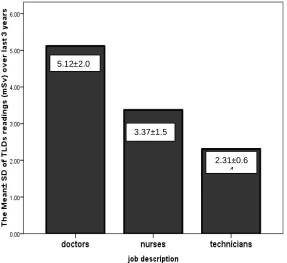
The effective doses for the cardiac catheterization team according to their TLDs readings over the three successive years was the highest for physician followed by nurses while technicians had the lowest reading (Fig. 1).
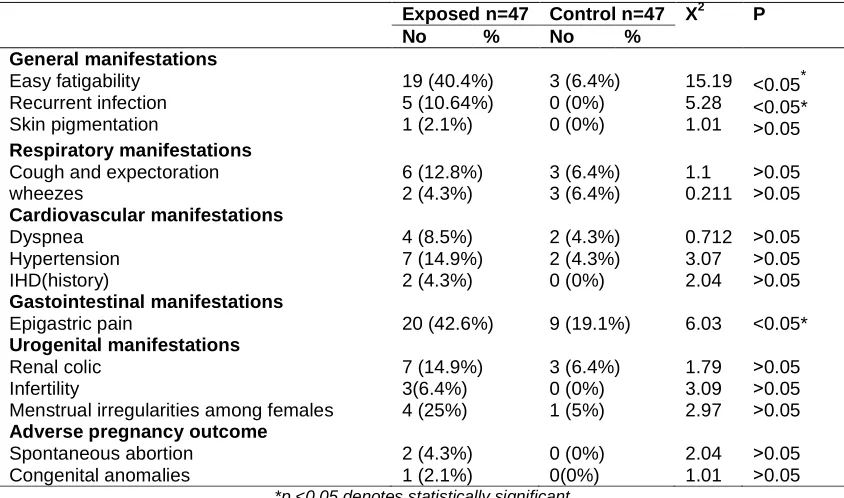
According to history taking and clinical examination there was a statistically significant difference regarding easy fatigability, recurrent infection and epigastric pain among the exposed group compared to control group. No significant difference was detected between both groups concerning the frequency distribution of other symptoms (Table 1).
Our results concerning the mean ±SD of male and female offspring revealed lower number of
male offspring among exposed group compared to their controls (Table 2).
Estimation of some immunological parameters revealed that the levels of CD4% and IL10 were statistical significantly lower among the exposed group compared to the control. A significant increase in the level of IL2 and IFNγ among the exposed was also detected (Table 3).
Our results showed a significant positive correlation between the mean TLDs readings and Th1 cytokines (IL2 and IFNγ). On the other hand there was a significant negative correlation between the mean TLDs readings and CD4% (Table 4).
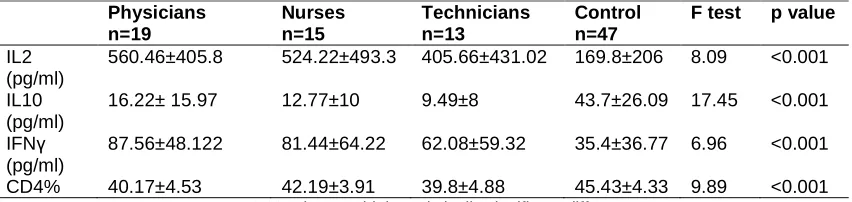
ANOVA test showed that there is a statistical significantly difference regarding IL2, IL10, IFNγ
and CD4% among the different job categories of the studied groups (Table 5). Post Hoc test showed the presence of a statistical significant difference between physicians and control as regards IL2, IL10, IFNγ and CD4% (p<0.001). Also, it reveals a statistically significant difference between nurses and control as regards IL2, IL10 and IFNγ (p<0.001). Further, there was a statistical significantly difference between technicians and control for IL10 and CD4% (p<0.001)
Fig. 1. The mean± SD of TLD readings in (mSv) among different categories of exposed groups over years 2012, 2013 and 2014
5.12±2.0
3.37±1.5 4
Table 1. The frequency distribution of different clinical parameters according to history taking and clinical examination among the studied groups
Exposed n=47 Control n=47 X2 P
No % No %
General manifestations
Easy fatigability Recurrent infection Skin pigmentation
19 (40.4%) 5 (10.64%) 1 (2.1%)
3 (6.4%) 0 (0%) 0 (0%)
15.19 5.28 1.01
<0.05* <0.05*
˃0.05
Respiratory manifestations
Cough and expectoration wheezes
6 (12.8%) 2 (4.3%)
3 (6.4%) 3 (6.4%)
1.1 0.211
˃0.05
˃0.05
Cardiovascular manifestations
Dyspnea Hypertension IHD(history)
4 (8.5%) 7 (14.9%) 2 (4.3%)
2 (4.3%) 2 (4.3%) 0 (0%)
0.712 3.07 2.04
˃0.05
˃0.05
˃0.05
Gastointestinal manifestations
Epigastric pain 20 (42.6%) 9 (19.1%) 6.03 <0.05*
Urogenital manifestations
Renal colic Infertility
Menstrual irregularities among females
7 (14.9%) 3(6.4%) 4 (25%)
3 (6.4%) 0 (0%) 1 (5%)
1.79 3.09 2.97
˃0.05
˃0.05
˃0.05
Adverse pregnancy outcome
Spontaneous abortion Congenital anomalies
2 (4.3%) 1 (2.1%)
0 (0%) 0(0%)
2.04 1.01
˃0.05
˃0.05
*p <0.05 denotes statistically significant
Table 2. Mean±SD of males and females offspring among exposed and control subjects
Exposed n=47 (Mean±SD)
Control n=47 (Mean±SD)
z p value
Male offspring among males
0.645±0.66 1.59±0.84 4.06 <0.001*
Female offspring among males
1.096±0.87 0.888±0.8 0.883 ˃0.05
* P <0.001 denotes high statistically significant difference
Table 3. Mean±SD of some immunological parameters (CD%, IL2, IL10 and IFNγ) among exposed and control subjects
Exposed n=47 Control n=47 Z p value
IL2 (pg/ml) 506.07±437.2 169.8±206.1 2.919 <0.05* IL10 (pg/ml) 13.26±12.44 43.7±26.09 6.602 <0.001** IFNγ (pg/ml) 78.56±57.8 35.4±36.77 3.509 <0.001** CD4% 40.71±4.47 45.4±4.33 5.194# <0.001**
# t- test; ** P <0.001 denotes high statistically significant difference; *p <0.05 denotes statistically significant
4. DISCUSSION
The radiation dose received by the members of interventional cardiac catheterization team can vary by the type of procedure and given patient dose [16]. In this work, annual cumulative exposure dose of the exposed group was assessed using the annual TLDs readings over the last 3 successive years preceding the current
Table 4. Correlation coefficient between mean TLDs readings over the last 3 years on one
hand and CD4%, IL2, IL10 and IFNγ on the other hand among exposed group
The mean TLDs readings over the last 3 years (3.785±1.96)
R p value
CD4% -0.312 <0.05* IL2
(pg/ml)
0.617 <0.001**
IFNγ
(pg/ml)
0.560 <0.001**
IL10 (pg/ml)
-0.11 ˃0.05
** P <0.001 denotes high statistically significant difference; *p <0.05 denotes statistically significant
Unfortunately, our study subjects only use single dosimeter under the apron at the waist height to measure the effective dose whose mean ±SD over three successive years was the highest for physicians (5.12±2.03 mSv) (range 2.03-9.03 mSv) followed by nurses (3.37±1.54 mSv) (range 1.53-6.33mSv) while technicians had the lowest readings (2.31±0.64 mSv) (range 1.3-3.2 mSv). This difference is probably due to their different nature of duties and daily working hours. These readings were in the normal range stated by ICRP 2007, the effective dose limits of whole body exposure to ionizing radiation for occupational workers during the five year block to be 100mSv with an average of 20 mSv/year and shall not exceed 50 mSv in any single year.
A similar pattern of measurements was reported by Chida et al. [19], who studied the annual occupational dose for interventional radiology staff; physicians, nurses and technicians. They showed that the annual occupational dose was in order physician˃ nurses˃ technicians. However,
the radiology staff in the later study, were wearing two dosimeters with strict adherence to radiation protection measures.
Comparable effective dose estimation was reported among workers in nuclear institute of medicine and radiotherapy, Jamshoro Pakistan, using film badges where readings were in the range of 1.21 to 7.78 mSv/year [20]. In Kenya, Korir et al. [21] estimated the average annual occupational effective doses for all medical radiation workers to be ranged from 1.19 to 2.52 mSv/year.
As regards history taking and clinical examination of the studied population, none of the studied groups showed significant differences concerning cardiovascular, respiratory, reproductive and urinary systems. These results agreed with an earlier study done by Vrijheid et al. [22]. When they used data from nuclear reactor workers in many countries to evaluate whether the mortality from diseases other than cancer is related to low doses of external ionizing radiation or not. They found that there was no increased risk of circulatory disease as a result of radiation exposure. They added that the increased risk of respiratory and digestive systems affection reported was attributed to confounding factors such as smoking and alcohol consumption. It was concluded that there was a little evidence for the relation between mortality from non-malignant diseases and low doses of external radiation received by workers in the nuclear industry.
However, Zielinski et al. [23] studied the relation between low dose ionizing radiation exposure and cardiovascular disease (CVD) mortality among Canadian radiation workers. They showed a strong positive association between radiation dose and risk of CVD mortality.
Table 5. ANOVA of mean± SD of immunological parameter (IL2, IL10, IFN γ and CD4%) among the different categories of the studied groups
Physicians n=19
Nurses n=15
Technicians n=13
Control n=47
F test p value
IL2 (pg/ml)
560.46±405.8 524.22±493.3 405.66±431.02 169.8±206 8.09 <0.001
IL10 (pg/ml)
16.22± 15.97 12.77±10 9.49±8 43.7±26.09 17.45 <0.001
IFNγ
(pg/ml)
87.56±48.122 81.44±64.22 62.08±59.32 35.4±36.77 6.96 <0.001
CD4% 40.17±4.53 42.19±3.91 39.8±4.88 45.43±4.33 9.89 <0.001
Regarding adverse urogenital and reproductive outcome, results showed no statistically significant difference between exposed and control groups (P˃0.05). Similar results were reported by Roman and his colleagues [24], when they found no increased incidence of infertility, menstrual disturbance, abortion or congenital anomalies among medical radiographers. However, an increased prevalence of neural tube defects in infants related to occupational exposure of parents to ionizing radiation before conception was reported [25]. The possibility that low dose exposure of parents could cause adverse reproductive outcome is of growing interest. Unfortunately, studies evaluating the effects of occupational exposure to ionizing radiation and congenital anomalies as an adverse reproductive outcome in humans are very limited.
On evaluating the personal history taken from exposed group there was a significant decrease in the number on male offspring compared to the control group with insignificant higher female offspring among exposed group. This result was in resemblance with Hama et al. [26], who reported that radiation exposure among male radiologists was associated with a significantly higher proportion of female offspring.
There was a statistically significant higher prevalence of easy fatigability and epigastric pain among exposed group compared to the control group (P<0.05). This epigastric pain can be explained by radiation induced inflammation and damage of the gastric mucosa and the production of reactive oxygen/nitrate leading to the induction of apoptosis, mucosal breakdown and activation of pro-inflammatory cytokines in the microvascular and mucosal compartment [27].
This was in agreement with the results of Saleh et al. [28], who studied the immunological effect of IR on health care providers of nuclear medicine unit at Assiut university hospital. They found a high prevalence of gastritis among exposed group. They explained this by radiation induced inflammatory changes and damage of blood vessels.
On estimation of CD4% level in our study, there was a statistically significant lower level of CD4% T lymphocytes among exposed group compared to the control (P<0.001). This decrease was significant among physicians (40.17±4.53) and technicians (39.8±4.88) compared to controls
(45.43±4.33). However, the observed variations in some cases could not be attributed only to the radiation exposure because of the impact of a number of other exogenous and endogenous factors on the immune system [3].
On analysis of the effect of immune status on the morbidity of the studied group, results revealed an increased frequency of recurrent infection among exposed group compared to. The observed results tend to be due to significant reduction of CD4% leading to serious consequences including risk for infection and cancer [29]. Similarly, these findings were matched with a study conducted by Ben and Emelia [30] to test the effect of radiation on the human immune system. They found higher infection rates in people exposed to radiation for long duration at low doses. This is also matched with another study which found an increase in the prevalence of the respiratory tract infection among children living around Chernobyl. This finding can be explained by the long term low dose exposure of the whole body to radiation [31]. In addition, the levels of CD4 T lymphocytes were found to be lower in exposed radiology workers compared with control which was associated with weaker humoral immune response [32].
However, other authors did not find any difference in the rate of CD4 cells of occupationally exposed persons [33-34].
In the current study further comparison between the exposed and control group regarding Th1(IL2
and IFNγ) and Th2 (IL10) cytokines level
revealed statistically significant increase in the level of Th1 cytokines and significant decrease in
level of Th2 cytokines among exposed group
compared to control.
personnel of the cardiovascular laboratories. They showed significant lower production of IL10 and IL5 compared to the control. Xu et al. [36], showed that LDR, in the range commonly received by atomic radiation workers or as a result of minor medical diagnostic procedures (0.25–10 mGy), stimulated the expression of IL-2 receptors on the surface of lymphocytes taken from normal human donors.
However, our results were inconsistent with Attar et al. [37], who studied the effect of high dose natural ionizing radiation HDR on the immune system of the exposed residents of Ramsar Town, Iran. They found elevated level of IL10, IL4 and lower IL2 and IFNγ. This inconsistency probably is due to the different nature, dose and duration of exposure to ionizing radiation.
The observed switching to Th1 profile among our
exposed group could be interpreted in terms of adaptation process at low dose radiation. However, at higher doses other compensatory mechanisms might be included and this was supported by data of Kusunoki et al. [13] about a radiation-induced imbalance between Th1 and
Th2 pathways, switching toward a Th2 profile in
high dose radiation.
5. CONCLUSION
In the current study there was a high prevalence of recurrent infection, easy fatigability and epigastric pain among radiation exposed workers. This was associated with a significant decrease in CD4% level among exposed group with shift of the immune cells towards the cell mediated immunity Th1 evidenced by significant
increase in the level of Th1 cytokines (IL2 and
IFNγ) and significant decrease in Th2 cytokines
(IL10). Occupational exposure to ionizing radiation may carry the risk for disturbance in the function of the immune system.
ACKNOWLEDGEMENT
The authors acknowledge the co-operation of the workers that participated in this study. We appreciate the efforts of the research assistants who assisted in the collection of data and the anonymous reviewers whose comments and suggestions helped to enrich the content of the manuscript.
COMPETING INTERESTS
Authors have declared that no competing interests exist.
REFERENCES
1. Bushong S. Radiologic science for technologists: Physics, biology, and protection. St Louis. Mosby/Elsevier. 2008; C2-C13.
2. Kuipers G, Velders X, De Winter R, Reekers J, Piek J. Evaluation of the occupational doses of interventional radiologists. Cardiovasc Intervent Radiol. 2008;31(3):483-489.
3. Gyuleva I, Panova D, Djounova J, Rupova I. Assessment of some immune parameters in occupationally exposed nuclear power plants workers. Flowcytometery. Measurements of T, B and NK cells. Int Dose-Response Society. 2015;13:1-15.
4. Liu S. Cancer control related to stimulation of immunity by low-dose radiation. Dose Response. 2007;5:39-47.
5. Mcbride W, Chiang C, Olson J, Wang C, Hong J, Pajonk F, et al. A sense of danger from radiation . Radiat Res. 2004;162:1-19. 6. Zdrojewicz Z, Belowska-Bien K. Radon
and ionizing radiation in the human body. Postepy Hig Med Dosw. 2004;58:150-157. 7. Wall B, Kendall G, Edwards A, Bouffler S,
Muirhead C, Meara J. What are the risks from medical X-rays and other low dose radiation? Br J Radiol. 2006;79(940):285-294.
8. Luckey T. Hormesis revisited. ROS Magazine. 1998;3:20-21.
9. Bogdandi EN, Balogh A, Felgyinszki N, et al. Effects of low dose radiation on the immune system of mice after total-body irradiation. Radiation Research. 2010; 174(4):480–489
10. Kidd P. Th1/Th2 balance: The hypothesis, its limitations and implications for health
and disease. Altern Med Rev. 2003; 8(3):223-246.
11. Guzik T, Korbut R, Adamek-Guzik T. Nitric oxide and super oxide in inflammation and immune regulation. J. Physiol. Pharmacol. 2003;54(4):469-487.
12. Kusunoki Y, Kyoizumi S, Yamaoka M, Kasagi F, Kodama K, Seyama T. Decrease proportion of CD4 T cells in the blood of atomic bomb survivors with myocardial infarction. Radiate Res. 1999;152(5):539-543.
capacity to produce interleukin 2 characterizes the T cells of heavily irradiated individuals. Radiat Res. 2001; 155(1):81-88.
14. Nakachi K, Hayashi T, Imain K, Kusunoki Y. Perspectives on cancer immune-epidemiology. Cancer SCI. 2004;95(12): 921-929.
15. Hollander G, Zuklys S, Morel C, Mizoguchi E, Mobisson K, Simpson S, et al. Monoallelic expression of the interleukin-2 locus. Science. 1998;279:2118-2121. 16. Kim K, Miller D, Balter S, Kleinerman R,
Linet M, Kwon D, et al. Occupational radiation doses to operators performing cardiac catheterization procedures. Health Physics. 2008;94(3):211-227.
17. International commission on radiological protection (ICRP). The 2007 recommendations of the International Commission on Radiological Protection. London: Elsevier; Report no. 103; 2007. 18. International Commission on Radiological
Protection (ICRP). Avoidance of radiation injuries from medical interventional procedures. Ann ICRP. 2000;25-43. 19. Chida K, Kaga Y, Haga Y, Kataoka N,
Kumasaka E, Meguro T, et al. Occupational dose in interventional radiology procedures. AJR. 2013;200:138-141.
20. Memon S, Qureshi S, Laghari N, Khuhro N. Radiation workers’ occupational doses. Are we really careful or overconscious. World academy of science. Engineering and Technology International Journal of Mathematical, Computational, Statistical, Natural and Physical Engineering. 2013; 7(8):856-858.
21. Korir G, Wambani J, Korir I . Estimation of annual occupational effective doses from external ionizing radiation at medical institutions in Kenya. SA Journal of radiology. 2011;15(4):116-119.
22. Vrijheid M, Cardis E, Ashmore P, Auvinen A, Bae M, Engels H, et al. Mortality from diseases other than cancer following low doses of ionizing radiation, results from the 15-Country Study of nuclear industry workers. Radiat Res. 1999;152:374-389. 23. Zielinski J, Ashmore P, Band P, Jiang H,
Shilnikova N, et al. Low dose ionizing radiation exposure and cardiovascular disease mortality: Cohort study based on Canadian national dose registry of radiation workers. Int J Occup Med Environ Health. 2009;22:27–33.
24. Roman E, Dagle P, Asnell P. Health of children born to medical radiographers. Occ and Env Med J. 1996;53:73-79. 25. Sever E, Gilbert E, Hessol N, Mcintyre J. A
case-cotrol study of congenital malformation and occupational exposure to low-level ionizing radiation. Am J Epidemiol. 1988;127(2):226-242
26. Hama Y, Uematsu M, Sakurai Y, Kusano S. Sex ratio in the offspring of male radiologists. Acad Radiol. 2001;8(5):421-424.
27. Ong Z, Gibson R, Bowen J, Stringer A, Darby J, Logan R, et al. Pro-inflammatory cytokines play a key role in the development of radiotherapy induced gastrointestinal mucositis. Radiation Oncology. 2010;5(1):22.
28. Saleh M, Zayet H, Azza M, Ez-Aldin A, Mohammed W, Thabet A, et al. Immunological effects of ionizing radiation among health care providers of nuclear medicine unit at Assiut University Hospital. Egypt J Community Medicine. 2013;31(4): 65-78.
29. Zakeri F, Hirobe T, Akbari Noghabi K. Biological effects of low dose ionizing radiation exposure on interventional cardiologists. Occupational Medicine. 2010;60:464-469.
30. Ben S, Emelia G. Health outcomes of low-dose ionizing radiation exposure among medical workers: A cohort study of the Canadian national dose registry of radiation workers. Int J Occup Med Environ Health. 2002;22(2):149-56.
31. Vykhovanets E, Chernyshov V, Slukvin I, Antipkin Y, Vasyuk A, Colos V. Analysis of blood lymphocytes subsets in children living around chernobyl exposed long term to low doses of cesium-137 and various doses of lodine-131. Radiation research. 2000;153:760-772.
32. Godekmerdan A, Ozden M, Ayar A, Ferit Gursu M, Tevfik Ozand A, Serhatlioglue S. Diminished cellular and humoral immunity in workers occupationally exposed to low levels of ionizing radiation. Arch Med Res. 2004;35:324-328.
34. Torkabadi E, Kariminia A, Zakeri F. Alteration of peripheral blood T-reg cells and cytokines production in angiography personnel exposed to scattered X-rays. Iran J Allergy Asthma Immunol. 2007; 6:181-187.
35. Hrycek A, Czernecka-Micinska A, Klucinski P, Badowski R. Peripheral blood lymphocytes and selected serum interleukins in workers operating X-ray equipment. Toxicol Lett.2002;132:101-107.
36. Xu Y, Greenstock C, Trivedi A, Mitchel R. Occupational levels of radiation exposure induce surface expression of interleukin-2 receptors in stimulated human peripheral blood lymphocytes. Radiat Environ Biophys. 1996;35:89-93.
37. Attar M, Kondolousy Y, Khansari N . Effect of high dose natural ionizing radiation on the immune system of the exposed residents of Ramsar Town. Iran J Allergy Asthma Immunol. 2007;6(2):73-78.
_________________________________________________________________________________
© 2017 Farahat et al.; This is an Open Access article distributed under the terms of the Creative Commons Attribution License (http://creativecommons.org/licenses/by/4.0), which permits unrestricted use, distribution, and reproduction in any medium, provided the original work is properly cited.
Peer-review history: