A NEW APPROACH TO PERFORMANCE
MEASUREMENT USING DATA ENVELOPMENT
ANALYSIS:
Implications for Organisation Behaviour, Corporate Governance
and Supply Chain Management
Alex Manzoni
Victoria Graduate School of Business Faculty of Business and Law
Victoria University
Doctor of Business Administration Declaration
I Alex Manzoni declare that the DBA thesis entitled A New Approach to Performance Measurement Using Data Envelopment Analysis: Implications for Organisation Behaviour, Corporate Governance and Supply Chain Management is no more than 65,000 words in length including quotes and exclusive of tables, figures, appendices, bibliography, references and footnotes. The thesis contains no material that has been submitted previously, in whole or in part, for the award of any other academic degree or diploma. Except where otherwise indicated, this thesis is my own work.
Alex Manzoni
Signed ……….
Acknowledgements
I am indebted to many people who have helped me in many ways to complete this work. After a long and successful career it is but fitting to complete a thesis in a discipline I have found exciting all my working life. I would like to acknowledge and thank all those people I have dealt with that have made this field special to me. I group the contributions of these people into four categories: supervisory support and guidance, academic and professional colleagues, friends, and family.
My supervisors Professor Sardar Islam and Dr Ian Sadler have helped me in complementary ways. Dr Sadler as a friend and work colleague is responsible for instigating this study and supporting me in dealing with the stumbling blocks created by bureaucracy. As the secondary supervisor his role has also been to give an alternative viewpoint and to be scathingly critical when asked. I am sure this has helped me. Professor Sardar (Naz) Islam has brought to my study his wealth of experience in supervising doctoral students and a guiding path to the completion of this type of academic venture. His background knowledge and experience in tangential fields has been an inspiration for me to broaden the scope of my own research. Both supervisors have been invaluable resources providing me with superlative mentoring and practical help. I can proudly say that they also belong to the other categories of colleagues and friends.
It is impossible to overemphasize the contribution of my academic colleagues and friends in my career, spanning vocational education, training, lecturing, and consulting for industry. There have been too many acquaintances to name them individually, but it would be remiss of me to not acknowledge them collectively. I thank them all.
Publications arising from this thesis
Refereed Publications in Proceedings of International Conferences
1 Manzoni, A 2005, ‘A Performance Scorecard in the Australian Context: the role of DEA’, Victoria University Business Research Conference, Victoria Graduate School of Business, Victoria University, Melbourne, 29 November.
2 Manzoni, A and Sadler, I 2005, ‘An Improved Performance Scorecard in the Australian Context’, in Proceedings of the 19th ANZAM Conference, University of Canberra, Canberra, 7-10 December.
3 Manzoni, A and Islam, SMN 2006, ‘An Improved Performance Scorecard for Supply Chain Networks in the Australian Context’, in Proceedings of the International Conference on Logistics and SCM (LSCM2006), Department of Industrial and Manufacturing Systems Engineering, The University of Hong Kong, Hong Kong, 5-7 January.
4 Manzoni, A and Islam, SMN 2006, ‘Measuring the Performance of Supply Chain Networks in Australia: A Business Process Model using DEA’, in Proceeding of the 4th International Conference on SCM and Information Systems (SCMIS 2006), National Chung Hsing University, Taiwan, 5-7 July.
5 Manzoni, A and Islam, SMN 2006, ‘Measuring the Performance of Collaborative Relationships in Supply Chain Networks Using DEA: A CG Perspective’, in Proceedings of the 4th International Logistics and Supply Chain Congress, Izmir University of Economics, Turkey, 29 November to 1 December.
International Journal Publications (invited and refereed)
1 Manzoni, A and Islam, SMN 2007, ‘Measuring the Effectiveness of Collaborative Relationships in the Logistics of Globalised Supply Networks: an Application of DEA’, International Journal of Logistics, Economics and Globalisation. Vol.1, no.1, pp. 77-911 (invited submission).
2 Manzoni, A and Islam, SMN 2007, ‘Measuring the Performance of Supply Chain Networks in Australia: A Business Process Model using DEA’, International Journal of Value Chain Management. (accepted, publication pending)
3 Tan, HB, Hooy, CW, Islam, SMN and Manzoni, A 2007, ‘Relative Efficiency Measures for the Knowledge Economies in the Asia Pacific Region’, Journal of Modelling in Management. (accepted, publication forthcoming)
Papers Under Review in International Journals (refereed)
Table of Contents
A New Approach to Performance Measurement using Data Envelopment Analysis: Implications for Organisation Behaviour, Corporate Governance and Supply Chain Management
Statement of Original Authorship ... ii
Acknowledgements... iii
Publications Arising from this Thesis... iv
Table of Contents………..v
List of Tables ... x
Table of Figures ... xi
Key to Acronyms ... xii
Abstract ... xiv
Chapter 1 Performance Issues in the Global Knowledge Economy:The Need for an Extended Framework for Enterprises 1.1 Introduction... 1
1.1.1 Background: The Global Knowledge Economy ... 1
1.1.2 The Behaviour of Management and the Role of Companies in Society ... 3
1.1.3 The Supply Chain Imperative ... 4
1.1.4 Organisational Performance Management and Measurement ... 7
1.1.5 The Elements of Performance... 9
1.1.6 Measures of Performance... 10
1.1.7 Data Envelopment Analysis... 12
1.2 Objectives ... 14
1.3 Methodology ... 15
1.4 Contribution of this Thesis... 16
1.4.1 Limitations of Existing Literature... 16
1.4.2 A New Approach-Overcoming the Limitations... 17
1.5 Structure of the Dissertation ... 18
Chapter 2 Critical Literature Review:OB, CG and SCM in the Measurement of Performance for Commercial Enterprises in a Global Knowledge Economy 2.1 Introduction: Issues and Developments in Contemporary Global Knowledge Economics and Business... 21
2.2 The Emergence of a Global Knowledge Economy... 23
2.2.1 Globalisation of Australian Business... 23
2.2.2 Competition for Australian Business in a Global Economy ... 26
2.2.3 The Emergence of Global Knowledge as Capital... 29
2.3.2 The Founding Fathers; Weber, Durkheim and Pareto ... 34
2.3.3 The Human Relations School and the Tavistock Institute... 35
2.3.4 Systems Theory... 36
2.3.5 Open Socio-Technical Systems ... 38
2.4 The Corporate Governance and Social Responsibility Approach to Organisation Performance Strategy... 44
2.4.1 Introduction... 44
2.4.2 The Current Corporate Governance Forum ... 45
2.4.3 Ethics and Morality in Business ... 48
2.5 The SCM Approach to Organisation Performance ... 50
2.5.1 Introduction... 50
2.6 The Measurement of Organisation Performance ... 59
2.6.1 Introduction... 59
2.7 DEA and the Measurement of Efficiency ... 64
2.7.1 Introduction: Background and Brief History of the Model... 64
2.7.2 Recent Research and Model Development ... 66
2.8 Conclusion ... 69
Chapter 3 Conceptual Framework and Research Methodology: A New Approach to Performance Measurement 3.1 Introduction... 70
3.2 Conceptual Framework for PM... 71
3.3 The OBPM Model... 75
3.3.1 Research Study Postulates ... 77
3.4 The Optimization Model of Business using DEA ... 79
3.4.1 Stages of an Applied Operations Research Study... 79
3.4.2 The Procedure for DEA Application ... 82
3.5 Linear Programming and DEA ... 83
3.5.1 Linear Programming ... 83
3.5.2 Linear Programming for DEA ... 85
3.5.3 Mathematical Programming with Spreadsheets... 87
3.6 Alternative Methodologies for Measuring Efficiency ... 87
3.6.1 Ratio Analysis and Efficiency Evaluation with Multiple Input and Multiple Output ... 88
3.6.2 The Pure Programming Approach ... 89
3.6.3 Regression Analysis with Multi Inputs and Outputs ... 91
3.6.4 The Deterministic Statistical Frontier Approach ... 92
3.6.5 The Stochastic Frontier Approach ... 93
3.7 Other Related Mathematical Models ... 94
3.8 Research Data for this Study... 100
3.8.1 The Data Source... 100
3.8.2 The DEA Data... 102
3.8.3 Validating the DEA Model ... 102
Chapter 4 DEA: Theory, Methods and Applications
4.1 Introduction... 105
4.2 The Basic Model ... 106
4.2.1 DEA for One Output and Two Inputs... 110
4.2.2 DEA for Two Outputs and One Input... 113
4.3 Extensions to the Base Model... 116
4.3.1 Technical and Allocative Efficiencies: Input and Output Orientations ... 116
4.3.2 Slack... 119
4.3.3 Returns to Scale ... 120
4.3.4 Weighting the DMUs ... 122
4.3.5 Setting the DMU weights... 123
4.4 DEA: Assumptions, Strengths and Limitations ... 125
4.4.1 Assumptions and Precautions of DEA... 126
4.4.2 Strengths and Advantages of DEA ... 127
4.4.3 Weaknesses and Limitations of DEA ... 128
4.5 Other Models and Issues ... 129
4.5.1 Other Models... 129
4.5.2 Other Issues... 130
4.6 Conclusion ... 131
Chapter 5 DEA of Corporate Governance: The Model and its Application 5.1 Introduction... 133
5.2 Corporate Social Responsibility ... 134
5.3 The DEA of Corporate Social Responsibility... 141
5.3.1 The CSR Database ... 141
5.3.2 The DEA Justification... 143
5.4 Applying DEA ... 145
5.4.1 Pilot Tests and Variable Selection ... 145
5.4.2 The DEA-Solver-LV Program ... 147
5.4.3 Test Trials of Data using DEA-Solver-LV ... 149
5.5 DEA of CSR using DEA-Solver-Pro 4.1 ... 152
5.6 Conclusion: the DEA for CG ... 158
Chapter 6 Results and Validation of DEA Application to Corporate Social Responsibility 6.1 Introduction... 161
6.2 The DEA Application to CSR in the OSTS... 162
6.2.1 The Findings of DEA Application to CSR ... 162
6.2.2 The Findings of DEA in the OSTS ... 164
6.3 Technical Considerations of the Findings... 164
6.3.1 Heuristics for DEA to Succeed: The Rules of Thumb... 164
6.3.2 Different DEA models ... 165
6.3.3 The Extreme Point Technique of DEA ... 167
6.3.7 The Effect of Input Congestion and Exogenous Factors ... 172
6.3.8. Efficiency versus Productivity ... 173
6.4 The CSR Construct ... 174
6.4.1 Correlations for Trial 1 ... 176
6.4.2 Correlations for Trial 2 ... 177
6.4.3 Correlations for Trial 3 ... 181
6.4.4 Correlation Summaries for all Trials ... 182
6.5 Conclusion ... 184
Chapter 7 Implications for OBPM, SCM and Organisation Design 7.1 Introduction... 188
7.2 Implications of the Results... 188
7.2.1 The Need for Further Development ... 189
7.2.2 Strategy for Organisation Design of the Future ... 191
7.2.3 Integrating the PMS into the OSTS Designed Enterprise... 195
7.2.4 Integrating the Supply Network into the OSTS Designed Enterprise ... 198
7.2.5 Integrating CG into the OSTS Designed Enterprise ... 199
7.3 Conclusion ... 201
Chapter 8 Summary, Conclusion and Future Research 8.1 Introduction... 202
8.1.1 Foundations in a Global Knowledge Economy ... 202
8.1.2 Critical Review of the Literature ... 203
8.2 A New Approach to PM... 205
8.2.1 The Conceptual Framework for the Measurement Methodology... 205
8.2.2 DEA ... 205
8.3 DEACSR Model and Results... 206
8.3.1 DEA for Corporate Governance ... 206
8.3.2 The DEACSR Model ... 207
8.4 Performance Measurement and Organisation Behaviour ... 208
8.5 Limitations and Areas for Further Research ... 209
8.5.1 Limitations of the Present Research... 209
8.5.2 Implications and Direction for Future Research ... 211
8.6 Conclusion ... 213
Bibliography... 215
Appendices Appendix 1: Definitions of Key Terms... 245
Appendix 2a: Spreadsheet Modeling of DEA in Linear Programming ... 249
Appendix 2b DEA Solver Pro 4.1... 259
Appendix 3 Summary of Business Units-Average Scores... 263
Appendix 4 All Business Units-Reversed... 264
Appendix 5 Sample with 48 DMUs... 265
Appendix 7 Service History of More than Five years ... 267
Appendix 8 Trial 1 ... 273
Appendix 9 Trial 2 ... 274
Appendix 10 Trial 3 ... 279
Appendix 11 The Balanced Scorecard of Kaplan and Norton... 280
Appendix 12 The Performance Prism of Cranfield University... 285
List of Tables
Table 3.1 Ratio Analysis for Two DMUs 88
Table 3.2 Classification of Models 96
Table 4.1 Two Inputs and One Output 111
Table 4.2 Two Outputs and One Input Data 113
Table 5.1 Social Responsiveness Dimensions and Indicators 139
Table 5.2 Breakdown of CSRCM Variables in the Study 142
Table 5.3 Parameters of the CSR Variables 145
Table 5.4 Cohort breakdown by Decision Making Unit 147
Table 5.5 DEA Models on DEA-Solver LV 147
Table 5.6 Test 1 Summary for Business Units with Averaged Scores 149 Table 5.7 Test 2 Summary for Business Units with Averaged Scores but Reversed
Input and Output Factors 149
Table 5.8 Test 3 for all DMUs. 150
Table 5.9 Test 4 Sample of DMU Dataset to Overcome the 50 DMU Limit. 150 Table 5.10a Results of Test 5 for Minimum, Average and Maximum
Scores in Each Business Unit. 152
Table 5.10b Results of Test 5 using DEA-Solver LV for Less than 50
DMUs per Business Unit 152
Table 5.11 Whole of Cohort Results of 6 Inputs(I) and 1 Output(O) 154 Table 5.12 Cohort-wide Efficiencies from Individual Business Units 154 Table 5.13 Aggregated Eficiencies after Testing at Individual Business Unit Level 155 Table 5.14 Individual Business Unit Comparisons Aggregated 155
Table 5.15 Comparison of Whole cohort to Individual Units 156
Table 5.16 Trial 3, the Eight Indicative Factors of CSRMC 156 Table 5.17 Indicative Factor Efficiencies by Business Units Origin 157
Table 5.18 Comparison of Different DEA Trials 157
Table 5.19 Comparison of Efficient DMUs by Trial Condition 158 Table 6.1 Summary of Trial Structures and Efficiency Results 162
Table 6.2 Summary of DMU Efficiencies by Trial 163
Table 6.3 Correlations for Trial 1 176
Table 6.4 Correlations for Trial 2 Unit A 177
Table 6.6 Correlations for Trial 2 Unit C 178
Table 6.7 Correlations for Trial 2 Unit D 179
Table 6.8 Correlations for Trial 2 Unit E 179
Table 6.9 Correlations for Trial 2 UnitF 179
Table 6.10 Correlations for Trial 3, Expanded Output Factors 181 Table 6.11 Summary of Acceptable Correlations for Trial 1 182 Table 6.12 Summary of Acceptable Correlations in Trial 2 and Trial 3 183 Table 6.13 Aggregated Correlations of All Trials for Six Input Factors 183 Table 6.14 Trial 3 Correlations of Output Factors to Inputs 184
Table of Figures
Figure 1.1 Generalized Model of the Supply network 6
Figure 1.2 The Extended OBPM Framework structured as the Performance Pyramid 10
Figure 1.3 Structure of the Dissertation 19
Figure 2.1 The connected elements of PM 23
Figure 3.1 PM Conceptual Framework 73
Figure 3.2 The Integrated OSTS for the OBPM Model 74
Figure 3.3 Generalized Steps in Modeling Optimization for DEA 80
Figure 3.4 The DEA Application Flow Chart 83
Figure 4.1 Farrell’s Isoquant Diagram 106
Figure 4.2 Data Enveloped by the Efficiency Frontier 110
Figure 4.3 Efficiency Frontier for Six DMUs with One Output and Two Inputs 111
Figure 4.4 Efficiency Improvement possible for 1 DMU 112
Figure 4.5 Efficiency Frontier for Seven DMUs with Two Outputs and One Input 114 Figure 4.6 Technical and Allocative Efficiency for Input Orientation 117 Figure 4.7 Technical and Allocative Efficiency for Output Orientation 118
Figure 4.8 Slack 119
Figure 4.9 Slack Identification of Improvement Potential 120
Figure 4.10 Models that Assume a Piecewise Linear Envelopment Surface 122
Figure 5.1 Model for CSR (from Black 2004) 137
Figure 5.2 The CSRMC Model of Black (2004) 139
Figure 5.3 Sample Data Sheet for DEA Solver LV 148
Figure A3.4 A Spreadsheet Model for the ABCo 251
Figure A3.5 Summary of Solver’s View of the Model 252
Figure A3.6 Invoking Solver from the Tools Dropdown Menu 253
Figure A3.7 Solver Parameters Dialogue Box Click Premium 253
Figure A3.8 Solver Parameters Dialogue Box Select LP Option 254
Figure A3.9 Specify the Set Cell 254
Figure A3.10 Specify the Variable Cells 255
Figure A3.11 Specify the Constraint Cells 255
Figure A3.12 Add the Non-negativity Conditions 256
Figure A3.13 Summary of how Solver Views the Model 257
Figure A3.14 The Solver Options Dialogue Box 257
Figure A3.15 The Optimal Solution 258
Figure A11 The Four Perspectives of the Balanced Scorecard 282
Figure A12a The Five Facets of the Performance Prism 285
Key to Acronyms
ABC Activity Based Costing ABS Australian Bureau of Statistics AE Allocative Efficiency AHP Analytical Hierarchy Process
AM Additive Model
ASCI Australian Council of Superannuation Investors ASX Australian Stock Exchange
B2B Business to Business B2C Business to Customer B2E Business to Employee BCC Banker, Charnes and Cooper BITC Business in the Community
BM Benchmarking
BPR Business Process Re-engineering BSC Balanced Scorecard
C2C Customer to Customer
CA Comparative Advantage
CCR Charnes Cooper Rhodes (DEA Model )
CG Corporate Governance
CI Consistency Index
CR Consistency Ratio
CRI Corporate Responsibility Index CRS Constant Returns to Scale
CSF Critical Success Factors
CSR Corporate Social Responsibility CSRMC CSR Management Capacity DEA Data Envelopment Analysis
DEACSR DEACSR model
DJSI Dow Jones Sustainability Index DMU Decision Making Unit
DP Dynamic Programming
DRS Decreasing Returns to Scale EDI Electronic Data Interchange
EE Economic Efficiency
ERP Enterprise Resources Planning ESRC Economic and Social Research Council EVA Economic Value Added
FTSE4 Global Index of London Stock Exchange and Financial Times GDP Gross Domestic Product
GSCF Global Supply Chain Forum
GP Goal Programming
ICT Information Communication Technologies IFSA Investment and Finance Services Association IMF International Monetary Fund
IP Integer Programming IPMS Integrated PM System IRS Increasing Returns to Scale
KE Knowledge Economy
KM Knowledge Management
KPI Key Performance Indicator LHS Left Hand Side
LP Linear Programming
MIP Multiple Integer Programming
MM Matrix Model
MNE Multinational Enterprises MOP Multiobjective Programming NLP Non-linear Programming OB Organisation Behaviour
OBPM Organisation Behaviour Performance Measurement Model OECD Organisation for Economic Cooperation and Development OEEC Organisation for European Economic Cooperation
OLS Ordinary Least Squares
OO Output Oriented
OR Operations Research
OSTS Open Socio-Technical Systems P2P Person to Person
PDEA Parametric DEA
PE Price Efficiency
PM Performance Measurement
PMS Performance Measurement System PP Partial Productivity
RHS Right Hand Side RTS Returns to Scale SBM Slack-Based Model
SBS Socio-technical Business Systems
SC Supply Chain
SCC Supply Chain Council SCM Supply Chain Management
SN Supply Networks
SDWT Self Directed Work Teams
SP Stochastic Programming
SRI Social Responsibility Index STS Socio-Technical System TBL Triple Bottom Line TdeB Tableau de Bord
Abstract
Background, Issues, Existing Literature and Limitations
Traditionally, the operational performance of enterprises has been measured in terms of financial accountability and profit since they provide a monetary yardstick of performance evaluation and comparisons. However, in the global knowledge economy, performance should be analysed beyond financial ratios criteria and systems, and should be measured in terms of corporate governance (CG), organisation behaviour (OB) and supply chain management (SCM) because these factors determine the performance of enterprises in the broader socio-economic perspective generally, and corporate social responsibility (CSR) specifically.
Conceptual and Theoretical Framework – A New Approach to Performance Measurement
An integrated approach to performance measurement requires an assessment of the contributions of stakeholders and the major tenets of modern organisation theory, namely OB, CG, SCM and corporate social responsibility because these are determinants of performance and missing in previous work.
The Methodology and Data
To implement the OBPM framework, the data envelopment analysis (DEA) linear programming technique of operations research is used to generate a ranking of CSR-related efficient performing business units. DEA is widely regarded as an effective modelling technique for the measurement of efficiencies in similar decision-making units (DMUs). The software, DEA Solver Pro 4.1, was applied to the ‘corporate social responsibility management capacity’ (CSRMC) dimensions of the OBPM framework in an Australian bank with national and international operations, thus providing a new application. DEA was applied to 231 DMUs of the bank to identify which were the most efficient CSR performers even though the bank itself, has achieved premier gold star ratings on national CSR indices for the last four years.
Results and Implications
The DEA results have listed 11 fully efficient (100%) units and rank ordered the remainder. The efficient units have strong characteristics of humanistic participative management, organisational support and empowerment, a commitment to business ethics and stakeholder acknowledgement and support. In addition, inter-item correlations of these characteristics for the efficient DMUs show that the results are not only plausible, but comprehensive and intuitively correct. Therefore the results support an OBPM framework on the basis that:
1) DEA is an effective instrument in the operations research methodology used to elicit efficiently performing business units; since
2) CSR is validated as a significant dimension of corporate governance; due to
3) the organisational behaviour inherent in an humanistic OSTS-designed enterprise which enhances corporate citizenship.
The implications of an OBPM framework and the DEA results obtained by applying this framework are as follows:
through the enhanced performance of collaborative relationships within the organisation and the whole supply network.
2) Humanistic styles of management, with the characteristics of business ethics and stakeholder empowerment, contributes to organisation performance.
3) CSR is a platform for stakeholder engagement and an essential element of organisation performance.
Limitation, Contribution and Conclusion
The limitation to this study is that the non-parametric nature of DEA means it is not applicable to the measurement of performance in every instance.
This thesis has made an original contribution to the literature in the area of performance measurement theory; by developing a new approach to performance measurement which goes beyond traditional financial measures, by implying new developments in OB and management theory, CG, and SCM, and by implementing this new performance measurement approach with DEA.
Chapter 1
Performance Issues in the Global Knowledge Economy:
The Need for an Extended Framework for Enterprises
I keep the subject of my inquiry constantly before me, and wait till the first dawning opens gradually, by little and little, into a full and clear light.
Sir Isaac Newton 1643-1727
1.1 Introduction
The subject of this dissertation is the development of an extended organisation behaviour (OB) and performance measurement (PM) model for a commercial enterprise in an Australian supply chain by the use of DEA. The chapter is structured to present the background to PM in the Australian context against the backdrop of international competitiveness in a global business environment. It also identifies the movement towards governance and corporate citizenship with their implications for OB and management style. The limitations of traditional methods for measuring performance are visited to introduce a measurement approach for the extended organization behaviour performance measurement (OBPM) framework. It then lists the objectives of this research followed by the methodology that is adopted. The chapter concludes with the contribution of this study and an outline of the structure for the thesis.
1.1.1 Background: The Global Knowledge Economy
Australia are booming with productivity growth surging in the second half of the 1990s, and real gross domestic product (GDP) growth averaging 4% since the turn of the millennium. Living standards now surpass all G7 countries with the single exception of the United States (OECD 2006b). In this modern economic era, Australian enterprises find a commercial world where survival is contingent on performing to standards of ‘world best practice’, while navigating the forces of multiple stakeholders. Whether proactive in pursuing political and trade agendas or reactive in assessing, diagnosing and responding to extraneous forces, Australia’s commercial enterprises have reaped the benefits of adopting sound business principles.
The concept of competitive advantage is familiar to businesses which for many years enjoyed the protections of the ‘barriers of distance’ and have recently recognized that these barriers no longer exist. Business has also learned the lesson that there is no ‘level playing field’ and the ruthless pursuit to win or serve customers is the only chance for success. Integral to the quest for betterment and the need to outdo competitors in their industry, is the assessment of one company against its peers. The comparisons that organisations make in an evaluation of their own standing against their competitors is in fact a measure of performance. PM, in its most ubiquitous sense, is the simple process of comparison; comparison to some standard that is meaningful and of value to the entity making the comparison. For the individual employee the measure informs about their own behaviour against the organisation’s goals, for the organisation it informs about the performance of various units, departments or cost centres, against corporate goals (Inman and Simmering 2006), while for the corporation it provides feedback on the degree to which it is fulfilling its stakeholders’ expectations. But, performance is not a unitary concept. To some it is related to results, such as the financial achievements over a given period, while others are focused on the determinants of such results, i.e. factors such as quality, responsiveness, flexibility and innovation, while still others discuss the increasing relevance of governance and partnership relationships. The differences suggest that there is a need for an inclusive framework which caters for all.
advent of the globalisation of business furnished by the international corporatization of companies and the networking of their supply chains. Some of these multi-national enterprises (MNEs) have economic power bigger than many sovereign nations. Global competitiveness is the mantra which distinguishes this economic era from previous ones. What has been responsible for the Australian achievement outlined at the beginning of this section? The key drivers for such a sustained effort are many and all subject to academic, political and social debate (OECD 2006b; Parham 1999, 2002). However, in all arenas there is agreement that progress has been made because of sound management and leading performance practices. Managers have adopted and used techniques that create and sustain superior performance within the organisation and transplanted these to partners in the supply network (Porter 2004). Performances have been measured by benchmarking comparisons but achieved by utilizing all resources effectively. The human resource with its knowledge capital should not be dimmed on this agenda. In other words, the mechanistic techniques for achieving competitiveness should be synthesized with the OB cultures that promote them.
1.1.2 The Behaviour of Management and the Role of Companies in
Society
In the developed world there is now a re-thinking of the best way to optimize the human resource. The ‘productivity-through-people’ strategy recognizes the importance and value of the ‘knowledge capital’ available to firms through its employees (Senior and Swailes 2004). OB theories have moved in favour of teams, based on empowered employees as the linchpin which gives a competitive advantage against the threat of low-cost unskilled labour. In this sense, competitiveness is about fully utilizing knowledge capital and harnessing the synergy of teams.
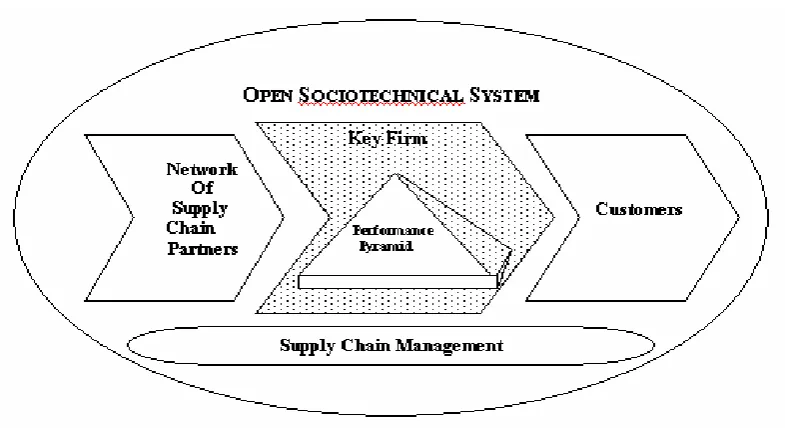
Organisation theory posits that outcomes and achievements are the consequences of organisation structure, policies, management culture and leadership style. The OSTS model prescribes a joint optimisation of technical and social subsystems. The social subsystem is one where the employee stakeholders bring knowledge, skills, attitudes, values and personal relationships to the work environment, which has hierarchical and organisational structures but which operates on humanistic principles of industrial democracy. Humanistic values within the firm and its management according to these principles, translates into an associative, democratic style where external stakeholders have a strong influence on corporate decision-making. In the transactional environment the stakeholders have an immediate connection with the firm as partners in the supply chain, whereas in the contextual environment the connection is a more nebulous one with the community and the general economy.
Corporate governance (CG) is the way in which the firm is controlled, and therefore reflective of the leadership and culture of the organisation. It is the stewardship of the firm, in a system comprising formal and informal institutions, laws, regulations and rules, ownership, and delegated power, to achieve financial, environmental and social goals. These goals are often stated as ‘the triple bottom line’. It is much touted to underpin organisational competitiveness and success, yet its measurement is frequently myopic, usually dimensionally-limited and often qualitative. However, its importance stipulates that it be included in any framework that claims to view organisational performance from a holistic vantage. In this study it forms the foundations for a performance model.
1.1.3 The Supply Chain Imperative
materials, components and other resources journey through value adding processes, such as manufacturing or service extensions, through distribution conduits to end users. Typically material, product and service flows go from suppliers to end users while financial flows are reversed, from customers to initial suppliers. Information and knowledge, on the other hand, is bi-directional (Hakansson and Person 2004).
In the 1990s the world of commerce was irrevocably changed by the impact of computerization and information communication technologies (ICT). The internet provided a myriad of inexpensive information transferring capabilities. The speed, flexibility, accessibility, accuracy and reliability of web-based communication established the norm in conducting business transactions. The impact on business is immediate, pervasive and unavoidable (Paganetto 2004). As opportunities have expanded through the globalisation of markets, so have the global competitors become more threatening to local businesses. The firm that operates as an independent entity with loosely-linked arrangements with suppliers and customers is facing the threat of becoming economically unable to survive, a small backwater business, or being taken over by a more competitive and efficient company. While in the past the pursuit of operational excellence may have kept a firm competitive against others that had a similar goal, it no longer succeeds with such a strategy when the others have tackled the goal of attaining greater efficiencies by challenging performances along the whole supply chain.
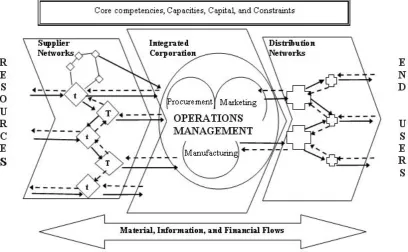
Extending the model to all business transactions which employ ICT, e-business can be further defined by the nature of the transaction, for example; business-to-business (B2B), business-to-customer (B2C), consumer-to-consumer (C2C), people-to-people (P2P), and even business-to-employee (B2E). Other transactions include government to citizens, intranets, and mobile (wireless) business. This overarching information technology has also irrevocably changed the mode of supply chain management (SCM). A generalized model of the concept of an integrated SC network, adapted from the Bowersox, Closs and Cooper framework (2007), is shown in Figure 1.1 below.
Figure 1.1 Generalized Model of the Supply Network
efficiencies through collaboration with partners, extending the enterprise by crossing ownership boundaries, and integrating service providers by outsourcing. Responsiveness can be an outcome of integrative management. Traditional business practices were based on predicting customer demands and therefore then performing essential work in anticipation of future requirements. This anticipatory work was duplicated along the SC. Joint planning and rapid information exchange between SC partners can, through synchronization of operations, provide a response-based business model that reacts to committed demand (Duffy and Fearne 2004). The customer not only initiates the order, but specifies its degree of customization as well. This also augers well for financial investment.
Since fast delivery means less ‘turnaround’ time, the time it takes for the investment to achieve its return is also reduced, hence a higher return on investment. Utilisation is a SC measure of the ratio of time an asset is idle to the time it takes to complete its task. Reducing time across the SC reduces investment necessary for it to perform its role and thus releases capital. This investment benefit is sometimes referred to as ‘cash spin’. The main enabler of the integrated SC is ICT as the force that drives globalisation. Globalisation can be seen as normal social evolution, albeit exponentially rapid in recent times, or a new force driven by technological innovation. Irrespective of definition, it is acknowledged as part and parcel of the current business arena and must be addressed. There are challenges which are significantly different to regional or even national operations. Distances are longer, governing authorities have laws and regulations which can complicate business transactions, consumers may exhibit different demand characteristics, and cultural diversity can be significant (Macbeth, 2002). Under these conditions and with these broader jurisdictions management has had to re-define itself and its role, and embrace more collaborative relationships with stakeholders.
1.1.4 Organisational Performance Management and Measurement
practiced today. But the finance discipline is not the only discipline involved in PM. There are many others (Lowson 2002). The diversity of disciplines includes organisation theory, strategic management, operations management, human resource management, economics, operations research and information systems. Relatively new to the literature is performance management in its own right and the emergence of productivity theory. To view organisational performance solely from any of these perspectives would be simplistic and myopic.
This thesis recognizes the importance of performance being studied by a multi-disciplinary approach and attempts to do so by crossing boundaries where necessary.
The management of performance is hinged on the knowledge of what it currently is, at what level the competitors are performing, and what performance could and should be. In other words, the management of performance is centred on its measured values, hence the importance of measurement above all else. It is the umbilical cord for improvement (Neely, Bourne and Adams 2003b). Often the measurement of performance has been viewed as simply the systematic collection of numbers to operational functions, resulting in metrics which purportedly allows meaningful comparisons. The accounting, financial and economic fraternities certainly accept that the financial metrics are suitable indicators of comparative performances amongst companies, industries and nations. Why is it so difficult to get meaningful information? Sink (1985) perceptively observed that most people who address the task of developing measurement systems eventually come to the conclusion that measurement is a mystery, and he notes that experts readily admit that measurement is complex, frustrating, difficult, challengingly important, abused and misused.
their synthesis. However, simply doing the exercise and obtaining them for ‘their own sake’ will not provide the motivational impetus to improve.
1.1.5 The Elements of Performance
The need for new measures of performance arises because of the change of direction from introspectively focused operational analysis of functional processes, individually within the firms of the supply chain, to customer-centred orientations which commence at the start of the supply chain through to the end-user (Hill and Alexander 2000). Every link in the chain has a customer at one end, including the internal customers as defined in the quality management literature.
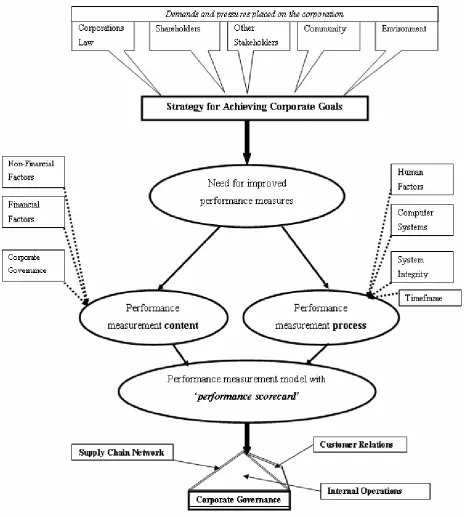
CORPORATE GOVERNANCE
SUPPLY CHAIN NETWORK C
USTOMER RELATIONS
INTERNAL OPERATIONS
Figure 1.2 The Extended OBPM Framework structured as the Performance Pyramid
The OBPM framework purposely recognizes the interdependence of each of the elements of performance while maintaining that organisational performance is ultimately a multi-dimensional phenomenon. In an ideal scenario all necessary metrics of performance provide a display of how the company is faring. Perhaps a ‘performance dashboard’ is an apt description of a pragmatic performance pyramid.
1.1.6 Measures of Performance
Traditional measures of organisational performance were financial and accounting based, and evolved into sophisticated systems which had several functions. Firstly, financial measures as tools were used to manage the financial resources of companies to support organisational objectives. Secondly, as financial performance measures they acted as barometers to signify achievement against major organisational objectives. Thirdly, they acted as motivators for future achievements. By providing a window of the past they were thought to be the instigators of future successes. The fact that they were cost-based and backward-looking provided little motivation to improve, and in some instances even hindered improvement (Kaplan 1986, Johnson and Kaplan 1987).
The difficulties with traditional measures of performance are many (Eccles 1991).
These include:
Cost accounting is still often dated and thus misleading in its information (Otley and Fakiolas 1995).
Performance is usually isolated to individual units, rather than holistically measured and interpreted (Otley 2002).
Many managerial decisions are historically founded in concepts such as return on investment and payback period.
Financial information used in managerial decision making is often far removed from operational relevance, resulting in a failure to understand the implications on processes (Keegan et al. 1989).
The importance of the customer is often ignored or downplayed in financial decisions (Hill and Alexander 2000).
There is no distinction in the use of management accounting rules applied to different types of operational processes such as: service operations, manufacturing to high volumes or wide variety, mass customisation, or other combinations (Otley 1999).
Bottom-line financial results are historically focused when the firm should be intent on going forward (Elkington 1997).
performance’; stakeholder satisfaction, strategies, processes, capabilities and stakeholder contribution (Appendix 12). These PM models and other similar ones, such as the performance tree of Lebas (1995), the performance matrix of Keegan, Eiler and Jones (1989) or even the Tableau de Bord (TdB, Epstein and Manzoni 1997), recognize the need for including non-tangible performance indicators in a broad-based metric. In many ways the elements of performance mentioned in section 1.1.5 above, or their surrogates, should be included in such models. They are not (Olve, Roy and Wetter 1999).
The BSC for example, fails to address the role and standing of competitors, and lacks prescriptive detail (Norreklit 2000), while the performance prism and BSC both fail to address the significance of CG. Similar arguments can be applied to other models which generally lack methods for measuring the extended OBPM framework presented in this study.
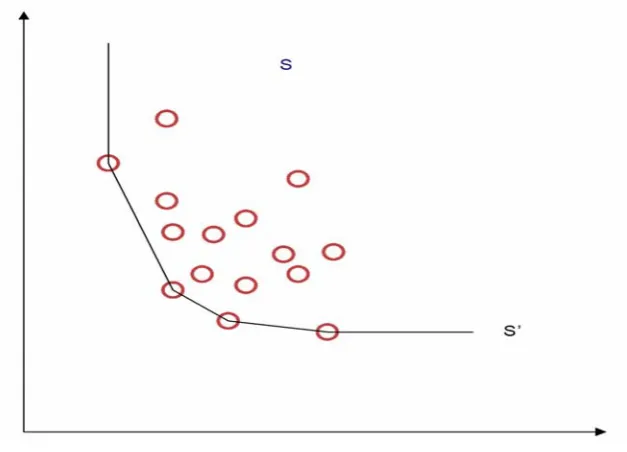
The approach taken in this research, namely of an extended OBPM framework, is possible because of the use of DEA. DEA is a linear programming technique for measuring productivity across a myriad of ‘decision making units’, and ranking the contenders in order of their performances. The best performers are benchmarked and assigned a rating of unity in comparison to lesser performers. This as a generic approach is not unique (Rouse 1997), but its application is. The DEA algorithm is applicable to all stages in the supply chain, commencing with an evaluation of CG. Such an approach has not been attempted before. While DEA has been successfully used to measure individual performance relationships in singular research dimensions and in different fields, it has never been used in an extended framework of PM which covers OB, supply chains and CSR. This is done in this dissertation.
1.1.7 Data Envelopment Analysis
financially-based indicators of performance inappropriate and in many ways misleading or meaningless. Consequently, other metrics were devised for specific instances and particular organisations but they lacked the ability to provide benchmark performance indicators that could provide objective analytical comparisons of the roles of successful, detrimental or influential factors.
Furthermore, they were incapable of unambiguously specifying where the poor performers were failing and what was the scope for improvement. The other less tangible variable in the performance matrix is the value or quality of the input resources required to achieve the desired outputs. For example, in recent times, knowledge capital has been touted as a valuable resource yet if fails to be successfully quantified, especially in relation to its contribution to organisational performance. Traditional easily counted resources such as workforce numbers, buildings, facilities and equipment have been financially valued but inadequately evaluated in their contribution to the organisational mission. In many ways their contributions may have been underestimated, and in some instances over-inflated. For example, state-of-the-art technological equipment in schools may be cited as the reason for academic excellence while life experiences and subject knowledge of teachers may be regarded as less important. Despite the subjectivity of the conventional metrics employed in assessing the performance of non commercial organisations, DEA has been successful in adapting these to determine the relative efficiencies of schools (education), health care (hospitals, clinics, etc), police forces, transport, banking, housing and other public sector utilities. A bibliography of DEA until 1992 is provided in Charnes, Cooper, Lewin and Seiford (1994).
or goods produced and often intangibly defined, and the inputs were the resources required and used in the production of these outputs. The fundamental DEA analysis is the ability to make comparisons of ratios with differing contributors to input resources and some defined differences in the outputs, and then discriminate between the various combinations to find the best ones. The best possible ratio is assigned the premier rating of 100% (or 1) and the others ranked against this are expressed as a percentage.
The organisational unit achieving this ‘best score’ is viewed as the most efficient under the given circumstances, and the one that others are compared against but it is not suggested nor implied that this is the “best possible” score in absolute values. How far others fall short of this 100% value expresses their potential for improvement under current conditions. In a fashion the best performer is set as the ‘current benchmark (BM)’ for others to aspire to, even though best performance is only ascribed as best relative to the field rather than an absolute ranking.
1.2 Objectives
The objectives of this thesis are to demonstrate the development of an extended OBPM model for a commercial enterprise in an Australian supply chain.
This will be done by:
Identifying the role of management style in creating OB which affects the performance of the enterprise.
Identifying the competitive forces, processes and methods that drive the need for PM in a modern business enterprise.
Identifying all stakeholder groups and their contribution and importance to every stage of production and the supply chain.
Critically reviewing and assessing past research in the field of OB related to performance.
Analyzing performance metrics and measurement processes, past and present.
Testing and applying the developed new approach and quantitative methodology with field data.
Validating the framework by identifying strengths and weaknesses in the model, and
Delineating the path forward for further research and development in this field.
1.3 Methodology
The research methodology used in this thesis is based on the positivist stance that allows mathematical modeling of a commercial environment. Operations research techniques are specific to this task. Here an optimization algorithm, available through the linear programming derived DEA, is used on empirical data from a large Australian publicly listed company to test the performance of 231 business units on their achievements in CSR as pronounced in corporate vision and promulgated in corporate policy and procedures. The data was originally collected and used by Black (2004) to establish a ‘Corporate Social Responsibility Management Capacity’ construct. This research uses that data in an explanatory and evaluative identification of the key factors in the conceptual framework of the OBPM model, the interrelationships of those factors, and the roles played by stakeholders. Key factors from the various concepts are operationalised and then subjected to quantitative analysis to reveal the strengths of causal relationships among these factors.
performance standard. The relationships tested by DEA have origins in production economics. Here efficiencies are depicted as the production frontier established by those units which display the best productivity, efficiency being the ratio of input resources to outputs of goods, services or other outcomes.
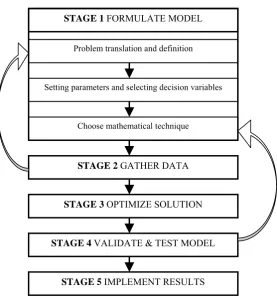
These production functions are evident in a multitude of relationships within the OBPM model of a business enterprise operating in a supply network. The methodology adopted in this thesis is routine operations research but novel in application. Model formulation, as the first step, requires problem definition, selection of decision variables and parameters, and choice of mathematical technique. The next step is data gathering, followed by model execution to obtain the optimal solution. This in turn is validated and tested before results are implemented. Some of the steps are iterative as new information becomes evident and adjustments are required.
1.4 Contribution of this Thesis
The impetus for this thesis comes from the failures of past and present performance measurement models to fully address the multi-dimensional nature of corporate performance. While many disciplines have been interested in organisation performance their research has been mostly myopic. Cross-fertilization of ideas has been sparse and holistic integrative approaches rare. Further motivation comes from the inability of current models to explain emerging issues such as the effect of globalisation and knowledge economy on corporate governance, supply networks, organisation behaviour, and enterprise design; let alone their ability to describe and measure performance in these areas.
1.4.1 Limitations of Existing Literature
1) Short-termism. Established financial measures are historical and short-term. They emphasize recent past performances as a basis for going forward. They are short term focused because of accounting and regulatory practices which require yearly reporting intervals.
2) Non contemporary. They are also accused of not being interpretive of real business situations, presenting a veneer of everyday operations, and not addressing emerging issues (Otley and Fakiolas 1995).
3) Non-integrated. They further fail because of their inability to integrate the styles of management, leadership, and OB dogmas which play important roles in making a company competitive, responsive to stakeholders, and socially attuned.
4) Stakeholder relationships. Other measures of performance fail to address the importance and contributions of all stakeholders including the intra and inter-relational network partners in the whole supply chain in which the modern enterprise operates.
5) Although some recent literature has attempted to redress these failings, particularly in commercial performance management frameworks, they are limited because of no formal rigorous mathematical modelling, no empirical testing, and little reporting in academic avenues.
1.4.2 A New Approach-Overcoming the Limitations
This thesis makes a significant contribution by developing a new framework for an integrative approach to PM. It incorporates the essential elements of: OB, SCM, PM and a novel use of operations research methodology as follows:
1) OB through a management model based on OSTS theory, and its application in humanistic styles of management reflected in CG and CSR. This also incorporates the concerns of all stakeholders.
3) A PM framework developed from successful contemporary models, and built on to integrate the critical success factors in each performance dimension.
4) An application of operations research methodology using DEA applied in a novel situation, enabling the quantification of qualitative information through relative, rather than statistical or absolute comparisons of efficiency, and paving the way for future new applications of this non-parametric tool.
In addition, this approach veers away from traditional practices by focusing on the emerging needs of a new era and developing a PM framework that is dynamic and maintains its relevance by evolution.
1.5 Structure of the Dissertation
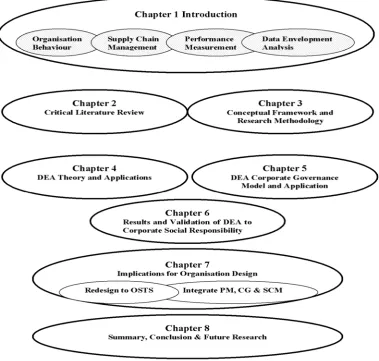
Figure 1.3 Structure of the Dissertation
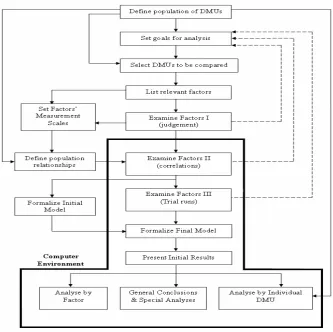
A critical review of the literature pertaining to PM, OB, CG, SCM and the global backdrop for Australian enterprises is presented in Chapter 2. A proposed conceptual framework for this thesis, of an extended OBPM framework to facilitate analysis and evaluation, is given in Chapter 3. This includes the methodology and the rationale for using the DEA algorithm as the instrument chosen for the measurement of performance at the various stages of the SC, commencing with the helm of the enterprise, CG.
Chapter 5 develops a corporate governance model of CSR so that it can be analysed within the DEA non-parametric framework. It then describes the application of DEA through trials and tests conducted on empirical data from a large Australian commercial enterprise, and presents the results of all tests.
Chapter 6 reports the results of the study with an interpretation of these findings, both in terms of CSR and the efficacy of the DEA algorithm as a diagnostic tool for this purpose. It reinforces the findings by conducting a correlation analysis of the significant variables. This chapter strongly supports the OBPM framework by demonstrating its positive relationship with the humanistic management style, inherent in OSTS and CSR. This achievement also strengthens the support for an operations research methodology by the demonstrated success of DEA.
Chapter 7 discusses the implications of the DEA and CSR findings in the previous chapter as an opportunity to redesign the organisation to meet its future needs. The strategy for redesign is to integrate the PMS into OSTS and adopt this design for both CG and the supply network. DEA becomes the measurement instrument for pivotal points in the integrated PM framework. This integrated framework provides the basis for an holistic ‘enterprise performance scorecard’. In this fashion it contributes to the advancement of knowledge in this field with a concept that has not been previously proposed.
Chapter 2
Critical Literature Review:
OB, CG and SCM in the Measurement of Performance for
Commercial Enterprises in a Global Knowledge
Economy
Between knowledge of what really exists and ignorance of what does not exist lies the domain of opinion. It is more obscure than knowledge, but clearer than ignorance.
Plato 428-348 BC
2.1 Introduction: Issues and Developments in Contemporary
Global Knowledge Economics and Business
This chapter will present a critical review of the contemporary literature for measurement of performance of modern commercial enterprises as they strive to succeed in the competitive global knowledge economy. The review will commence with issues and developments in the contemporary global economic and business marketplace in which commercial enterprises must now compete. This is discussed in the first section where the new business arena is preponderant with information communication technologies (ICT) and their rapid evolutionary benefactions. The evidence of this is witnessed through the emergence of a global knowledge economy. With this backdrop, how management handles the task of running the firm is studied through the contribution of OB to organisational performance by the emergence of new OSTS paradigms, and is reviewed next.
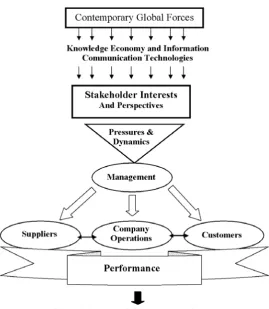
societal pressures of external stakeholders as they impact on organisational performance. Strategic direction emanates from the highest levels of an organisation’s hierarchy and is translated into the dictums of senior management as it seeks to ensure the organization remains profitable and competitive. These are studied through the myriad of PMS organisations used to gauge their success. Extending beyond the firm’s sovereign boundaries allows us to then further study the impact of the multi-faceted supply chain interactions on organisational performance. It is the contemporary nature of these issues and emerging trends that motivates us to develop an inclusive OBPM framework which is currently absent in the literature.
Figure 2.1 The Connected Elements of PM
2.2 The Emergence of a Global Knowledge Economy
2.2.1 Globalisation of Australian Business
New reporting standards have emerged (see IIA 2004 and ISEW 2004 for reference to AA 1000) and comparisons between competitors have been conducted. The need for PM to communicate achievements, good and poor, has never been greater.
Globalisation is the economic and social phenomena which diminishes the impact of distance on trade and difference insocial cross-border interactions to the extent that inter-regional and transcontinental trade, investment and flow of capital act as if they are always part of the local economic business environment (Ricks 2003). The International Monetary Fund (IMF) describes it as the growth in interdependence of countries through the increasing cross border transactions in volumes and variety of goods and services, and international capital flows expedited through the pervasiveness of ICT. This interdependence also means that CG mechanisms need to reflect fairness, transparency and social responsibility (Sgro 2003). To this extent it is responsible for increasing the competitive forces on business strategy to the world. In Australia for example, this trend can be traced to the unilateral lowering of tariffs in 1986 (Oxley 2000).
In simple neoclassical economic terms, the beneficiaries of capital inflow, investment and business development, are those countries where domestic costs are lower than elsewhere. These countries have a comparative advantage (CA) and benefit at the expense of those that have lost business because they are not cost competitive. These are not necessarily only the poorer countries. Investment and international trade are seen as the engines of world growth. While it is credited that globalisation has been responsible for the elevation from poverty of three billion people over the last 50 years it is also estimated that if trade were liberalized further by a reduction of 50% in protection levels, Australia would benefit to the value of $7 billion per year (Globalisation Guide 2005). Rich and poor both benefit. Wolf (2004) sums this up by saying that never before have so many people or so large a proportion of the world’s population enjoyed such large rises in their standard of living. This dictum of capitalism can only promote further globalisation. It is therefore necessary to view this phenomenon as a major force in the contemporary business arena.
Companiesare constantly under scrutiny for their operational performance and are liable to face closure or relocation to less costly regions. The only strategy for self preservation, predominantly within control of the organisation, is that of performing well and adopting a ‘competitive advantage’ ethos.
Michael Porter’s (1998) seminal work on CA has lower costs and product differentiation as locational advantages which describe the organisation’s leadership standing in its industry. How a company achieves an advantage pertains to the way in which it uses its resources and capabilities in the form of distinctive competencies which enable it to create value in its own activities as well as the value system of upstream suppliers and downstream channel members (Gunasekaran, Patel and Tirtiroglu 2001). Implicit in the processes of striving for CA are methods of comparative analyses including those referred to as benchmarking. Sometimes alternative strategies involve a rethinking of how the firm conducts business (Hammer and Champy 1993) or seeking the value streams in all company operations (Hines et al. 2000).
The benchmarking strategy is ideally suited to DEA methodology as described in this study.
2.2.2 Competition for Australian Business in a Global Economy
While globalisation has added a new element to the force of competition, it has merely strengthened the business imperative of creating wealth for the owners of commercial enterprises. Some organisations are capable of providing product differentiation through mechanisms such as brand imaging or genuine uniqueness of product or service. The majority of other organizations do not have this ability and when the only option left is to seek a cost advantage, we see a strategy of profit maximization through cost reduction and operational efficiency improvements. Initially this attention may be inwardly focused and rewarding but as incremental improvements are achieved at diminishing rates of return on effort, the focal area broadens to include the complete supply chain in its global setting. Inefficiencies in the supply chain resulting from firms operating in a self-centered fashion are there to be exposed and exploited to the benefit of the partners, albeit not necessarily in equal proportions.
The Australian commercial environment is based on free market economics, within government regulation, where the firm has to compete and survive on the basis of some local advantage, be it knowledge and expertise, responsiveness, service or some other feature. The transnational and global corporations that operate in Australia have, in a fashion, the luxury to respond to international pressures in a fluid and dynamic way which serves the corporation at the expense of the host nation, and avails them of a multitude of strategies to combat competition. Local industries are not so fortunate. They are impacted by the forces of international business yet limited in their response capability (Porter 2004). Most often they are not players on the international scene yet are subject to some of its pressures. Their survival mechanism is to operate locally, in a cost effective and customer-service focused way, so that their product or service has a local identity attraction.
overseas-manufactured rivals. If the product is overly costly, and hence not cost competitive, then its attractiveness can only lie in other features for which customers are willing to pay. Stability of government, reliability of supply, cheapness of resources and an educated workforce displaying a capital of knowledge, are examples of factors of attractiveness which can counter the cheaper option.
Other times, firms may focus on process management through philosophies based on quality, teams, empowerment and continuous improvement (Evans and Lindsay 2005; Evans 2008) and benefit from such strategies.
Measuring the performance of a firm is not new (Neely, Gregory and Platts 1995; Carter, Klein and Day 1992; Dixon, Nanni and Vollman 1990). In fact the financial and accounting functions that pertain to business are probably as old as business itself. Financial record-keeping and the managerial controls associated with it have been a stalwart of commerce in the modern era to the extent that they were regarded as the only measures of performance of any value. Australian businesses have been no different in this respect and have treated them as equally paramount. But, like all commerce that was managed on past performances and past successes, the rising profitable strategies of visionary competitors cannot be matched by simply adopting historically dated policies and projecting them forward (Kaplan 1990).
2.2.3 The Emergence of Global Knowledge as Capital
Thomas Friedman (1999) provides a view of globalisation that is widely held. He says it is:
…the inexorable integration of markets, nation-states, and technologies to a degree never witnessed before - in a way that is enabling individuals, corporations and nation-states to reach around the world farther, faster, deeper and cheaper than ever before...the spread of free-market capitalism to virtually every country in the world. (p 7)
What has facilitated this integration? It is the advent of the enormously powerful technology of computerization and the exponential growth of the associated information technologies. Information communication technology has witnessed a process of general cumulative advances rather than a succession of discrete unlinked innovations. It has expanded contagiously, taking an increasingly integrative form, offering substantial contributions to the systematic coordination of business functions. It is a contemporary view of an established concept in economic geography where the ‘flattening of the world’ means that “we are now connecting all the knowledge centers on the planet together into a single global network” (Friedman 2005, p. 8). It is so pervasive that authors such as Jones (1999) claim that we are now in the post-industrial ‘information age’ of intense intellectual, cultural and political activity. It has the characteristics of a shift in employment patterns, from capital intensive employment for production to increases in services in sophisticated economies.
The emergence of MNEs with their economic and knowledge power, greater than many nations, unleashed by instantaneous communication has led to an international division of labour dictating where and how business will be conducted. ‘Information rich’ employees who understand the new technology will be more valuable, while the unskilled ‘information poor’ computer illiterates will become the new lumpenproletariat
(Marx’s ragged workers). The gap widens and knowledge becomes capital in Drucker’s (1968) knowledge economy. How has information technology contributed to this intensification of knowledge? Sheehan et al. (1995) attribute enhanced economic growth to five features of the information technology revolution.
These are:
1) chip technology where miniaturisation through micro-electronics has provided exponential increases in output at decreasing capital investment;
2) photonic communication technologies facilitated by optic fibre and wireless networks;
3) digitisation of products, processes and services through open-system integrated circuits;
4) a convergence of standards and protocols, supporting technologies, such as the capture, storage and display of data, augmenting other technological advances; and
5) continuing software development to enable these technologies.
Alternatively, a greater reliance is placed on specialists who are experts in their field but who lack the wider picture. In an organisational sense, as the enterprise becomes too large and complex for decision-makers to have a synoptic vision of all factors relevant for policy-making, it adopts a ‘disjointed incrementalism’ as its modus operandi. The specialists who are experts in their field but do not understand the whole, take power from the generalists who do not understand the parts but are responsible for the whole. The key is the power of information through its application as knowledge.
Information has four inherent properties that make self propagation possible and knowledge dissemination fragmented. It is inconsumable because it does not reduce or disappear with use. It is also non-transferable because while it moves from A to B it still remains at A. Information is indivisible because it can only be used as a complete unit or set but these units are cumulative. It can be used over again, to be added to and to grow, as a building block of knowledge. The computer provides concentration, dispersion, circulation and feedback, all at exceptional speeds. Together with these four additional properties provided by computers it becomes the almost completely flexible tool for all configurations of communication. The technological capacity now available primes us for a ‘technological determinism’ where basic decisions are shaped by the technology at hand and every problem has a technological fix (Sheehan et al.1995). The more complex the problem the more high tech the fix. For example, augmented cognition focuses on the computer deducing a decision-maker’s cognitive state with the aim of somehow enhancing it because we live in an era of ‘continuous partial attention’ where information is flowing in faster than the person can absorb, and therefore needs programmed assistance in decision making.
The payoff potential of this is huge, with improvements in customer service, shorter delivery cycle times and increased collaboration within the firm and with external partners. Knowledge can also be sold or traded, as well as shared. It is for this reason that the ‘information stream’ is now regarded as one of the key elements of supply networks and a critical characteristic for global supply chains (Rungtusanathan et al. 2003, Ross, Venkataramanan and Einstberger, 1998). However while information is personality-free, as a construction of data building blocks that simply reside in databases, knowledge is the human value-added interpretation of information, and resident in mortal beings (Carr and Pearson 1999). Knowledge is thus organic, fluid and reflective, within the human vessel where it resides. It is subject to all things human and used in all ways human. It is therefore, the basis for how employees of the organisation behave, individually, collectively and culturally, and a contributing factor in OB (Mitchell and Nault 2003). It is a feature of the learning organisation. It is the modus operandi of the organisation through its people and is as idiosyncratic of the organisation as of its members. Organisations, like people, differ in every possible way. They have uniqueness yet commonality. Uniqueness is the synergistic sum of all the individual features of the organisation while commonality is the similarity of individual characteristics. This suggests a need for the study of OB and the theories of management which explain these behaviours in the new economic era.
2.3 The Emergence of an OSTS Approach to OB
2.3.1 Introduction
The competitiveness of the corporation and its performance is judged by comparison with its peers and against world best practice, but its standing is bedded in more than the governance that directs it and the global supply networks it operates in. It is genotypic organisational theory which subsumes its existence. Therefore, results of any PM study should be analysed within the interdisciplinary boundaries of organisation theory, SCM and PM. Is the organisation modeled on the bureaucratic ideas and formist (ideal type typologies centered on bureaucracy) images of Max Weber, or the structured functionalism of Talcott Parsons? Alternatively, does the modern version of Newton’s 17th century mechanistic science express itself through an enriched Tayloristic ‘scientific management’, facilitated by advances in information technology (Niepce and Molleman 1998)? Or, does the organic metaphor of the firm provided by Henri Fayol suffice? This section traces the development of organisation theory to arrive at the paradigm of OSTS as the one that has a substrate of CG which permeates the performance of organisations trading in the commercial field of global supply networks.